

The Career Switch Playbook into Product Management by Nkeonye Akumah - HTML preview
Download the book in PDF, ePub, Kindle for a complete version.
Introduction
Why Product Careers Are Growing Fast
Over the past decade, one career path has quietly moved to the center of modern business: product. Whether it is a mobile app, a banking platform, an online learning tool, or even a healthcare system, every organization today depends on products to reach customers and grow. Behind each successful product is a team making careful decisions about what to build, why to build it, and how to improve it. This is where product professionals step in.
Product careers are growing fast because businesses are no longer competing only on price or marketing. They are competing on user experience, value, and innovation. Customers expect simple, fast, and meaningful solutions. If a product is confusing or poorly designed, people switch quickly to alternatives. Companies understand this. That is why they invest heavily in people who can think clearly about user problems and turn ideas into valuable solutions.
Unlike many traditional roles that focus on a single function, product roles sit at the center of business, technology, and customer experience. Product professionals connect engineers, designers, marketers, and leadership teams. They help ensure that everyone works toward a shared goal. This central position makes the role both challenging and powerful.
Another reason product careers are expanding is the startup culture. Small teams now build tools that reach millions of users. These teams need structured decision-making, even when resources are limited. Product professionals bring clarity in uncertain situations. They decide what matters most and what can wait. In fast-moving environments, this skill is extremely valuable.
Remote work has also opened global opportunities. A graduate in one country can now work on products used worldwide. Digital collaboration tools make it possible to manage roadmaps, analyze data, and run experiments from anywhere. This global access increases demand for skilled product thinkers across industries.
Simply put, companies need professionals who understand customers deeply, think strategically, and execute efficiently. That combination defines product careers today.
The Rise of Digital Products
We live in a digital-first world. Ordering food, booking flights, attending classes, consulting doctors, managing money — almost every daily activity now depends on software. Even traditional industries such as construction, healthcare, and manufacturing rely on digital tools to improve efficiency.
This shift did not happen overnight. As smartphones became widespread and internet access improved, customers started expecting instant access to services. Businesses adapted by building apps and platforms to meet these expectations. Over time, digital products became the main channel for revenue and customer interaction.
Digital products also allow continuous improvement. Unlike physical goods, software can be updated regularly. New features can be added. Bugs can be fixed quickly. Data can be collected to understand how people use the product. This ability to learn and improve makes digital products dynamic.
However, building digital products is not only about writing code. It requires understanding user needs, market demand, competition, pricing models, and long-term vision. Without structure, teams may build features that nobody wants. Product professionals help prevent this waste. They ask important questions:
• What problem are we solving?
• Who exactly are we solving it for?
• How will we measure success?
• What should we build first?
As digital products continue to expand into every industry, the need for skilled product professionals will only grow stronger.
Why Companies Value Product Thinking
Product thinking is more than managing tasks. It is a way of approaching problems with clarity and purpose. Companies value product thinking because it focuses on outcomes, not just activity.
Many teams are busy. They release features, attend meetings, and follow processes. But being busy does not guarantee impact. Product thinking asks: Is this work creating real value?
A product-oriented mindset includes:
• Customer focus: Understanding real pain points rather than assumptions.
• Prioritization: Choosing what matters most instead of trying to do everything.
• Data awareness: Using evidence to guide decisions.
• Collaboration: Aligning teams around shared goals.
• Long-term vision: Thinking beyond quick fixes.
When companies hire product professionals, they are not just hiring managers. They are hiring decision-makers who reduce risk. Good product decisions save time, money, and reputation. Poor product decisions can damage trust quickly.
In competitive markets, product quality often decides success. Marketing may bring customers once, but product experience keeps them. That is why product thinking sits at the heart of sustainable growth.
Common Myths About Product Management
Because product roles are relatively new compared to traditional careers, many misunderstandings exist. Let us clear up a few common myths.
Myth 1: Product managers just tell engineers what to build. In reality, product professionals collaborate. They do not command. Engineers, designers, and analysts contribute expertise. Product professionals align everyone around shared priorities.
Myth 2: You need to be highly technical to work in product. Technical awareness helps, but deep coding expertise is not always required. What matters more is understanding how technology supports user needs and business goals.
Myth 3: Product management is glamorous and strategic all the time. The truth includes spreadsheets, feedback analysis, difficult trade-offs, and detailed documentation. Strategy is important, but execution requires discipline.
Myth 4: Only extroverts succeed in product roles.
Clear thinking, empathy, and structured communication matter more than personality type. Both introverts and extroverts can thrive.
Myth 5: There is one fixed path into product.
There is no single route. Some professionals come from engineering, others from marketing, design, finance, or completely unrelated fields.
Understanding these realities helps you prepare honestly for the journey ahead.
Who This Book Is For
Fresh Graduates
If you have recently completed your degree and feel unsure about your next step, this book is for you. Many graduates struggle because university education often focuses on theory rather than practical business decision-making.
You may not yet have years of experience. That is normal. Product careers reward structured thinking and willingness to learn. This book will guide you in building relevant skills, creating a portfolio, and preparing confidently for interviews.
Career Switchers
Perhaps you are working in marketing, engineering, teaching, finance, healthcare, or another field. You may feel curious about product roles but unsure how to transition.
Career switching can feel risky. However, many product professionals began in other domains. Your past experience is not wasted. In fact, it may give you a unique advantage. For example, healthcare experience can help you build medical apps. Teaching experience can help you design educational tools.
This book will help you map your transferable skills and create a structured transition plan.
Early Professionals
If you already work in a junior role — such as business analyst, project coordinator, UX assistant, or associate product manager — you may want clarity on how to grow.
Early professionals often feel overwhelmed by expectations. You may wonder how to speak confidently in meetings, how to prioritize work, or how to think more strategically. This guide will provide structure so you can move from reactive work to thoughtful leadership.
How to Use This Book
Step-by-Step Learning
This book is organized in a logical sequence. Each chapter builds on the previous one. You can read it from start to finish or focus on the areas most relevant to you. However, following the full roadmap will give you a stronger foundation.
Avoid rushing. Product thinking develops gradually. Take time to understand each concept before moving forward.
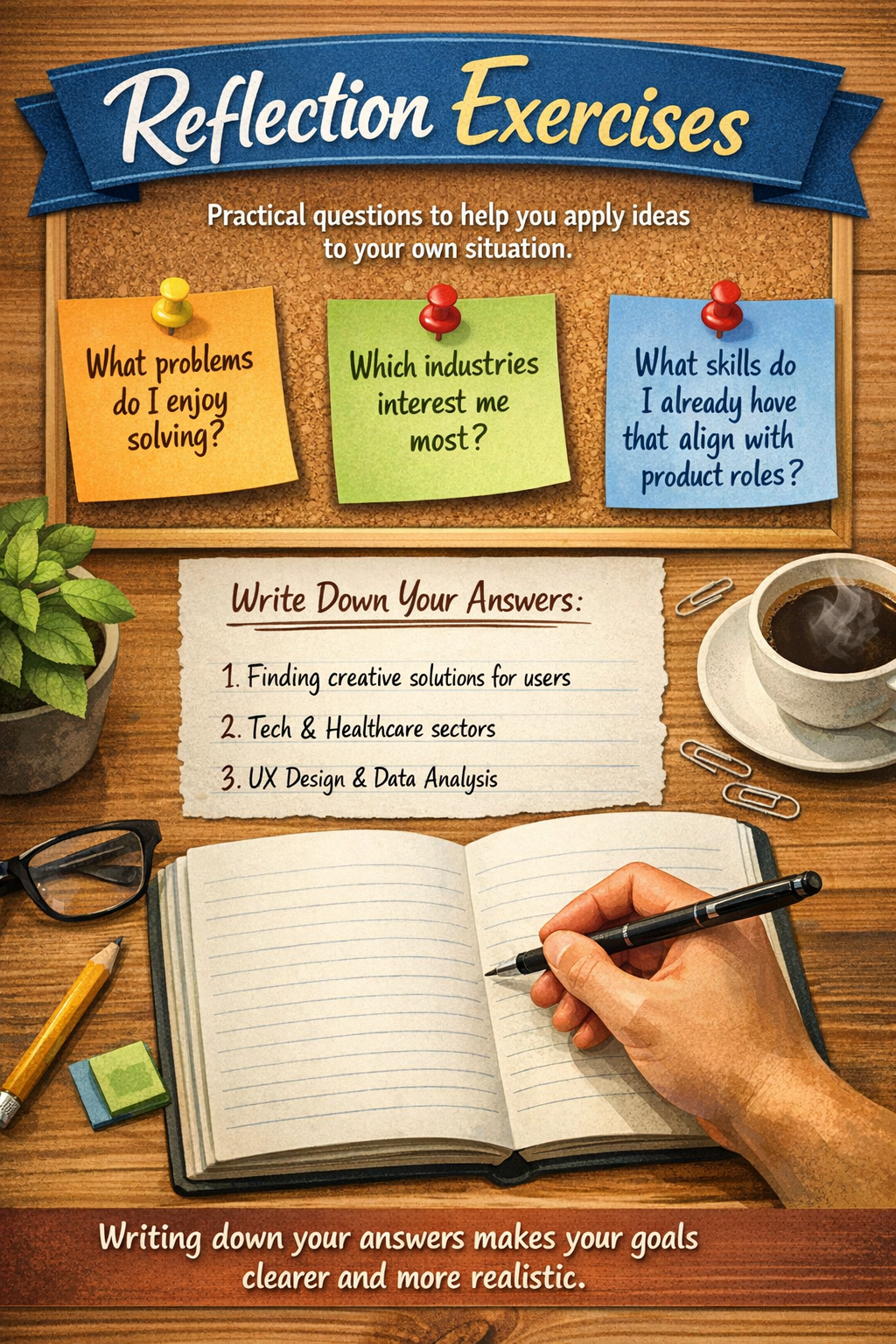
Reflection Exercises
Throughout the book, you will find reflection prompts. These are not academic exercises. They are practical questions designed to help you apply ideas to your own situation.
For example:
• What problems do I enjoy solving?
• Which industries interest me most?
• What skills do I already have that align with product roles?
Writing down your answers will make your goals clearer and more realistic.
Skill-Building Roadmap
This is not just a theory book. It is a roadmap. By the end, you should have:
• A clear understanding of product roles
• A defined skill development plan
• A portfolio strategy
• Interview preparation structure
• A 12-month action plan
Think of this book as your structured guide from uncertainty to direction.
The journey from graduate to product professional is not about luck. It is about clarity, discipline, and consistent improvement. If you are willing to learn step by step, you can build a meaningful and impactful career in product.