

Sons in the Shadow: Surviving the Family Business as an SOB (Son of the Boss) by Roy H. Park Jr. - HTML preview
Download the book in PDF, ePub, Kindle for a complete version.
REBUILDING PARK OUTDOOR
The best profit of the future is the past.
—Chinese Fortune Cookie
In a sales meeting with my managers in 2001, I recapped some of the things we had to do to get the company I bought in 1988 moving again. I highlighted our history, which, most of them already knew, pointing out that starting in mid-1985, our acquisitions included 24 eight-sheets in Utica we bought from Sweet Outdoor and 12 faces from Howard Signs in Erie, PA. The following year we purchased 10 bulletin faces in Syracuse from Roberts Outdoor, which followed our entry into that market the previous year without objection from Norm Simpson, the dominant Syracuse plant operator, building five structures on I-81 and I-690, some costing as much as $80,000.
In 1986 we also bought 64 eight-sheet faces from Maypat Outdoor in Watertown. Then in 1989 we strengthened our position in Binghamton by acquiring Midstate Outdoor with 400 faces in the Triple Cities market. That same year we bought 600 faces from Matthew Outdoor in Northern New York and the Mohawk Valley.
We made one small and sometimes not-so-small acquisition after another, and one September morning in 1990, while I was shaving, I realized I personally owed $8.8 million dollars. Chase Manhattan was still my bank at the time, and although it was small change for them, it was big bucks for me. Not to be deterred, in 1993 we bought three bulletins and 7 thirty-sheets from Mincom in Syracuse. That same year we also bought four bulletins in the Binghamton area from the Meigs-Street Corporation. The following year we traded inventory with Penn Outdoor in two counties in Pennsylvania for 55 thirty-sheet faces in Elmira, Watkins Glen, Bath and Utica, mostly as a defensive measure to prevent further expansion by competitors in our markets.
By this time, we were stretched from along the Canadian border to the north into Erie, PA, to the west and all along the Southern Tier of New York (and into a number of northern counties in Pennsylvania) from Jamestown to Oneonta. It’s a lot easier to control cost when you are concentrated in a single large market, and we were very labor-intensive, covering an area that encompassed about half the state of New York. We were able to make payments on the loan but had very little left over to maintain and upgrade our inventory. There were always other outdoor operators out there wanting to buy, and we finally decided to look at some of the offers.
In October 1994, we carved off our western division. It took at least four hours to drive from Ithaca to Jamestown and down into Erie. Because of the requirements in the Western New York and Pennsylvania divisions and building in the territory from national outdoor competitors and local individuals, selling the division was prudent to reduce overhead and debt.
Then we took a hard look at what we called our northern division, which covered north from Oswego and Watertown up to Ogdensburg, Canton, Potsdam, Massena and Malone and even Chateaugay along the St. Lawrence River. This included new boards we had built in Watertown, but most of them were old. The weather was so cold in this part of our territory for five months of the year that we had to mix calcium chloride in the paste to freeze the poster paper on the boards. When spring came, the ice and paste dissolved and the paper slid off, leaving us with massive cleanups and reposting jobs. And every time a storm blew in several structures suffered damage. In November 1995, northern became our second divestiture. We did retain some boards from this sale for our Utica plant, but overall the proceeds from both sales were enough to reduce the principal on our loan dramatically. We were now able to concentrate on improving the remaining inventory, which covered some 15,000 square miles, an irregular circle averaging 240 miles wide around our headquarters in Ithaca.
In 1999, we bought 12 bulletin faces on the fairgrounds in Syracuse from Empire Outdoor, and in 2001, 49 faces in Utica-Rome and the Mohawk Valley from Seifert and Stannard Signs. In 2003, we bought 43 faces in Fulton and Montgomery Counties from Lang Media and added them to our Utica operation, and our company continues to explore opportunities for further expansion.
We also continue to obtain new leases in legal areas and follow up by building on these sites. Through the energetic efforts of our Outdoor Advertising Council of New York, we have been able to pass a vegetation bill passed in New York State, and trimming trees in front of existing boards is like finding or building new inventory.
In our 2001 meeting, I also told my employees about a speech I heard in October of that year. It was one of the Cornell Business School Durland Lecture Series, which had been created with help from my father. The CEO of American Express, Kenneth I. Chenault, spoke just after the World Trade Center attack. This was a company that had to evacuate its New York headquarters housing 4,000 employees after the September 11 attack. The company lost ten people in the World Trade Center collapse and had to relocate its remaining employees all over Westchester County and elsewhere in New York City to continue operations. He spoke of his company’s rules for success, and I shared them with our people.
Chenault said that personal accountability by all employees, from top to bottom, was critical along with a strong commitment to customers. There are also three traits you should bring with you in all of your sales contacts: a sense of humor and the traits of humility and honesty. “You need a true sense of all three to be an effective salesperson,” he said.
He said you must be innovative to be a consistent winner—be able to develop value-added ideas that will make a fundamental breakthrough. For every problem there is a solution. There is never a problem without one. You need to take the complex and make it simple. He also said that your employees must be cooperative and collaborative with each other but still not shy away from constructive confrontation with their leadership. You must have the ability, as well, to raise the performance bar for yourselves and your colleagues. You also must be a team player, and do what you can to help each other. The result is that all of you, together, will move your company forward. And all of you, together, share the results. In summary, he said you must be able to anticipate the future and the setbacks that come, not just react to them. We all must think ahead, and be adaptable, which means being able to do more than just cope with change after it takes place. We must anticipate change, adapt to it, and be prepared in advance to confront it. And win. This, he said, is the single most critical ingredient for survival and success.
I added one thought to my managers on what is critical to survival and success. And that was the single word organization. Donald Trump’s book on how to get rich suggests a prime rule is to let people know how successful you are. My father did not brag about his achievements. They spoke for themselves. What he had in common with Trump was showmanship.
As an aside on The Donald, remember my mention of returning to New York with JWT and inappropriately dining at the Four Seasons restaurant at the company’s expense? During a trip to New York on foundation business in the early 1990s, I returned there with family and friends for a late dinner. We were headed up the stairway when I thought I recognized someone coming down.
I intercepted the gentleman and his stunning companion on the landing and asked how everything was going. After a brief and friendly exchange, I told him how good it was to see him again. We parted, and when I came up to join my group, they commented they didn’t realize we knew each other. Then one of them said, “But you called him Jim.” I said yes, that’s James Rosenfield, my father’s colleague when he was president of the CBS TV Network. My friend said, “That was Donald Trump and Marla Maples. You didn’t see his double take when you called him Jim. He’s probably going to need to see his psychiatrist in the morning.”
In more recent years I came across Donald Trump in New York restaurants several times and each time he courteously acknowledged my greeting as I walked past his table, even though he had no idea who I was. These memories were brought back to me today because I am wearing a beautiful pink Donald Trump signature tie truly worthy of his showmanship.
But as I told my managers, you don’t need showmanship or how-to-get-rich strategies to survive and succeed. It’s difficult enough running a small business in New York State. Survival is our basic goal, and to do it you have to be organized. It is the single most important ability you must acquire. It applies to any business you run, people you manage, your personal life, and commitments you make to your spouses, children, suppliers, bankers, lawyers and brokers.
Keep organized files. Throw nothing out that could come back to bite you later. This will allow you to confront any challenges or problems that will come up, even outside of your business. It will allow you to put history behind your arguments and the points you want to make in your counterattacks. It will allow you to stay on course, without having “to reinvent the wheel.” Staying on course means survival, and without being organized, outside pressures and events can keep that from happening every day.
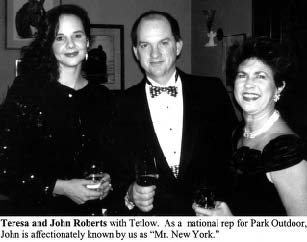
Shortly after our meeting, our contracted national sales representative, John Roberts of Power Sales Advertising, an invited guest, wrote me the following note. He represented our client, R.J. Reynolds Tobacco for many years before that company was forced to drop billboard advertising. Because of the integrity of the way we managed our company, he said he would like to represent us when he started his own business. We were the first outdoor company to sign him up.
I wanted to drop you a note of thanks for including me in the annual Park Outdoor meeting a few weeks back. The development of the attached photos from the “awards” ceremony affords me this opportunity to send regards.
What I take away from that session is the quality and continuity of the people of Park Outdoor. Dave mentioned this as a “strength” of the company in his remarks and it truly is.
I recently cleaned out my Rolodex and discarded more than one-half of my Lamar business cards for departed managers and changed addresses. I have Park Outdoor cards from the ’80s that could’ve been printed yesterday. In my mind, this is the mark of a remarkably stable company.
And while most outdoor vendors continue to wring their hands over a downturn in national business, Park Outdoor has positioned itself for any “uncontrollable” economic dislocations. It’s a great regional economic story.
In 1989, the first full year I owned the company, our sales increased by a million dollars, exceeding $5 million and within the next two years, we reached $6,000,000. The sale and loss of billing from both our northern and western divisions in 1994 and 1995 dropped us back into the $5.5 million range and it took us a couple of years to recover from the loss of this inventory. In 1998 our sales were back above $6 million, and growing at a stable average rate of roughly 5 percent over the years, Park Outdoor sales exceeded $9 million in 2007.
Small potatoes to the communications empire my father built, but for something he bought primarily for its depreciation benefit to reduce taxes, not too shabby. We pay plenty of taxes now and Park Outdoor means a lot to the several hundred employees and extended families that depend on the company for their livelihood.