

Sons in the Shadow: Surviving the Family Business as an SOB (Son of the Boss) by Roy H. Park Jr. - HTML preview
Download the book in PDF, ePub, Kindle for a complete version.
PURCHASING PARK OUTDOOR
Park Outdoor now had an independent office but our Monday meetings were still held at Terrace Hill. The bottom line was still in my father’s control. I knew the only way that the company could survive, and I could survive, was to buy it. Soon. I had to buy it while it was still viable or preside over its slow death.
The most difficult job I ever faced was to convince my father to sell Park Outdoor to me. Despite the fact that I had come back as CEO, and was immediately blindsided by the sale of Scranton, I had continued to build a base of operations with what remained and upgrade the integrity of the entire company. I had retained a loyal set of managers, sales people and production workers, and I managed to salvage a good deal of national business despite the loss of our Scranton operation. It was time to expand, but the restrictions placed on my goals continued, with my father keeping his fingers in every move I made, despite the autonomy that should have been granted to my CEO status.
As I said, while we had poured $600,000 in capital improvements into Scranton, I had the foresight to invest some of the additional money in refurbishing and upgrading the inventory in New York, so it was in much better shape than the year before I had returned. Our overall sales were going up, along with modest increases in operating profit, but certainly not to the extent my father would have wanted. I knew the only way to bring peace back to the family was to, again, become independent and eliminate the working relationship. So after legal counsel, I developed a plan to approach my father to purchase the company early.
He was adamantly opposed and immediately flew in his tax attorney to explain all of the reasons, aside from our agreement, that he couldn’t sell it early. I point out here that this, and ensuing disagreements with my parents over the years cost me hundreds of thousands of dollars in legal fees, a far cry from the first twenty-one years of my life, and in fact all of the years before I came back to work for my father. Except for the last two years of his life, I lost a father when I came back to work for him in 1971. And later, and I’ll come to this, I lost for a while my mother when a decision was made to divide our family foundation, a decision endorsed by our outside trustees.
Life is simple, and we only have to look at nature to understand ourselves. When a plant is under stress, it blooms freely, the object being to spread its seed. The older animals head the flock, pack or herd because they are the survivors. It’s no wonder that old men chase their nurses around the bed before finally packing it in. The ones that survive, be it plant, animal or man, are those nature has properly designated to continue the species. But it is unfortunate that as men get older, understanding, generosity and wisdom often go by the boards. If not chasing women, they are chasing power and control, the sad fact of human nature. It is a depressing truth that fathers and grandfathers do not always mellow when they enter old age. I have always thought that as you grow older, you tend to seek serenity. I had pictured my father dispensing wisdom like Uncle Remus in Br’er Rabbit, or even the guy behind the curtain in The Wizard of Oz.
But, as Sherwood Anderson wrote in “Discovery of a Father,” a son’s wish for what he imagines to be a perfect father does not always come true: “One of the strangest relationships in the world is that between father and son. I know it now from having [a son] of my own. A boy wants something very special from his father. You hear it said that fathers want their sons what they feel they cannot themselves be, but I can tell you it also works the other way. I know that….I wanted my father to be a certain thing he was not.”41 I had hoped for a sharing of wisdom from him, not hardened aggressiveness, and always thought that as I got older, I would spread wisdom, love and compassion to the younger members of my family. But maybe that won’t happen. It didn’t happen with my father. Despite all the books and movies where “on Golden Pond” people mellow, I am not sure that it happens much in real life.
For no real reason I could see, he was determined to hold on to Park Outdoor. But this time also, my mother was on my side, and she also could see no reason why my father could not sell the company to me. His tax attorney, on the other hand, was asked to come up with every reason in the book to make the case that my father could not sell ahead of the agreed-upon date. And he was good at it. In the early stages, I relied on my attorney, a personal friend, but this time he urged me to add first-class counsel. As the saying goes, if you want peace, you better be prepared for war. So I hired the managing partner of one of the largest law firms in New York. The tax counsel working with his firm was the best I could find, after all, he was up against the tax attorney who had represented my father and his dealings over the years.
My approach, despite an unyielding legal opinion of my father’s tax attorney that the company could not be sold, was simple. I repeated the mantra that went to the heart of their position each time we met over a two-month period, “You can, but you won’t.” The stalemate was finally resolved when my lawyer came up with a formula that factored in the value of what an immediate outside buyer might pay with the understanding that under my agreement they would have to sell it back to me in three years. In other words, the formula took into account the value of the company to an outside buyer by positioning me as an outside buyer at the time, and the logic was irrefutable.
Only after my mother threw her support behind the idea of selling it to me without fully understanding why my father wouldn’t, or comprehending the formula that made it impossible for him to deny the sale, were we able to move ahead.
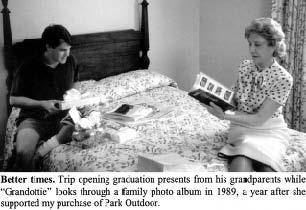
Working as I had been for an extremely low salary over the seventeen years, I had been unable to put aside much, and to accomplish the sale I obviously had to pledge the company, as well as everything I owned, as collateral. But at age fifty, I was able to convince Chase Bank to lend me the money. As far as the inventory, I would have felt a lot more secure about my personal pledge if the majority of the boards were not unsightly, rickety old structures built some forty years ago.
After the sale my father tried to convince my mother he had given me a “sweetheart deal.” But after I pledged the inventory I bought, along with my family’s house, car, furniture and whatever else we had of value, and owing a mortgage, car payments and student loans, and with the purchase price being over thirty times my annual income before taxes, the deal wasn’t all that “sweet” to me. It was a gamble, but with all my employees still in place, I knew I had a fighting chance. With the huge debt load of principal and interest the company had to meet, and with Chase breathing down my neck at every turn, we started back to work. The pressure was intense for the next couple of years with the bank hovering over my shoulder more than any board of directors ever could. The debt load left little to spare for capital improvements or the construction of new locations even though we had the leases. My father did not have to struggle with that sort of tough situation with the proceeds he had after he sold his company to Procter & Gamble.
But slowly and surely we climbed out, and even our suppliers helped us by allowing us to pay them back over longer periods of time.