Bussiness is Money by Kazi Rejwan Islam - HTML preview
Download the book in PDF, ePub, Kindle for a complete version.
INTRODUCTION

Why do some entrepreneurs consistently make smart financial decisions

while others struggle, even when they have similar skills and resources?
The difference often lies in their mindset and the unseen psychological
forces influencing their choices.
As an entrepreneur, every day brings financial decisions that shape the
future of your business. From small expenses to large investments, these
choices create the foundation for growth—or lead to costly mistakes.
What many overlook is that emotions, habits, and mental biases often
drive these decisions more than logic or data.
"Entrepreneurs who consciously develop a healthy relationship with money are significantly more likely to reach their financial objectives.".
Consider the case of Emily, a tech startup founder who missed growth
opportunities because of her cautious approach to risk, shaped by her
experiences during the 2008 financial crisis. Once she identified her
unconscious bias and learned to manage it, her business grew by 300% in
just two years. Her story highlights the powerful impact of understanding
the psychology behind financial decisions.



Financial success isn’t just about numbers and spreadsheets—it’s about

understanding the emotional and behavioral patterns that influence

every choice. Fear, excitement, and deeply ingrained habits often play a
larger role than we realize, and learning to recognize and manage these
forces is essential for long-term success.
Mastering the psychological side of financial decision-making gives you a
unique edge. It helps you make confident, balanced choices that align
with both your business goals and personal values. This means spotting
and avoiding cognitive biases, using emotions like fear as signals instead
of obstacles, and developing habits that naturally lead to better
outcomes.
Entrepreneurs who actively work on their relationship with money are far
more likely to achieve their financial goals. Yet few business owners
invest in this kind of self-awareness and growth. By diving into these
principles, you’re taking a critical step toward mastering an often-
overlooked aspect of entrepreneurial success.
This guide is designed to help you build a mindset for financial growth—
not through empty promises, but with proven strategies and actionable
insights. Whether you’re launching a new venture or scaling an existing
one, you’ll learn how to improve decision-making, avoid common traps,
and create systems that foster sustainable success.
Let’s explore how understanding the psychology of financial decisions can
unlock your full potential as an entrepreneur. Turn the page, and let’s get
started.







Unseen Influences Shaping

Your Money Choices

____
When you make financial decisions in your business, you might think
you're being purely rational. However, behind every investment choice,
budget allocation, or strategic move lies a web of hidden influences that
shape your decision-making process.
Understanding these forces can help you make better financial choices
and avoid common pitfalls.

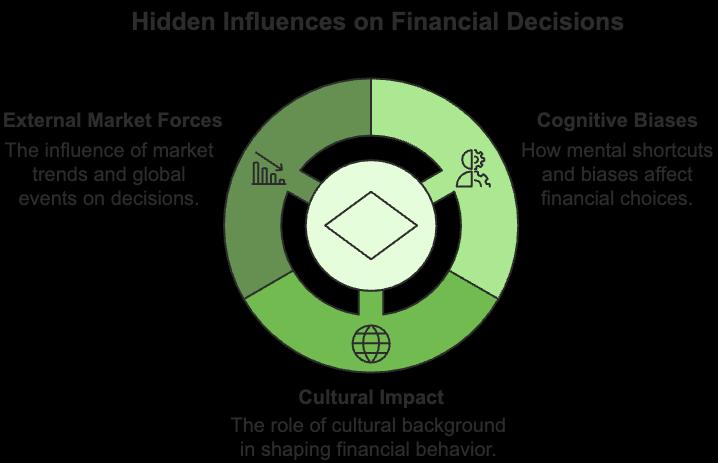

Your brain processes financial decisions in ways that often surprise you.

While traditional financial theories assumed business leaders made

choices based purely on logic, modern research tells a different story:
Your perception of money and risk directly impacts
your decision-making in business.
Observe how you react to potential losses versus gains. You're probably
more likely to feel the pain of losing $1,000 more intensely than the
pleasure of gaining the same amount. This natural tendency explains why
you might hesitate to pursue profitable opportunities when they involve
some risk, even when the potential rewards clearly outweigh the possible
downsides.
Your mind also uses mental shortcuts that can affect your financial
judgment. For example, when you're negotiating, the first number
mentioned often becomes an anchor point that influences the outcome,
regardless of whether that initial number makes sense. This anchoring
effect can lead you to make decisions based on arbitrary reference points
rather than actual value.
Time also plays tricks on your financial thinking. You might find yourself
choosing immediate financial rewards over potentially larger long-term
benefits. This temporal bias can lead you to sacrifice sustainable growth
for quick wins, a common challenge many business leaders face.








Your cultural background influences your financial choices more than you

might realize. From the way you save and invest to your attitudes toward

debt and spending, culture plays a subtle yet powerful role in shaping
your financial behavior.
The values, traditions, and social norms that you inherit from your
community or family can create a framework through which you
interpret financial decisions, often without conscious awareness.
However, it's not just your personal or family culture that impacts your
financial behavior. It also extends to the culture of your workplace or
company environment. How your organization handles compensation,
benefits, and even financial communication can significantly affect your
financial decisions.
Understanding how company culture influences financial decisions is
especially crucial in organizations with varying power dynamics, where
the approach to decision-making can significantly impact the
opportunities and risks perceived by employees at different levels. In
cultures where hierarchy is important (high power distance), financial
decisions tend to be made at the top with little input from lower-level
employees. This centralized approach can lead to missed opportunities
and overlooked risks that frontline workers might spot.
The contrast between individualistic and collectivist cultures also affects
financial behavior. If you're operating in an individualistic culture, you're
more likely to take risks and focus on short-term gains. In collectivist








cultures, you'll find a stronger emphasis on stability and group harmony,

leading to more conservative financial approaches.

Your organization's culture matters too. Companies with strong
innovation cultures tend to invest more in new technologies and
encourage calculated risk-taking at all levels. This cultural orientation can
significantly impact how you evaluate and pursue new opportunities.
External Forces That Shape Your Financial Choices
The world around you constantly influences your financial decisions in
subtle ways. Technological disruption forces you to reassess traditional
business models and consider new digital initiatives. Additionally, global
events can dramatically shift your perception of risk and influence your
investment timing.
Market sentiment acts like an invisible current pulling your decisions in
certain directions. Emotions can spread through markets, leading to herd
behavior and overreactions to news. When everyone around you is
excited about a particular investment or worried about a market trend, it
becomes harder to maintain an objective perspective.
The overwhelming amount of information available today presents its
own challenges. The Investments & Wealth Institute (2020) found that
when you're under pressure to process complex information quickly,
you're more likely to rely on gut feelings rather than careful analysis. This
tendency becomes even stronger when you're dealing with information
overload or facing competitive pressures that demand quick decisions.
To make better financial decisions, you need to recognize these hidden
influences and develop strategies to manage them. Create structured


decision-making processes that account for your natural biases. Build

your cultural awareness to better understand how background and

context affect your choices. Most importantly, remember that awareness
of these hidden forces is your first step toward making more objective
and effective financial decisions.
By understanding and actively managing these invisible influences, you
can make more informed choices that lead to better outcomes for your
business. The key lies not in eliminating these forces (that's impossible),
but in learning to work with them consciously and strategically.







Mindset Mastery: The Key to Financial

Success

____
When you're building a successful business, your mindset shapes every
financial decision you make. Entrepreneurs who embrace
experimentation and continuous learning consistently outperform those
stuck in traditional thinking patterns. By developing the right mental
approach, you can unlock new opportunities and drive sustainable
growth for your business.
Building growth-oriented Financial StrategieS
Your approach to growth needs to balance ambition with practical
implementation. Successful entrepreneurs recognize that strategic
resource allocation goes beyond basic budgeting—it's about investing in
your future. According to Forbes, you should prioritize investments in
areas that drive long-term value: digital transformation, market
expansion, research and development, and talent retention.
To make your growth strategy work, you need a systematic approach to
financial decisions. Start by identifying opportunities in your market, then
assess potential risks and available resources before creating an
implementation plan. Regular performance monitoring helps you stay on
track and adjust your strategy as needed. Remember to maintain a
dedicated innovation budget and gather competitive intelligence to
inform your decisions.


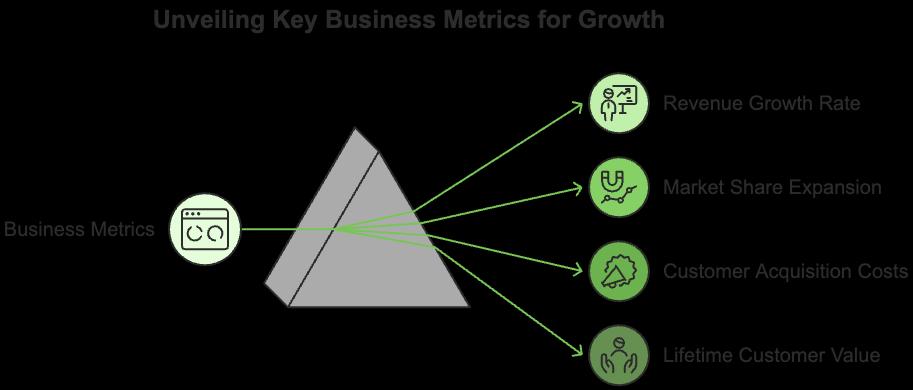
When measuring your progress, focus on metrics that truly matter.

Revenue growth rate, for example, shows how quickly your business is

expanding and can signal the effectiveness of your overall strategy.
Another crucial metric is market share expansion, which highlights your
position in the industry and how well you're competing against others in
your field. Customer acquisition costs, on the other hand, help assess the
efficiency of your marketing and sales efforts, ensuring you're not
overspending to acquire new customers.
Finally, lifetime customer value measures the total revenue a customer
generates over the entire duration of their relationship with your
business, providing insight into long-term profitability and customer
retention strategies. Together, these metrics offer a panoramic view of
your business's performance and guide data-driven decisions for
sustained growth.
These indicators specifically help you understand whether your strategy
is working and where you need to make adjustments. Research from
LinkedIn shows that entrepreneurs who consistently invest in innovation,


even during challenging times, experience higher revenue growth and

improved market positioning.

Navigating Implementation Challenges
You'll inevitably face obstacles when putting your growth strategy into
action. Resource constraints often present the first challenge. Combat
this by prioritizing high-impact investments and exploring strategic
partnerships.
During periods of market uncertainty, maintain flexible strategies and
build strong contingency plans. When facing competitive pressures, focus
on differentiation and strengthening customer relationships.
To future-proof your business, commit to continuous learning and
adaptability. Stay updated on market trends, study emerging
technologies, and analyze competitor strategies.
Successful entrepreneurs remain flexible in their approach and view
change as an opportunity rather than a threat. This mindset helps you
build resilient systems that can withstand market fluctuations and
evolving business conditions.
Foster innovation throughout your organization by encouraging creative
thinking and supporting calculated risk-taking. Create an environment
where teams feel empowered to experiment and learn from both
successes and failures. This approach helps you identify unique market
opportunities and develop sustainable competitive advantages that set
your business apart.


Success in modern business requires more than traditional financial

knowledge—it demands an entrepreneurial mindset that combines

strategic thinking with practical action. By implementing these strategies
and maintaining a growth-oriented perspective, you'll be better equipped
to navigate challenges and seize opportunities in today's complex
business environment.







____

Your daily actions determine your financial success more than any grand

strategy or ambitious plan. While understanding psychology and mindset
matters, it's the small, consistent steps you take each day that transform
knowledge into tangible results. Let's explore the practical habits that
successful entrepreneurs use to build lasting wealth.
Essential Daily Financial Practices
Start your day by reviewing your business's vital signs. This morning ritual
sets the tone for informed decision-making and helps you spot potential
issues before they become problems.







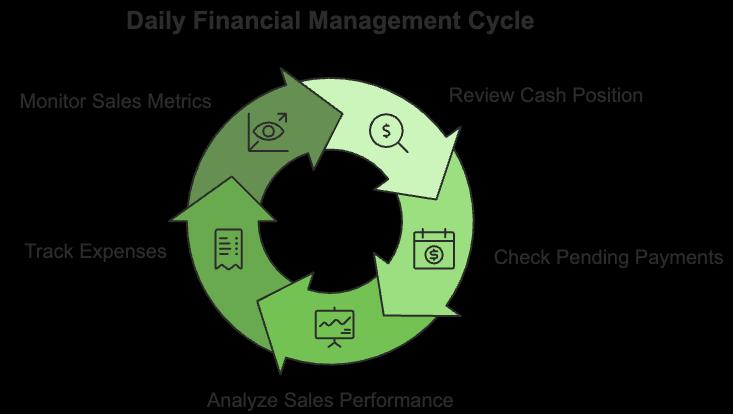

Dedicate 30 minutes each morning to check your cash position, review

pending payments, and analyze your daily sales performance.

Entrepreneurs who maintain this practice are more likely to consistently
outperform those who don't.
Create a simple but effective tracking system for your expenses. Record
everything, no matter how small: those $10 monthly subscriptions can
add up to thousands over time.
Use your phone to snap pictures of receipts immediately and categorize
them daily. This habit prevents the end-of-month scramble and gives you
real-time insight into your spending patterns.
Monitor your sales performance with focused attention. Review your
previous day's figures and compare them against your targets. Pay special
attention to your customer acquisition costs and retention rates. These
metrics often reveal opportunities for improvement before they show up
in your bottom line. You are more likely to achieve your growth targets if
you track these metrics every day.
Tools and Systems for Success
Technology can transform these daily habits from burdensome tasks into
smooth, automated routines. Choose accounting software that offers
real-time reporting and automated reconciliation.
You can also look for expense-tracking apps that automatically categorize
your spending and integrate with your accounting system. The IT Supply
Chain recommends selecting tools that provide predictive analytics and
scenario planning capabilities to help you make better financial decisions.


Set up your digital dashboard to display key metrics at a glance. Include:

1) Daily cash position

2) Pending payments
3) Sales performance
4) Customer retention rates
5) Expense categories
Integrate these tools into your daily workflow. Schedule specific times for
financial reviews and stick to them. Set up automated alerts for unusual
spending patterns or dips in cash flow. Implementing steps like these is
crucial because entrepreneurs who leverage technology for financial
monitoring spend less time on administrative tasks while maintaining
better financial oversight.
Create standard operating procedures for your financial tasks and
document them clearly. Train your team on these procedures and
regularly review their effectiveness. As your business grows, these
systems should evolve, but the core habits of daily monitoring and
proactive management remain constant.
Your path to financial success begins with these daily practices. Start
small. Choose one crucial habit and master it before adding more. And
track your progress using simple metrics and adjust your approach based
on what works for you.
Consistency matters more than perfection. These daily disciplines,
practiced faithfully, will compound over time to create a significant
financial impact on your business.