

Qigong For PTS by Jeffrey Smoley - HTML preview
Download the book in PDF, ePub, Kindle for a complete version.
Your Secret Room:
This next Qigong is a guided meditation. Dr. Glenn Morris taught a version of this as “Dao Mo’s Cave”. Some prisoners of war developed a similar concept to help them through that situation.
Begin by doing a short progressive relaxation gong while seated or laying down.
Close your eyes. Imagine you have a private island that you can get to simply by imagining or visualizing you are there. This island has no beaches facing the ocean; anyone approaching would see waves violently crashing against steep, towering cliffs. The only way into this island is a hidden passageway, under the cliffs to the central lagoon. There is a beach surrounding this lagoon and a path though the trees towards the cliffs. This path reaches the base of the cliffs and there seems to be no way through or up. You know where there are hidden hand and foot holds that will allow you to easily climb the cliffs, and you know all the traps that would stop anyone else from following you.
At the top of the climb is a ledge that seems to end. You step to the edge and there is another ledge around the corner that allows you to continue, until you come to another apparent dead end. You put your fingers in the holes that only fit your hand, and a door silently glides open. There is a tunnel leading into the mountain. You touch a hidden switch and there is now sufficient light to enter the tunnel.
You walk the tunnel noticing the traps set to catch anyone but you traveling this path. At the end of the tunnel, there is a locked door. You have the key in your pocket and you open the door; there is a stairway that leads up and then around so that you come out into a cave.
There is a large table or workbench in the center of the cave and doors all around the perimeter that you know contain rooms that you have designed. There is a kitchen with just the right type of appliances to make the meals you like, a pantry, refrigerator and freezer that hold everything you like to eat. A spice rack contains everything from the common to the most exotic spices to be found. Another room has a pool or spa, or both. There is a bedroom with a bed like a cloud. There is a library with books of all types, and if you are a techie, a computer room with ultra high-speed access to the Internet, various types of computers and terminals, and backup power supplies and a generator, so it will never go down. If you love music there is a sound proof room with a sound system that is the best ever designed.
If you are a musician there is a room with the finest instruments, a Stradivarius, perhaps a Gibson Les Paul actually played by Les Paul, a perfect Hammond B3 and others. A martial artist would find rooms with mats, weapons, robot partners to allow full contact techniques and old scrolls and books with the secrets of ancient masters.
There are rooms with tools or machinery to make whatever you would like to create. There is a security system that allows you to monitor the entire island.
Your gaze returns to the table in the center of the cave. On it is a thick book. You walk over to it and see that the title is “Everything I need to know”. You know that if you are taking a test, you can close your eyes, go your cave, open the book and find the answer. If you need to remember something or find something you misplaced, it can be found in the book. If you need to escape from a stressful situation, and just doing a relaxing gong is not enough, you can go to your cave, enter a room and listen to music or get into a hot tub or whatever you need to relax. Next to the table is a very comfortable chair. You walk over to the chair and sit down and relax. It reclines and you can relax even more. It may have a vibrator, heat or be a massage chair, and you turn it to the most relaxing setting and any tension just melts away. You breathe deeply and exhale. Open your eyes. Become aware of your surroundings.
What special rooms do you have in your cave?
The Eight Section Brocade.
Ba Duan Jin:
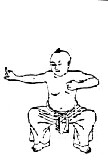
There are several versions of the 8 section brocade, this is the most complete I have found. In some versions the sections are done in different order every time you practice. These movements come from the oldest known drawing of Qigong or Qigong like forms, found on the walls of a cave in China and carved on a turtle shell.
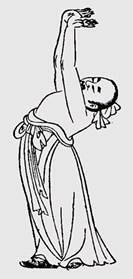
Reaching for the heavens:
The first section is started in the Natural stance. Exhale as you bend your knees while keeping your back straight; reaching out and down as if scooping up a large ball. As you hands reach the width of your legs, start to inhale and stand up as if you are lifting the ball. When your hands reach chest high turn them as if you are going to push the ball up, watching your hands without moving your eyes, so the head tilts back, as your hands go above your head, raise up on your toes, palms rotate so fingers point towards each other. Keep your tongue up and breathe into your abdomen. As you inhale you are expanding your whole body. Turn your fingers in, start to exhale and lower your arms sideways and sink on to your heels, and you start the scoop again. Repeat eight times.
Drawing the Bow or Single Whip:
This section starts by stepping out to the side to about double shoulder width, if you can. Maintain the correct foot and hip position. Sink your weight onto the right leg and turn slightly to the right. Lift your hands, forearms crossed with the left hand index and the middle fingers erect and other fingers bent, touch your thumb to your ring finger tip if you can. Inhale as you push with the right leg to turn the hips to the left, as your left arm extends to shoulder height, palm faces away. Sink to your left leg as the right hand forms a chicken’s beak, sometimes called a monkey’s fist: all finger tips touching. The right arm extends as you turn back to the right and the right arm extends to shoulder height. The knees stay slightly bent. Open the left hand, exhale with the “ha” sound and push from the right foot to the hand, with a silk reeling spiral. Drop your arms to the crossed position. Repeat eight times, return to the resting position.
White Crane Lifts Wings:
I usually see this taught without the leg movements. This version is from the YuLi (Jade Power) Qigong Crane set: Start with your legs about ½ shoulder width apart. Place both hands on the front of your thighs. As you inhale, raise your right knee and your right hand. The hand rotates slowly so that when it is shoulder high, it is palm up, then the fingers turn to the right, so that when your arm is extended the palm points up and the fingers point to the rear. Your upper leg is parallel to the floor. When you exhale, the foot slowly drops and the hand and arm fall vertically, elbow leading until the palm reaches your thigh. You are drawing Qi from the ground, spiraling up to your hand where it mixes with the Qi from the air and you draw both in through the Laogong point (this point is on the palm of your hand between the knuckles of your index and ring finger. If you bend your hand with the fingers straight, it is at the bottom of the crease.) It travels down your arm to your Dantien.
Your weight then shifts to the left leg and you repeat the sequence. Inhale up and exhale down. Repeat up to 18 times per side.
Now begin the same way, but raise the left hand when the right leg rises, and the right hand moves down and the arm straightens, but the fingers point forwards. As the left hand drops, the right hand begins to rise, when the right foot lands, the weight shifts and the left foot rises. Your tongue still is kept on the palate and the breathing is abdominal, one breath per up / down cycle. The knee is raised high and if you can, bring it almost to the chest. The toes of the foot point down when the knee is raised up.
Turning the head:
The fourth piece starts with a small step sideways to just wider than shoulder width. Look ahead with your body relaxed, focusing on the distance. Lift your left arm around the front of your face and hold the back of your head. Lift the right hand to your back, palm out at the same time. Your middle knuckle should be just past the Mingmen point. Mingmen means life gate and is opposite the Dantien, in the small of your back. Reach your left hand further and grasp the right ear with the index and middle fingers. Turn the waist to the right and look over your right shoulder. Look forwards again. Return to the starting pose, lowering the left hand and massaging your neck. Reverse this movement. Inhale while lifting your arms and turning your waist. Exhale while returning to the starting position. Keep the body straight while looking back. Do this six times in each direction.
Punching with feeling:
The fifth section starts with a big step sideways, feet parallel and two-shoulders' width apart. Sink down, bending both knees and bring your fists to your waist, palms up. Punch slowly with the right fist as you exhale, but do not over rotate the hand, the knuckles should be vertical. Do not extend the arm until the elbow locks. Turn the hand palm up and then pull back the fist. Repeat with the left fist. Teeth are together and eyes stay opened wide. Your weight should be slightly forward, about 60% on the balls of your feet and 40% on the heels. Your hips are slightly tucked in. A variation on the same form is to open the hand and rotate it to a palm out position, thumb to the left and as your arm reaches 90% extended, you snap the hand shut as if catching a fly. Repeat eight times.
Bending back and forwards:
Section six is a stretching exercise. Start in the relaxed position, feet shoulder width apart. Lift your arms up like you are doing the start of "Wuji forms Taiji" (This is in the Nine Dragon Qigong), but continue to lift until they are behind your head then lean backwards. Keep your head straight. Bend forwards and bring your hands to your chest, just under the ribs. Slide them down your legs and try to grasp your toes with your hands. Pull your toes up and keep your legs straight. Inhale while going up and exhale while stretching down. If you are not flexible enough to reach your toes, just go as far as you can, but lift the toes. Bend the knees and slide your hands up to the starting position. Repeat six times.
Snake bends his spine:
The seventh brocade relaxes the spine. Step sideways to shoulder width and bend down, knees bent a little. Let your arms hanging naturally. The first movement is raising and lowering your shoulders in turn, to swivel the vertebrae of the spine. The second movement is swinging your arms back and forth while swaying the head, shoulders and hips right and left. The spine weaves like a snake. Breathe at a normal rate. Sink the hips and bend the knees, then stand up straight. Put your hands over the Dantien and raise your right hip to the right. Lower your right shoulder to the right. Straighten up and then raise your left hip up to the left. Lower your left shoulder to toward your left hip. Straighten up and push your hips forwards, then bend at the waist to lower your shoulders. Straighten up and push your hips back and put your shoulders back. Do this twice.
Knocking the heels:
The final section starts in the relaxed stance. Lift your heels and raise your body. Drop your heels to the ground to give your body a little shock. Inhale while lifting the heels and exhale after you are down. For those who are not very strong, lower the heels gently. The head should be kept erect to prevent too much shock to the cervical vertebrae. Do this twice. Click your teeth together 36 times and generate saliva. Swallow in three sections feeling Qi settle in the Dantien. Take a deep breath and feel it push the Qi throughout your body.
Adding Six Healing Sounds to the Eight Section Brocade:
Reaching for the Heavens: to relieve tension and stress. Make the sound HEE (instead of the ha sound).
Drawing the Bow: deals with sadness and grief. Make the sound SSSS. This exercise specifically strengthens the lungs.
White Crane: for the worries of the heart, spleen and stomach. Make the sound HAW (for worries of the heart and spleen) or HOO (for worries of the stomach and everyday worries).
Turning the Head: deals with the five strains, seven emotions and changes in the weather. Make the sound AAAHH with your mouth rounded like you would be saying “oh”.
Punching with Feeling: helps to relieve anger and helps the liver. Make the sound SHHH.
Bending Backwards and Forwards: neutralizes fear and strengthens the back. Make the sound CHUAY. Imagine or visualize brown soot leaving the mouth.
Snake Bends Spine: detoxifies the body and loosens the spine. Make the sound Xi (shheee)
Knocking the Heals. This exercise rids the body of negative energy. Make the sound HAAAH.
The sounds should last from three to six seconds long.
You may have noticed there are nine sounds described for the “Six Healing Sounds”. Actually there is another, the Ah sound with the mouth in a big smile.
The effects of the Eight Section Brocade (according to Chinese traditional medicine):
Reaching for the Heavens regulates the three visceral cavities housing the internal organs (san jiao): It regulates all internal organs, from your heart and lungs in your upper torso through to your kidneys and intestines in your lower abdomen. It relieves fatigue, increases inhalation, and helps prepare your body for the exercises that follow. It also helps invigorate the muscles and bones of your back and waist and can help correct poor posture of the upper back and shoulders.
Drawing the Bow places the emphasis on your thorax - the home of your heart and lungs - thus greatly improving the circulation of blood and oxygen. It also improves the flow of energy in your small intestine.
White Crane regulates the heart, spleen and the stomach. It increases the flow of energy along both sides of your body and benefits your liver, gall bladder, spleen, and stomach. This helps to prevent diseases of the gastro-intestinal tract.
Turning the Head relieves the exhaustion of the five internal organs and injuries caused by the seven human emotions.
Punching with Feeling develops the flow of Qi from your feet through your entire body and extends it through your hands and eyes. It excites your cerebral cortex and related nerves, and speeds the circulation of blood and oxygen in your cardiovascular system. This is not just a punching exercise, it is designed to strengthen the flow of your internal power: it must be done slowly and calmly with great concentration. Each movement begins gently and the full power comes in only at the end of each extension.
Bending Backwards and Forwards to rid the heart of its illness. It is good for the muscles of your lower back and legs and for stretching your spine. It is also beneficial for the internal organs of your lower abdomen. The movements of your waist actually bring every tissue and organ of your abdomen into play. The whole exercise strengthens your kidneys, your adrenal glands, and the arteries, veins, and nerves associated with them. Since your kidneys play a vital role in regulating the water metabolism of your entire body, this exercise helps maintain a healthy balance in your internal environment. Do not practice this exercise when pregnant.
Snake Bends Spine to remove excess heat from the heart. Helps reduce fever and reduce tension in the sympathetic nervous system. It has a relaxing effect and eases the flow of energy along a number of your body's meridians. has a powerful effect on your central nervous system and the circulation of both blood and Qi to your head. It stimulates the kidneys. It also strengthens the activity of your eyes, your neck and shoulder muscles and your nervous system. It helps with alleviating high blood pressure and hardening of the arteries. Do not practice this exercise when pregnant.
Knocking the Heels to ward of illness. This aims to refresh and regenerate all your internal organs by enabling them to massage each other. It is also excellent for your spine, your nervous system, and your sense of balance. Do not practice this exercise when pregnant.
A seated version of Ba Duan Jin:
Form 1: Holding Mt. Kunlun with Both Hands
Loosen your belt and clothing. Sit upright on a mat or towel with legs bent, the right calf over the left with both soles facing obliquely upward. Relax your whole body and concentrate your mind, looking straight ahead. Tap your teeth together lightly 36 times, with tip of tongue touching hard palate, and pause briefly. When your month becomes filled with saliva, swallow it in three gulps with a gurgling sound. Then cover your ears with your palms, fingers spread out like a fan. Place forefingers on middle fingers and tap on the back of the head 24 times. Take a deep breath, inhaling and exhaling slowly and evenly.
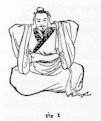
Form 2: Shaking the Heavenly Pillar
Sit upright with legs bent, right calf over the left, with soles facing obliquely upward. Place right palm on left above navel, with fingers slightly bent. Turn your head to the left, eyes looking backward as far as possible, for one or two seconds . Then turn your head to the right, reversing the position of palms with a friction. Repeat 24 times. Keep torso erect while turning your head.
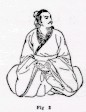
Form 3: Raising Arms
Sit upright with palms resting on bent knees, right calf over the left, both soles facing obliquely upward, and eyes straight ahead. Make relaxed fists and raise them overhead as if you were hanging from a horizontal bar. Move your tongue around the inside of your month 36 times to produce saliva, and swallow this in three mouthfuls. Close your eyes and imagine that your heart is being warmed by a torch with the flames spreading gradually throughout the whole body. Return palms to knees.