

Crazy Horse by Edward Drobinski - HTML preview
Download the book in PDF, ePub, Kindle for a complete version.
By
Edward Drobinski
Copyright © 2023 by Edward Drobinski All rights reserved
Table of Contents
1 – Crazy Horse - The Consummate Outsider ..................... 1
2 - Lakota – Oglala Sioux – Teton Sioux ...................... 22
3 – Visions of Crazy Horse ................................... 58
4 – Crazy Horse’s Battle Involvements ........................ 88
5 - Lakota Religious System ................................. 102
6 – Females Three ........................................... 113
7 – Attempted Imprisonment and Death ........................ 117
8 - Tribal Politics with Lakotas- In- ....................... 132
Name-Only – the Real Killers ................................ 132
9 – The Lakota Last Stand ................................... 160
10– Legacy and Memorials .................................... 185
11– Little Bighorn .......................................... 195
12- Red Horse Drawings of Little Bighorn .................... 272
13– Crazy Horse’s Story of the Battle ....................... 291
14- Crazy Horse Quotes ...................................... 305
15– Suggestive Errata Relegated ............................. 309
Page 1
1 – Crazy Horse - The Consummate Outsider Crazy Horse - Tȟašúŋke Witkó – “His-Horse-Is-Crazy;” circa 1840
– September 5, 1877, was a Lakota war leader of the Oglala band in the 19th century. Though his birth and childhood occurred late in the land grab game, subsequent to Native Americans having signed treaties with the US Army which resulted in their being generally relegated to reservations, he took up arms against the United States federal government to fight against encroachment by White American settlers on Native American territory and to preserve the traditional way of life of the Lakota people. His heroic and exemplary participation in several famous battles of the Black Hills Wars on the northern Great Plains, most significantly among them the Battle of the Little Bighorn in 1876, in which he led a mixed Native American war party to a decisive victory, earned him great respect from both his enemies and his own people, in some cases they being one and the duplicitous same.
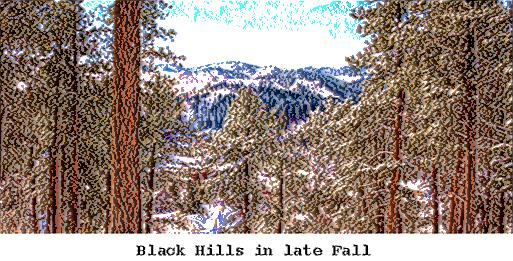
Sunrise in the Black Hills
Crazy Horse
Page 2
It was 1840, a late autumn day in the Black Hills of the Wild West as well in present day South Dakota. Some overnight lows had been dropping into the teens and the waters falling from the sky had been manifesting as modest snow, accumulating slowly during the Fahrenheit freezing days, not venturing much out of the comfort zone, perhaps portending something different.
Perhaps not. It was not the first time this had happened. Only time would be able to tell that this day was one of lasting significance.
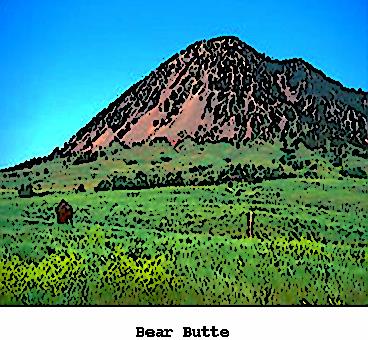
Rattling Blanket Woman, born in 1814, and a member of the Brule Sioux; a Lakota Sioux married to a man named Crazy Horse, actually the second Crazy Horse, an Oglala Sioux shaman, another Lakota Sioux, gave birth to a son. According to the Lakota oral history, he was born near Bear Butte, a sacred site in the Black Hills.
Crazy Horse
Page 3
Rattling Blanket Woman’s first name for him was Čháŋ Óhaŋ,
“Among the Trees,” which he most certainly was. As his light skin and hair developed she began calling him Pȟehíŋ Yuȟáȟa -
Curly Son; and Žiží - Light Hair, until she prematurely died at age thirty in 1844, when he was four.
Crazy Horse did indeed have lighter complexion and hair than others in his tribe, with prodigious curls. Boys were traditionally not permanently named until they had an experience that earned them a fitting name, so Crazy Horse was called
“Curly Hair” and “Light Haired Boy” as a child.
Page 4
He had two siblings. Little Hawk was his younger half-brother and Laughing One, sometimes called Iron Cedar, his younger half-sister. Little, if anything, has been written of their close relationships. Crazy Horse’s difference in age from his half-sister contributes to this.
Little Hawk - Čhetáŋ Čík'ala, circa 1842–1871, was the offspring of the remarriage of Worm, Crazy Horse #2, Crazy Horse #3’s widowed father, to a pair of sisters of the Brulé Lakota chief Spotted Tail, Iron Between Horns and Kills Enemy. The name Little Hawk was given to Crazy Horse # 3’s younger brother by uncle Little Hawk, who then took the name Long Face. According to He Dog, Little Hawk liked fast horses and was a thrill seeking risk taker; making no efforts to calculate potential risks and potential rewards. Little Hawk was killed on a war expedition, south of the Platte River. Crazy Horse, upon hearing of his brother's death, traveled to locate Little Hawk's remains. After preparing Little Hawk's remains, Crazy Horse killed Little Hawk's horse so that the horse could help Little Hawk travel to the spirit world.
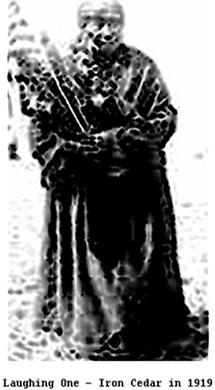
Because Crazy Horse and Little Hawk had no direct descendants, the family is related by blood only through his half-sister, Laughing One - Iron Cedar, A/K/A various derivations of Julia Iron Cedar Clown, who was born in 1868, making her about
Page 5
thirteen when Crazy Horse was killed by Lakotas-in-name-only. It was after Crazy Horse’s death that the family began their descent into hiding and decades of silence. They were told that if anyone spoke of Crazy Horse or of members of the family, to listen, then walk away. It was not until decades later that she orally passed on their life history, including the attack on Lt.
Col. Fetterman; the Wounded Knee massacre; the battles of Rosebud and Little Big Horn; and the murder of Crazy Horse at Fort Robinson, offering versions which did not correlate with the “official” diatribe of popular Custer “heroics.” It was also noted that Crazy Horse had a premonition of his demise fifteen months before his death. Laughing One’s stories were not written until the twenty-first century, by another member of her husband’s Clown family.
Crazy Horse
Page 6
As an adolescent, Crazy Horse earned the name “His Horse Looking” or Tȟašúŋke Witkó – “His Horse is Crazy,” but he was more commonly known as “Curly” until 1858 when, following a battle with Arapaho warriors he was given his father’s name, Crazy Horse, while his father then took the name Waglula - Worm.
Few historical figures of such significance have so little of their lives accurately known, accurately written about, and pictured. Ominous warnings about speaking truth and the fact that historians may have difficulty in trying to deal with someone who was at odds with the world in general, that trait
Page 7
not so challenging to find anywhere, but one also at times at odds with his own people; the Lakotas, as well as other Native American tribes; being a “daunting” complication.
The child who would eventually be known as Crazy Horse; actually the third Crazy Horse; was also averse to being photographed. As he was quoted saying to photographer Valentine T. McGillycuddy, of the US Army; “My friend, why should you wish to shorten my life by taking from me my shadow?”
In fact, Crazy Horse’ premature death was likely caused by a partnership, a conspiracy of White Army soldiers and his
“fellow” Lakotas who sought capitulation to and paid jobs from the US Army. This was not the official diatribe until mentioned much later by Crazy Horse’s descendants. Little Big Man, a Lakota, and distant cousin, who served in battle under Crazy Horse, but who at the time was working as a policeman-guard for the US Army was present at and integral in Crazy Horse’s betrayal and stabbed demise.
Crazy Horse was known to have a personality characterized by aloofness, shyness, modesty and presumed lonesomeness. He was generous to the poor, the elderly, and children. By omission, this may have indicated a distrust and/or dislike of adult Lakotas in their prime years, who he generally ignored. He was a
Page 8
nonconformist, who tribal elders described in oral history to tribal members as quiet and even reclusive. While he was highly spiritual and participated in ceremonies, elders say he didn’t consider himself bound to protocol. Instead, he preferred to follow his own dreams and visions. He would go about the village without noticing people or saying anything. In his own teepee he would joke, and when he was on the warpath with a small party, he would also joke, in this situation in an attempt to make his warriors feel comfortable. But around the village, he hardly ever noticed anybody, except little children. All the Lakotas like to dance and sing, but he never joined a dance, and they say nobody ever heard him sing. But everybody liked him, and they would do anything he wanted or go anywhere he said.
Crazy Horse
Page 9
Sources differ on the precise year of Crazy Horse's birth, but all agree he was born between 1840 and 1845. Yet they seem to agree that he was a Sagittarian through an implied repetition and more so, a dearth of refutation; one source proclaiming December 4 as the special day. According to Šúŋka Bloká - He Dog, he and Crazy Horse "were both born in the same year at the same season of the year," which census records and other interviews place as having been in 1842. Ptehé Wóptuȟ’a -
Encouraging Bear, an Oglala medicine man and spiritual adviser
Page 10
to Crazy Horse, reported that Crazy Horse was born "in the year in which the band to which he belonged, the Oglala, stole one hundred horses in the fall of the year," a reference to the annual Lakota calendar or winter count. Among the Oglala winter counts, the stealing of 100 horses is noted by Cloud Shield, and possibly by American Horse, and Red Horse, as equivalent to the year 1840–41. Oral history accounts from relatives on the Cheyenne River Reservation place his birth in the spring of 1840. On the evening of his son's death, the elder Crazy Horse told Lieutenant H.R. Lemly of the US Army that the year of birth was 1840.
This book will use the 1840 date as this is the date most provided by Native American testimony, and one would think that the father knows, though it matters little other than simplification.
There is no dispute in the current, prevailing “wisdom” over Crazy Horse having been born in the Black Hills of South Dakota, near Rapid Creek, unorganized US territory, and that as a child, he was named “Curly Hair” due to his light complexion and hair that made him stand out from all the other boys. It is also near universally believed that he acquired his final name, the same his father bore, after an 1858 battle with Arapaho warriors. One other account said that after the son had reached maturity and
Page 11
shown his strength, his father gave him his name and took a new one, Waglúla - Worm. Yet another version of how the younger Crazy Horse acquired his name is that he took it after going through the Lakota haŋbléčheya ceremony, in which one goes to a secluded place to fast and pray for a number of days, crying to the Spirits for a vision. The Spirits often answer with gifts of power, some of which end up becoming new ceremonies.
............ No matter in a way regarding the name Crazy Horse, as the hero owned the name.
The Grattan Massacre
An early formative event happened when Crazy Horse was twelve years old. He was involved in what would become known as the start of the First Sioux War. A Mormon wagon train had lost a cow that ended up being killed for meat by a visitor in the village where Crazy Horse was staying. The US Army at Fort Laramie administration sent 24 year old Lieutenant Grattan to arrest the shooter, but the village chief attempted to talk Grattan out of the arrest until the local Native American agent could come. Conquering Bear was explaining that the shooter was a visitor and not under his command, but Grattan's interpreter was reported to be intoxicated and angry. When this was considered unsatisfactory, the Native Americans became more than reasonable and offered to pay for the cow and apologize for the
Crazy Horse
Page 12
incident, but Grattan would take nothing less that the arrest.
One of Grattan's men fired an unprovoked shot and killed Conquering Bear. In quick retaliation, the Sioux ran down and killed Grattan and his 29 men. Crazy Horse immediately rode to a nearby hill to try to understand all that had happened. He had a vision of a warrior with a lightning bolt on his face that went through many battles unscathed. From that point on, Crazy Horse would always paint a black lightning bolt on his cheek before a battle. The US military would come back for revenge on the Sioux at the “Battle of Ash Hollow.” Crazy Horse was not injured in the retaliation attack at Ash Hollow by the US, but he did witness over 100 Sioux die. This fueled his hatred of Whites and his need to become a great warrior.
Page 13
Crazy Horse immediately knew that he was supposed to be a great warrior. A year after Ash Hollow, thirteen year old Crazy Horse snuck into the rival Crow Native American camp and stole their horses. In his late teens and early twenties, Crazy Horse earned the title of War Chief and led numerous war parties during Red Cloud's War. He led the Sioux in the Fetterman Massacre in 1866, in which he laid a trap for a group of US troops chasing him and then killed all 80 soldiers. In 1868, Red Cloud signed a peace treaty with the US government. Crazy Horse refused to sign and would continue to attack troops and forts.
“Shirt Wearer”
Through the late 1850s and early 1860s, Crazy Horse's reputation as a warrior grew, as did his fame and popularity among the Lakota. The Lakota already told accounts of the young man in their oral histories. His first kill was a Shoshone raider who had murdered a Lakota woman washing buffalo meat along the Powder River. Crazy Horse fought in numerous battles between the Lakota and their traditional enemies, the Crow, Shoshone, Pawnee, Blackfeet, and Arikara, among other Plains tribes.
In 1864, after the Third Colorado Cavalry decimated Cheyenne and Arapaho in the Sand Creek Massacre, Oglala and Minneconjou bands allied with them against the US military. Crazy Horse was
Page 14
present at the Battle of Platte Bridge and the Battle of Red Buttes in July 1865. Because of his fighting ability and for his generosity to the tribe, in 1865 Crazy Horse was named an Ogle Tanka Un; "Shirt Wearer," or war leader, by the tribe.
Until he was killed after Little Bighorn at the Soldiers' Town on White River, he was wounded in battle only twice; once by accident and both times by one of his own people when he was not expecting trouble and was not thinking about the possibility of inter-tribal subversion; never by the US Army, directly.
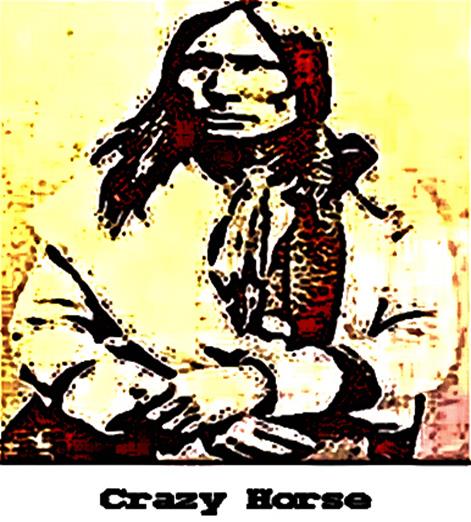
Virtually all sources question whether Crazy Horse was ever photographed. Valentine McGillycuddy, a member of the US Army, but nonetheless considered a friend by Crazy Horse, doubted any photograph of the war leader had been taken. In 1908, Walter Camp wrote to the agent for the Pine Ridge Reservation inquiring about a portrait. "I have never seen a photo of Crazy Horse,"
Agent Brennan replied, "nor am I able to find any one among our Sioux here who remembers having seen a picture of him. Crazy Horse had left the hostiles but a short time before he was killed and it's more than likely he never had a picture taken of himself."
In 1956, a small tintype portrait purportedly of Crazy Horse was published by J. W. Vaughn in his book “With Crook at the
Page 15
Rosebud.” The photograph had belonged to the family of the scout Baptiste "Little Bat" Garnier. Two decades later, the portrait was published with further details about how the photograph was produced at Fort Robinson, though the editor of the book
"remained unconvinced of the authenticity of the photograph."
In the late 1990s the original tintype was on exhibit at the Custer Battlefield Museum in Garryowen, Montana. The museum says that it is the only authentic portrait of Crazy Horse.
Historians continue to dispute the identification.
“Experts” argue that the tintype was taken a decade or two after 1877. The evidence includes the individual's attire, the length of the hair pipe breastplate, and the ascot tie, which closely resembles the attire of Buffalo Bill's Wild West Native American performers active from 1883 to the early 1900s. Other “experts”
point out that the gradient lighting in the photo indicates a skylight studio portrait, common in larger cities. In addition, no other photograph with the same painted backdrop has been found. Several photographers passed through Fort Robinson and the Red Cloud Agency in 1877, including James H. Hamilton, Charles Howard, David Rodocker and possibly Daniel S. Mitchell; but none used the backdrop that appears in the tintype. After the death of Crazy Horse, Private Charles Howard produced at
Page 16
least two images of the famed war leader's alleged scaffold grave, located near Camp Sheridan, Nebraska.
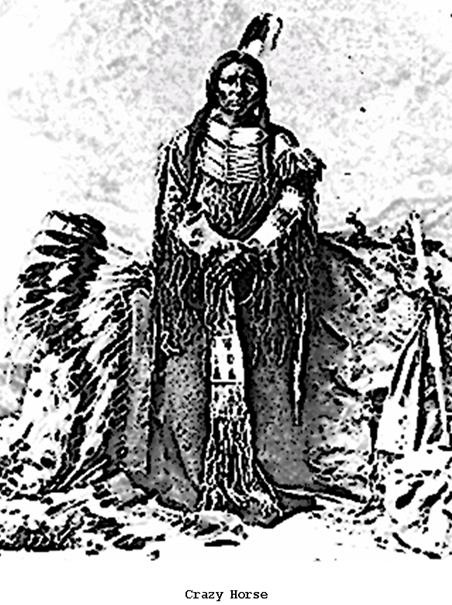
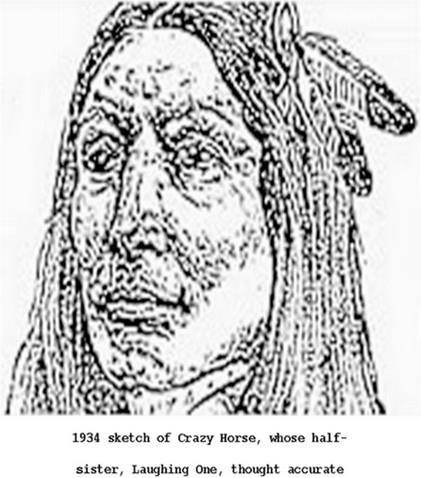
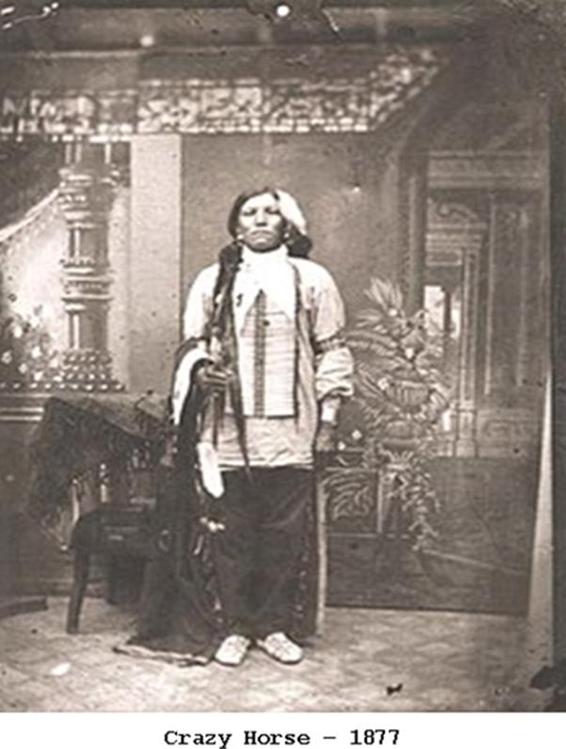
Given Crazy Horse’s extreme aversion to being photographed, citing it as the equivalent of stealing one’s soul, it seems highly likely that any of the photographs purported to be of him, all those currently known appearing as if Crazy Horse had posed, have to be fakes. The only ones which could possibly be authentic are those taken when Crazy Horse was unaware of the photographer. To date, nothing resembling that exists.
Having said that, pictures are provided herein, in recognition of the fact that people seem to like and insist upon images.
The most famous tintype is reproduced below.
Crazy Horse
Page 17
Page 18
Crazy Horse’s Early Life
One account said that after the son had reached maturity and shown his strength, his father gave him his name and took a new one, Waglúla - Worm. Another version of how the younger Crazy Horse acquired his name is that he took it after going through the haŋbléčheya ceremony. Crazy Horse's cousin, the son of Hewáŋžiča - Lone Horn, was Maȟpíya Ičáȟtagya - Touch the Clouds.
He saved Crazy Horse's life at least once, though nowhere is it specified where and how, and was with him when he died.
Crazy Horse’s mother, Rattling Blanket Woman or Tȟašína Ȟlaȟlá Wiŋ (1814–1844) was the daughter of Black Buffalo and White Cow, also known as Iron Cane. Her older siblings were Lone Horn, born 1790, died 1877, and Good Looking Woman, born 1810. Her younger sister was named Looks At It, born 1815, and later given the name They Are Afraid of Her, which was also the name given to Crazy Horse’s only officially recognized child. She died at the age of four. The historian George Hyde wrote that Rattling Blanket Woman was Miniconjou and the sister of Spotted Tail, who became a Brulé head chief. She may have been a member of either of the One Horn or Lone Horn families, leaders of the Miniconjou. She was said to be beautiful and a fast runner.
Page 19
In 1844, while out hunting buffalo, Waglula helped defend a Lakota village under attack by the Crow. In gratitude the chief gave Waglula his two eldest daughters as wives; Iron Between Horns, age 18, and Kills Enemy, age 17. Chief Corn's youngest daughter, Red Leggins, who was 15 at the time, requested to go with her sisters; and all became Waglula's wives. When Waglula returned with the new wives, Rattling Blanket Woman, who had been unsuccessful in conceiving another child, thought she had lost favor with her husband and hanged herself.
Waglula went into mourning for four years. Rattling Blanket Woman's sister, Good Looking Woman, came to offer herself as a replacement wife, and stayed on to raise Crazy Horse. Other versions of the legend posit that she was grief stricken by the deaths of those she knew; that her husband accused her of running off with her brother-in-law; or that she had had an affair with a European-American man.
According to Frederick Hoxie's “Encyclopedia of North American Native Americans,” Crazy Horse was the third in his male line to bear the name of Crazy Horse. The love of his life was Tȟatȟáŋkasápawiŋ - Black Buffalo Woman, whom he courted, but she married another man named Mní Níča - No Water. At one point, Crazy Horse persuaded Black Buffalo Woman to run away with him.
No Water borrowed a pistol and ran after his wife. When he found
Page 20
her with Crazy Horse, he fired at him, injuring him in the face and leaving a noticeable scar. Crazy Horse was married two times, first to Tȟašinásápawiŋ - Black Shawl, and second to Nellie Larrabee - Laravie. Half-White, Nellie Larrabee was said to have been given the task of spying on Crazy Horse for the military, so the marriage is suspect. Only Black Shawl bore him any children, a daughter named Kȟokípȟapiwiŋ - They Are Afraid of Her, who died at age four of undisclosed cause.
To recap the basics, Crazy Horse was born in the Black Hills of South Dakota in 1840, the son of the Oglala Sioux shaman/medicine man also named Crazy Horse and his wife, a member of the Brule Sioux.
Crazy Horse had lighter complexion and hair than others in his tribe, with prodigious curls. Boys were traditionally not permanently named until they had an experience that earned them a name, so Crazy Horse was called “Curly Hair” and “Light Haired Boy” as a child.
As an adolescent, Crazy Horse earned the name “His Horse Looking,” but he was more commonly known as “Curly” until 1858
when, following a battle with Arapaho warriors he was given his father’s name, while his father took the name Worm.
Page 21
It is this name changing, among other less significant things, which causes confusion, and necessitates arduous explanation which is probably almost as much fun to read as it is to write.
Attempts at absolute clarity must die absolutely for the sake of the popular insistence upon required “entertainment.”
Page 22
2 - Lakota – Oglala Sioux – Teton Sioux
.
The Lakota are a US Native American people. They are also known as the Oglala Sioux or Teton Sioux. The terms are often used interchangeably, though that is technically a smidgeon misleading or incorrect. But, it is done so often, for the purposes of a book like this, it seems best to just go with the flow, and not get bogged down in the miserable details, primarily of interest only to a small group of “scholars.” The Lakota are one of the three prominent subcultures of the Sioux people; the other two being the Santee and the Yankton -
Yanktonai. Their current lands are in North and South Dakota.
They speak Lakȟótiyapi, the Lakota language, the westernmost of three closely related languages that belong to the Sioux language family.
There are seven bands or "sub-tribes" of the Lakota, who are in turn a sub-section of the Sioux;
Sičháŋǧu – Brulé - Burned Thighs
Oglála - They Scatter Their Own
Itázipčho - Sans Arc - Without Bows Húŋkpapȟa - End Village - Camps at the End of the Camp Circle Mnikȟówožu - Miniconjou - Plant Near Water - Planters by the Water
Crazy Horse
Page 23
Sihásapa - Blackfeet or Blackfoot
Oóhenuŋpa - Two Kettles
Tȟatȟáŋka Íyotake - Sitting Bull was from the Húnkpapȟa, and Tȟašúŋke Witkó - Crazy Horse was from the Oglála and Mnikȟówožu.
Sioux language speakers may have originated in the lower Mississippi River region and then migrated to or originated in the Ohio Valley. They were agriculturalists and may have been part of the Mound Builder civilization during the 9th–12th centuries AD. Lakota legend and other sources state they
Page 24
originally lived near the Great Lakes. The tribes of the Dakota, the term also incorrectly used interchangeably with Lakota, before European contact in the 1600s, lived in the region around Lake Superior. In this forest environment, they lived by hunting, fishing, and gathering wild rice. They also grew some corn, but their locale was near the limit of where corn could be grown. This may be conflation with the Algonquian speaking groups typically in that region, though Sioux peoples probably migrated there later. In the late 16th and early 17th centuries, Dakota-Lakota speakers lived in the upper Mississippi Region in what is now organized as the states of Minnesota, Wisconsin, Iowa, and the Dakotas. Conflicts with Anishnaabe and Cree peoples pushed the Lakota west onto the Great Plains in the mid to late 17th century.
Early Lakota history is recorded in their winter counts -
Lakota: waníyetu wówapi, pictorial calendars painted on hides, or later recorded on paper. The “Battiste Good winter count”
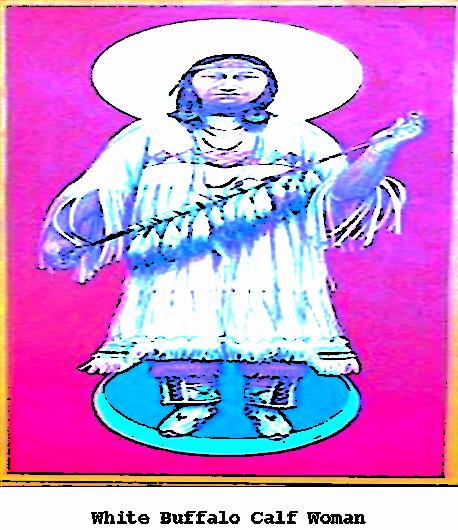
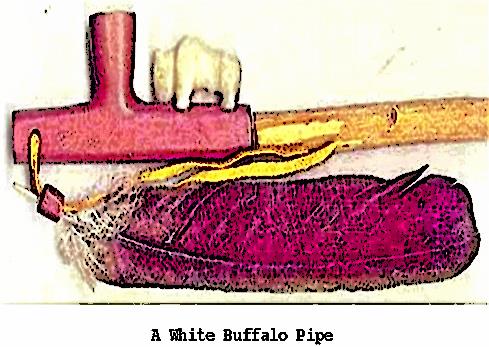
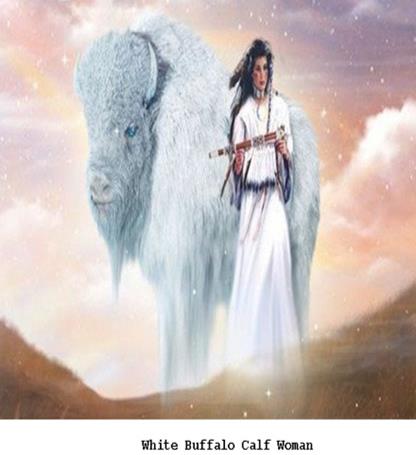
records Lakota history back to 900 AD when White Buffalo Calf Woman - Ptecincala Ska Wakan gave the Lakota people the White Buffalo Calf Pipe.
Crazy Horse
Page 25
Before the appearance of the Buffalo Calf Woman, the Native American honored only the disembodied Great Spirit. But for the Sioux, the coming of Buffalo Calf Woman brought a most important
Crazy Horse
Page 26
instrument, the pipe, which is now used in all ceremonies. This sacred pipe came into being many, many years ago.
The story begins when two men of the Sioux tribe were hunting and they saw something approaching in the distance. As the figure grew close, they observed a maiden, attired in white buckskin, carrying a bundle wrapped in buffalo hide.
As she walked slowly toward them she sang out and repeated;
“Behold me. For in a sacred manner I am walking.”
One of the men had evil thoughts about this maiden and moved towards her. The other Sioux tried forcibly to restrain him, but the evil warrior pushed the good warrior away. A cloud descended and engulfed the evil one, and when it lifted, his body was a skeleton being devoured by worms, symbolizing that one who lives in ignorance and has evil in their hearts may be destroyed by their own actions.
Page 27
The good warrior knelt in fear, trembling as the buckskin clad maiden approached. She spoke to him, telling him to fear not and to return to his people and prepare them for her coming. The warrior did so, and the maiden appeared, walking among them in a sunwise (clockwise) direction.
She held forth her bundle and said; “In this bundle is a sacred pipe, which must always be treated in a holy way. No impure man or woman should ever see it. With this sacred pipe you will send your voices to Wakan Tanka, the Great Spirit, Creator of All, your Father and Grandfather. With this sacred pipe you will walk upon the Earth, which is your Grandmother and Mother. All your steps should be holy. The bowl of the pipe is red stone, which represents the earth. A buffalo calf is carved in the stone facing the center and symbolizes the four legged creatures who live as brothers among you. The stem is wood and represents all growing things. Twelve feathers hang from where the stem fits the bowl, from the Spotted Eagle. These represent all the winged brothers who live among you. All these things are joined to you who will smoke the pipe and send voices to Wakan Tanka. When you use this pipe to pray, you will pray for and with everything.
The sacred pipe binds you to all your relatives, your grandfather and father, your grandmother and mother. The red stone represents the Mother Earth on which you will live. The
Page 28
Earth is red, and the two leggeds who live upon it are also red.
Wakan Tanka has given you a red road, a good and straight road to travel. And you must remember that all people who stand on this earth are sacred. From this day, the sacred pipe will stand on the red earth, and you will send your voices to Wakan Tanka.
There are seven circles on the stone, which represent the seven rites in which you will use the pipe.”
The White Buffalo Calf Woman then instructed the people to send messengers to the different bands of the Sioux nation, to bring in the leaders, the medicine people, and the holy ones. When the people gathered, she instructed them in the sacred ceremonies.
She told them of the first rite, the Keeping of the Soul. She told them that the remaining six rites would be revealed to them through visions. As she prepared to leave she said; “Remember how sacred the pipe is, and treat it in a sacred manner, for it will be with you always. Remember also that in me are four ages.
I shall leave you know, but shall look upon you in every age, and will return in the end.”
The Sioux begged the woman to stay among them. They promised to build a fine lodge and let her select a warrior to provide for her, but she declined their offer.
Page 29
She replied; “No, the Creator above, the Great Spirit, is happy with you, you the grandchildren. You have listened well to my teachings. Now I must return to the spirit world.”
She walked some distance away from them and sat down. When she arose, she had become a white buffalo calf. She walked farther, bowed to the four quarters of the universe, and then disappeared into the distance. Her sacred bundle was left with the people.
To this day, a Sioux family, the "Keepers of the Sacred Bundle,"
still guards the bundle and its contents on one of the Sioux reservations. Today, other ceremonies have supplanted some of the original seven ceremonies taught through the Buffalo Calf Woman. The Sun Dance, Sweat Lodge and Vision Quest are still major ceremonies that are widely practiced. The Pipe Ceremony itself is now used to open gatherings, meetings, and sweat lodges. The Pipe Ceremony is used in naming ceremonies, in which one is given an Earth or Native American name. It is also used in Native American marriage ceremonies.
Crazy Horse
Page 30
In times of religious persecution, the visible ceremonies had to go underground. Sweat lodges, which were common around most lodges and tipis in the early reservation days, started to disappear when Christian missionaries began to entrench their power with governmental authorities. The pipe was much easier to hide. Sioux spirituality thus came to depend for its secret expression upon the pipe. Now that Native Americans have won back their religious freedom, the Pipe Ceremony remains established.
Crazy Horse
Page 31
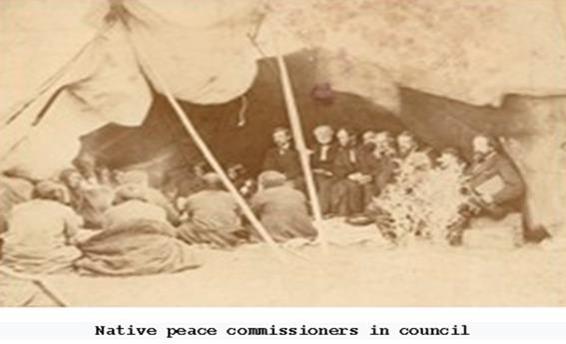
The Buffalo Calf Woman told the Sioux where to find the sacred red stone to make the peace pipe. In the pipestone quarries in southwestern Minnesota, near the town of Pipestone, the Sioux and all other Native American nations dug for their red stone in peace. They also traveled to and from the quarries in peace. No warfare was allowed. Peace councils were often held in this place.
Page 32
Mother Earth is now in grave danger. Why not turn to ceremony, at least to get the feeling, the message that Mother Earth must live? She is speaking to us quite strongly already. Let Her speak also in ceremony. We can gain a special resolve by communicating within the ceremonies. By listening to nature through nature based ceremonies, we can live, and our planet can not only survive, but thrive.
The Seven Sacred Rites
The seven traditional rituals use the sacred pipe in accordance with the Buffalo Calf Woman’s teachings; 1. The Keeping of the Soul
2. Inipi - The Sweat Lodge Ceremony or Rite of Purification 3. Hanblecheyapi - Vision Quest
4. Wiwanyag Wachipi - The Sun Dance Ceremony 5. Hunkapi - Making Relatives
6. Ishnata Awicalowan - Preparing a Girl for Womanhood 7. Tapa Wanka Yap - Throwing the Ball Around 1730 Cheyenne people introduced the Lakota to horses, which they called šuŋkawakaŋ - dog of power/mystery/wonder.
After they adopted horse culture, Lakota society centered on the buffalo hunt on horseback. The total population of the Sioux; Lakota, Santee, Yankton, and Yanktonai was estimated at 28,000
Page 33
in 1660 by French explorers. The Lakota population was estimated at 8,500 in 1805. It grew steadily and reached 16,110 in 1881, one of the few Native American tribes to increase in population in the 19th century. The number of Lakota has increased to more than 170,000 in 2010, of whom about 2,000 still speak the Lakota language - Lakȟótiyapi.
After 1720, the Lakota branch of the Seven Council Fires split into two major sects, the Saône, who moved to the Lake Traverse area on the South Dakota – North Dakota – Minnesota border, and the Oglála-Sičháŋǧu, who occupied the James River valley.
However, by about 1750 the Saône had moved to the east bank of the Missouri River, followed ten years later by the Oglála and Brulé - Sičháŋǧu.
The large and powerful Arikara, Mandan, and Hidatsa villages had long prevented the Lakota from crossing Missouri. However, the great smallpox epidemic of 1772–1780 destroyed three quarters of these tribes. The Lakota crossed the river into the drier, short grass prairies of the High Plains. These newcomers were the Saône, well mounted and increasingly confident, who spread out quickly. In 1765, a Saône exploring and raiding party led by Chief Standing Bear discovered the Black Hills - the Paha Sapa, then the territory of the Cheyenne. Ten years later, the Oglála and Brulé also crossed the Missouri. Under pressure from the
Crazy Horse
Page 34
Lakota, the Cheyenne moved west to the Powder River country. The Lakota made the Black Hills their home.
Initial United States contact with the Lakota during the Lewis and Clark Expedition of 1804–1806 was marked by a standoff.
Lakota bands refused to allow the explorers to continue upstream, and the expedition prepared for battle, which never came.
Some bands of Lakota became the first indigenous people to help the United States Army in an inter-tribal war west of the Missouri, during the Arikara War in 1823. This may be just a technical footnote, as disloyal Lakotas had co-operated with, if in fact not “aided” US troops since the days of Crazy Horse and Sitting Bull.
Crazy Horse
Page 35
In 1843, the southern Lakota attacked Pawnee Chief Blue Coat's village near the Loup in Nebraska, killing many and burning half of the earth lodges. Next time the Lakota inflicted a blow so severe to the Pawnee would be in 1873, during the Massacre Canyon battle near Republican River.
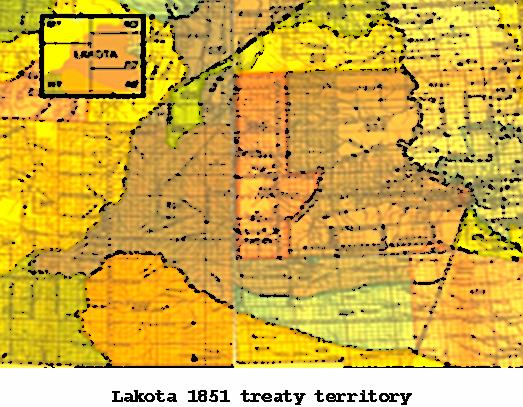
After the United States had built Fort Laramie without permission on Lakota land, it negotiated the Fort Laramie Treaty of 1851 to protect European-American travelers on the Oregon Trail. The Cheyenne and Lakota had previously attacked emigrant parties in a competition for resources, and also because some settlers had encroached on their lands. The Fort Laramie Treaty acknowledged Lakota sovereignty over the Great Plains in
Page 36
exchange for free passage for European Americans on the Oregon Trail for "as long as the river flows and the eagle flies."
The US government did not previously enforce the treaty restriction against unauthorized settlement, and Lakota and other bands attacked settlers and even emigrant trains as part of their resistance to this encroachment, resulting in public pressure on the US Army to punish them. However, on September 3, 1855, 700 soldiers under US Brevet Major General William S.
Harney avenged the Grattan massacre by attacking a Lakota village in Nebraska, killing about 100 men, women, and children.
A series of short "wars" followed, and in 1862–1864, as Native American refugees from the "Dakota War of 1862" in Minnesota fled west to their allies in Montana and Dakota Territory.
Increasing illegal settlement after the American Civil War resulted in war on the Plains again.
This was the world Crazy Horse saw and experienced during his early years.
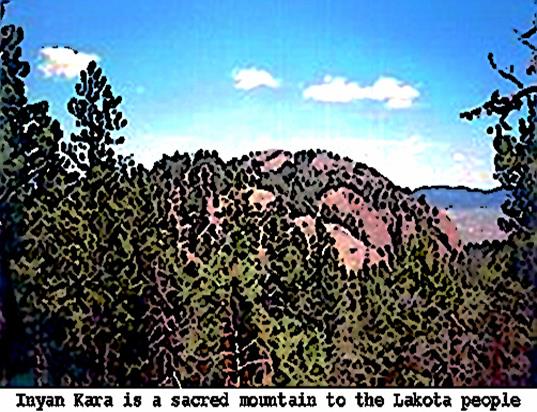
The Black Hills were considered sacred by the Lakota, and they objected to mining. Between 1866 and 1868 the US Army fought the Lakota and their allies along the Bozeman Trail over US forts built to protect miners traveling along the trail. Oglala Chief Red Cloud led his people to victory in Red Cloud's War. In 1868,
Page 37
the United States signed the Fort Laramie Treaty of 1868, exempting the Black Hills from all White settlement forever.
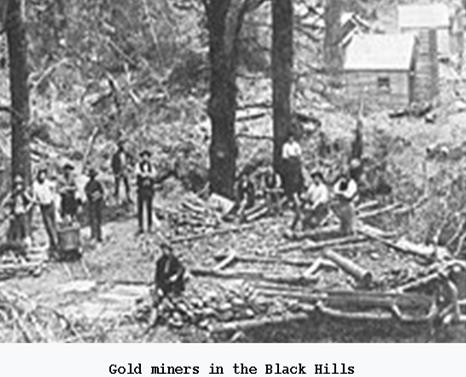
Four years later gold was discovered there, and prospectors descended on the area.
The attacks on settlers and miners were met by military force conducted by army commanders such as Lieutenant Colonel George Armstrong Custer. General Philip Sheridan encouraged his troops to hunt and kill the buffalo as a means of "destroying the Native Americans' commissary."
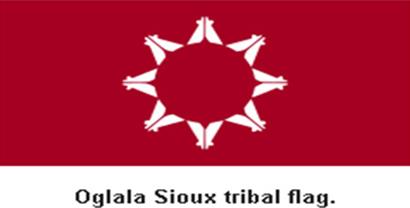
The allied Lakota and Arapaho bands and the unified Northern Cheyenne were involved in much of the warfare after 1860. They fought a successful delaying action against General George Crook's army at the Battle of the Rosebud, preventing Crook from locating and attacking their camp. A week later in 1876 they defeated the US 7th Cavalry in at the Battle of the Greasy Grass at the Crow Native American Reservation. Custer attacked a camp of several tribes, much larger than he realized. Their combined forces, led by Chief Crazy Horse, killed 258 soldiers, wiping out the entire Custer battalion in the Battle of the Little Bighorn, and inflicting more than 50% casualties on the regiment.
Crazy Horse
Page 38
The Lakota and their allies did not get to enjoy their victory over the US Army for long. The US Congress authorized funds to expand the army by 2,500 men. The reinforced US Army defeated the Lakota bands in a series of battles, finally ending the Great Sioux War in 1877. The Lakota were eventually confined to reservations, prevented from hunting buffalo beyond those territories, and were forced to accept government food distribution.
In 1877, some of the Lakota bands signed a treaty that ceded the Black Hills to the United States; however, the nature of this treaty and its passage were controversial. The number of Lakota leaders who backed the treaty is highly disputed, though clear
Page 39
objections were registered only by Crazy Horse and Sitting Bull.
Crazy Horse died of a knife wound that same year, inflicted while in US Army custody and “guarded” by a Lakota-in-name-only employee of the US Army. Low intensity conflicts continued in the Black Hills.
Fourteen years later on December 15, 1890, Sitting Bull was killed at Standing Rock reservation. The Native Americans’
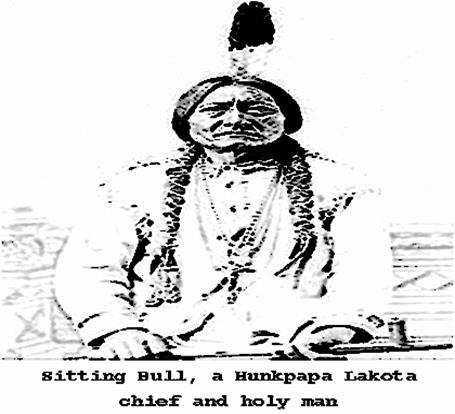
Little Bighorn victory celebrations were short lived. Public shock and outrage at Custer's defeat and death, as well as the government's understanding of the military capability of the remaining Sioux, led the War Department to assign thousands more soldiers to the area. Over the next year, the new American military forces pursued the Lakota, forcing many of the Native Americans to surrender. Sitting Bull refused to do so and in May 1877 led his band across the border into the North-West Territories, Canada. He remained in exile for four years near Wood Mountain, refusing the promise of a pardon and the chance to return. When crossing the border into Canadian territory, Sitting Bull was met by the Mounties of the region, who advised him that they were now on British soil and must obey British law. Mounty leader Walsh emphasized that he enforced the law equally and that every person in the territory had a right to
Crazy Horse
Page 40
justice. Walsh became an advocate for Sitting Bull and the two became good friends for the remainder of their lives.
While in Canada, Sitting Bull also met with Crowfoot, who was a leader of the Blackfeet, long time powerful enemies of the Lakota and Cheyenne. Sitting Bull wished to make peace with the Blackfeet Nation and Crowfoot. As an advocate for peace himself, Crowfoot eagerly accepted the tobacco peace offering.
Page 41
Sitting Bull and his people stayed in Canada for four years. Due to the smaller size of the buffalo herds in Canada, Sitting Bull and his men found it difficult to find enough food to feed their starving people. Sitting Bull's presence in the country led to increased tensions between the Canadian and the United States governments. Before Sitting Bull left Canada, he may have visited Walsh for a final time and left a ceremonial headdress as a memento.
It was hunger and desperation which eventually forced Sitting Bull and 186 of his family and followers to return to the United States and surrender on July 19, 1881. Sitting Bull had his young son Crow Foot surrender his Winchester lever action carbine to Major David H. Brotherton, commanding officer of Fort Buford. Sitting Bull said to Brotherton; "I wish it to be remembered that I was the last man of my tribe to surrender my rifle." Two weeks later Sitting Bull and his band were transferred to Fort Yates, the military post located adjacent to the Standing Rock Agency. This reservation straddles the present day boundary between North and South Dakota.
Sitting Bull and his band of 186 people were kept separate from the other Hunkpapa gathered at the agency. Army officials were concerned that he would stir up trouble among the recently surrendered northern bands. The military decided to transfer
Page 42
Sitting Bull and his band to Fort Randall to be held as prisoners of war. Loaded onto a steamboat, the band of 172
people was sent down the Missouri River to Fort Randall, near present day Pickstown, South Dakota, on the southern border of the state. There they spent the next twenty months. They were allowed to return north to the Standing Rock Agency in May 1883.
In 1884 show promoter Alvaren Allen asked Agent James McLaughlin to allow Sitting Bull to tour parts of Canada and the northern United States. The show was called the "Sitting Bull Connection." It was during this tour that Sitting Bull met and befriended Annie Oakley. Sitting Bull felt that she was "gifted"
by supernatural means in order to shoot so accurately with both hands. As a result of his esteem, he symbolically "adopted" her as a daughter in 1884. He named her "Little Sure Shot;" a name that Oakley used throughout her career.
In 1885, Sitting Bull was allowed to leave the reservation to go Wild Westing with Buffalo Bill Cody's “Buffalo Bill's Wild West.” He earned a decent salary and it is rumored that he cursed his audiences in his Native tongue during the shows.
Sitting Bull stayed with the show for four months before returning home. During that time, audiences considered him a
Page 43
celebrity and romanticized him as a warrior. He earned a small fortune by charging for his autograph and picture.
Sitting Bull returned to the Standing Rock Agency. The tension between Sitting Bull and Agent McLaughlin increased and each became warier of the other over several issues including division and sale of parts of the Great Sioux Reservation. In 1889, during a time of harsh winters and long droughts impacting the Sioux Reservation, a Paiute Native American named Wovoka spread a religious movement from Nevada eastward to the Plains that preached a resurrection of the Native. It was known as the
"Ghost Dance Movement" because it called on the Native Americans to dance and chant for the rising up of deceased relatives and the return of the buffalo. The dance included shirts that were said to stop bullets. When the movement reached Standing Rock, Sitting Bull allowed the dancers to gather at his camp. Although he did not appear to participate in the dancing, he was viewed as a key instigator. Alarm spread to nearby White settlements.
James McLaughlin, the US Native American agent at Fort Yates on Standing Rock Agency, feared that the Lakota leader was about to flee the reservation with the Ghost Dancers, so he ordered the police to arrest him. On December 14, 1890, McLaughlin drafted a letter to Lieutenant Henry Bullhead, a Native American agency policeman, that included instructions and a plan to capture
Page 44
Sitting Bull. The plan called for the arrest to take place at dawn on December 15 and advised the use of a light spring wagon to facilitate removal before his followers could rally. Bullhead decided against using the wagon. He intended to have the police officers force Sitting Bull to mount a horse immediately after the arrest.
Like an FBI operation, around 5:30 AM on December 15, 39 police officers and four volunteers approached Sitting Bull's house.
They surrounded the house, knocked and entered. Bullhead told Sitting Bull that he was under arrest and led him outside.
Sitting Bull and his wife noisily stalled for time, and the camp awakened and men converged at the house. As Bullhead ordered Sitting Bull to mount a horse, he said that the Native American Affairs agent wanted to see the chief, and that Sitting Bull could then return to his house. That wasn’t even an adequate lie, never mind good. When Sitting Bull refused to comply, the police used force on him. The Sioux in the village were enraged.
Catch-the-Bear, a Lakota, shouldered his rifle and shot Bullhead, who reacted by firing his revolver into the chest of Sitting Bull. Another police officer, Red Tomahawk, shot Sitting Bull in the head, and Sitting Bull dropped to the ground.
Sitting Bull died between 12 and 1 PM.
Page 45
The US Army attacked Spotted Elk’s, A/K/A Bigfoot Mnicoujou band of Lakota on December 29, 1890, at Pine Ridge, killing at least 153 Lakota. The tribal estimates are higher; including numerous women and children, in the Wounded Knee Massacre.
Today, the Lakota are found mostly in the five reservations of western South Dakota;
Pine Ridge Native American Reservation, home of the Oglála, the most numerous of the Lakota bands.
Rosebud Native American Reservation, home of the Upper Sičhánǧu or Brulé.
Lower Brule Native American Reservation, home of the Lower Sičhaŋǧu.
Cheyenne River Native American Reservation, home of several other of the seven Lakota bands, including the Mnikȟówožu, Itázipčho, Sihásapa, and Oóhenumpa.
Standing Rock Native American Reservation, home of the Húŋkpapȟa and to people from many other bands.
Lakota also live on the Fort Peck Native American Reservation in northeastern Montana, the Fort Berthold Native American Reservation of northwestern North Dakota, and several small
Crazy Horse
Page 46
reserves in Saskatchewan and Manitoba. During the Minnesota and Black Hills wars, their ancestors fled for refuge to
"Grandmother's A/K/A Queen Victoria's Land" - Canada.
Large numbers of Lakota live in Rapid City and other towns in the Black Hills, and in metro Denver. Lakota elders joined the Unrepresented Nations and Peoples Organization (UNPO) to seek protection and recognition for their cultural and land rights.
.
The Holy Land – The Black Hills
The Black Hills is currently an isolated mountain range rising from the Great Plains of North America in western South Dakota and extending into Wyoming, United States.
Page 47
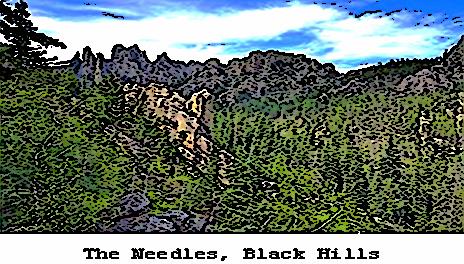
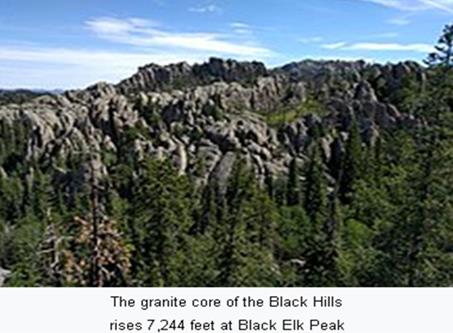
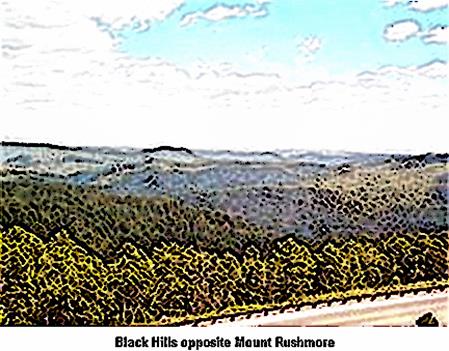
Black Elk Peak, formerly known as Harney Peak, which rises to 7,244 feet, is the range's highest summit. The Black Hills encompass the Black Hills National Forest. The name of the hills in Lakota is Pahá Sápa. The Black Hills are considered a holy site by them. The hills are so called because of their dark appearance from a distance, as they are covered in evergreen trees. Ostensibly some pundits think that green means dark at a distance. Native Americans have a long history in the Black Hills and all consider it a sacred site. After conquering and chasing out the Cheyenne in 1776, the Lakota took the territory of the Black Hills, which became central to their culture. In 1868, the US government signed the “Fort Laramie Treaty of 1868,” establishing the Great Sioux Reservation west of the Missouri River, and exempting the Black Hills from all White settlement forever. However, when settlers discovered gold there in 1874, as a result of George Armstrong Custer's Black Hills expedition, miners swept into the area in a gold rush. The US
government took the Black Hills and forcibly relocated the Lakota, following the Great Sioux War of 1876, to five smaller reservations in western South Dakota, selling off nine million acres of their former land. Unlike most of South Dakota, the Black Hills were settled by European Americans primarily from population centers to the west and south of the region, as
Page 48
miners flocked there from earlier gold boom locations in Colorado and Montana.
As the economy of the Black Hills has shifted away from natural resources like mining and timber since the late 20th century, the hospitality and tourism industries have grown to take its place. Locals tend to divide the Black Hills into two areas;
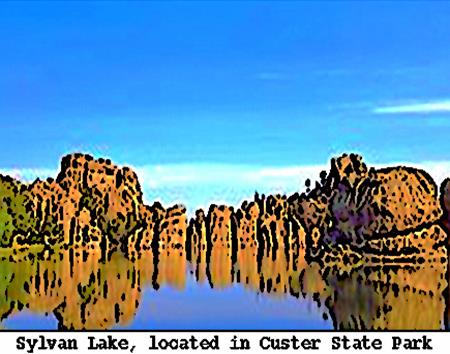
"The Southern Hills" and "The Northern Hills." The Southern Hills is home to Mount Rushmore, Wind Cave National Park, Jewel Cave National Monument, Black Elk Peak, the highest point in the United States east of the Rockies, formerly and still more commonly known as Harney Peak, Custer State Park, the largest state park in South Dakota, the Crazy Horse Memorial, and The Mammoth Site in Hot Springs, the world's largest mammoth research facility.
Attractions in the Northern Hills include Spearfish Canyon, historic Deadwood, and the Sturgis Motorcycle Rally, held each August. The first Rally was held on August 14, 1938, and the 75th Rally in 2015 saw more than one million bikers visit the Black Hills. Devils Tower National Monument, located in the Wyoming Black Hills, is an important nearby attraction and was the United States' first national monument.
Crazy Horse
Page 49
Although the written history of the region begins with the Sioux domination of the land over the Native Arikara tribes, researchers have carbon dating and stratigraphic records to analyze the early history of the area. Scientists have been able to utilize carbon dating to evaluate the age of tools found in
Crazy Horse
Page 50
the area, which indicate a human presence that dates as far back as 11,500 BC with the Clovis culture.
The Arikara arrived by 1500 AD, followed by the Cheyenne, Crow, Kiowa and Arapaho. The Lakota, also known as Sioux, arrived from Minnesota in the 18th century and drove out the other tribes, who moved west. They claimed the land, which they called Ȟe Sápa
- Black Mountains. The mountains commonly became known as the Black Hills.
François and Louis de La Vérendrye probably traveled near the Black Hills in 1743. Fur trappers and traders had some dealings with the Native Americans.
Page 51
European Americans increasingly encroached on Lakota territory.
In order to secure safe passage of settlers on the Oregon Trail, and to end inter-tribal warfare, the United States government proposed the “Fort Laramie Treaty of 1868,” which established the Great Sioux Reservation west of the Missouri River and acknowledged Native American control of the Black Hills. The treaty protected the Black Hills "forever" from European-American settlement. Both the Sioux and Cheyenne claimed rights to the land, saying that their cultures considered it the axis mundi, or sacred center of the world.
Although rumors of gold in the Black Hills had circulated for decades, confirmation of the deposits came first in 1874, when Brevet Major General George Armstrong Custer of the 7th US
Cavalry led an expedition there and discovered gold in French Creek. An official announcement of gold was made by the newspaper reporters accompanying the expedition. The following year, the Newton-Jenney Party conducted the first detailed survey of the Black Hills. The surveyor for the party, Dr.
Valentine McGillycuddy, became the first European American to ascend to the top of Black Elk Peak. This highest point in the Black Hills is 7,242 feet above sea level.
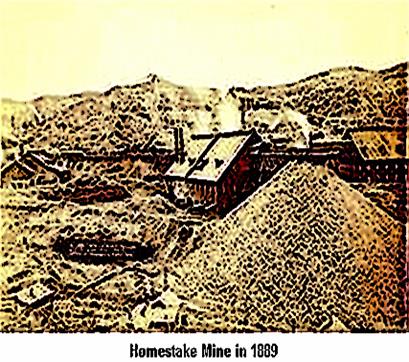
During the 1875–1878 gold rush thousands of miners went to the Black Hills. In 1880, the area was the most densely populated
Crazy Horse
Page 52
part of the Dakota Territory. Three large towns developed in the Northern Hills; Deadwood, Central City, and Lead. Around these clustered groups of smaller gold camps, towns, and villages.
Hill City and Custer City sprang up in the Southern Hills.
Railroads were quickly constructed to the previously remote area. From 1880 onwards the gold mines yielded about $4,000,000
annually, and the silver mines about $3,000,000 annually.
The conflict over control of the region sparked the Black Hills War in 1876, also known as the Great Sioux War, the last major Native American War on the Great Plains. Following the defeat of the Lakota and their Cheyenne and Arapaho allies in 1876, the
Page 53
United States took control of the Black Hills. Despite their forced relocations and excepting some Lakota flunkies happy to be put on the US Army payroll, the Lakota people never accepted the validity of the US appropriation. They have continued to try to reclaim the property.
On July 23, 1980, in United States v. Sioux Nation of Native Americans, the Supreme Court of the United States ruled that the Black Hills were illegally taken by the federal government and ordered remuneration of the initial offering price plus interest, nearly $106 million. The Lakota refused the settlement, as they wanted the Black Hills returned to them. The money remains in an interest bearing account, which, as of 2015, amounts to over $1.2 billion, but the Lakota still refuse to take the money, thereby rejecting any amount of cash
“reparations” as inherently inadequate. Crazy Horse would have been proud of them. They believe that accepting the settlement would allow the US government to justify taking ownership of the Black Hills.
Crazy Horse
Page 54
Page 55
Wildlife is both diverse and plentiful. Black Hills creeks are known for their trout, while the forests and grasslands offer good habitat for American bison, white tailed and mule deer, pronghorn, bighorn sheep, mountain lions, and a variety of smaller animals, like prairie dogs, American martens, American red squirrels, Northern flying squirrels, yellow bellied marmots, and fox squirrels. Biologically, the Black Hills is a meeting and mixing place, with species common to regions to the east, west, north, and south. Some endemics are Cooper's Rocky Mountain snail, Black Hills subspecies of red bellied snake, and a Black Hills subspecies of southern red backed vole. Some birds that are only in the Black Hills and not the rest of South Dakota are pinyon jay, Canada jay, three toed woodpecker, black backed woodpecker, American dipper, ruffed grouse, and others.
The northern Black Hills approximate Lawrence and Meade Counties and are roughly equivalent to the Northern Hills District of the Black Hills National Forest. The central Black Hills, the Mystic District of the Black Hills National Forest, are located in Pennington County west of Rapid City. The southern Black Hills are in Custer and Fall River Counties and are administered in the national forest's Hell Canyon District. Finally, Wyoming's Black Hills follow the Bearlodge District, approximately Weston and Crook Counties.
Crazy Horse
Page 56
Crazy Horse
Page 57
Page 58
3 – Visions of Crazy Horse
Crazy Horse was not completely orthodox with regard to his tribe’s customs, shrugging off many of the traditions and rituals that the Sioux practiced. However, for the most part, his “personal shortcuts and disregards” led to beliefs and customs which mirrored theirs.
In 1854, Crazy Horse rode off into the prairies for a vision quest, purposefully ignoring the required rituals. The accounts of this first vision differ slightly, likely because none of them were related by Crazy Horse directly.
Fasting for two days, Crazy Horse had a vision of an unadorned horseman who directed him to present himself in the same way, with no more than one feather and never a war bonnet. He was also told to toss dust over his horse before entering battle and to place a stone behind his ear and was directed to never take anything for himself.
Crazy Horse followed these instructions until his death.
Crazy Horse lived in a Lakota camp in present day Wyoming. In 1854, when he was 13-14, the camp was entered by Lieutenant John Lawrence Grattan and 29 other US troopers, who intended to arrest a Miniconjou man for having stolen a cow. The cow had
Page 59
wandered into the camp, and after a short time someone butchered it and passed the meat out among the people. When the soldiers fatally shot Chief Conquering Bear, the Lakota returned fire, killing all 30 soldiers and a civilian interpreter in what was later called the Grattan massacre.
After witnessing the death of Conquering Bear at the Grattan massacre, Crazy Horse began to get trance visions. Curly went out on a vision quest to seek guidance but without going through the traditional procedures first. In his vision, a warrior on his horse rode out of a lake and the horse seemed to float and dance throughout the vision. He wore simple clothing, no face paint, his hair down with just one feather in it, and a small brown stone behind his ear. Bullets and arrows flew around him as he charged forward, but neither he nor his horse was hit. A thunderstorm came over the warrior, and his people grabbed hold of his arms trying to hold him back. The warrior broke their hold and then lightning struck him, leaving a lightning symbol on his cheek, and white marks like hailstones appeared on his body. The warrior told Curly that as long he dressed modestly, his tribesmen would not touch him; and if he did not take any scalps or war trophies, then he would not be harmed in battle.
As the vision ended, he heard a red tailed hawk shrieking off in the distance. Curly’s father later interpreted the vision and
Page 60
said that the warrior was going to be him. The lightning bolt on his cheek and the hailstones on his body were to become his war paint. Curly was to follow the warrior’s role to dress modestly and to do as the warrior's prophecy said so he would be unharmed in battle. For the most part, the vision proved to be true and Crazy Horse was rarely harmed in battle, except for when he was struck by an arrow after taking two enemy scalps.
His father Waglula took him to what today is Sylvan Lake, South Dakota, where they both sat to do a hemblecha or vision quest. A red tailed hawk led them to their respective spots in the hills; as the trees are tall in the Black Hills, they could not always see where they were going. Crazy Horse sat between two humps at the top of a hill north and to the east of the lake. Waglula sat south of Black Elk Peak but north of his son.
Crazy Horse's vision first took him to the South where, in Lakota spirituality, one goes upon death. He was brought back and was taken to the West in the direction of the wakiyans -
thunder beings. He was given a medicine bundle to protect him for life. One of his animal protectors would be the white owl which, according to Lakota spirituality, would give extended life. He was also shown his "face paint" for battle, to consist of a yellow lightning bolt down the left side of his face, and white powder. He would wet this and put marks over his
Page 61
vulnerable areas. When dried, the marks looked like hailstones.
His face paint was similar to that of his father, who used a red lightning strike down the right side of his face and three red hailstones on his forehead. Crazy Horse put no makeup on his forehead and did not wear a war bonnet. Lastly, he was given a sacred song that is still sung by the Oglala people today and he was told he would be a protector of his people.
Black Elk, a contemporary and cousin of Crazy Horse, related the vision in “Black Elk Speaks: Being the Life Story of a Holy Man of the Oglala Sioux,” from talks with John G. Neihardt; ”When I was a man, my father told me something about that vision. Of course he did not know all of it, but he said that Crazy Horse dreamed and went into the world where there is nothing but the spirits of all things. That is the real world that is behind this one, and everything we see here is something like a shadow from that world. He was on his horse in that world, and the horse and himself on it and the trees and the grass and the stones and everything were made of spirit, and nothing was hard, and everything seemed to float. His horse was standing still there, and yet it danced around like a horse made only of shadow, and that is how he got his name, which does not mean that his horse was crazy or wild, but that in his vision it danced around in that strange way. It was this vision that gave
Page 62
him his great power, for when he went into a fight, he had only to think of that world to be in it again so that he could go through anything and not be hurt. Until he was killed in surrender at the Soldiers' Town on White River, he was wounded only twice, once by accident and both times by one of his own people when he was not expecting trouble and was not thinking; never by an enemy.
Crazy Horse received a black stone from a medicine man named Horn Chips to protect his horse, a black and white pinto he named Inyan - Rock or Stone. He placed the stone behind the horse's ear so that the medicine from his vision quest and Horn Chips would combine. He and his horse would be one in battle.”
The more accepted, though not necessarily the more accurate account, however, is that “Horn Chips” gave Crazy Horse a sacred stone that protected him from bullets. Subsequently, Crazy Horse was never wounded by a bullet. In addition, "Horn Chips" is not the correct name of this medicine man, though it has become a repeated error since its first publication in 1982. His Lakota name was Woptura, and he was given the name "Chips" by the US
government and was referred to as “Old Man Chips.” “Horn Chips”
was one of his sons, who was also known as “Charles Chips.”
Final Vision
Page 63
The prophetic Lakota leader’s final days still haunt today.
There were too many tongues. Crazy Horse sought quiet on solitary walks on the prairie, away from his village. On one of these walks, toward the end of his life on this plane, around age 36, he chanced upon a dead eagle, and it deeply disturbed him. Crazy Horse returned to his lodge and sat in silence for several hours. The war chief was often immersed in his own thoughts, but those close to him sensed something was different.
When asked what troubled him, Crazy Horse’s answer was startling. He said he’d found his dead body on the prairie.
A short time after this incident, Crazy Horse experienced a terrifying dream. In the dream, he rode a white pony on an elevated plain. On all sides were enemies and even cannons.
Crazy Horse said he was killed in this dream, but how he met his fate he didn’t know. All he knew was that he didn’t die from a bullet. For a man guided by visions and dreams, this powerful nightmare could only be a foreboding.
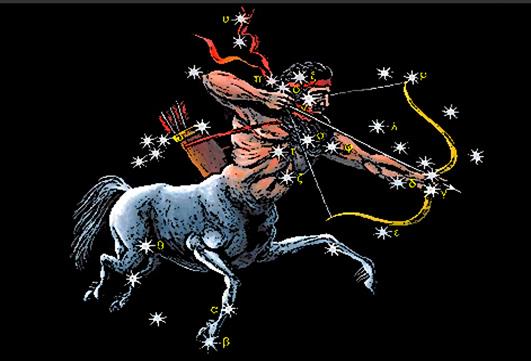
A Sagittarian
Though there is much dispute over the year of Crazy Horse’s birth, curiously there is no argument over his being a Sagittarian, one source spouting December 4 as the special day.
It seems fitting. One doesn’t have to be a believer in astrology
Crazy Horse
Page 64
to see that his characteristics match that of his sign extraordinarily well. Coincidence? One does not have to be a prior believer in astrology to make note of the uncanny parallels.
Sagittarius Traits and Overview
Sagittarius Dates: Nov 22 to Dec 21
Symbol: The Centaur - Archer
Mode and Element: Mutable fire
Page 65
Ruling Planet: Jupiter
House: Ninth
Mantra: “I see.”
Appearance / Body Parts: Hips, thighs, and liver Colors: Maroon and Navy blue
Tarot Card: Temperance
Meaning of Sagittarius Rising Sign
Sagittarius rising means that Sagittarius was the zodiac sign that was on the eastern horizon at the time of one’s birth. As a Sagittarius rising, one is the adventurer of the zodiac. This ascendant sign is always looking for new experiences with unabashed enthusiasm and hope for the future. They are free spirits, demanding their own personal freedom wherever they go and granting it to all they encounter.
Sagittarius, the ninth sign of the zodiac, is the home of the wanderers of the zodiac. It’s not a mindless ramble for these folks, either. Sagittarians are truth seekers, and the best way for them to do this is to hit the road, talk to others and get some answers.
Page 66
Knowledge is key to these folks since it fuels their broad minded approach to life. Those born with a Sagittarius zodiac sign are keenly interested in philosophy and religion, and they find that these disciplines aid their internal quest. At the end of the day, what Sagittarius wants most is to know the meaning of life, and to accomplish this while feeling free and easy.
If you think that this Sagittarian section has indicated any divergences from the nature of Crazy Horse, you might do well to reserve judgement until you read further.
Sagittarius Symbolism and Myth
The Sagittarius zodiac symbol of the Centaur is based on the Greek mythological association with Chiron, the great teacher of music, medicine, hunting, and prophecy. Chiron healed the hero Achilles and mentored him in archery and many other great arts when he cared for him as a child. Achilles later grew to be victorious in the Trojan War, likely having learned to be brave and clever while under the tutelage of this benevolent centaur.
Sagittarius’ connection to travel, higher knowledge, and truth seeking stem from the centaur race’s questing attributes, yet mostly from Chiron, who was the kindest, most generous and friendly to humans of them all. Being half human and half beast, the centaur/archer holds both an intelligent civilized side, and
Page 67
also an untamed, bestial nature, embodying a balance of primal instinct and wisdom.
Sagittarius Element, Mode, and Season In the western tropical zodiac, Sagittarius season begins on November 22, commencing at the end of the autumn in the Northern Hemisphere. It’s a time of year when the days have begun to get shorter, and the night begins to dominate. There is a feeling of change in the air as the last warm days of the fall begin to wane, and the hints of the oncoming cold, insular season of winter are beginning to take hold of the weather.
Mutable Mode
Sagittarius is the third of the four mutable signs of the zodiac, which all hold an elemental energy of change and adaptation at the transitional end of the four seasons.
Sagittarius’ fiery and mutable presence begins to clear the stage for the next seasonal performance and helps describe Sagittarius’ restless, change seeking, and adventurous nature.
Fire Element
Sagittarius’ element is fire, the lightest, brightest element, thought by ancient astrologers to be akin to the divine light of the stars and the vital, life giving rays of the sun.
Page 68
Sagittarian affinity for enthusiasm, truth seeking, authenticity, and at times brutal honesty, is kindled in the fire element.
Sagittarius Planetary Rulership - Domicile of Jupiter In classical astrology, Jupiter was assigned rulership of both Pisces and Sagittarius. Sagittarius was thought to be the diurnal/day home of Jupiter, an adaptive fire sign that allows Jupiter to be as expansive, affirming, and joyful as it likes to be when placed there.
Jupiter is the biggest planet in our solar system, reflecting the most amount of light from the sun. This is the reason why it was called the “greater beneficiary” and was recognized as having the greatest power to bestow luck and good fortune of all the seven visible planets.
This planetary rulership connection adds another layer to the natural qualities of Sagittarius, being the source of the sign’s affinity for optimism, friendliness, and enthusiasm. Those who are born with their sun placed in Sagittarius are big thinkers, truth seekers, and love to engage in philosophical inquiries and debates. Those born with Jupiter in its fiery home of Sagittarius tend to have a strong baseline of optimism to fall
Page 69
back on and may have luck when following their highest beliefs and values.
Detriment of Mercury
Sagittarius is in polarity with the mutable air sign Gemini.
Sagittarius likes to affirm, expand, and explore universal truths, where Gemini loves to analyze, preferring to focus on gathering small, fascinating details, using mischief to tease, prod, and disrupt. As a result, Mercury and its “mercurial” ways were traditionally thought to be in detriment, or at a bit of a disadvantage when placed opposite from its home in Sagittarius’
bold, brave, and unbounded world.
It’s a placement that the planet of communications and language would have to compensate for to be in, finding creative ways to think and get important messages across. The result is often a tangential way of speaking and writing since those with this placement take the long way around when expressing themselves.
With Jupiter’s influence, however, the focus of thought, speech, and learning is on understanding the unifying truths of life.
And while Mercury in this sign seems to take a long time to get to the point, there is always a grand idea and a big picture understanding in mind.
Page 70
Mercury in Sagittarius may challenge those born with this placement to edit and focus their awareness on one subject more deeply at a time, as they prefer to follow their curiosity to learn a little bit about a lot of topics.
Sagittarius House Rulership - The Ninth House In the modern astrology system of the Twelve Letter Alphabet, each zodiac sign rules one of the twelve houses in the birth chart. This innovation was created by psychological astrologers to match sign affinities to related house topics.
Sagittarius was assigned the ninth house of foreign travel, higher learning, and spirituality, since it’s questing, adventurous, and curious nature has an affinity for these topics. Since Sagittarius is ruled by Jupiter, this modern astrology system invites an ebullient, expansive sub-signature to the significance of the ninth house.
The Eleventh House
In classical astrology, Sagittarius’ planetary ruler, Jupiter, was said to find its “joy” in the eleventh house of “good spirit” in the birth chart. This house, associated with friends, alliances, hopes, and gifts is a natural, affirming, and happy place for Jupiter to be.
Page 71
Since Jupiter likes to expand and dissolve boundaries, this house speaks to the opportunities that are available to us when we feel connected to a community and receive encouragement, validation, and support. The eleventh house is associated with alliances we form and gifts we receive in our public or social roles, perhaps as an extension of our career activities.
Sagittarius Characteristics
Personality
Sagittarius’ traits are derived from its active, masculine, or yang qualities, making this sign oriented toward assertive engagement with the outer world. Alive in both a Sagittarius woman or Sagittarius man, those born with the centaur as their rising sun, or moon sign have enthusiastic energy in their core personality; like the joyous, benevolent qualities of Jupiter.
As a mutable sign, the Centaur holds the power to be a change maker, giving those with prominent Sagittarius in their charts a natural affinity for adaptation, exploring the world, as well as teaching and practicing diverse forms of spiritual devotion and philosophy. Ruled by expansive Jupiter, Sagittarius Natives can be thought of as the “seekers” of the zodiac who like to expand their minds by seeking out new perspectives and experiences.
Crazy Horse
Page 72
Strengths
The primary strength of Sagittarius is their optimism. Being born with a bold, jovial disposition, Sagittarius Natives usually find it easy to feel happy, enthusiastic, and to see the bright side of life. Being influenced by Jupiter’s affirming and confident nature, Sagittarians rarely succumb to self-doubt and
Page 73
are usually able to propel themselves forward in life, believing that everything will work out for the best.
The Centaur’s thirst for travel and adventure takes on an epic significance, where they see their lives unfolding like the plot of a mythopoetic tale, always carrying them to the right place, at the right time. Since their lives are likely to be filled with fascinating experiences, they are typically wonderful storytellers and great teachers, weaving universal messages of truth and inspiration into their lessons and tales. Crazy Horse seems to be one who told his stories and did his teaching by example. However, it should be noted that outside of his participation in a few great events almost nothing is known of his day to day life.
Personal integrity is very dear to Sagittarians, and they will have a difficult time following the status quo or suffering what they feel to be false or inauthentic roles, ideas, or laws. When a Sagittarius feels moved by a cause, they’ll express what’s in their minds and hearts with great zeal and conviction.
Like their fire sign neighbors, you will always know where you stand with a Sagittarius, but since they aspire to a sense of higher philosophy and greater truth, they rarely hold a grudge or have time to be petty.
Page 74
Sagittarians are very unlikely to be possessive or materialistic since their lives prioritize being able to change, move, and adapt easily. Though they can be non-committal, they are also rarely jealous, extending the same freedoms to others that would also love to enjoy themselves.
Weaknesses
Some sources of weakness for Sagittarius are rooted in their great strengths. Being a mutable fire sign, Sagittarius will passionately state their opinions or principles in the moment, yet reserve the right to always change their mind, stating just as passionately their new views later on. This can be disorienting for others who were sure they knew their Sagittarian colleague’s position on a matter, giving them a reputation for being unpredictable, or at times unreliable.
Due to their adventurous spirit, and love of change and travel, Sagittarians are famously non-committal when it comes to plans, as they also reserve the right to change their agendas with their moods.
The Archer’s optimism is generally positive, and even infectious, but they can become so enamored with their ideals that they become very ungrounded and unrealistic, finding regular life and its limitations to be inconvenient as well as
Page 75
disappointing. Sagittarius children, especially, will benefit from guidance on how to add healthy structure and commitment to their lives and friendships, so that they grow up with a sense of support when they need it most.
In classical astrology, Jupiter is associated with wise teachers and kings, giving Natives from this sign a bold, authoritative way of speaking. This can verge on condescension, however, if they are not respectful of those they are communicating with, giving the other party the feeling of being spoken down to, or arrogantly dismissed. Like all fire signs, Sagittarius will have to manage their impulsivity, impatience, and short temper, which can present as the Centaur’s famous “brutal honesty”.
Sagittarius Life Purpose and Career Mantra and Purpose
The voice of optimism, enthusiasm, and thirst for adventure comes forward in the Sagittarius mantra; “I see.” The Archer’s sense of purpose is all about seeking the universal truths of life, and this sign will go to the very ends of the earth to
“see” and experience all that life has to offer for themselves.
Crazy Horse’s vision quests fit especially well here.
Page 76
We all have Sagittarius somewhere in our birth chart, so we can look to the house this sign rules to find the specific area of life we approach in an expansive, optimistic way, or where we need to call in the Centaur’s optimistic energy for mastery.
Sagittarius people tend to be drawn to any pursuit where they can grow on a spiritual level and teach others to do the same.
Traveling, motivating, public speaking, sharing knowledge, adventure, and enlightenment will provide Sagittarians an outlet for their adaptable, fiery energy.
Sagittarius at Work
Sagittarius’ sense of free spirited optimism and adventure makes them uniquely suited for professions where they are trailblazers of some kind, creating their own roles and opportunities in the world so they can earn a living with their diverse and eclectic interests. Their careers need to be challenging and dynamic enough to fulfill their adaptive natures. Sagittarius’ warmth and idealism will likely be their strong suit, so jobs in which they can teach, inspire, and work for a higher cause or purpose will be best.
This could manifest in many professions, but likely will not be found in staid, routine type jobs that require laboring over finicky details or analysis. Like all the fire signs,
Page 77
Sagittarius needs challenge, movement, and space, so will not be content for long in the same location unless of course, that location is in an exotic place!
Since Sagittarius is ruled by Jupiter, the planet of optimism, higher truths, and expansion, a natural vocational fit could potentially be found in activism. Any way that a Sagittarian Native can take an active role in inspiring positive change through personal example fulfills his destiny, as in the case of Crazy Horse.
Since Sagittarians lean toward activism and preserving integrity, and are often great advocates of the underdog, any facet of law could be fulfilling. Sagittarians can have great empathy for human struggle, often having to carve an unconventional path themselves in life. Jupiter is associated with justice and higher values, often guiding these folks toward realizing these ideals.
In classical astrology, Jupiter is connected to spirituality and spiritual teachers, also being associated with “gurus” in Vedic astrology, so being a spiritual leader of some kind would be an appealing, natural fit for Sagittarians. This could be within any belief system the Native is connected to, placing them in
Page 78
leadership roles in community churches, at the local yoga studio, or even in coaching.
Sagittarians tend to have a natural curiosity for, and a knack for languages and understanding what is written between the lines, so jobs in writing, storytelling, or even translation would be appropriate for the articulate and well-studied Centaur.
With a love of travel and adventure, Sagittarians could make excellent tour guides, where they can combine their social gifts for storytelling, higher knowledge of local culture, and love for nature in a dynamic and fun role.
As with all fire signs, Sagittarians have athletic leanings, so working in the fields of sport and movement may be appealing.
Though Centaurs love to be active, they may not be particularly status seeking, ambitious, or competitive; and may participate in sport for the joy and camaraderie and can make great team coaches, or even practitioners of sports medicine. Crazy Horse seemed especially consistent in never having demonstrated any interest in status, ambition, or competition; in the latter case, other than when he deemed it necessary to compete against armed others who sought to take away his and his people’s rights.
Page 79
Sagittarius Health
Constitution
In classical medical astrology, there were four temperments, which were connected to four vital fluids, and four essential constitution types. As a fire sign, Sagittarius is associated with a more moderate version of the choleric temperament, which was thought to be hot and dry, and connected the production of digestive bile.
Since Sagittarius is ruled by Jupiter, this gives Sagittarians an additional mix of the sanguine constitution, which is warm and moist, and prone to dissipation of energy and digestive gasses. Those born with Sagittarius rising, especially, may present the fiery physicality of an athletic body, who may tend to run hot physically and emotionally, making them vulnerable to restlessness, dehydration, and overheating.
Body Parts
In classical astrology medicine, the entire zodiac was mapped out on the human body, with Sagittarius ruling over the hips and thighs, and internally, the liver. As a result, those with Sagittarius may have strong legs but may need to protect
Page 80
themselves from strain or overuse of thigh muscles, bones, and hip flexors.
The liver is a very Jupiterian organ, being large and expansive, and ever regenerating, much like its planetary ruler, so it is a special organ of focus for this sign. It’s important that liver care is incorporated into the Centaur’s diet so that it does not become overburdened or toxic.
Sagittarius Natives need to keep their diets and exercise in balance with their love of celebrating life with good food and drink.
Herbal Allies
Dandelion root is a prime Sagittarius herbal ally, with its primary benefits being helpful, supportive, and healing for the liver. Loaded with antioxidants and anti-inflammatory properties, it is protective against cellular damage caused by free radicals in the system. Dandelion root supports digestion, reduces water retention, and helps cleanse excess fats from the liver. It can be moderately cooling and drying, helping to calm excess heat and moisture in the stomach and liver, as well as in the Sagittarian body system that tends to overheat.
Page 81
Lemon balm is another Sagittarius ally, with a calming fragrance and qualities that clear the liver and promote digestion. Being a Jupiterian herb, it tends to grow abundantly, and its tea and tinctures help calm the nervous system and stimulate the bile to help promote fat digestion and liver function.
It was said by classical physicians to “purge” melancholy, a state of dryness and coldness in the body that leads to stiffness and depression, so it can be used to emphasize warm and relaxed qualities where these are deficient.
Yellow dock is an example of another Jupiterian plant, whose leaves can be eaten in salads and carry much of the same minerals and vitamins as spinach. Yellow dock was said to be cooling, drying, and strengthening to the liver by Culpepper, who recommended its tea to cleanse and cure boils and infections of the sinuses and respiratory tract. Yellow dock contains constituents that have a stimulating and laxative effect on the bowels, which helps to ease constipation and to flush out an overburdened liver.
Esoteric Sagittarius
The Three Decans of Sagittarius
Page 82
Each of the twelve zodiac signs represents a thirty degree slice of a 360 degree band of constellations, circling the earth. The thirty degrees of each sign can be further subdivided into three ten degree decans, or faces, each with its own planetary sub-ruler placed around the zodiac in Chaldean order.
These faces can be used for timing magical rituals when seeking to evoke and harness Jupiter’s planetary power. In studying the Sagittarius personality, we can use the faces of Sagittarius to fine tune the flavor and nuance of planets or points placed within these decanic degrees.
First Decan of Sagittarius: Mercury Degrees 0 through 9 of Sagittarius are ruled by Mercury. This is the detriment of the messenger planet, making those with planets in the first decan very expansive and creative in their language use, but also highlights some potential struggles with intellectual focus and discipline.
In terms of personality, the first decan of Sagittarius can be more analytical and inclined toward gathering and sharing information than the other decans of Sagittarius. This makes them potentially great orators, storytellers, and teachers, but can also amplify their tendency to be overly enthusiastic and
Page 83
verbose when speaking. This gift may shine best in the classroom, or in roles of spiritual inspiration and motivation.
Second Decan of Sagittarius: Moon
Degrees 10 through 19 of Sagittarius are ruled by the moon, making those born with planets here more inclined toward emotional enthusiasm and impulsivity. The nurturing and caring qualities of the moon blend with the passionate and inspirational tendencies of Sagittarius to bring forward very bold expressive feelings as well as demonstrations of these. The changeable qualities of the moon blend with Sagittarius’ mutable fire, creating a potential for mood swings in those with planets in this decan. Crazy Horse showed this when in 1877, upon finding starvation conditions, capitulated to the US Army, only to reverse his course when he saw that the Army, supplemented by turncoat Lakotas-in-name-only on their payroll, equated capitulation with incarceration, after ling and promising only the former.
Third Decan of Sagittarius: Saturn
Degrees 20 through 29 of Sagittarius are ruled by Saturn, the planet of duty, determination, and perseverance. Saturn’s influence here potentially focuses and stabilizes the impulsive tendencies of Sagittarius and can make those born with planets
Page 84
in the third decan of Sagittarius more sober, realistic, and patient.
Sagittarius typically likes to say “yes” to life and experience, but Saturn’s serious and pragmatic influence tempers these Sagittarian tendencies, making them more able to set boundaries and conditions on their activities and explorations.
Sagittarius Tarot Cards
Major Arcana: Temperance
The Tarot card that correlates to Sagittarius is number 14; Temperance. This card depicts a calm and focused angelic character, masterfully balancing a flow between two chalices.
The angel of Temperance has one foot on land, and one foot in the water, showing a harmonious blend between stability and fluidity that lies between intuition and the ability to materialize.
The Temperance card speaks to the temperate nature and mindset that can help harness Sagittarius’ naturally expansive and enthusiastic spiritual belief and exploration, helping to hone the insights gained into something sustainable and attainable in the material world.
Minor Arcana
Page 85
8, 9, and 10 of Wands
In the Minor Arcana of the Tarot, the Suit of Wands is associated with the element of fire. Here we see the three decans of Sagittarius assigned to the 8, 9, and 10 of wands, cards associated with the management of inspiration and creative energy. These cards depict an important passage in harnessing the power of fire by developing spiritual awareness, mastery, and faith in our highest ideals.