

The Desclergues of la Villa Ducal de Montblanc, Second Edition Omnibus by Nico Declercq - HTML preview
Download the book in PDF, ePub, Kindle for a complete version.
C. Toy (QT8178855, 7cm), V. Montoya (RY7588173, 7cm), D. Montoya (DF6197018, 7.2cm). The shared DNA is spread over
© 2024 Nico F. Declercq
The Desclergues of la Villa Ducal de Montblanc, 2nd ed., Omn., VOL. VII
1593
Chromosomes 1, 2, 3, 5, 9, 12, 16, and 19. In particular, on Chromosome 16, there is an overlap between N. F. Declercq and samples QT8178855 and DF6197018 of 220 SNPs, corresponding to around 7cm. So, we have proven that Montoya’s genes are found in the DNA of Declercq and that, in this case, there is an equivalence between Toy and Montoya.
73.10.3.4 Genes in common with Cortés
Y. Cortés (kit M457652), shares 7.5cm with N. F. Declercq (kit YT7724759). Cortés is found in the Desclergue ancestry, as shown in Chapter 27.2. Therefore, having one showing up with DNA in common is not surprising.
73.10.3.5 Genes in common with de la Cruz
This investigation is essential to verify the couple Antoni Desclergue (DC07) and Martina de la Cruz, described in Chapter 37, and find clues that Martina also descended from the Spanish military in Flanders.
We investigated the following samples with which N. F. Declercq (kit YT7724759) has DNA in common:
J. Santa Cruz (kit QN5403715, 10.7cm), S. Cruz (kit M737394, 10.2cm), A. Cruz (kit LW6388670, 8.2cm), E. De la Cruz (kit BB2639553, 7.4cm), D. Cruz (kit A667080, 7.4cm), H. De la Cruz (kit XK9692595, 7.2cm), J. Cruz (kit A333632, 7.1cm).
Apart from chromosome 20, we find an overlap between N. F. Declercq and ’Cruz-DNA.’ Each sample is significantly different, concluding that they are not closely related to one another to ensure no redundancy in the analysis. In total, there are 30 overlapping DNA sequences. Of particular interest are the following observations:
On chromosome 1, samples LW6388670 and XK9692595 share 309 and 237 SNPs, respectively, with N. F. Declercq, and within these overlaps, they share 237 SNPs. It means that Cruz and De la Cruz likely have a common De la Cruz ancestor and a common ancestor with N. F. Declercq. On Chromosome 3, samples BB2639553 and A667080 share respectively 298 and 352 SNPs with N.
F. Declercq, and these samples share, within these overlaps, 23 SNPs, which is again a sign that Cruz and De la Cruz may share a distant common ancestor and with N. F. Declercq. On chromosome 13, samples M737394 and A667080 share 220 and 401 SNPs with N. F. Declercq.
Within these overlaps, they also share 220 SNPs. On chromosome 19, samples A333632 and A667080 share 369 and 203 SNPs with N. F. Declercq. Within these overlaps, they also share 200 SNPs.
73.10.3.6 Genes in common with de Poch
In N. F. Declercq’s genealogy, along his mother’s side, as described in Part X, there is a branch which in recent years was called
’de Vos,’ but originated from a marriage between the Desclergue and a de Poch or de Vos branch. We don’t know if this de Poch branch originated in Flanders and was, therefore, de Vos or if it originated in Spain and transformed from de Poch to de Vos. The genealogy shows that both are possible. The investigations below reveal that N. F. Declercq has DNA in common with individuals with names derived from de Poch or de Pocht.
Note that this does not mean that every person with the name Vos, Voss, or de Vos would have a de Poch ancestor, but it merely shows that, in our case, the name de Poch may have evolved to de Vos or vice versa.
In the samples with DNA in common with N. F. Declercq, we found one cluster of instances, which are also genetically linked with each other, of people carrying the following names and are indicative of the above statement:
S. Vose (kit M572954, 7.7cm), G. Voss (kit A204423, 8.8cm), J. K. Vos (kit A495369, 7.1cm), S. Fossat (kit H697225, 7.4cm), G.
Voss (kit BH1138433, 9.1cm), M. Fosse (kit HK6046832, 7.5cm), G. W. Voss (kit WZ6946482, 7.6cm), P. J. Vos (kit FB3672503, 8.1cm).
There were also other samples named Vos or Voss not belonging to this cluster. The cluster indicates that likely there has been a transformation of de Poch or de Pocht to Vos, Fosse, Voss, or Vose, depending on where these families have ended up. The shared DNA is spread over all chromosomes except 2, 9, 10, and 11.
In particular, on Chromosome 1, samples M572954 and A204423 overlap around 250 SNPs, while samples A495369 and H697225
overlap 233 SNPs. On Chromosome 6, samples BH1138433, HK6046832, and H697225 overlap 205 SNPs. On Chromosome 7, samples BH1138433 and WZ6946482 overlap 240 SNPs. On Chromosome 12, samples FB3672503 and A495369 overlap 213 SNPs.
On Chromosome 14, samples A204423 and H697225 overlap around 50 SNPs. On Chromosome 16, samples HK6046832 and A204423
overlap 200 SNPs.
73.10.3.7 The maternal Perlan Irish Ancestry Line
The genealogy is shown in Chapter 72 while the mtDNA is explained at the beginning of Chapter 73 and another analysis is shown in Chapter 72.2, and Chapter 72.3. The maternal ancestry line (mother - grandmother - great-grandmother - ..) descends from an Irish family in Flanders (Irish military in service of the Spanish army in Flanders) in the 17th century. The eldest known maternal ancestor carried the name Perlan, which is Irish but is just one of the many forms of McFarland or McParland. DNA evidence is given in Chapter 73.8 on page 1590. With this in mind, the GEDmatch® database was investigated to find samples of a person with similar names, with DNA in common with N. F. Declercq and showing genetic overlap among the sequences shared with Declercq. The following samples were found:
McFarlane (kitSC7698123, 7.5cm), Farley (kit A301179, 7.5cm), McFarlane (kit T281461, 7.1cm), McFarland (kit JQ9067454, 11.7cm), Farley (kit CE9993253, 10.1cm), McFarleyn (kit A295883, 8.2cm), Farlance (kit T151842, 7.7cm), K. Parlee (XM4891665, 7.5cm) and J. F. M. Parlou (A232803, 7.2cm).
The shared DNA is spread over all chromosomes except chromosome 8. On Chromosome 1, samples T281461 and A295883 have approximately 400 SNPs in common. On Chromosome 2, samples XM4891665 and T281461 have approximately 400 SNPs in common. On Chromosome 6, samples T151842 and A301179 have approximately 260 SNPs in common. On Chromosome 12, samples SC7698123 and XM4891665 have 224 SNPs in common. On Chromosome 14, samples T151842 and A295883 have 216
SNPs in common. On Chromosome 15, samples T151842, T281461, A295883, and A301179 have around 200 SNPs in common.
Also, on Chromosome 15, samples T151842 and A232803 share another sequence of around 220 SNPs. On Chromosome 21, samples A295883 and T281461 share around 240 SNPs, and on the same chromosome, samples JQ9067454 and A232803 have 245 SNPs in common. The results show that the different formats of the family name Perlan indeed show genetic equivalence, and the found samples also show DNA overlap with N. F. Declercq.
The Desclergues of la Villa Ducal de Montblanc, 2nd ed., Omn., VOL. VII
© 2024 Nico F. Declercq
CHAPTER 73. DNA ANALYSIS OF N. F. DECLERCQ
73.10.3.8 Genes in common with Montaigne
The ancestry of N. F. Declercq contains a Marie Montaigne, shown in Chapter 39, and was born in 1711. In the GEDmatch® database, we found a ’Lamontagne’: R. Lamontagne (kit A783412, 7.6cm).
73.10.3.9 Genes in common with Lombaerde
The ancestry of N. F. Declercq contains a Marie Anne Thérèse Lombaerde, shown in Chapter 40, born in 1750. In the GEDmatch® database, we found several matches, which allow us to assume that this family may have distant roots in Italy.
B. Lombardo (kit JD8437890, 9.8cm), T. J. Lombard (kit EQ1015866, 9.3cm), M. Lombardi (M366886, 8.8cm), B. Lombardo (A877481, 8.3cm). The shared DNA is spread over all chromosomes except chromosomes 8, 9, 12, 13, 17, 18, and 22. On chromosome 14, samples A877481 and JD8437890 share around 500 SNPs with N. F. Declercq. We also refer to Chapter 73.8 on page
73.10.3.10 Genes in common with Lesage
N.F. Declercq’s grandmother was Irma Lesage, from the branch described in Chapter 64. Therefore, finding some traces of individuals with this or similar names should not be surprising. We found no entries in the existing ’Lesage’ database. However, we found V.
Sage (kit H080882, 8cm), A. Blocksage (kit NL8470218, 7.9cm), and L. Sage (kit M142232, 7.4cm). The shared DNA is spread over all chromosomes except chromosomes 8, 12, 22. On chromosome 6, sample M142232 shares 700 SNPs with Declercq and samples H080882 and NL8470218. On chromosome 15, samples M142232 and NL8470218 share around 300 SNPs with Declercq and each other. On chromosome 18, samples NL8470218, M142232, and H080882 share around 350 SNPs and with Declercq.
73.10.3.11 Genes in common with Desplenter
Along the Benoit ancestry line, in Chapter 66.1.14 and Chapter 66.1.15, we have ancestors named Desplenter. In the GEDmatch® database, we found one sample with DNA overlap, Cornelis Splinter (kit M023854, 8.2cm).
73.10.3.12 Genes in common with Benoit
The Benoit ancestry lines are described in Chapter 66.1, and Chapter 66.2.
We found two Benoit family samples that overlap with N. F. Declercq: D. Benoit (kit RJ8043857, 7.3cm) and J. Benoit (kit ZL1169783, 7cm). The two samples show no mutual overlap.
73.10.3.13 Genes in common with Goddyn
Barbara Goddyn appears in the ancestry tree connecting us to de Patin, as shown in Chapter 66.2.16 and Chapter 68.7. We investigated all the people in the database who had Goddard, Godwin, and Godin names. Two Godwins were probably related to each other. The Godin sample was possibly not associated with any of the different samples. The Goddard samples did not appear to be linked to one another. These were the samples with DNA overlap: Goddard (kit AM2744639, 19.1cm), Kristina Godin (kit M715205, 9cm), J. Godwin (kit M523734, 8.2cm), A. Godwin (kit M025056, 7.9cm), B. Goddard (kit A441714, 7.5cm), K. Goddard (kit BX8039308, 7.2cm), G. Goddar (kit WM8199489, 7.1cm), R. Goddar (kit A586941, 7.4cm).
73.10.3.14 Genes in common with Pennet
We have Marie Claire Pennet in our ancestry tree, and she links us to our de Patin ancestry. She can be found in Chapter 65.15.
GEDmatch® shows several persons with similar names, showing DNA overlap with our sample, namely S. D. Pine (kit M045360, 7.4cm), T. Pines (kit A478647, 7.4cm), K. S. Pinetti (kit LU4517107, 7.1cm) and Z. Pine (kit M045360, 7.4cm).
73.10.3.15 Genes in common with Corneille
We have a Maria Josepha Corneille in our ancestry tree, shown in Chapter 48.9.2.3.3. GEDmatch® delivered one result of such family name with shared DNA, namely M. Cornell (kit ZS7091868, 7.6cm, mostly on chromosome 17).
73.10.3.16 Genes in common with De Croock
We have the branch of Marie Thérèse de Crook in our ancestry tree. Her family line is described in Chapter 69. GEDmatch® delivered one result of such family name with shared DNA, namely M. L. Crook (kit KW6461426, 7cm).
73.10.3.17 Genes in common with Massa
In our ancestry, we found several appearances of persons we believe were Massa but were referred to as Maes or Maas in the old church documents because Maes or Maas is a common name in Flanders, while Massa is not. We can refer to Chapter 29.8.1, and in particular, Chapter 29.8.4. As an exercise, we searched for a genetic link between at least one Maes or Maas sample and one Massa sample in the GEDmatch® database (who, in this case, each share DNA with us as well, although showing this was not the purpose here). We found that R. L. Massa (kit CF4034306) and R. J. Maas (XL5298287) have a significant amount of DNA in common. We were lucky as both samples also have their Y-DNA Haplogroup indicated. They belong to the Haplogroup R-Z225, significantly manifested in Iberia and Italy. They likely had a common ancestor, and Massa was changed to Maas for one branch of the descendants.
73.10.4 Detailed autosomal DNA analysis with a focus on the involved Regions
73.10.4.1 Spain and Portugal without further geographical specificity
73.10.4.1.1 Spain For Spain, without association to specific regions, we found:
Delgado (18), Saz (17.2), Romero (16.8), Hernández (16.4), Gonzalez (15.8), Perez (15.7), Lanzo (15.7), Rodriguez (15.5), Arteaga (15.5), Garcia (15.2), Cantu (15), Cano (14.9), Salas (14.9), Andres (14.9), Garcia Sierra (14.6), Martinez (14.4), Altamuro (14.1), Morales (12.4), Martinez (11.8), Rivas Varela
© 2024 Nico F. Declercq
The Desclergues of la Villa Ducal de Montblanc, 2nd ed., Omn., VOL. VII
1595
(11.7), Lara Santos (11.3), Reyes (11), Sanchez (10.8), Rodriguez (10.8), Santa Cruz (10.7), Velasquez (10.7), Tejeda (10.7), Garcia (10.6), Rivera (10.5), Asturias (10.4), Salazar (10.3), Soares (10.2), Chamacho (10.2), Cruz (10.2), Ferraez (10.2), Rascon (10.1), Medrano (10.1), Rodriguez (10), Montes (10), Vega (9.9), Juarez (9.9), Zambrano (9.8), Gallego (9.8), Arroyo (9.8), Aroza (9.8), Martinez (9.7), Ramos (9.6), Blum (9.6), Santos (9.6), Rodriguez (9.6), Lopez (9.5), Guerrero (9.5), Morales (9.5), Juarez (9.5), Santo (9.5), [incognito] (9.4), Andres (9.3), Perez (9.3), Barrera (9.3), Plano (9.3), Sanchez (9.2), Arredondo (9.2), Casa (9.2), Carasa (9.2), Diaz (9.1), Blum (9.1), Rojas (9.1), Acosta (9.1), Mouro (9), Guttierez (8.9), Morales (8.9), Martinez (8.9), Aparicio (8.9), Mendez (8.9), Sotomayor (8.9), Salada (8.9), Alonso (8.8), Perez (8.8), Romero (8.8), Gomez (8.8), Chaviano (8.8), Gonzales (8.7), Lozano (8.7), Tello (8.7), Moreno (8.7), Valencia (8.7), Aceves (8.7), Corrales (8.6), Vargas (8.6), Diaz (8.6), Estrada (8.6), Domingo (8.6), Gaona (8.6), Mesa (8.6), Lopez (8.6), Sandoval (8.5), Gallegos (8.5), Diaz (8.5), Pacheco (8.5), Lopez (8.5), Rodriguez (8.5), Reyes (8.5), Garcia (8.4), Gonzales (8.4), Ocon (8.4), Valdez (8.4), Junco (8.4), Lopez (8.4), Reyes (8.4), De la Fuente (8.4), Diaz (8.4), Garcia (8.4), Juarez (8.4), Cabrera (8.4), Valdez (8.4), Bella (8.4), Roque (8.4), Robles (8.3), Macias (8.3), Hernández (8.3), Gonzalez (8.3), Guillen (8.2), Calleja (8.2), Cruz (8.2), Lara (8.2), Vazquez (8.2), Estrada (8.2), Herrera (8.2), Valencia (8.2), Bacas (8.2), Moya (8.2), Cardenas (8.2), Cervera (8.2), Gallo (8.2), Palma (8.1), Mejia (8.1), Aguirre (8.1), Aguirre (8.1), Rodriguez (8.1), Lopez (8.1), Salas (8.1), Medina (8.1), Narvaez (8), Delgado (8), Fernandez (8), Chavez (8), Torres (8), Sanchez (8), Sanchez (8), Blum (8), Ponce (8), Lucero (8), Martinez (8), Baez (8), Lopez (8), Rivera (8), Lucero (8), Gomez (8), Gonzalez (8), Robledo (8), Leon (8), Gavilan (8), Guardino (8), Vidal (8), Archuleta (7.8), Garcia (7.9), Baez (7.9), Olivarez (7.9), Moreno (7.9), Barela (7.9), Morales (7.9), Ruiz (7.9), Martinez (7.9), Rodriguez (7.9), Diaz (7.9), Carmona (7.9), Contreras (7.9), Alvarado (7.9), Toledo (7.9), Holguin (7.9), Fernandez (7.9), Garcia (7.8), Gallegos (7.8), Sanchez (7.8), Martinez (7.8), Perez (7.8), Rios (7.8), Anton (7.8), Medina (7.8), Naranjo (7.8), Vilegas (7.8), Bravo (7.8), Sanchez (7.8), Guzmán (7.8), Gonzalez (7.7), Figueroa (7.7), De Leon (7.7), Mendoza (7.7), Solorzano (7.7), Rivera (7.7), Pedro (7.7), Caminero (7.7), Marquez (7.7), Torres (7.7), Torres (7.7), Cavazos (7.7), Fernandez (7.6), Montes (7.6), Figueroa (7.6), Guerra (7.6), Zamora (7.6), Gomez (7.6), Castillo (7.6), Tomas (7.6), Melendez (7.6), Gomez (7.6), Enriquez (7.6), Regalado (7.6), Velloso/Veloso (7.6), Hernández (7.6), Aguilar (7.6), Morales (7.6), Calderon (7.6), Hernández (7.6), Riveros (7.6), Gelizo (7.6), Juarez (7.5), Espinoza (7.5), Gonzalez (7.5), Lima (7.5), Garcia (7.5), Ruiz (7.5), Lopez (7.5), Acevedo (7.5), Sanchez (7.5), Lopez (7.5), Perez (7.5), Vasquez (7.5), Ramirez (7.5), Fernandez (7.5), Medina (7.5), Sanchez (7.5), Vargas (7.5), Gomez (7.5), Perez (7.5), Hernández (7.5), Corrales (7.5), Varga (7.5), Vazquez (7.5), Rodriguez (7.5), Honorato (7.5), Viramontes (7.5), Lope (7.4), Palma (7.4), Dominguez (7.4), Mendez (7.4), De La Cruz (7.4), Rios (7.4), Cortés (7.4), Vera (7.4), Romero (7.4), Davila (7.4), Lopez (7.4), Mendonça (7.4), De Leon (7.4), Costas (7.4), Latorre
/ Torres (7.4), Cagigas (7.4), Carreno (7.4), Hernández (7.4), Diaz (7.4), Diaz (7.4), Sierra (7.4), Sandoval (7.4), Soto Marquez (7.4), La Rosa (7.4), Martinez (7.4), Martinez (7.4), Martinez (7.4), Velasco (7.4), Eslava (7.4), Santiago (7.4), Cruz (7.4), Plascencia (7.4), Casiano (7.4), Pablo (7.3), Mendez (7.3), Davila (7.3), Medrano (7.3), Gonzalez (7.3), Ochoa (7.3), Hernández (7.3), Tirado (7.3), Romero (7.3), Velez (7.3), Alvarez (7.3), Campos (7.3), Garcia (7.3), Valverde (7.3), Gonzalez (7.3), Campos (7.3), Gomez (7.3), Martinez (7.3), Velasquez (7.3), Contreras (7.3), Contreras (7.3), Rodriguez (7.3), Delgado (7.3), Toran (7.3), Duran (7.3), Rios (7.3), Madera (7.3), Gonzalez (7.3), Lopez (7.3), Sanchez (7.3), Cadavid (7.3), Botero (7.3), Velardo (7.3), Quinonez (7.3), Fierro (7.2), Rivas (7.2), Lopez (7.2), Merino (7.2), Aguilera (7.2), Marquez (7.2), Martinez (7.2), Sanchez (7.2), Rodriguez (7.2), Gomez (7.2), Alfonso (7.2), Olivarez (7.2), Salinas (7.2), Mendoza (7.2), Trujillo (7.2), Gandara (7.2), Martinez (7.2), Garcia (7.2), Ortiz (7.2), Fernandez (7.2), Colon (7.2), Ramirez (7.2), Casas (7.2), Montoya (7.2), De Rosa (7.2), Corpas (7.2), Gomez (7.2), Quintero (7.2), Blum (7.2), Mora (7.2), Ramos (7.2), Garcia (7.2), Garea (7.2), Saldana (7.2), De la Cruz (7.2), Burgos (7.2), Hernández (7.2), Castile (7.2), Santos (7.2), Espericueta (7.2), Maduena (7.2), Puerta (7.1), Acosta Paz (7.1), Salas (7.1), Carmona (7.1), Villalba (7.1), Aguilar (7.1), Romero (7.1), Garcia (7.1), Redondo (7.1), Torres (7.1), Garcia (7.1), Zamora (7.1), Pacheco (7.1), Cabo (7.1), Gallinera (7.1), Gonzalez (7.1), Sanchez (7.1), Garcia (7.1), Alvarado (7.1), Cruz (7.1), Rodriguez (7.1), Guerra (7.1), Rodriguez (7.1), Suarez (7.1), Alfonso (7.1), Reynaldo (7.1), Blanco (7.1), Carlos (7.1), Diaz (7.1), Carpio (7.1), Mejia (7.1), Falero (7.1), de Penaranda (7.1), Guillen (7.1), Sanchez (7.1), Castillo (7.1), Rivera (7.1), Morales (7.1), Rivera (7.1), Morgaso (7.1), de la Garza (7.1), Ceniza (7.1), Ruiz (7), Lazo (7), Martinez (7), Salinas (7), Zamora (7), Toy (7), Blanco (7), Toro (7), Diaz (7), Guttierez (7), Martinez (7), San Gil (7), Aranda (7), Gallego (7), Julian (7), Rodriguez (7), Prieto (7), Valdez (7), Lorenzo (7), Fuertes (7), Gomez (7), Mena (7), Brava (7), Silva (7), Ortiz (7), Abadia (7), Lucero (7), Canova (7), Costanzo (7), Castillo (9.9), Perez (7).
73.10.4.1.2 Portugal For Portugal, we found:
Correa (16.7), de Albuquerque (11.7), Ferreira (9.7), Botelho (9.5), De Canha (9.4), Almeida (8.8), Pires de Oliveira (8.4), (8.4), Cunha (8.4), Fernandes (8.1), Guimaraes (8.1), Mascarenas (7.9), Chamosa (7.9), Ferreira (7.9), Medeiros (7.8), Vianna (7.7), Fernandes (7.6), Mendes (7.6), Rodrigues dos Santos (7.5), Tavares (7.5), Pereira (7.5), Da Silva (7.5), Ferreira (7.5), Lopes (7.5), Dutra (7.5), Medeiros (7.5), Nogueira (7.4), Fernandes (7.4), Carvalho (7.4), Couto (7.4), Pinto do Rosa (7.4), Correa (7.4), Cardoso (7.4), Rosonina (7.4), Machado (7.4), Jordao (7.3), Melo (7.3), Pereira (7.3), Macedo (7.2), Barcelos (7.2), De Souza (7.2), Brito (7.2), Telo (7.2), Fonseca (7.2), Monteiro (7.2), Barbosa (7.2), Dos San (7.2), Botelho (7.2), Cordeiro (7.1), Bolonha (7.1), Guimaraes (7.1), Dos Santos (7.1), Da Rosa (7), Vieira (7), Cabral (7).
73.10.4.1.3 Iberia, unspecified Names that are Iberian without a specific link to any region or country: Costa (14.8), de Almeida (11.6), Irizar (11.5), Souza (9.8), Souza (9.3), Rosario (9.2), Rosario (9.1), Montes (8.9), Barraza or Baraza (8.7), Teixeira (8.7), Jorge (8.7), Costa (8.7), Lucena (8.3), Varela (8.2), Avina (8), Batista (7.9), Batista (7.9), Cuba (7.9), Silva (7.4), Pinto (7.4), Silva (7.3), Souza (7), Nunes (7).
73.10.4.2 Galicia
We found three family names that are assumed to be highly linked to Galicia, either historically, by present-day presence, or both: Collazo (7.1), Otero (7.1), Pena (7.1).
For nearby Asturias, we found Cobiella (8.1).
Between Asturias and Navarra, in the area of Bilbao (in Biscaya), we found Zavala (8.9), Aguiriano (7.8), Izaguirre (7.3), Vicondoa (7.1), Lascano (7.1), and Ozana (7).
For Navarra we found Orellano (9.3), and Gongora (7.6).
The above list of names is smaller than Brittany’s results, and the number of centiMorgan’s is also lower. This indicates that the DNA links to Galicia are older than to Brittany itself, which suggests that the Desclergues have more recent connections to Brittany (9th-14th centuries) than to Galicia (5th-9th centuries).
73.10.4.3 Brittany
The reader may be interested in reading Chapter 73.10.3.1 and Part VI.
73.10.4.3.1 Old families of Brittany For names of old families of Brittany, we found:
Goales (13.4), Blevin (9.6), Corson (8.2), Maze (8.2), Dinan (7.7), Le Bihan (7.6), Goff (7.5), Caro (7.4), Braz (7.1).
The Desclergues of la Villa Ducal de Montblanc, 2nd ed., Omn., VOL. VII
© 2024 Nico F. Declercq
CHAPTER 73. DNA ANALYSIS OF N. F. DECLERCQ
73.10.4.3.2 Other names related to Brittany, in Brittany For other names associated with Brittany by their current physical presence, we found:
Cuen (13.2), Fouque (12.7), Simoneau (12.2), Dior (10.8)), Guicheteau (10.7), Madore (9.9), Bedard (9.7), Le Blanc (9.7), Cosson (9.6), Visage (9.5), Grondin (9.3), Burgoyne (9.2), La Berto (9), Le Borgne (9), Gonos (8.8), Arcenceaux (8.6), Fonteneau (8.6), Orvin (8.5), Coupa (8.3), Bastiou (8.3), Bedard (8.2), Halais (8.1), Sillau (8), Binaisse (7.9), Le Blanc (7.9), Renouard (7.8), Laventure (7.8), Raz (7.7), Levine (7.5), Mercer (7.4), Loper (7.3), Titour (7.2), Herron (7.2), Tacon (7.1), Bevan (7.1), Lamour (7.1).
73.10.4.3.3 Other names associated with Brittany, around Brittany For names associated with Brittany and spread over the departments around Brittany, we found:
Esnault (14.1), Sable (8.8), Geuret (8.4), Cousineau (8.3), Cousineau (8.3), Metivier (8.2), Briere (8.1), Corbin (8), Farin (8), Bourdelais (8), Cras / Cras (7.8), Gastineau (7.8), Belanger (7.7), Cadieux (7.4), Legault (7.4), Bales (7.3), Yon (7.2), Frensel (7.1), Blais (7.1), Barentin (7.1).
73.10.4.3.4 Names possibly related to the ’legend’ that Du Guesclin had some of his roots at the coast of Algeria (Bougie) For names that are also present in Algeria, we found:
Banares (11.5), Nasol (9.1), Hamza (8.5), Chriqui (8.1), Gelardo (7.9), Guiles (7.8), Manzo (7.5), Fazio (7.5), Polla (7.4), Amalfitano (7.2), Kaua (7.1), Vella (7.1).
Note that the above results for Algeria are not necessarily linked to the old history before the life of Du Guesclin but may also be the result of the colonial period of the past century.
73.10.4.4 Other Particular Spanish Regions
73.10.4.4.1 Soria Linked to Soria, we found:
Yague (7.9) (Spain, In the big cities / the rural areas around Soria);
Anguiano (7.9) (Spain, rare name with peak at Soria);
Guzmán (7.8);
Barrena (7.2) (Spain, almost everywhere, including a peak at Soria);
Soriano (12.1) (Spain, east and south).
73.10.4.4.2 Catalonia Specifically for Catalonia, we found:
Farias (18.2), Callau (12.2), Sabates (11.6), Poquette (10), Tafur / Tafurer (9.5), Parella (9.2), Escarra (8.3), Pena (8), Erola (7.9), Jorda (7.5), Masso (7.4), Ralda (7.4), Pou (7.3), Bosch (7.3), Balaguer (7.2), Bosch (7.1). Note that more names from Catalonia match, but they are separately dealt with below, compared to the Census of Montblanc of 1359. The reader may be interested in reading Chapter 18.10.1 concerning Bosch.
73.10.4.4.3 Navarra, Aquitaine, Cerdanya, and Provence These autosomal DNA results can be associated with the ancestry of the Counts of Barcelona, our ancestors:
Lavigne (9.8), Turrell (9.2), Mays (8.2), Caffarelli (8.2), Bivens (8.2), Carrere (8.1), Navarret (7.6), Dubon (7.6), Francou (7.5), Vignalats (7.4), de Pocht (7.4), Laborde (7.3), Ascencio (7.1), Sarantis (7.1), Massa (7.6), Chavonne (12.5).
73.10.4.4.4 Crown of Aragon For the Crown of Aragon (North East of the Iberian Peninsula), we found:
Soriano (12.1), Soriano (12.1), Ceron (11.4), Mero (11.4), Salvo (10.6), Valles (9.8), Barbera (9), Soriano (8.3), Garcia Ramo (8.2), Paco (8), Trallero (8), Capella (7.9), Serra (7.8), Catala (7.7), Orce (7.7), Ribera (7.4), Marti (7.3), Corro (7.2), Cardona (7.1), Neto (7), Loren (7).
73.10.4.5 Regions related to the expansion of Catalonia and the Crown of Aragon
73.10.4.5.1 Sardinia For Sardinia, we found:
Casula (13.5), Schirru (11.3), Tasso (8.9), Castellani (8.8), Passino (7.2), Marati (7.1).
73.10.4.5.2 Naples For the area of Naples, we found:
Fortino (11), Napoli (8.9), Bavaro (8.9), Moccia (8.3), Celentano (7.9), Panico (7.7).
73.10.4.5.3 The deep South Italy For the very south of Italy, we found:
Misurelli (10.2), Papasidero (9.1), De Luca (9), Figliola (8.8), Caputo (8.7), Capparelli (8.7), Strollo (8.4), Ruffolo (7.6).
73.10.4.5.4 Sicily For the island of Sicily, we found:
Orlando (7), Di Mento (7.2), Costagliola (7.2), Camarata (7.4), La Grassa (7.5), Pancaldo (7.6), Mangiaracina (7.7), Aliffi (7.7), Restivo (8), Criaco (8.2), Salamone (8.6), Alu (9), Farrugia (9.1), Cugliotta (10.2), Balistrieri (10.4), Carico (10.7), Pusateri (11.3), Gennusa (12.5).
73.10.4.5.5 Greece For Greece, we found:
Troullinos (9.8), Nicklous (7.4), and a nameless entry with a Greek email address (7.2).
73.10.4.5.6 Malta For Malta, we found:
Camenzuli (9.9), while for Morocco, we only found Hmada (7.1).
73.10.4.6 Regions linked to Spanish Possessions in the 16th-17th centuries
It is interesting to keep the Spanish-governed areas and the Spanish route in mind, shown in Figure 73.12 when analyzing the appearance of autosomal DNA links in European regions.
© 2024 Nico F. Declercq
The Desclergues of la Villa Ducal de Montblanc, 2nd ed., Omn., VOL. VII
73.11. GENETIC ANALYSIS BASED ON MYTRUEANCESTRY®
1597
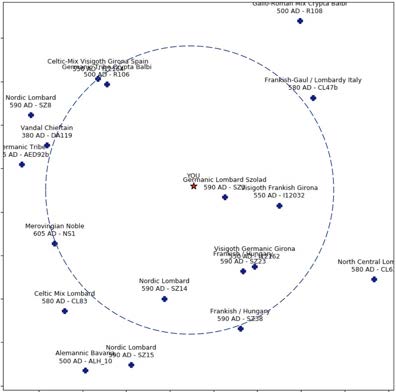
Figure 73.13: The genetic distance between the Declercq sample and the closest
ancient skeletons in the database. The appearance of 3 Visigothic skeletons found
at Girona in Catalonia dating from around 500 AD and Lombardic and Vandal
skeletons must originate from Spanish/Catalan roots. (MyTrueAncestry®)
73.10.4.6.1 Milan and Genua For names closely linked to Milan and Genua, we found:
Dallardas (21.4), Bertoni (17), Stiscia (15.8), Caprotti (14.7), Tessa (12.5), Zamprogno (11.5), Rucci (11.4), Sciaraffa (11); Viola (10.7), Nesi (10.6), Angeleri (10.5), Lavezzari (10.5), Del Bello (10.3), Dalmasso (10.1), Leta (10.1), Visconti (9.7), Agudio (8.9), Lombardi (8.8), Pizzichemi (8.6), Monteverdi (8.5), Valseriati (8.4), Garbarino (8.3), Cantu (8.2), Bodrato (8.2), Canepa (8.2), Ricotti (8.1), Gazzo (7.8), Torielli (7.5), Baiardo (7.5), Sarina (7.4), Cantoni (7.1), Gonzo (7.1), Tazzari (7.1).
73.10.4.6.2 Milan and Genua, but also the Deep South of Italy Interestingly, we also found names that specifically appear frequently in the Milan and or Genua region, but also in the deep south of Italy:
Maniscalco (14.4), Coscia (10.4), Caligiuri (10.4), Ruggiero (10.2), Prota (10.2), Ferraro (8.5), Papallo (8.4), Roppolo (8.3), Galati (8.2), Lo Monaco (8), Servello (7.8), Pastore (7.6), Primerano (7.5), Vullo (7.2), Tantillo (7.1), Lamanna (7.1).
73.10.4.6.3 Cross match between GEDmatch® and the Montblanc Census of 1359 As a point of interest, we
investigated the article of Lluis Paris i Bou,6 in which we find the remains of the census of 1359 at Montblanc, ordered by King Pere III of Aragon. Although, as explained in Chapter 25.0.2.1, the information dates from a more recent century, the list of names is significant for the current purpose. We compared this list with the results of GEDmatch®. One should expect some names from ancient Montblanc to also appear in the GEDmatch® results. 10 % of the families in Montblanc had a family name that also appears in the GEDmatch® results of our autosomal Desclergue DNA.
Results in alphabetical order:
Anglada (7.3), Barcelo (7.2), Capella (7.9), Catala (7.7), de Royo (7.1), Ferrer (7.2), Morell (7.8), Negre (8), Nicolau (8.2), Ponç (8), Rocha (7.1), Sanz (8.3, 7.9), Torres (9.7, 8, 7.7, 7.7, 7.1), Vidal (8).
Our Ferrer ancestry is described in Chapter 26.0.2 on page 291.
73.10.4.7 Cross-match between GEDmatch® and other Spanish names of interest
The names are:
Torres (9.7, 8, 7.7, 7.7, 7.1), Guzmàn (7.8), Molina (7.8), Sandova (8.5, 8.3, 7.8, 7.4), Nuñes (8.6, 7), Herrera (8.2, 8), Diaz (9.1, 8.6, 8.5, 8.4, 8, 7.9, 7.5, 7.4, 7.4, 7.1, 7).
73.11 Genetic Analysis based on MyTrueAncestry®
This platform is an easy-to-use tool for investigating one’s genetic background. The disadvantage is that users must learn what procedures or databases are used for this task. Nevertheless, comparisons are possible with skeletons found at different locations globally and from various times in history. Therefore, the platform allows comparing one’s DNA with ancient skeletons and modern populations. The platform uses PCA (Principle Component Analysis) to determine the genetic distance between samples and populations.
6Lluis Paris i Bou, ’El creixement de Montblanc medieval i un fogatge de finals del s. XVI’ , Aplex de Treballs, vol 1 (1978), p 145-152
The Desclergues of la Villa Ducal de Montblanc, 2nd ed., Omn., VOL. VII
© 2024 Nico F. Declercq
1598
CHAPTER 73. DNA ANALYSIS OF N. F. DECLERCQ
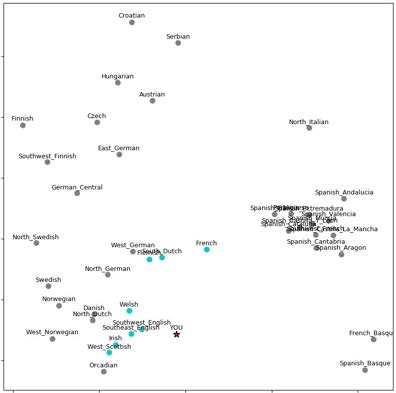
Figure 73.14: Genetic distance between the Declercq sample (red star near the
bottom) and modern populations. A Spanish cluster appears on the right side, while
an Irish/British cluster appears on the left. (MyTrueAncestry®)
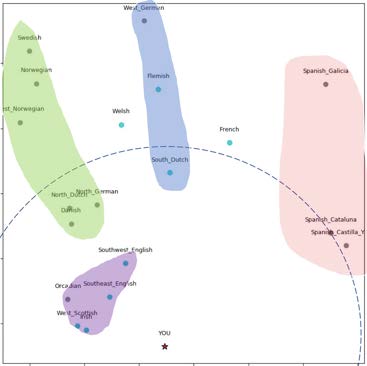
Figure 73.15: Fewer populations are shown compared to the previous im-
age, but with colors added to the Iberians (red), the Low countries (blue), the
Vikings (green), and the Irish (purple). (MyTrueAncestry®)
© 2024 Nico F. Declercq
The Desclergues of la Villa Ducal de Montblanc, 2nd ed., Omn., VOL. VII
73.11. GENETIC ANALYSIS BASED ON MYTRUEANCESTRY®
1599
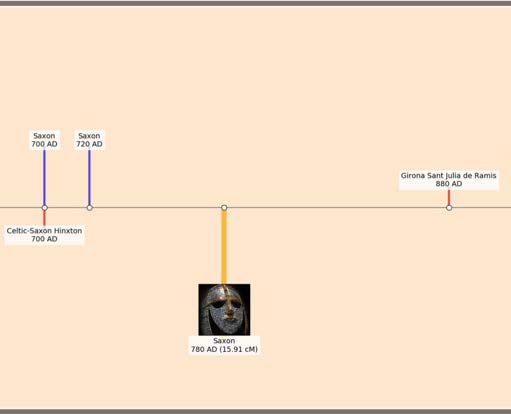
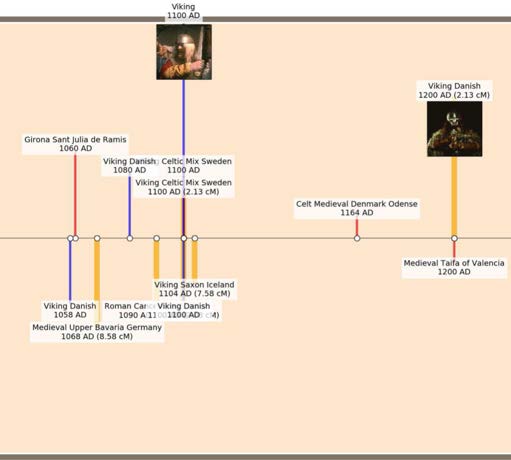
Figure 73.16: The timeline of the historic skeleton matches the Declercq sample, 700 AD - 1000 AD. Likely, the Saxons are part of the many matches with modern DNA on the British Isles. (MyTrueAncestry®). A
sample at Girona from 880 AD is also visible.
Figure 73.17: The timeline of the historic skeleton matches the Declercq sample, 1000 AD - 1200 AD.
(MyTrueAncestry®)
The Desclergues of la Villa Ducal de Montblanc, 2nd ed., Omn., VOL. VII
© 2024 Nico F. Declercq
1600
CHAPTER 73. DNA ANALYSIS OF N. F. DECLERCQ
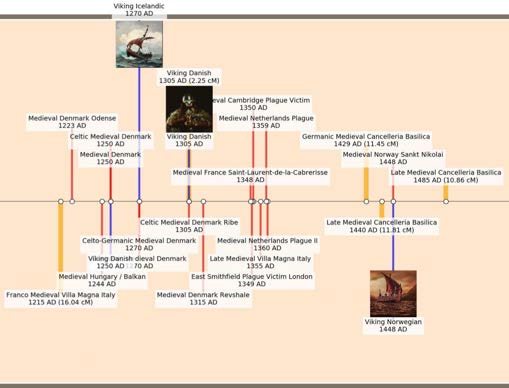
Figure 73.18: The timeline of the historic skeleton matches the Declercq sample, 1200 AD - 1500 AD.
(MyTrueAncestry®)
The skeletons found at Girona, have also been described in the literature7.
Population distances are shown in Figures 73.13, 73.14, and 73.15, while a timeline is given in Figures 73.16, 73.17, and 73.18.
73.12 Genetic Analysis based on MyHeritage®
Out of curiosity, we tested at MyHeritage® to ensure there were no contradictions with the results obtained by other services.
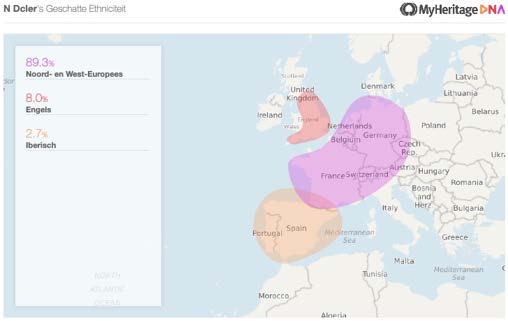
MyHeritage® is a different database but shows many matches in and around Belgium and Spain. The ethnicity, shown utilizing a map in Figure 73.19, is perfectly average for Flemish, namely the North Sea Bassin and France, but indicates Iberia. For this database, the estimated inheritance is 2.7% Iberian.
73.12.1 Spanish Rooted
An exciting sample can be found on MyHeritage® of Arva Chichenhof, born Arva De Spain. She was born in 1937 in Prescott, Arizona, and died on November 17, 2021, in Nampa, Idaho. She was married to Gerald Chichenoff. Her parents were Walter De Spain and Clarissa. The name ’De Spain’ comes from the French d’Espagne and was given to persons from Spain residing in France or England before they migrated to the United States.
According to this family’s ancestry tree, the oldest known forefather is Gedeon De Spaigne, born in Canterbury on April 16, 1626, in England.
Interestingly, this person has only one region in common with the author, according to MyHeritage®, namely Iberia. The DNA in common is 16.4 cM, on Chromosome 18.
An exciting sample from the UK can be found on MyHeritage® of Spyridon De Castro Leon. We share two segments, a total of 13.9 cM. In particular, a segment of 6 cM is found on Chromosome 22, which is only shared with Spanish ancestors.
73.12.2 Spanish Residents
Spanish DNA links with people residing in Spain or by My Heritage considered 100% Spanish are given below, with the region added, if known:
Baltar (6 centiMorgans).
Jimenez (6.4 centiMorgans).
Sahagun (7.1 centiMorgans) (Miguel Sahagun), ancestors: Sahagun, Castellanoz, Gonzáles and Márquez, region: Castilla y Léon, Castilla-La Mancha and Andalucia.
Silveira Correia da Silva (8.3 centiMorgans).
Guzmán (7.4 centiMorgans).
Craxan (8.1 centiMorgans) with roots in Tarrassa in Barcelona and ancestor Uriarte.
Arellano (8.1 centiMorgans), from Puerto Rico, with ancestors Arellano, Castro, Rivera and Cordero.
Garcia, Javier (8.4 centiMorgans)
Roblizo y Cazorla (8.7 centiMorgans), ancestors: Roblizo y Pizarro, Castro, Padron, Vallester, Castellano, Cazorla, Cortés, Suarez, Silva, Garnica, Roblizo, Martin, region: Madrid.
Junco (Ana Maria Junco)(8.7 centiMorgans), ancestors: de Torró, Pacheco, Orellano (Arrellano), Segarra, Colon, de la Roelas, de Rivera and De Montalvo.
7Joan Llinàs Pol, et al., ’Pla de l’ Jorta (Sarrià de ter, Girona): Una necrópolis con inhumaciones Visigodas en la Tarraconense Oriental’ , Archivo Español de Arqueología 2008, 81, págs. 289-304.
© 2024 Nico F. Declercq
The Desclergues of la Villa Ducal de Montblanc, 2nd ed., Omn., VOL. VII
73.12. GENETIC ANALYSIS BASED ON MYHERITAGE®
1601
Figure 73.19:
MyHeritage®, which is based on a different database than FamilyTreeDNA®, GED-
match® etc., shows results equally in agreement with our ancestry tree. (August 22, 2020)
Note that De Mostalvo means De Monte Albo, meaning ’from Montblanc’ (the name also exists as Montalban, Mon Blanch and Montalvo). Cortes (this person has DNA classified as 75% Spanish) (8.9 centiMorgans).
Sanz y Carmona (9.1 centiMorgans), ancestors : Pilar, Sanz, Carmona, region: Estremadura.
Cruz (10 centiMorgans).
Esmeralda Ibar Pérez (12.4 centiMorgans), ancestors: Pérez, Garcia, Jimenez, Terron, Galán, Infante, Cruzado, Terron, Antúnez, Leiva, Muñoz, Hernández, Sanagustín, region: Barcelona.
Diez Fernández, Ignacio (12. 5 centiMorgans), ancestors: Vega, Dominguez, Diez, Hernandez.
Jimenez, Carolina Millan (12.9 centiMorgans), ancestors: Guzmán, Jimenez, Millan, Valencia.
Sifuentes, Ana Maria (13.2 centiMorgans), ancestors: Sifuentes, Cambana, Carmelino, Chirichigno, Cortés, Burneo Valdiviezo.
Prieto, Carmen (13.5 centiMorgans), ancestors: Prieto, Martinez, Rey, Alonso, Casado, Alvarez, Arenal, Cañas, Garcia, Sastre, Beneitez, Nava, Gonzalez, Pellitero, Corzo, region: Madrid.
Macarena Rodríguez García de la Calera (13.9 centiMorgans), ancestors: Rodríguez, García de la Calera, region: Madrid.
Garcia (15 centiMorgans).
Daniele Jane Proust (15.4 centiMorgans), ancestors: Tapia, Villegas, Vasquez, Gallardo, Arenas.
Soledad Guerero Ferreyra (18.5 centiMorgans), ancestors: Ferreyra, Gomez, Guerrero, Roldan.
Prieto, Amaia Vergara (20.4 centiMorgans), ancestors Prieto, Vergara, Rey, Azaldedui.
Hernando de la Heras, Jose Luis (20.9 centiMorgans).
Dakota Redern with Spanish roots (28.8 centiMorgans); ancestors: Ortiz, Alvarado, Peña, Solis, Vilescas, Paiz, Cardoza, Pacheco, and Rodriguez.
Jorge Piqueras López (28.7 centiMorgans), ancestors : López, Piqueras, Rodriguez, Santacruz, region: Albacete, Spain.
Arce (Sindy Arce) with all roots in Spain. This sample shared DNA with the author that she also shares with Beatrice Torró, Devin Reyes, Cacilia Benavides and Destiny Benavides.
Preda (40.8 centiMorgan): Craig Wood with ancestor Preda, coming from the area south of the Pyrenees in Spain .
73.12.3 Portuguese Residents
Spanish DNA links with people residing in Portugal or by My Heritage considered 100% Iberia:
Marcos Soares (12.1 centiMorgans), ancestors: Alvares, Alves, Carvalho, dos Santos, Andrade, da Rocha.
An exciting match is Freddie Martinez Vazques (16.1 centiMorgans) from the USA, with common DNA links with Crucita Cruz, Shaira Vargas, Dorothy Krois and Ana Maria Junco. The two formats of the name De la Cruz appears to confirm a link through such bloodline. Shaira Vargas shares DNA with us, with Martinez Vasques and also with Ana Maria Sifuentes.
Another exciting match is with Ana Montoya (15.3 centiMorgans).
Another exciting match is with Rui Lavarinhas (14.3 centiMorgans), who is considered 100% Iberian by My Heritage and with whom we share DNA with Mrs Sanchez Rubio from Madrid.
An intriguing match is with ’Eric Castillon’ (13.4 centiMorgans), who is considered 100% Iberian by My Heritage.
73.12.4 Other
Elsy Depraetere (43.7 centiMorgans): She is from the same geographic region as the author’s Den Dauw ancestors among which Depraetere also appears.
Johan Verrecchia (21.4 centiMorgans): This person is from the privince of Lazio in Italy.
Maria Vermeersch (9.4 centiMorgans): This person has patrilineal roots in Geluwe. The author shares ancestors through his Vermeersch-de Patin ancestry in Geluwe.
The Desclergues of la Villa Ducal de Montblanc, 2nd ed., Omn., VOL. VII
© 2024 Nico F. Declercq
CHAPTER 73. DNA ANALYSIS OF N. F. DECLERCQ
73.13 Genetic Analysis based on Geneanet®
DNA matches on Geneanet® were not yet well developed when the first edition of this work was published. More data was collected and entered into the second edition. At the end of 2023, however, this company stopped DNA research. We may, therefore, not hope to find more information through this platform.
73.13.1 Spanish Links
Quellec-Riou: a person whose ancestors are highly embedded in Brittany (16.8 centiMorgans).
Dias: a person with only Spanish and Portuguese ancestors (12.6 centiMorgans).
Paixao: a person with Portuguese and Brazilian ancestors (12.9 centiMorgans).
Gonçalves da Silva, Portuguese (9.9 centiMorgans).
de Oliveira, Portuguese (9.1 centiMorgans).
Bonnefoy: a person in the South of France with Iberian roots such as Cathala, Gomez, Vaez, Mendez, Lopes, Dacosta, Ibarra, Peixoto, Vives and Franca (9.3 centiMorgans).
de Contreras (Elke Schietse, from Oudenaarde): has Pedro Leonis de Contreras, militis Hispania, as ancestor, from Leon. Pedro Leonis had a son, Pedro de Contreras, Militis Hispania, who was born in Pamele, Oudenaarde, on June 12, 1609, and who died in Ghent and was buried at Sint Salvador on October 31, 1675.
Pedro de Contreras married Maria Fierens at Sint Salvador in Ghent on October 11, 1654 (8.6 centiMorgans).
Selosse with Spanish ancestors Gonzalez, Rivera Ramirez-Arellano, and Castro (8.1 centiMorgans).
Pierna (7.9 centiMorgans).
Bervas with ancestors in Brittany, including ancestors carrying the names Le Guernec, Kerneach, Le Floch, Cojan, Ropars, Le Clech, Gac (7.5 centiMorgans).
73.13.2 Links with Brittany
Pierna, with ancestors Guezennec, Bougennec, Guehezec, Bouguennec, le Guennec, and le Breton (7.9 centiMorgans).
Yvon (7.7 centiMorgans).
Vaultier, with all ancestors located in the South-West of Normany and the North of Bretagne near the birthplace of Du Guesclin (7.4 centiMorgans).
73.13.3 Other
Another interesting DNA sample links us with de Patin and de Caestecker:
de Brabandere, Jean-Marie Achille. This person is a patrilineal descendant of Antonius de Brabandere (1725-1799), whose brother, Ignatius Franciscus de Brabandere (1737-1816) was married to Godelieve Clara van Klooster (1745-1796), parents of Carolus Bernardus de Brabandere (1776-1834) who married Francisca Coleta Vynckier (1772-1803) (DNA evidence is given in Chapter 73.8 on page 1590.) in 1798 and were the grandparents of Nathalia Juliana de Caestecker (1830-1971) who married Clement Lammens (1825-1893) in 1864 and are the parents of Eudoxie Romanie Lammens (1868-1931), wife of Emile Theophile Lesage, the author’s great-grandfather. We refer to Chapter 71.7.2 on page 1547. This person is also blood-related to de Patin - Vermeersch, like the author, presented in Chapter 65.13 on page 1316, hence a relatively large DNA connection (21 centiMorgans).
Vannieuweborgh, the daughter of Martha Lammens, granddaughter of Arthur Lammens (36.6 centiMorgans).
Simon, with ancestors Van Hulle from Wortegem (17.2 centiMorgans).
73.14 Comparison with Ancient Skeletons by GEDmatch®
The platform GEDmatch® has a tool, made in collaboration with Felix Immanuel, to compare the autosomal DNA of a person with that of found skeletons. It can show where ancient ancestors lived and when they migrated to certain areas. The database ranges from Neanderthal skeletons to more modern Anglo-Saxon specimens. The tool looks for DNA matches from 0.5 centiMorgans to 10 centiMorgans and lights up for every match found on each chromosome. One should discover matches with all skeletons if one goes far enough back in time for small centiMorgans values. We have set the threshold to 2 centiMorgans to have only meaningful output. In the analysis described below, we have added weight, a number matching the observed lines on the result provided by GEDmatch®. It should be considered an indicative value because lines may have different thicknesses and therefore represent higher centiMorgan or certain matching lines can be so close to one another that GEDmatch® puts them out as one result, i.e., one line. Below, all the found skeletons with DNA match with our sample are listed and organized per region. Every person has multiple origins, so remember not to assume that ancestors migrated between the areas mentioned. The GEDmatch® database contains over 100 DNA samples of ancient DNA; 39 had some autosomal DNA in common with ours. The ages shown below are those of the found skeletons. They do not necessarily match the era when ancient ancestors lived in each region.
73.14.1 Alps (13700 year old skeletons)
With known Burgundian ancestors and many French ancestors, it’s no surprise that a skeleton found in Switzerland, probably representative of the Burgundy region in France, delivers a high match, despite its age of almost 14000 years.
73.14.1.1 French-Burgundian-Helvetian
Switzerland (13700 years ago; weight 21).
F999803 Bichon, Switzerland, 13.7ky cal BP (weight 21).
© 2024 Nico F. Declercq
The Desclergues of la Villa Ducal de Montblanc, 2nd ed., Omn., VOL. VII
73.14. COMPARISON WITH ANCIENT SKELETONS BY GEDMATCH®
1603
73.14.2 Byzantine area (8300-9700 year old skeletons)
There have been migrations from the Black Sea area to the rest of Northern and Southern Europe. Therefore, it’s no surprise to find such DNA in our blood, either through the Germanic link or the Iberian.
73.14.2.1 Georgia (9700 years ago; weight 22)
F999804 Kotias, Georgia, 9.7ky cal BP (weight 22).
73.14.2.2 Turkey (8300-8400 years ago; weights 1-5)
F999842 BAR2-L11-213, Barcin, Turkey, 8.3ky, Anatolia Neolithic (weight 1),
F999844 BAR20-M13-170, Barcin, Turkey, 8.3ky, Anatolia Neolithic (weight 2),
F999847 M11-3663, Barcin, Turkey, 8.3ky, Anatolia Neolithic (weight 2),
F999851 BAR99-M10-35, Barcin Turkey, 8.3ky, Anatolia Neolithic (weight 2),
F999862 M13-72, Barcin, Turkey, 8.3ky, Anatolia Neolithic (weight 1),
F999863 L12-393, barcin, Turkey, 8.4ky, Anatolia Neolithic (weight 1),
F999865 L14-200, barcin, Turkey, 8.3ky, Anatolia Neolithic (weight 5).
This connection is unsurprising given the early alliance between Desclergues and Greek settlers in Empúries. Indeed, they were from Phocaea or Phokaia, nowadays Foça in Turkey, around 300 km from Barcin. The progenitor of the Desclergues in Greek Empúries north of Barcelona had a local father (hence our Y-DNA from that area) and a Greek mother from Phocaea, as explained in Chapter 9.2.
73.14.3 Iberia (4700-7200 year old skeletons)
Given the title of this book and all the other genetic and documented evidence we have discovered to prove the Spanish ancestry of the Declercq (Desclergue) line, it would be surprising not to find ancient DNA links on the Peninsula. The results are all from Spanish skeletons from the Northeast quarter of the Peninsula. El Portalon is located in the Sierra de Atapuerca near Burgos. La Mina is located near Arcos de Jalón. The Els Trocs cave is located in Northern Spain between Llerida and Huesca.
73.14.3.1 Spain (4700-7200 years ago; weights 3-10)
F999881 ATP2, El Portalon, Spain, 4.7ky BP, Late Chalcolithic (weight 10),
F999834 Mina18, La Mina, Spain, 3.8ky BCE, Iberian Mid Neolithic (weight 3),
F999835 Troc5, Els Trocs, Spain, 5.2ky calBCE, Iberian Early Neolithic: (weight 4),
F999841 MIR586, El Mirador Cave, Spain, 5.0ky, Iberia Chalcolithic (weight 3).
Note that La Mina is located near Barcelona and, therefore, not far from Empúries, where the Desclergues originate.
Els Trocs is not so far either, high up the Pyrenees between Huesca and Lérida (Lleida).
El Mirador Cave is in Ibeas de Juarros, Burgos.
73.14.4 Celtic British Isles (4000-5200-year-old skeletons)
73.14.4.1 Ireland (4000-5200 years ago; weights 28-40)
F999800 Rathlini, Ireland, 2.0ky cal BC (weight 40),
F999805 Ballynahatty, Ireland, 3.2 ky cal BC (weight 28).
73.14.5 Germanic-Hungarian (3100-7000-year-old skeletons)
73.14.5.1 Hungary (4200-7200 years ago; weights 1-2)
F999855 HUNG353C01, Apc-Berekalya I, Hungary, 4.9ky, Central Mid Neolithic (weight 1),
F999856 HUNG302NE2, Debrecen Tocopart Erdoalja, Hungary, 7.2 ky, Hungary Early Neolithic (weight 2),
F999857 HUNG86NE3, Garadna, Hungary, 7.2ky, Hungary Early Neolithic (weight 1),
F999858 HUNG372NE5, Kompolt-Kigyoser, Hungary, 7.2ky, Hungary Neolithic (weight 1),
F999859 HUNG370BR1, Kompolt-Kigyoser, Hungary, 4.2ky, Hungary Bronz Age (weight 1),
F999860 PF839-1198NE4, Polgar Ferenci hat, Hungary, 7.2ky, Hungary Early Neolithic (weight 2).
This DNA may have entered the Desclergues bloodline during the Visigoth period in Spain.
73.14.5.2 Germany (3100-7000 years ago; weights 1-5)
F999811 HAL36C, Germany, 1.1ky cal BCE (weight 2),
F999812 ESP24, Germany, 3.2ky cal BCE (weight 3),
F999819 HAL16, Halberstadt-Sonntagsfeld, Germany, 2.0ky cal BCE (weight 1),
F999821 HAL4, Halberstadt-Sonntagsfeld, Germany, 5.0ky, calBCE (weight 1),
F999822 UWS4, Unterwiederstedt, Germany, 5.1ky cal BCE (weight 3),
F999823 QUEX116, Quedlinburg XII, Germany, 2.3ky calBCE (weight 1),
F999824 ESP16, Esperstedt, Germany, 2.5ky calBCE (weight 1),
F999825 ESP11, Esperstedt, Germany, 2.4 ky calBCE (weight 2),
F999826 ESP29, Esperstedt, Germany, 2.2ky cal BCE (weight 1),
F999827 ALB3, Alberstedt, Germany, 2.4ky calBCE (weight 5).
The Desclergues of la Villa Ducal de Montblanc, 2nd ed., Omn., VOL. VII
© 2024 Nico F. Declercq
CHAPTER 73. DNA ANALYSIS OF N. F. DECLERCQ
73.14.5.3 Russia (1500-5300 years ago; weights 1-5)
F999810 Uz0074, Rusia, 5.3ky BCE (weight 1),
F999829 SVP3, Ekaterinovka, Samara, Russia, 2.9ky calBCE (weight 2),
F999830 SVP12, Novoselki, Samara, Russia, 1.5ky calBCE (weight 5),
F999836 SVP39, Spiridonovka II, Samara River, Samara, Russia, 1.7ky BCE (weight 1),
F999839 SVP53, Lopatino II, Sok River, Samara, Russia, 4.7ky, Poltavka (weight 1).
73.14.6 Roman and Anglo Saxon British Isles (1500-1800-year-old skeletons)
Note that the Saxons were Germanic.
73.14.6.1 (1500-1800 years ago; weights 1-13)
F999867 04, Oakington, Cambs., England, 400-545 AD, Early Anglo Saxon (weight 13),
F999874 3DRIF-16, Driffield Terrace, Yorks, England, 200-300 AD, Roman (weight 1),
F999880 6DRIF-3, Driffield Terrace, Yorks, England, 200-400 AD, Roman (weight 1).
© 2024 Nico F. Declercq
The Desclergues of la Villa Ducal de Montblanc, 2nd ed., Omn., VOL. VII
DNA Analysis of Shirani O. de Silva
74.1 Introduction
We already knew Shirani O. de Silva had Ibero-Indian-Ceylonese roots; therefore, a deeper investigation using DNA to reveal this complicated background was fascinating. We used a sample of her brother to investigate the DNA of Shirani Olupathage de Silva.
The reason is that otherwise, we could get no information about the paternal ancestry, while we still could extract information about the maternal lineage. The results agree with what we know about the origin, as described in Chapter 54. Indeed, a Carvalho of an Iberian bloodline with ancient links to India has blended with an Iberian de Silva, and their children took the name, de Silva.
The lineage went on a voyage from Portugal to India and settled in Goa during the Portuguese rule.
They later moved to Sri Lanka to settle at the fortress of Uduwara on the Kalu Ganga River. The mtDNA reveals that the maternal ancestry line is mid-west Indian Brahmin due to the residence and mixed marriage in Goa. The paternal ancestry line matches samples in Goa and Portugal. As expected, autosomal DNA shows several Sri Lankan links and links with Goa and Iberia.
Furthermore, old traces of DNA are retrieved along the ancient route the paternal ancestors took when they migrated from NorthWest India, Persia to Byzantine in the Mediterranean, and then along the North coast to Iberia. They arrived in India as pilgrims expelled from Byzantine because of the Byzantine war. The results are significant in complementing earlier studies concerning ancient migrations to Spain. Indeed, such studies are often limited to proto-Gitano tribes, but others have migrated along the same path and found Iberia their new destination. The most crucial difference is that the proto-Gitano tribes have hardly mixed with the other Iberians and have formed a different group in society. The ones who settled and blended became indistinguishable from the average Iberians. Still, the similarity in the pathway taken from Northern India, via Persia and Byzantine to Iberia inevitably leaves genetic traces as the witness of their history, caused by local mixed marriages and most likely crossed unions with the other migrating tribes.
Investigating their past before the written records is mandatory to understand the DNA of de Silva and vice versa, which is the goal of this chapter. Further, Chapter 54 gives an overview of the written evidence. We focus on the time before, during, and after their contributions to the Portuguese expansion to Goa in India and Sri Lanka.
Modern DNA technology, specifically next-generation sequencing (NGS), has facilitated the precise mapping of Shirani Olupathage de Silva’s ancestry. We analyzed her mitochondrial DNA (mtDNA) and her autosomal DNA through NGS. The mtDNA analysis, which traces the matrilineal heritage, confirmed the maternal lineage’s origins in mid-western India Brahmins.
Given the historical context of intermarriage within Goa, a significant hub during the Portuguese colonial period, this was expected.
The autosomal DNA, which provides a broader genetic overview, highlighted her genetic links to Sri Lanka, Goa, and Iberia, affirming her diverse heritage.
The paternal lineage, assessed through Y-chromosome analysis, traced its origins to Portugal and Goa, corroborating historical narratives of Portuguese expansion and settlement in the Indian subcontinent. This analysis also uncovered ancient genetic markers along the migration route from North-West India, through Persia and Byzantine, to Iberia. These markers suggest a complexity of migrations and interactions, including integration and intermarriage with local populations.
These findings align with the broader context of genetic studies on ancient migrations and underscore the significance of gene admixture in shaping present-day populations. Unlike the proto-Gitano tribes, which remained relatively isolated, the de Silva ancestors integrated extensively with local populations, as evidenced by their genetic markers. This integration reflects broader migration and settlement patterns.
The implications of these genetic findings extend beyond mere confirmation of historical narratives. They offer insights into the broader dynamics of migration, integration, and genetic diversity. The de Silva lineage serves as a case study in the complex interplay between genetics and history, illustrating how genetic evidence can complement and enrich our understanding of historical migrations and cultural interactions.
In conclusion, using DNA technology in this genealogical investigation has provided a nuanced understanding of Shirani Olupathage de Silva’s ancestry. By tracing maternal and paternal lineages, we have uncovered a rich genetic diversity that spans continents and centuries.
This chapter aims to explore these findings in detail, highlighting the connections between genetics and history. Chapter 54 provides a comprehensive overview of the written evidence, contextualizing these genetic insights within the broader framework of the family’s historical journey.
74.2 Iberia and the Ancestors Before Genealogical Records: The Byzantine
Migration Path 224-1300
Combining our de Silva sample’s autosomal and Y-DNA analysis with historical sources reconstructs the migration. In particular, we refer to Johannes Preiser-Kapeller et al.1 In the period (224-661), Indian tribes left North East India for Persia for work. Some were nomadic, though most were artisans, musicians, astrologers, and merchants. Those migrations were reported during Shah Ardashir in Persia (224-241) and Bahram Gur, the Shah of Persia (420-438), who brought musicians from India. In the period (661-855), the area was under Arab rule.
Apart from some novel arrivals from India around 661, most tribes of Indian origin were pushed from the Basra area towards 1’Migration Histories of the Medieval Afroeurasian Transition Zone, Aspects of Mobility between Africa, Asia, and Europe, 300-1500 CE,’ edited by Johannes Preiser-Kapeller, Lucian Reinfandt and Yannis Stouraitis, published by Brill, Leiden-Boston, 2020.
The Desclergues of la Villa Ducal de Montblanc, 2nd ed., Omn., VOL. VII
© 2024 Nico F. Declercq
1606
CHAPTER 74. DNA DE SILVA
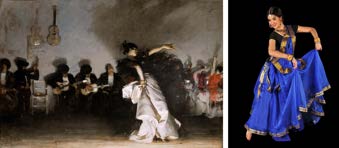
Figure 74.1: Left is a flamenco dancer in the famous painting ’El
Jaleo,’ Spanish Flamenco, by John Singer Sargent, 1882. Right is a
Kathak dancer (Licenced under the Creative Commons Attribution-Share
Alike 2.0 Generic licence by Adarsh Upadhyay / Adjum Bharti, in 2011).
Antioch on the Mediterranean coast by Caliph Muawiya in (669-670) and from Mesopotamia to Antioch by Caliph Walid (710), followed by Caliph Yazid II (720). In 820, Indian tribes established a state in Mesopotamia but were defeated in 834 and expelled to Ainzarba, the Adana Province in Turkey. In 855, the battle of Ainzarba took place, which the Greeks won.
They brought people of Indian origin from Ainzarba to Byzantium. They spread across the Byzantine Empire and became, essentially, Byzantine. Our de Silva ancestors were amongst them. Historical reports appear, for instance, in 1050 at Constantinople, where they were veterinarians, or in 1290 in Greece, where they appeared as shoemakers.
Around that time, instability arose in the Byzantine empire, forcing the tribes of Indian origins to spread towards Iberia (along with the Santiago de Compostela pilgrimage road), the Balkan, etc. This process took place until around 1450. In this process, the nomads moved first to central Europe and arrived in Spain and Italy via France after 1400. The sedentary tribes or families arrived over the Mediterranean along the pilgrimage roads to Compostela early in this process. Although both types had different lifestyles, their communities have crossed one another’s pathways for hundreds of years and, therefore, a DNA analysis of the nomadic tribes may offer insight and comparison for our study, mainly because, in the past decades, numerous scientific articles have appeared on their genetics. The instability of Byzantine covered a significant period.
Indeed, for instance, in 1261, the conquest of Constantinople occurred by Byzantine troops from the exiled state of Nicaea. In 1270, the eighth Crusade of King Louis IX of France took place with an attack on Tunis. In 1274-1282, the churches of Rome and Constantinople briefly united. In 1271-1294, Marco Polo investigated Asia. In 1294-1302, there was a war between the Byzantine Empire and Venice.
In 1302, refugees from the Western Asia Minor region moved to Constantinople after the first defeat of the Byzantines against the Ottomans at Bapheus. In 1321-1328, there was a civil war in the Byzantine Empire, while in 1326, the Ottomans conquered Bursa, a Byzantine city (Pursa) in Northwest Asia Minor.
Finally, in 1331, the Ottoman conquest of the Byzantine town of Nikaia (Iznik) occurred in the Northwest Asia Minor area. We can safely state that the de Silva ancestors arrived in Iberia around 1300, more than 700 years ago, and were not Nomadic but sedentary professionals.
Interesting genetic studies indicate that the early arrivals from Byzantine who were sedentary and of high status blended with the local population equally for men and women. Later arrivals, i.e., the nomadic tribes, show different patterns. Indeed, it is shown that in those populations, DNA arrived in the tribe mostly from local men and not vice versa.
This indicates that nomadic women were more attractive to the locals than men. Nomadic female partners were probably taken for their beauty, while their low social status hampered the nomadic male partners. An example study that also investigates the Indian origins of the Nomadic people is found in Begoña Martinez-Cruz et al.2
Our DNA analysis results in a known Y-DNA Haplogroup, specifically located on the human genome ancestry tree, on the known mt-DNA Haplogroup and autosomal DNA. In particular, the combination of the Y-DNA information, transmitted from father to son and hardly susceptible to mutations, with autosomal DNA that allows comparisons with people worldwide, permits a complete reconstruction of the past.
74.3 Mixed Byzantine and Iberian Genes
The history of Iberia is fascinating. Without going into any details here, we can safely state that by 1400, the peninsula was a real melting pot of many races from many regions globally, South, North, and East of the Mediterranean Sea. An H-L901 Y-DNA Haplogroup typically characterizes paternal ancestry lines with pre-Byzantine roots in North India. It is believed that they had initially been Dravidian and first entered the Iberian peninsula between 1100 AD and 1200 AD as Pilgrims expelled from Byzantine or later as nomadic tribes through France. Modern genetic studies confirmed this early hypothesis, which was based initially on language studies of the nomadic tribes3 that indicated an ancient origin in Punjab and Rajasthan and the first departures from Indian before 1000.
It is known from historical sources that they arrived in Persia in different waves in the 9th and 10th centuries. Those who came as nomads did so in the 1400s, known from written sources dating from 1417.
Of the nomadic tribes, few chose Iberia as their destination, while most prevailed on the Balkans. Authorities first reported them in Paris in 1427.
The de Silva paternal ancestors were among the sedentary Brahmins expelled from Byzantine. They did not belong to the nomads.
They arrived in Iberia as Pilgrims to Santiago de Compostella around 1300, usually the only legitimate way to reach the peninsula.
Being of high social rank thanks to their profession, the sedentary Byzantines integrated quickly. Marriage partners were easily accessible because of their status and beautiful looks, which were caused by their ancient Indian origins and different blends with people from Persia and Byzantine. The Iberian society became so biased that later arrivals in the 1400s and 1500s, who were nomadic but looked similar, were treated equally as nobles initially, received welcome letters from powerful persons, and would 2Begoña Martinez-Cruz et al., ’Origins, admixture and founder lineages of European Roma,’ European Journal on Human Genetics, 2016 Jun; 24(6): 937-943.
3Fraser, A., 1996, The Gypsies (Oxford: Blackwell) pp. 339
© 2024 Nico F. Declercq
The Desclergues of la Villa Ducal de Montblanc, 2nd ed., Omn., VOL. VII
74.3. MIXED BYZANTINE AND IBERIAN GENES
1607
become unwanted only after a few decades. For instance, a document of 1425 AD exists, issued by King Alfonso de Aragon to grant safe passage to the nomads and permitted access to the towns and cities. Their destiny since then assimilated with that of the Jews and the Muslims, and they became subject to prosecution. 4567.
By then, the Byzantines who had arrived around 1300 were integrated, mixed, and had taken local names. Likely, most of them did not know their origins. The ones who were prosecuted attempted to turn the tide by assisting in the wars against the Muslims.
For instance, in 1492, ’Gitano’ auxiliaries helped the Crown of Castile and Leon in the Reconquista of Granada, ending the reign of Muslims in Spain.
Gitanos, descendants of the Nomadic arrivals in the 1400s and the 1500s, retained most of their original looks and often continued as dancers and musicians. They reveal how the Byzantine arrivals around 1300, such as the de Silva ancestors, looked initially while being a mixture of Byzantines and Indians.
Interestingly, the Indian Kathak dance is a precursor of the famous Spanish Flamenco dance, both shown in Figure 74.1. Also, Indian classical music, when accelerated and played with a bit more energy and emotion, sounds like Flamenco.
For DNA analysis, while remembering that the Byzantine immigrants in 1300 shared DNA with the later nomadic arrivals, verifying the names taken by the Nomads is essential. Indeed, most received their Iberian name through baptism or by choice, probably frequently copied from the earlier sedentary arrivals. In contrast, others obtained Iberian family names through local marriage, where the most favorable name was transmitted to the children.
Extensive work in the literature clarifies under which family names nomads lived, in different locations and in different eras in Spain and Portugal. Such information is essential to compare with the sedentary Byzantine DNA such as Shirani de Silva’s ancestors.
Although most investigations are based on genealogical records, it is safe to conclude that many persons carrying such names must still have genetic links to Byzantine and India, either autosomal or through their Y chromosome.
Here we list all the names which have been used by such Nomads in Spain in the period 1783-1785, as listed by Gamella et al.8:
Acosta, Adrian, Agiral, Aguilar, Aguilera, Aguilo, Aiguader, Alameda, Albara, Albiar, Alcala, Alcario, Alfonso, Almagro, Almendin, Alonso, Alvarado, Alvarez, Álvarez, Amador, Amador Blas, Amaya, Ambrosio, Angel, Antequera, Antereyes, Aparicio, Ara, Aragones, Araujo, Arbones, Arenas, Arjona, Aroche, Arpon, Arrabal, Arroyo, Asensio, Avendano, Ayala, Baca, Badia, Baena, Baltasar, Baptista, Barciela, Barquero, Barrera, Barrios, Barros, Barrul, Barrull, Barulla, Batista, Bautista, Becerra, Bejarano, Benitez, Benjumea, Berenguer, Bermala, Bermúdez, Bermudo, Bernal, Bernaldo de Quiros, Bernardo, Biedma, Blanco, Blanquete, Bohigas, Bohigues, Bolanos, Boneo, Bori, Borrull, Borrut, Bravo, Bueno, Bustamante, Caballe, Caballero, Cabello, Cabra, Cabral, Cabrera, Cadiz, Caldera, Calderon, Camacho, Camison, Campana, Campano, Campo, Campos, Cano, Cantarel, Cantarell, Can-tarote, Cantoral, Caracol, Caragol, Carbonell, Carbonero, Carcel, Cardenas, Cargol, Carguero, Carmona, Carnicero, Caro, Carrasco, Carreno, Carreño, Carrillo, Casado, Castello, Castelló, Castellón, Castile, Castillo, Castro, Catalan, Catalana, Ceballos, Cebolla, Cera, Cerda, Cerdan, Chaparro, Chavarria, Chaves, Chavez, Cheverria, Claveria, Clavijo, Colorada, Conejo, Contreras, Copeta, Cordera, Córdoba, Cordon, Corona, Corrala, Correas, Cortés, Cota, Crurrieta, Cruz, Cuadra, Cuenca, Cuesta, Custodio, de Grecia, De la Mata, Del Carpio, Del Cuadro, Del Valle, Delarosa, Delgado, Díaz, Diez, Díez, Dominguez, Dorado, Echevarria, Escalona, Escano, Escobedo, Escuder, Escudera, Escudero, Espera, Espinar, Espinas, Esquivel, Estrada, Evangelista, Exposito, Ezpeleta, Fabre, Fajardo, Fau, Febrer, Feligrana, Fernández, Ferrer, Ferrera, Filigrana, Fina, Flores, Florez, Fontanet, Fraila, Franco, Frias, Frutos, Fuentes, Gabarri, Galan, Galán, Galana, Galinda, Galindo, Galvan, Galván, Gálvez, Gandeay, Garcelan, Garcés, García, Garcias, Garrancha, Garrido, Gasera, Gaspara, Gavarre, Gavarri, Gavira, Gil, Giles, Giménez, Gispert, Godo, Gómez, Gomis, González, Gorreta, Gracia, Graciano, Granada, Granados, Grande, Granero, Greciano/ Greciana, Gregorio, Guerrera, Guerrero, Guirado, Gutierrez, Guzmán, Guzmán, Heredia, Hermosilla, Hernández, Herrera, Herrero, Hevia, Hidalga, Hidalgo, Huguet, Iniesta, Jamas, Jiménez, Joan, Juan, Junquera, La Gaga, La Tardia, Lafore, Larrosa, Las Heras, Laso, Lavado, Lazo, Leal, Leandro, Leira, Leon, Leria, Lerida, Linares, Lisado, Lobato, Locaya, López, Loray, Lorenzo, Loreto, Losada, Lozano, Luarto, Lucas, Luna, Machuca, Madrid, Madrugon, Maldonado, Malla, Malsa, Mampabon, Manas, Manga, Manzana, Manzano, Marchante, Marco, Marin, Marina, Marmala, Marnues, Marnués, Marot, Martín, Martínez, Martos, Mascaro, Mata, Mateo, Mateos, Matet, Matias, Mauro, Maya, Mayo, Mediano, Medina, Medrano, Mejia, Mena, Menacho, Mencia, Mendez, Méndez, Mendoza, Menoza, Mercader, Merced, Mercino, Mesa, Micaela, Minan, Miranda, Moa, Moate, Mohedano, Molina, Molla, Mollate, Monje, Montanes, Montañés, Montanesa, Montañesa, Montano, Monte, Montenegro, Montero, Montes, Montilla, Montoya, Montros, Moraga, Morales, Moran, Morata, Moreda, Moreno, Morera, Moreu, Morgado, Morón, Mos, Motos, Moya, Moyate, Mulero, Muniz, Muñoz, Narvaez, Navarrete, Navarro, Neira, Nieto, Nino, Noguera, Nolla, Núñez, Obaya, Obejero, Ocana, Olia, Oliva, Oliver, Olivera, Olmeda, Orbaneja, Orellana, Orozco, Ortega, Ortiz, Osorio, Ovejera, Ovejero, Pabon, Pacheco, Padilla, Paez, Pajizo, Palacios, Paladins, Palmera, Pantoja, Para, Parcelan, Pareja, Parreno, Pastor, Patrach, Patricia, Paula, Pavon, Pedraza, Pegote, Pelaez, Pena, Peña, Peralta, Peregila, Pérez, Pilolo, Pina, Pineda, Pizarro, Planton, Plantón, Polonia, Ponce, Porras, Portal, Portilla, Portugues, Pozo, Prado, Prisiga, Pubill, Puche, Puerta, Puig, Pujal, Puona, Puyol, Quadra, Quero, Quiroga, Quirós, Quirosa, Ramírez, Ramos, Real, Redonda, Redondo, Reina, Reinoso, Rentero, Reyes, Ribera, Ricart, Riera, Rincon, Rio, Rios, Rius, Rivas, Rivera, Rivero, Robles, Roca, Rodrigo, Rodríguez, Roge, Roger, Rojas, Rollan, Román, Romero, Romo, Ronda, Rosa, Rosado, Rosales, Ruano, Rubio, Ruiz, Saavedra, Sabe, Saez, Salas, Salazar, Salguero, Salomon, Salomón, Salvi, San Martin, San Pedro, Sánchez, Sandoval, Santandres, Santiago, Santos, Sanz, Sarmiento, Segado, Segovia, Segundo, Senora, Serna, Serra, Serrano, Serviola, Siguenza, Silva, Solana, Solano, Solem, Soler, Soriano, Sosa, Soterrano, Soto, Suárez, Suero, Tamariz, Tamayo, Tejada, Tellez, Tinajo, Tinoco, Tirado, Tobas, Tomena, Torcuato, Toribio, Tornesa, Torralba, Torre, Torrejon, Torres, Trampa, Tribola, Trigueros, Trimen, Tripiana, Trujillano, Uceda, Urena, Utrera, Vaca, Valdes, Valdini, Valdiri, Valencia, Valenti, Valentin, Valentín, Valenzuela, Valiente, Valladares, Vallejo, Varas, Vargas, Vazquez, Vázquez, Vega, Vegas, Velasco, Velazquez, Ventura, Veredas, Vicent, Vicente, Victoriano, Vidal, Vila, Villanueva, Violante, Voltas, Vorda, Ximénez, Ximeno, Yunquera, Zaes, Zambrano, Zamora, Zarzo, Zelades, Zurita.
FamilyTreeDNA® has collected a vast number of DNA samples and also managed the ones corresponding to the terms Silva/da Silva/de Silva/Sylva. Numerous Haplogroups are found carrying such a family name, which reveals that they do not have a common paternal ancestor, which is well-known. Genealogical studies have shown that ’de Silva’ is more like a clan than a patrilineal family name. One of the reasons is that the name was often transmitted from mother to son when the father’s family name was lower ranked.
The ancestry of Shirani de Silva is no exception to this rule. Indeed, in Chapter 54.3.4, it is shown that her paternal ancestor, Juan Carvalho de Silva, described in Chapter 54.5.25, received his de Silva’s name from his mother. His parents were Honorato de Carvalho & Maria de Silva. In other words, Honorato de Carvalho was the paternal ancestor of Shirani de Silva, and he had ancient paternal roots in Byzantine with origins in North India.
Unsurprisingly, the Y-DNA Haplogroup belongs to the H-M82 branch, i.e., H-Z34561, as a sub-branch of H-SK1225, and his earliest known paternal ancestors arrived in Iberia around 1300. Male relatives with common paternal ancestors appear as Carvalho and 4Sánchez, M. H., 1976. Documentación selecta sobre la situación de los Gitanos españoles en el siglo XVIII (Madrid: Editora Nacional), pp. 268
5Sánchez, M. H., 1986. Evolución y contexto histórico de los Gitanos españoles. En Entre la marginación y el racismo. Reflexiones sobre la vida de los Gitanos, editado por T. San Román (Madrid: Alianza Universidad), pp. 13-60; San Román, T., 1984.
6Gitanos de Madrid y Barcelona. Ensayo sobre aculturación y etnicidad (Barcelona: Editorial Universidad Autónoma de Bellaterra), pp.132.
7Liégeois J.P., 1987, Gitanos e itinerantes, Madrid: Asociación Nacional Presencia Gitana, pp. 290.
8Juan F. Gamella, Antonio Gomez Alfaro, Juan Perez Perez, ’Los apellidos de los Gitanos españoles en los censos de 1783-1785’ , in Revista de Humanidades, Num 19, Enero-Diciembre 2012.
The Desclergues of la Villa Ducal de Montblanc, 2nd ed., Omn., VOL. VII
© 2024 Nico F. Declercq
1608
CHAPTER 74. DNA DE SILVA
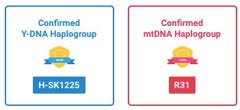
Figure 74.2: 2019-11-01 FamilyTreeDNA® badges of
the Haplogroups de Silva
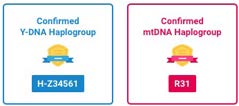
Figure 74.3: 2020-05-03 FamilyTreeDNA® badges of
the Haplogroups de Silva (update)
as Carvajal, depending on local customs and perhaps following similar traditions as later arrivals9.
The most represented family names in the Nomadic communities, often copied from the early arrivals or received by marriage, in modern Spain, with their relative frequencies, are:
Cortés (7.65%), Jiménez (6.99%), Fernández (6.51%), Amaya (4.96%), Flores (4.24%), Moreno (4%), Santiago (3.7%), Heredia (3.58%), Hernández (2.87%), Silva (2.03%), Gabarre (1.79%), Amador (1.73%), Muñoz (1.67%), Vázquez (1.55%), Gómez (1.49%), González (1.14%), González (1.14%), Romero (1.13%), Vargas (1.08%), Montoya (1.02%), Salguero (0.95%), Barrull (0.9%), Escudero (0.9%), Garcia (0.9%), Manzano (0.9%), Reyes (0.9%).
Note that those names also appear in other Spanish families. Of particular interest to our book are Amaya and Cortés (appearing in the four investigated provinces of Madrid, Cordoba, Zaragoza, and Barcelona), Silva (appearing in the 3/4 explored areas of Madrid, Cordoba, and Barcelona), and perhaps also Montaña (only in Madrid).
Note that Montoya is also among those names and appears in the Declercq ancestry in Chapter 29.10.
In Spain, the name ’Silva’ is not prevalent and represents less than 0.45% of the population.10 The website ’Mapa de Apellidos’
indicates that the family name ’Silva’ appears in 3187 places in Spain, spread over the entire country, with very high concentrations around Barcelona, Madrid, and the Northern border with Portugal. The name ’da Silva’ appears in 862 places and ’de Silva’ only in 115 locations.
74.4 An Interesting Observation Related to the First Spanish and Portuguese
Settlers Overseas
They were primarily persons of mixed Byzantine descent. We refer to an exciting work by Gamella et al.11.
A Royal Order made the lists on which the article was based and addressed to the Spanish Gitanos in 1783. It stated that local authorities were required to list all residing in their counties. This action collected the names of more than 12000 such individuals in Spain and formed a fascinating source of information on which family names they had. Again, the family names that appear are not unique to Gitanos. In their abstract, the authors state that,
’All Gitano surnames of 1785 are of Spanish origin and have suffered the Christianization and Castilianization of most family names in the country. The most popular were common patronymics such as Fernández, Ximénez, García, Rodríguez, Muñoz, and also surnames of Spanish origin that have become associated with Gitano identity in some regions such as Heredia, Vargas, Cortés, Reyes, Montoya, Moreno, Santiago, Maya, Amaya, Gabarri, etc. Baptism and blended marriages are the most likely source for adopting such surnames by this minority that likely experienced some ’name drift’ and ’name inbreeding’ . Thus, the frequency of some surnames is probably related to their earlier adoption.’
From the paper, we may highlight the following names, which appear to be linked to Shirani de Silva’s ancestors and are connected to the early Portuguese settlements in Goa and Sri Lanka and Spanish in the Americas. The list makes the author assume that many of the early Iberian settlers on the Indian subcontinent and Americas may have been descendants of Byzantines with Indian roots. Since many had been mixed with the Iberian nobility but likely were not wealthy, they may have been the most motivated Hidalgos or Fidalgos to be shipped to the new world for war, trade, or solely for a new life and to obtain nobility titles when possible. They were also the most gentle towards the local populations because of their mixed race.
Names include:
Mendez, Cortez, Cruz, Gonzalez, Torres, Vargas, Garcia, Santiago, Gomez, Castro, Rodriguez, Escudero, Romero, Diaz, Acosta, de/da Silva, Ortiz, Franco, Serrano, Aguilera, Amaya, Ortega, Lopez, Gimenez, Santos, Perez, Roman, Arroyo, Roge, Vidal, Gispert, Oliva, Guzmán, Cabrera, Sosa, Cabra, Pacheco, Alonso, Alfonso, Afonso, Fuentes, Gutierrez, Mauro, Orozco, Ponce, Cabral, Casado, Correas, Calderon, Contreras, Mendoza, Carillo, Pereyra,. . .
74.5 DNA analysis by FamilyTreeDNA®
The DNA analysis described below is based on Shirani de Silva’s brother, Olupathage Losantos de Silva (Olupathage Lasantha de Silva). The sample reveals the Y-DNA Haplogroup of Shirani’s father, the mt-DNA Haplogroup of her mother and herself, and the autosomal DNA analysis represents both parents. In theory, the autosomal DNA may differ from Shirani’s, but that’s no problem because the purpose was to look for signs revealing ancient connections between her family and Goa in India and Iberia in Europe.
If Autosomal DNA was the most desired research tool, we could have repeated the research for every brother and sister, which would have been very costly.
Of the Indian subcontinent population clusters, ’MyOrigins Version 3.0’ of FamilyTreeDNA® estimates 12% Western Indian, which is the West of India (excluding the North), from Goa to Delhi. This percentage is high compared to other Sri Lankans found 9In J. Lermo, J. Román, M. D. Marrodán y M. S. Mesa, ’Modelos de distribución de apellidos en la población gitana Española,’ Antropo, 13, 69-87, 2006.
10We do not know the exact number, but 0.45 is a threshold used in table 3 of the paper by Lermo et al.
11Juan F. Gamella, Antonio Gómez Alfaro and Juan Pérez Pérez (the University of Granada), ’Los apellidos de los Gitanos españoles en los censos de 1783-85’ , Revista de Humanidades 19, 2012.
© 2024 Nico F. Declercq
The Desclergues of la Villa Ducal de Montblanc, 2nd ed., Omn., VOL. VII
74.5. DNA ANALYSIS BY FAMILYTREEDNA®
1609
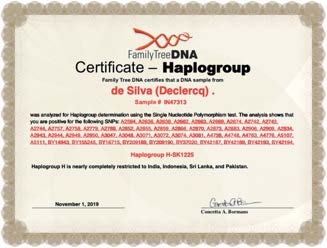
Figure 74.4:
2019-11-01 certificate of
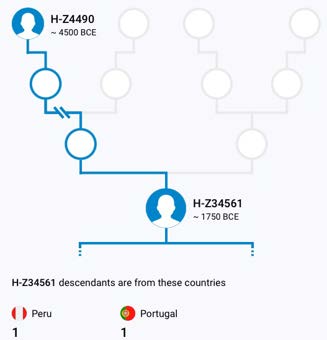
Haplogroup H-SK1225 for the de Silva
sample
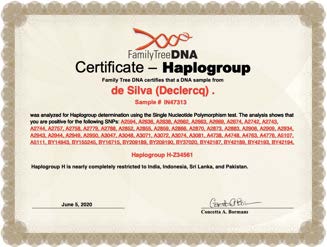
Figure 74.5:
2020-06-06 certificate of
Haplogroup H-Z34561 for the de Silva
sample (update, which shows a refined
branch within H-SK1225 as follows: H-
SK1225 H-Z5885 H-Z4490 H-Z34561)
Figure 74.6:
FamilyTreeDNA® re-
veals that two persons are known within the
Haplogroup H-Z34561, one from Peru and
one from Sri Lanka with Portuguese roots
(our sample). The one from Peru has only
known Spanish roots.
The Desclergues of la Villa Ducal de Montblanc, 2nd ed., Omn., VOL. VII
© 2024 Nico F. Declercq
1610
CHAPTER 74. DNA DE SILVA
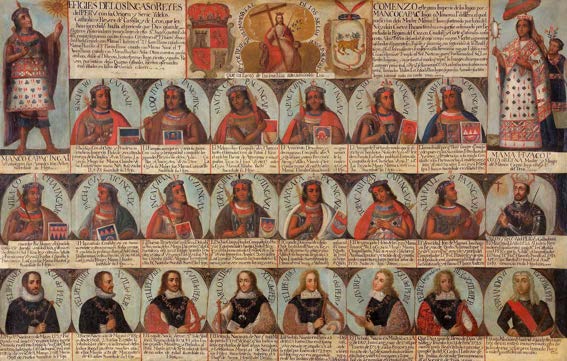
Figure 74.7: During the viceroyalty period of Peru, artistic representations were produced, including portraits of the Incas or rulers of the Inca Empire. One intriguing aspect of these paintings is their association with the Spanish monarchs, starting with Carlos V, who sought to portray themselves as "Incas" of Peru and rightful heirs to their legacy.
on FamilyTreeDNA® and results from the Genetic contribution of ancestors from Goa’s clan. The Portuguese Carvalho de Silva married before the family moved to Sri Lanka and blended further with South-Indian/Ceylonese blood.
The certificates received from FamilyTreeDNA® are shown in Figures 74.2, 74.3,74.4 and 74.4.
74.6 The Iberian Byzantine Haplogroup
We described the Byzantine migration path in Chapter 74.2. It’s essential to keep this in mind to understand the DNA analysis.
First, FamilyTreeDNA®predicted the Y-DNA Haplogroup as H-L901 based on a statistical comparison with the Y-STR values of other samples. Then, ’ NEVgen’ made a more precise prediction as H1a1a-M82. A few weeks later, FamilyTreeDNA® determined exactly the Y-DNA Haplogroup.
The Y-DNA Haplogroup of Shirani de Silva’s father (determined through a sample given by her brother) is H-SK1225, more precisely, H-L901 - H-M2826 - H-M69 - H-M52 - H-L182 - H-M82 - H-M2745 - H-M2772 - H-SK1225 - H-Z34561.
The Haplogroup is prevalent in India up to H-M82, with no further refinements, but the other advances from H-M82 to H-SK1225
and H-Z34561 are found along the route from India to Iberia (Iraq and Iran, Israel, Lebanon, Turkey, Macedonia, Croatia, Spain).
Also, the known downstream entries of H-SK1225 are found along that same route for side branches (Romania, Hungary, Bulgaria, Switzerland, and the British Isles).
There is an exciting paper by Isabel Menizabal et al.12 that confirms the correspondence between retrieved DNA and the known history of the Byzantine immigrants in Iberia. The paper focuses on the nomadic tribes that arrived later than the early sedentary ones, but, as explained earlier, common DNA exists, which makes this study very exciting. Based on DNA, the paper estimates that the common ancestors lived in Northern India around 1500 years ago.
They passed through the Balkans more than 38 generations ago, which means more than 700 years ago. As described above, the migration to the Balkan coincided with the sedentary migration over the Mediterranean to Iberia. The Y-STR values and the autosomal DNA can reveal more details about the path from India to Iberia.
Private communication with another FamilyTreeDNA® member, namely Warren Perera, revealed that his Haplogroup (H-Z12533) and our de Silva sample descend from H-Z5885. He has much autosomal DNA in common with Carvalho in Portugal and numerous families in Latin America (mostly Garcia, Hernández, Rodrigues, Perez, and Barrera).
Genealogical research revealed that he descends from Dutch Burghers in Sri Lanka with a male ancestor who arrived from Pennsylvania in North America, a Spanish-rooted father, and a mother of Swiss descent (Baumgartner, born in 1786 in Pennsylvania). The male line was Iberian, from a Byzantine Iberian ancestor. Therefore, it can be assumed that this person’s ancestors belonged to the same tribe that arrived in Iberia, connected to Carvalho (settlement), and later spread to other countries in the colonial period.
This family’s known and documented roots are in Europe, and it’s astonishing how they were able to prove this exciting trajectory through genealogy. The main reason is that the ancestors arrived in Sri Lanka in a documented period. Therefore, the arrival is written and leads to the earlier overseas ancestry. They received the Perrera surname through a female ancestor by switching registration territories, which resulted in the last name being kept as a surname, which was, in their case, according to Spanish tradition, the mother’s surname.
The names appearing in the documented ancestry of 2 persons, studied below, who have autosomal DNA in common with Warren Perrera and our de Silva sample, are, based on the Ancestry®:
de Carvalho, Monteiro, Montiero, Goncalves, Simoes, Costa, Sousa, Almeida, Ramalho, Fernandes, Rodrigues, Goncalves, Pedra, Gomez, Sardinha, Pereira, Correia, Borges, Carreira, Guilhoto and da Silva.
Interestingly, Warren Perera overlaps autosomal DNA with a particular Yvan Hernández from Mexico, attributed to India.
12Isabel Menizabal et al., ’Reconstructing the Population History of European Romani from Genome-wide Data,’ Current Biology 22, 2342-2349, December 18, 2012
© 2024 Nico F. Declercq
The Desclergues of la Villa Ducal de Montblanc, 2nd ed., Omn., VOL. VII
1611
MyHeritage® did the analysis. It shows that, as stated in Chapter 74.4, many of the people who went overseas before 1800 had Pilgrim or Byzantine roots.
Figure 74.6 shows that FamilyTreeDNA® is aware of two persons having the Haplogroup H-Z34561, one from Peru, who claims to have Spanish roots and one from Sri Lanka with Spanish-Portuguese roots (our sample). An investigation of the Peru sample and the de Silva history reveals that the connection is likely through Gaspar Rodriguez de Silva, born in Spain around 1534, who is known as the conquistador of Peru and, even more likely, through Diego de Carvalho, described in Chapter 54.3.2 on page 1064.
Additional links are found through Diego de Silva y Guzman, a conquistador and poet who died in Cusco, Peru, in 1576, and Jeronimo de Silva, a conquistador born in Valladolid in 1518 and who died in 1574 in Huamanga, Peru. Peru and Spain have been strongly connected in that the rulers even considered themselves as the successors of the Incas, as seen in Figure 74.7. Jeronimo de Silva of Peru is described in Chapter 54.9.2.7 on page 1080.
An investigation on GEDmatch® (DNA comparison between Burgher DNA NL7000624 (*Baumgartner) and FD9011758 (Santos de Silva)) revealed that the DNA of this person (who also has DNA in common with Warren Perrera) and that of our de Silva has almost no Sri Lankan or Indian DNA in common, but a few dozens of samples of Iberian and Jewish descent and also some names which may be linked to the Netherlands and surrounding areas through the VOC. It is indeed known that the Dutch preferred marriages with Portuguese Burghers rather than other islanders. This may have caused VOC blood as part of the autosomal DNA and Portuguese blood. Examples of common ’blood’:
-Iberian and Mediterranean: Posada (LG5236271), Alves (JM5872914), Arayici (PD6003729), Ignacio (FS9728914)
-Jewish: Kerekes (LP4048532), Orwitz (HD1886169), Feltman (YH6251597), Pasmanik (UR6368752), Goldman-Emmer (HR2392509), Brazinski (EK2412315), Michalik (NC9395526), Bernstein (NH9974704), Slutsky (MD9749820), Cohen (GL7279953, PQ1765534, AD9225805).
-VOC: Vetsch (UE2140334), Maes (CS9344618), Greiner (WA4715757), Ackerman (ZQ3915765), Frentz (Frentz), Beauregard (ZC3514800), Deweese (YL4949234), Krupnick (QL5255790), Wagner (ZT1540408), Adams (TS3945916), Schipper (BF2149974).
Another investigation on GEDmatch® (DNA comparison between Burgher DNA A013628 (Errol Perera) and FD9011758 (Santos de Silva)) revealed that the DNA of this person (who also has DNA in common with Warren Perrera) when compared to that of our de Silva, results in similar conclusions. Examples of common ’blood’ :
-Iberian and Mediterranean: Dominguez (BS7183722), Perez (QT9013437), Sorlino (UU2265417), Medina (TR1489251), Marosi (RA5245046), Perera (A699541), Saiz (EF4708588), Serrano (CT3826623), Getola (WJ5119078), Gianopoulos (TY4352768), Peludat (ZZ6395529).
-Jewish: Freeman (CM5235199), Springmeyer (GY8067404), Bernstein (TR5969810), Morkovsky (RA3249304), Heim (AC8268946), Shmueli (ZQ2055140), Kuhilava (DN5484821), Jakab (XV3287731)
-VOC: De Neve (TY6795873), Wieder (DW8502789), Cornelis (UR9983156).
The two examples above, where Burgher DNA is matched, reveal expected results through two Iberian ancestors with our de Silva DNA.
Indeed, the Burgher community is a blend of Iberians and VOC ancestors.
In the VOC, there were Jews who resided in the Netherlands and in areas that are now Germany. It’s also known that Burghers married Burghers and that Dutch Burghers preferred to marry Portuguese Burghers when they decided to marry locally. It is yet a confirmation that the de Olupathage de Silva clan in Uduwara originates from Portuguese Burghers.
74.7 YFull® DNA analysis
YFull® further specifies the Y-DNA Haplogroup as follows:
H-SK1225 - H-Z5885 - H-Z4490 - H-FT167357 (FT167357-FT167608 + 15 SNPs).
Even though Sri Lankans appear in sub-branches of H-SK1225, none are on the branches from H-SK1225 to H-FT167357. This is consistent with the fact that the Haplogroup is not indigenous to Sri Lanka.
74.8 The Y-STR values indicate Iberian Roots from a Byzantine Origin
In all cases described below, the closest Y-STR comparisons for the different studies show the time to the nearest common ancestor between 500 and 1200 years, the most adjacent being samples from Portugal with a common ancestor around 500 years ago.
FamilyTreeDNA® reveals that the closest match from the Indian subcontinent is a specific Touseef Butt from Pakistan, having a nearest common ancestor around 1200 years ago.
Concerning the Y-STR values, a comparison with FamilyTreeDNA® data reveals the closest match as being a certain Alfonso Enriquez (IN37433) whose entry is found in the groups ’The Iberian Peninsula’ and ’Portugal DNA,’ whence we assume this sample is from a Portuguese male. His predicted Haplogroup is H-L901, so we hope this person has also taken more in-depth tests to determine precisely to which branch of H-L901 he belongs.
Another fascinating case is that of Juan Luis Caetano Noronha from Goa in India (N48234). Of the 12 Y-STR values this (predicted by FamilyTreeDNA®) H-M69 person (H-SK1225 is a subclade of H-M69) tested for, he is at a distance of 2 compared to de Silva.
In particular, the Enriquez sample forms evidence of the Portuguese origins of the de Silva family. Autosomal DNA can help us further, for the moment, or databases developed by specific studies. Rai et al. published one such study. The results allow us to compare the de Silva Y-STR values to those of several Nomadic populations globally. The results, as described below, clearly incline towards a Portuguese origin of the de Silva.
Particular cases of interest are also given in Gusmao et al.13. The data files give 17 Y-STR values for 126 self-proclaimed nomads from Portugal, from the districts of Aveiro (Av); Lisboa (Li); Viana do Castelo (VC); Braga (B); Porto (P); Bragança (Bn); Vila Real (VR); Viseu (Vi); Coimbra (Co); Guarda (Gu); Castelo Branco (CB); Leiria (Le); Santarém (Sa); Setúbal (Se); Portalegre (Po); Évora (Ev); Beja (Be); Faro (Fa); and Funchal (Fu).
They are ordered according to their Haplogroup and are listed with the DYS19 values first. The reason is that, for their 126
samples, the DYS19 values were classified according to the Haplogroup for this population. There are 11 samples from the H1a-M82
Haplogroup. They all have, just like our de Silva sample, a DYS19 value of 15. The nearest to de Silva differs in 3 Y-STRs, with a total genetic distance of 4; the specimen is called H15 and is from Lisboa (Li). The two other near samples (which differ in 4
Y-STR values) are H8 and H13, respectively, from Leiria (Le)/Braga (B) and Lisboa (Li). These results are in agreement with the study described below.
13A. Gusmao, L. Gusmao, V. Gomes, et al., ’A Perspective on the History of the Iberian Gypsies Provided by Phylogeographic Analysis of Y-Chromosome Lineages,’ Annals of human Genetics, Volume 72, Issue 2, March 2008, Pages 215-227.
The Desclergues of la Villa Ducal de Montblanc, 2nd ed., Omn., VOL. VII
© 2024 Nico F. Declercq
1612
CHAPTER 74. DNA DE SILVA
Figure 74.8: William Morey (1864-1916), son of United States Consul to Colombo,
William Morey (1837-1908) and Karava Lady with Portuguese Burgher roots,
Francina Perera from Colombo. He shares DNA with our de Silva sample.
Indeed, a study by Rai et al.14, explains that the Portuguese Nomads of the H1a1a-M82 Haplogroup are closer related to the Serbians of the same Haplogroup and have the same modal Y-STR values as the ones in North East India. Furthermore, a comparison between the Y-STR values of de Silva and the 15 modal values listed in the paper for different populations reveals that de Silva is closest related to the ones in Portugal, Serbia, and North-West India, with Portugal forming the closest match.
As mentioned above, a detailed STR comparison based on 15 Y-STR values listed by Rai et al. for 376 individually sampled persons of the H1a1a-M82 Haplogroup reveals genetic distances between 2 and 18. We list the first four distances as follows: Genetic distance 2: Serbia (3 samples), Portugal (2 samples).
Genetic distance 3: Serbia (14 samples), Portugal (5 samples), Croatia (5 samples), Rajasthan (1 sample).
Genetic distance 4: Serbia (20 samples), Portugal (11 samples), Croatia (6 samples), Madhya Pradesh (1 sample), Gujarat (1 sample), Rajasthan (1
sample), Tamil Nadu (1 sample), Maharashtra (1 sample).
Genetic distance 5: Croatia (53 samples), Rajasthan (5 samples), Gujarat (4 samples), Portugal (3 samples), Maharashtra (3 samples), Serbia (2 samples), Madhya Pradesh (1 sample).
The above study also provides data for regions where the genetic distances were larger than 5: Afghanistan, Andhra Pradesh, Chattishgarh, Haryana, Jharkhand, Karnataka, Kerala, Orissa, Pondicherry, Uttar Pradesh.
Suppose we divide the number of samples in the above list by the total samples of the respective countries or regions, i.e., Serbia 40, Portugal 20, Croatia 76, Madhya Pradesh 63, Gujarat 16, Rajasthan 21, Tamil Nadu 10, Maharashtra 13. In that case, we obtain the following results:
Genetic distance 2: Portugal (10%), Serbia (7.5%).
Genetic distance 3: Serbia (35%), Portugal (25%), Croatia (6.5%), Rajasthan (4.7%).
Genetic distance 4: Portugal (55%), Serbia (50%), Tamil Nadu (10%), Maharashtra (7.7%), Croatia (7.9%), Gujarat (6%), Rajasthan (4.7%), Madhya Pradesh (1.6%).
Genetic distance 5: Croatia (69.8%), Gujarat (25%), Rajasthan (23.8%), Maharashtra (23%), Portugal (15%), Serbia (5%), Madhya Pradesh (1.6%).
We may gently conclude that Portugal and Serbia’s regions result in closer genetic links than the areas in India. Also, the further the genetic distance, the more prevalent the links in India. This means that our sample must have passed through Portugal.
We also refer to another investigation by Regueiro et al.15. The investigation was limited to Indians and Serbians who were self-claimed nomadic. Of the 16 tested Y-STR values for 260 samples, we only took the 141 H-M82 haplotype samples, limited to Serbia and India’s few regions. The closest distance to our sample was 5 for two referred samples. The first one came from Belgrade, and the second was from Vokkaliga, India, near Goa. These findings are consistent with the comparisons, as mentioned earlier. Had the de Silva Haplogroup been Indian 600 years ago, they should have closer Y-STR similarities with India. The results for India and Serbia are consistent with the assumption that they came from Portugal.
Begoña Martinez-Cruz et al.16, published the YSTR values and Haplogroups of 1341 samples of nomadic males in different countries, of which 335 of the Haplogroup H-M82, namely 102 from Bulgaria, 37 from Greece, 79 from Hungary, 44 from Romania, 59 from Slovakia, eight from Spain and six from Ukraine. The paper reported 22 Y-STR values for all these individuals. When we select, from that database, all individuals of whom a maximum of 4 Y-STR values were different from our de Silva sample and for whom the total genetic distance was a maximum of 5, then this resulted in 5 samples (SR010, SR018, BR175, BR183, ER109). So, if we only look at the H-M82 matches, following the above criteria, then, for Spain, we have a match of 1 out of eight samples; for Slovakia, we have a match of 2 out of 59 samples, and for Bulgaria, we have a match of 2 out of 102 samples. In other words, there is a 3.7 times higher match for Spain than for Slovakia, a 6.4 times higher match for Spain than for Bulgaria, and a 1.7 times higher match for Slovakia than for Bulgaria. It implicates a correspondence between these weights and the migration path from India to Iberia through the Byzantine.
74.9 The Autosomal DNA Analysis Reveals Sri Lankan, Indian, Byzantine and
Iberian Origins (FamilyTreeDNA®)
As mentioned above, the autosomal DNA is that of Shirani’s brother. It may be slightly different from Shirani’s, but at least we know it comes from the same parents and can be used to find links with Goa and Iberia or elsewhere. We must emphasize that DNA analysis in Sri Lanka is limited. Also, many specimens found come from Europeans of Sri Lankan origin, who were either blended or adopted by European couples as children. Therefore, we must be extra careful and conservative and always request information from the persons appearing to be a match.
As of 2021, only a few dozen samples in the FamilyTreeDNA® databased revealed matches. Many were adopted or mixed children, indicated by a Western family name and a Sri Lankan first name, their picture (if they posted it), the ancestry tree (if it was published), or merely by asking. All these samples were not interesting for our research, except if they gave the exact location of origin or if they mentioned a caste-related family name.
We found a few 100% European persons, with the European name, picture, and available ancestry trees revealed. Such cases, without connection to the Indian subcontinent, are evidence that the autosomal DNA of the Olupathage de Silva family contains 14Rai N, Chaubey G, Tamang R, Pathak AK, Singh VK, et al., ’The Phylogeography of Y-Chromosome Haplogroup H1a1a-M82 Reveals the Likely Indian Origin of the European Romani Populations,’ PLoS ONE 7(11): e48477, (2012)
15Maria Regueiro, Luis Rivera, et al., ’Ancestral modal Y-STR haplotype shared among Romani and South Indian Populations,’ Gene, Volume 504, Issue 2, August 10, 2012, Pages 296-302
16Begoña Martinez-Cruz et al., ’Origins, admixture and founder lineages in European Roma,’ European Journal of Human Genetics, 2016 Jun; 24(6): 937-943
© 2024 Nico F. Declercq
The Desclergues of la Villa Ducal de Montblanc, 2nd ed., Omn., VOL. VII
74.9. THE AUTOSOMAL DNA ANALYSIS REVEALS SRI LANKAN, INDIAN, BYZANTINE AND
IBERIAN ORIGINS (FAMILYTREEDNA®)
1613
DNA sequences that are purely European, and therefore, there must be at least one European ancestor in the family. Of those samples, most were Iberian, and some were British. We even found a person from Norway with ancestry until 1600 without any link with Sri Lanka. Suppose we assume that there were no British ancestors. In that case, a possible explanation is that the British and Norway examples descend from Sephardic Jews or have arrived in Sri Lanka through distant relatives who joined the VOC. Of the found matches with clearly Sri Lankan origins, 25% were X-matches. As most adopted Sri Lankans in the 1980s were Tamils, we may assume that this indicates that somewhere along the ancestry tree, one or more maternal branches may have been of Tamil-speaking origin, as expected for castes like the Salagama and the Karava. In more than one case, we found autosomal DNA matches with the Liyanage clan. This clan is Karava, which indicates that although the family nowadays is Salagama, they must have associated in the beginning with Karava clans.
Here we list a couple of particular samples which we found exciting:
Gaffen and Heller: A genetically blent family of UK families with De Silva ancestors from Kandy in Sri Lanka (93 centiMorgans, 18230 matching SNPs in the one case and 110 centiMorgans, 23091 matching SNPs in the other case),
-Liyanage: a Karava person (93 centiMorgans, 22628 matching SNPs),
-Van Velzen: adopted from Ragama in Sri Lanka, NE of Colombo (83 centiMorgans, 16617 matching SNPs),
-Van Unen: adopted from Kalutara-South in Sri Lanka (66 centiMorgans, 14872 matching SNPs),
-Roten: a Swiss who was adopted from India (60 centiMorgans, 13349 matching SNPs),
-Martens: adopted from Gallela in South Sri Lanka, 100 km NE of Matara (45 centiMorgans, 9477 matching SNPs),
-Verzi: adopted from India (41 centiMorgans, 11440 matching SNPs),
-Liyanage Silva: a Karava person (40 centiMorgans, 10128 matching SNPs),
-Scheitlin: a person from Switzerland with no links or whatsoever with Sri Lanka or India (40 centiMorgans, 8485 matching SNPs),
-Wijayasinghe: from Sri Lanka, and his blood relatives look very European (39 centiMorgans, 9494 matching SNPs). Note that a member of the Wijayasinghe family constructed the Richmond Castle at Kalutara along the Kalu Ganga in recent times. The castle is described in Chapter 62.2.
-Robinson: originates from Sri Lanka (38 centiMorgans, 11863 matching SNPs),
-Thanthrige: mixed with Jayasooriya and Jinadasa, a person of the Karava caste from Sri Lanka (35 centiMorgans, 11500 matching SNPs),
-Hazekamp: adopted from India (31 centiMorgans, 7660 matching SNPs),
-Sherman: This person is characterised by FamilyTreeDNA® as 0% Indian Subcontinental, but is 100% European: less than 1% Slavic, 17% Iberian, 27%
Central European, 33% British, 21% Irish, 3% Scandinavian; By Ancestry DNA he is characterised as 1% Southern Indian / Sri Lanka and 1% Southern Central Asian). According to private communication with Mr Sherman, his father is half German and half Irish. At the same time, his mother is entirely English, apart from one exception, a great-great-grandmother from Sri Lanka. Mr Sherman has some autosomal DNA in common with our de Silva sample. He has a distant ancestor called Francina Perera, born around 1846 and dead in 1901, a Karava lady (her ge-name was probably Pathirage) with Portuguese Burgher roots, from the Colombo-Negombo area, who married, in 1866, William Morey (1837-1908), who later, in 1877, became the Consul of the United States of America at Colombo. Their son, also called William Morey, is shown in Figure 74.8, was born in Colombo on December 17, 1864, and would die on December 13, 1916, in Otis, ME, USA. The latter was a civil engineer and married Evangeline Angie Chapman in 1884 in Orono, Penobscot, ME, USA. The couple is buried at Rock Creek Cemetery, Washington DC, USA. Confirmation that Francina Perera must have descended from Portuguese is found because the tested sample should typically contain around 6% Indian Subcontinental DNA had she not had European roots. The latter is not the case because FamilyTreeDNA® found 0% (which probably means less than 1%).
In comparison, Ancestry DNA only found 1-2% Southern Indian DNA. Besides, FamilyTreeDNA® found Iberian DNA and there is a DNA match with our de Silva sample. The equivalent relation scheme shows that both samples are separated from each other, like 3rd or 4th cousins. Had Francina Perera been an ancestor of de Silva, and if de Silva did not have Iberian ancestors, then the number of generations since her would have matched the number of shared centiMorgans, namely 24. At the same time, the sample should, in that case, have revealed 6% Indian Subcontinental DNA, while it shows, at the most, 2% such DNA. This is evidence that the overlapping DNA between de Silva and Sherman’s sample is not Indian but Iberian. Interestingly, the de Silva sample shares the same DNA as a Portuguese Burgher (Rosalie K. S.) in Sri Lanka. Also, X-DNA is shared, which forms waterproof evidence that our de Silva originates from a clan of Portuguese burghers (24 centiMorgans, 6400 matching SNPs).
-Kirkwood: a British without Sri Lankan or Indian roots and does not share any DNA with any of the other autosomal links we found (24 centiMorgans, 6400 matching SNPs).
-Vogel: a person who descends from Dutch grandparents (Vogel) and Spanish grandparents (Juarez and Guerrero). This person has no Sri Lankan roots whatsoever. (24 centiMorgans, 5561 matching SNPs).
-Appoo: We found two entries of the Appoo family. This family descends from John Jacobus Appoo, born around 1822 in Trincomalee in Sri Lanka and married to a da Sylva. His father was John Emmanuel Appoo; therefore, his mother was probably Da Sylva. John Jacobus worked on ships. This Da Sylva was likely of Portuguese descent and was also Appoo. Recent genealogists in New Zealand and Australia assumed that this John Jacobus Appoo, despite his European name, was also a Singhalese. Perhaps he spoke Singhalese, and some certificates found concerning him may have been in Singhalese.
He ended up in Australia and New Zealand, and there is a place named after him: Appoo’s Creek in the Aorere Valley. He became a famous gold digger there. He died in 1861 in Amherst in Victoria, Australia, and was, according to his death record, 38 years old. Some of his relatives appear in documents as ’Aposylva.’ We found pictures online of John Jacobus Appoo’s granddaughter, Rebecca Morris. There is no physical indication that she may have had Indian or Sri Lankan DNA. She looks Portuguese.
Furthermore, the other family members, descending from this Rebecca, all look very Portuguese indeed. Therefore, it is highly likely that the couple Appoo - da Sylva was Portuguese or had Portuguese (i.e., not mixed with locals) parents. Because Goa was still Portuguese when Sri Lanka and the rest of India had become British, it is possible that such a Portuguese family, for economic reasons, ended up in Trincomalee, long after Portuguese Ceylon, but during Portuguese Goa. We cannot be sure due to a lack of information. It is equally unclear where the name Appoo comes from. In its different spellings, such as Apo and Apoo or Appo, the name may have been Iberian or from other regions in Europe. We conducted a thorough investigation but found no clear evidence, as the term is prevalent worldwide. However, we may note an interesting document in a book published by John Penry Lewis (1854-1923)17 that describes the circumstances of the death of Mr. Dick. Several witnesses, including ’Don Juan Appoo’ (Sic), are mentioned. The appearance of the Spanish name ’Don Juan Appoo’ is remarkable because 1847 was during British Ceylon. One would instead expect Dom Joan Appo, or Don John Appoo, or rather Mr John Appoo. If the family has initially been Singhalese, then it is weird that they appeared very much spread throughout the world in the 19th century and that the name is tricky to find in Sri Lanka, if not impossible. Probably, the family was naturalized British and came from a former Portuguese or Spanish area in the world. This would explain the appearance of ’Don Juan,’ ’Da Sylva,’ and ’Appoo’ itself. A candidate is Goa: Indeed, the British briefly occupied Goa from 1799 to 1813. To make things even more interesting, we found the following passage in a book by George Turnour in 183618, ’156, Raaja Singha 1st Seetaawaka, 1581, a descendant of Siri Sanbo, a great favorite of the nation, son of Maaya Dunnai of Seetaawaka. In the course of his wars with Don Juan, he captured Kotta and laid siege to Colombo, which he was obliged to raise, in consequence of 17Frederick Laey Dick, ’List of inscriptions on tombstones and monuments in Ceylon, of historical or local interest, with an obituary of persons not commemorated,’ page 121, about the Holy Trinity Church, Saint Sebastian’s Hill in Colombo, serial number 401, dated August 29, 1847.
18George Turnour, ’An Epitome of the History of Ceylon: Compiled from Native Annals, and the First Twenty Chapters of the Mahawanso,’ 1836, page 51.
The Desclergues of la Villa Ducal de Montblanc, 2nd ed., Omn., VOL. VII
© 2024 Nico F. Declercq
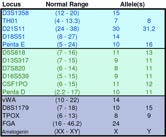
1614
CHAPTER 74. DNA DE SILVA
Figure 74.9: 2014, Consanguinitas® dNA test of de Silva. Although
the results were more primitive than the 2019 FamilyTreeDNA® re-
sults, database comparisons were consistent with the current conclu-
sions of an Iberian origin with Byzantine origins and ancient Indian
roots.
the Portuguese bringing Koon Appoo Bandar from Goa and sending him with an army to Uda-Rata (Oudarata), to make a diversion in their favor - he was a descendant of the branch of the Royal family, that had settled at Peradeniya, and had been sent in his childhood to Goa - The King subsequently relinquished Buddhism and became a convert to the Brahminical faith - he built the Bairaindi Kowille at Awissawelle and bestowed the shrine of Adam’s Peak on some Aandee Fakiers - he extirpated the priests of Budha, and destroyed the books containing the tenets of their religion, wherever they could be found - he also put to death every member of the Royal family, he could get into his power - he died, while engaged in war with Koon Appoo Bandar, at Kukal Bittrawella in 2135’. On the same page, there is also ’His relationship to Raja Singha is not stated - he succeeded him at Seetaawaka, and was put to death - Raja Singha’s sister, who had married Raja ascended the throne - She was made prisoner by Don Juan, and the Portuguese, and her daughter five years old, was sent to Goa.
FamilyTreeDNA® has a tool to check which persons with autosomal links have that particular DNA in common with other people. It appears that the two Appoo entries are linked but not to anybody else with DNA in common with our sample. This may indicate that their roots are not Sri Lankan but indeed European. The DNA they have in common with our sample is located on Chromosome 1.
In addition, the Douglas sample has DNA in common with one sample that also has DNA in common with our sample, although it’s not the same DNA section. The sample is of Nillson-Linstrom, with an ancestry tree known until around 1600, and it is confined to Scandinavia, particularly Sweden and Finland. It concerns Chromosome 9, on which 1493 SNPs, i.e., 7.77 centiMorgans, are shared on the genomic position 111474408 - 116059622, the most extended section. Our sample shares 32 centiMorgans with the Nillson-Linstrom sample with a definite European origin. Note that there are many connections with Iberia in the lower numbers of shared centiMorgans, as described below in the GEDmatch® analysis section.
The two Appoo DNA entries are:
-Douglas: A genetically blent person of Irish, Scottish, English, and New Zealand families with an ancestor Appoo who was in the Trincomalee area; hence, the link could be European through Appoo or a local blend between Appoo and a Sri Lankan (23 centiMorgans, 6797 matching SNPs).
-Bougen: A genetically mixed person with most roots in the UK and New Zealand and with a great-great-grandfather called Da Silva Appoo with Appoo European and likely Da Sylva Portuguese (21 centiMorgans, 4881 matching SNPs) .
74.10 The mt-DNA Haplogroup reveals the Kuru Kingdom as the Maternal-
line Origin (FamilyTreeDNA®)
The mitochondrial DNA (mt-DNA) Haplogroup is R31 and was determined by FamilyTreeDNA®. The overwhelming number of matches higher in the Haplogroup tree (from R to R31) are Europeans. Furthermore, the literature found that the Haplogroup R31
is Indo-European. The locations in India where it is found chiefly are Uttar Pradesh, Andhra Pradesh, and Rajasthan. Furthermore, the ones found in those regions in India are subHaplogroups of R31 (R31a and R31b), which indicates that the maternal ancestors of Shirani de Silva have been separated from those regions for many centuries. This agrees with the observation that the maternal clan must have been of the Karava caste in the past (before they turned into Salagama during the VOC period).
Therefore, they originated from the Kuru Kingdom in the regions mentioned above in Northern India. We have yet to find out and will only find out when many more people test their DNA, which is the route they migrated from the Kuru Kingdom to Sri Lanka.
It may have been through Goa, just like the paternal ancestry line, or it may be through the South Indian coast, as is usually assumed by historians who describe the history of the Karava in Sri Lanka. Indeed, the maternal ancestry does not define the early de Silvas wives in Goa, but the ascendance starting with Shirani, her mother, her grandmother, etc., may have been embedded in Sri Lanka for many centuries.
The literature finds that the R31 mt-DNA Haplogroup originated in Northern India, with the subHaplogroups R31a mainly found in Brahmins from Uttar Pradesh and Rajputs from Rajasthan. In contrast, the subHaplogroup R32b is found primarily in Reddys from Andhra Pradesh. Interesting papers on this matter are Malliya Gounder Palanichamy et al.19 and Gyaneshwer Chaubey et
74.11 Old DNA analysis by Consanguinitas® Agrees with New Results
Several years before the above-described extended FamilyTreeDNA® DNA-test, namely in 2014, a primitive commercially available test has been done based on a limited number of autosomal markers compared to results in different regions worldwide.
The results are shown in Figure 74.9. Although the results were probably primitive, perhaps based on a somewhat limited database of samples and not easy to interpret due to a lack of information provided by the company ’Ancestral Origins,’ which explained the undertaken test executed by Consanguinitas®, some exciting features appeared which are consistent with the above mentioned more sophisticated DNA test performed by FamilyTreeDNA®. Application of an automatic, those days online available application,
’Earth Human STR Allele Frequencies Database,’ which is nowadays only used by ’Interpol’ and no longer accessible to the public for privacy reasons, offered the following results.
First of all, 58% of the tested marker matches appeared in Portugal and territories that formerly belonged to Portugal. In comparison, 11% occurred in Spain and the former Spanish settlements in the Americas. Then, we also found matches in central Europe likely caused by the nomadic tribes who followed a similar migration path:
Northern Poland (1.43%), North-Central Poland (0.74%), North-Eastern Poland (0.73%), Central Poland (1.66%), Lodz (Poland) (0.72%), South-Eastern Poland (0.58%), Transylvania (Romania) (1.44%), Wallachia (Romania) (1.65%), Dobruja (Romania) 19Malliya Gounder Palanichamy et al., ’Phylogeny of Mitochondrial DNA MacroHaplogroup N in India, Based on Complete Sequencing: Implications for the Peopling of South Asia,’ American Journal of Human Genetics. 75 (6): 966–78, 2004.
20Gyaneshwer Chaubey et al., ’Phylogeography of mtDNA Haplogroup R7 in the Indian peninsula,’ in BMC Evolutionary Biology. 8: 227, 2008.
© 2024 Nico F. Declercq
The Desclergues of la Villa Ducal de Montblanc, 2nd ed., Omn., VOL. VII
74.12. GEDMATCH® RESULTS FOR DE SILVA
1615
(1.18%).
Further, we found matches in the area matching Byzantine: Van (Eastern Turkey) (2.17%), Greece (2.56%), Cyprus (2.62%).
Then, the area close to Byzantine: Macedonia (2.03%), Novi Sad (Serbia) (1.35%), Bosnia-Herzegovina (0.73%), Croatia (0.88%), North East Tuscany (2.04%), Italy (1.64%), Sicily (2.11%).
Finally, and specifically Northern Portugal (1.02%).
In particular, we found eastern Timor outside of Iberia, showing the most outspoken DNA match with Shirani de Silva, who had been Portuguese until recently (1596 - 1975). Certainly, the family name de/da Silva appears to be well-spread in Eastern Timor.
When the Consinguinitas® results were compared, one by one, with the statistical allele listings21, several of the 13 STR comparisons indicated Hispanic race.
74.12 GEDmatch® Results for De Silva
74.12.1 Population Matches with de Silva (GEDmatch®)
The DNA sample of de Silva, analyzed by FamilyTreeDNA® , was submitted to GEDmatch® as ’Kit FD9011758’ in December 2019 to double-check the conclusions while making comparisons with a much more extensive database. This investigation is purely autosomal and may, therefore, indeed be considered as proof of the pudding.
The de Silva sample’s Autosomal GEDmatch® analysis was complicated because of the broad stretch of geographical regions involved between India and Iberia. Therefore, we ran all models and presented the results for each below.
GEDmatch® compares autosomal genetic information with databases, always limited to specific regions. Therefore, numbers should still be considered cautiously, and numbers from one database should not be weighed against others. The results prove that the autosomal DNA originated from North India and was mixed with populations along the Byzantine path from India to Portugal.
The most abundant genetic correspondence is with India, so unless specific regions are known, we will not mention India in what follows. The various Admixture Proportion tools have difficulty producing consistent results because of the healthy mix of genes from India’s vast stretch of land to Portugal and then back to Goa and Sri Lanka.
74.12.1.1 Dodecad V3 Admixture Proportions
This shows 5.15% West European, 3.56% Mediterranean, 3.04% Northwest African.
74.12.1.2 MDLP K23b Admixture Proportions
This database shows 0.51% arctic, 1.71% European early farmers, 0.33% Near East, 2.64% North Africa.
74.12.1.3 HarappaWorld Admixture Proportions
This database shows 0.21% North-East European, 1.64% Mediterranean.
74.12.1.4 MDLP K16 Admixture Proportions
This database shows 4.18% North African and 1.02% Arctic.
74.12.1.5 puntDNAL K12 Modern Admixture Proportions
This database shows 2% European Hunter-Gatherer and 0.31% Anatolian NF, Near East 3.31%
74.12.1.6 Eurogenes K12b Admixture Proportions
This shows 0.16% Western European, 3.90% Caucasus.
74.12.1.7 Eurogenes K13 Admixture Proportions
This database shows 1.12% North-Atlantic, 0.72% Western Mediterranean, 0.32% Northeast African.
This database also shows Baltic between 5% and 8% for chromosomes 4, 8, 9, 10, 17 and 19.
74.12.1.8 Eurogenes EUtest V2 K15 Admixture Proportions
This database shows 1.66% North-Sea, 2.19% Eastern European, 1.47% Western Mediterranean, 0.29% North Eastern African.
This database also shows Atlantic between 4% and 15% for chromosomes 3, 10, 12, 16 and 21.
74.12.1.9 Eurogenes K36 Admixture Proportions
This shows 0.28% Arabian, 0.55% Basque, 4.74% Malayan.
74.12.1.10 Dodecad K12b Admixture Proportions
This database shows 2.13% Atlantic-Mediterranean and 30.27% Gedrosia (Coast of Pakistan).
74.12.1.11 MDLP K16 Modern Admixture Proportions
This database shows 1.20% Steppe, 1.02% Arctic, 1.02% East African, 4.18% North African.
74.12.1.12 MDLP World Admixture Proportions
This database shows 29.9% Caucasia-Parsia, 1.52% Middle-East, 0.22% North and East European.
21Bruce Budowle and Tamyra R. Moretti, ’Examples of STR Population Databases for CODIS and Casework,’ FSRTC, FBI Academy, Quantico, VA 22135, USA - Note: this work does not include Indian populations.
The Desclergues of la Villa Ducal de Montblanc, 2nd ed., Omn., VOL. VII
© 2024 Nico F. Declercq
CHAPTER 74. DNA DE SILVA
74.12.1.13 MDLP World-22 Admixture Proportions
This database shows 0.71% South American, 6.53% Indo-Iranian, 0.23% Near East.
74.12.1.14 puntDNAL K15 Admixture Proportions
This database shows 1.53% Mediterranean, 20% Caucasian, 15% White Nile River,
74.12.1.15 EUtest Admixture Proportions
This database shows 2.96% East European, 0.13% East Mediterranean, 2.91% Middle Eastern. In addition, the database also shows 9.2% for chromosome 19 and shows between 9% and 11% North-Central Europe for chromosomes 8 and 16; and between 10% and 14% Atlantic for chromosomes 10 and 21.
74.12.1.16 puntDNAL K13 Global Admixture Proportions
This database shows 1.57% Noth-East Europe and 1.34% South West Europe, and 26.01% West Asia.
74.12.1.17 EthioHelixK10 Africa Only Admixture Proportions
This database shows a 46.80% match with North Africa.
74.12.1.18 Jtest Admixture Proportions
This shows 2.96% East European, 0.13% East Mediterranean, 2.91% Middle Eastern.
74.12.1.19 Africa9 Admixture Proportions
This shows 43.66% European match and 37.07% South-West Asia match.
74.12.1.20 Harappa World Admixture Proportions
This shows 30.37% Balochi (Iranian), 0.21% North-East European, 1.64% Mediterranean
74.12.1.21 A focus on India
When the database of MDLP World Oracle is consulted with a focus on Indian populations, we find, in order of closeness (shortest average genetic distance) from close to distant: Indian Jews, Sindhi, Burusho, Pathan, Balochi, Makrani, Pashtun, Brahui, Parsi, Kalash, Roma, Tadjik, Turkmen, Hazara, Uzbek, Kusunda, Iranian, Uygur, Azeri.
If in the database admixtures are searched of ’Indian’ with specific populations, then the database returns in order of distance (closest first): Sindhi, Brahui, Balochi, Kalash, Jewish India, Makrani, Burusho, Pathan, Parsi, Pashtun, Abhkasian, Georgia Imereti, Kurd, Ossetian, Georgian Laz, Lezgin, Avar, Iranian, Lak, Azeri.
Detailed output of puntDNAL K13 Global Oracle for admix populations related to India gives the shortest distance to the communities of Chenchus from Karnataka with either Markani, Brahui, or Balochi of Sindhi, which is, in fact, geographical evidence of origins in Goa, India.
Perhaps the most interesting analysis comes from the MDLP K23b database.
It gives genetic correspondence to India (a majority of 63%) but also Europe (2%) and North Africa (2.64%). For India, the closest genetic distance in that database is what the Bhili people, located in the North West of India, and the Lodhi, found in the central North of India, likewise for the Tharu in the very North of India. For the admix populations in the database, the closest distance is with certain castes in Tamil Nadhu blended with Algeria, Morocco, Berber, or Spanish Canarias. The latter reveals correspondence to local blends in Sri Lanka and also Iberians.
74.12.2 Individual Matches with de Silva (GEDmatch®)
As was done in the above analysis based on FamilyTreeDNA®, we also checked individual matches using GEDmatch®, which deals with a much more massive database than FamilyTreeDNA®. Below are matches listed according to the number of centiMorgans.
There were many matches with names characteristic of the British Isles, the Low Countries, France, and Germany, which we ignored in this analysis because they may be adoptions. So we limited this overview to terms linked to the Mediterranean, including Jews, nomads and Muslims, Turkish and Persian. We also listed Indian and Sri Lankan names if they appeared. The latter group is deficient, which can only be explained because probably very few Indians submit their samples to GEDmatch®. Names with (*) behind are also in the above list of nomadic families. We assume similarities between the early sedentary arrivals in Iberia, such as the ancestors of de Silva, and the later Nomadic arrivals.
74.12.2.1 Total centiMorgans 40.0-50.0
Iberia: Corea.
Sri Lanka: Wickramaratne.
74.12.2.2 Total centiMorgans 16.5-20.0
Iberia: Melo.
Sri Lanka: Weeratne, Munasinghe.
© 2024 Nico F. Declercq
The Desclergues of la Villa Ducal de Montblanc, 2nd ed., Omn., VOL. VII
74.12. GEDMATCH® RESULTS FOR DE SILVA
1617
74.12.2.3 Total centiMorgans 10.1-16.5
Iberia: Melo, Garella, Quintanilla, Rivera (*), Rosa (*), Vegas (*), Valdes (*), Sanchez (*), Kunas (Cunha?), Barales, Toledo, Diaz (*), Escobar, Jose (from Azores), Ramirez (*), Mejia (*), Perez (*).
Sri Lanka: Liyanage, Chandani, Vijeratnam, Dayawansa.
Italy-Croatia-Malta-Corsica: Sforzini, Bons, La Calamito, Capote.
Jewish: Segal
Byzantine: Zsiros, Golos, Gianapoulos.
74.12.2.4 Total centiMorgans 9.0-10.0
Iberia: De Soyza, Lopez (*), Ruiz (*), Garcia (*), Vazquez (*), Salinas, Mendoza (*), Delgado (*), Santos (*) Chamosa, Perez (2x) (*), Silva (*), Cordova (*), Mejias (*), Arellano, Grecco (*), Jurado, Amado (*), Castro (*), Cruz (*), Sosa, De Soyza, Castillo (*), Domingo.
India: Pale.
Italy/Croatia/Malta/Corsica: Menchetti, Taliaferro, Ganni, Pierrela, Lombardi, Colnaghi, Castagnetti, De Martino, Rondero.
Byzantine: Demirkaya, Zezula, Posner.
74.12.2.5 Total centiMorgans 8.5-8.9
Iberian: Hernández (*), Delgado (*), Perez (*), Bravo (*), Gallegos, Martin (*), Gonzalez (*), Lopez (*), Lara, Castillo (*), Archa, Naina, Solares, Latorre.
Sri Lankan: Liyanage.
Indian: Singh.
Italy/Croatia/Malta/Corsica: Mandracchia, Marocco.
Byzantine: Istvan, Arpad.
Jewish: Bernstein, Meyer.
Persia: Eshghi.
74.12.2.6 Total centiMorgans 8.0-8.4
Iberia: Chavez (*), Roman (*), de Faria Antunes, Vargas (*), Ramos (2x) (*), Aguilar (*), Hernández (*), Ramirez (*), Castellanos, Martin (*), Viquez, Nunez (*), Ramundo, Perez (*), Zaragoza, Aguilera (2x) (*), Hispano, Reneses, Parilla, Soto (*), Trujilo (*), Elizondo, de Faria, Rivera (*), Cruz (*), Pinto, Madeira, Sephardi, Torres (*), Vasquez (*), Vazquez (*), Moreno (*), Perez (*), Lopez (*), Quiroga (*).
India: Pale, Samlal, Patel, Narajan, Kalvala.
Italy/Croatia/Malta/Corsica: Goracci, Morelli, Milazzo, Ippolito, Di Martino, Muraco, Zerilli, Crisafulli, Marsaglia, Paolella.
Byzantine: Niculescu, Kalmeta, Pondusa, Nicolaevici.
South and East Mediterranean: Abdullabekoc.
Jewish: Meyers, Goldstein, Schupper.
74.12.2.7 Total centiMorgans 7.5-7.9
Iberia: de Almeida (2x), Carvalho, Palmos (2x), Fernandez (*), Martin (*), Perez (6x) (*), Colon, Silva (2x) (*), Melia, Ortiz (2x) (*), Lopez (2x) (*), Garza, Ogas, Mattos, Guimaraes, Coelho, Cannon, Estrada (*), Magalhaes Pires da Silveira Isoldi, Soliva, Perez (*) Vallejo (*), Regueiro, Hernández (*), Garcia (*), Benitez, Soliz Hernández (*), Perez (*), Soliz, Voltas (*), Gomez (*), Gonzalez (*), Garces (*), Corrala (*), Alvarez (*) Almodovar, Morales (*), Romanos, Ezparza, Esparza, Pinto, Ruiz (*), Cam, Flores (*), Blum, Delatorre, Moreno (*), Regueiro, Sada (2x), Garcia (*), Rosa (*), Enriquez, Gonzalez (2x) (*), Burgos, Ventura (*), Ortega (*), Mendez (*), Alvarez (*), Almodovar, Souza, Macado, Blum, Espiritu, Miya, Ramos, Lapena, Pérez (*), De la Fuente.
India: Khan, Vinopal, Kapur, Kumar.
Italy/Croatia/Malta/Corsica: Giordano (2x), Delfino, Graziosi, Calabrese, Pine, Stradiotto, Baldarelli, Gianotti (2x), Pauli, Strollo: Coletti, Basterrechea, Panozzo, Anasteli, Russo, Chappetto, Caputo, Masucci (2x), Allegro (2x), Yanos, Mazzeo, Trespalacios, Mandarano, Perfetto, Musto, Allegro, Sorlino, Cisco, Masucci, Chappetto, Viola, Pugliese, Burba, Berlando.
Byzantine: Dinica, Czuj, Tomanic, Yanos, Porteous, Mouratidis, Koutroumpousis, Strupaitis.
South and East Mediterranean: Younes (2x), Harmouche, Meidi.
Armenia: Bojadzian.
Jews: Klein, Elbaz, Cohen, Selman (sx), Solomons (2x), Koenig (2x), Gerych, Ozery, Romerstein.
74.12.2.8 Total centiMorgans 7.0-7.4
Iberia: Equijas, Castro (2x) (*), Perera, Gonzalez (4x) (*), Ortega (*), Garcia (4x) (*), Medina (2x) (*), Cruz (*), Silva (3x) (*), Franco (*), Gutierez (3x) (*), Guzmán (*), Talledo, Vargas (*), Quijas (2x), Sanz (2x) (*), Pereira (2x), Santos (*), D’ Almeida, Chiappe, Estrada (*), Estradda (*), Gimeno de Ariza, Sanchez Casas, Chiappe, Mollina (*), Morales (*), Montes (*), Moncada, Ramos (*), Alvarez (2x) (*), Navas, Nevarez (2x), Carrera Melo, Melo, Nunez (*), Martin (2x) (*), Vasquez (*), Martinez (*), Perez (*), Cunha, Costa-Enes, Salgado Y Marshall, Correa (2x) (*), Dominguez-Barraza, Melendez, Leon (*), Aguirre, Thomas, Dominguez, Quintanilla, Rivera (*), Rosa (*), Mejia (*), Valdes (*), Valdez (*), Almanza, Galeana (*), Calista, Carmona (*), Villalba, Casinol, Blum, Nieto (*), Capote, Toledo, Alves, Ambrose (*), Andreu, Baral, Carvalho, Cavaco, Cortés (*), Cuba, Cutillas, Davalos, Del Roc, Diaz (*), Guzmán (*), Guttierez (*), Fontana (*), Marcia (2x), Mendoza (*), Shapiro , Pacheco (*), Peres (*), Munoz (*), Rodriguez (*), Rosario, Ruiz (*), Salazar (*), Salinas, Sanchez (*), Santo (*), Rivas (*), Vasco (*), Velasco (*), Velazquez (*), Aguayo, Briceño, Burgaña, Cantiberos, Capilano, Higuera, Madore, Neves, Rodela, Aguayo, González (*), Higuera, Salazar (*), Bauza, Carmona (*), Andreu, Gimeno de Ariza, Navas, Mires, Ricardo, Melendez, Violeta, Rueda, Silva, Iniguez.
Sri Lanka: Dayawansa (2x), Wijesinghe, Pathegama, Liyanage.
India: Singh.
Italy/Croatia/Malta/Corsica: Caputo (2x), Piccione, Costello, Silverio, Decesare, Fazio, Napoli, Sciacca, Paulini, Bauza, De Cesare, Desianti, Tortorice, Brando, Strango, Raneri, Pecora, Ancona, Garolla, Sforzini, Napoleon, Capo, Cappo, Carretto, Civello, Fagiani, Fulco, Martorana, Mazza, Mazzarella, Mazzetti, Moretta, Rinaudo, Santoro, Capranica, Sciacca, Napoli, Caruso, Beacco.
Byzantine: Shijan, Carrasco (*), Kapla, Nagy, Gashi, Szabo, Diamantopoulos, Sgouris.
South and East Mediterranean: Hoseini, Mehdi, Hossain, Hadi, Husein, Mubarak.
The Desclergues of la Villa Ducal de Montblanc, 2nd ed., Omn., VOL. VII
© 2024 Nico F. Declercq
CHAPTER 74. DNA DE SILVA
Jewish: Asher, Silver, Klein, Ishmael, Meyer, Goldman Emmer, Rosenthal, Stein.
74.12.3 Match between de Silva and Declercq
A comparison was made between the de Silva DNA sample and the Declercq DNA sample, 195955 SNPs were used to place the centiMorgans, mentioned above in perspective. There were only five shared segments, all on Chromosome 6, total centiMorgans: 4.1. It can be assumed that this minor autosomal connection has ancient roots and these roots exist through a connection between the Desclergues and de Silva through Cortés and the Counts of Barcelona, as outlined in Chapter 54.5.7 on page 1068 and Chapter
74.12.4 Old Ancestry Matches between de Silva and de Rivera
Between the sample of de Silva (kit FD9011758) and other kits, we found 2 Riviera samples. Note that the name appears in Shirani de Silva’s ancestry before the arrival of the family in Goa, found in Chapter 54.5.21.4.
Noemi Rivera (kit V8664801, 15.1cm) and Nathanael Rivera (kit EN4432346, 8cm).
74.12.5 De Silva - Carvalho - de Almeida DNA (GEDmatch®)
There are very few Indian or Sri Lankan autosomal matches, which may be partly because not many people from these countries have submitted their DNA. The inbreeding of the past centuries in Udiwara, Sri Lanka, may also be a reason for the database’s deficiency.
We have collected all the autosomal samples of de Silva, Carvalho, and de Almeida or their variants. The result proves the correctness of Shirani de Silva’s ancestry, whose brother’s DNA was investigated by GEDmatch® as kit FD9011758.
74.12.5.1 Carvalho
We found Odilia Carvalho (kit SU2662050) with 7.5cm DNA overlap. This person is confirmed from Portugal. Shirani de Silva’s paternal ancestry originates from Carvalho, shown in Chapter 54.5.25.
74.12.5.2 de Silva
We found Beatriz Silva (kit UL6057388) with 9cm DNA overlap; Molly Silva (kit KQ6243221) with 7.9cm DNA overlap. Beatriz is from Portugal, Molly lives in the USA and is of Iberian descent; Brian Silva (kit YD4810304), with 7.5cm DNA overlap.
74.12.5.3 de Almeida
We found d’ Almeida (kit QZ9788433) with 7.9cm DNA overlap and (kit DX6566664) with 7.3cm DNA overlap. In 1955, this person lived in Rio de Janeiro and descended from a family from the North of Portugal that moved to Brazil in the early 20th century. In Portugal, they resided in Santo Tirso in the previous century, just a few kilometres away from Martim. The Portuguese explorer and military commander Lourenço de Almeida was born around 1480 AD. The information was obtained via private communication with the owner’s nephew Pedro D’ Almeida who handled his DNA-sample analysis and genealogy. The blood relationship is also described in Chapter 54.10
74.12.5.4 Joint Overlap Between De Silva, Carvalho and de Almeida
Within the DNA sequences in common between our de Silva DNA (kit FD9011758) and the found samples of Carvalho, de Silva and de Almeida, there are also mutual overlaps that show that these particular samples partake a shared DNA pool, which proves that the ancestry tree is correct.
Each of the described ranges of overlap is within the range that also overlaps with our FD9011758 DNA.
On Chromosome 1, SU2662050, KQ6243221 and DX6566664 overlap around 50 SNPs with each other.
On Chromosome 6, UL6057388 and KQ6243221 overlap around 200 SNPs.
On Chromosome 8, DX6566664 and UL6057388 overlap around 100 SNPs.
On Chromosome 9, SU2662050 and DX6566664 overlap around 200 SNPs.
On Chromosome 14, UL6057388 and SU2662050 overlap around 300 SNPs; and UL6057388 and SU2662050 overlap around around 260 SNPs.
On Chromosome 17, KQ6243221 and SU2662050 overlap around 310 SNPs; while DX6566664, KQ6243221 and SU2662050 overlap around 50 SNPs.
On Chromosome 21, SU2662050 and UL6057388 overlap 202 SNPs.
On Chromosome 22, UL6057388 and KQ6243221 overlap 220 SNPs.
74.12.5.5 DNA Comparison with the Families of the First Fidalgos of Goa and Kotte (GEDmatch®)
Early in the Portuguese period of Kotte in Sri Lanka, several family names were among the most famous fidalgos in the literature.
We have found these family names in the database with links to the de Silva DNA as well, some of which were also listed above: A. De Soyza (kit ZT7552027, 9.8cm), J. de Faria Antunez (kit WP8424593, 8.2cm), A. A. Pinto (kit GP9657924, 7.7cm), P. Cam (kit QQ4911292, 7.4cm), R. Correa (kit PR8498562, 7.3cm), P. Correa (kit KF3958978, 7.2cm), O. Carvalho (kit SU2662050, 7.5cm), R. de Almeida (kit DX6566664, 7.3cm), C.
Castro (kit WP7483624, 7.4cm), A. Castro (kit A091973, 7.3cm), K. Alvarez (kit DU7518869, 7.3cm), E. Alvarez (kit SA9382395, 7.1cm), J. Alvarez Almodovar (kit HJ7588412, 7.5cm), S. Pereira (kit SN4523185, 7.2cm), A. Diaz (kit CN5148025, 7.1cm), R. Pacheco (kit TD7820024, 7.2cm), E. Souza (kit EW2191560, 7.5cm), J. Gonzalez (kit WD2183511, 7.6cm), R. Gonzales (kit EF6297298, 7.5cm), L. Gonzales (kit XN1185472, 7.3cm), D. Gonzalez (kit NV6184555, 8.5cm), C. Mendez (kit M812616, 7.5cm), M. Lopez (kit A783130, 8.1cm), F. Lopez (kit DF1517638, 8cm), A. Lopez (kit LC8169345, 9.4cm), F. Lopez (kit HR7947503, 8.5cm), C. Britto (kit M993395, 7.3cm), D. De Melo (kit TE9011504, 7.1cm), R. C. Melo (kit ZJ7918649, 7.3cm), L.
Cunho (kit H533114, 7.2cm), J. Castany (kit T845237, 7.3cm).
The DNA results are listed below in 22 figures, namely Figures 74.10, 74.11, 74.12, 74.13, 74.14, 74.15, 74.16, 74.17, 74.18,
74.19, 74.20, 74.21, 74.22, 74.23, 74.24, 74.25, 74.26, 74.27, 74.28, 74.29, 74.30, and 74.31. Each figure is a snapshot of the GEDmatch® output. Still, the essential information remains with several columns cut out of the image (such as the donors’
© 2024 Nico F. Declercq
The Desclergues of la Villa Ducal de Montblanc, 2nd ed., Omn., VOL. VII
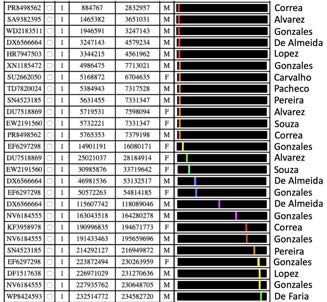
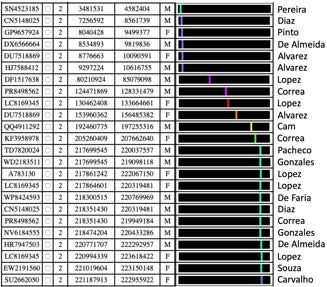
74.13. GENETIC ANALYSIS BASED ON MYTRUEANCESTRY®
1619
Figure 74.10:
Chromosome 1. Over-
lapping DNA-sequences between de Silva
(kit FD9011758) and other kits (code in-
dicated left) of family names (indicated to
the right) which appeared at Goa and at
Kotte early in the Portuguese period.
Figure 74.11:
Chromosome 2. Over-
lapping DNA-sequences between de Silva
(kit FD9011758) and other kits (code in-
dicated left) of family names (indicated to
the right) which appeared at Goa and at
Kotte early in the Portuguese period.
complete name and email address and the centiMorgan and SNP estimates per section). We added the persons to which each sample kit (left column) belongs on the right-hand side. Note that for specific terms, we used more than one kit. In that case, the difference can be seen by the variation in the kit code in the right column. The 4th and 5th columns show the DNA sequence’s B37
Start Position and the B37 End Position, which appears both on the de Silva sample and the specific sample in the figure. This shared section is indicated by a color bar in the graphic image in the 7th column. The numbers and the graphical representation make comparing common overlaps between de Silva and several samples easy. These family names appear as clusters of persons with common DNA in the de Silva DNA, which indicates inbreeding within a small population. Since the samples are from Iberia, this inbreeding, shared with our de Silva sample, must have occurred before the Portuguese voyages to India. A reasonable assumption is that this is caused by marriages amongst the nobility, somewhat similar to unions within the same caste.
Further inbreeding occurred in Goa, India. However, the first Portuguese arrivals in Goa married local women; from the second generation onward, sons probably mainly married daughters of other Luso-Indian families. Therefore, after a century or so, the pioneering Luso-Portuguese families at Goa and Sri Lanka must have been blood-related to each other. However, The latter explanation is insufficient because the samples have an Iberian origin. Therefore, the strongest inbreeding must have occurred in the period before the settlement at Goa, i.e., marriages within the nobility class.
74.13 Genetic Analysis based on MyTrueAncestry®
The platform uses PCA (Principle Component Analysis) to determine the genetic distance between samples and, consequently, between populations. The technique has been described in Chapter 73.11 on the DNA analysis of Declercq. The results are shown in Figures 74.32, 74.33, 74.34, 74.35 and 74.36.
Of the closest Indian tribes and peoples linked to de Silva, we find, in Figure 74.36, the following four: Dusadh: they are also known as Paswan; they form a Hindu caste and are found in Bihar, Purvanchal, and Jharkhand, not far from Jaunpur;
North-Kannadi: this population is found where Goa is located and the area East of Goa (Uttara Kannada); Chenchu: an ancient Dravidian tribe in Karnataka (just East of Goa) and areas further east.
Kol: this tribe is spread all over the North-East of India.
MyTrueAncestry® provided a timeline, shown in the Figures 74.37, 74.38, 74.39, and 74.40.
The Desclergues of la Villa Ducal de Montblanc, 2nd ed., Omn., VOL. VII
© 2024 Nico F. Declercq
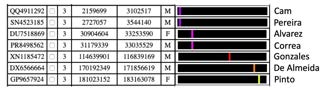
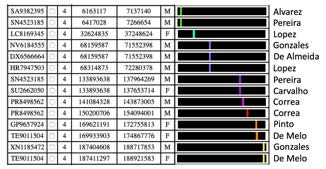

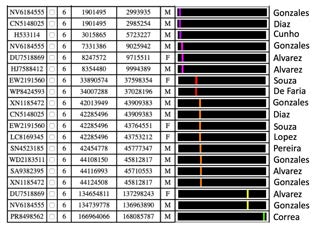
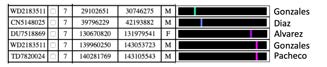
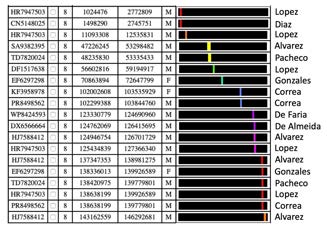
1620
CHAPTER 74. DNA DE SILVA
Figure 74.12:
Chromosome 3. Over-
lapping DNA-sequences between de Silva
(kit FD9011758) and other kits (code in-
dicated left) of family names (indicated to
the right) which appeared at Goa and at
Kotte early in the Portuguese period.
Figure 74.13:
Chromosome 4. Over-
lapping DNA-sequences between de Silva
(kit FD9011758) and other kits (code in-
dicated left) of family names (indicated to
the right) which appeared at Goa and at
Kotte early in the Portuguese period.
Figure 74.14:
Chromosome 5. Over-
lapping DNA-sequences between de Silva
(kit FD9011758) and other kits (code in-
dicated left) of family names (indicated to
the right) which appeared at Goa and at
Kotte early in the Portuguese period.
Figure 74.15:
Chromosome 6. Over-
lapping DNA-sequences between de Silva
(kit FD9011758) and other kits (code in-
dicated left) of family names (indicated to
the right) which appeared at Goa and at
Kotte early in the Portuguese period.
Figure 74.16:
Chromosome 7. Over-
lapping DNA-sequences between de Silva
(kit FD9011758) and other kits (code in-
dicated left) of family names (indicated to
the right) which appeared at Goa and at
Kotte early in the Portuguese period.
Figure 74.17:
Chromosome 8. Over-
lapping DNA-sequences between de Silva
(kit FD9011758) and other kits (code in-
dicated left) of family names (indicated to
the right) which appeared at Goa and at
Kotte early in the Portuguese period.
© 2024 Nico F. Declercq
The Desclergues of la Villa Ducal de Montblanc, 2nd ed., Omn., VOL. VII
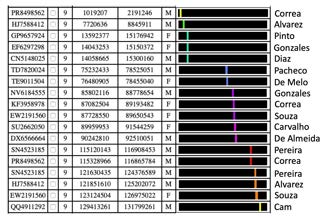
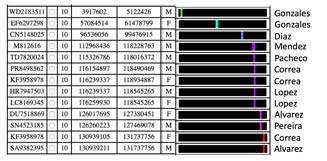
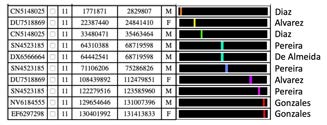
74.14. GENEANET® DNA RESULTS FOR DE SILVA
1621
Figure 74.18:
Chromosome 9. Over-
lapping DNA-sequences between de Silva
(kit FD9011758) and other kits (code in-
dicated left) of family names (indicated to
the right) which appeared at Goa and at
Kotte early in the Portuguese period.
Figure 74.19: Chromosome 10. Over-
lapping DNA-sequences between de Silva
(kit FD9011758) and other kits (code in-
dicated left) of family names (indicated to
the right) which appeared at Goa and at
Kotte early in the Portuguese period.
74.14 Geneanet® DNA Results for De Silva
On Geneanet®, some individuals described in other tests appear and are not repeated here. Instead, we focus on a few matching samples found only in Geneanet®, although the centiMorgan numbers are small.
We found several links in the Navarra area (on the Spanish and the French side of this historical region): Marcella Vallejo (7 centiMorgans),
Laspumaderes and Lasmarigues (7.5 centiMorgans),
Crabos (7.5 centiMorgans),
Someone from near Biaritz (22.4 centiMorgans).
We also found Spanish persons or persons with definite Spanish roots:
Sebastien Kaeuffer with ancestors de Espinosa, de Aragon, de la Torre, de Miranda, de los Monteros, de Burgos, Sanz (7.1 centiMorgans) Christophe Dagues, a French with Spanish roots (Falgas, Costa, Creissels, Colomer, Pujol, Delbo, Pages, Esteve, Dominjo, LLoansi, Estrada, Moulenat, Doulatge, Delonqua, Vidal, Llensa, Marty, Bosc, Delonca, Andreau) (7 centiMorgans).
A person with Spanish ancestors Molina, Belasi, Linco and also Dupuits (1.4 centiMorgans)
de Rico, sharing 7.8 centiMorgan with de Silva. Geneanet® shows the registrations of de Rico before 1600 as having a maximum in Castille and Leon (in Salamanca) and, interestingly, exposing a ring around the old Sevilla Kingdom. The map is shown in Fig. 74.41.
The French persons in this list were from Aquitaine and are probably linked through ancestors of Fernando Samara de Cunha y Rala because Samara originates in that area. This person, a Sri Lankan with Portuguese ancestors, played a significant role in establishing Uduwara, where Shirani de Silva’s ancestors lived. He is described in Chapter 56.7. The connection is probably to be found in the Navarra Kingdom. The DNA likely entered the family through mutual descendants of Samara de Cunha y Rala and Antonio Carvalho de Silva in Uduwara, Sri Lanka.
Autosomal links in Latin America are equally prevalent.
Inalda Santos from Brazil (7.2 centiMorgans)
Even the VOC can be retrieved
Maria-Laura Louise Kapellen, a person with only Dutch ancestors and old Sephardic ancestors (8.3 centiMorgans).
Interestingly some British traces are also found, which we cannot explain based on the known ancestry. It concerns either an old Iberian connection, or an illegitimate ancestor.
Drewel-Hedden with only ancestors in Great Britain (7.2 centiMorgans).
We equally found a Sri Lankan connection that shows that the de Silva clan of Uduwara must, in the beginning, have been Karava caste.
Prishani Arachchige, with ancestors Ranasinghe Arachchige, Disanayake, Kandadage (48.6 centiMorgans).
Nilukshi Alankara, with ancestors Alankara, Perera, Abeysinghe en Wanniarachchige and blood-related with the above Prishani Arachchige.
Figure 74.20: Chromosome 11. Over-
lapping DNA-sequences between de Silva
(kit FD9011758) and other kits (code in-
dicated left) of family names (indicated to
the right) which appeared at Goa and at
Kotte early in the Portuguese period.
The Desclergues of la Villa Ducal de Montblanc, 2nd ed., Omn., VOL. VII
© 2024 Nico F. Declercq
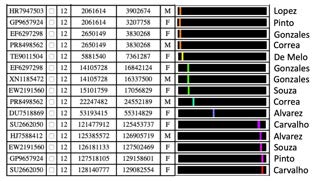
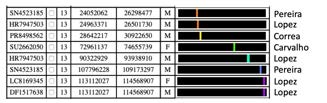
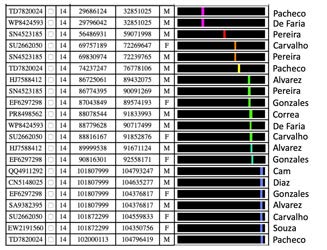
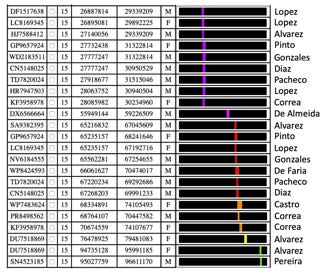
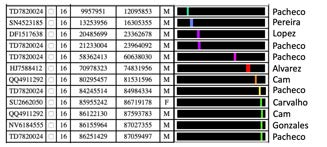
1622
CHAPTER 74. DNA DE SILVA
Figure 74.21: Chromosome 12. Over-
lapping DNA-sequences between de Silva
(kit FD9011758) and other kits (code in-
dicated left) of family names (indicated to
the right) which appeared at Goa and at
Kotte early in the Portuguese period.
Figure 74.22: Chromosome 13. Over-
lapping DNA-sequences between de Silva
(kit FD9011758) and other kits (code in-
dicated left) of family names (indicated to
the right) which appeared at Goa and at
Kotte early in the Portuguese period.
Figure 74.23: Chromosome 14. Over-
lapping DNA-sequences between de Silva
(kit FD9011758) and other kits (code in-
dicated left) of family names (indicated to
the right) which appeared at Goa and at
Kotte early in the Portuguese period.
Figure 74.24: Chromosome 15. Over-
lapping DNA-sequences between de Silva
(kit FD9011758) and other kits (code in-
dicated left) of family names (indicated to
the right) which appeared at Goa and at
Kotte early in the Portuguese period.
Figure 74.25: Chromosome 16. Over-
lapping DNA-sequences between de Silva
(kit FD9011758) and other kits (code in-
dicated left) of family names (indicated to
the right) which appeared at Goa and at
Kotte early in the Portuguese period.
© 2024 Nico F. Declercq
The Desclergues of la Villa Ducal de Montblanc, 2nd ed., Omn., VOL. VII
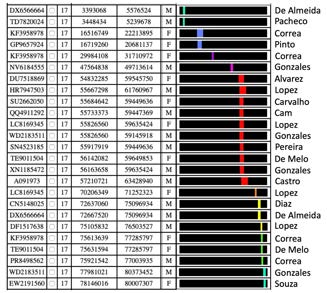
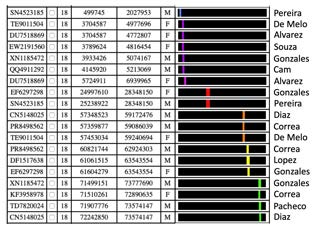
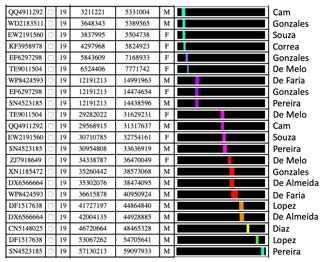
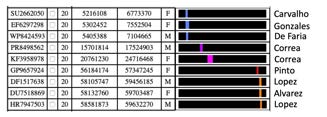
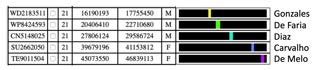
74.14. GENEANET® DNA RESULTS FOR DE SILVA
1623
Figure 74.26: Chromosome 17. Over-
lapping DNA-sequences between de Silva
(kit FD9011758) and other kits (code in-
dicated left) of family names (indicated to
the right) which appeared at Goa and at
Kotte early in the Portuguese period.
Figure 74.27: Chromosome 18. Over-
lapping DNA-sequences between de Silva
(kit FD9011758) and other kits (code in-
dicated left) of family names (indicated to
the right) which appeared at Goa and at
Kotte early in the Portuguese period.
Figure 74.28: Chromosome 19. Over-
lapping DNA-sequences between de Silva
(kit FD9011758) and other kits (code in-
dicated left) of family names (indicated to
the right) which appeared at Goa and at
Kotte early in the Portuguese period.
Figure 74.29: Chromosome 20. Over-
lapping DNA-sequences between de Silva
(kit FD9011758) and other kits (code in-
dicated left) of family names (indicated to