

The Desclergues of la Villa Ducal de Montblanc, Second Edition Omnibus by Nico Declercq - HTML preview
Download the book in PDF, ePub, Kindle for a complete version.
Maria Lesage died in 1980. Her death announcement and mortuary card are shown in Figures 64.156 and 64.157.
64.7.7.5 Their Offspring
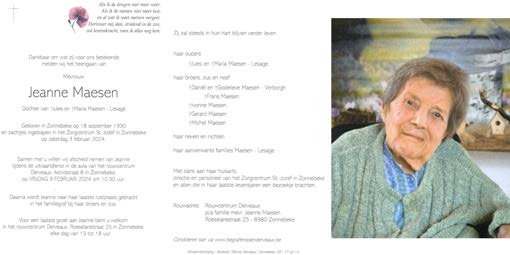
The Maesen-Lesage family had five children. The eldest child, Daniel Maesen (1926 - 1976), married Godelieve Verborgh. He was the only one who established a family, and they lived in Moustier, near Frasnes-Les-Avaing. The other children, in order of birth, were Ivonne Maesen (died before 2020), Jeanne Maesen (born on September 18, 1930, and she died, in Figure 64.181 on February 3, 2024, in Zonnebeke), Gerard Maesen (died before 2020), and Michel Maesen (born in Zonnebeke on August 28, 1939, and died, in Figure 64.158, in Zonnebeke on April 6, 2020). Despite having five children, the family reached a tragic end for two main reasons.
Jules Maesen sadly died in a car accident, and his only child, Frans, also perished in a car accident a few years later. The other descendants of the Maesen-Lesage family were so focused on their possessions, consumed by greed and suspicion, that they never married and lived together until their deaths. They owned a vast farm in Zonnebeke, but what is the purpose of owning land if one has no life and no sense of purpose?
The author’s father, Maurice, extended his help to Godelieve Verborgh, Daniel’s widow, and frequently visited Moustier to assist her with her garden and enjoy the farm life away from the hustle and bustle of Deerlijk, returning to his farm roots. Moustier, where Godelieve lived, was more accessible from Deerlijk than from Zonnebeke. Offering help was second nature to Maurice and Godelieve, who had endured a miserable life and found solace in chatting with her cousin-in-law rather than her brothers-in-law.
Maurice was Godelieve’s link to the outside world, her cornerstone, and her freedom.
The author knew Godelieve Verborgh very well, visiting her frequently with his father in Moustier. After her son’s death, Godelieve was very lonely but refused to leave Moustier because it was where her husband and son were buried. Her situation was perfectly understandable, yet she could not find peace tragically. Her son’s bedroom remained undisturbed until her death as if he could return any day. She had only disturbed the room once when she moved from her farm to a house on Rue de Grandmetz in Moustier, where she recreated the room as if her son could return home at any moment.
The author takes care of the gravestones in Moustier mainly out of respect for Frans Maesen, who had to balance his education with farming after his father’s death. He must have been a very courageous and exemplary young man. For example, while his schoolmates ate quietly in the refectory, Frans had to eat his sandwiches on the tractor while quickly working a piece of land.
Tragically, such a brave young man had to die so early. Frans’ fiancée never abandoned her would-be mother-in-law, visiting Godelieve weekly. Godelieve cherished these visits and was glad that Frans’ fiancée had found another husband and had children, though the thought that those children could have been her grandchildren was painful. Life can indeed be harsh and bitter.
Godelieve deserved a better life; she was correct and generous, and the author remains grateful.
Perhaps she recognized her son Frans in him, appreciating his dedication to combining school and family life during his education.
The tomb of Daniel Maesen and Godelieve Verborgh is shown in Figure 64.159. The obituary card of their son Frans Maesen is shown in Figure 64.160, and his tomb is shown in Figure 64.161.
The Desclergues of la Villa Ducal de Montblanc, 2nd ed., Omn., VOL. V
© 2024 Nico F. Declercq
1270
CHAPTER 64. THE LESAGE ANCESTRY LINE
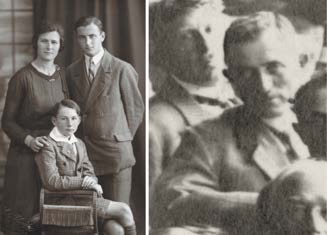
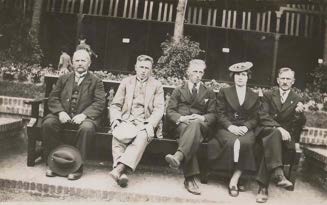
Figure 64.165:
Paul Lesage, his wife
Marie Magdalena Herpoelaert, and their
son Gaston Lesage. The photo was taken
by ’Photo Vlieghe Wevelghem.’ The other
photo is of Paul Lesage in 1933 at a
Banquet in Deerlijk on August 16. Ed-
ward Vermeulen, Marnix Gijsen, Ernest
Constant Declercq, and many others were
seated next to him. A description can be
found in Chapter 44. (Declercq de Silva
Archive)
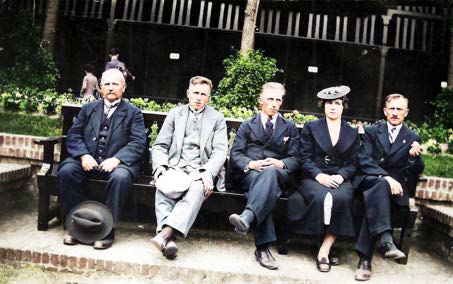
Figure 64.166: Zoo in Antwerp, 1938, left to right: Désiré Herpoelaert, Daniel Lesage, Paul
Lesage, Maria Herpoelaert, Joseph Ziller (described in Chapter 44.8.4 and Chapter 64.7.8.5).
MyHeritage® colorized this photo. (Declercq de Silva Archive)
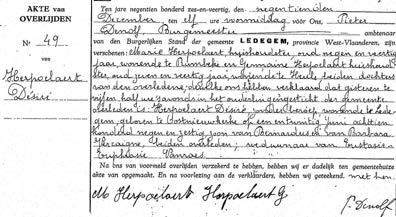
Figure 64.167: Ledegem, December 18, 1946, the death of Désiré Herpoelaert, born
at Oostnieuwkerke on June 21, 1869, son of Bernaerdus Herpoelaert and Barbara
Vercaigne and widower of Eustasie Euphrasie Vanraes. The death was reported by his
daughters, 49-year-old Marie Herpoelaert from Rumbeke and 47-year-old Germaine
Herpoelaert from Heule. Note that Oostnieuwkerke is next to Westrozebeke. Hence,
Désiré Herpoelaert and Emile Lesage probably knew each other from there.
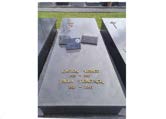
Figure 64.168: The tomb of Gaston Lesage and Paula Demuynck,
Roeselare. (Declercq de Silva Archive)
© 2024 Nico F. Declercq
The Desclergues of la Villa Ducal de Montblanc, 2nd ed., Omn., VOL. V
64.7. THE OFFSPRING OF EMILE LESAGE AND EUDOXIE LAMMENS
1271
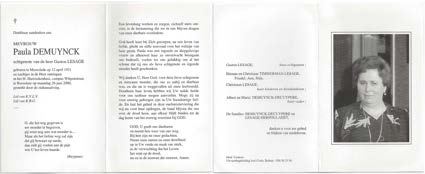
Figure 64.169: The obituary card of Paula Demuynck, the wife of Gaston Lesage. She
was born in Moorslede in 1931 and died in Roeselare in 2000. (Declercq de Silva Archive)
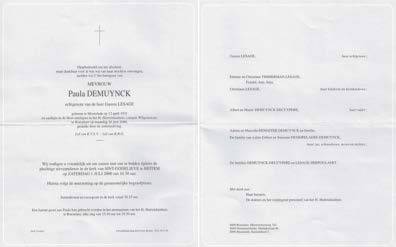
Figure 64.170: The death announcement of Paula Demuynck, the wife of Gaston
Lesage. (Declercq de Silva Archive)
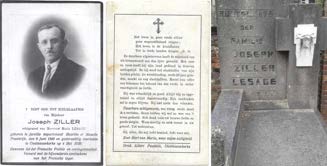
Figure 64.171:
The obituary card of
Joseph Ziller, husband of Maria Lesage.
He died in 1939 and was French. Right, we
see his grave at Westrozebeke. (Declercq de
Silva Archive)
Figure 64.172: Martha, Maria, and Godelieve Lesage (left to right)
at the funeral of their brother-in-law, Michel Declercq, at Sint Lodewijk,
Deerlijk, August 1963. (Declercq de Silva Archive)
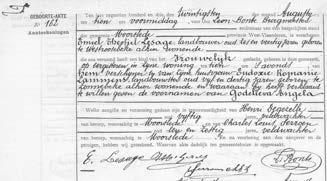
Figure 64.173:
Moorslede, August 18,
1903, the birth of Godelieve Angela Lesage,
daughter of 46-year-old farmer Emile
Theophile Lesage and 35-year-old Eudoxie
Romanie Lammens.
The Desclergues of la Villa Ducal de Montblanc, 2nd ed., Omn., VOL. V
© 2024 Nico F. Declercq
1272
CHAPTER 64. THE LESAGE ANCESTRY LINE
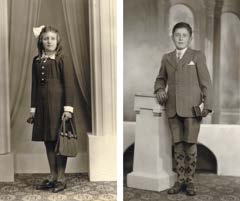
Figure 64.174: Maria and Jules Verhaeghe are the two
children of Camiel Verhaeghe and Godelieve Lesage. Stu-
dio Gerard Moorslede took the photo. (Declercq de Silva
Archive)
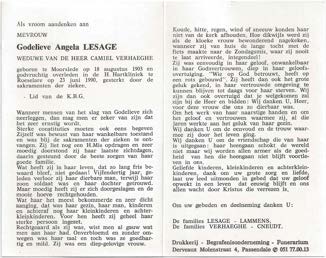
Figure 64.175:
The obituary card of
Godelieve Angela Lesage, wife of Camiel
Verhaeghe, 1990.
(Declercq de Silva
Archive)
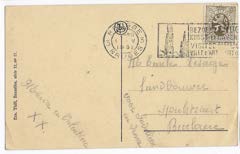
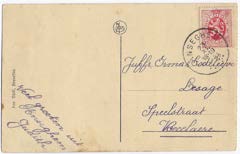
Figure 64.176: May 4, 1931, a postcard sent to Irma
Lesage and Godelieve Lesage, by Maria Declercq and
Valentine Declercq, addressed to Emile Lesage. (Declercq
de Silva Archive)
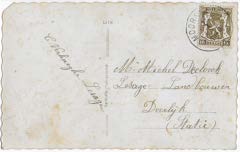
Figure 64.177: November 23, 1931, a postcard sent
from Anzegem, to Irma Lesage and Godelieve Lesage in
Beselare, by Judith Declercq. (Declercq de Silva Archive)
Figure
64.178:
January 1940, a postcard sent
by Camiel Verhaeghe and Godelieve Lesage, from
Moorslede, to Michel Declercq and Irma Lesage in Deer-
lijk. (Declercq de Silva Archive)
© 2024 Nico F. Declercq
The Desclergues of la Villa Ducal de Montblanc, 2nd ed., Omn., VOL. V
64.7. THE OFFSPRING OF EMILE LESAGE AND EUDOXIE LAMMENS
1273
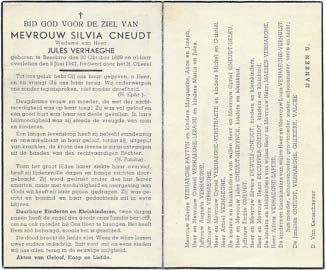
Figure 64.179: 1947, the obituary card
of Silvia Cneudt, the widow of Jules Ver-
haeghe. The family list mentions ’Heer
en Mevrouw Camiel Verhaeghe Lesage en
kinders Maria en Jules.’ (Declercq de Silva
Archive)
64.7.8 Paul Ireneus Lesage
64.7.8.1 Introduction
Readers may be interested in reading Chapter 44.8.3 first.
Paulus Ireneus Lesage (Moorslede, June 19, 1902 - Roeselare, September 1, 1976) had three brothers when he was born and three sisters: Cyrille, Martha, Amandine, Gerard, Hector and Maria. Later, he would have two more brothers and two sisters, Godelieve, Irma, Oscar, and Daniel.
Paul was born in Moorslede, near the train station in Statiestraat 518.
In July 1912, the family moved to Ledegem to a farm at Kortwagenstraat 33. Everything went well until WWI started in the summer of 1914. During the Germans’ invasion of Belgium, Eudoxie fled to Oudezeele in northern France, close to the Belgian border.
Emile Lesage stayed at the farm in Ledegem with Paul while Cyrille was in the military. Later, the other sons, Gerard and Hector, would join the military after moving with their mother to Oudezeele.
On July 23, 1917, Emile Lesage and Paul were expelled from their village of Ledegem and went to Wielsbeke.
Paul had his arm severely injured during a bombardment on August 1, 1916, while he was peeling potatoes. Emile and Paul stayed a couple of months at the farm of the Declercq family.
Paul Lesage was the same age as the eldest son of the Declercq family.
The official Belgian address of the entire Lesage-Lammens family remained at Ledegem throughout, although nobody lived there anymore from July 1917 onwards.
On September 30, 1921, the family changed its official address from Ledegem to Beselare, Spilstraat 12 on Keiberg, at the junction with Slangemeersstraat. Paul Lesage, however, stayed at Ledegem and would, given that he had an injured arm on July 23, 1917, due to a bombardment, become a harness manufacturer.
64.7.8.2 His Birth
His birth document at Moorslede in 1902 is shown in Figure 64.162.
64.7.8.3 About Petrus Jules Herpoelaert
Petrus Jules Herpoelaert was the brother-in-law of Paul Lesage.
We refer to his military registration in Nationale Militie, lichting van 1914, 36e militiekanton, gemeente Ledeghem. We found in register 18 that Petrus Jules Herpoelaert was a blacksmith, born in Ledegem on October 24, 1894, son of Désiré Herpoelaert from Oostnieuwkerke and Eustasie Euphrasie Vanraes from Beselare.
He died in Dentergem on November 2, 1918, during the liberation of Belgium by the Belgian armed forces.
His death certificate appears on the same page as that of Hector Lesage in Figure 64.163, described in Chapter 64.7.6.
64.7.8.4 His Marriage and Offspring
Paul Lesage was married, in Figure 64.164, to Maria Magdalena Herpoelaert (1897-1967), daughter of Désiré Herpoelaert (1869-1946) and Eustasie Anastasie Vanraes (1864). They had one child, Gaston Lesage, who married Paula Demuynck, daughter of Albert Demuynck and Maria Decuypere. Paul Lesage was born in Moorslede on June 19, 1902, and died in Roeselare on September 1, 1976.
Figure 64.165 shows a family picture of Paul Lesage, Maria Herpoelaert, and their son Gaston.
In Chapter 44, we described Paul’s presence at a Banquet in Deerlijk in 1933, where the picture in Figure 64.165 was taken.
The photo in Figure 64.166 was taken during a visit to the Zoo of Antwerp 1938. We don’t know who joined the journey, but in the picture, we can see Désiré Herpoelaert, father of Maria Herpoelaert, who lived with Paul Lesage and Maria Herpoelaert at Ledegem en would die there in 1946. His death is shown in Figure 64.167.
We can also see Paul Lesage with his wife, Maria Herpoelaert.
Daniel Lesage was next to Désiré Herpoelaert, who was, since 1934, married to Magdalena Meersseman.
On the right is Joseph Ziller, who would die in 1939, husband of Maria Lesage.38
38This particular Maria Lesage was probably not related and should not be confused with Maria Lesage, who was married to Jules Maesen. It probably concerns Godelieve Maria Lesage, born in Ledegem in a Lesage family from Moorslede, on June 21, 1908, daughter of another Emile Theophile Lesage and Elodie Taillieu.
The Desclergues of la Villa Ducal de Montblanc, 2nd ed., Omn., VOL. V
© 2024 Nico F. Declercq
1274
CHAPTER 64. THE LESAGE ANCESTRY LINE
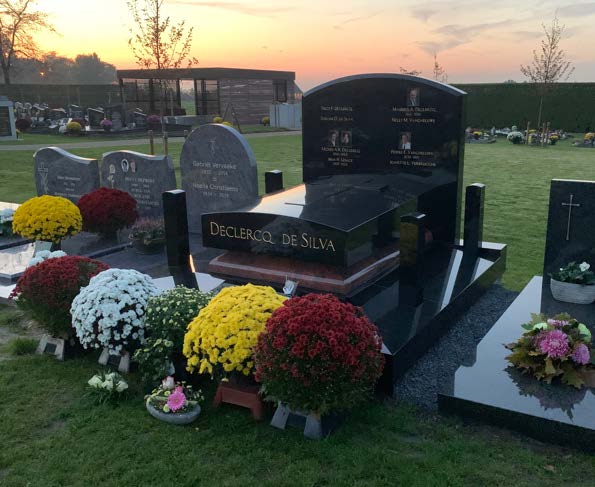
Figure 64.180: Irma Lesage rests alongside Michel Declercq in the Declercq de Silva family grave at Sint Lodewijk in Deerlijk.
Their tomb, designed and crafted in Ypres near the Menin Gate, stands as a tribute to Irma’s heritage and origins. (Declercq de Silva Archive)
Figure 64.181: The death announcement and photo of Jeanne Maesen, February 3, 2024, in Zonnebeke.
She died at the age of almost 94 peacefully and was buried in the family tomb with her parents, sister, and brothers. (Declercq de Silva Archive)
© 2024 Nico F. Declercq
The Desclergues of la Villa Ducal de Montblanc, 2nd ed., Omn., VOL. V
64.7. THE OFFSPRING OF EMILE LESAGE AND EUDOXIE LAMMENS
1275
Paul Lesage’s son, Gaston, was married to Paula Demuynck. Her death documents are presented in Figures 64.169 and 64.170.
Their tomb is seen in Figure 64.168.
64.7.8.5 About Joseph Ziller
He is also mentioned in Chapter 44.8.4. Joseph Ziller can be found in Figure 64.166, taken at the Zoo in Antwerp in 1938. He was married to Maria Lesage. Nevertheless, this was not Maria Lesage, daughter of Emile Lesage and Eudoxie Lammens. Joseph Ziller was likely a family friend since their stay at Oudezeele and was, as a coincidence, married to Maria Lesage. Or else, this Maria Lesage was the family of Emile Lesage. The fact that the Lesage family spoke French must have strengthened their bond because Joseph was French. In Figure 64.171, his obituary card insinuates that he died in 1939 because of health consequences related to WWI.
Interestingly, we found a Godelieve Maria Lesage, born at Ledegem on June 21, 1908, daughter of Emile Theophile Lesage (not our Emile Theophile Lesage) and Elodie Taillieu. Her brother was Leon Lesage, born at Ledegem in 1905 and died in Roeselare in 1999. Likely, the two families knew each other from either Ledegem or Moorslede. Perhaps this Godelieve Maria Lesage even joined Eudoxie to Oudezele in France when WWI began and went to know Joseph Ziller there. Joseph Ziller’s tomb is also shown in Figure 64.171.
64.7.9 Godelieve Angela Lesage
64.7.9.1 A Brief Description
The author knows Godelieve Lesage and has met her several times with Daniel Lesage. She was already over 80 years old. She can be seen in Figure 64.172.
When Godelieve Angela Lesage (Moorslede August 18, 1903 - Roeselare, June 23, 1990) was born, in Figure 64.173, she had three sisters, Martha, Amanda, and Maria; and four brothers, Cyrille, Gerard, Hector, and Paul. Later, two more brothers, Oscar and Daniel, and one sister, Irma, would follow.
Godelieve was born and raised in Moorslede (Statiestraat 518) and moved to Ledegem, where the family had a farm at Kortwagenstraat 33. When WWI started, her eldest brother, Cyrille, was in the military and died in 1916. Two more brothers became military during the war Gerard and Hector. In October of 1914, the latter died, while Gerard, a gas attack victim, died of health problems in 1933.
Godelieve stayed with her mother, Eudoxie, and her siblings in Oudezeele during the war. They remained with the Secq family at Route des Trois Rois 77, the road from the village center to Café des Trois Rois, the house being located near the village center.
The home was designated number 49 on the list of homes of refugees at Oudezeele during WWI. Godelieve’s father, Emile, and her elder brother, Paul, had not joined them but stayed in Ledegem at the family farm.
On September 30, 1921, the whole family changed its official address from Ledegem to Beselare, Spilstraat 12 on Keiberg, at the junction with Slangemeersstraat. Godelieve lived there in the 1920s and also a period in the 1930s until she married.
64.7.9.2 Her Marriage and Offspring
She was married to Camille Achiel Verhaeghe, born in 1898 in Beselare, and he died at Beselare in 1955. They had a daughter, Maria Verhaeghe, in Figure 64.174, born in 1935, married to Raymond Vulsteke (1926-2001).
They had a son, Jules Verhaeghe (1936-2001), also in Figure 64.174, who was married to Rachel Vangheluwe.
64.7.9.3 Her Death
Godelieve Lesage died in 1990. Her mortuary card is presented in Figure 64.175.
64.7.9.4 Some Memorabilia
Some memorabilia are shown in Figures 64.176, 64.177, 64.178 and 64.179.
64.7.10 Irma Helena Lesage
She is the author’s grandmother, and her life is extensively described in Chapter 45.2. She was the great-great-great-great-great-granddaughter of Adrienne de Patin (DP12) and was born in 1905 in Moorslede, Belgium, as the daughter of Emile Theophile Lesage and Eudoxie Romanie Lammens.
She married Michel Achiel Renatus Declercq (DC15) and died in 1953 in Kortrijk, Belgium. She is now buried in the family grave established by the author, in Figure 64.180.
She is equally referred to in the following chapters: Chapter 66.1 as great-great-great-granddaughter-in-law of Barbara Benoit; Chapter 66.2 as the great-great-great-great-granddaughter of Maria Jeanne Christine Benoit; Chapter 68 in the ’t Kint ancestry line; in Chapter 65 as great-great-great-great-great-granddaughter of Adrienne de Patin (DP12); and Chapter 71 as the granddaughter of Clemens Lammens and Natalia Juliana Decaestecker.
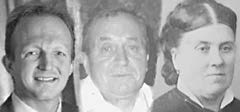
Figure 64.182: Left is Oscar Lesage at
the age of 13-14. In the middle is his wed-
ding with Anna Soenen. Right is a picture
taken from his obituary card. (Declercq de
Silva Archive)
The Desclergues of la Villa Ducal de Montblanc, 2nd ed., Omn., VOL. V
© 2024 Nico F. Declercq
1276
CHAPTER 64. THE LESAGE ANCESTRY LINE
Figure 64.183:
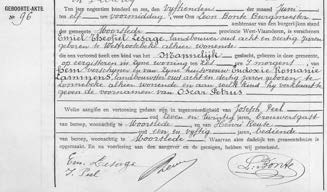
Moorslede, June 13,
1906, the birth of Oscar Petrus Lesage,
son of 48-year-old farmer Emile Theophile
Lesage and 38-year-old farmer Eudoxie
Romanie Lammens.
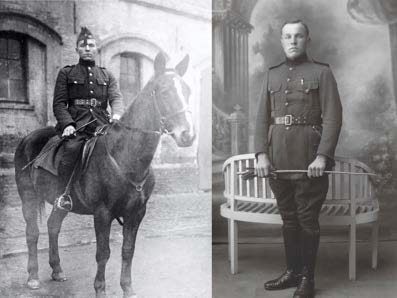
Figure 64.184: Oscar Lesage is a cavalry soldier on a horse and in uniform.
(Declercq de Silva Archive)
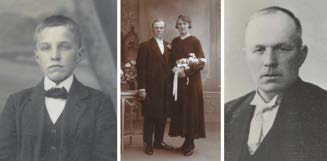
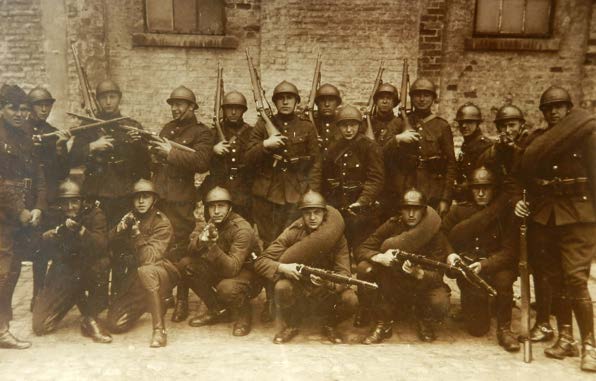
Figure 64.185: Oscar Lesage is in this picture standing in the back, almost in the middle, 7th person from the right of the image, and 7th from the left. (Declercq de Silva Archive)
© 2024 Nico F. Declercq
The Desclergues of la Villa Ducal de Montblanc, 2nd ed., Omn., VOL. V
64.7. THE OFFSPRING OF EMILE LESAGE AND EUDOXIE LAMMENS
1277
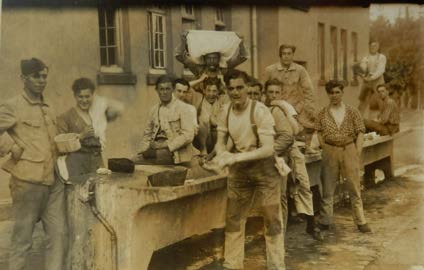
Figure 64.186: As a cavalry soldier, Oscar Lesage was at a washing table, the person
in front, soaping his friend’s feet, in 1926. The location is unknown. Military barracks
from the same period often looked the same, so it will probably never be known where this
washing table was in Belgium. (Declercq de Silva Archive)
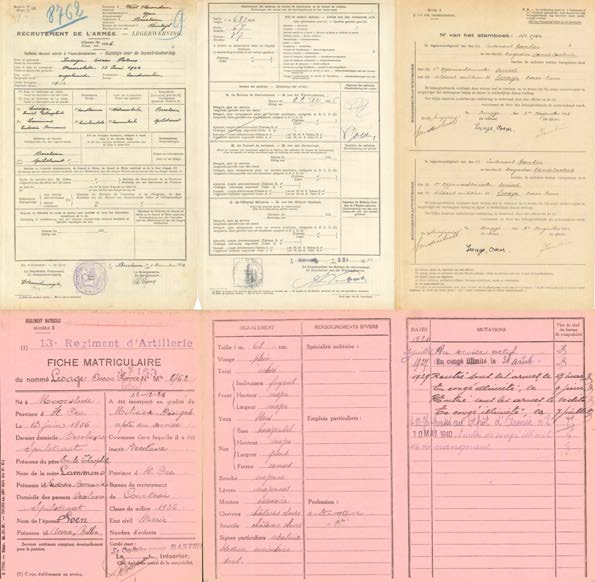
Figure 64.187: The military records of Oscar Lesage, sheets 1-5.
The Desclergues of la Villa Ducal de Montblanc, 2nd ed., Omn., VOL. V
© 2024 Nico F. Declercq
1278
CHAPTER 64. THE LESAGE ANCESTRY LINE
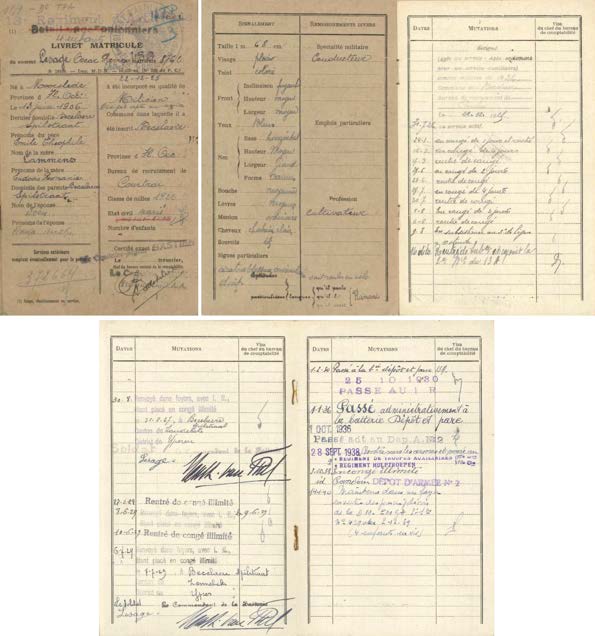
Figure 64.188: The military records of Oscar Lesage, sheets 6-8.
Figure 64.189:
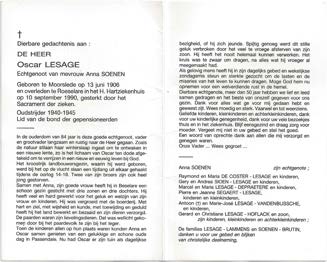
The obituary card of
Oscar Lesage, husband of Anna Soenen,
1990. (Declercq de Silva Archive)
© 2024 Nico F. Declercq
The Desclergues of la Villa Ducal de Montblanc, 2nd ed., Omn., VOL. V
64.7. THE OFFSPRING OF EMILE LESAGE AND EUDOXIE LAMMENS
1279
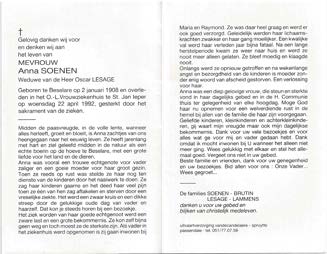
Figure 64.190:
The obituary card of
Anna Soenen, widow of Oscar Lesage,
1992. (Declercq de Silva Archive)
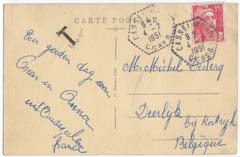
Figure 64.191: A postcard to Michel Declercq (an ad-
dress was not needed), in Deerlijk, by Oscar Lesage and
Anna Soenen, sent from Oudezeele in France. (Declercq
de Silva Archive)
64.7.11 Oscar Petrus Lesage
Because Oscar Lesage was closest in age to his brother Daniel, who the author knew well, the author frequently heard about Oscar.
He is shown in Figure 64.182.
64.7.11.1 His Birth and Youth
Oscar Petrus Lesage (Moorslede, June 13, 1906 - Roeselare, September 10, 1990) was born one year after Irma Lesage, in Figure
64.183. He had many siblings: Cyrille, Martha, Amandine, Gerard, Hector, Maria, Paulus, Godelieve, and Irma. Later, Daniel would be born when Oscar was five years old. The family lived in Moorslede when Oscar was born, near the train station at Statiestraat 518.
In July 1912, the family moved to Ledegem to a farm at Kortwagenstraat 33.
During the German invasion of Belgium in WWI, Oscar fled to Oudezeele, with his mother and most of the siblings, in the North of France, close to the Belgian border. Emile Lesage stayed at the farm in Ledegem with Paul while Cyrille was in the military.
Later, the other sons, Gerard and Hector, joined the military after moving with their mother to Oudezeele.
The family lived in Oudezeele with the Secq family at Route des Trois Rois 77, the road from the village center to Café des Trois Rois. The house was near the village center. The home was designated number 49 on the list of refugee homes at Oudezeele during WWI. The family consisted of two adults (+ children), and Eudoxie was registered as Mme Eudoxie Lesage.
The two adults were Eudoxie and her eldest daughter Martha.
On September 30, 1921, the family changed its official address from Ledegem to Beselare, Spilstraat 12 on Keiberg, at the junction with Slangemeersstraat. In the meantime, Oscar went, with his younger brother, to school in Beitem at Sint Lodewijkschool and moved, with his wife, to the parents’ home in Beselare in the 1930s. The young Oscar Lesage appears in Figure 64.182.
64.7.11.2 His Marriage and Offspring
Oscar Lesage and Anna Soenen, shown in Figure 64.182, had the following children: Maria Lesage (1934-2005), who married Raymond Decoster; Andrea Lesage (1936), who married Gery Sioen (1934-2015); Marcel Lesage, who married Maria Depraetere; Jeanne Lesage, who married Pierre Segaert (1932-2020), Antoon Lesage (1943-1987), who married Marie José Vandenbussche, and Gerard Lesage (1947-2011), who married Christiane Hoflack (1947-1999).
The census of Beselare does not list Oscar Lesage in 1920-1930. He appears with his wife Anna Soenen and his daughters Maria and Andrea on the census of 1930-1940, Keiberg, Spilstraat 12. Therefore, he lived elsewhere before he married, just like his brother, Daniel Lesage.
He would continue to live with his family on his parent’s farm in Beselare.
The author has warm memories of Andrea Lesage and Gery Sioen and is still in touch with Stefaan Lesage, a wise grandson of Oscar Lesage and son of Gerard Lesage (1947-2011).
64.7.11.3 His Military Service during the Interbellum and WWII
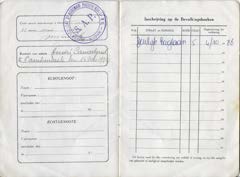
He was born in Moorslede on June 13, 1906, and joined the army in the class of 1926. He lived in Beselare when the army recruited him on December 1, 1925, although we did not find him in the census. His military records show that he was 1.68 m tall, his weight was 67 kg, and his thorax was 87.
He was recited as a soldier militias 26 in the 13th Artillery Regiment, registered as number 8762.
When the army recruited him, he was already married to Anna Bertha Soenen.
His military records lists his characteristics as follows:
The Desclergues of la Villa Ducal de Montblanc, 2nd ed., Omn., VOL. V
© 2024 Nico F. Declercq
1280
CHAPTER 64. THE LESAGE ANCESTRY LINE
Taille: 1m 68cm. (Size: 1m 68cm)
Visage: plein. (Face: full)
Teint: Coloré. (Complexion: Colorful)
Front inclinaison: fuyant. (Front tilt: fleeing)
Front Hauteur : Moyen. (Front Height: Medium)
Front largeur : moyen. (Front width: medium)
Yeux : bleu. (Blue eyes)
Nez base : horizontal. (Nose base: horizontal)
Nez hauteur : moyen. (Nose height: medium)
Nez largeur : grand. (Nose width: large)
Nez Forme : camus. (Nose Shape: Camus)
Bouche : moyenne. (Palate: medium)
Lèvres : moyennes. (Lips: medium)
Menton : ordinaire. (Chin: ordinary)
Cheveux : châtains clairs. (Hair: light browns)
Sourcils : châtains clairs. (Eyebrows: light browns)
Signes particulier : blessure auriculaire droit. (Particular signs: right atrial injury)
Langue Flamant. (Flemish language)
Specialité militaire : conducteur. (military specialty : horse rider)
Profession : cultivateur. (Profession: farmer)
He became an active soldier on July 31, 1926, and was released on August 31, 1927. On May 27, 1929, he was recruited again and released on June 9. On October 1, 1936, he presented himself to the army.
In September 1938, he was recruited in the 2nd regiment of hulptroepen (Auxiliary troops).
On January 14, 1940, he was stationed at home, where he had four children. On May 10, 1940, he was recruited again as a cavalry soldier, shown in Figure 64.184.
On June 4, 1940, he was reported as missing. Other images of Oscar as a military are shown in Figures 64.184, 64.185 and 64.186.
Experts to whom Figure 64.185 was shown noted that the spurs on the boots and the style of their trousers indicate that they were cavalry. The weapons were the Mauser Carabin model 1889. They are wearing the First Company uniform model 1915. Further details revealed that it was probably an artillery-on-horse regiment (Régiment d’ Artillerie ’a Cheval – RACH ) based at Leuven and Namur.
When WWII started, Oscar Lesage became a military again in May 1940 and took part in the 10-day war between Belgium and Germany.
Oscar Lesage’s military records until Belgium’s capitulation in 1940 are shown in Figures 64.187 and 64.188.
64.7.11.4 His Death
Oscar Lesage died on September 10, 1990, in Figure 64.189, and was buried on September 15 at Passchendaele. Anna Soenen died in 1992, in Figure 64.190.
64.7.11.5 Some Memorabilia
Oscar Lesage and Anna Soenen sent a postcard, presented in Figure 64.191.
64.7.12 Daniel Abel Lesage
He was like a grandfather to the author. It’s primarily thanks to Daniel that the author knows how the Lesage family was and possibly how the more distant relatives of de Patin must have been, illustrated in Figure 64.192.
64.7.12.1 Introduction
By the end of the 1920s, Daniel Abel Lesage had earned the moniker of the ’million-dollar bachelor.’ As the youngest son and the only unmarried member of his family, he enjoyed considerable support from his father and brothers, mainly due to the limitations imposed by a slightly handicapped left hand. This impairment was the result of a childhood accident in Oudezeele, France, where he fell from a tree. The injury was inadequately treated because of the ongoing World War I, leading to his hand not healing correctly.
Daniel often recounted this incident with humor and regret, highlighting the lack of medical care available during the war.
Daniel was once engaged to his sister-in-law, Valentine Declercq, who was celebrated as the most beautiful daughter of the Declercq-Devenyn family in Wielsbeke, as noted in Chapter 44.5.5. However, fate intervened, and their engagement did not culminate in marriage, a twist of destiny also detailed in that chapter.
Daniel Lesage passed away when the author was merely twelve years old. Despite the brevity of their time together, Daniel left an indelible mark on the author’s life, a sentiment that would resonate for years to come. The author’s opportunity to attend university was partly due to Daniel’s influence and support. In the absence of living paternal grandparents, Daniel stepped into a grandfatherly role, a mutually cherished relationship. Daniel, having no children or grandchildren of his own, treated his godson, Maurice Declercq (the author’s father), as his son.
Daniel’s remarkable sense of humor and sharp, calculating mind were among his most notable traits. He often engaged the author Figure 64.192: Exciting compilation of 3 blood-related
faces. From left to right: Nico F. Declercq (Desclergue
branch), Daniel A. Lesage (Lesage Branch) and Hort-
ence du Montet de Malussin (de Patin Branch). The
author’s forehead is more that of the Declercq line, but
facial characteristics resemble Emile Lesage and Daniel
Lesage, as shown here. Daniel’s blood relationship with
the de Patin family is evident compared to Hortence du
Montet, pictured right. (Declercq de Silva Archive)
© 2024 Nico F. Declercq
The Desclergues of la Villa Ducal de Montblanc, 2nd ed., Omn., VOL. V
64.7. THE OFFSPRING OF EMILE LESAGE AND EUDOXIE LAMMENS
1281
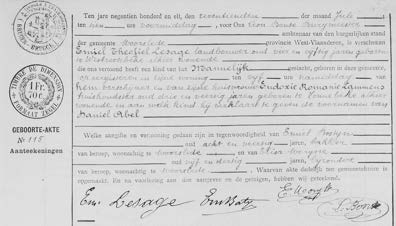
Figure 64.193: Moorslede July 16, 1911, the birth of Daniel Abel Lesage, the son
of 54-year-old farmer Emile Theophile Lesage and 43-year-old Eudoxie Romanie
Lammens.
Figure 64.194:
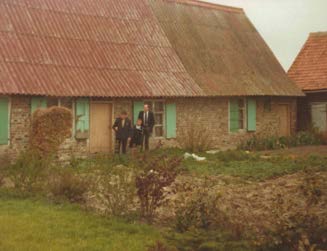
1982, Daniel Lesage
showed the author where the Lesage family
resided during WWI. The episode is de-
scribed in Chapter 64.6.2. (Declercq de
Silva Archive)
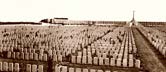
Figure 64.195: Tyne Cot Cemetery at Passchendaele-Zonnebeke just
after its construction. With Daniel, the author often made tours along
the Western Front and to the North of France, like Cassel, Eperlecques
(Sperleke), and Oudezeele. A stop at Tyne Cot was also often on the
agenda, and they had a strange habit of picnicking on a cloth on the
grass during wartime stories. The author, as a child, often played in
the bunkers that were still there.
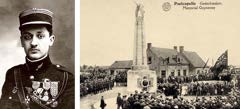
Figure 64.196: Left is Georges Guynemer, Paris 1894
- Poelkapelle 1917. While Daniel resided in Oudezeelle,
Guynemer’s stories must have been very famous. His
statue at Poelkapelle was where Daniel always wanted
to halt during the numerous rides at the Western Front.
Guynemer’s statue at Poelkapelle is shown right.
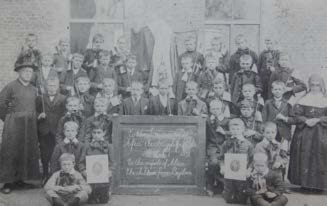
Figure
64.197:
A Class picture at
Beitem, in 1919, just after WWI, when
Daniel was eight years old. Daniel is the
boy in the front, on the right-hand side of
the picture. The boy on the other side
is Jeroom Deseyn, who lived in ’Tuime-
laarsstraat.’ The nun on the right was
Sister Anna and had the nickname ’Mous-
tache.’ The priest on the left was Louis
van Sluys, who had the nickname ’Louitje
flot.’ The picture was also published in a
book edited by Daniel Lesage.a (Declercq
de Silva Archive)
a’Sint-Lodewijkschool Beitem, 1881-1981,’
a book reviewed and commented by Daniel
Lesage, 23 pages, Drukkerij Wilfried Deleye
Ledegem.
The Desclergues of la Villa Ducal de Montblanc, 2nd ed., Omn., VOL. V
© 2024 Nico F. Declercq


1282
CHAPTER 64. THE LESAGE ANCESTRY LINE
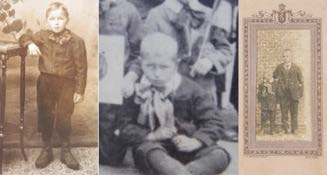
Figure 64.198: Left, 1921, Daniel Lesage
at Beitem at the age of 10. Middle, Daniel
Lesage at the school ’Sint Lodewijk’ in
Beitem, just after WWI. Right, Beitem,
1919, this picture was taken at school; we
can see 8-year-old Daniel Lesage and 13-
year-old Oscar Lesage. (Declercq de Silva
Archive)
Figure 64.199: Different scenes of Moorslede, such as a view of Breulstraat and the town hall (Gemeentehuis), in the 1920s or 1930s; He market square in 1922. It’s astonishing how fast so many homes have been reconstructed after 1918. The shape and size of the trees and the lack of pavement are still indications of the past devastation. We also observe a sketch made by the German military, we presume, at the beginning of WWI. In addition, we notice ’ Stationsstraat’ with a view of the boarding school ’Pensionaat ter Bunderen.’ The picture dates from the early 1920s.
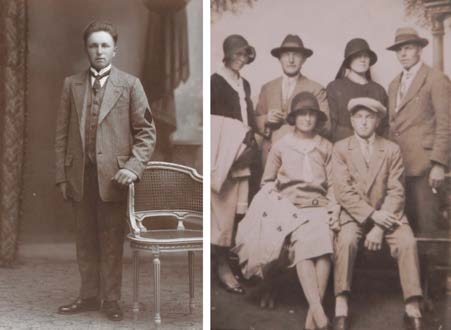
Figure 64.200: 1931, Daniel Lesage, wearing a mourning sign on his sleeve after his mother’s
death. He was twenty years old. We have a press-sealed picture cut from the above, stamped in
Moorslede. Therefore, Daniel must have lived in Moorslede in 1931 or soon after. The other
photo was taken in 1932 or soon after. In the back, we can see, from left to right, Magdalena
Meersseman with her husband, Gerard Lesage, and also Irma Lesage with her husband, Michel
Declercq. In the front, we see Valentine Declercq and Daniel Lesage. (Declercq de Silva Archive)
Figure
64.201:
The birth of Mag-
dalena Meersseman (’Magdalene Maria
Meersseman’), Moorslede, February 3,
1899 (record 31), in the administrative list
of Moorslede.
© 2024 Nico F. Declercq
The Desclergues of la Villa Ducal de Montblanc, 2nd ed., Omn., VOL. V
64.7. THE OFFSPRING OF EMILE LESAGE AND EUDOXIE LAMMENS
1283
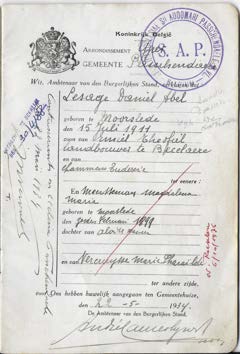
Figure 64.202:
The marriage book of Daniel Abel
Lesage and Magdalena Maria Meersseman, Passchen-
daele, May 22, 1934. The groom was born in Moorslede
on July 15, 1911, as the son of Emile Theophile Lesage
and Eudoxie Lammens, farmers at Beselare. The bride
was born in Moorslede on February 6, 1899, as Alois
Xavier Meersseman and Maria Pharailde Vercruysse’s
daughter. An administrator later added on the page
that Magdalena died in Roeselare on October 6, 1976.
In Deerlijk, the administration later wrote that Daniel
Lesage died on April 30, 1988. The second page mentions
that the Notary was André Caemerlynck in Passchen-
daele, settling a contract on May 16, 1934. In Deerlijk,
the administration added Daniel’s address, Berglaan 5,
on October 4, 1986. (sheet 1) (Declercq de Silva Archive)
Figure 64.203:
The marriage book of Daniel Abel
Lesage and Magdalena Maria Meersseman, May 22,
1934. (sheet 2) (Declercq de Silva Archive)
Figure 64.204: May 22, 1934, the wedding of Daniel
Lesage and Magdalena Meersseman. Magdalena first
married Daniel’s elder brother, Gerard Lesage, who died
in 1933 or 1934. MyHeritage® colorized this photo.
The Desclergues of la Villa Ducal de Montblanc, 2nd ed., Omn., VOL. V
© 2024 Nico F. Declercq
1284
CHAPTER 64. THE LESAGE ANCESTRY LINE
Figure 64.205: Zoo in Antwerp, 1938,
left to right: Désiré Herpoelaert, Daniel
Lesage, Paul Lesage, Maria Herpoelaert,
Joseph Ziller. More details are to be found
in Chapter 64.7.8, in particular Figure
64.166 on page 1270. The author inherited
the picture from Daniel Lesage. (Declercq
de Silva Archive)
Figure 64.206: Daniel Lesage at his brother-in-law Michel Declercq’s funeral at Saint Louis,
Deerlijk, 1963. Daniel was Irma Lesage’s brother. Several decades before, he had been the fiance of
Valentine Declercq, Michel’s sister. (Declercq de Silva Archive)
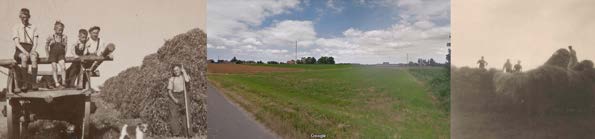
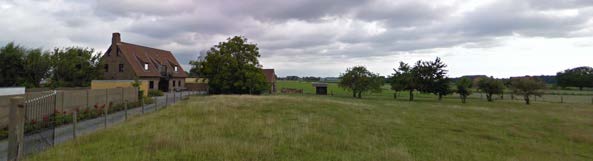
Figure 64.207: Passchendaele, Kazakke, at Messestraat 4, 1953-1955, on the chariot Daniel Lesage, at the haystack Maurice Declercq. The Kazakke is a suburb where Daniel had the land. He would only sell this land in 1966 after Maurice had decided not to become a farmer. The children on the chariot are from a nearby family, also shown right. The latter shows the atmosphere during the work on the field in ’de Kazakke.’ On the back of the picture, Daniel Lesage wrote that it is the family of the brothers Jean, Pierre, Jacques, and Georges with their aunts Mimi and Alice. The father of this family was Mr George, and he is buried at the Sint Amanduskerk in Westrozebeke. We assume it is the same family that was on the hay cart left. The middle shows a modern view of Passchendaele, Kazakke, at Messestraat 4, courtesy of Google®. (Declercq de Silva Archive) Figure 64.208: This is a current view, from Oude Molenweg in Moorslede, of what used to be the farm of Daniel Lesage and Magdalena Meersseman. The old gate is also still recognizable. Daniel used the land in front of the farm for rabbit farming.
Crops grew on two neighboring lands; one is owned by Daniel’s heirs and is located in Oude Molenweg, where horses enjoy the beautiful landscape and fresh grass. The author’s father, Maurice Declercq, has opened and closed the iron gate numerous times. (Declercq de Silva Archive)
© 2024 Nico F. Declercq
The Desclergues of la Villa Ducal de Montblanc, 2nd ed., Omn., VOL. V
64.7. THE OFFSPRING OF EMILE LESAGE AND EUDOXIE LAMMENS
1285
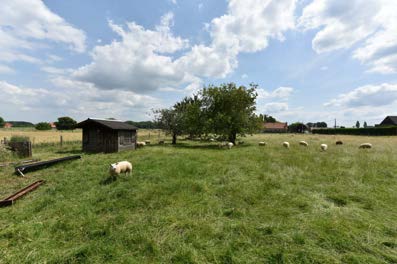
Figure 64.209: A view from the former house of Daniel and Magdalena Lesage
Meersseman at Moorslede. Around one hectare, this field was close to the home
and used for rabbit farming. More recently, sheep enjoyed the land. It’s located in
Moorslede at the junction of Roeselaarsestraat and Oude Molenweg. (Declercq de
Silva Archive)
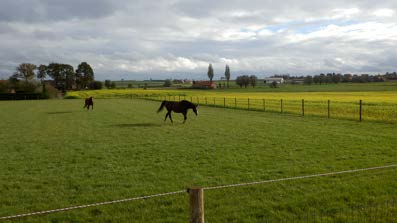
Figure 64.210: This photo, taken in Moorslede in 2012, captures a scene that
would bring a smile to Daniel Lesage’s face. The horses still roam here, and if he
were to return, he would find his home unchanged. Nothing has vanished. (Declercq
de Silva Archive)
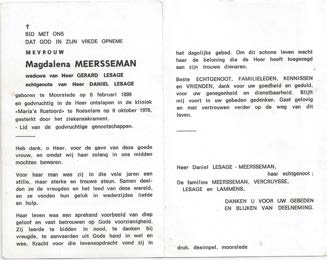
Figure 64.211:
The obituary card of
Magdalena Meersseman, the wife of Daniel
Lesage, 1976. (Declercq de Silva Archive)
The Desclergues of la Villa Ducal de Montblanc, 2nd ed., Omn., VOL. V
© 2024 Nico F. Declercq
1286
CHAPTER 64. THE LESAGE ANCESTRY LINE
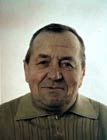
Figure 64.212: Daniel Lesage around 1980. (Declercq de Silva Archive)
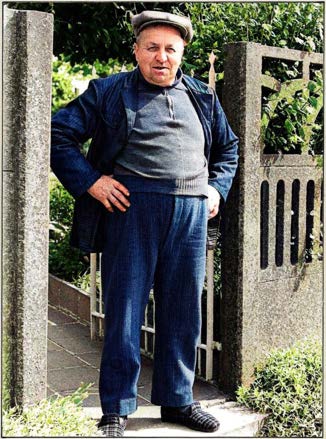
Figure 64.213: As Daniel Lesage entered
the twilight of his life, residing alone on his
cherished farm following his wife’s pass-
ing, a young photographer happened upon
his doorstep. Captivated by her charm,
Daniel agreed to her request for a photo-
graph, a moment soon forgotten amidst the
solitude of his days. In time, Daniel relo-
cated to a home for older people. Amidst
his regular visits to the familiar bakery on
Roeselarestraat, near the intersection with
Oude Molenstraat, he encountered a heart-
warming surprise. With a delighted smile,
the baker presented him with a photograph
left by the photographer, who had been un-
able to track him down. This photograph,
a splendid portrayal of Daniel, became a
cherished memento in his room at the el-
derly home. The image resonated deeply
with him, capturing the essence of his be-
ing: the pride of a dedicated farmer, the
resilience he found after his wife’s death,
and the glimmer of hope rekindled by the
charming young woman who had seen him
in a new light. His eyes sparkled with a vi-
tality that belied his years, and even his left
hand, visibly swollen from a childhood in-
jury sustained during WWI in Oudezeele,
told a story of perseverance. This hand,
long impaired, had never deterred him from
his laborious life on the farm.
When
Daniel eventually moved in with his god-
son, Maurice Declercq, in Deerlijk, the
photograph accompanied him, a constant
reminder of his journey. It was more than
an image; it was a testament to his endur-
ing spirit, capturing the complex tapestry
of his life, marked by hardship, resilience,
and an unyielding connection to his past.
MyHeritage® colorized this photo. (De-
clercq de Silva Archive)
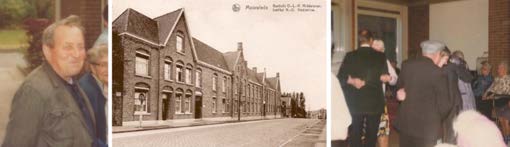
Figure 64.214: 1981, this is Daniel Lesage at the home for the elderly in Moorslede, where he resided a few years after his wife, Magdalena Meersseman, died, and before he relocated to Deerlijk. He had some moments of joy there, but overall, it was a painful period. He did not belong there. On the right, we see him dancing during a party organized by Dumortier Nutten, a Belgian champion accordion player. A Grey
African parrot (Psittacus erithacus) is in the back (the cage is visible), probably descending from a Congolese bird. The bird belonged to a particular ’Michel,’ and always shouted ’Michel, Michel, Michel...!!’ As a child, the author thought the bird was calling its owner but later realized he had copied that man’s wife’s voice and phrases. When his wife died, he moved to the elderly home and took the parrot with him - an exact copy of his wife’s voice. (Declercq de Silva Archive)
© 2024 Nico F. Declercq
The Desclergues of la Villa Ducal de Montblanc, 2nd ed., Omn., VOL. V
64.7. THE OFFSPRING OF EMILE LESAGE AND EUDOXIE LAMMENS
1287
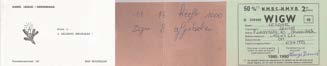
Figure 64.215: Daniel was a wise man
with a massive archive of numerous docu-
ments and photos. After his wife’s death,
he liked to stay in touch with everyone and
had New Year’s wishes pre-printed to make
it easier to bless everyone and receive a
message back. In the middle, we can see
that Daniel liked riddles. This card, for in-
stance, was discovered in 2015, many years
after his death, and described the code of
his bank safe: 111310. The right-side
document is Daniel’s public transportation
card. (Declercq de Silva Archive)
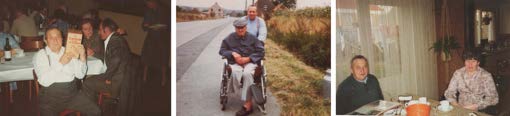
Figure 64.216: Left, we see Daniel Lesage in 1981 at the Rodenbach ballroom in Ledegem. We don’t know
which party Daniel visited on this occasion, but the picture tells us that he won a coffee pot at the tombola.
The middle photo shows Daniel, who often made walks in Moorslede with a friend in a wheelchair. He was a compassionate man. He called this particular friend ’Den Drogen.’ Many older men, usually war veterans, missed an arm or a leg at that time. They were the WWI generation. Right, we see Daniel Lesage, around 1981, regularly visiting the Verkyndere family, of whom Mrs Georgette was immobilized. They lived in a house with number one-two-three, as he used to say. The author once was presented with a rabbit named
’Lino’ and a 14-year-old blackbird. Lino became a pet for a couple of years until it was eaten by a gang of dogs that intruded the rabbit house after the author’s cousin, a jealous bully, had opened the door in the evening so that the dogs could go in during the night. He was also presented by a blackbird once, totally tame. The blackbird accidentally escaped, and the author still remembers that very beautiful chirp on his way to freedom, very lovely. (Declercq de Silva Archive)
with mathematical and geometrical riddles, stimulating a young mind eager for challenges. His stories of World War I, the regions of Westhoek and Bachten de Kupe, and the various battles there were frequent and vivid. Daniel also took the author on several trips to Eperlecques in Northern France, explaining the manufacturing of the V1 and V2 bombs during World War II. Visits to the Houthulst cemetery, where his brother Hector Lesage was buried, were also a frequent and important part of their excursions.
One of the author’s most endearing memories is of their numerous picnics at picturesque spots along the small roads of Westhoek and Northern France. They even picnicked on the grass at the Tyne Cot cemetery in Passchendaele when others scarcely visited it. While this might seem morbid to some, these moments were marked by profound respect and were filled with war-time stories.
Daniel’s ability to identify every church on the horizon around the Ypres salient with his binoculars was particularly impressive.
Despite not having many personal memories of the war, Daniel’s curiosity and ability to recount the stories he had heard from his siblings were profound. His wisdom and storytelling prowess left a lasting impression on the author, who remembered many of these tales and verified them during the research for this book. Daniel’s legacy, thus, continued to influence and inspire, embodying the wisdom and warmth of a beloved grandfather.
64.7.12.2 Birth and Early Childhood
Daniël Abel Lesage (Moorslede July 15, 1911 - Deerlijk, April 29, 1988) was the youngest child of Emile Lesage and Eudoxie Lammens. His elder siblings were Cyrille, Martha, Amanda, Gerard, Hector, Maria, Paul, Godelieve and Irma. When WWI began, Daniel was still a petite boy. His elder brother Oscar was five years older, while Irma was six. His birth is shown in Figure 64.193.
In July of 1912, the family had moved from Moorslede (Statiestraat 518) to Ledegem, where they owned a farm at Kortwagenstraat 33.
64.7.12.3 His Childhood in Oudezeele during WWI
Following the summer of 1914, his mother relocated Daniel Abel Lesage and most of his siblings to Oudezeele in Northern France.
During their stay in Oudezeele throughout the war, they resided with the Secq family at Route des Trois Rois 77, near the village center and the Café des Trois Rois. Their residence was designated as number 49 on the list of homes for refugees in Oudezeele during World War I. The adult members of the household were Eudoxie Lammens and Martha Lesage. At the outset of the war, the eldest son, Cyrille, served in the military, while other sons, Gerard and Hector, joined the ranks during the conflict. Each individual is described in detail in separate chapters of this work.
During his youth in Oudezeele, Daniel suffered a significant injury when he fell from a tree and broke his wrist. Due to the wartime conditions, the injury was never properly treated, resulting in a lifelong disadvantage. Figures 64.194 and 45.91 on page
846 illustrate moments from his time in Oudezeele and his later visits.
Daniel cherished the simple joys of life, such as picnicking at the war cemetery of Passchendaele, depicted in Figure 64.195, or stopping along the road during trips to Northern France. One of his favorite war heroes, whose tales he often recounted, was Georges Guynemer, shown in Figure 64.196. Born in Paris on December 24, 1894, Guynemer held a special place in Daniel’s stories.
His statue in Poelkapelle is also featured in Figure 64.196.
The significance of Guynemer to the Lesage family can be understood in the context of their residence in Northern France during the war.
The Desclergues of la Villa Ducal de Montblanc, 2nd ed., Omn., VOL. V
© 2024 Nico F. Declercq
1288
CHAPTER 64. THE LESAGE ANCESTRY LINE
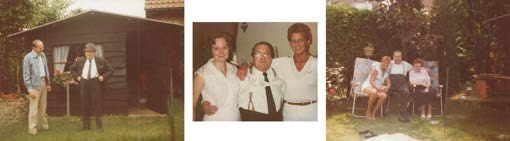
Figure 64.217: In the middle photo, taken in 1982, Daniel mimics the Mother Superior of the elderly home where he temporarily resided, whom he detested. The picture was taken during a visit to Jeanette Verbrugghe in Deerlijk, with Nelly Maria Vangheluwe on the right. Daniel, known for his humor and calculated nature typical of farmers, is also seen in the right photo at Saint Louis Deerlijk, flanked by Nelly Maria Vangheluwe (the author’s mother) and Nelly Devarreware, who may have been his lover. Despite the lack of proof, they were very close, and the author often visited Nelly Devarreware with his father after Daniel’s death. Lonely and heavy-smoking, Nelly joined family trips discreetly to avoid jealousy from the Mother Superior, who overcharged Daniel for his stay. The constant struggles with the nuns contributed to his decision to move in with his godson. The left photo, taken in 1981, shows Daniel Lesage in Deerlijk, posing in front of a garden house built by the author and his father, reflecting his years as a rabbit farmer and his willingness to share his expertise. (Declercq de Silva Archive)
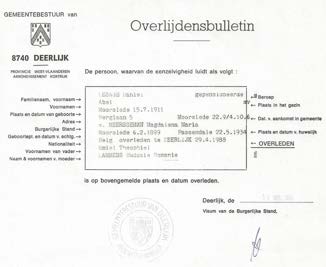
Figure
64.218:
The death registra-
tion at Deerlijk of Daniel Abel Lesage,
born in Moorslede on July 15, 1911,
and died on April 29, 1988, at Deerlijk.
He was a retired widower of Magdalena
Maria Meersseman (Moorslede, February
6, 1899) and married his wife in Pass-
chendaele on May 22, 1934. He arrived in
Deerlijk on October 4, 1986. His parents
were Emile Theophile Lesage and Eudoxie
Romanie Lammens.
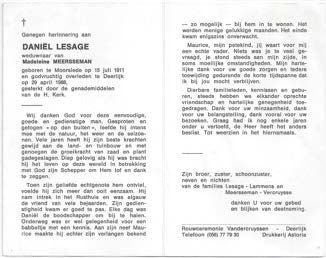
Figure 64.219:
The obituary card of
Daniel Lesage, widower of Magdalena
Meersseman and godfather of Maurice De-
clercq, 1988. (Declercq de Silva Archive)
© 2024 Nico F. Declercq
The Desclergues of la Villa Ducal de Montblanc, 2nd ed., Omn., VOL. V
64.7. THE OFFSPRING OF EMILE LESAGE AND EUDOXIE LAMMENS
1289
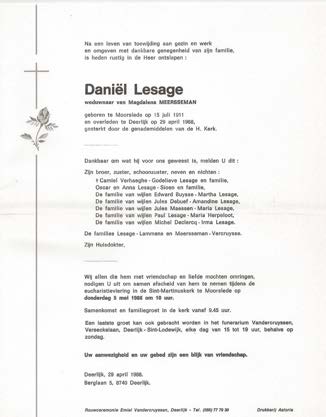
Figure 64.220: The death announcement
of Daniel Lesage, widower of Magdalena
Meersseman and godfather of Maurice De-
clercq, 1988. The name ’Herpeloot’ was an
error and had to be ’Herpoelaert’ . (De-
clercq de Silva Archive)
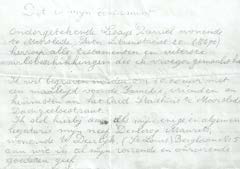
Figure 64.221: The will of Daniel Lesage, dated Jan-
uary 30, 1985, at Pater Lievensstraat 20, Moorsledea,
reveals his meticulous planning and care for his god-
child Maurice A. Declercq, whom he treated as a son.
Daniel, who had no children, entrusted his affairs to An-
dré Camerlynck, later succeeded by Debucquoy. The au-
thor, who shared a close bond with Daniel, recalls their
weekly lunches in Deerlijk, discussing various topics, in-
cluding war and investments. Daniel’s integrity and
commitment to his promises left a lasting impression,
guiding the author’s decisions and shaping his life. (De-
clercq de Silva Archive)
aNotary Ludo Debucquoy at Passchendaele, May 20 1988,
booked at Ypres on May 25, 1988, book 22, foil 53, section 20.
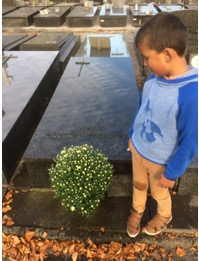
Figure 64.222: In October 2018, the graves of Daniel
Lesage and Magdalena Meerseman were in Moorslede.
The young boy in the picture is Lambert, the author’s
youngest son. In the past, when the author visited
Daniel’s grave a couple of times per year with his fa-
ther, they always paid a visit to Daniel’s acquaintances
until they, too, had died. The maintenance of the tomb
is still the author’s responsibility and is an event to look
back to the past. (Declercq de Silva Archive)
The Desclergues of la Villa Ducal de Montblanc, 2nd ed., Omn., VOL. V
© 2024 Nico F. Declercq
1290
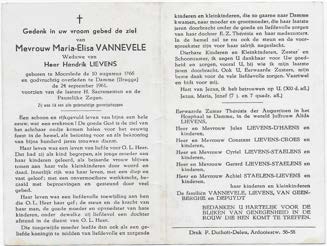
CHAPTER 64. THE LESAGE ANCESTRY LINE
Figure 64.223:
The obituary card is
from Maria Elisa Vannevele, sister-in-law
of Constant Lievens. (Declercq de Silva
Archive)
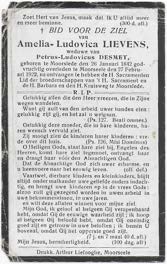
Figure 64.224: The obituary card of Amelie Louise Lievens, widow
of Pierre Louis Desmet. (Declercq de Silva Archive)
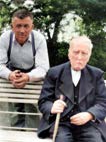
Figure 64.225: Daniel Lesage was acquainted with notary Camiel Arthur Deneckere
(Mesen 1856 - Roeselare 1922) and his brother, candidacy-notary Hector Leon De-
neckere (Mesen 1865 – Moorslede 1949, seen in this picture). The family lived in
Pater Lievensstraat, and their servants were Victorine Verhulst and Leon Debrauwer.
MyHeritage® colorized this photo. (Declercq de Silva Archive)
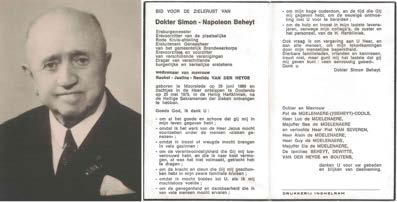
Figure 64.226: The obituary card of Simon Beheyt, 1975. (Declercq de Silva
Archive)
© 2024 Nico F. Declercq
The Desclergues of la Villa Ducal de Montblanc, 2nd ed., Omn., VOL. V
64.7. THE OFFSPRING OF EMILE LESAGE AND EUDOXIE LAMMENS
1291
Figure 64.227:
The obituary card of
Georges Bostyn, 1960. (Declercq de Silva
Archive)
Figure 64.228: The Bultinck family ran
Moorslede as mayors around WWII. They
housed refugee children from Brussels dur-
ing the war to enjoy the fresh air and the
relative peace in the countryside. (Declercq
de Silva Archive)
Figure 64.229: The obituary card of Ida Maria Iweins, 1962. She was born in
Zonnebeke in 1876 and was the daughter of Eugene Iweins (1838-1902) and Louise
Hynderick de Ghelcke (1849-1927). (Declercq de Silva Archive)
Figure 64.230: The obituary card of Gerard Jules Deltour, 1974 (Declercq de Silva Archive)
The Desclergues of la Villa Ducal de Montblanc, 2nd ed., Omn., VOL. V
© 2024 Nico F. Declercq
1292
CHAPTER 64. THE LESAGE ANCESTRY LINE
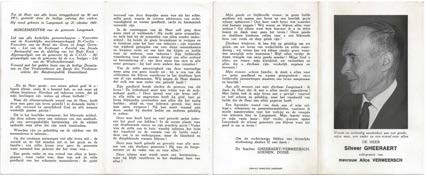
Figure 64.231: The obituary card of Silveer Gheeraert, husband of Alice Vermeersch,
1971. (Declercq de Silva Archive)
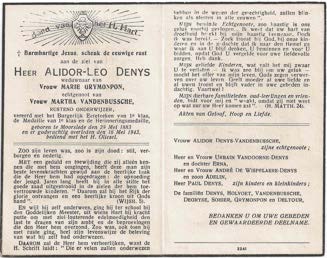
Figure 64.232: The obituary card of Ali-
dor Leo Denys, 1943. (Declercq de Silva
Archive)
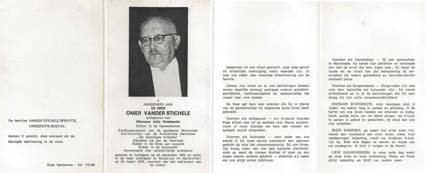
Figure 64.233: The obituary card of Omer Vander Stichele, husband of Julia Vandeputte,
1974. (front) (Declercq de Silva Archive)
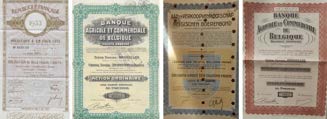
Figure 64.234: 1932 shares of Banque
Agricole et Commerciale de Belgique SA
Action ordinaire; French shares of 1933.
Landbouwkrediet shares of 1935.
A
Boerenbond share of 1939. (Declercq de
Silva Archive)
© 2024 Nico F. Declercq
The Desclergues of la Villa Ducal de Montblanc, 2nd ed., Omn., VOL. V
64.7. THE OFFSPRING OF EMILE LESAGE AND EUDOXIE LAMMENS
1293
Immersed in French culture and news, the family, particularly Eudoxie Lammens and her children, were inspired by French heroes celebrated and honored by the French people. These figures, such as Guynemer, provided hope and inspiration. Guynemer, a celebrated flying ace, was as revered by the French as the Red Baron, Manfred von Richthofen, was by the Germans. His 53
aerial victories marked Guynemer’s heroism before he was ultimately shot down near Poelkapelle on September 11, 1917. His body was never recovered, but he was commemorated with a memorial at the Pantheon in Paris. His aerial battles often extended into German-occupied territories as deep as Houthulst and Westrozebeke.
During tours of the Westhoek region in Flanders, Daniel Lesage would invariably pause at the statue of Guynemer in Poelkapelle.
Through these moments, he introduced the author to the legendary pilot, sharing stories that reflected both admiration and a deep sense of historical connection. These shared experiences, along with many other cherished memories, underscored the bond between Daniel and the author, imbuing their relationship with the warmth and wisdom characteristic of a beloved grandfather.
64.7.12.4 The Time at Beitem
Following the devastation of World War I, the region where the Lesage family resided in Belgium lay in ruins. Officially, their address remained at Ledegem until September 30, 1921, when they relocated to Beselare, specifically at Spilstraat 12 on Keiberg, near the junction with Slangemeersstraat. During this period, Daniel Abel Lesage and his brother Oscar attended Sint Lodewijkschool in Beitem just after the war. Visual records from this era can be found in Figures 64.197 and 64.198.
Beitem, a parish at the intersection of Ledegem, Moorslede, and Rumbeke, served as a strategic schooling location for the Lesage brothers. Given the family’s composition of adults and children and with Eudoxie still registered at Oudezeele for several years, the Lesages were likely dispersed across various accommodations, including homes and barracks—a common situation in the post-war era, as many families were rendered homeless.
Paul Lesage remained in Ledegem, while visual documentation of Moorslede post-war is presented in Figures 64.199. Daniel’s brother Gerard married Magdalena Meersseman after the war, likely settling in the eastern part of Moorslede, within the Koekuit-Beytem-Ledegem triangle or near Passchendaele. Despite the central family’s move to Beselare, where they established a new farm, Daniel and Oscar continued their education at Beitem, possibly residing with Gerard and Magdalena Meersseman in Zilverbergstraat.
Being local to the area, Magdalena had familial ties there, with her brother Andre Meersseman living in their parents’ home until his death in Koekuit, Moorslede.
Magdalena and Gerard managed a farm in the Koekuit region.
After Gerard’s untimely death, leaving no children, it was deemed necessary by Emile Lesage for Daniel to marry Magdalena.
Consequently, Daniel ended his engagement with his sister-in-law, Valentine Declercq, as detailed in Chapter 64.7.12.5. By marrying Magdalena, Daniel expanded his wealth by inheriting Gerard’s and Magdalena’s shares and solidified his familial and economic standing.
Despite their union, Daniel and Magdalena did not have children, partly due to the age difference, as Magdalena was twelve years older than Daniel. Eventually, they relocated to a smaller farm near Roeselaarsestraat and Oude Molenweg in Moorslede. When Daniel’s youngest sister, Irma Lesage, married Michel Declercq, she moved to Wielsbeke and later to Deerlijk. In 1941, the birth of Maurice Declercq, to whom Daniel became a godfather, marked a significant turn in Daniel’s life. He cherished Maurice, the author’s father, as his son.
Maurice spent all his vacations with Daniel and Magdalena in Moorslede, especially after the early death of his mother, Irma Lesage, in 1953.
Daniel’s relationship with Maurice exemplified the depth of his familial bonds and his role as a surrogate grandfather to the author.
Their shared experiences, enriched by Daniel’s stories and wisdom, forged a lasting connection that transcended the boundaries of traditional familial roles, leaving an enduring legacy of love and guidance.
64.7.12.5 His Love Affair with Valentine Declercq
The engagement of Daniel Abel Lesage and Valentine Declercq has left an indelible mark on our family’s history, weaving a narrative rich with romance, heartache, and enduring affection. Daniel, depicted in Figure 64.200 from 1931, shared a profound relationship with Valentine, a year his senior. Their love, immortalized in the poetry of Valentine’s close friend Gabrielle Demedts, was both passionate and poignant. Unfortunately, the relationship was cut short by the untimely death of Gerard Lesage, which precipitated Daniel’s decision, or perhaps coercion, to marry Gerard’s widow, Magdalena Meersseman, in 1934. This marriage, widely understood to be arranged and devoid of love, marked a tragic turn for Daniel and Valentine.
Valentine, who remained single for a time, eventually married Maurice Wullaert but passed away in 1939. Maurice Wullaert later married Valentine’s sister, Rachelle. The heartbreak and separation between Valentine and Daniel inspired Demedts to pen evocative poems, capturing the depth of their connection and the sorrow of their parting. These poems are detailed in Valentine’s Chapter
The author’s personal memories of Daniel, who was like a grandfather to him, reflect a bond forged from familial ties and shared stories and experiences. In 1984, during a visit to Wielsbeke, the author accompanied Daniel to see Gerard Verbrugghe, described in Chapter 77, and Maria Vandenabeele. Daniel’s request to visit the Declercq farm, ’Hof van Brussel,’ in Reynaertstraat, underscored the place’s deep sentimental value for him. It was not merely the historical significance—where his father Emile, his brother Paul, and his sister Irma, the author’s grandmother, had resided—but also the poignant memories of his time with Valentine that drew him back.
Daniel’s father-like feelings for Maurice Declercq, the author’s father, are deeply rooted in this context. Maurice, named after Valentine’s later widower Maurice Wullaert, was Daniel’s godson—a choice perhaps motivated by a sense of guilt or profound respect. These feelings manifested in the affectionate and grandfatherly manner Daniel displayed towards the author, sharing stories of farming, war, and life’s riddles. One such riddle, remembered vividly by the author, was solved with surprising speed, eliciting Daniel’s astonishment and admiration. In hindsight, this moment likely brought back memories of Valentine’s cleverness, intertwining past and present in love and remembrance.
The relationship between Daniel and Valentine, though ultimately thwarted, continues to resonate through the generations, encapsulated in the poetry of Demedts and the cherished recollections of the author.
Their story, marked by romantic fervor and enduring affection, remains a poignant chapter in the family’s legacy.
The Desclergues of la Villa Ducal de Montblanc, 2nd ed., Omn., VOL. V
© 2024 Nico F. Declercq
CHAPTER 64. THE LESAGE ANCESTRY LINE
64.7.12.6 His Marriage with Magdalena Meersseman
Magdalena Maria Meersseman was born in Moorslede on February 3, 1899, as depicted in Figure 64.201. She was the daughter of Aloïs Xavier Meersseman, a farmer born in Oostnieuwkerke on September 21, 1848, and Marie-Pharaïlde Vercruysse, born in Moorslede on July 6, 1860. Aloïs and Marie-Pharaïlde had married in Moorslede on October 3, 1884. Magdalena passed away on October 6, 1976, in Roeselare, while her husband, Daniel Abel Lesage, died in Deerlijk on March 30, 1988.
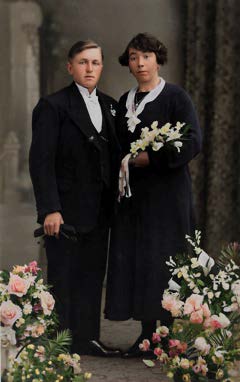
Aloïs Xavier Meersseman’s parents were Pierre Meersseman and Catherine Synaeve, while Marie-Pharaïlde Vercruysse’s parents were Pierre Jean Vercruysse and Lucia Vanbiervliet. The familial roots of Magdalena were deeply intertwined with the regions significant to Emile Theophile Lesage, who felt a moral obligation to look after her following Gerard Lesage’s death. Consequently, Emile urged Daniel to marry Magdalena, as illustrated in Figures 64.202, 64.203, and 64.204. This union also safeguarded the family’s assets, ensuring they were not dissipated to other families—a common practice among farming communities.
Daniel and Magdalena married on May 22, 1934, in Passchendaele and initially resided at Messestraat 4, presumably the farm where Magdalena had lived with Gerard until his passing. Images of Daniel as a newlywed are available in Figures 64.205 and 64.206.
The simplicity and hard work typical of farming life marked their life together. They were devoted to their land and each other, embodying the resilient spirit of rural life.
Although the author does not have personal memories of Magdalena, frequent visits to Daniel’s childhood home left a lasting impression. The author feels a connection to Magdalena through the stories shared by Daniel and the photographs that adorned his house. One charming anecdote from the author’s childhood reflects the warmth and humor that permeated their household.
As a tiny child, the author once went silent while crawling on the ground, only to be discovered eating food meant for the cats—a testament to the lively and loving environment Daniel and Magdalena fostered.
Daniel and Magdalena’s life together was characterized by mutual respect and affection, not only for each other but also for the author, whom they cherished as if he were their grandchild. Though initially arranged, their marriage blossomed into a partnership that exemplified the quiet dignity and enduring bonds of farming life. Daniel’s eventual move to Deerlijk on October 4, 1986, to live with his godson Maurice Declercq underscores the deep familial ties and the enduring legacy of love and care that defined his life with Magdalena.
Despite their devoted partnership, Daniel always harbored a deep pain for the relationship, and he could not continue with Valentine Declercq. Similarly, as a widow, Magdalena perpetually carried the memory of her former husband, Gerard Lesage, in her heart.
Daniel and Magdalena were, in many ways, wounded souls who had lost significant love. However, they found solace and warmth in each other, built primarily on mutual respect rather than passionate romance. Though formed under the shadow of past loves and losses, their bond was a testament to their resilience and ability to find comfort and companionship in the face of life’s adversities.
64.7.12.7 His godchild Maurice Declercq
Although Daniel Lesage never had any children, his godson Maurice Declercq, the author’s father, was like a son to him. His life is found in Chapter 46.
64.7.12.8 His Career as a Farmer
Daniel Lesage dedicated his entire life to farming, a vocation intertwined with cherished memories, as depicted in Figure 64.207.
Faced with the reality of remaining childless and Maurice Declercq’s decision against relocating to Moorslede to pursue farming, Daniel and Magdalena resolved to scale back their agricultural ambitions. They chose to retreat to their modest farm in Moorslede, as shown in Figures 64.208, 64.209, and 64.210, content with sustaining themselves without further expansion.
Their property portfolio included a 40-are farm at Passchendaele (Messestraat 4), a mere two kilometers from their residence at Oude Molenweg/Roeselaarsestraat in Moorslede. This farm was leased to Delbeecke-Lyncket and subsequently sold to Delbeecke-Derycke from Ledegem on July 18, 1966, under the auspices of notary André Camerlynck.
Maurice Declercq held a deep affection for the land at Messestraat, having spent many of his youthful holidays assisting Daniel with farming activities. He once guided the author to this beloved location, sharing his enduring fondness. The precise address eluded the author for some time, remembered only by general direction once rediscovered through diligent examination of notary records.
Even Daniel’s wedding book bears the notation Kazakke in pencil, corroborating the notarial documents.
Daniel ultimately sold his 55-acre farm to Vandaele-Vandermersch on September 17, 1980, again facilitated by notary André Camerlynck in Passchendaele. By this time, Daniel had already taken up residence in an elderly home in Moorslede.
64.7.12.9 The Death of his Wife and the Decision to move to the Elderly Home
Magdalena Meersseman’s mortuary card is shown in Figure 64.211. As a widower, Daniel is shown in Figures 64.212 and 64.213.
When Daniel Lesage, the author’s granduncle, lost his beloved wife, Magdalena Meersseman, the weight of his grief was overwhelming. The void left by her absence pushed him into a deep depression, leading him to make the heart-wrenching decision to move into a home for older people. It was the 1980s, and the home was located in Moorslede, Flanders—a far cry from the comforting familiarity of his own house.
The elderly home, as depicted in Figures 64.214, was stark and austere, devoid of the warmth and luxuries that one might hope for in such a place. The author, then a child, visited Daniel weekly with his parents, a routine imbued with a sense of duty and affection. They brought along his favorite treat each visit: vanilla pudding accompanied by gingerbread cookies, a recipe likely passed down from Daniel’s mother, Eudoxie Lammens. This small gesture of comfort stood in stark contrast to the bleakness of his surroundings.
The home was populated by other older men, many of whom bore the physical and psychological scars of war. The sight of men with amputated limbs was a common one, and the young author initially believed these injuries were simply a part of aging. It was only later that he learned these men were veterans of World War I, each with their own story of loss and survival.
The home echoed with the shouts of nearly deaf residents, their voices raised to communicate, and the air was thick with the persistent smell of tobacco from pipes smoked incessantly.
Daniel’s time in the elderly home before Maurice Declercq’s intervention was marked by profound loneliness and mistreatment. He was bullied by the nun in charge, forced to pay exorbitant fees, and despite the many residents, he felt isolated. The indignities he suffered were compounded by the psychological toll of his wife’s death, making this period the darkest chapter of his life.
Yet, amidst the gloom, there were fleeting moments of respite. Daniel’s well-calculated and determined nature, captured in Figures
64.215, allowed him to carve out small pockets of social interaction.
He found solace during parties or when visitors filled the living room, moments when the sterile walls of the institution faded into
© 2024 Nico F. Declercq
The Desclergues of la Villa Ducal de Montblanc, 2nd ed., Omn., VOL. V
64.7. THE OFFSPRING OF EMILE LESAGE AND EUDOXIE LAMMENS
1295
the background, replaced by the warmth of human connection, as shown in Figures 64.214, 64.216, and 64.217.
The author’s weekly visits became a lifeline for Daniel, a reminder that he was still tethered to the world outside the home’s confines.
The author’s memories of these visits are tinged with a deep emotional resonance, a blend of childhood innocence and the dawning awareness of the complexities of adult life and loss. The elderly home in Moorslede remains etched in his memory as a place of stark contrasts: the severe realities of aging and war interwoven with the tender threads of familial love and duty.
64.7.12.10 His Move to Deerlijk
After enduring the harsh conditions of the elderly home, Daniel Lesage’s life took a transformative turn when Maurice Declercq, the author’s father, extended a lifeline of compassion and familial love. Maurice invited Daniel to live with him in Deerlijk, a gesture that promised a change of residence and a complete renewal of spirit.
The contrast between the two living situations could not have been starker. Where the elderly home in Moorslede was a place of isolation and despair, Maurice’s home in Deerlijk was a haven of warmth and vitality. As soon as Daniel moved in, he was enveloped in an atmosphere that was the polar opposite of his previous environment. The oppressive gloom of the elderly home gave way to Maurice’s household’s bright, inviting ambiance. Here, Daniel found a place to live and a home where he was valued and cared for.
Living with Maurice, Daniel’s days were filled with simple yet profound joys that rejuvenated his spirit. He embraced a farmer’s lifestyle, immersing himself in the rhythms of rural life. He took great pleasure in helping to look after the neighbor’s pigeons, which brought him purpose and companionship. Daniel quickly integrated into the local community, finding like-minded farmers with whom he could chat, share stories, and predict the weather—one of his favorite pastimes.
The author fondly remembers the image of Daniel enjoying his meals, slurping his soup with satisfaction, and sipping ’table beer’
during lunch, which he claimed was good for his stomach. His days followed a comforting routine: waking up early, engaging in meaningful daily activities, and retiring early to bed. These habits, rooted in his past, provided a sense of continuity and stability.
Unfortunately, Daniel’s health began to decline a few years after moving to Deerlijk. Despite this, his time there was imbued with a sense of peace and fulfillment that had been absent during his years at the elderly home. He relished the opportunity to talk about his past, sharing stories of his time in France, Moorslede, and Beitem. These conversations were not just a means of reminiscing but a way of connecting with those around him, bridging the gap between generations and keeping his memories alive.
Daniel found a sanctuary in Maurice’s home where he could live out his final years with dignity and contentment. His presence brought joy and a sense of continuity to the household, as illustrated in Figures 64.217. This period of his life, though short-lived, was a testament to the profound impact of love, family, and the simple pleasures of rural life. Daniel’s rescue from the elderly home by Maurice was more than just a physical relocation; it was a rescue of his spirit, allowing him to experience the twilight of his life not in the shadow of his loss but in the light of newfound hope and companionship.
64.7.12.11 His Death
Daniel Lesage had found solace and peace in Maurice’s home, but as with all things, his time came to an end. Daniel had developed a fondness for a small siesta after lunch, a brief respite that symbolized his newfound tranquility. One day, after one such nap, he awoke feeling an unusual weakness. With effort, he stumbled to the living room, where he found Maurice, the author’s father. In a moment heavy with finality, Daniel managed to utter, "I cannot anymore," before kneeling on the floor and passing away instantly.
The suddenness of his death was a profound shock to all who knew him. Daniel’s death registration, announcement, and mortuary card, depicted in Figures 64.218, 64.219, and 64.220, serve as stark reminders of the fleeting nature of life. His passing left a deep void in the household, a silent testament to the irreplaceable presence he had become.
Daniel left behind not material wealth but a legacy of deep sentiments and cherished memories. His foster son and godson, Maurice, received his heartfelt sentiments, as shown in Figure 64.221. This legacy was not measured in tangible assets but in the profound emotional connection and the values imparted—a legacy far more valuable than any material possession.
The author, who had come to see Daniel as a grandfather figure, continues to take full responsibility for Daniel’s tomb in Moorslede, as seen in Figure 64.222. The care and respect shown to his final resting place are a testament to the enduring bond they shared.
Months before his passing, Daniel had assured the author that he would support him if he ever chose to become a farmer. Though the author eventually took a different path, finding his calling in academia, the sentiment behind Daniel’s promise remains a treasured memory.
Daniel’s life and his ultimate departure left an indelible mark on those who loved him. His quiet strength, his simple joys, and his unwavering support provided a foundation upon which the author has built his life. The memories of Daniel’s time, his stories of war and resilience, and his caring nature are woven into the fabric of the author’s identity. Despite the sorrow of his loss, there is a glimpse of hope in the lasting impact of Daniel’s life—a reminder that love and memories can transcend even death.
64.7.12.12 Some Acquaintances
Daniel often spoke of ’Pater Lievens’ from Moorslede, although he was not precisely an acquaintance. Constant Lievens was a Jesuit missionary to India, born in Moorslede on April 11, 1856, at Koekuit, the same place where Daniel Lesage lived. Constant was the seventh of eleven children. At eleven, following his mother’s death, he left school to work at home, first as a cowkeeper and later as a horse servant. His expertise with horses would later prove invaluable in his missionary work.
Lievens pursued his studies at the Klein Seminarie in Roeselare, where he was in the class of notable individuals, including Albrecht Rodenbach, and was part of what writer Hugo Verriest termed ’The Wonder Class.’ In October 1877, he commenced his studies at the ’Groot Seminarie’ in Bruges. However, Lievens aspired to become a missionary.
Thus, in October 1878, he joined the Jesuits in Drongen to begin his two-year novitiate. In October 1880, he departed for India, a journey that took six weeks, arriving in Calcutta on December 2. He continued his education in Asansol, and on January 14, 1883, he was ordained to the priesthood by Mgr Goethals in the Cathedral of Calcutta. He began his teaching career at Saint-Francis College.
In 1885, Lievens embarked on his missionary work in Chota-Nagpur, Bengal. By the end of July 1885, he had moved to Torpa to start a new mission. Initially, he converted a few inhabitants to Catholicism. Realizing the locals needed legal assistance against regular oppression, he offered legal advice. To this end, he studied the general and regional laws, as well as the local customs of the Mundas. His efforts soon earned him fame and appreciation as a missionary.
In 1886, Lievens established 26 schools, traveling by horse to visit each one. This endeavor resulted in the conversion of 2000 people shortly thereafter. From 1887 onwards, he managed to convert entire villages, reminiscent of the Portuguese missionaries in the 1500s.
The Desclergues of la Villa Ducal de Montblanc, 2nd ed., Omn., VOL. V
© 2024 Nico F. Declercq
CHAPTER 64. THE LESAGE ANCESTRY LINE
By October 1888, Father Lievens had become the district superior of Ranchi. However, he fell ill and went to Calcutta for a diagnosis, where he was found to have tuberculosis. He then traveled to Darjeeling in the mountains to recuperate. When his health did not improve, he returned to Belgium and embarked on a journey back to Calcutta on September 3, 1892. Unfortunately, his disease had progressed too far by the time he arrived. Constant Lievens died in Leuven on November 7, 1893.
Lievens’ impact extended beyond his lifetime. His methods of combining education, legal assistance, and religious conversion set a new standard for missionary work in India. His approach to understanding and integrating local customs and laws into his mission work garnered significant respect and led to substantial, sustainable conversions. The schools he established played a critical role in the education and upliftment of the Indigenous populations, laying the groundwork for future missionary efforts in the region.
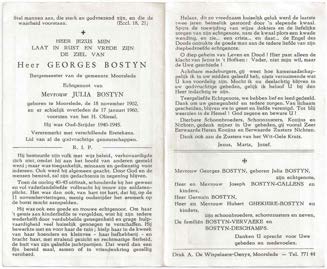
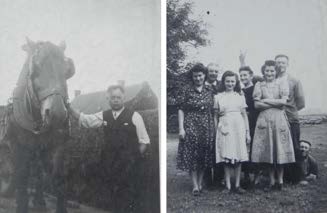
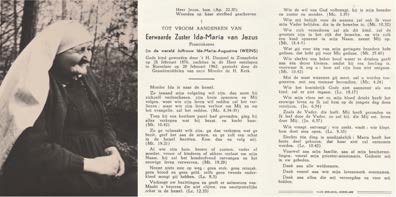
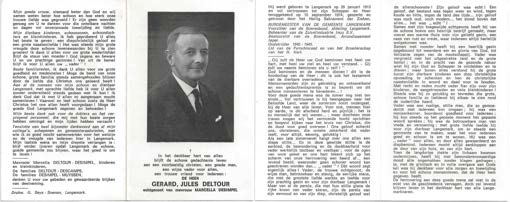
Some acquaintances of Daniel are shown in Figures 64.223, 64.224, 64.225, 64.226, 64.227, 64.228, 64.229, 64.230, 64.231, 64.232
and 64.233.
64.7.12.13 Some Memorabilia
Daniel Lesage left numerous documents from his archive. Some were old shares, no longer of any value, but that he did not destroy.
He also left many pictures, notes, and other memorabilia, some appearing throughout this book. Illustrations are shown in Figure
64.8 Irma Helena Lesage & Michel Achiel Renatus Declercq
64.8.1 Irma Helena Lesage
She was born in 1905 at Moorslede, Belgium, the daughter of Emile Theophile Lesage (DP12V03DW02L01) and Eudoxie Romanie Lammens. She married Michel Achiel Renatus Declercq (DC18) and died in 1953 in Kortrijk, Belgium.
Irma Helena Lesage (DP12V03DW02L02) is primarily described in Chapter 45.2 as the wife of Michel Achiel Renatus Declercq and the author’s grandmother. She is equally referred to in the following chapters: Chapter 65 as great-great-great-great-great-granddaughter of Adrienne de Patin (DP12); Chapter 66.1 as great-great-great-granddaughter-in-law of Barbara Benoit; Chapter
66.2 as the great-great-great-great-granddaughter of Maria Jeanne Christine Benoit; Chapter 68 in the ’t Kint ancestry; and Chapter
71 as the granddaughter of Clemens Lammens and Natalia Juliana Decaestecker.
64.8.2 Michel Achiel Renatus Declercq (DC15)
He was born in 1906 in Wielsbeke, Belgium, as the son of Ernest Constant Declercq and Marie Elody Devenyn. He died in 1963 in Deerlijk, Belgium. Michel Achiel Renatus Declercq (DC15) is primarily described in Chapter 45 as a descendant of the Desclergues and grandfather of the author. He is equally referred to in the following chapters: Chapter 65, as the husband of Irma Helena Lesage and great-great-great-great-great-grandson-in-law of Adrienne de Patin (DP12); Chapter 66.1, as great-great-great-grandson of Barbara Benoit; Chapter 66.2, as the husband of Irma Lesage and great-great-great-great-grandson-in-law of Maria Jeanne Christine Benoit; Chapter 68, in the ’t Kint ancestry; and Chapter 71, as grandson-in-law of Clemens Lammens.
64.8.3 Their Marriage
Their wedding was in 1932 at Beselare, Belgium, and is shown in Chapter 45.3.
64.9 Maurice Alois Declercq (DC16) & Nelly Maria Vangheluwe
64.9.1 Maurice Alois Declercq (DC16)
Maurice Alois Declercq (DC16) is the son of Michel Achiel Renatus Declercq (DC15) and Irma Helena Lesage. He is primarily described in Chapter 46 as a descendant of the Desclergues and father of the author. He is equally referred to in the following chapters: Chapter 65, as great-great-great-great-great-great-grandson of Adrienne de Patin (DP12); Chapter 66.1, as great-great-great-great-grandson of Barbara Benoit; Chapter 66.2, as a great-great-great-great-great-grandson of Marie Jeanne Christine Benoit; Chapter 67, as the son-in-law of Anna Den Dauw; Chapter 68, as a descendant of ’t Kint; Chapter 69, as great-grandson-in-law of Marie Nathalie Surmont; and Chapter 71, as the great-grandson of Clemens Lammens.
64.9.2 Nelly Maria Vangheluwe
Nelly Maria Vangheluwe is primarily described in Part X as the daughter of René Vangheluwe, Anna Den Dauw, and the author’s mother. She is equally referred to in the following chapters: Chapter 65, as great-great-great-great-great-great-granddaughter-in-law of Adrienne de Patin (DP12; Chapter 66.1, as great-great-great-great-granddaughter-in-law of Barbara Benoit; Chapter 66.2, as a great-great-great-great-great-granddaughter-in-law of Marie Jeanne Christine Benoit; Chapter 67, as the daughter of Anna Den Dauw; Chapter 68 a descendant-in-law of ’ t Kint; Chapter 69, as the great-granddaughter of Marie Nathalie Surmont; Chapter
71, as great-granddaughter-in-law of Clemens Lammens; and in Chapter 72, the maternal (mt-DNA) ancestry line, as the mother of the author.
64.10 Nico Felicien Declercq (DC17) & Shirani Olupathage de Silva
64.10.1 Nico Felicien Declercq (DC17)
Nico Felicien Declercq (DC17) is the author of this book, is a grandson of Irma Helena Lesage and Michel Achiel Renatus Declercq, and is primarily described in Chapter 47, as a descendant of the Desclergues.
He is equally referred to in the following chapters: Chapter 65, as great-great-great-great-great-great-great-grandson of Adrienne de Patin (DP12); Chapter 66.1, as great-great-great-great-great-grandson of Barbara Benoit; Chapter 66.2, as a great-great-great-great-great-great-grandson of Maria Jeanne Christine Benoit; Chapter 67, as the grandson of Anna Den Dauw; Chapter 68, as a descendant of ’t Kint; Chapter 69 as the great-great-grandson of Marie Nathalie Surmont; Chapter 71 as the great-great-grandson
© 2024 Nico F. Declercq
The Desclergues of la Villa Ducal de Montblanc, 2nd ed., Omn., VOL. V
64.10. NICO FELICIEN DECLERCQ (DC17) & SHIRANI OLUPATHAGE DE SILVA
1297
of Clemens Lammens; and in Chapter 72, the maternal (mt-DNA) ancestry line of the author.
Furthermore, he is referred to in Part XII as the husband of Shirani Oluphathage de Silva.
64.10.2 Shirani Olupathage de Silva
Shirani Olupathage de Silva is first described in Chapter 47.3, as the author’s wife.
She is equally referred to, in much detail, in Part XII, and also in the following chapters: in Chapter 65, as great-great-great-great-great-great-great-granddaughter-in-law of Adrienne de Patin (DP12); Chapter 66.1, as great-great-great-great-great-granddaughter-in-law of Barbara Benoit; Chapter 66.2, as a great-great-great-great-great-great-granddaughter-in-law of Maria Jeanne Christine Benoit; Chapter 67, as granddaughter-in-law of Anna Den Dauw; Chapter 68, as a descendant-in-law of ’ t Kint; Chapter 69,
as great-great-granddaughter-in-law of Marie Nathalie Surmont; Chapter 71, and as great-great-granddaughter-in-law of Clemens Lammens.
The Desclergues of la Villa Ducal de Montblanc, 2nd ed., Omn., VOL. V
© 2024 Nico F. Declercq
CHAPTER 64. THE LESAGE ANCESTRY LINE
© 2024 Nico F. Declercq
The Desclergues of la Villa Ducal de Montblanc, 2nd ed., Omn., VOL. V
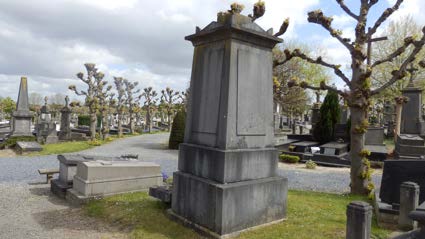
Chapter 65
Ancestry line de Patin
65.1 Introduction
This concerns a bloodline with roots in Cambrai and later Geluwe, Ypres, and Langemark. Ypres was one of the most beautiful towns in Belgium until WWI, when it was destroyed. Remarkably, the cemetery along Zonnebeekseweg, not far from the Menin gate, remained intact. The tomb in Figure 65.1 is that of Vicomte de Patin and was constructed in 1796. Based on the data obtained from Heemkring Flambertus in Vlamertinge1, we assume that the tomb was constructed for Joseph de Patin (DP12by1y2y1) who died in 1792 and was married to Catherine Thérèse Françoise de Ghelcke. His family is described in Chapter 70.4. The de Patin family had old roots in Cambrai and has always been close to and cared a lot about people from all classes of society around them.
The author appreciates this attitude very much. A description in the literature is shown in Figure 65.2. Just like the Desclergues, the de Patin family also owned mills. In their case, it concerned windmills, one of which is shown in Figure 65.3.
It is believed that the early pronunciation of Patin was the pronunciation still found in Flemish, which is ’pat-yn’ with ’-yn’ as in
’Evelyn.’ Therefore, the generally accepted assumption that the English name Patton originated from the French name Patin and arrived on the English Isles during the reign of Normandy2 and later came to the United States3 through migration, looks pretty plausible.
It is found in many sources that the names Patton, Patin, Patyn, Pattyn, Pattijn, Pattin, Patterson, Patun, Paton, Patisson, etc., come from a Norman derivative of Patrick. In West Flanders, when checking specific heraldic shields, there is a tendency to believe that Patin comes from Pat4, and even Patin from ’skate.’
One is, therefore, not surprised to find a skate or a crane as symbols to represent such families. Nevertheless, as can be found in Part XV, and more precisely, the autosomal DNA results, genetic links to several Patton and Patterson families are evident because we probably share the same roots through this family line around 1000 years ago.
The name of the de Patin family has undergone several variations like most ancient names: Patin, Pattin, Pattyn, Pattijn, Patins and Pattyns or Pattijns. It is believed, however, that the original spelling was Patin or de Patin.
The origin of this family is primarily French, where the first documented members of this house are found towards the middle of the twelfth century, before the appearance of this name in the Annals of the History of Flanders. De Carpentier5 relates the family to Raoul de Patin, governor of the castle of Cambrai and Cambresis, under the bishop Guillaume de Hainaut. Raoul’s wife was Guyotte de Hames, described in Chapter 65.2.2 with Merovingian roots, among others, as outlined in the appendix, in Chapter 76
on page 1673.
The heraldic shield of the de Patin family that shows some resemblance with that of the author, although far from identical, is shown in Figure 65.4.
Raoul de Patin had married Guyote, the daughter of Autier de Hames, governor of Kortrijk, in 1272. De Carpentier also said that this house belonged to Wautier de Patin, a knight living in 1370, of which was born Jossin de Patin, wife of Heylaert, the lord of Moorslede, son of Jean, the lord of Moorslede, and Marguerite de Poucques, the daughter of Heylaert, Beer (Baron) de Poucques.
Their son, Jean de Moorslede, captain of Ravenstein, married Philippine de Baenst. This Raoul de Patin, mentioned above, is the ancestor of Pierre de Patin, from whom we are sure of the further descendants.
Figure 65.1: This is the tombstone of the family de Patin at Ypres (2014). (Declercq de
Silva Archive)
1Heemkring Flambertus in Vlamertinge, ’Twee eeuwen Ypresse grafcultuur.’
2The Battle of Hastings in 1066.
3General Georgia Smith Patton, California 1885 - Luxemburg 1945.
4Pat stands for ’leg’
5De Carpentier, ’Histoire générale des Pays-Bas ou Histoire de Cambrai ou du Cambrésis, II, 861’ .
The Desclergues of la Villa Ducal de Montblanc, 2nd ed., Omn., VOL. V
© 2024 Nico F. Declercq
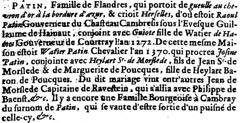
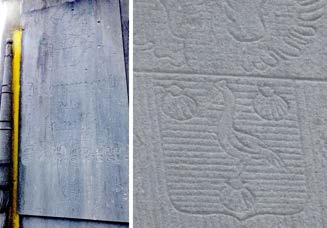
1300
CHAPTER 65. ANCESTRY LINE DE PATIN
Figure 65.2: A description of the family de Patin in
’Histoire généalogique des Païs Bas.’
Figure 65.3: The de Patin family owned the ’Waterdammolen’ mill at Moorslede for
a long time. Pierre de Patin (born in 1660), followed by Charles Philippe de Patin
(born in 1687), François Guillaume de Patin (born in 1724), Jean Charles de Patin
de Langemarck (born in 1757) and Joseph Felix de Patin (born in 1824). The British
attempted its demolition on Monday, October 19, 1914 (’Schuwe Maandag’ a), but
they failed. The next day, it was turned to ashes by the Germans on the evening of
October 20, 1914.
aSchuwe Maandag appears in Chapter 48.9.5.4.5, Chapter 64.6.1.5.1, Chapter 64.7.1.6.7
and Chapter 65.
The de Patin family is ancient and noble de race, or noble race, comparable to the Desclergues, who are hidalgo de sangre.
The family de Patin has crossed the centuries with honor, and its alliances have always been illustrious. The family has rendered outstanding services to her country. Typically, the family appears among the noble families listed in numerous books in Flanders and Belgium.
Emiel Huys6 describes the family ’De Patin (Pattyn),’ having a weapon shield,
’in Azur, with a standing Crane, having a red beak and red legs, together with three shells in silver, namely two at the top and one at the bottom. The helmet is crowned, and on top, we find a swan breast between two golden wings.’
An illustration is shown in Figure 65.4.
According to Huys, the motto of de Patin is:
’Qu’ oncques n’ en a pati nocher crois !,’
which is different from what we found in other sources, such as Carpentier, stating that it was initially ’Herselles’7, Selles being the river running through Cambrai, shown in Figure 65.5.
The ancestry line of de Patin, illustrated in Figures 65.6, 65.7, and 65.9, described below is based on research done by the author in the Belgian Archives. Besides, and perhaps even more importantly, it is also based on several books, such as in Figures 65.10 and
65.10, and sources, some of which were found in numerous consulted sources, such as Emiel Huys8, in which the ancestry is presented created by Mr Desideer-Pieter de Patin (Pattyn), Prost of Onze Lieve Vrouw van Blindekens in Bruges; Annuaire de la Noblesse de
Belgique9; Annales de l’ Académie d’ Archeologie de Belgique10; Le Carpentier1112; Gaillard13; de May14; la Cour Féodale de la Salle de Lille 15; Epitaphiae Comitatus Flandria 16; Koninklijke Bibliotheek te Brussel17; Du Mont18; Jan van Dadizeele19; Rijksarchief te Brugge2021; Archief van het Bistdom te Brugge;22 and Rijksarchief te Kortrijk.23
Figure 65.4:
Plaque with family name
’de Patin’ and arms on the family’s tomb-
stone in Ypres. The family’s old, original
weapon shield is in the center of the ex-
tended shield used in the Austrian period.
(Declercq de Silva Archive)
6Emiel Huys, ’Geschiedenis van Geluwe,’ Chapter 6.
7Herselles means ’army of Selles.’
8Emiel Huys, ’Geschiedenis van Geluwe’ , Kortrijk, Weduwe Nyse en Zonen, Sweveghemstraat 31, 1891.
9Annuaire de la Noblesse de Belgique, t. VIII, p 165.
10Annales de l’ Académie d’ Archeologie de Belgique, année 1853, t. X, p. 211 and further.
11Le Carpentier, Histoire de Cambrai, t. II, p. 861.
12Le Carpentier, ’Histoire générale des Pays-Bas ou Histoire de Cambrai ou du Cambrésis, II, 861’ .
13Gaillard, Bruges et le Franc, t. I, p. 117, 118.
14G. de May, Inventaire des Sceaux de Flandre, Paris, 1873, t. I, n2584, t. II, n 5336.
15Registre des fiefs de la Cour Féodale de la Salle de Lille, année 1389.
16Epitaphiae Comitatus Flandria, p. 69.
17Koninklijke Bibliotheek te Brussel, handschriften, nrs 4503, 1524, bz. 36, 1509, f 35.
18Du Mont, Framents Genealogiques, Gand, 1862, t. 5, v. 2, p. 151.
19Gedenkschrijften van Mhr Jan, heere van Dadizeele, Brugge, haar 1850, bz 146 and further.
20Rijksarchief te Brugge, Verzameling der Kasselrij van Waesten, voorlopige nr 51, akte van den 30 December 1695.
21Rijksarchief te Brugge, Register der heerlijkheid van Wevelghem, 1713-1732, nr 9.
22Archief van het Bistdom te Brugge, chaarder van Maarte 1474.
23Rijksarchief te Kortrijk, Wezerijboeken en ’Registers van Kennessen’ .
© 2024 Nico F. Declercq
The Desclergues of la Villa Ducal de Montblanc, 2nd ed., Omn., VOL. V
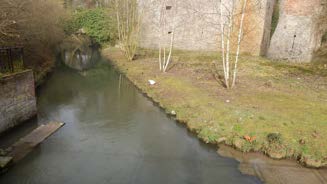
65.2. RAOUL DE PATIN (DP01) & GUYOTTE DE HAMES
1301
Figure 65.5: The walls of the Chateau
de Selles at Cambrai on the Selles River
were constructed in 1270 by Nicolas de
Fontaines as a fortress for the Compte-
Éveque of Cambrai (March 2014). (De-
clercq de Silva Archive)
65.2 Raoul de Patin (DP01) & Guyotte de Hames
65.2.1 Raoul de Patin
He was the governor of Cambrai Castle and Cambrésis between 1292 and 1296 under Bishop Guillaume de Hainaut. He had married Guyote, daughter of Autier de Hames, the governor of Kortrijk, in 1272.
He was a Knight and appeared in documents in 1300 at Cambrai, France. To this house of de Patin also belonged Knight Wautier de Patin, still alive in 1370 whose daughter was Jossine de Patin, wife of Heylaert the Lord of Moorslede and son of Jean the Lord of Moorslede and Marguerite de Poucques, daughter of Baron de Poucques; their son was Jean de Moorslede, captain of Ravenstein and was married to Philippine de Baenst. The preference of later generations of the family of de Patin to spell their name in French, i.e., de Patin, and not according to local customs such as Pattyn, Pattyns, Pattijn, Patyn etc. stems from specific genealogical records of this particular family back to Cambrai, shown in Figure 65.12, in France around 1300 where the name was spelled Patin.
65.2.2 Guyotte de Hames
She was the daughter of Wautier de Hames, the governor of Kortrijk in 1272, and the wife of Raoul de Patin. Hames, or Haemes, is shown in Figure 65.8.
An appendix is devoted to Guyotte de Hames, who has a noble ancestry that includes, e.g., Merovingians. The reader is referred to Chapter 76 for more information.
65.2.3
Their descendants
The descendants of Raoul de Patin and Guyotte de Hames are shown in Figure 65.13.
65.2.4 Catherine de Patin & Jan van Dadizeele (van Veerdeghem)
Not a single genealogist has ever been able to prove, through documentation, if and how Catherine de Patin was related to the de Patin family we are describing here. Nevertheless, given her status and location, it is reasonable to assume that her father was Martin or Wautier de Patin (DP04) and her mother was Attente Peronne or that this couple was an uncle and auntie to her. She died early.
She was born in 1410 and married Jan (van Veerdeghem), Lord of Dadizele. She died in 1435. Jan van Dadizeele died on March 20, 1440. Their son was Jean Knight of Dadizelle24, described in Chapter 65.2.5.
65.2.5 Jan van Dadizele & Catherine Breydel
He was the son of Catherine de Patin (DP04b2) and Jan van Dadizeele (van Veerdeghem). He is the famous Jan van Dadizele, known as Jan van Veerdeghem, who was murdered and is still buried in the Basilica of Dadizele. He was born in Dadizele on February 23, 1432; he was Councilor and Chamberlain Count of Flanders, Ghent’s grand bailiff, and Flanders’s sovereign bailiff in 1478. He defeated the French near Oudenaarde and was slaughtered in Antwerp on October 20, 1481, by the lord of Montigny. He was married to Catherine Breydel.
Jan van Dadizele and Catherine Breydel had the following children: Marie de Dadizele (1450), wife of Roger de Cordes; Catherine de Dadizele, a nun in Marquette; and Anne de Dadizele (1459), wife of Baudouin de la Woestine. The reader may be interested in further information given by Vegianos and Herkenrode25 Jan van Dadizele’s and Catherine Breydel’s graves can be found in the Basilica of Dadizele and are shown in Figure 65.14.
Interestingly, the Basilica of Dadizele was reconstructed after WWI, and Theophile Verhaeghe, described in Chapter 48.9.2.2, was one of the entrepreneurs.
65.3 Richard de Patin (DP02)
He was the son of Raoul de Patin and the father of Pierre de Patin (DP03) and Wautier de Pain (DP03b).
65.3.1 Wautier de Patin or Gauthier de Patin (DP03b)
Wautier de Patin was a bailiff of Halewijn in 1403. He had a daughter, Helizoete, who married Rogier van Steelant, a knight and the lord of Lophem. Helizoete died in 1403 and was buried next to her husband at Lopem26.
24Jean Knight of Dadizelle was the famous Jan van Dadizele, equally known as Jan van Veerdeghem.
25p 616 of ’Nobiliaire des Pays-Bas et du Comte de Bourgogne, par M de Vegianos’ d’ Hovel et neuf de ses suppléments, rédiges et classes en un seul ouvrage par familles et d’ après un système alphabétique et méthodique par le baron J. S. F. J. L. de Herkenrode. Premier Volume, Gand, Imprimerie et Lithographie de F. et E. Gyselynck, Rue des Peignes, 36, 1865’ .
26M Felix-Victor Goethals, Dictionnaire Généalogique et Héraldique des Familles Nobles du Royaume de Belgique, tome premier, 1849, page 459.
The Desclergues of la Villa Ducal de Montblanc, 2nd ed., Omn., VOL. V
© 2024 Nico F. Declercq
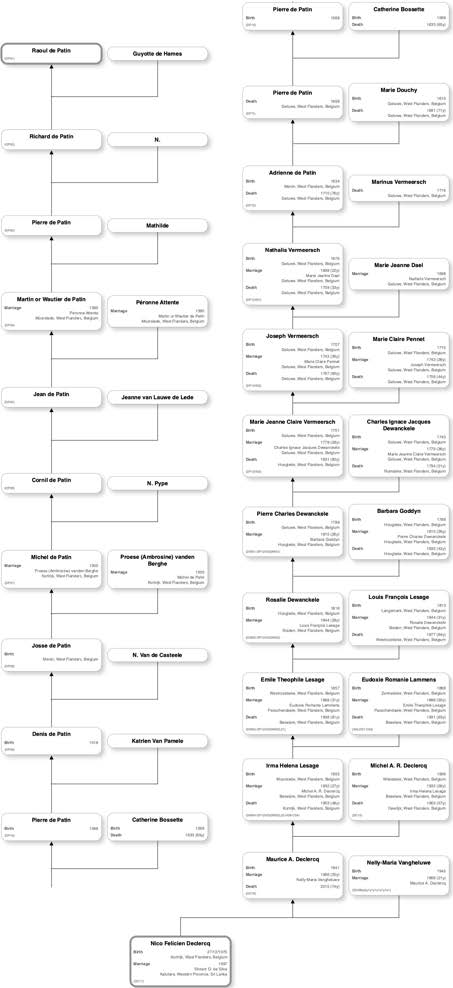
1302
CHAPTER 65. ANCESTRY LINE DE PATIN
Figure 65.6: The entire descendence line from Raoul de Patin in Cambrai until the author,
until Pierre de Patin and Marie Douchy, left, and starting with them, right.
© 2024 Nico F. Declercq
The Desclergues of la Villa Ducal de Montblanc, 2nd ed., Omn., VOL. V
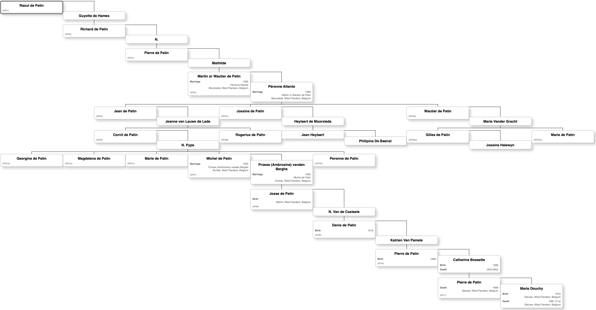
65.4. PIERRE DE PATIN (DP03) & MATHILDE
1303
Figure 65.7: Ancestry tree linking Raoul de Patin, husband of Guyotte de Hames, with Pierre de Patin, husband of Marie Douchy.
65.4 Pierre de Patin (DP03) & Mathilde
65.4.1 Pierre de Patin
He was a Squire and the grandson of Raoul de Patin and Guyotte de Hames. He has been cited in a 1389 document of the chamber of Lille (France). He was married to a particular Mathilde.
65.4.2 Mathilde
Her family name or other details are not known. She was married to Pierre de Patin.
65.4.3 Their Children
Pierre de Patin (DP03) and Mathilde had at least one child: Martin de Patin (DP04) or Wautier de Patin.
65.5 Martin or Wautier de Patin (DP04) & Attente Peronne
He was a contemporary of Bertrand Du Guesclin, the paternal ancestor of the Desclergues, described in Part VI. Martin or Wautier de Patin (DP04) was a son of Pierre de Patin (DP03) and Mathilde, and he had three children: Jean de Patin (DP05), Martin or Wautier de Patin (DP05b), and Jossine de Patin (DP05c). Wautier de Patin (DP04) appears in a document in 1370, where one can find that he was a Knight. His wife was Attente Peronne27. He was the provost of the manor of Quesmes in 1412. He died on July 23, 1445, and is buried at Halewijn in the Chapel of Saint Jacques. Wautier de Patin (DP04) had five children: Wautier de Patin (DP05b), Catherine de Patin (DP04b2), Jeanne de Patin (DP04b3), Josine de Patin (DP04b4) and Perchine de Patin (DP04b5).
The descendants of Martin or Wautier de Patin (DP04) and Attente Peronne are given in Figure 65.15.
65.5.1 Wautier de Patin (DP05b) & Maria van der Gracht
He was a Knight and bailiff of the city of Menin from 1459 to 1460 and, according to other sources, even from 1414 until 1460. He married Maria van der Gracht, sister of Roland van der Gracht. Wautier de Patin (DP04b1) and Maria van der Gracht had three children: a son, Gilles de Patin (DP04b1y), a daughter, Josine de Patin (DP04b1x1), and a daughter, Marie de Patin (DP04b1x2).
65.5.1.1 Gilles de Patin (DP05by)
He was a Squire and was born at Menen, was the lord of Nedermoorschure and Legelant, and was a member of the Council of Flanders as advisor of Charles de Bold (Karel de Stoute), Duke of Burgundy, described in Chapter 8.5.4. On March 18, 1463, he married Josine van Halewijn and buried Ghent with his wife. He had a son, Roeland, who, in 1476, became a Priest of Royghem at Ghent.
Gilles de Patin (DP04b1y) died on September 16, 1479. Josine van Halewijn died on November 8, 1489. She was the daughter of Squire Wautier de Halewyn. Gilles de Patin had no children. The couple constituted a perpetual annuity favoring the Carthusian church near Ghent, where they were buried with an epitaph.
65.5.1.2 Marie de Patin (DP05bx)
She was alive in 1464 and died in 1479.
27Registers of Dadizeele, f 17 v, and 22 r.
The Desclergues of la Villa Ducal de Montblanc, 2nd ed., Omn., VOL. V
© 2024 Nico F. Declercq
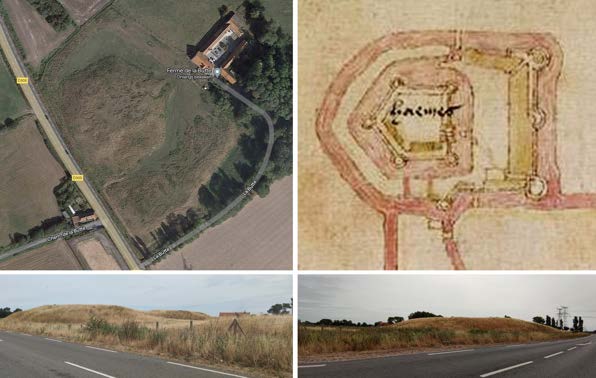
1304
CHAPTER 65. ANCESTRY LINE DE PATIN
Figure 65.8: Top right: Hames Castle looking north down. Excerpt from “Map of the Marches of Calais”. Henry VIII -
British Museum. The other images show a current aerial view and photos along the road (courtesy of Christophe Pattyn).
Hames is found in la Butte, on the other side of Chemin de la Butte, after crossing the D305 in 62340 Hames-Boucres, France.