

Publishing Your First Book by 22 Lions Publishing - HTML preview
Download the book in PDF, ePub, Kindle for a complete version.
Table of Contents
Introduction 06
Chapter I: The Publishing World 07
Chapter II: Traditional Publishing 09
Chapter III: Self-Publishing 11
Chapter IV: Hybrid Publishing 13
Chapter V: Side-by-Side Comparison 15
Chapter VI: Decision Quiz 16
Chapter VII: Preparing Your Manuscript Like a Pro 18
Chapter VIII: Global Distribution 21
Chapter IX: Audiobooks, Translations, and 19
Reaching Readers Worldwide
Chapter X: How First-Time Authors Actually Sell 26
Books
Chapter XI: Avoiding Scams & Pitfalls 18
Chapter XII: Your Publishing Journey Starts Now! 21
WWW.22LIONS.COM @22LIONSBOOKSTORE

Introduction
You've poured your heart and soul into writing your first manuscript, a monumental achievement in itself. Now, a new adventure begins: bringing your words to the world.
This guide is designed to empower you with clear, honest, and practical insights into today's publishing landscape. We'll explore the three main paths— Traditional, Self-Publishing, and Hybrid—helping you choose the perfect fit for your unique vision and goals. Let's embark on this exciting journey!
6

The Publishing World – Part 1/2
The publishing industry is a vibrant ecosystem, constantly evolving with new technologies and reader behaviors. For a new author, understanding this landscape is crucial. We live in an era of unprecedented access and opportunity. Forget the old gatekeeping myths; while traditional publishers still hold significant sway, the paths to publication are more diverse than ever before. You have choices, and informed choices lead to the most satisfying outcomes.
Today, publishing isn't just about getting your book into a few local stores. It's about reaching readers globally. Wide distribution is the norm, with books readily available through major online retailers, physical bookstores, and libraries. This vast reach is powered by print-on-demand technology, meaning your book can be printed as needed, reducing inventory costs and increasing availability.
Beyond print, the audio revolution continues its surge. AI-generated audiobooks are now mainstream, offering cost-effective and efficient ways to bring your story to listeners. Multi-language translations are also more accessible, opening doors to international markets that were once the exclusive domain of established authors and major publishing houses. This is a golden age for authors, where technology amplifies reach and creative control.
7

The Publishing World – Part 2/2
📋 Key Takeaways
The publishing landscape is dynamic, with diverse paths to publication.
Global distribution is now standard.
AI audiobooks and accessible translations offer expansive reach.
Reflect on your personal goals for your book. Is it prestige, maximum control, or a balance of both?
8

Traditional Publishing – Part 1/2
Traditional publishing has long been considered the gold standard, offering the prestige of a major publishing house and the backing of an experienced team. This path means a publisher acquires the rights to your manuscript, pays you an advance against royalties, and handles all aspects of editing, cover design, marketing, and distribution. It's a collaborative process where you typically relinquish a significant amount of control over the final product in exchange for their expertise and resources.
The journey to traditional publication often begins with securing a literary agent. Agents act as your advocate, pitching your manuscript to acquiring editors at publishing houses. This process can be highly competitive and lengthy, requiring immense patience and resilience. Think of it as navigating a carefully guarded gate. According to industry statistics (e.g., Publisher's Marketplace data), only a small percentage of submitted manuscripts secure an agent, and an even smaller fraction land a publishing deal. This selectivity is what contributes to the prestige of being traditionally published.
Royalties in traditional publishing typically range from 10-15% of the book's net price for print and 20-25% for e-books. While this percentage might seem lower than other paths, it's applied to a wider distribution network and often comes after a substantial marketing push funded by the publisher.
9

Traditional Publishing – Part 2/2
Advances can vary widely, from a few thousand dollars for debut authors to six or seven figures for established names. Remember, an advance is not extra money; it's an upfront payment against your future royalties. If your book doesn't "earn out" its advance, you don't receive additional royalties until it does.
📋 Key Takeaways
Traditional publishing offers prestige and publisher-funded support
(editing, marketing, distribution).
Requires a literary agent and involves a competitive, time-consuming
submission process.
Royalties are typically 10-15% for print, 20-25% for e-books, after an
advance.
If traditional publishing appeals to you, start researching literary agents specializing in your genre.
10

Self-Publishing – Part 1/2
Self-publishing puts you squarely in the driver's seat. You become the publisher, wielding 100% control over every single aspect of your book's journey, from editing and cover design to pricing, marketing, and distribution. This path offers unparalleled creative freedom and direct access to your readers. However, with great control comes great responsibility; you are accountable for all costs, effort, and strategic decisions.
The beauty of self-publishing lies in its accessibility and speed. Once your manuscript is ready, you can upload it to platforms like Amazon Kindle Direct Publishing (KDP) and Apple Books, often seeing your book live within days. This direct-to-reader model typically yields higher royalty rates, ranging from 35-70% of the book's list price, depending on the platform and pricing structure. For instance, Amazon KDP offers 70% royalties for e-books priced between $2.99 and $9.99, and 35% for those outside that range, or for print books.
The financial investment in self-publishing is entirely yours. This typically includes professional editing (e.g., $1,000-$5,000+ for a full manuscript), cover design ($300-$1,500), interior formatting ($200-$800), and marketing efforts ($500+ for initial campaigns). While these costs might seem daunting, they are investments in your product's quality and marketability. Many successful self-published authors view these expenses as essential business costs, recouping them through consistent sales over time.
11

Self-Publishing – Part 2/2
The primary challenge in self-publishing is marketing and discoverability. Without the marketing engine of a traditional publisher, you are solely responsible for building your author platform, engaging with readers, and promoting your book. This requires dedication, learning, and often, a significant time investment beyond the writing itself. However, for those who embrace the entrepreneurial spirit, self-publishing offers a direct and rewarding connection to their audience.
📋 Key Takeaways
Self-publishing offers 100% creative control and direct-to-reader access. You bear all costs and responsibilities for editing, design, and marketing. Higher royalty rates (35-70%) but requires significant author-led promotion.
Consider if you have the time, resources, and inclination to manage all aspects
of your book's publication and promotion.
12

Hybrid Publishing – Part 1/2
Hybrid publishing, also known as partner or assisted publishing, offers a compelling middle ground between traditional and self-publishing. This model combines the professional services and support typically associated with traditional houses with the author's creative control and higher royalties characteristic of self-publishing. It's a "best of both worlds" scenario designed for authors who want professional guidance without relinquishing ownership or waiting years for a deal.
In a hybrid model, the author pays an upfront fee for a suite of professional services. This fee can range from approximately $500 to $15,000, depending on the level of services included. These services typically encompass professional editing (developmental, copyediting, proofreading), bespoke cover design, interior formatting for both print and e-book, ISBN assignment, and comprehensive wide distribution. Many hybrid publishers also offer marketing credits, publicity support, multi-language translation services, and even AI audiobook production as part of their packages.
The significant advantage for authors is that they retain 100% of their royalties after retailer fees are deducted. For example, if Amazon takes 30% of an e-book sale, you keep the remaining 70%. This contrasts sharply with traditional publishing's lower percentage royalties.
13

Hybrid Publishing – Part 2/2
With Hybrid Publishing, you retain creative control over your manuscript, cover, and marketing decisions, all while leveraging the publisher’s expertise and industry connections. It's crucial to distinguish legitimate hybrid publishers from "vanity presses." A reputable hybrid publisher will adhere to the industry standards set by organizations like the Independent Book Publishers Association (IBPA). They should have a selective submission process, offer transparent contracts, provide professional-grade services, and ensure wide distribution. Research is key to finding a partner that aligns with your values and goals.
📋 Key Takeaways
Hybrid publishing blends professional services with author control and
higher royalties.
Authors pay an upfront fee ($500-$15,000) for services like editing, design,
and distribution.
Authors keep 100% royalties after retailer fees; retain creative control.
Some examples of publishers often recognized for following industry standards are 22 Lions Publishing, Mindstir Media, SparkPress, Amplify Publishing Group, Manhattan Book Group, and Greenleaf Book Group.
14

Side-by-Side Comparison
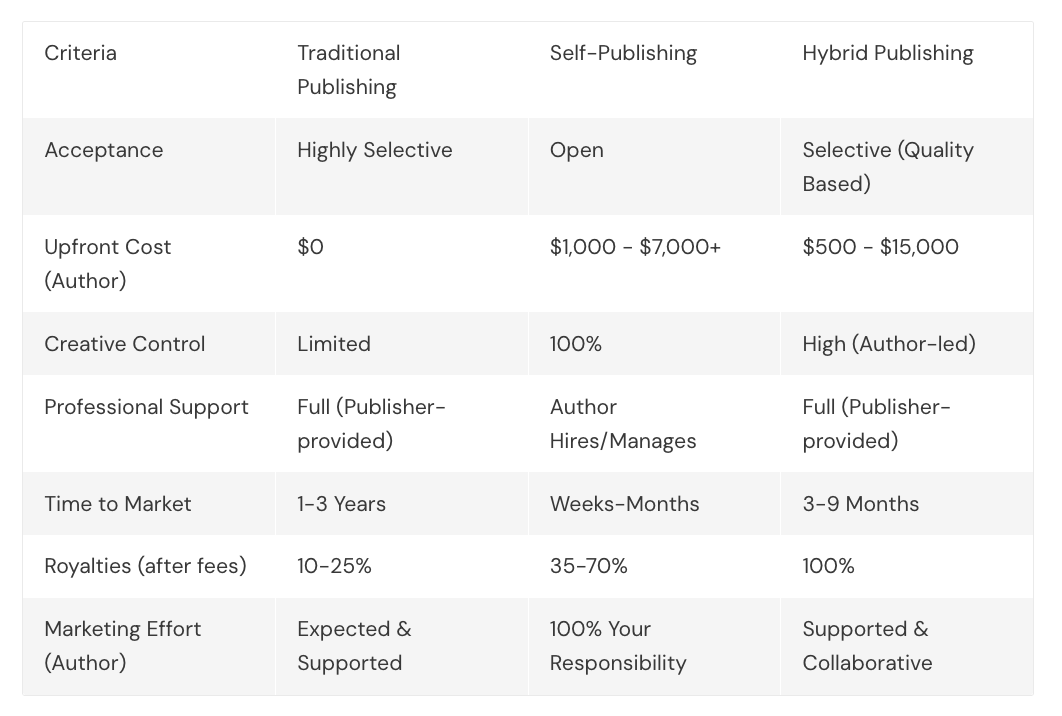
Choosing the right publishing path is a deeply personal decision, influenced by your goals, resources, and appetite for involvement. To help you make an informed choice, here's a comprehensive side-by-side comparison of the three models, followed by a decision quiz to guide your thinking.
Publishing Path Comparison
15

Decision Quiz – Part 1/2
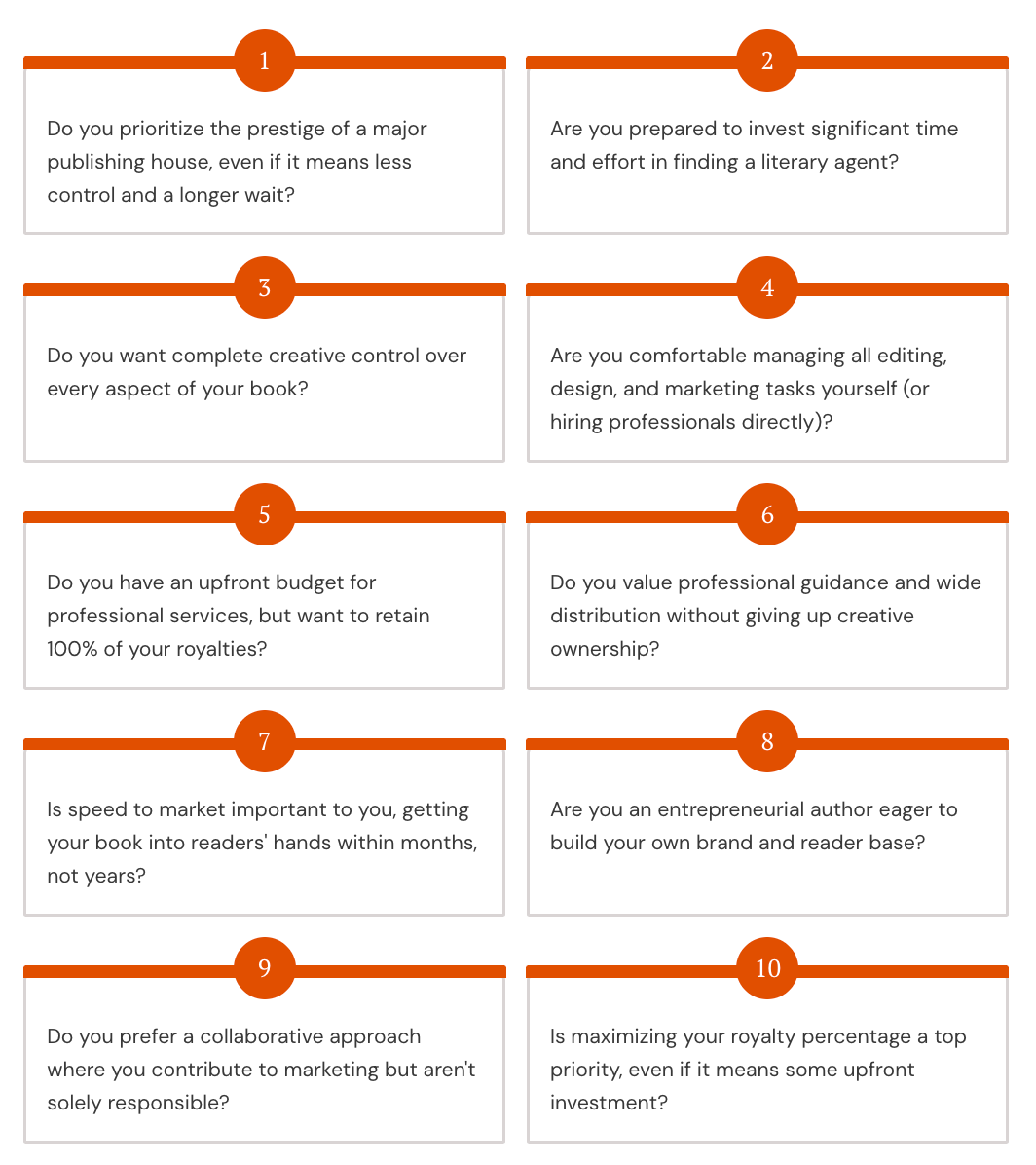
Decision Quiz: What's Your Publishing Path?
16

Decision Quiz – Part 2/2
If you answered mostly YES to questions 1-2: Traditional Publishing might be your ideal path.
If you answered mostly YES to questions 3-4, 7-8: Self-Publishing could be your perfect fit.
If you answered mostly YES to questions 5-6, 9-10: Hybrid Publishing is likely your best option.
📋 Key Takeaways
Each path offers distinct advantages and disadvantages regarding control, cost, and support.
Your personal goals and resources should guide your decision.
Based on the comparison and quiz, tentatively identify the publishing path that resonates most with you.
17

Preparing Your Manuscript Like a
Pro – Part 1/3
No matter which publishing path you choose, a professional-quality manuscript is non-negotiable. This stage is where your raw creation transforms into a polished, market-ready product. Skimping here is the most common mistake new authors make, and it can severely impact your book's success and reputation.
🖋 Editing
Professional editing is the bedrock of a successful book. It typically involves several stages:
Developmental Editing: Focuses on big-picture elements like structure,
plot, pacing, and clarity. (Cost: $0.05-$0.15 per word)
Copyediting: Addresses grammar, spelling, punctuation, syntax, and
consistency. (Cost: $0.02-$0.05 per word)
Proofreading: The final check for any lingering errors before publication.
(Cost: $0.01-$0.02 per word)
Even for nonfiction, these stages are critical to ensure your message is clear, credible, and compelling.
18

Preparing Your Manuscript Like a
Pro – Part 2/3
🎨 Cover Design
Your book cover is its most important marketing tool. It must instantly convey genre, tone, and professionalism. A professional designer understands market trends, typography, and imagery to create a cover that grabs attention and appeals to your target audience. (Cost: $300-$1,500). Do not attempt to design your own cover unless you are a professional graphic designer with experience in book covers. A poor cover signals an unprofessional book.
📑 Interior Formatting
This is about how your book looks inside, both in print and e-book formats. Proper formatting ensures readability and a professional aesthetic. For print, this includes margins, fonts, chapter headings, and page numbers. For e-books, it means creating a reflowable text that adapts to different devices. (Cost: $200-$800)
19

Preparing Your Manuscript Like a
Pro – Part 3/3
#⃣ ISBNs
An International Standard Book Number (ISBN) is a unique 13-digit commercial book identifier. If you self-publish, you'll need to purchase your own ISBNs (in the US, from Bowker). Many hybrid publishers include ISBNs in their packages. Traditional publishers assign them. You'll need separate ISBNs for different formats (e.g., print, e-book, audiobook).
📋 Key Takeaways
Professional editing is essential for a high-quality manuscript.
Invest in a professional cover design to attract readers.
Proper interior formatting ensures readability across all formats.
Understand ISBN requirements for different publishing paths and formats.
Create a budget for the professional services your chosen publishing path will necessitate. Professional assistance can be procured through websites and marketplaces like 22 Lions Publishing, Reedsy, Editor World, 99designs, Damonza, Scribendi, BookBaby, Palmetto Publishing, and Fiverr.
20

Global Distribution – Part 1/2
The concept of "local" publishing has largely dissolved. Authors now have the unprecedented ability to reach readers across continents, making your message accessible regardless of geographical boundaries. This wide reach is primarily driven by advancements in digital distribution and print-on-demand (POD) technology.
Wide Distribution: Whether you go traditional, self-published with a service like IngramSpark, or hybrid, your book can be available through a vast network. This includes major online retailers like Amazon, Barnes & Noble, Apple Books, Google Play Books, and Kobo, as well as thousands of independent bookstores and chains. Many distribution services boast access to 40,000+ stores worldwide. This means a reader in Sydney can order your book just as easily as someone in Seattle.
Print-on-Demand (POD): POD is a game-changer for authors. Instead of printing thousands of copies upfront (and potentially having them sit in a warehouse), books are printed only when ordered. This eliminates inventory costs, reduces waste, and makes it feasible for even niche books to remain in print indefinitely. Services like IngramSpark and Amazon KDP are leaders in POD, ensuring your physical book is available globally without you needing to manage inventory.
21

Global Distribution – Part 2/2
Libraries: Reaching libraries is a significant goal for many authors, as it expands readership and lends credibility. Today, books distributed through major channels like Ingram are automatically discoverable by over 200,000 libraries worldwide. Library patrons can order your book, and many libraries even purchase e-book licenses. This represents a massive opportunity to connect with readers who actively seek out new authors and diverse content.
International Stores: Beyond general distribution, specific platforms cater to international markets. Your e-book can be available in country-specific Amazon stores (e.g., Amazon.co.uk, Amazon.de, Amazon.ca), and through other regional retailers. This global footprint means your message can truly transcend borders, reaching audiences you might never have imagined.
📋 Key Takeaways
Modern publishing ensures global reach to 40,000+ stores and 200,000+
libraries.
Print-on-demand (POD) technology makes physical book availability
seamless and cost-effective.
Your book can be discoverable and purchasable by libraries worldwide.
Access to international online stores expands your audience significantly.
22

Audiobooks, Translations, and
Reaching Readers Worldwide – Part
1/3
The evolution of digital media has opened thrilling new avenues for authors to connect with audiences. Today, audiobooks and multi-language translations are no longer niche offerings but mainstream opportunities that can dramatically expand your book's reach and revenue potential.
🎙 AI Audiobooks: The audiobook market continues its explosive growth, and AI narration has become a game-changer for independent and hybrid authors. AI voices are now sophisticated enough to provide a natural, engaging listening experience, drastically reducing the cost and time involved in producing an audiobook.
Instead of thousands of dollars and weeks for a human narrator, AI audiobooks can be generated for a fraction of the cost, often under $500, and produced in days. This accessibility means your book can reach the rapidly expanding audience of audiobook listeners, providing a new income stream and a broader impact.
23

Audiobooks, Translations, and
Reaching Readers Worldwide – Part
2/3
🌎 Multi-Language Translations: Breaking down language barriers is easier than ever. While professional human translation for a full-length book can still be costly ($0.08-$0.20 per word), advanced machine translation tools, often paired with human post-editing, offer a more affordable route for reaching non-English speaking markets.
Many hybrid publishers, such as 22 Lions Publishing, now include professional translation services in their packages—22 Lions currently offers translations into six languages: Spanish, French, Italian, Portuguese, Greek, and Romanian —enabling your book to reach new global audiences in these key markets without the complexities of navigating foreign publishing markets yourself.
24

Audiobooks, Translations, and
Reaching Readers Worldwide – Part
3/3
🌐 Reaching Readers Worldwide: Leveraging platforms like Google Play Books, Kobo, and regional Amazon stores (beyond just Amazon.com) ensures
your e-book has a truly international presence. For physical books,
IngramSpark's global distribution network means your print book is available
to bookstores and libraries across dozens of countries. This seamless global
reach allows your message to resonate with a diverse readership, making your
first book a truly international endeavor.
📋 Key Takeaways
AI audiobooks offer an affordable way to tap into the booming audiobook market.
Multi-language translations (including AI-assisted) broaden your international appeal.
Global distribution ensures your book is available to readers worldwide, across all formats.
25

How First-Time Authors Actually Sell
Books – Part 1/2
Let's talk openly about the realities of selling books as a first-time author. While the dream of overnight success is appealing, the reality is that selling books requires consistent effort, strategic marketing, and a clear understanding of your financial investment and potential returns.
Marketing Costs: Marketing is an investment. For self-published and hybrid authors, this can range from a few hundred dollars for basic social media ads and website setup to several thousand for professional publicity campaigns. Traditional publishers cover these costs but expect you to actively participate in promotion. Consider email list building, author website, social media, book launch teams, and paid advertising (e.g., Amazon Ads, Facebook Ads).
Royalty Range: Traditional: 10-15% print, 20-25% e-book (after advance earns out). Self-Publishing: 35-70% (direct from retailers). Hybrid: 100% (after retailer fees), often recouping initial investment within 100-500 copies sold depending on pricing. Understanding these percentages is crucial for projecting your income.
26

How First-Time Authors Actually Sell
Books – Part 2/2
Average First-Year Sales: For most debut nonfiction authors, especially self-
published or hybrid, selling 250-1,000 copies in the first year is a realistic
benchmark. This number can fluctuate wildly based on genre, marketing effort,
and author platform. Success is often a marathon, not a sprint, built on
consistent engagement and quality content.
Your 90-Day Action Plan
Day 1-30: Refine & Prepare
Finalize editing (professional copyedit/proofread). Work with your cover designer. Choose your publishing path and finalize contracts/platforms.
Day 31-60: Build Buzz & Launch
Set up your author website/social media. Build an email list. Plan a launch team. Create advanced reader copies (ARCs). Schedule interviews/guest posts.
Day 61-90: Promote & Engage
Launch your book! Run initial ads. Engage with early readers for reviews. Participate in online communities. Analyze sales data and adjust strategy.
27

Avoiding Scams & Pitfalls
To protect yourself and your work as you navigate the publishing landscape, be aware of common traps and unrealistic promises:
Vanity Presses: Publishers that charge exorbitant fees for basic services
and promise unrealistic results without selectivity.
Guaranteed Bestseller Status: No one can guarantee bestseller status.
Focus on sustainable marketing.
Unprofessional Services: Always check portfolios and references for
editors, designers, and marketers.
Your publishing journey is an entrepreneurial one. Be informed, be proactive, and celebrate every milestone!
📋 Key Takeaways
Marketing is an essential investment for all authors. Understand realistic royalty percentages and sales expectations. Follow a strategic action plan for launch and ongoing promotion. Educate yourself to avoid common publishing scams and bad deals.
28

Your Publishing Journey Starts Now!
The path to getting your book into the hands of readers—whether through the prestige of a traditional house, the control of self-publishing, or the supported model of hybrid publishing—is within your reach. It requires dedication to the craft, strategic decision-making about your path, and a willingness to embrace the entrepreneurial side of being an author. By following the steps outlined in this guide and choosing the perfect fit for your unique vision, you can transform your manuscript and unlock a life of creative achievement.
Don't wait for permission or the perfect moment. The new publishing landscape is happening now, and you have the tools—from global distribution to AI audiobooks—to make your book an international endeavor. Take that first step, invest in professional quality like editing and design, and prepare to share the story you’ve always dreamed of telling. Join the community of informed authors and start building your future today!
29
30

Congratulations! You've poured your heart and
soul into writing your first manuscript, a
monumental achievement in itself. Now, a new
adventure begins: bringing your words to the
world.
This guide is designed to empower you with clear,
honest, and practical insights into today's
publishing landscape. We'll explore the three main
paths—Traditional, Self-Publishing, and Hybrid—
helping you choose the perfect fit for your unique
vision and goals. Let's embark on this exciting
journey together!
www.22Lions.com
You may also like...
-
Writing & Publishing Bestselling Books Writing & Publishing by 22 Lions PublishingWriting & Publishing Bestselling Books
Reads:
22Pages:
54Published:
Dec 2025Tired of earning pennies in Amazon royalties while the big-name authors quietly build empires? This is the exact playbook today’s six- and seven-figure author...
Formats: PDF, Epub, Kindle, TXT
-

The Silent Witness Writing & Publishing by Vatsal BhargavaThe Silent Witness
Reads:
4Pages:
63Published:
Feb 2025Clara Monroe, the courageous detective, had emerged as a guide of light, her courage and determination motivating those around her. She had faced the darkness...
Formats: PDF, Epub, Kindle, TXT
-

Show, don’t tell: A Step-by-Step Handbook for Aspiring Screenwriters, Producers, Directors Writing & Publishing by AL FENDERICOShow, don’t tell: A Step-by-Step Handbook for Aspiring Screenwriters, Producers, Directors
Reads:
27Pages:
99Published:
Dec 2024Unlock the art of visual storytelling with Show, Don’t Tell, the must-have guide for aspiring screenwriters, producers, and directors. Master techniques to cr...
Formats: PDF, Epub, Kindle, TXT
-
Infinite Possibilities - Writing with ChatGPT Prompts Writing & Publishing by Sam MaiyakiInfinite Possibilities - Writing with ChatGPT Prompts
Reads:
754Pages:
22Published:
Mar 2023This book is a unique and innovative writing tool that will take your creativity to the next level.Inside this book, you'll find hundreds of thought-provoking...
Formats: PDF, Epub, Kindle, TXT