

Writings Near the End of the Human Era: Stories and Book Reviews by Peter McMillan - HTML preview
Download the book in PDF, ePub, Kindle for a complete version.
Reviewing Chen Qiufan's Waste Tide (August 2023)
Though originally published in 2013, the English translation of Waste Tide came out only in 2019. Of interest for this review is not the work as narrative science fiction but its value as a relevant contemporary social critique. And in China, writers must be careful, much as were writers from the USSR and the East Bloc during the Cold War. This would especially be the case for Chen who still lives and writes in China.
Science fiction has often served as a platform for social criticism, and such is the case in present-day China where the genre has recently come to the attention of the English-speaking world. Chinese authors may have to write the occasional socialist realism piece to satisfy the party officials as for example in Liu Cixin's short sci-fi story 'Fire in the Earth'—a gripping piece about the harsh world of futuristic coal mining in China—in order to get passed more politically sensitive works like Ball Lightning, which explores the dark dealings between scientists and state officials in developing advanced weapons of war.
Silicon Isle is the setting of this novel. It is the fictional equivalent of the real world town of Guiyu in the Shantou Special Economic Zone, which in turn is within the globalization 'hothouse' of Guangdong Province that surrounds Hong Kong. Silicon Isle, so named because of the e-waste processed there, is the destination for consumer electronic waste, principally originating from the U.S. TerraGreen Recycling is an American company, marketing itself as an environmentally responsible corporation. But no one on Silicon Isle is fooled. Scott Brandle, an employee and self-described economic hit man, knows what's what, of course. Environmental science is still science in the service of global business, but in the case of e-waste processing, science returns to its more familiar role of contributing to national security, which makes e-waste recycling a bankable investment.
.
The secret was rare earth metals, nonrenewable resources more precious than gold. They were like the witch’s magical dust in fairy tales: a small amount was enough to greatly improve the tactical value of ordinary materials and bring about astounding leaps in military technology, allowing the possessor to hold on to an overwhelming advantage on the modern battlefield.
Because the extraction of these metals is extremely costly and hazardous, the lure of high profits is inadequate to generate the desired level of investment if processing is carried out in the U.S. The solution—ages old—is to export the e-waste to countries predisposed to attract foreign investment to reward their privileged classes and demonstrate a modicum of benevolence towards the unemployed. So, fully-laden container ships transport tons of consumer e-waste across the Pacific to Silicon Isle to be processed in a special economic zone where the absence of government regulation reduces labour and environmental costs and attracts global capital meanwhile boosting foreign investment and increasing employment in China. "WIN, WIN, WIN." No matter the financial and human costs absorbed by the 'waste people.'
On introducing the reader to Silicon Isle, Chen appeals to a Western audience with a quote from Dante's Inferno, Canto III, wherein the inscription on the archway at the entrance to Hell reads
Through me you pass into the city of woe:
Through me you pass into eternal pain:
Through me among the people lost for aye....
All hope abandon, ye who enter here.
But there are two Silicon Isles. One is the world of BMW, Mercedes-Benz, Bentley, Porsche and Maserati. The other is hellish. A 'waste child' is entertained by a discarded prosthetic arm that uses its fingers to crawl among the rubbish ... for as long as the battery lasts. A world of silicon debris ... dangerous and deadly, but the only one known by the these children.
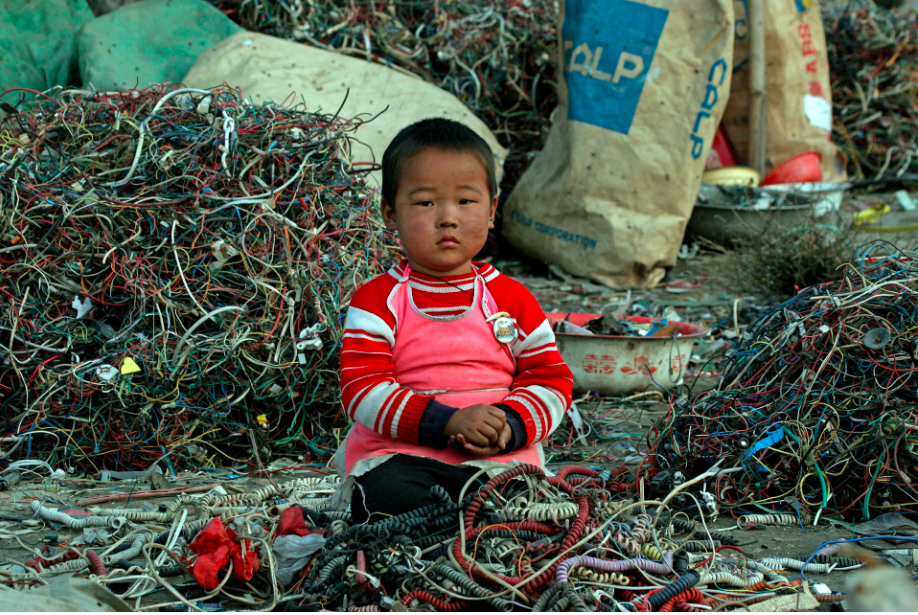
A small child sitting among cables and e-waste in Guiyu, China © Greenpeace / Natalie Behring
Metal chassis, broken displays, circuit boards, plastic components, and wires, some dismantled and some awaiting processing, were scattered everywhere like piles of manure, with laborers, all of them migrants from elsewhere in China, flitting between the piles like flies. The workers sifted through the piles and picked out valuable pieces to be placed into the ovens or acid baths for additional decomposition to extract copper and tin, as well as gold, platinum, and other precious metals. What was left over was either incinerated or scattered on the ground, creating even more trash. No one wore any protective gear.
Waste Tide rips back the veil to show the perpetuation of China's legacy of shame from the Century of Humiliation (roughly mid-1800s to mid-1900s), during which foreigners, aided and abetted by China's government, exploited China's land and people. This is well illustrated in Lao She's Cat Country, published in 1933, a classic in Chinese dystopian science fiction that reads like Swiftian satire to Western eyes. In the novel, foreigners exploit a China that does not fight back, mirroring the real world of the Eight-Nation Alliance of Germany, Japan, Russia, Britain, France, US, Italy and Austria-Hungary during the Boxer Rebellion, which militarily obtained economic concessions from China. These concessions presaged the re-opening of China to special economic zones created by Deng Xiaoping in the post-Mao era. In Crack-Up Capitalism: Market Radicals and the Dream of a World Without Democracy (2023), historian Quinn Slobodian writes that
From their beginnings in the late 1970s, the SEZs [special economic zones] multiplied from southern anomalies to further experiments up the coast, until they spread across the entire country.
In 1990, Friedman said that the right model for Eastern Europe after state socialism was not the United States, Great Britain, or Sweden. It was Hong Kong. Capitalism did not need democracy to work, and the path to success led through the zone.
And so, while the ascendance of China to great power status is bemoaned in the West, for many Chinese, the humiliation continues. Our leaders in North America, business and political, don't talk about special economic zones or the Century of Humiliation in which the West was complicit. But they might if special economic zones are one day located in America (or Canada) and Chinese (and other foreign) firms are allowed to operate free from government regulation—the laissez-faire pass. It could happen for international capital regards borders as barriers to economic growth and profit. For market radicals whose neoliberal origins are traced back to the Austrian School of economic thought by Quinn Slobodian in Globalists: The End of Empire and the Birth of Neoliberalism (2018), government exists solely to create the conditions for commerce—investment and trade—and everything else, in particular anything to do with social justice, is to be sorted out by the efficient and self-regulating market.
_____
Returning to the idea that Waste Tide's significance lay in its contribution to identifying sources of social injustice, how is it that the following passed the Chinese censors?
Welcome to the “Compound Eyes” system of Shantou, which connected hundreds of thousands of cameras and image-recognition artificial intelligence. Twenty-four hours a day, seven days a week, the system kept under surveillance the city’s every street, every corner, every expression on every person, searching for signs of crime or acts of terrorism and protecting the lives and properties of the inhabitants.
The offices in the skyscrapers were lit bright as day. The giant eye zoomed in and observed a hundred thousand faces staring at computer monitors through closed-circuit cameras; their tension, anxiety, anticipation, confusion, satisfaction, suspicion, jealousy, anger refreshed rapidly while their glasses reflected the data jumping across their screens. Their looks were empty but deep, without thought of the relationship between their lives and values, yearning for change but also afraid of it. They gazed at their screens the way they gazed at each other, and they hated their screens the way they hated each other. They all possessed the same bored, apathetic face.
Clearly, this is a reference to China's surveillance state, and it is anything but fawning. And that's not the end of it. When Chen takes on the cruelty of animal testing (the torture of Eva the chimpanzee is reminiscent of Edward Taub's experiments on the Silver Springs macaque monkeys), technology diffusion sponsored by greed, wide and widening income and wealth inequality, the swelling global waste tide of discarded consumer products and packaging, and the superficiality of the ever-expanding nouveau riche who don't think or care about how wealth gets created, he can be taken as talking as much about China as the U.S. (or Canada). Among the cast of characters, the two principal villains demonstrate the sinister collaboration between the foreigner (Scott Brandle, the economic hit man) and the native son (Luo Jincheng, the Chinese clan boss), though each is conflicted by his own passing moments of moral conscience. Predictably, one of the protagonists, Mimi, is a 'waste girl' and surprisingly the other, Chen Kaizong, is an ABC (American-born Chinese).
But to appease the Party and get the novel published in China, 'waste tide' can be easily understood to be something foreign, invasive, and harmful. And that could implicate America, because America, to many around the world and not just in China, see the American face behind horrific scientific experiments on people and animals, in the race to develop technology to dominate global affairs through military and economic superiority, and in the unsated greed that fuels the capitalist machine as it creates then destroys in order to create again, always for the benefit of the Global North. In other words, there is plenty to meet the approval of the Party, so that China need not face itself in the mirror when it can see plainly outside its window to the east.
For an American or Canadian, what would be the value of reading this book? Simple. It's about seeing ourselves as we are seen, so that hopefully we will want to change the image not just for the benefit of the rest of the world but also for those of us who are not satisfied with the hypocrisy of perpetuating our own domestic versions of the Global South.