

Turtles Do Climb Fences by Daniel Moran - HTML preview
Download the book in PDF, ePub, Kindle for a complete version.
Chapter 9
It was time to let the turtles go. Summer was nearly over and the turtles knew it was time to prepare for the winter. They would need to fill up on water and clear their body of waste in order to go into hibernation. They would need to find the right spot to borough into the ground. To make it through the cold, they certainly had stored lots of fat from all the food they were fed. Now, they knew it was time to go.
That Saturday Dad and the children let them out of the pen. All of them turned to the back of the yard and headed down the hill to the woods where there was a creek. Within a few hours all the turtles where out of sight and safely back into the woods.
The children enjoyed the turtles very much while they visited with them. It was good to let the animals go back to the wild though. It is what they wanted and it made the children happy to see them go. They learned so much about them. And yes, turtles do climb fences! The summer of the turtles will not be forgotten.
For Parents:
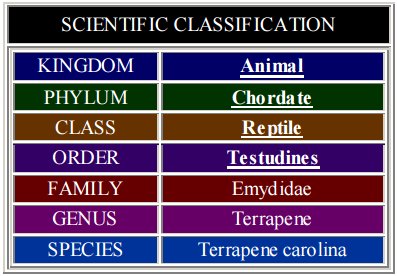
The most common box turtle is the Eastern Box Turtle. The shell is typically high and rounded. The upper shell is the carapace and the bottom shell is the plastron. The upper shell is typically black or dark green with yellow or orange patterns of stripes on it. The carapace is composed of many plates or scutes. The age of the turtle can be determined by counting the rings on the scutes of the carapace. The plastron has two hinges that cover the back and front of the animals shell making the animal completely housed within. This protects the softer parts of the animal from attack by their predators; skunks, raccoons, minks, other rodents and even snakes. The upper shell is created as an extension of the spine and the ribs of the animal. The lower shell rises from the rig cage as the animal develops in the egg. All internal organs are protected within the shell.
The animal has no outer ear but picks up sounds very well through a membrane on the sides of the head. The skin is thick and scaly and each foot has long thick claws for digging, climbing and holding down food as it is torn by the animal’s beak. The turtle does not chew food but swallows chunks of food whole. Box turtles have no vocal cords but may make a hissing sound when approached by another box turtle that has invaded its territory.
The box turtle is a terrestrial turtle or tortoise. It lives in fields and in forests and never wanders far from its birthplace. The home range of a box turtle is around 750 feet from its birth place. This animal can live, on average, 30 years but some have lived up to 100 years or more. Box turtles stop growing larger when the shell hardens completely at 7 years of age. The shell may thicken from the growth rings each year but this does not add much to the size of the animal. They do not grow much larger than 8 inches and typically grow to 4.5 to 6 inches.
The male turtle’s eyes have red irises and the female’s are orange. The female can store the sperm from the male for up to 4 years so that it does not have to mate every year to produce fertile eggs. The female may lay 3-8 eggs each year and dozens over its lifetime. Typically, only 2-3 offspring ever survive to adulthood. The female lays the eggs in the summer months. She buries them in a shallow pit and covers them with soil, leaves, and other debris from the forest floor. The young emerge from the shell fully formed and able to fend for themselves.
Turtles eat berries, mushrooms, snails and slugs, fish, frogs, salamanders, flowers, insects, roots, earthworms, and dead animals. They are omnivorous but the young are typically carnivorous and the adults’ vegetarians. Some mushrooms that are poisonous to humans are eaten by the turtle without ill effect. The turtle may remain poisonous if it is eaten after consuming such mushrooms.
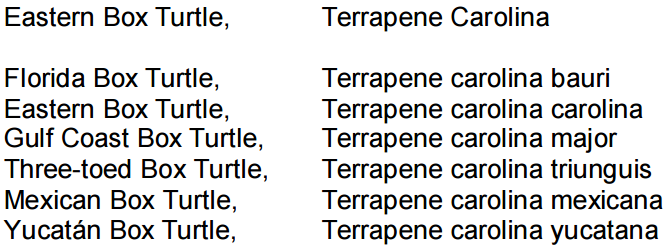
The animal hibernates in the colder climates from October or November through to spring. They may dig as deep as 2 feet into the forest floor, or use mammal borrows, creek banks, and old stump holes for a borrow. They remain in this state for up to 5 months or until the air allows them to achieve a body temperature of 84 degrees Fahrenheit. The animal cannot endure heat above 100 degrees F and must seek cool shade, shallow ponds or it will dig into cool earth to manage its body temperature. There is only one species of box turtle in North America and it is recognized by 6 subspecies which are geographically isolated.
Today most States protect the box turtle as its habitat is slowly being converted into housing for humans. It is unlawful to harvest and sell box turtles. Trying to keep them as pets is not recommended and may be unlawful today. The success rate of domesticating a box turtle is very poor. Enjoy them when you see them and get them off the road, if that is the case. But leave them where you find them.
You may also like...
-
![Dead Man Walking II [ER]](/2d_covers/large/1784736989.jpg)
Dead Man Walking II [ER] Short Stories by Robby RichardsonDead Man Walking II [ER]
Reads:
29Pages:
100Published:
Jul 2026An unapologetic collection of poems and a short story that cut deep into people who have shaped and scarred my life. Each piece is written with sharp honesty,...
Formats: PDF, Epub
-

Runaway Short Stories by Pete BertinoRunaway
Reads:
0Published:
Apr 2026A sixteen year old from South Philly on the run from the police finds refuge in a world of goblins, wizards and dragons.
Formats: PDF
-

The Invisible Man Series Short Stories by BILAL DADARThe Invisible Man Series
Reads:
37Pages:
62Published:
Dec 2025He is the whisper no one hears, the presence no one sees, and the reckoning no one escapes. InMan moves through the world unseen — not as a superhero, but as ...
Formats: PDF, Epub, Kindle, TXT
-

Writings Near the End of the Human Era: Stories and Book Reviews Short Stories by Peter McMillanWritings Near the End of the Human Era: Stories and Book Reviews
Reads:
15Pages:
157Published:
Nov 2025There are two collections in this book: one of 15 short stories and one of 11 book reviews. Fiction and nonfiction don't usually get combined this way, but, i...
Formats: PDF, Epub, Kindle, TXT