

Stories of Place by Tom Wallace - HTML preview
Download the book in PDF, ePub, Kindle for a complete version.
Introduction
This is a collection of stories on the theme of place. There’s quite a diverse range of tales, memoirs and short essays here. But there is something of a narrative developing from work to work.
The first stories start us off in the most intimate of places – our own bodies, and our own beds.
As the themes spread out from home to city to world, then the stories start to ask us about how our mindsets shape our world, and what we might do if the shape of the world is not to our liking!
Some stories explore what might go wrong, whilst others show what might be going right!
I’d like to think that there is hope in all of them and hope for our collective future.
Whether some of the scenarios presented here will be appealing or horrific to you, I don’t know!
But I hope that all - or some of them at least-will be thought-provoking. And if they are, I’d love to hear back from you! The book is posted on a few different free websites, as well as places where a paperback version can be purchased. It would be great if you took a few moments to share your thoughts about a particular story, or about the whole book. I’d be happy to hear from you and to answer any questions – it’s all about the conversation!
7
S T O R I E S O F P L A C E
8
S T O R I E S O F P L A C E
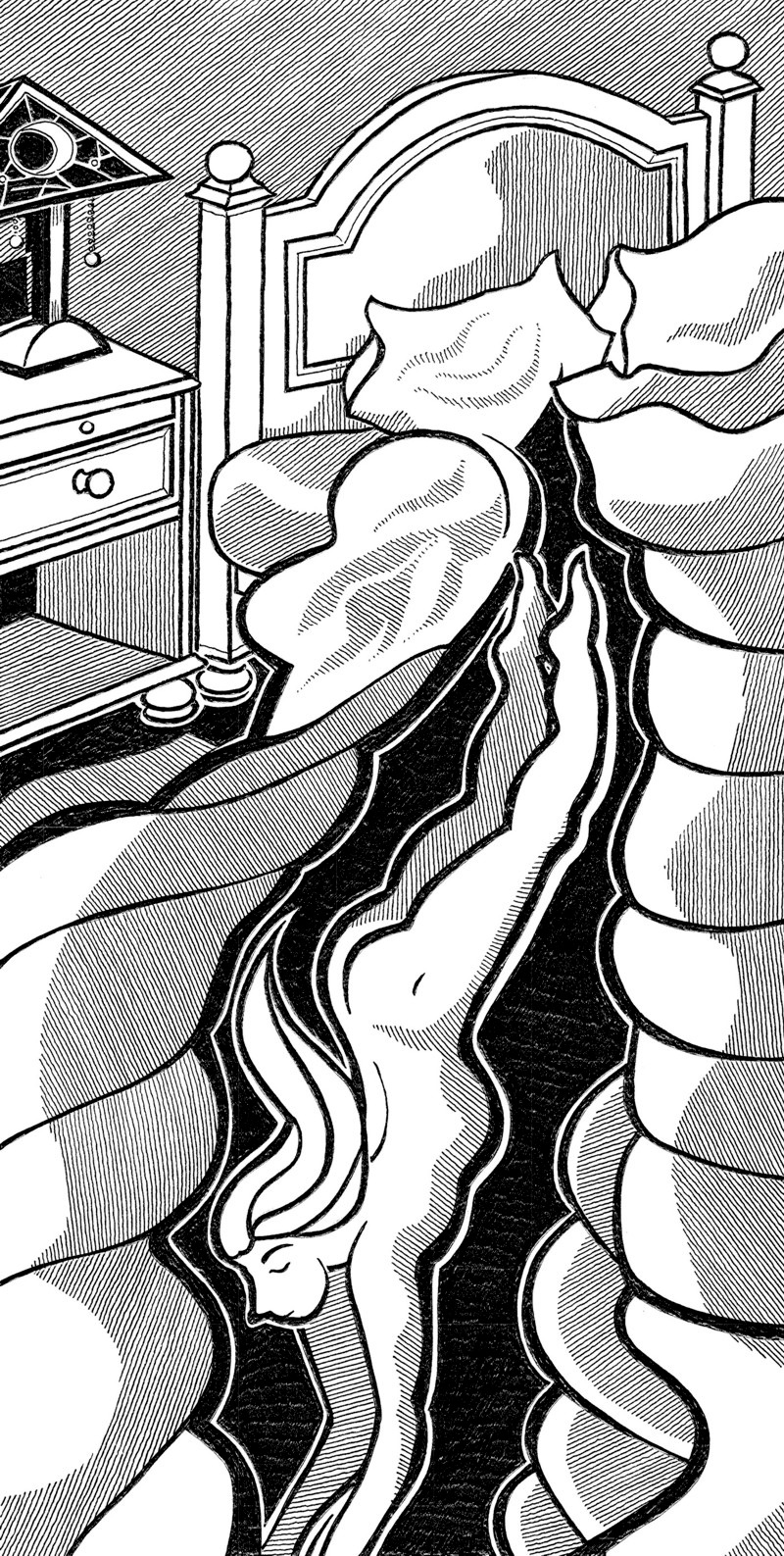
Bed
And surely there’s nowhere else I’d rather be!
It’s just an opinion – and you might think I’m crazy – but I think the world would be a better place if we all just spent more time in bed!
Think of all the pointless work that could then be left for another day! And after a while we’d realise that a lot of work really is just pointless and there’s no reason to be doing it at all!
Think of how much more rested everyone would be. So there’d be a lot fewer grumpy and anxious people to deal with. And think how much energy could be saved just by staying under the downie and blankets.
Most of us were conceived and born in bed and many of us will die in bed. It’s literally the threshold of both life and death. And of course it is also the threshold to that other world that lives within us – the world of dreams and imagination. Going to bed is like being a pearl diver – plunging down into the depths of our minds and hoping to return to the surface with treasure.
These are journeys best taken in the nude.
Nudity is the uniform of the pearl diver – the diver into the imagination. Then we are at once truly ourselves and also truly vulnerable – open 9
to what life, death, dream and imagination might want to give us.
It’s a mysterious world we enter when we dream. Some dreams see us in situations that are potentially credible, real-world events. The mind is perhaps rehearsing it’s waking-life tasks. But other dreams seem full of symbols.
In our human hubris, we think it is our intellectual abilities that create these symbols.
But perhaps the symbols really come to us from elsewhere – perhaps some emergent factor of culture, or even of the whole bio-sphere, generates these symbols that filter down to us in sleep. Carl Jung called it the collective conscious. Maybe we are better people, receiving these symbols, even although we may rarely grasp their meaning.
Of course the unconsciousness of sleep can sometimes feel like a dangerous place. For the sleeper, the world has stopped, even whilst it continues on beyond our sleeping selves. That moment of waking back into the world, is, I think, the most significant moment of every day.
In that moment, we can truly know ourselves, even if only for an instant.
And bed is also the place of love. I’m not talking so much about sex here – more about intimacy. The pillow-talk. If waking is the most honest moment we have with ourselves, then those talks between the sheets must surely be the most honest moments we have with another person. Listen carefully and we can gain a wisdom worth more than gold. Stop listening, and, well, that is a sad loss – no matter how well everything else may seem to be going.
Bed is one of the few places we can be at one with ourselves and at home in our bodies.
Perhaps you feel we are odd creatures, lacking 10
the scales, fur or feathers of most other life on the planet. But no, let’s just accept that we are different and celebrate all that bare flesh! Let’s take pleasure in our embodied selves.
The bedroom then has got to be the most important room in anyone’s life! To feel safe and protected there is to feel grounded in who we are. The bedroom is the place of all our dreams and imaginings and therefore the place where plans are formed, decisions made, hope secured, futures charted, projects begun! Truly, everything starts in bed!
Good night, sweet dreams, see you on the other side.
11
S T O R I E S O F P L A C E
12
S T O R I E S O F P L A C E
Red Dust
A young woman finds a new life amongst one of Africa’s most remote tribes.
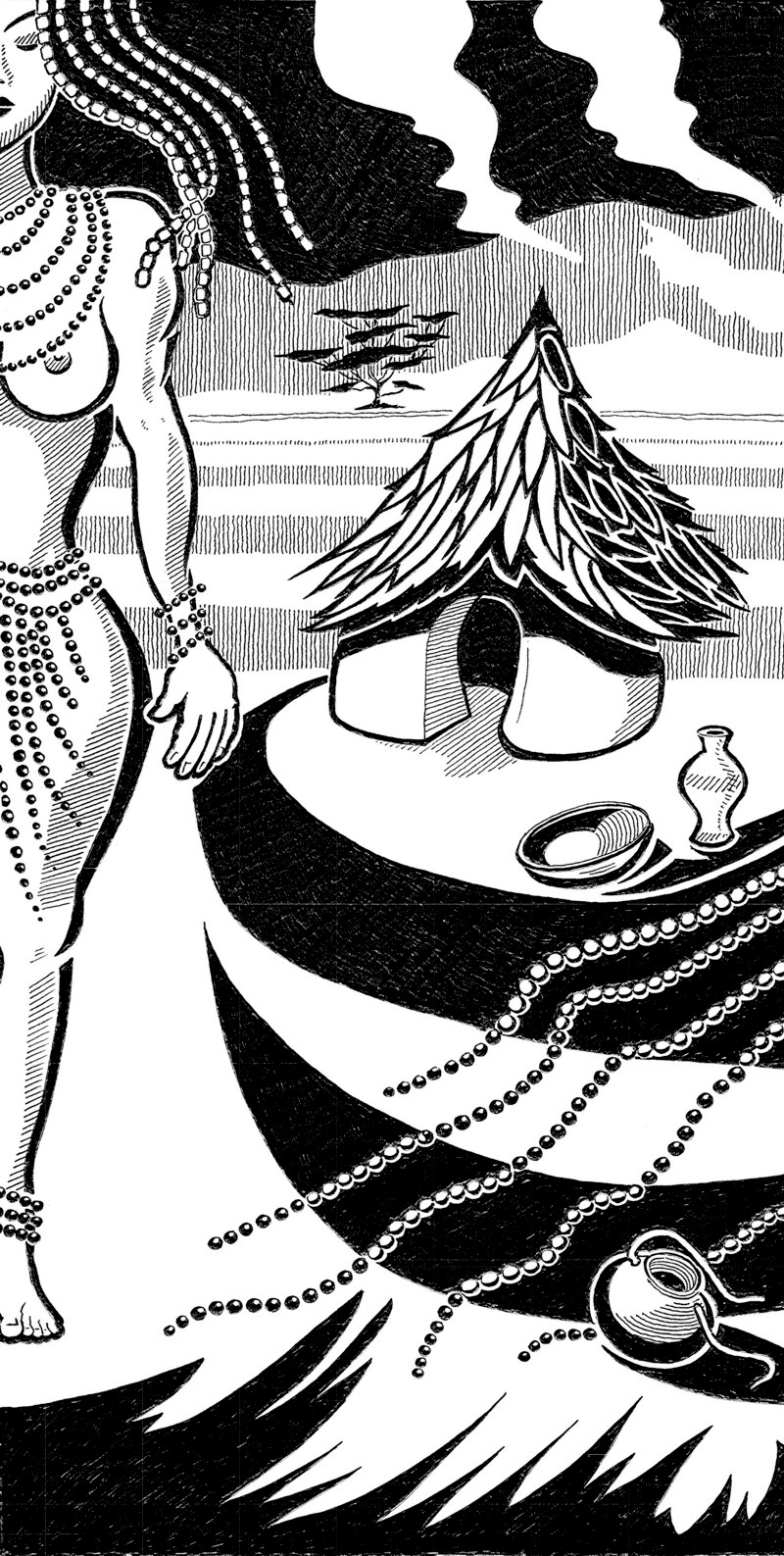
I know what you’re thinking! How come I, a 23-year-old from Essex, England, have ended up here, one of the remotest parts of Africa, to live with this tribe. This tribe who are known for covering themselves in red ochre and otherwise mostly just wear beads. Considered one of the most ‘primitive’ tribes of the world’s remaining indigenous populations (although I’d call them the most wise and sophisticated beings who have ever graced this planet).
Well, it started with a documentary. Put an ordinary English family down into the middle of Africa and see how they cope with a radically different way of life. Great telly! The family was my mum, my dad, two brothers and me.
To be honest we had a huge winnebago and plenty of supplies. We could almost have avoided any interaction at all with the tribespeople, if we’d wanted to. And that, indeed, was what the family did! Except, that is, for me.
So now, having finished school, I’m back. And this time, I’m intending to stay. No mod-cons.
My small suitcase of Western clothes will be 13
stashed away in case I ever go home. The only other things I have with me from ‘civilisation’
are paper, envelopes and pens, all carefully wrapped up to protect them from insects and damp weather. My only contact with home will be letters, which are passed on via the health workers that visit the tribe every few months.
The tribe remember me and the women take me away at once to get kitted out in the red ochre that covers their whole bodies and is even woven into their hair – our hair. Some have gifted necklaces and strings of beads to go around my waist and hang down as a beaded skirt. Nevertheless, I’m rather ‘bead-poor’ for a woman of my age. Children start off naked for a few years – apart from the red dust – but then start to accumulate belly bands and necklaces that may stay with them their whole lives. Or they may be given away, or laid into the grave of a departed loved one. It is not easy to figure out why something is kept and why something is given away. But the tribe seems to know instinctively what is the appropriate behaviour.
Anyway, I’m to spend the first few days of my new life working with the older women, getting
‘beaded up’! These women are mostly too old to work in the fields, although they may do a bit of cooking. Apart from that, they sit in little groups, chattering and stringing beads. Even now, one is collapsed in laughter at some joke shared amongst them. This is a happy pastime.
What a way to spend your old age!
But after that, it’s the fields for me, like everyone else – even the youngest of children.
My tribe only does crops and some foraging – no hunting, no trade, no money, no shops. It’s a precarious existence, for sure, and a year of drought could wipe out almost everyone – only a 14
little food can be stored into another year.
Thankfully, in recent times, the government is able to step in and provide food aid in times of crisis. There are some plastic containers and old tin cans here and there from previous such interventions.
This is a lush place normally though, and crops grow in abundance. It takes a few weeks for me to get through a whole working day in such heat though. I am forced by the friendly tribespeople to sit in the shade. Children bring me water.
There are no fences or boundaries. The tribe has no real concept of owning land or being part of a nation. Wild animals wander nearby and sometimes make their way through the fields and orchards. Depending on the animal, the tribe either tolerates this or makes some efforts to drive the animals out. But it’s all done with the feeling that the animals have as much right to the land as we have. Lions are (thankfully) mostly frightened of humans, so they take a wide berth. The most problematic are elephants. Elsewhere in Africa there are signs that humans tried to erect earth mounds as a protection against such beasts – and it may have been so long ago that some even more impressive creatures were still around, like the giant rhino and the larger species of big cat.
But well, you can imagine the labour involved in such fortification. Today, it’s more a case of distraction! Somehow the tribe knows when elephants are approaching days in advance and will make preparations to go out and re-direct them away from the village and the fields.
(Elephants themselves will cross dozens and even hundreds of miles for water, somehow knowing where they will find it.) Likewise, working in the fields, there will be a ripple of 15
excitement when other creatures are spotted and everyone will know within a few minutes. It might be a female cheetah with her cubs, or a herd of antelope – somehow the word is out, and I only catch up with the news hours later!
I’ve been essentially adopted by a couple who have two teenage sons and their own hut. Huts are mud reinforced with timber posts and covered in grass roofs. The living arrangements shift depending on family groupings. A family will likely have its own hut for a while, but may also take in an elderly parent, aunt or uncle. All this seems to happen very easily and with little discussion. Meanwhile, teenagers naturally make eyes at each other, disappear into the fields or forests from time to time and before you know it (or at least, before I know it) kerpow! They’re a couple! Once babies arrive a new hut may go up, or an existing hut vacated by some older folk and the young couple have a place to rear their kids. And that’s it! No fuss.
No mortgage. No bills.
All this is done with so much friendliness and cheerfulness that it makes me weep sometimes when I see it. That’s why I say my tribe is the most wise and gracious that has ever walked the Earth.
The only real intrusion of the 21st century (apart from the food aid I mentioned earlier) is the visits from the health workers. After a few months in the tribe the sight of their landrover, medical equipment and uniforms feels like an alien invasion to me. These folk are still Africans, but very much Africans of the Westernised variety. It’s difficult to know what they think about the tribe – whether they think we’d all be better off in a city, or whether they respect the choice of living as part of the land.
16
But anyway, babies are weighed, medicines distributed, a few minor ailments are sorted on the spot and from time to time someone is carted off to the hospital, over a hundred miles distant. There are herbs and remedies amongst the tribe of course, but generally Western medicine is accepted. Before all this, someone in chronic pain or close to death – well, it was just a case of easing the pain and giving them the most comfortable journey into the hereafter.
The tribe calls the land ‘home’ and the next life as well. Death is ‘going home’.
I wonder if I will ever ‘go home’, in the sense of go back to England. I hope to make it through most of my life here, if not all of it, but who knows. But whether I go back or not, I hope I will always call this tribe and this land my home.
17
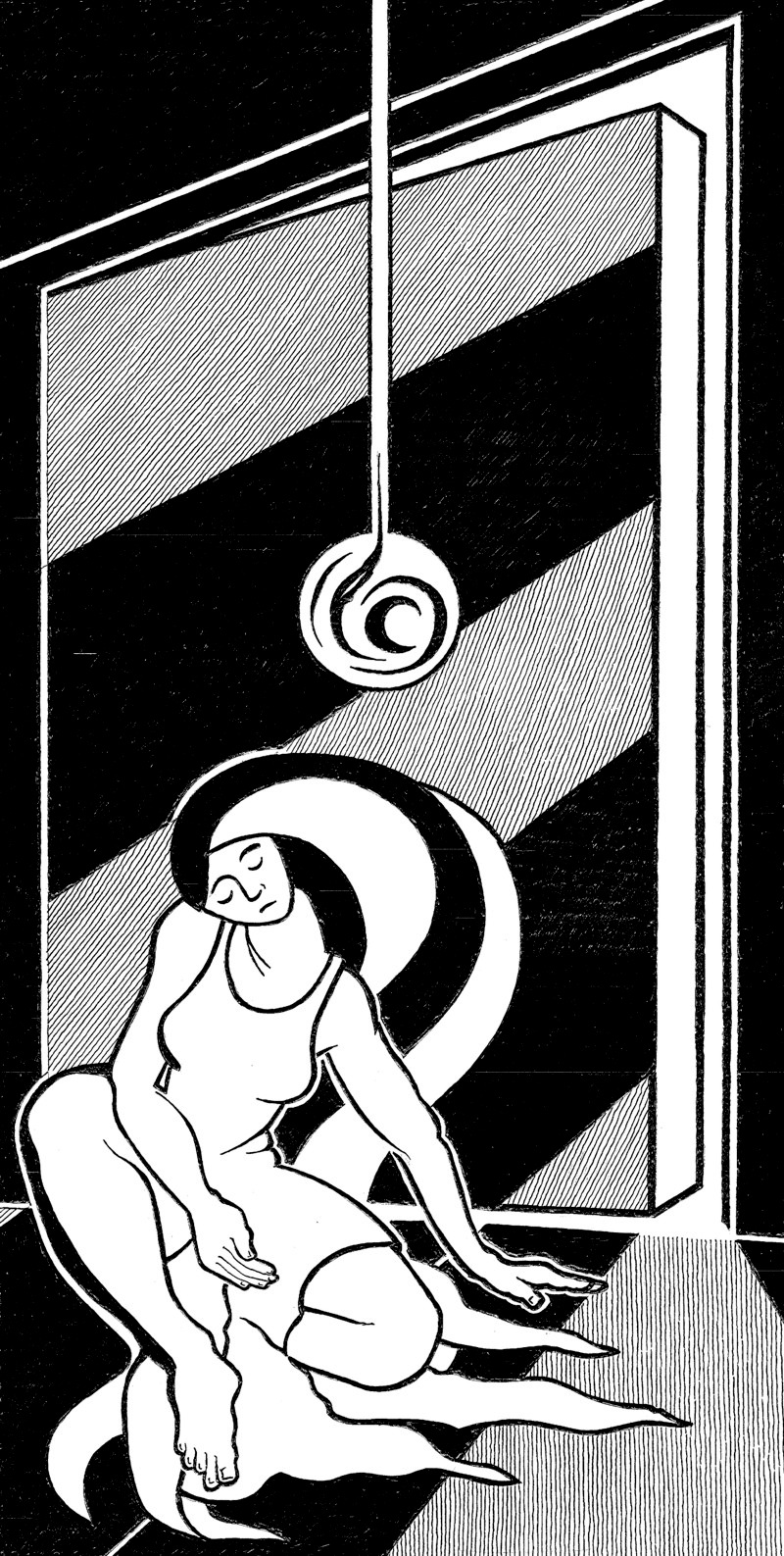
S T O R I E S O F P L A C E
18
S T O R I E S O F P L A C E
What They Cannot Take
A young woman comes to see life differently after a meltdown in her care home.
Today’s meltdown all started over a cup of coffee. One coffee plus a cake a day is about all my allowance will afford me – or hoard it up and buy something bigger – the way I managed to save for my phone. Anyway, I’d been out for my regular latte and donut and the coffee seemed a bit cold. So I complained and the woman said, ‘people like you should just have coffee at home’. Not pleasant, but on the other hand, not a reason for a complete meltdown. I left the stuff on the counter and walked out. I don’t even remember if I’d paid for it. And now I’ve been here in the closet of my room for the last several hours.
‘People like you should just have coffee at home.’ I should explain that it was the mention of home that got me. Because, you see, I have no home, and never had. Well, perhaps my single mother, whoever she was, had a home when she gave birth to me. I don’t know –
although I may find out before too long. But no, otherwise it’s been eighteen years three months in care.
With fits of depression and violent ‘outbursts’
19
over the years, I was classified as ‘difficult’ so never adopted. Instead I’ve moved from hostel to hostel and school to school, never really fitting in. The current hostel – which, having reached eighteen, will be my last – is typical of the style of place I’ve grown up in. Sunnyvale Residential Hostel – then someone added
‘onwards and upwards’ after its name. Whoever thought that one up has obviously not tried living here! Polished bare concrete floors (occasionally heated above TOTALLY FREEZING)
– this is the only source of heating. Solid blockwork walls, rendered over in cement and painted. There are various pockmarks in the walls that have been filled in and painted over.
No doubt the result of furniture smashed into the walls. The furniture itself – a metal desk and chair. The bed is built into the wall and has a heavy mattress covered in thick plastic. No bedside table, no lamps, no plug points. Anyone with a phone has to ask to re-charge it at reception or take it out somewhere that it can be plugged in.
The bathroom has a stainless steel toilet and a stainless steel sink. Only the flush for the toilet and the push-action taps and water spout for the sink stick through into the room –
everything else is carefully built in behind the painted concrete walls. The shower is similar and with just a kind of plastic panel around three sides. No shower door or curtain. The lights are recessed into the ceiling – flourescents covered over with thick plastic panels. They come on when you open the door and go off after a couple of minutes. No light switches.
You have to keep opening and shutting the door to keep a light on in the evening. The single window to the bedroom has a solid plastic panel 20
fitted across it, pockmarked with burns and scratches.
Concentration camp chic.
Everything designed to stop you trying to pull it apart and to try to stop you damaging yourself in some way. In short, the only difference between this and a prison is that I have a key –
or at least, a swipe card, to open the main door of the room. Then there’s a storage area and a second door into the bedroom. The two door arrangement means that you hear very little of any shouting or screaming that may be going on in the corridors or other rooms. And this closet, behind another heavy door, is more or less completely silent.
I’ve hung a little ornament in the closet, like something people might hang on the inside of a window – but I would not want to risk trying to hang it in front of the room window. It’s coloured glass and always seems to have a faint glow of colour to it, even when the closet seems to be pitch dark. Not sure where I got it – I wonder if it might even had belonged to my mother. So this ornament, and the silence, these are my companions, you might say.
Silence is the only kind of comfort that soothes me – well, soothes me eventually. I’m finally done crying and see a little line of light in front of my eyes. It registers at last that this is daylight coming in under the door. I struggle to my feet and push the door open to step into the bedroom. I’d changed into my nightgown. I take this off now and stand in my ill-fitting underwear in front of the full-length mirror (a piece of stainless steel bolted to the wall). Even my underwear isn’t really ‘mine’ – all my clothes have been bought for me. But in only a few days’ time I should get my first proper money, 21
backdated to my eighteenth birthday.
Meanwhile I look at myself in the cold light of day. This is all I’ve got, I think – this body.
But, I’m fit and well. It’s a start, isn’t it? The start of something much better and happier.
Maybe one day that word ‘home’ will really mean something. Meanwhile, here I am, at home in my body.
22
23
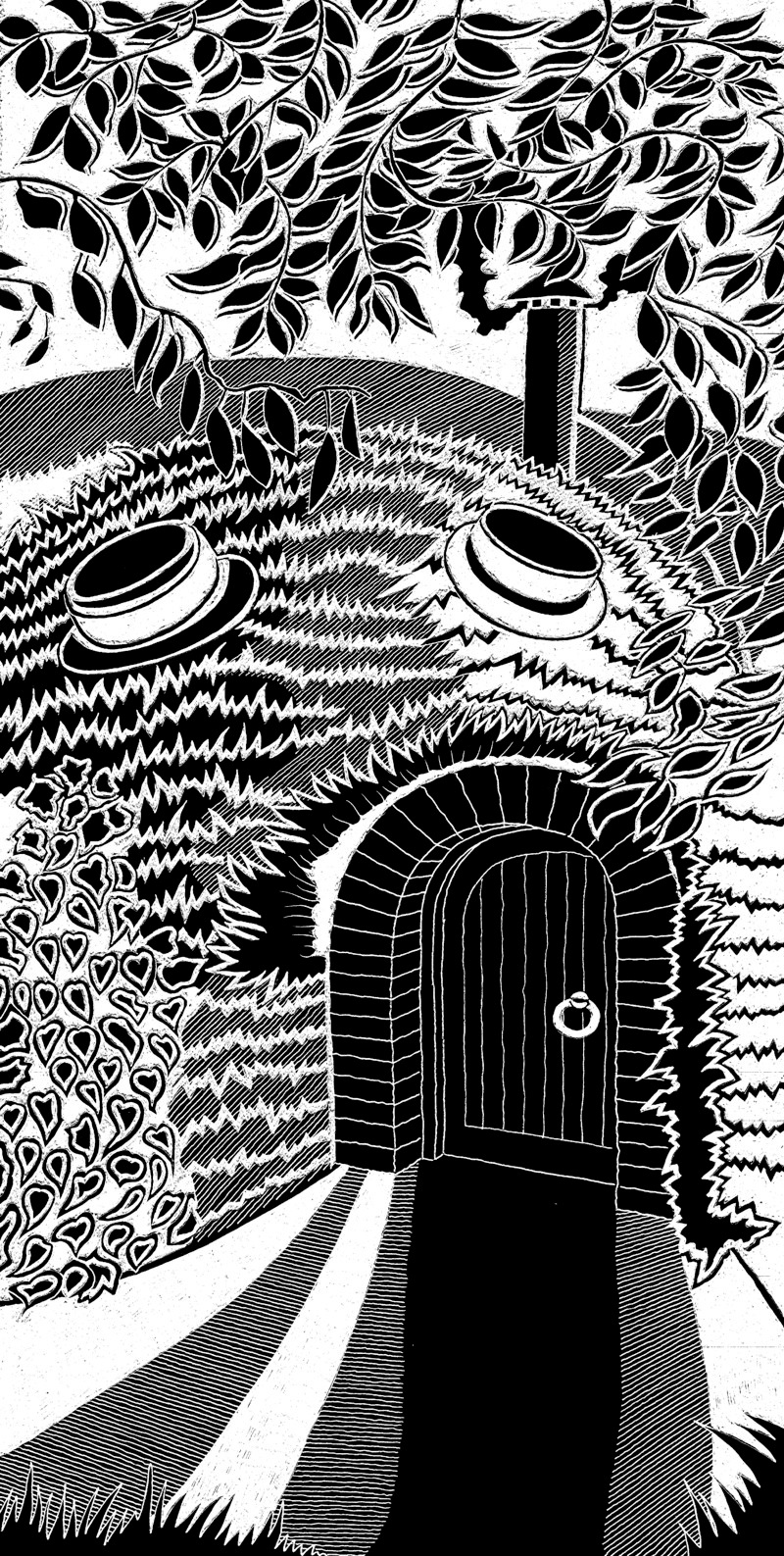
S T O R I E S O F P L A C E
24
S T O R I E S O F P L A C E
Wild Man
A man is struck by the paradox of trying to ‘save the planet’ so takes up a new life in the woods.
This is surely the longest part of the day –
waiting for the first coffee. The kettle was filled the night before, of course, and the wood set out neatly for lighting the little stove. But even though the heat builds up quickly, the kettle still seems to take an age first thing in the morning.
So whilst I wait, I’ll tell you a little about how I live and how I got here.
The first inkling of my changed life was a strange fact about cars. Make a car more fuel-efficient and people will drive more – in fact, people will drive more than even the extra amount that is allowed by the improved fuel-efficiency. This strange fact of human nature is repeated in numerous other examples. Staying with cars, for instance, if the price of fuel is reduced then again mileage goes up, beyond the amount that compensates for the price saved in fuel. Across the board, wherever there is an energy ‘saving’, we humans will end up using and spending more on whatever form that energy or saving happens to take.
Well, so what? You might be thinking. So – it occurred to me a few years ago – all of our 25
efforts towards avoiding a global disaster of
‘peak oil’ and climate change were actually having the effect of getting people to USE MORE
ENERGY! The better we get at renewables and efficiencies, the worse things get – and the figures are bearing me out.
What to do? The answer is obviously something to do with human nature and not with energy efficiency. So there are two choices. Make energy incredibly expensive or change the way people think.
Out of these two, you may be thinking, the easiest option by far would be to make energy incredibly expensive. But what government is ever going to do that? There's not a chance that this will happen unless a scarcity of energy was somehow forced on us. And let’s face it, technology is very good at making things better.
Despite the scares about shortages and all the rest, there’s always enough energy and more, and in the long-term the price will keep going down.
That leaves us with the second choice – change people.
Governments, of course, are not going to do that either.
So my conclusion. We need to change ourselves.
That’s where I’d reached a few years back. And it occurred to me that if I were going to preach to people about change then I had to start by changing myself – I had to live my message.
So I took to the woods! Initially I asked around some of the big landowners to see if any of them would let me live in one of their forests –
preferably in one of the patches of ancient woodland that are the remnants of the vast Caledonian forest that once covered the whole 26
nation. One of the landowners said yes. I started out with ordinary camping gear and gradually I’ve learnt to build shelters using just the materials I can gather from the woods themselves.
Let me describe the current dwelling. It’s called a ‘bender’. It can be made just by bending a few large saplings towards each other and then binding their branches together, then covering over the rough dome that is formed with turf.
But this one is a bit more complex. The timber has been cut and set into holes in the ground, which are wedged for support. There’s a root membrane and some waterproofing under the turf. Then, the two main problems with benders have been addressed. One is how to get a decent
doorway
into
the
thing
without
weakening the structure and without resulting in a very draughty house. I solved this with an offset double door – making a kind of shell-like shape for the whole structure. The second big problem with benders is getting some light in!
I’ve solved this with what I suppose could be called DIY sun pipes. They stick up above the domed grassy roof surface of the bender and reflective tubes lead through the roof and down into the interior. I’m always trying out different ways of making these and keeping them watertight.
The bender’s heated by a stove, which has a hot plate (where the kettle is heating now) and a small oven. Keeping enough heat in the structure is important, since although it keeps the rain out it can be damp. Moisture and ventilation – these two things are critical for leading a safe and comfortable life, both in winter and in summer – and it takes a good part of most of my days just addressing these two 27
issues.
So yes, this first boiling of the kettle is just the start of a day of heating water, collecting and storing wood, washing, collecting food and all the other tasks needing to be done just to stay warm, dry, healthy and reasonably well-fed.
I don’t yet grow all my own food, but I’m getting close. I confess of course to the coffee – my only real indulgence. I have a paraffin lamp, a few torches and a radio, which can be re-charged via a USB port. I have to do this in the café of the nearest town however, which is a twenty mile walk. They know me there as the wild man! All of my stuff’s stored in wooden chests that are arranged around the low inside walls of the bender. A small bed sits in an alcove formed by these chests. There are rugs on the floor, a small desk and chair, and a rocking chair to sit by the fire at night. And that’s it. That’s all my worldly wealth that’s left.
Well, you’re probably wondering by now – how does any of this make a difference to that task of changing people? Sure, I may have changed my life, but how do I even get the message out there to people, living my hermit’s life in the woods?
Well, first of all, you don’t change people by telling them to change – that’s kind of obvious when you stop to think about it. In fact – a bit like the use of energy that we started out with –
there is a tendency for people to do the opposite from what you try so hard to convince them to do!
So step back, take a break, and here are three things that need to be in my life before I can presume to say anything about anyone else’s life
– looking, humility and acceptance.
By looking, I mean keeping careful watch on 28
what’s happening in the world and not being lead along by campaigns and newsreels that are really just flouting their opinions about how the world needs to be. It was by looking that the whole energy-use, fuel-saving paradox started to make sense to me. (It actually has a name –
it’s called Jevons’ paradox.) But looking also involves studying people and what really motivates
and
inspires
them
–
all
the
unconscious and semi-conscious desires that make up the REAL story of a person’s life.
And it also means looking at nature. For let’s face it, the world’s full of crazy creatures – crazy animals, crazy birds, plants and bugs – and of course, crazy people. So, hence, humility! I need to remember that I too am crazy! I need to know that I might be horribly wrong in my assessment of humanity and the way the world is heading. And so – no preaching. If people ask about how I live I just tell them plainly. If people ask me why then I tell them about the whole energy paradox thing that I explained earlier. But that’s it. I’m not offering solutions.
Because even if everyone in the world took to living in benders in the woods and growing their own vegetables, then no doubt another weird paradox of human nature would spring up, and another, and another.
And so, hence, acceptance! I can only live my message up to a point. It’s the nature of a paradox that it cannot be solved. If it could, it would cease to be a paradox.
And who knows, perhaps the universe just wants or needs crazy humans with high-tech gadgets who will always do the opposite of all the things that they say they believe in! I need to accept this possibility – really sit with it and accept it – before I can say any more.
29
Well, time will tell! And meantime, coffee’s ready.
30
31
S T O R I E S O F P L A C E
32
S T O R I E S O F P L A C E
Home in the Woods
The meaning of home surrounds our lives, our work and our future on the planet. What will we do with our time in the sun?
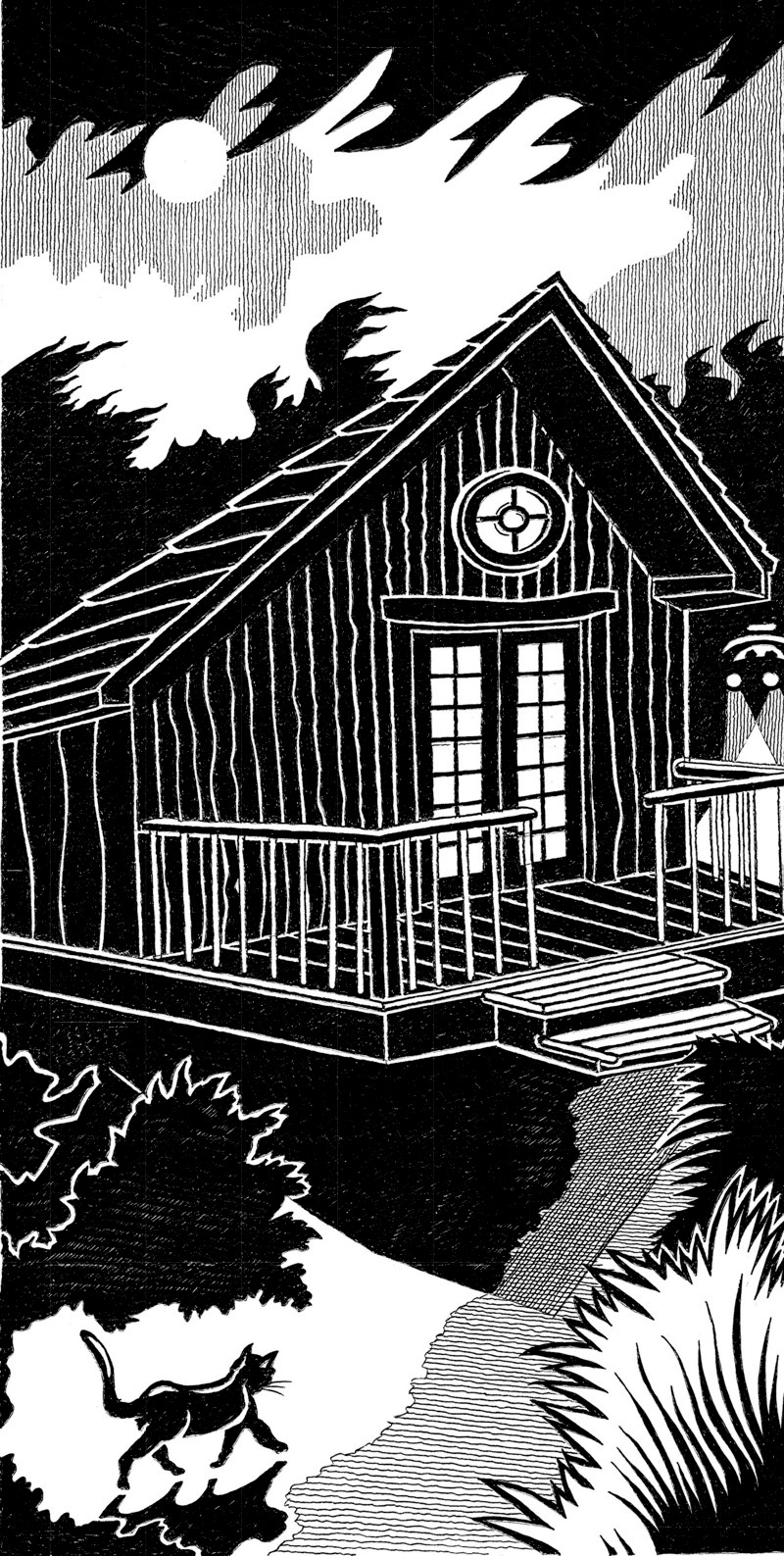
Jack thought his eyes were playing tricks when he saw blue lights flashing through the bare winter trees. But the lights soon resolved themselves into a vehicle – a police vehicle. It was approaching along the muddy track some 500 yards away – the nearest anything on wheels can really get to his cabin.
He went outside and waited under the porch light. Two uniformed officers had emerged from the car and were picking their way towards him through the rough undergrowth. Jack stood passively and without expression.
‘You live here?’ one of them calls, when they are about 20 yards from Jack. They have flashlights and the beams wander off across the cabin for a few seconds and then back to Jack’s face.
‘Yes, that’s right.’ Jack keeps his voice calm and neutral. The officers have reached him now and stand in front of him puffing cold air.
‘You live here all by yourself?’
‘That’s right’, Jack says again.
There’s a pause whilst the policemen take stock of this, then one of them says in a more familiar 33
tone, ‘Geez, don’t you get lonely?’
‘I like it quiet’, Jack replies.
The officers exchange glances with one another and seem to decide things are okay.
‘Just came to warn you, storm’s coming. You can evacuate if you want, or sit it out.’
‘I’ll sit it out’, Jack says.
‘We could give you a lift into town if you want to evacuate. You got somewhere to shelter?’
‘Yes, I’ve got shelter’.
‘Okay then…. Well, we’ll leave you be. Stay safe now.’
With that the officers turn and make their careful way back to the patrol car.
Jack stands still and watches them. He continues to watch as the tail-lights of the car finally disappear into the woods. The turnout from the track onto the nearest road is too far to see from the cabin, but Jack waits on for a few more minutes, just to be sure that the car’s really gone. It’s the first vehicle to have come up the track in over 20 years.
Just as Jack turns to go inside there’s a rustle of branches as a gust of wind whips through the forest – the first sign of the storm to come.
There’s also a glint of something from a nearby clump of bushes. Jack’s keen eye spots it and he waits. Fox? Hedgehog?
No. A cat. The cat slowly emerges from its hiding place and makes its way towards Jack.
No purring or sound from it at all. None of that rubbing against the leg stuff. The cat just sits down a few yards from Jack and looks him in the eye.
Jack’s never been a fan of domestic pets, but would he leave this creature out in a raging storm? No. It’s clearly someone’s pet, very lost. Jack scoops it up and heads indoors. A 34
while later he climbs down into a recess formed below the floorboards of his little cabin and from there down into a small basement.
The cat goes with him.
Muffled sounds from above suggest the storm is now in full force. Jack’s not overly worried –
he’s weathered many storms before. He and the cat go to sleep.
Jack wakes with a start, forgetting he’s in the basement. He fumbles for a flashlight and checks the time. Morning. The cat stares at him impassively. No sound of wind outside so they make their way up into the cabin.
Everything’s intact. Looking around outside there are a few branches down but no fallen trees so far as Jack can see.
Jack’s lived his solitary lifestyle for more than 40
years now. He built the cabin himself about 30
years ago, just after managing to buy the woodland that surrounds it.
It’s an off-grid cabin. No electric of any kind.
No piped water supply. Jack heats water and cooks food on a stove, which is also the only heating source for the dwelling. There is a tank that stores water collected from the roof and a hand-pump to raise the water to a tank in the loft. Jack has a paraffin lamp, a few flashlights and a couple of radios – battery operated. He chops wood and heats water for a lot of the time each day. Once a fortnight he walks five miles to the nearest town and buys food, batteries, candles and anything else he might need.
Jack is a writer and an artist. He writes by hand and draws in ink on heavy paper. When in town he types his writing into a computer at the library and then sends his work out to various magazines and publishers. And he gets his art scanned or photographed and sends this out 35
too. None of this brings in much money, but it’s enough for Jack’s simple lifestyle.
Jack’s simple life used to be a stand against materialism
and
consumption
–
against
consumer capitalism – and all the harm it’s doing to the planet. Jack doesn’t see it that way anymore – his simple life is just the way he’s chosen to live. His art and writing used to be verging on protest, preaching and ranting. Now he will barely mention such issues as climate change or pollution.
For a while Jack tried to weave some philosophy into his work instead. The thing about philosophy is that there’s nothing ever proven or agreed on. (If some issue ever gets settled, it ceases to be philosophy and just becomes science!) But for Jack, the real pleasure is that people like to engage with the questions, if you frame them the right way. For instance, you can ask someone how they know that everyone else in the world is not just a zombie and they are the only conscious person. Then you’re likely to get some cheerful reply like, ‘Hey, didn’t you know, everyone else IS a zombie!’
(By contrast, try asking a stranger a question about politics or climate change. You could well get an earful of abuse.)
The best thing about these philosophical questions though – or so Jack hoped for a time –
is that they invite people to question and think for themselves. It seemed to Jack that many of the world’s problems – if not all of them – were really down to people just going with the flow and doing what everyone else was doing. So, wars dragged on for decades and people lived with various assumptions they’d just inherited and would in turn pass on to their kids.
There were signs of hope on this front, Jack 36
thought. Young people really did seem to be more free-thinking and willing to question authority. But for Jack personally it was difficult to know if his work was really hitting the mark.
So, recently, a different tack – home.
Home is a tricky word. Something we all long for, but are never quite sure if we’ve reached it.
Could it be better? Will it always be something we remember from a rose-coloured past? The key message for Jack though was that we don’t mess our own back yards. And nowadays, isn’t it obvious, our back yard is actually the whole planet. Pollution drifts in the air across continents, or sweeps down rivers, dropping poison on the doorsteps of other towns and cities downstream. Nature feels the effects of human actions sometimes thousands of miles away. If we could only see the Earth as our home, Jack thought, then perhaps we’d see things differently. Then all our national borders, and even our local fences and boundaries, would be shown for what they really are – just arbitrary lines that mean nothing.
Home in the body, home in nature – home even in the cosmos. It seemed so stupidly obvious to Jack. If we could only REALLY be at home in those ways then a whole lot of stuff would get sorted. No need for all the complicated ways that people came up with to solve the world’s ills
– just home! Beauty, thought Jack, leading to wonder and enchantment – that’s what’s needed to make the connections with cosmos, nature and self positive connections. If we could achieve this then we were ‘grounded’, we are home! It is not about what kind of house you have, but it is about location and a connection with place – how you interact with place.
Jack could see the irony in this though – him 37
owning two hundred acres of woodland, albeit not exactly fenced off. Somehow his pocket of the Earth had escaped notice. The local town was losing population rapidly and his land was becoming more and more remote from where people were living. He’d been lucky, he felt, very lucky….
Jack found something to put the cat in so he could carry her into town. The vet checked her over. There was no identity chip, so Jack put signs up around town. No-one ever claimed her so she stayed with Jack.
The cat just ate and slept. During her waking hours she simply watched – sometimes she watched Jack, but often she stared out into the surrounding woods, as if expecting something.
She showed no signs of wanting to explore beyond the cabin however, being content just to observe things carefully from her adopted dwelling – from her home.
She lived on for 17 years, and when she passed peacefully in her sleep Jack buried her in the woods. By now Jack was struggling to make the walk into town. Over the years, he had set aside firewood, food and other supplies, knowing this day would come. (Of course it had crossed his mind that he could simply get food delivered to the cabin, but that would mean at least having a phone, and perhaps an internet connection and a laptop. Jack wasn’t willing.) There were supplies enough to last Jack about three years, without any further trips into town….
After two and a half years, Jack realises he must make a decision. He manages, with enormous effort, to walk into town and take a bus. He travels 120 miles to the nearest city – the longest trip he’s made in over 60 years. He 38
checks into a care home for the elderly. He’s no paperwork to prove who he is, but they take him in and the home sets about trying to bring Jack’s ID up to date.
After three months, it’s not working out. The endless bright lights and the endless loud voices of the staff with their fake cheerfulness are driving Jack crazy. The other ‘inmates’ – as Jack calls the care-home residents – just sit around talking about their various ailments.
Every night, Jack’s dreams are full of the woods and the cabin.
Jack escapes. Gets himself a taxi into the city.
Buys himself a smartphone. Catches a bus home.
The cabin is just as he’d left it. Jack takes about three weeks of reading the phone’s instruction manual before he can figure out all its features.
Someone is called to put rubble and gravel on the track that leads up to the cabin – the track last used by the police car some 20 years previously. Food and other supplies can now be delivered almost to his door.
One day Jack is out for a walk through the woods. He feels a wave of tiredness, so he sits down in the shade of an old tree. His eyes close.
Jack’s eyes don’t open again. Before long, his body is returning to the soil from which it came.
Jack had never believed in an afterlife, but nonetheless he’d always referred to death as
‘going home’. Perhaps it was because the Earth always takes back her own. We set out from home and we return home, and if we’re lucky and smart, we make home, or at least recognise home, for that brief bit of time whilst we’re alive in the sunshine.
The cabin survived a further 50 years before the 39
roof gave way. Inside, Jack’s life’s work was there in the form of around 60 folders of hand-written stories, essays and books, some 500 ink drawings and some 200 sketch books. All of this was also carefully stored in typed and electronic format on two memory sticks. With the roof gone, the wind, rain and insects would start to destroy everything.
Would Jack have minded, to see his life’s work disappear into nothing? I suspect probably not.
Jack used to say the important thing was for people to have the conversation. And the
‘conversation’ did not necessarily mean talking face to face, because, as you know, Jack was a reclusive person, to say the least.
No. Writing is a conversation. Artwork is a conversation. And they last only as long as the sun shines on the participants. And then the world moves on.
40
41
S T O R I E S O F P L A C E
42
S T O R I E S O F P L A C E
My Past and Future Life
When the resting place of ghosts is disturbed, the residents must seek a new home…
The front and the back of our house represented different worlds.
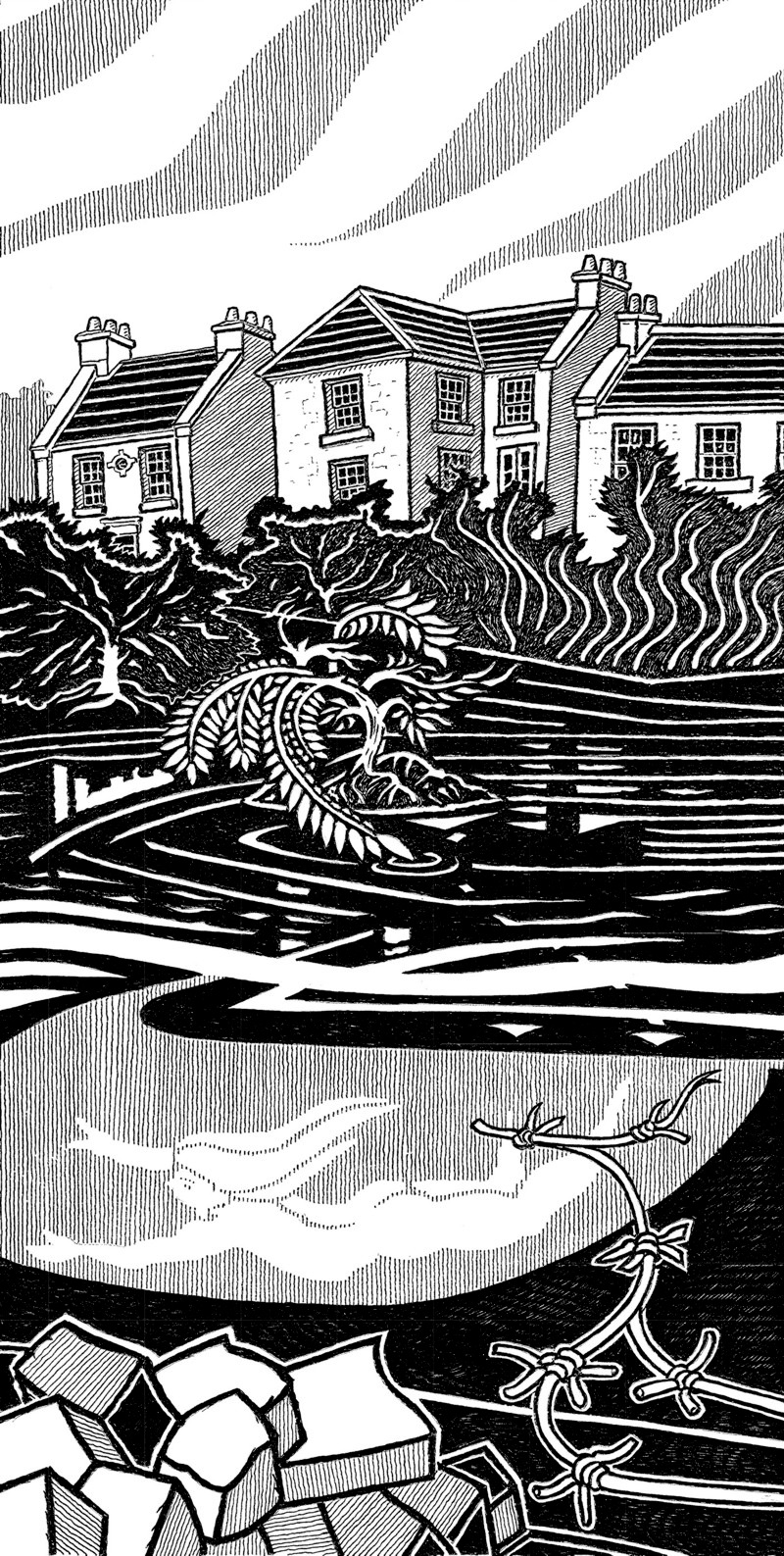
To the front, a busy road, noise and bustle. To the back, a quiet garden leading out to a small lane. The lane in turn lead to a river. A bend in the river harboured a strange quirk in an otherwise fairly flat landscape. A little hill had been partly eaten as a quarry. The quarry had long ago been abandoned, was flooded by the river, and formed a deep pool of languid water.
This was the world into which I was born in 1965 – an only child.
Ours was a little house in a row of similar cottages. Our house though had the distinction of being flanked by the old prison building. Its cold stone walls enclosed part of the rear garden. They were damp even after weeks without rain. In winter, water would dribble down them and freeze before reaching the ground – even when the weather was relatively mild.
I was still very young when I became aware of something else relating to the prison house.
There were ghosts there. My bedroom window 43
looked out onto the rear garden and the old prison, and it was through my bedroom window that the ghosts found their way into the house.
I was frightened of the ghosts at first. It was not that they did anything really, just that one could sense their presence in my bedroom and sometimes there was something that felt like a gentle breeze on my cheek. In time though I grew used to the ghosts and welcomed their presence.
My father was a quiet man. He left the house late each morning through the door to the front.
He returned each evening through the same door. A swirl of traffic noise, cold harsh air and dust would announce his return.
Often he sat sobbing on his return. As a child I did not know what the sobbing meant. My mother would comfort him as best she could.
After we’d eaten they would sit together in front of the stove in the little lounge. My mother would lean her head into my father’s shoulder and they would both doze.
Later I became aware that my father had been a supply teacher of English in some of the worst schools in the region. He had a remarkable ability for knowing just exactly the right thing to say to people in order to elicit a good response.
As such, his teaching skills were exceptional.
He had not been sobbing therefore as a result of struggling with unruly classes. He had sobbed because most, if not all, of his pupils had no hope. My father was very often the only figure in those kids’ lives that gave them any kind of self-belief.
My mother cried less often, though when she did I never knew the reason. My father would hug her and place a gentle finger over her lips to stop her from articulating her concerns. Perhaps 44
he should have let her speak, but even so this cure seemed to work. Before long her shy smile returned to her rounded face.
The radio played softly. After my mother had gone to bed my father would sit at his desk writing long into the night. This was why he was so often late setting off in the morning. My mother sat at the same desk and wrote during the day.
We seldom left the house as a family. I had a little seat by the fire, but from a young age I took up residence behind the sofa. Squares of paper, cut neatly to the same size, were somehow always there.
I did not leave home to go to school. I do not remember really how I learnt anything. I just remember my mother, on her hands and knees, crawling into my little world behind the sofa. In her hand were some squares of paper inscribed with letters and little drawings she had prepared herself with a broad calligraphy pen and a bottle of ink. Even the simplest of these would somehow be vibrant and life-affirming – I kept many of them for decades. She would be a little red in the face from entering the world behind the sofa and a little strand of hair would dangle down in counterpoint to her round face. At first there were letters, then simple words, then little explanations about the world and questions and songs. So, little by little, I suppose my knowledge grew without any kind of formal schooling.
Behind me in my place behind the sofa, was an enormous set of shelves, stocked with numerous books.
Many of the books seemed to arrive via the funny little man. The funny little man must have been a friend of my mothers – he would 45
often visit during the day. He waved his hands when he spoke and made lots of funny faces and silly accents. My mother would listen intently, her head tilted slightly to one side. Sometimes she would laugh out loud at something the funny little man had said. If I should venture out from behind the sofa, the funny little man would first stand up, then kneel down and just wait to see if I would approach as he crouched down at my eye level. I sometimes walked over to him to pat him on the head. This seemed to please the funny little man and he would smile his clown smile at me until I giggled.
Sometimes the funny little man would still be there when my father returned home from work.
The funny little man would rise to his feet and shake my father’s hand very seriously. Often he would present my father with a book. His voice would change when my father was there and he would be hesitant when he spoke. My parents would invite him to stay and eat with us and we would all huddle around the same little desk used by both my father and my mother, or we would just give up and balance plates on our laps.
Sometimes the funny little man would stay late.
He and my father would sit outside drinking wine and talking long into the night. I could hear them speaking outside my bedroom window. The ghosts seemed happy with them.
I don’t know what happened to the funny little man but at some stage he stopped visiting. I think he may have travelled to Brazil in search of the ayahuaska plant, a natural hallucinogenic
– I’m not sure. As I grew older though I started to dip into the many books that the funny little man had brought over the years and which stocked the shelves behind the sofa. I owe a 46
great debt of gratitude to the funny little man, whose life still seems so unexplained.
Children swam naked in the old quarry when I was very young. Then, after a few years, they were swimming in swimsuits. A girl drowned in the quarry when I was 12. She was the first ghost there. She was not sad though – as one might expect from her life being cut short – she was a happy ghost. Sometimes I thought I saw her, swimming effortlessly beneath the still waters of the quarry. From that time on the quarry took on an even more magical feel.
There were other drownings to follow and after a time, no-one swam there any more. Wire fences and warning signs went up. But I went on swimming there, always nude, and knowing that I swam with ghosts. Eventually though the quarry was sold off and its magical pool filled in.
Another person who visited the house was Stephanie. Stephanie was an architect – I was later to learn. She often brought drawings of houses beautifully drawn by hand and hold them up for my parents to inspect. My parents seemed to be very fond of Stephanie and her designs. Stephanie herself was the most charming person one is ever likely to meet. She always smiled from her happy face framed in long blonde hair and it seemed she was unrelentingly positive. I think it was Stephanie who made me decide to pursue a career in architecture myself.
Another person who visited was Francesca. She had a shock of unruly black hair and dark skin.
Francesca played guitar with a great deal of passion. She would stand as she played and her hips would be swaying and thrusting in time to the music. My parents would both applaud her enthusiastically.
47
Another musician visited – her name was Crystal. She played guitar more quietly. Her voice had a faraway hypnotic feel to it, as if it came from another world. Her songs seemed to speak of a world that could only be dreamt, but when she sang you could believe for a time that those worlds were possible.
When it came time to choose a future for myself I simply sent off a set of drawings and a letter to the nearest school of architecture. I had no formal qualifications so no idea of my chances of success. I was accepted onto the course without condition.
From there on though it was a struggle. I had settled on neo-classical architecture right from the start. But the school, like all schools of the time, was hoping for modernism, then latterly for post-modernism. I just scraped through. I worked for others for a while but soon set up on my own. When computers became the norm I resisted. I continued to draw everything by hand right up to my retirement.
My parents died young, in quick succession –
both just passing away quietly in their sleep. I had by that time moved into a place of my own.
But when they died I inherited the house and moved back in. It was only after my father’s death that it was revealed what he had been doing all those nights writing at his desk.
Hidden away in the house was a folder full of numerous letters – all written to politicians on a variety of issues and all filed away with various replies, notes and press cuttings. A lifetime of quiet and courteous diplomacy that he had remained silent about all his life. And then there were illustrated books, written by my mother, and which I had never seen. Each book was dedicated to Stephanie, Francesca, Crystal 48
and Crispin. Crispin of course was the funny little man.
Back in the house I left everything exactly as it was. For several months my parents’ ghosts seemed to be present in a more definite way than the ghosts from the jail. Then, within the space of a few days, their presence faded, as if they had joined the other ghosts.
The years pass and I become an old man. I sit each day at the little desk my parents had used.
I make ink drawings, with old-fashioned ink and dip pens. Figures, always figures, and always trying to express the wonder and ecstasy of being alive. The mystery of it all – a puzzle that never needs to be solved.
Houses gradually encroached to the back of my parents’ house and the traffic to the front grew ever busier. The world had changed. Storms were frequent and crops were now raised under endless plastic greenhouses that stretched across the surrounding countryside.
A new neighbour decided to demolish the remains of the old prison house that backed onto the rear garden. One day all the old stones were dumped into a skip out in the lane. I was too old by then, but I managed to go out and rescue a few stones and bring them to my garden before the skip was taken away – as much as my tired hands could carry. The ghosts stayed, thank goodness and the ghost of the dead girl from the quarry, plus some others, have come to join them.
Well, of course, I am dead now myself and have joined the ghosts. We sheltered for a time rather miserably amidst the little pile of stones in the garden. It is difficult to speak of time passing, but eventually we decided it was time to move on.
49
A new house was being built, just where the old quarry had been filled in, beside the bend in the river and next to the little hill. The couple building the house gathered up stone from all around. It was the perfect move for us, and we shelter within the walls of a new home, built with love and care. The folk who built the house were surprised at first, to find us living with them. But they have learnt to love us and we bless them in any way we can. I rest in peace.
50
51
S T O R I E S O F P L A C E
52
S T O R I E S O F P L A C E
Sweat the Small Stuff
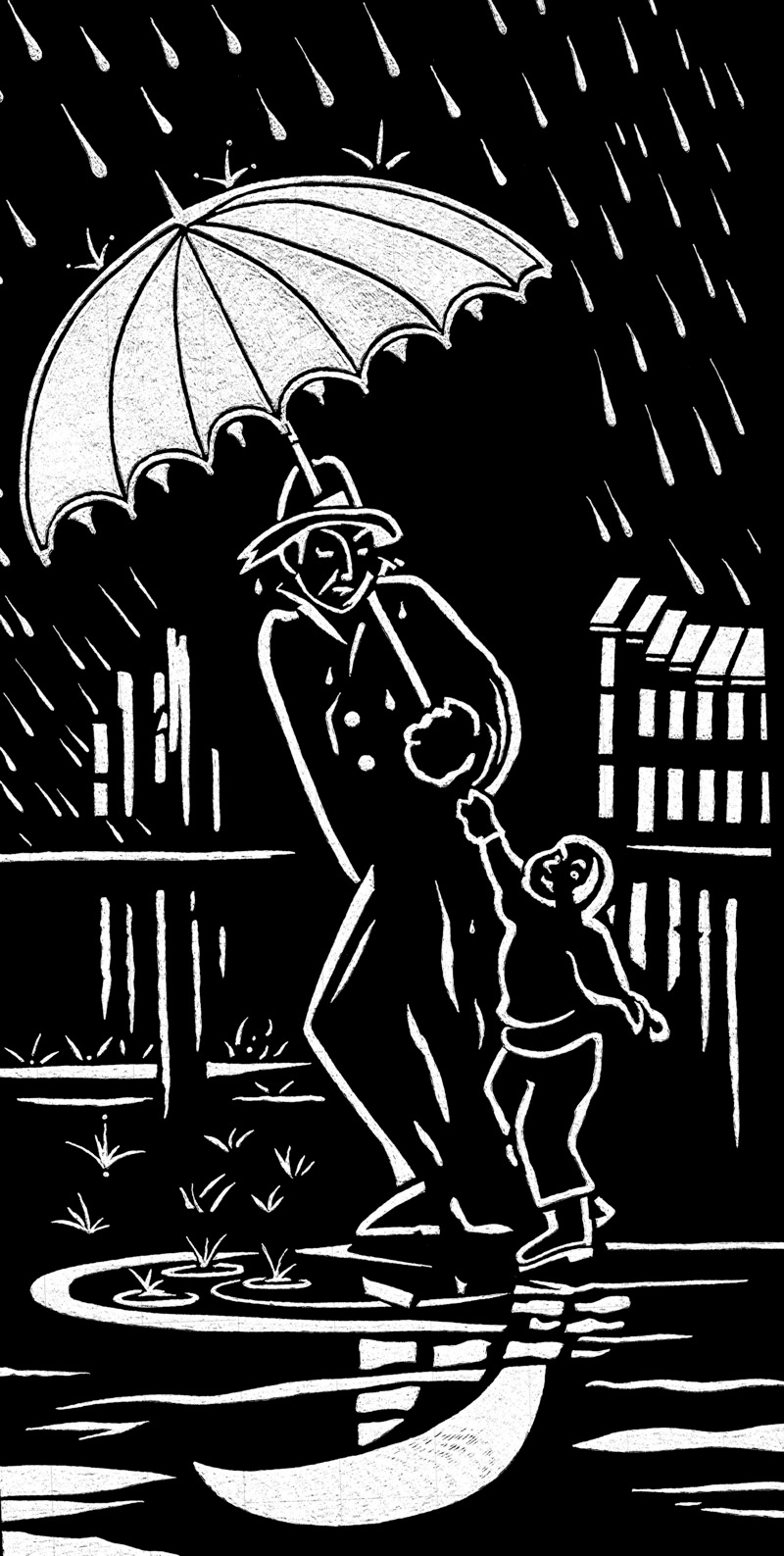
Home, like an umbrella held up against the rain, is a place that needs careful tending. Here are some thoughts and memories of home…
The thing I remember most about childhood is when my Dad came home from work. He always had a tired and dishevelled look, but a grin would break across his face when he came through the door. He would hug Mum –
sometimes bringing her a bunch of flowers or a small gift. Mum, in turn, would lead him to the sofa, lay him down and bring him a glass of wine or a cup of coffee. In fact it was something of a thing in our house that whenever someone came in tired or stressed they would be led to the sofa, made to lie down, and given a drink or a snack. Us kids started to do it for our parents, and eventually for each other.
Sometimes, you see, there was some difficult problem needing to be discussed. But no use discussing it when tired and stressed. Best to lie down and relax for a bit, then have dinner.
After that there would be time for talking.
Mealtimes Dad would try to tell us jokes. Mum would groan at his stupid stories. The kids took over on the jokes front. Mum still groaned.
…Christmas, decorating the tree with the 53
baubles that seemed to have survived for decades. A train set spreads across the lounge floor. It’s in place for the whole holidays –
people being forced to step over it. The locomotive somehow manages to produce steam from its funnel as it chugs along….
Every family has its big incidents – its crises.
Everything was talked through with such care.
No raised voices. Somehow Mum and Dad just knew how to diffuse a situation – to smooth ruffled feathers, mend broken hearts – all with a lightness of touch. No drama, no preaching or moralising. They just saw the bigger picture and got life’s upsets into perspective.
…Aged nine. Ill in bed. Mum brings chicken and vegetable soup. In my fevered state she seems surreal, standing there with the soup. She puts a cool hand on my forehead and smiles reassuringly. She leaves the door a little ajar so she can hear me if I call out….
Years later, I have my own place – a flat in the city. Mum and Dad are in town for a conference and we are to meet up in the evening for a meal. Suddenly they seem so small and frail against the backdrop of the city. How could they be my parents? How could they have suddenly grown so old?
When I get back to my flat after meeting with them I’m agitated. Although it’s late I set off back into town – this time by bus. I want noise, alcohol, women, dancing. I sit in a noisy bar with a drink, just soaking up the chatter and vibrancy of the young people all around me – so full of life and energy. I breathe it in.
…A dark evening. Heavy rain. Going somewhere with my Dad. His big black umbrella is held up high above us. A light from somewhere catches some drops of water that 54
are running around the brim of his hat and then dropping down onto his coat. I can smell the damp clothing and hear his leather shoes squeaking. He looks down at me briefly and smiles….
That’s the thing about home and family. It’s like an umbrella held up against the rain – a little pocket of safety in amongst a storm.
Now it’s me that must take over. But the hands clutching the umbrella feel weak and shaky.
Will it turn inside out in the wind and blow away?
Home’s never as big and secure when it’s you that has to build it and keep it in place. It’s a dream of the past, with the effortless ease of parents who seemed to know just the right way to face the world. And it’s a dream of the future
– that one day we will be safe from life’s storms
– one day we’ll be at peace. Meanwhile real homes are caught somewhere between past and future, trying to keep it together in the here and now.
There’s a phrase I hear sometimes: ‘Don’t sweat the small stuff’. Perhaps people using the phrase mean, don’t get bogged down in small details, but instead, try to deal with the big and really important issues. But it seems to me that home and family are all about the small stuff –
the lie down on the sofa, the teasing of siblings, the way, just from a single look, everyone knows immediately what you’re thinking and feeling. It’s mostly a billion small things, and just the occasional need to consider the big picture. That’s the careful balance that needs to be struck – to carry our little pocket of peace and safety into the future. Sweat the small stuff.
55
S T O R I E S O F P L A C E
56
S T O R I E S O F P L A C E
The Wise Women and their Tree
Through centuries of change, a mysterious house and garden remain and protect their human guests.
Thomas
Moore,
in
his
book,
The
Re-
enchantment of Everyday Life, tells us this:
‘Gardens… take us in our senses into the liminality, a mundus imaginalis, a special place in the imagination that is neither wild nor cultivated, neither human nor otherworldly. The liminality, felt physically and emotionally as we walk in a garden, is analogous to tremenos, and it, too, is a rare gift of the soul, because liminality presents a window onto eternity and offers epiphanies and deep sensations of transport that are of greatest importance to the soul.’
…
The place dates back before anyone can remember. It started way back when wise women were still accepted – indeed, not just accepted, but positively cherished by any village lucky enough to have one.
The first woman came from – well, who knows where. She was wandering near the village and saw a group of trees set in a wide arc. It was a sheltered and welcoming place – or so it seemed 57
to the woman. She gathered stones and branches and had soon made herself a crude shelter. She would improve it as the years went by. The villagers soon found her of course, and before long they were coming to her tiny house looking for cures, healings or sometimes just advice. She proved her worth. They left her loaves of bread, fruit and sometimes some meat.
She was perhaps 70 years old – maybe even 80
or 90. Almost impossibly old for a person in those times. It added to her mystery! Not long after setting up her home, she planted a tree – a yew tree. It looked like a tiny, fragile thing.
But the yew takes a long view when it comes to growth. It starts by building a good root. The yew tree will not yield its first fruit until it is perhaps a century old.
The woman planted fruit trees and vegetables along with the yew. And of course the herbs and other plants that made up a lot of her remedies. She always had a pot of broth simmering on the fire. She always had plenty of food to sustain her.
Before long the woman takes a girl on from the village. She’s about 10. A shy, lonely girl, who had a habit of wandering off alone into the woods. Her parents had taken this as a sign that she was different, and set apart for higher things. They are fiercely proud when the old woman takes their daughter on as an assistant.
So the years roll by, the girl becomes a woman, and the wise woman dies. She’s had time to impart all her knowledge to her assistant. The girl had learnt well and even surpasses her teacher. The villagers are proud. The yew tree is by now about three feet tall.
The pattern continues, with one wise woman 58
replacing another by means of local children who seem set apart with ‘the gift’. The shack becomes a proper stone cottage, with a chimney stack, a strong wooden door and wooden windows that can be shuttered against cold weather.
Centuries pass this way, with one woman succeeding another without a break. The house’s thatched roof is replaced many times.
The doors and windows are changed. The fruit trees keep giving fruit. The yew tree reaches 4,000 years and 15 feet.
But times have changed in the human world. A new religion had swept across Europe in recent centuries and its impact was at last reaching the village beside which the house and its garden stood.
Witch trials. Torture. Burnings. ‘Wise’ women were not considered wise anymore. They were a threat. Villagers no longer considered it a blessing to have such a woman in their midst –
in fact, it was a curse.
So there were no more women and the house fell into disrepair. The roof collapsed. Stones dropped from its walls. Eventually there is only a pile of rubble remaining and the yew tree growing in its garden nearby.
Oddly, in the centuries following, the house, the garden and the yew tree get forgotten.
Eventually walls enclose it on all sides and rows of brick terraced housing are built. There’s a tarmac road and a pavement going past where the front of the house used to be, and to the rear there’s a high brick wall and a block of flats beyond.
Then, a woman was passing by on the pavement. She noticed the leaves of the yew, just visible beyond the high wall. She wondered 59
what was beyond. The yew hadn’t grown much in the last five centuries, since the last wise woman departed for prison and execution.
The woman, Anna Mack, went to the council and asked about the land enclosed by walls, and with seemingly no way in. There is no record of it, so, in the way of town councils, they decided it was council land and offered to sell it to Anna.
Anna accepted, and soon had the deeds drawn up. Anna gathered some friends and they broke through the brick wall and into the garden.
A pile of rubble and the yew tree. But Anna sensed something special about this place. In the weeks and months that follow she returns almost every day and picks up stones, piling them carefully in one corner of the garden.
Then she dug over the entire garden, finding more stones, but not much else besides.
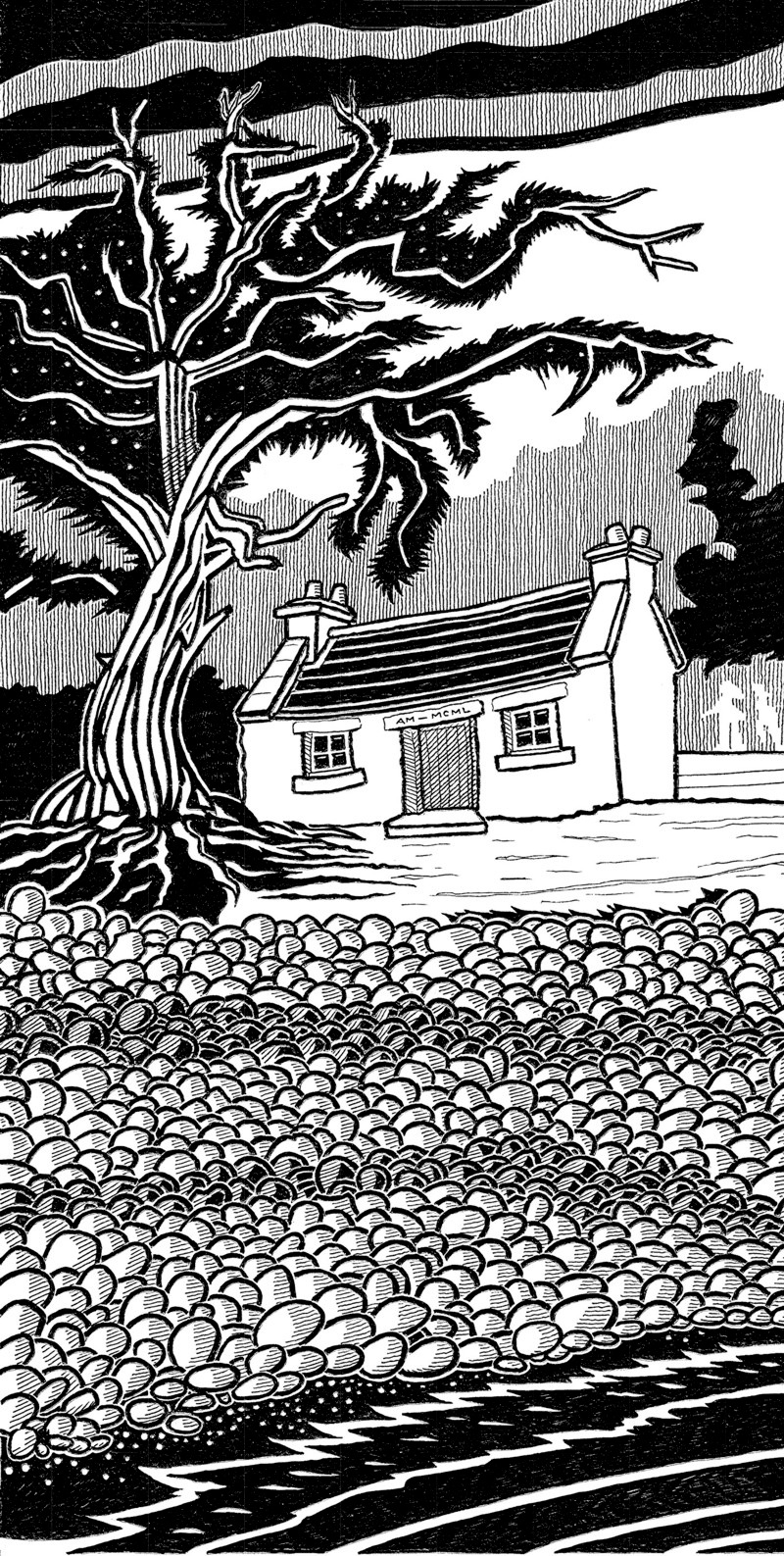
There were what might once have been stone lintels on the site, but they’re broken. Anna had new lintels made and she built up the stone walls of a house roughly in the same place that the ancient cottage had stood. On the lintel over the doorway Anna had an inscription added. It said: AM – MCML.
Anna had not lived there too long before she noticed
small
saplings
and
other
plants
sprouting up around the house. She watched and waited. Within five years, a garden of fruit trees, herbs and vegetables had grown up without any effort on Anna’s part, except for weeding and watering.
Anna learnt the names of all the plants and as the years passed she researches their uses as medicines. The yew tree grows an extra five feet in height.
Anna reached 90 – a wise woman by then – self-trained in the ancient wisdom. But at that time 60
the world was about to suffer another shockwave of change.
…
Now, five more centuries have passed. The yew tree still stands – approaching the age of 5,000
years. The house is a ruin once again, but at least recognisably a house. Anna had built well and the lintel over the now-ancient door still carries her initials and the date carved into its stone.
All the surrounding houses are gone however.
Around the ancient house there is just open countryside, wooded with sycamore and oak.
The land has sunk and the seas have risen and the house and its yew now stand next to a beach.
Large white pebbles form the upper part of the beach, where once there had been pavement and tarmac. Beyond this, there's a stretch of sand, leading down to the sea. On this bright morning the air is crystal clear, the sky has a faintly purple hue and the sea is a deep turquoise. Sunlight sparkles off the pebbles of the beach and little chips of sand glint in the light, giving it an almost dizzying radiance.
A little group of people are approaching along the shore. One of them keeps stopping and looking around, as if searching for something.
It’s a young woman. The others beckon her to keep walking, but she holds back. Then she spots the yew tree and the ruined house.
She approaches cautiously and reads the lintel.
AM. Someone’s initials? And then MCML.
Numbers flash before the woman’s eyes as her implanted computer provides a translation.
1950. 550 years old.
There’s something about this place, she thinks, something that makes her want to stay for ever.
61
…
The yew tree is pleased with the new arrival.
This time, this time surely, there will be a harvest.
62
63
S T O R I E S O F P L A C E
64
S T O R I E S O F P L A C E
Café Culture
Reflections on cafés – surely our ultimate symbol of civilisation!
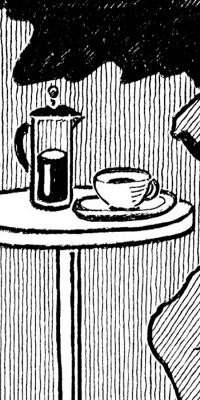
The ultimate expression of civilisation – that’s what I’d call them! I’m talking about cafés.
Along with restaurants, bars and pubs – there’s something about sitting still and having food made for you and drinks poured for you that is just hard to beat.
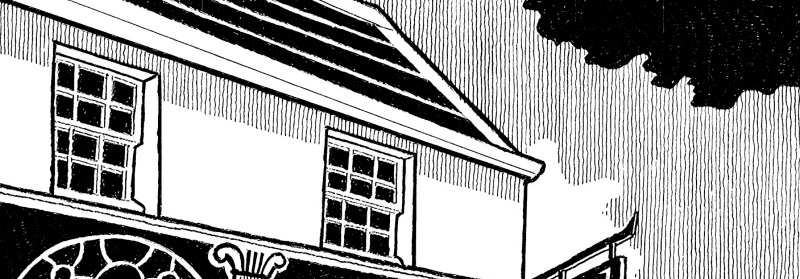
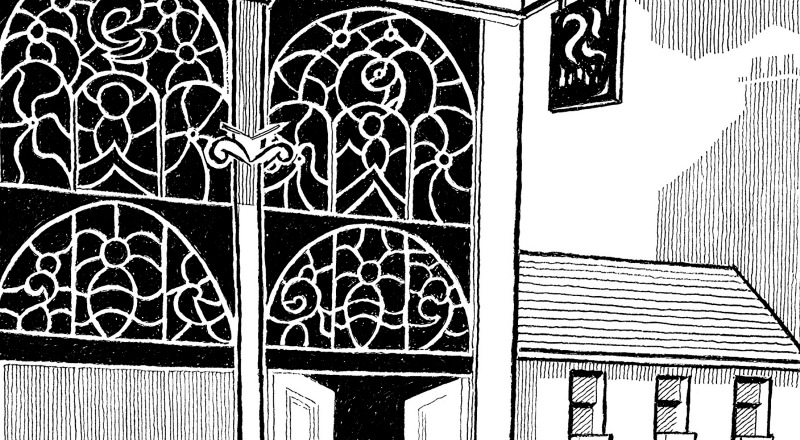
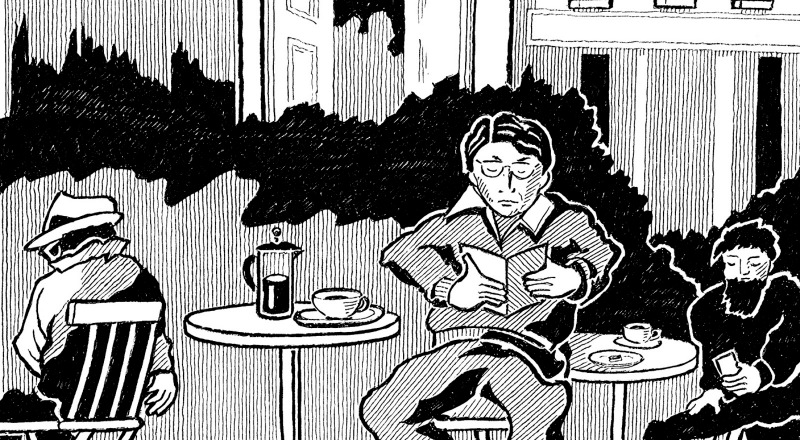
The café is a liminal space – half way between private and public. There is the private realm of eating, drinking and conversation. There is the public realm of the street, the passers-by and the traffic. And the café sits in between. It is the place of the flaneur – the drifter who simply observes. It is the place to read and to write and sketch – all the better to create a separation between self and environment – so that observation is easier. (Perhaps also it is the place of the poseur, who just enjoys others seeing them writing and sketching!) For a good café vibe there needs to be some other customers there. Not too many that it feels crowded. But not too few or it can feel awkward. And certainly not no other customers!
Otherwise you almost might have preferred staying home.
65
There needs to be a buzz of conversation, but no-one who has an annoyingly loud voice or an embarrassing laugh! That’s too much of a distraction (unless you’re in the mood for distraction). The staff, likewise, should not be too loud, and they should not be engaged in endless conversation with each other or with customers.
Otherwise
this
just
makes
customers feel like they’ve stepped into a private party and their presence is not especially welcome. We just want friendly staff and a few brief exchanges with regulars – nothing more than that. That way, it stays special, and the divide between customer and staff is respected without being a burden. That’s the game we’re playing in a café.
A table outdoors can be brilliant, tucked away slightly from passers-by – especially if it’s a busy street – so that you don’t feel people are about to walk into your table. Here, the café-goer must be on their best behaviour. A quick flick of the eye to passers-by is the most that should ever be ventured. You don’t want to be a gawper. Think how that feels for the gawpee –
the receiver of gawps. Not good. In fact, it’s possibly
best
just
to
ignore
passers-by
altogether! If there’s a view – other than of other people – then drink it in!
If you’re writing or typing, this usually works out fine – although perhaps it’s something of a wasted opportunity when you have an outdoor café table. If, on the other hand, you’re sketching, then the dynamic can change completely.
You see, in a café seat indoors, other customers will flick glances towards you if you’re sketching (you become the gawpee) but they won’t approach. Too much of an intrusion. But at an 66
outdoor table you become a little more part of the street. So people have more confidence in stopping and maybe having a chat. This can be very welcome – especially for the poseur. Three things make you a safe person to stop and speak to – a baby, a dog (preferably small and quiet) and a sketch book. And of those three, the sketch book is probably the most beneficial.
For one thing, it’s not going to be sick over people. For another, it comes with greatly fewer costs and responsibilities than either babies or dogs.
My best outdoor café experience (amongst several memorable ones) was on a rainy day in my home city of Edinburgh. It was summer (allegedly) but this was one of those days of heavy downpours we sometimes get in August –
the month of festivals in the city. There was a big sunshade over the sturdy wooden table –
and of course the sunshade acted as a fine umbrella on a day of rain. Around its edges there were little white lights. A large glass of wine and some salted mixed nuts. Perfect! I think I may have done a little writing, but otherwise I just stared out at the rain.
Given the climate in Edinburgh (and Scotland generally) we don’t get too many chances for good outdoor café experiences. Some people will brave the weather, no matter what, because (and we can only rejoice in this) café culture has reached even the coldest and formerly austere parts of our nation! But for most of the year, that culture needs must take place indoors.
You’ll have sussed by now that I’m a café snob, so generally I’ll be avoiding franchises! I want an owner that cares about their croissants, Danish pastries, muffins, scones and flapjacks.
Some of our better cafés also get locally-made 67
soup brought in from a place in the city that cooks with mostly local fresh ingredients and then distributes their wares in small metal urns, which they deliver by bicycle – the urns stored in a wicker basket at the front, or sometimes towed behind in a little metal trailer. That’s class!
I’ve not found my perfect indoor café yet, although there are a few contenders that I visit regularly. One such is Qupi, a Greek establishment that makes everything on the premises. It’s an odd little place, tucked into some old buildings. As such, every seat in the café has its own particular character. There is only one true window seat, and it’s carefully fitted in, like a little desk with a window. I can spend three or four hours there, writing and ordering drinks and snacks. The staff maintains just the right level of friendliness without intrusion.
Another is nearby – the Printworks Café. Better street views from here, and some outdoor tables. Food all made in-house. Indoors, and again a variety of great tables. There’s a subtle ambience to this place that seems to somehow allow people more conversation and interaction.
Finally (although within a franchise) there is a lovely old armchair and small table, tucked neatly into a corner, by a window that looks out onto a small street. I call this the best seat in Edinburgh, and it forms part of a bookshop. So, I’ll call in when passing and see if the seat is free. If not, I’ll browse the bookshop and come back to try again.
There’s always another café, restaurant and bar.
If I could live in them forever, reading and writing, sketching and drawing, then that, for me, would be a perfect life. Call me a fanatic, 68
but cafés could save the world!
69
S T O R I E S O F P L A C E
70
S T O R I E S O F P L A C E
My Soul Lives Elsewhere Now!
Memories of a first house lead to speculations on how souls view homes and places…
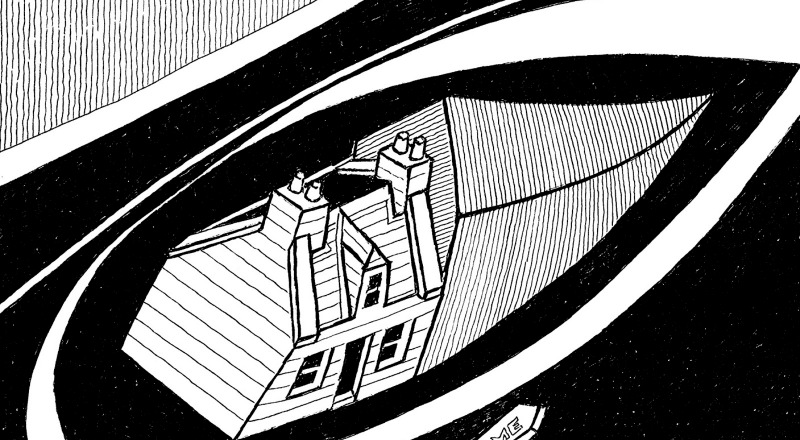
There’s a house – it really exists – tucked in between two bigger houses, in a quiet street, in a quiet seaside town. From the street side, the house looks very small. But then, the roof angles back and the house extends further than its neighbours to the rear, with a little paved courtyard right behind the back gable.
The courtyard adjoins three neighbouring gardens to one side. If there were a doorway made to the other end of the court it could link up to the back of the neighbouring property on the other side, and then to a little path that links a few further gardens.
This was my first house.
I left it nearly 25 years ago now, but I still dream of it. It’s not that it’s the biggest place I’ve ever owned. Perhaps it’s because the first house is a terraced house, whilst all my subsequent properties are flats? I don’t know.
But let me tell you about the dreams.
For one thing, the house is always in need of repairs. Many nights I find myself sitting in the loft, which seems to stretch out forever. There’s usually a tradesman or two, discussing how the 71
roof might be extended or modified. It’s always expensive and complicated.
Meanwhile, within the house itself, there is any number of people living with me (whereas I had lived there alone). These people are never anyone I know, but they seem friendly enough.
They are slumped on the sofa in the lounge, sitting on the stairs, sleeping in the bedrooms, or making food in the kitchen. Strangers also come and go in the neighbouring gardens (never the actual neighbours). The back court has been opened up to the other side, and there are people
moving
about
in
these
other
neighbouring gardens and the connecting pathway as well. There are even people out in the street, leaning in through the front window.
Sometimes the dream takes on a slightly more sinister turn. People are trying to force their way in through the front door, which never seems to lock properly. Or there may be tigers in the house, and they will always find a way to reach me, even if I think I’ve barricaded myself into a room and shut them out.
I do occasionally dream of my current home, or my parents’ house. But, like I say, dreams of my first house persist.
I think the only solution is to buy a detached property rather than a flat or a terraced house.
Will this let my subconscious or my soul finally make the move away from my first property?
Because it really seems like my soul is grounded still in that other place and does not see itself as living anywhere else.
It does seem important, that your soul is staying where your body is living!
And I wonder if other people’s dreams are likewise haunted? Perhaps there are millions of us, grounded in places where we don’t actually 72
live? That’s a spooky thought, that millions of souls find homes in other people’s houses, or even in places where there are no longer any buildings at all. Should we fix it? Or does it mean something else? Should we run with it and see where it takes us?
73
S T O R I E S O F P L A C E
74
S T O R I E S O F P L A C E
Buildings That Make Us Go Yuck!
Some thoughts on architecture, for those of us in pain from contemporary buildings!
There are many attractive hilltop towns in Italy.
But one particular town must be marked out as exceptional. Its name is San Gimignano, and it’s known as the city of towers.
What its stone towers are all about is not entirely certain. They seem to have been built by rival merchants in the Middle Ages, and perhaps they had some use as storage space.
But for the most part they are just squarish and fairly featureless blocks of soft yellow stone.
Perhaps it’s the stone towers in particular that attracts generations of architectural students on visits. Scores of them can be seen most days, sketching and photographing. I’m not sure what impact this place has on the future careers of these architects. But I wonder if they will use various features of San Gimignano to justify all kinds of architectural abuse right across the globe. The towers, for one thing, do bear a certain similarity to Manhattan skyscrapers. But if you were to take San Gimignano’s towers and scale them up five or ten times to Manhattan proportions, plus build them in steel and glass instead of stone, then the effect would be, well, 75
drastically different.
San Gimignano is a small town with a city wall.
Going in through the main gateway in the wall, the main street curves gently and slightly uphill to reach a large town square bounded by a church. The church is set at an angle to the square and flights of steps lead up to its entrance doors. The church also partly joins with its surrounding buildings and there are small streets and lanes leading away from where the buildings are gathered around its flanking walls. The result of all this is that, no matter where you stand or sit in the town square, you get an interesting view of the church, and interesting views of the square itself and the streets that lead in and out of it. Architects such as Camillo Sitte, Frances Tibbald and Christopher Alexander pick up on such features.
In fact, in various ways, they have tried to formulate just exactly what it is that makes all these combined features of San Gimignano and towns like it so successful. Their writings are inspiring. But where they have tried to apply their own rules to their own buildings – nyeah, mixed results at best! The Italians themselves seem to have few scruples about directly replicating historic buildings – and after all, this is their own vernacular style. But in other nations there is the fear of ‘pastiche’ – in other words, copying stylistic features from old buildings in a kind of formulaic manner, to make something
look
‘traditional’
but
without
necessarily thinking things through. Style without content, perhaps it could be called.
All of this, I have to say, is painful to recount!
My own city of Edinburgh in Scotland is home to some
fantastic
Georgian
and
Victorian
architecture. When I see more and more of our 76
townscape savaged by architects and planners it makes my heart sink.
Architecture’s a tough job, to be sure. You cannot just do what you want – you have to deliver for your client. And if you don’t like what your client is proposing, well, do you have the courage to walk away? After all, you need to pay yourself a salary and perhaps pay staff as well. It takes a lot of commitment for architects to stick to their principles. And even then, a particular architect’s principles might be for buildings that make the rest of us go YUCK!
Planners are perhaps a bit more culpable. They, after all, will usually have a job with the state, whether they make good decisions or bad ones.
But inevitably planners are part of THE SYSTEM, and the system is only interested in money and power. We, the public, meanwhile, get very little say about how our towns and cities are being molested.
So is there anything that can be done?
In August each year, Edinburgh plays host to one of the largest arts and music festivals in the world. It’s at this time that otherwise vacant or under-used corners of the city are brought to life with elaborate constructions of wood, lights, flags, tents and other paraphernalia. And it’s when these impromptu stage sets, cafés and bars get built that we sometimes see just the kind of happy incident of features that come together in San Gimignano’s town square. The view might be to the entrance of an elaborate tent, rather than a church frontage, but otherwise we’re dealing with similar ideas. So maybe stage designers, artists and show-people have a better eye for what works than architects and planners.
Sometimes it’s said that the wrong sorts of 77
people become architects. It is, after all, something of an exhibitionist kind of profession.
Paintings and drawings are tucked away in people’s homes and in galleries. Music and drama are mostly confined to theatres, TV, and Youtube. Literature is in books, Kindle and podcasts. Even sculpture is often discreet. But architecture is everywhere – the inescapable art.
But in fact I wonder if architects are just the unfortunate middle people. They don’t normally have the engineering skills essential to make sure buildings stay up (that must be done by structural engineers). Nor, sometimes, do they have the technical skills of making sure the building keeps out the rain and the wind, uses energy efficiently and is adequately serviced (that
must
be
done
by
architectural
technologists, services engineers and the like).
So if they are also not delivering on the visual delight that we would like our towns and cities to give us, then maybe there’s no place for them.
Planners, meantime, need to insist on beauty! A city built for business makes money in the short term. Then it becomes a wasteland of redundant properties. The circus moves on to some new location and the once-gleaming towers of a new development are left to fester, or have to be knocked down so that the same sad story can start over again. A city built for beauty, on the other hand, endures, and attracts not just financial wealth but cultural and social wealth. The bar-owners and the show-people of our festivals know how it works. Why don’t our planners take some tips from their playbooks?
78
79
S T O R I E S O F P L A C E
80
S T O R I E S O F P L A C E
Cities – It’s the System, Stupid!
Some thoughts on how our cities are designed, and how they might change, if we were to wish them to be different.
We seem to be heading inexorably towards most of us living in cities. This has some clear advantages: More space left for nature: Infrastructure can be more concentrated, and therefore cheaper and less polluting: The interaction of people in cities often leads to greater innovation and cultural richness.
The lack of nature though can be a problem for people of an ecological persuasion. Perhaps they’d
prefer
innumerable
eco-villages
interspersed with farming and nature. But then, unless people were willing to lead very simple and sedentary lifestyles, this could really be a less eco-friendly alternative. There are some interesting attempts to combine nature with large buildings. Time will tell how these will cope in the long-term. But I wonder about trees and plants lifted 15 storeys above the earth. Is this not the plant equivalent of putting animals in zoos?
When it comes to these kind of ecological options, it has to be said that people display a distinct ambiguity. Most people will say yes, we 81
must have more renewable energy, we must care for nature, we must live within our ecological limits, we must, in short, SAVE THE
PLANET! But then again, most people, when choosing for themselves, will make anything but the correct choices for the environment.
Perhaps this will change before long. Perhaps we will be forced to change. But in the meantime, there is no use designing for people the way we think they should live. We need to design for people AS THEY ACTUALLY ARE!
So we can ask, what should cities be like, to allow people to feel that this is a place we long to live in – a place where our souls can feel at home?
At this point, it’s easy to become critical of how cities have ‘gone astray’ over the last several decades.
The
predations
of
modernist
architecture in particular – and of modernism’s awkward offspring, post-modernism – have wreaked havoc.
Architects have their dreams of fantastic buildings, but when their projects are set down into our old familiar and comfortable streets, the effect can be anything but pleasant. The architects now use this rather odd term –
‘intervention’. ‘Have you seen my intervention on Main Street?’ they say. And we say, WTF?
But we have to remember what a city is really about. A city’s about what humanity, collectively, thinks is important. And just as we saw the ambiguity that individuals demonstrate with their lifestyles when it comes to ecological issues, the same story is played out on a much bigger scale with cities as a whole.
We could say that – despite all the rhetoric about ‘community’, ‘place-making’, ‘eco-cities’
and ‘walkability’ – the city actually demonstrates 82
THE SYSTEM!
And you just can’t beat THE SYSTEM!
So what do I mean by the system? I hear you ask, dear reader.
Well, our dominant system in Western nations is a consumer capitalist one. And that’s why the big buildings in our cities are often banks, corporate headquarters and shopping malls.
Because these are our true priorities – this is where the power and the money is. It’s also why these buildings seem to jostle for prominence and squash their neighbours. Plus, we are in love with personal autonomy. So private
transport
dominates
every
city,
sometimes to the total exclusion of anyone stupid enough to be a pedestrian!
Let me tell you, despite the good intentions of a significant number of architects and planners, we cannot design our way out of this mindset.
The only way for it to change is either for PEOPLE to change, or THE SYSTEM to change.
In fact, because people make the system and the system makes people, then BOTH would need to change before our cities would be any different.
Personally, I think that’s bad news. It breaks my heart to see cities trashed by another gleaming
corporate
icon
to
power
and
commerce. But think for a moment what it would be like if a dictator (let’s call them a benevolent dictator) imposed incredibly strict planning laws and created beautiful cities of parks, sweeping terraces and boulevards. The city would be car-free, eco-friendly, based around small community hubs, with amazing public transport and with everything in a vernacular style of architecture that local people had voted as their favourite type of building 83
design. Sound idyllic? Would you think that people would be pleased that a strong dictator was able to impose this kind of top-down decision-making and give us what we might consider the ideal kind of city for the 21st century?
But wait, oh no! Someone wants a car!
Someone wants to build 20 storeys of offices when the rules say there’s a maximum of five.
So, unfortunately, even in this unlikely scenario, we’d end up with an awkward compromise. The dictator’s cities would be sort of what we know we should want, but also not really who we are
– again, just like the ambivalence over ecological issues we noted above.
Hope, perhaps, lies elsewhere.
Hope lies in rebellion.
And as you’ve probably figured out by now, it’s not rebellion of an architectural kind. It can only be a rebellion that is about challenging the system and about changing people.
What then does that rebellion look like?
It is, inevitably, small-scale for now. It is those places you come across where nature is allowed to flourish, where people work with her and not against her. There’s tree-planting and food-growing, forest gardens, permaculture and regenerative agriculture. There are off-grid buildings that are full of soul and enchantment –
buildings that respect the land, the climate and the seasons.
Like I say, it’s small-scale just now – and compared to the scale of a modern city it feels like something of a hippy circus. Could it ever scale up to a population of a million? Ten million? It’s difficult to know what that would look like. As I said right at the start, a landscape that is essentially just an endless 84
expanse of eco-village is not necessarily going to be a good thing, even if it were more ecologically-sustainable.
There are visionaries out there who dream big and try to imagine future cities on a grand scale.
And I’m all for that – I’m all for dreaming. But I’ve written this so that we might get a proper grounding for our dreams. What are people REALLY like? What do our cities REALLY say about us? And of course, IT’S THE SYSTEM, STUPID! Until we address these issues, then we cannot make a start.
85
S T O R I E S O F P L A C E
86
S T O R I E S O F P L A C E
Getting By or Getting On
A tower gives us a perspective on a town or city, and also a perspective on life. How are we coping with all the pressures of the world? And might it be that there is hope for us in the most unlikely places?
In Invisible Cities, Italo Calvino says:
‘…one morning your desires waken all at once and surround you. The city appears to you as a whole where no desire is lost and of which you are a part, and since it enjoys everything you do not enjoy, you can do nothing but inhabit this desire and be content.’
…
Towers say something about what society aspires to. Way back, it was churches that were the only buildings with towers. Then came clock towers, university buildings and libraries. Then it was the turn of merchants and finally our own modern-day ‘merchant-class’ – towers for banks and corporate headquarters. A few places though have put up towers of a different sort.
Towers that are really just for looking out from.
One thinks of Montreal, Seattle, Canberra, Dubai.
It’s a pity there are not more of these – not necessarily on such an immense scale, but even 87
something like five or six storeys – as long as it gives a view.
Because a tower, whilst it is often a valuable landmark from the ground, is also a great place to look out from and get some perspective on what the surrounding town – and the world in general – is all about.
I’m in one such tower now, looking out at the city below. It’s a cloudy evening with some rain. Traffic trails away to the north, the head and tail lights reflecting off wet roads.
Commuters heading home. From this distance they seem to be moving very slowly. Then again, probably they are moving very slowly!
I get to thinking, what has shaped this city?
Architects, is the answer that springs to mind immediately. But they are generally only responsible for individual buildings. So then, planning? Planning regulations can have a big impact. But then, the planner is answerable to the politician and the politician is answerable to BIG MONEY – the lure of investment and employment that might be offered to a city, if the terms are right. So you could say it’s THE
SYSTEM that shapes the city – the system of money and power.
In any case, certainly not the people!
What are all of my fellow humans doing and thinking as they go about their business down there below? Well, if they have aspirations towards
a
greener,
less
polluting,
more
ecologically sustainable city then they might as well give those ideas up right now! They’re working for THE MAN. And THE MAN just wants them to get on and work, so that money can be made.
And if they have aspirations towards peace, justice and freedom – well, might as well shelve 88
those notions too! The system just ain’t interested in social justice. The system is only interested in power.
So what can they do? What can any of us do, except GET BY.
GETTING BY sounds like a precarious place to be. We say JUST getting by, and BARELY
getting by. From the tower, the world seems bigger, whilst the people seem smaller. Yes, it seems to me, we are fragile.
Towers are dangerous places though, sure enough. Easy to get above yourself. Easy to think that YOUR perspective is the only one that counts. The trick is to use the tower as an opportunity
to
see
OTHER
PEOPLE’S
PERSPECTIVE – and maybe find a bit of empathy, a bit of compassion. That way, the tower is worth it.
What if we all just collectively chose to give up on this type of life – the fragile GETTING BY
kinds of existence that society seems to have carved out for us? What then? What if all the soldiers and police resigned? What if we all gave up our jobs and started doing our own thing? A peaceful anarchy, helped along by mind-altering drugs? That would be my kind of utopia – or at least a first step to get us started on a different way of being in the world.
But I know what you’re thinking. Where I see utopia, you see zombie apocalypse!
Perhaps it’s the older person’s prerogative to think of things as coming to an end – along with their own declining years. That’s it, I think, I’m just getting old. I think the bubble is going to burst very soon. Infinite growth on a finite planet. Ecological collapse. Climate chaos. No other generation has faced this! Surely, this time, it really is the end?
89
Then again though, another part of me is thinking, something else, surely, is going on.
All those folk down there have their own ideas of what’s wrong with the world. Here’s me blaming it all on THE MAN, on THE SYSTEM! So I’m
seeing
the
neo-liberal
hegemony,
Washington Consensus as the source of the blame. But to others, isn’t that going to appear just like a liberal conspiracy theory? (And of course I inevitably bundle in climate change and vague hints towards communism, to boot!) I might as easily go for a hard right, ‘red pill’ kind of theory. Or is there really just a cartel of the ultra-rich (who are really giant lizards from another planet)? The first tower, after all, was the tower of Babel. You have to ask why God didn’t like people building a tower. Hubris, I suppose.
It
wasn’t
just
about
having
knowledge, it was about assuming too much knowledge and having too much pride. So God puts a stop to it – makes it so that we’re just babbling to each other. Makes it so that we just don’t understand each other’s stories.
Is that where we’re at today?
But we’ve even lost God as the ‘grand narrative’
that should put all of our partial stories into perspective. We are into ‘post-modernism’ –
anyone’s truth is as good as anyone else’s – but hey, none of it is REALLY true.
Fully dark now. Lights coming on all over the city.
It doesn’t need to be so negative - I’m thinking.
Why hate and be confounded by other people’s stories? Actually, I love your red pill story, and even your giant lizard theory!
And there’s one group of people who love stories more than any of us. Yes – the kids. After all, they’re the ones who are going to inherit this 90
world on the brink of collapse.
A lot of the lights down there are kids’
bedrooms. Inside, they sit at screens – lost in alternative worlds.
That’s what a grown-up would think though, isn’t it?
They can be anyone in those worlds. A dragon, a werewolf, a superhero, a wizard.
Infinite wants in a finite world? But do I really think they are so stupid that they do not know that? Do I really think that they won’t figure that out?
And meanwhile, what is the world they’re building?
A magical world in cyberspace, where you can take on any character you want, but at the same time you can truly be yourself. A world where your full creative potential can be realised. A place where there is unlimited sharing, where everyone has a voice.
A world detached from the natural living world, on which we rely for our very existence. Ah, there’s the ‘responsible adult’ speaking again!
Don’t you think the kids have not already seen that problem as well?
Time to go home, I think. I turn towards the lifts.
Am I just scrabbling for hope then? Or are kids not just getting by, but GETTING ON?
I’m not sure. Gonna need a bigger tower.
91
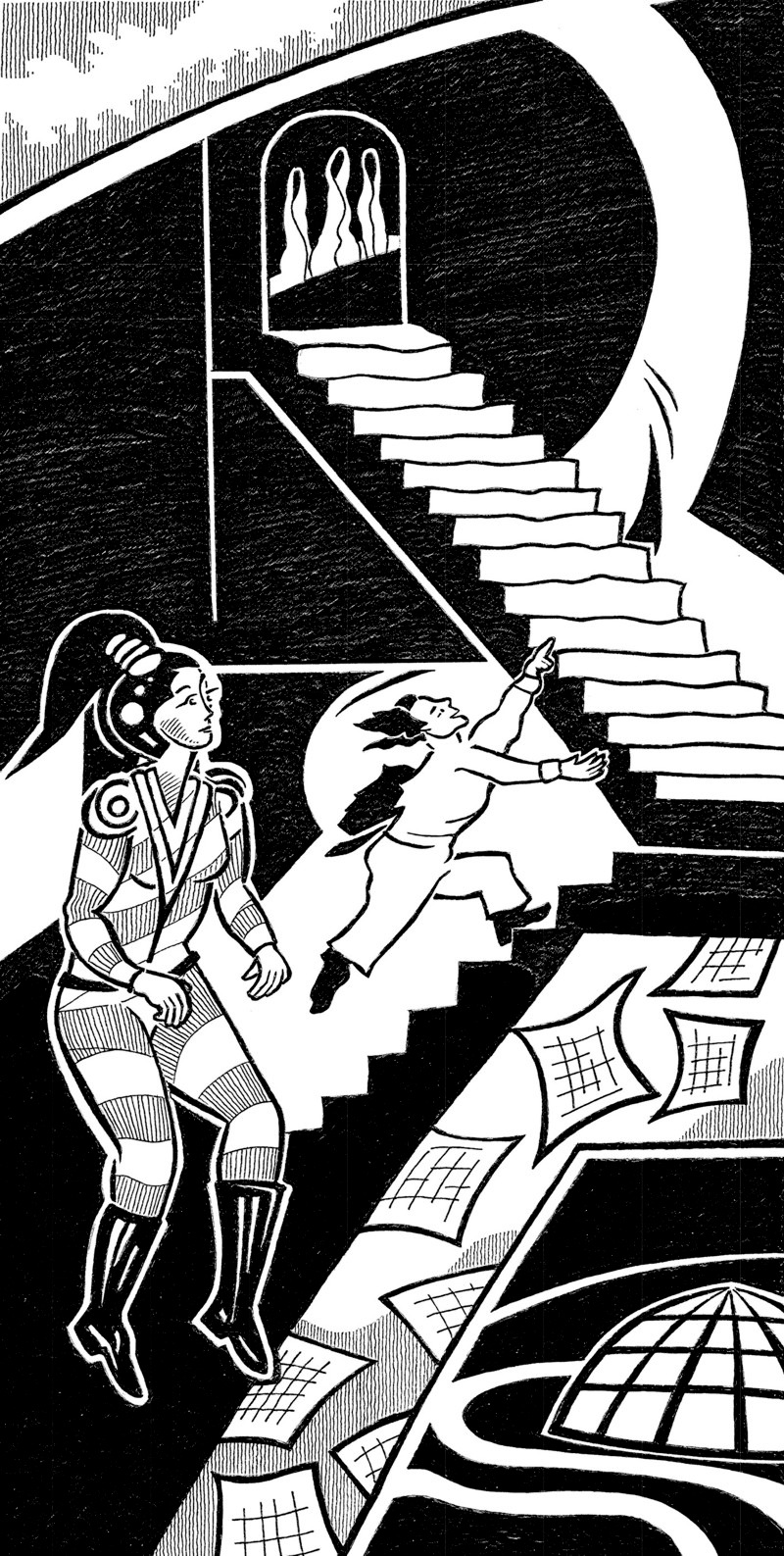
S T O R I E S O F P L A C E
92
S T O R I E S O F P L A C E
Advance to the Next Level
In a post-apocalypse world, a teenage boy dreams of returning to the devastated surface of the Earth. With his new friend – half human, half robot – they make their move.
Billy had never been much like other kids. He didn’t, for instance, spend much time in the holo
– which, let’s face it, is where most kids spend the majority of their waking hours. It gave his parents some worry, as holos are, after all, for school as well as for play and contacting friends.
Instead, Billy was always asking for paper and pencils, of all things! Who, in their right minds, used paper and pencils these days. Billy’s parents did their best to source some, but it was difficult. Even when most things could be made at home with a 3D printer, you had to find the right download, and the ‘paper’ and ‘pencils’
that came up were often useless for the actual task of drawing – they were just seen as historic curiosities.
Apart from the drawing, Billy had one other abiding interest – he wanted to know what was on the ‘outside’. Sure, he knew the history.
Humans, and a whole bunch of other stuff, used to live on the surface of the Earth. But various cataclysms had led them to take shelter below 93
ground. You’d think that this would be something of a disastrous development, but in fact humanity had got so used to staying indoors anyway, and doing everything with robots, that it hadn’t made such a huge difference. There were just the matters of air supply, food growing, and of course, all the tunnelling, to take care of. But humanity had, by then, got in plenty of practice by building colonies on the Moon and Mars.
In fact, sometimes Billy thought that the Martians actually had it better than those back on Earth. At least they could genuinely see outside! See, that is, with their own eyes – see the sky and the sun and the stars.
But the Martian colonists had paid a price with Mars, what with the low gravity, high radiation and poison soil. Genetic engineering was transforming the human body to try to make it better for the gravity. But even after several generations that was still ‘ongoing’. Martian children tended to be born thin and spindly, and with various health problems right from the get-go. And of course, not much you could do about the radiation and the poisons, apart from a lot of tunnelling and protective gear – like on Earth.
The Moon had been abandoned, when things got really bad on Earth. It had still relied too much on stuff coming up from home to make it viable.
But Mars had got quite a way towards self-sufficiency by then, so they had survived.
Numerous space ships sat beside the main Mars colony, but whether they could get off the ground or not – it was just too risky, with all the dust in the Martian atmosphere giving any piece of kit a fairly short life span. One day, new ships would be built. But honestly, was there much point to that? Anything could be made, 94
anywhere. And food and drink was much the same wherever it was grown. Anyway, more and more was lab-grown now – no need for animals, no need for soil or all that messy farming business that robots had to do.
All this fascinated Billy. But no-one else seemed to be that interested, it had to be said. The disasters on Earth that had driven humanity underground were 200 years ago now. Of course, there were sensors and satellites and probes monitoring the surface. It looked just kind of covered in grass and trees, for the most part. Some ruined cities – but not much left of those. But hey – REAL GRASS! REAL TREES!!
Why was that of no interest to anyone else?
Billy wondered what creatures might lurk amongst all that pristine forest and savannah.
He’d been told everything had been killed off.
But well, trees and grass had made it, hadn’t they? What about insects? Cockroaches? They could survive anything. Rats? Mice?
Someone, somewhere though, was taking an interest. This had been plaguing Billy for a number of weeks now, and was another reason for his reluctance to enter the holo. Whatever he was watching there would be a few seconds where the whole thing would just stop and some shadowy figures would appear – just silhouettes
– and say something like, ‘find your way out Billy, find your way up’.
Spoooooky!
Well, easier said than done – finding a way out, that is. You couldn’t just go to the surface. No-one just went to the surface – or if they did, it was kept very quiet. Besides which, there was no obvious ‘outside’ or ‘inside’ anymore. When people bought a house, they just chose an interior. Then, like most things, it was 3D
95
printed – only of course with much bigger printers and robots. It could be just about anywhere. Robots took care of tunnels, infrastructure and the transport links that everyone used from time to time when there really was some reason to leave home – such as, mainly, to get to hospital. But, what anything looked like from the ‘outside’ of a house, or whatever, was by no means clear.
There were tracks for robots, but any particular house, like I’ve said, could be just about anywhere, so far as you could tell just by looking. And well, of course, no-one bothered even to look.
Billy was all for giving up. Perhaps he should commit fully to the 23rd century. He had, after all, never even put on one of the full interactive bodysuits you could use in the holo. He often did not even put on the gloves and socks, the standard kit that let you feel things with your hands and think that you were really standing on the ground of wherever the holo was taking you. He just shoved on the headset and that was that.
You’d think, with all the simulations available, people would long for the real thing. But no.
When he turned 18, he could, of course, go even further into techno-land – go the whole way and get his consciousness uploaded into a holo.
Then he could do anything in cyberspace and it would be like his mind and body were really there, without part of him knowing that you were just sat down, or lying down, inside a machine.
Or, he could go the other way, as it were, and maybe get his brain and some or all of his internal organs transplanted into a cyborg.
There were, of course, ‘pure’ borgs – robots that 96
were fully mechanical and electronic – but looked more or less exactly like a human. Then there
were
borgs
that
had
biological
components, but which had been artificially created. And every shade in between, right through to ‘people’ who were essentially just a human consciousness inside a walking, person-like robot.
Billy couldn’t help being curious about this, despite his current aversion to technology.
There were a lot of folk who didn’t seem to like borgs of any kind – were ‘borgphobic’ – and seemed to be particularly nasty towards people who ‘transitioned to borgness’, which did, after all, sound unpleasant. (This carried the equally unpleasant title of ‘transborgphobia’.) Maybe the prejudice was because most transborgs chose ridiculously over-the-top bodies – muscle-men and super-babe women mostly – and it all seemed a bit, well, unnecessary to Billy. After all, you could live your life mostly without being seen, if you wanted to. And you could just have an avatar for your holo presence. So why waste all that effort on getting a super-fit ‘real’ body, when so few people would see you in your
‘borghood’? But, Billy realised, there was family and there was dating, and a lot of that was still done in ‘traditional’ ways. So sometimes Billy thought that some kind of transborg body might be the way to go. Perhaps it was all the possibilities – and the opportunities to be anyone you wanted – that made it appealing.
And then there were the various options for having children – well the choices got pretty numerous for that! Transborg babies were a whole
other
thing
–
putting
a
baby
consciousness into a synthetic body – such that you’d robbed them of the choice of growing up 97
as a natural human. It was sort of illegal so far, but it was done for foetuses that would otherwise be birthed with disabilities. Well, that’s for natural births where surgery wasn’t possible. Most births now of course were from artificial wombs.
Well, I could go on. But as it turned out it was a transborg girl that led Billy to finding his way out. She was heart-wrenchingly beautiful – at least in Billy’s eyes. But well, there was of course all that awkwardness of wondering how much of her, or how little, was original human, how much synthetic biology and how much machine – if these things could even be quantified. And then there was the question of whether she had even originally been a girl. But Billy did his best not to be prejudiced. And besides, they were, as yet, just friends.
It had to be said though that if anything was going to encourage Billy to spend more time in a holo it was this new friend – Electra being her name – they had a habit of choosing names like that!
Before things could develop any further however, Electra told him a critical piece of information:
Every house has a trap door!
It was obvious when you thought about it –
blindingly, stupidly obvious! Some stuff had to get in and out of a house that could not be brought in through the actual door – the door that just led to public transport tunnels. But everything – all the complex mechanics and computer systems of a modern house – was so carefully hidden away these days. You’d just never really think about it.
‘So where is it?’ Billy asked Electra, as soon as she’d told him.
98
‘Back of the main holo, most like’, says Electra.
After much searching, Billy found a panel. It was almost impossible to see it, but it was there. Big enough to crawl through, because, after all, at some point – worst case – a maintenance borg might have to go in and carry out repairs. So, likely enough, there was space enough for someone, or someborg, to squeeze through to a trap door on the other side. Which should, in turn, lead to the ‘real’ outside – at least the real underground outside.
But first Billy needed tools. Flashlight, something to prize open doors, and, most difficult,
an
oxygen
tank
and
breathing
equipment. It all took a bit of doing, but in a few days he had what he needed – plus food, clothes and other stuff he thought might be useful. If he got out of the house, who knew how many tunnels he’d have to wander through until he found his way up to the surface.
To get out of the house wasn’t so difficult in the end. Just a few minutes to ease open the inner panel, and then Billy did his best to pull it back into place from inside the mechanical guts of the house that lay beyond. Then a ridiculously short crawl through various wires, tubes and machine parts to another panel. This he only had to unscrew, and he was ‘out’ – or, at least, outside into a service tunnel. There was a faint glow from somewhere. Billy switched on his flashlight and saw that piles of houses surrounded him in a sort of semi-organised, semi-chaotic way. Each house was roughly spherical from the outside and each had some rectangular panels that glowed faintly. This was the source of the small amount of light Billy had noticed before he’d switched on his flashlight.
Billy realised that the glow was most likely from 99
the backs of the large screens that covered the walls of most houses and could be set to display pretend exteriors, or just pictures or patterns –
anything the owners wanted.
Not much else could be seen. There was what might be described as a ‘road’ running away in both directions, but it curved quickly away to either side of Billy and where it might lead was hidden by further clusters of houses.
It was too dark to see much more. The ground (or floor) was fairly smooth, but dusty. Maybe just dry compacted earth. There were some tracks, presumably from service vehicles and the equipment that’s used to make new houses.
Nothing for it but to follow the road. Billy had brought a device that could read the amount of oxygen in the air (all houses of course had artificial atmospheres). It was reading 18%
oxygen – just about enough to breathe okay, but he took his oxygen tank and face mask with him anyway. Who knew if the surface would be the same?
Just then, a light and a voice!
‘Billy!’
It was Electra!
She was standing half-way up a flight of metal steps, to Billy’s right. Of course, he’d never seen her in real life, as it were. He ran towards her.
‘How did you….?’
‘Plans’, she said. ‘There had to be plans of tunnels somewhere. I found them eventually and worked out where you live.’
‘Why is everything so secretive? Why does no-one want us to know where tunnels are, for God’s sake? They’re just for robots.’
‘Or give any decent maps, even of normal transport. It’s because of me.’
100
Electra didn’t explain further, but instead she turned and walked up the rest of the metal steps above her to a rusty metal door.
‘This way’, she said to Billy.
Billy was having trouble coming to terms with seeing a real other person outside of his parents, especially one such as Electra – who seemed, from the flashlight beam, to be a combination of flesh, fabric, metal and … who knew what else. A transborg in real life, Billy decided, was a sight to behold.
Electra pushed at the metal door and it swayed open with a creak. There was just a metal spiral staircase beyond. They both shone flashlights up at it, but couldn’t see the top.
‘It’s here! The maps were correct! Come on, let’s climb.’
They started the ascent. And as they did so, the words Electra had spoken started to sink into Billy’s mind.
‘What did you mean when you said everything’s hidden because of you?’ he asked.
‘I didn’t mean me personally. I meant people like me. Transborgs.’
‘Oh’, said Billy. This was at least a little reassuring. ‘Do you know what’s on the surface?’ he continued.
‘Just grass and trees, I guess’, said Electra.
‘I think there might be people up there.’ Billy went on to explain about the shadowy figures that had been interrupting his sessions in the holo.
Electra stopped and turned to him.
‘Government people?’ she asked.
‘I don’t know. I don’t think so.’
‘Not what I’d been expecting for a first date!’
She turned and continued climbing. She calls back:
101
‘It’s the government that doesn’t like us transborgs. They’re trying to stop us. They want to keep humans, borgs and sims separate.’
(Sims are the folk who get their consciousness uploaded into either borgs or holos.)
‘But why would they want to keep tunnels secret? It doesn’t make sense’, Billy continues.
‘I’m beginning to wonder if it’s something about the surface. Something they don’t want us to know about up there.’
It wasn’t long before they’d start to find out.
The staircase ended with just a little landing and another metal door. Electra pushed it and it swung open.
Swung open onto paradise.
Trees towered above them, with sunlight dappled through millions of leaves. Insects buzzed. Hundreds of birds flitted between branches, chirruping and singing. Various small creatures scurried about beneath their feet.
Electra and Billy both gasped in astonishment.
But they hardly had time to take all this in before they saw the figures, standing there, shadowy and indistinct, as if they had been expecting this arrival.
The figures did not speak or make a move. It was difficult to tell if they were real or not.
Everything else was so vivid and so real, but the figures looked as if they were barely there at all.
‘Sims’, said Electra quietly to Billy.
‘And false info on all those so-called feeds from the surface. None of them shows it to be anything like this!’
‘Then why not just show a barren wasteland, if they’re faking it anyway? Why show grass and trees?’
‘Good question’, said Billy.
‘Sims as in avatars?’ Billy asked Electra.
102
‘No’, she said. ‘Something else.’
But then one of the figures moved, raising a hand in welcome.
‘Billy! And if I’m not mistaken, Electra.’
‘Who are you?’ Billy asked in reply.
‘That doesn’t matter for now. We mean you no harm. In fact we’re delighted you’ve arrived.’
But Billy persisted. ‘Are you sims?’
‘Not in the manner you understand the term, no.
We’re not projections of avatars.’
‘Not from the government?’ Electra interjected.
‘No. We are consciousness that can exist as energy, or can manifest in various forms, such as the projections you are seeing now. So, a different sort of sim, as you’ve already guessed.
Electra seemed satisfied with this. But she asks:
‘Do you know why the government don’t like transborgs or why they might not want people to come back to the surface?’
‘They don’t like you because you’re so close to being as we are – to manifest in any form. Isn’t it true you’ve already an idea of how it’s done?
As for the surface – well, it’s just that it would be too much disruption right now. If everyone is underground, hooked up to their holos, they can spread their hate-speech more easily.’
‘Yes, but why make out that there’s trees and grass? Why not just show wasteland and desert?’
‘Because Mars can see Earth’s surface directly, but far enough away that trees and grass don’t arouse any suspicion. The fact that there’s a lot more life here than anyone knows about wouldn’t show up unless Mars took a much closer look.’
‘Anyway’, the being continued – and here was the real shock – ‘welcome to Level 2.’
103
‘Wait a minute, Level 2? You make it sound like a game or something’, said Billy.
‘It is a game of sorts. Let us show you.’
And with that, some kind of screen appeared in the air, just to the left of the beings, with drawings and writing on it.
Billy studied it for a while and no-one spoke.
‘So’, he said at last, ‘Level 2 is the Earth, 3 is the solar system, 4 is the galaxy, 5 is the universe, 6 is the multiverse. 7? I don’t get that one.’
‘And besides,’ Billy continued, ‘where do you guys fit into all this? Do you have real bodies somewhere? Are you aliens?’
‘That’s a lot of questions all at once! Let’s start with the last point. We’re not aliens, we were once normal humans like you, then transborgs like Electra – some of the first. A transborg is a mixture of different energies you see, a mixture of different fields and forces. And there came a point when there was a leap. Suddenly, somehow, we were able to transfer our consciousness into anything, or project it anywhere.’
‘So that’s Level 2?’ Billy asked.
‘No, no. The levels are about areas of control.
Control of the physical world. That is, until you get to Level 7. Then, there’s so much physical control and technical ability that what we achieved by accident could be, er, manufactured
– made real just with technology.’
‘So that’s why the government see us as a threat,’ Electra said. ‘We could jump to Level 7
without any of the extra effort?’
‘That’s exactly it! For them, transborgs are too much of a risk. The government wants to keep all of the power and control.’
Electra looked thoughtful for a few moments, 104
then she said: ‘Was it really just an accident? I mean, you guys getting to be this special kind of sim?’
‘We’re not fully sure,’ the beings answer. ‘It’s something about the soul of the person, something about managing to be at peace with the world, but at the same time knowing – not just sensing, but really knowing – that there’s an outside.’
Electra looked away, and Billy noticed that there was something in her manner that suggested that – had she been fully human – she might be blushing or shedding a tear right now.
Electra was thinking – ‘that’s exactly what they say about us, that we don’t have souls.’ But out loud she said: ‘So what of Level 2? What does that mean exactly?’
‘The planet’s surface. It has healed and bounced back in the two centuries since the devastation. You might say that it has become the outside in a literal way, for humanity. A chance for a new beginning.’
Electra and Billy looked back at the doorway from which they had emerged from the underworld. It looked tiny amongst the huge trees.
‘Are there more of these? I only found this one because it was near to where Billy lives’, Electra said.
‘Not many more, but a few. You were just lucky you didn’t have to walk a hundred miles to the next one! There’s fruit, nuts and more besides, to eat here. You could live a good life. Start a safe place where things might have a chance to turn out differently.’
‘But won’t they find us?’
‘Not for a while at least, and we can teach you ways to defend yourselves if needed. The 105
surface is hardly monitored at all. It’s all just the fake newsreels now, if anyone even bothers to look.’
A whole world, just for transborgs, Electra was thinking – and free from persecution. Or maybe they should call themselves something else.
Transborgs was such an awful name. But that could come later. For now, decisions had to be made.
‘I’d say, we do it!’ she said.
Billy was a bit taken aback by the ‘we’ in this announcement! But he could hardly think of anything better, right then, than starting a life with Electra. His mind flitted to the thought of cyborg/human babies, and whether he should turn trans himself. But those things could be solved, one way or another. They could always
‘borrow’ technology from downstairs, when they needed it. To live on the outside! To see the sun, moon and stars! And possibly Electra and he were the start of something entirely new –
advancing to the next level – or indeed skipping straight up to the top level! It had to be worth trying! He was in.
106
107
S T O R I E S O F P L A C E
108
S T O R I E S O F P L A C E
Pub Philosophy
The people in a the local bar might surprise you, if you take a bit of time to listen…
The beer garden is quiet, despite the good weather. Kevin was sat in the sun with his top off. He’d had one pint himself already, and is waiting for the arrival of his friends, Gary and Derek, before having any more.
They arrive at that moment, strolling leisurely into the beer garden with cheerful smiles. Both are large men, like Kevin himself, and with ample beer-bellies, but handsome men for all that.
‘Wocha, Kev!’ says Gary.
‘Wocha, Gary, Derek’, Kevin replies.
‘Wocha ‘avin?’ says Derek – this, sort of a word-play on the ‘wocha’ greeting…. A bit difficult to explain really, but suffice to say, the banter had already started.
‘Make mine a beer!’ Gary and Kevin chant in unison. Derek smiles and turns back to the bar to order them their drinks.
When he gets to the bar there’s a group of five young guys there, buying shots and downing them in one. They’re already very drunk.
‘Alright, big man’, the leader (there’s always a leader) says to Derek.
109
‘Alright.’
The young men all laugh and then make silly impersonations of Derek’s reply:
‘Alright. Alright.’
The leader turns to Brenda, the landlord’s wife, and asks for another five shots.
‘Think you’ve had enough boys’, she says. ‘Best you just set off now.’
The leader leans across the bar and tries to grab Brenda’s arm. Derek catches him by the back of his T-shirt, pulling him down forcibly onto a bar stool. The leader spins round and tries to throw a punch at Derek. Derek easily catches the punch in his own big right hand, and holds on.
The leader's face contorts in pain. Derek marches him to the door, forcing the leader to walk backwards. When they’re outside he says,
‘Go home son. Don’t want no trouble.’ The leader only pulls a knife! But this doesn’t phase Derek one bit. He bats it away with his left hand as if it were just an annoying wasp.
Derek comes back to the bar, picking up the fallen knife on the way. He stands next to the remaining four lads. Brenda looks at Derek, as if she is suggesting she do something, like call the cops. But Derek narrows his eyes and gives the slightest shake of his head.
The remaining boys are whispering amongst themselves, looking awkward. They keep looking over at the door, but their friend’s not coming back in. Eventually one of them says,
‘We didn’t mean no harm mister.’
So it’s mister now!
‘No worries’, says Derek. ‘Best you be getting along now.’
There is more whispering and then finally they turn and leave. Brenda let’s out a long sigh.
‘Woz wrong vid’em, eh Derek?’, she says, ‘the 110
rest of us ‘as evolved.’
Derek’s not sure he agrees with Brenda’s judgement, but he just says, ‘yeah, right Brenda.’
Derek returns to Kevin and Gary with their round of beers.
‘What took ya?’ says Gary.
‘Spot of bovver.’
‘What bother?’
‘Ah, nothing. Hardly worth telling. What you guys on?’
‘We was just saying about euthanasia…’
This perhaps is where Kevin, Gary and Derek might seem a bit different from other men who drink beers in bars. The conversation is rarely about football, cars or women – and why assume it ever has to be? These guys break the stereotype at this point. For the most part, their conversation focuses on issues currently in the news. It might be politics, but could easily be abortion, LGBTQ issues, taxation, climate change – or, like today – euthanasia. The guys don’t argue exactly. It’s more of a debate than an argument. They don’t do anything with their conclusions – if there are any conclusions – but might come back a few days later with further thoughts or revised opinions.
I call it pub philosophy.
This is a friendly pub (well, generally!) and the three guys are especially careful to say a brief hello to anyone they see who’s not a regular. I remember one time a really posh-looking bloke came to the pub. You could tell he was something important like a doctor or a lawyer.
Kevin had been at the bar and said hello to him.
‘What do you do then, mate?’ Kevin had asked.
‘Er, I’m at the university,’ the man had replied in a quiet voice, obviously quite drunk.
111
‘Oh yeah? What do you do there then?’
‘I’m a professor – professor of philosophy.’
Kevin was taken aback. ‘Jesus, mate!’ he said,
‘d’you wanna come an’ sit with us? We was just havin’ a debate about gene cloning.’
The professor was intrigued enough to join Kevin and the others. Before long he’d lost any inhibitions he might have had and was merrily chatting away. What a range of subjects they covered that night! The professor said they were all matters of ethics and that his speciality was more along the lines of metaphysics. He gave a quick summary of what metaphysics is all about. The others got stuck in debating about this as well.
Anyway, they kept in touch. The professor drops by from time to time, to get another sampling of pub philosophy. I think he finds it refreshing.
It’s around half-past five now. The sun is still warm and the guys could have stayed on a bit longer. But Kevin looks at his watch and interrupts the conversation (now onto the future of artificial intelligence).
‘Lads, the ladies.’
‘Oh, right, of course’, the others chime in.
They set off for the washroom to clean up and put on some neat shirts they all had with them.
For this evening their wives are joining them for a drink.
The ladies arrive and they’re smartly dressed.
They’ve obviously gone to some trouble with hair and makeup. Brenda has gone home by now and has been replaced at the bar by her husband Pete, plus a barmaid to help out as the place gets busier.
‘Alright girls’, Pete greets the ladies as they walk in.
112
‘Alright Pete.’ They head on through to the beer garden, to which the guys have now returned.
The guys have now chosen different seats –
ones that are in the shade – and they stand up as their wives approach. There’s an exchange of hugs all round and then everyone gets settled and studying the menus. Pete puts on a good range of food.
They’re proud of their husbands, the three ladies. Not high-flyers, by any means. But certainly not low-lifes, or lazy, or dodgy. Just solid, dependable, regular guys. Diamond geysers. Salt of the Earth. And what more, really, could a girl ask for? That’s their feelings.
Sharon,
Tracey
and
Susan
are
likewise
dependable women. The guys love their wives like nothing else on Earth. But again, this is where things get a bit different.
Because I’ve sat with them all sometimes. And I tell you, it’s not the usual table of guys out with their wives. Sure, it’ll start off with some news of family, plans for holidays, and all that.
But then you’d expect the women to gradually start chatting amongst themselves, and likewise the guys. But it’s not like that with these folk.
After a bit, one of the guys might say, ’we was just having some thoughts on…’ and then mention a topic that had come up amongst the guys earlier. The ladies might then take turns to share their thoughts. And the guys would really listen. I mean REALLY listen. Because the different perspective is always worth serious attention. And that’s just like them – all that listening and considering – pub philosophy at its best.
It’s an odd place, a pub. Much more social than a restaurant or a café. Or, I could say, social in a different way. Because people weigh you up 113
when you go in there. Are you posh? Are you a bit above yourself? Are you phoney? Are you dodgy? Are you lonely? Are you flighty? Are you genuine? And then, well, if it’s a friendly enough pub, you might be okay, even if you don’t fit in too well. But if it’s an unfriendly pub, and you don’t fit in with the majority, well then, it will be a struggle. You might be better to take yourself off somewhere else. You might be better to have a bit of a think about what went amiss there and if it’s really the regulars who have it wrong or if it might not actually be you….
Well now, you might be thinking, how do Kevin, Derek and Gary fit into all this? They’re not regular guys really, are they? They’re not your typical pub-goer? But no, I think we have to look closer. It might SEEM at first, that certain folk are going to behave in certain ways, based on their appearance, their accents, their mannerisms. But if you wait a bit, and listen a bit, you might find that people will break your expectations. People could be a lot more surprising than you’d ever think.
And that’s how it is with these guys. Pub philosophy, eh? I’m glad I joined in. I’m glad I took the time.
114
115
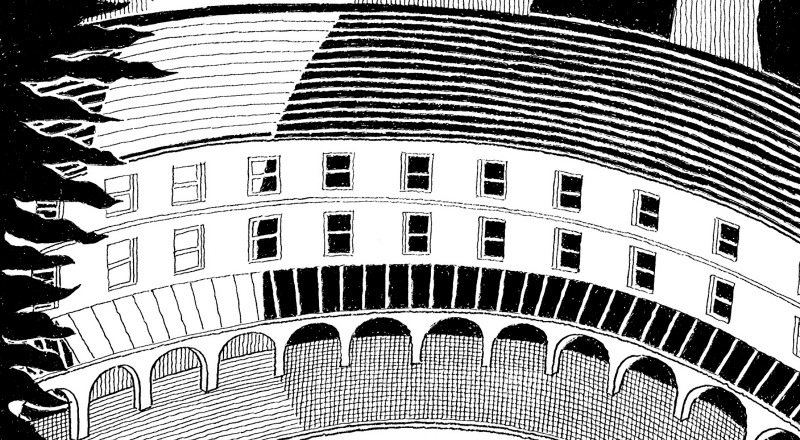
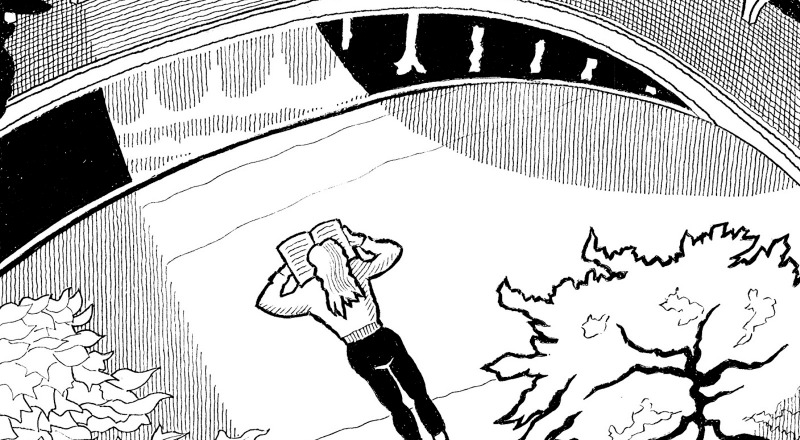
S T O R I E S O F P L A C E
116
S T O R I E S O F P L A C E
Hey Presto, Transformation!
A history student of the future looks back at the changes that shook the world in 2070.
Julie walks across the grass and finds a nice spot in the sunshine. She spreads a towel and lies down. She’s not here just to sunbathe however. She rummages in her bag and pulls out a folder of notes, spreading the folder out in front of her. Then she props herself up on her elbows, flicking her pen and thinking about her work.
This is history. And she needs to write a bit more history before she’s got enough for the current assignment. Here’s how it reads so far: By 2070 the world was really on the brink of collapse. International trade had all but ceased, with nation states highly protective and closing their borders to foreign investment, foreign goods and most of all, immigration. A siege mentality reigned, and meanwhile national governments were struggling to keep control of their own populations. Food shortages, water shortages and collapsed economies were leading to civil unrest on a massive scale – and in some cases, to revolution.
But then, as we all know, came the change.
Perhaps there were signs of it, stretching back a 117
century or more, with activist groups and protests of one sort or another. But they had seemed so insignificant compared to the scale of the problems they had been trying to address.
We know this time, of course, as the time of the Great Transformation – and when it came, it came quickly. The reasons for this I will set out later in this essay. But for now, let’s look at the consequences….
Julie looks up from her folder of notes and pauses for a while to think over what to write next. Unbelievable, what these people had faced, two centuries ago. But, to be honest, all that she’d learnt about history so far was suggesting that they didn’t lead such very different lives to the way people are living now.
It was more about a change in attitude than a change of technology or economics, or anything else. How had that change happened so fast, all those years ago? That’s what she needed to explain in her essay. But for now, yes, stay with the consequences.
She looks around at the town square where she’s lying – hoping for clues. It’s quite a small square of old buildings – perhaps circa 1900’s, she guesses, based on the architecture. There is the grass she now lies on, in the centre of the square, and some trees for shade. Cobbled pathways run here and there. A few cafés and bars line the square. There’s a gentle murmur of voices from these and from other folk sunbathing on the grass. Others sit beneath the trees, reading, or working, like her, or just enjoying the weather. There are birds singing in the branches above her head. What’s missing?
Julie thinks. What would it have been like in 2070?
Noise, is the first thing that comes to mind.
118
This square, and in fact the whole city, would have been full of noise. Cars, lorries, buses.
Aircraft flying overhead. The square could have been tarmac or concrete back then and probably the centre of it would have been for parked cars.
All of this in amongst a city dominated by the interests of money and all of it consuming energy as if there was no tomorrow.
There hadn’t been too much to do to this square really except get rid of all the vehicles. Which, in turn, got rid of most of the pollution. Which, in turn again, started to let nature get a foothold. It was as simple as that. But imagine this same scenario played out in millions of streets and squares, thousands of towns and cities, right across the world. Small changes, on a global scale, add up to a lot.
So then, nature bounced back. And with more nature, better climate and less pollution. And with better climate and less pollution, even more improvements in nature. And so it had gone on, until, 200 years later, the natural world was as thriving as it had been back in the 19th century.
And you could see the same cascading effect in people. A bit of resistance – don’t take nonsense from government any more, don’t let BIG MONEY rule – and small changes had to be permitted. With those small changes, further demands. Tighter controls on pollution. Legal protection for eco-systems, animal, bird, insect and plant species. Clean energy. Safe water.
Food security. Then more change. And more.
Somehow all the trappings of power and hierarchy just melted away. It seemed that this would have been impossible – and it’s not even clear how it really happened – but today, somehow, there is just no abuse of power. Not 119
only that, but there’s hardly even a glimmer left of what ‘abuse of power’ really meant. Could you take someone from the 21st century and explain to them what living free of power even means, Julie wonders. A ‘post-power society’?
So a new politics came about, mostly without much conflict, despite the riots and civil wars that were bubbling away in the 2070’s.
Somehow, governments had been just sensible enough to listen to their citizens. And most citizens had been just sensible enough to make their demands in civilised ways.
With political change came economic change.
With economic change came technological change. And with all that came cultural change.
People – the difference in people – that was the big consequence.
People
had
started
out
just
demanding
something be done about the rapidly-worsening state of the economy and the world in general.
But as changes were achieved, so in turn did this change the people.
How to describe the changes in people?
Julie looks around again. Everyone seems so relaxed, for one thing. No-one is hurrying. And everyone looks very unique, of course. When you look back at video footage from the 21st century the thing that strikes you is how angry and impatient everyone seems. And how uncomfortable with themselves. Kind of manic and self-obsessed. Trying to express who they are, but failing miserably, because very few knew themselves. Their efforts at ‘authenticity’
– as it was called then – just seem laughable to Julie.
How strange though. How strange that, in a way, so little was needed to make such massive change. A bit more self-awareness, a bit more 120
sensible
discussion,
and
hey
presto,
transformation! But then, most big upheavals in history were like that, Julie thinks. Before they happen they seem like impossible dreams –
after they happen they just seem like common sense.
Julie rolls onto her back and looks at the trees and branches above her. She’ll try a bit more writing later, she thinks, but for now there’s the bones of the essay sort of worked out.
Thank God, thank God, she thinks, to be born in an age when all that’s behind us. Thank God we came through.
121
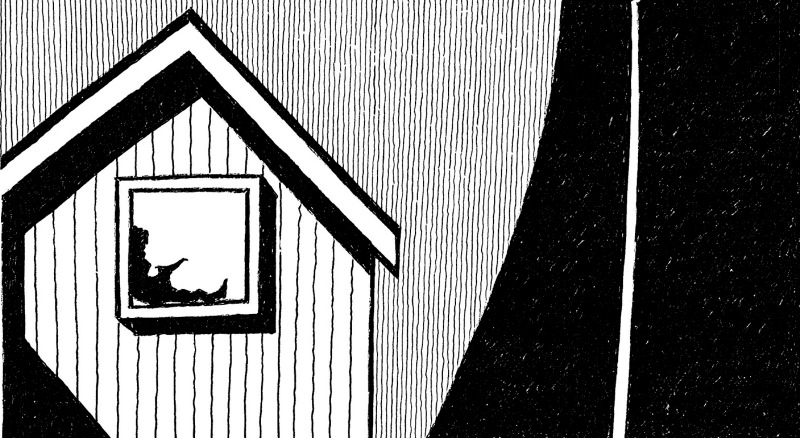
S T O R I E S O F P L A C E
122
S T O R I E S O F P L A C E
Homo Fickilus
Community is no longer on the agenda in this essay of changing world views and changing pleasures…
In Invisible Cities, Italo Calvino says:
‘…it is pointless trying to define whether Zenobia is to be classified among happy cities or among the unhappy. It makes no sense to divide cities into these two species, but rather into another two: those that through the years and the changes continue to give their form to desires, and, those in which desires either erase the city or are erased by it.’
…
I find it stifling living in this place, I really do.
Take the other day, for instance. A neighbour stops me in the street. ‘We have a nice little COMMUNITY around here’, she says.
Which was a lie for a start.
‘…and we don’t want people like you spoiling it!’
What had I done to encourage this verbal assault? Well, nothing much, as far as I’m concerned. Okay, it was a bit naughty, but not actually illegal!
Anyway, my point is, why can’t people just leave other people alone, to have fun any way they want to? Or perhaps that word ‘fun’ makes you 123
a bit nervous? So let’s say, find their own pleasures. More nervous now, huh?
Okay, okay, I’ll go with happiness. But if we were being strict about it, I’d say happiness needs some underlying purpose behind it, and some long-term strategy. And joy? That, to me, suggests some long-lasting, almost spiritual place, beyond any circumstances the world might throw at us. The thing about fun and pleasure is that they’re in the moment and they don’t have to have any meaning.
So why should anyone want to stop that? It’s how children see the world, and animals.
The whole thing about it is that we’ve grown tired of having rules and values – especially the kinds of rules and values that other people want to bash us over the head with! A bit like my snotty neighbour.
Make a rule and humans want to break it!
Fickle! We should really be called Homo Fickilus.
So once there was religion, trying to keep everyone in line. And then along came the Enlightenment. But of course, whilst rejecting rules from the past, it had its own rules. And then came Modernism. Same again. New rules.
What was next? Post-modernism? The idea that there are no grand narratives. So you’d think that at least we’d broken free of rules.
But, in a way, no. Post-modernism still took itself very seriously, with its ‘deconstruction’.
Utopian stories that are really dystopian –
dystopias that are longing for a utopia. Fickle, fickle. Fickle!
Now where are we at? Post-post-modernism?
Fickle to the power of five?
I suppose we finally got wise to the idea that there’s always an inherent contradiction in 124
whatever theory you try to promote – be it philosophical, scientific, political, or whatever.
Even if I were to say, the whole point of my life is just to have fun, then this is a kind of a contradiction, because I’ve sort of given myself a point, even whilst denying that there’s really any point.
A good example is anarchy. Anarchists are very well organised! So, you see the contradiction there straight away! Could there ever be an anarchist revolution though? The problem is that then they really would have to live the inherent contradiction of the need for massive amounts of organisation on the one hand, and disruption,
chaos,
fun,
freedom
and
independence on the other.
Could they ever do it? I don’t know.
But I’m wondering what current governments should do, given that people are feeling restless about a whole bunch of stuff. What do they do about protests, say around the G20 talks, or the UN climate talks? Perhaps, instead of trying to keep protest out, they should just invite it in?
Sit down with everyone and have a good sensible chat, plus plenty of great food and drink for everyone – not just for the big shots.
But, us being fickle and all that, this would probably lead to protest about something else!
Maybe the point of it is that there is opposition.
Maybe the government should play a wiser game and continue with their policing, but do it in a playful way, so we keep the opposition going (the contradiction) but yet we all know that it’s just a game?
The weird thing I’ve noticed recently – the thing that’s really puzzling – is that the more people try to have fun, the more bland the rest of the world seems to get. So, everyday clothes have 125
become boring uniforms, and cities have become boring expanses of office blocks and houses that all look the same. But meanwhile there are festivals and carnivals, processions and parties – with people in fancy dress and wild, colourful fashions.
You could ask, should architects and planners and the government get their heads together to build more exciting and fun buildings and cities
– to match the way people REALLY are, when we’re enjoying ourselves? But then, in the spirit of contradiction, maybe we need all the bland and boring buildings as a background to all the exciting stuff. So maybe a very straight and formal city is the way to go, so all the colour and vibrancy and bedlam resides with the people and what we create in those formal spaces. Maybe it just works better that way. So the more depressing, ugly and boring our cities become (or the more logical, clean and organised) the more the bars, clubs, carnivals, festivals, processions and protests will shine!
Which kind of takes me back to that whole thing with the neighbour – and that comment about community. Because, well, I live alone, and more and more people are doing the same. I don’t talk much to my neighbours and they don’t seem to talk much to each other. So that’s why I said there isn’t really community there at all.
Community’s no longer about place, it’s about networking with friends – and all that stuff happens online. Then, occasionally, there could be a meet-up, for some event that sparks your interest. But, let’s face it, that could happen anywhere. In fact, if the venues keep changing, that probably helps to keep people’s interest.
And well, if you lose interest in something – lose interest in one of these online communities –
126
then you just drop it. Likely as not, no-one will mind. No-one will miss you much because there’s always new folk coming along, and you yourself can just go looking for the next new thing you want to do.
So community’s not in a place and community’s not about longevity, commitment, loyalty or solidarity any more. I wonder though about friends and family. If we applied the same mindset to them, this might not be so good.
But then, we’re forgetting contradiction! The more society becomes fractured into interest groups with people flitting in and out, the more the delusion of a settled community takes hold!
And, arguably, the greater we relish the contrast with our long-term friendships and stable families. So we have fantasy villages where people can live out this myth of community –
eco-villages on the one hand and gated communities on the other.
Meanwhile, we who embrace the solitary life have our own new styles of living – boutique apartments and the pied-à-terre. You wouldn’t even THINK of calling your neighbour a neighbour in such a set-up! The solitary life is a very close-knit community, but we wouldn’t want to visit each other!
Where does all this leave our towns and cities then? Perhaps we needn’t worry, because if these trends I’ve been describing (of interest groups springing up and occupying temporary venues, plus the gated communities and boutique apartments) – if these trends are really the future, then eventually the city will transform itself to reflect this new way of being in the world. The city is always a reflection of ourselves.
I thought for a while, this would be a half 127
measure, that the whole city needed to transform itself into one giant carnival before we could really feel that life had been re-enchanted.
But maybe it’s not like that. Maybe, like anarchy,
re-enchantment
has
to
be
contradictory and subversive.
Either way, we have an ally in nature, where playfulness always seems to be on the agenda.
When we talk about government, cities and communities, then there are always the big questions of climate change, pollution and failing eco-systems lurking in the background.
Looking at all the ways people seek pleasure nowadays, it’s easy to think it’s just hedonism.
But it’s more than that. People’s whole way of being in the world is shifting. It’s shifting towards being about emotion, spontaneity, joy and experience, and away from having fixed ideals, rules or philosophies. Will this help solve the big problems?
I think it might, because I think the new mindset that’s emerging is just the sort of strange, contradictory and subversive mindset that might serve us well in the future. We won’t solve our problems with new laws, or new economies or technologies. People need to change first – and we are changing. If nature’s starting to act weird, then we’ll go weird in turn and win back her friendship. That’s who we are
– Homo Fickilus!
128
129
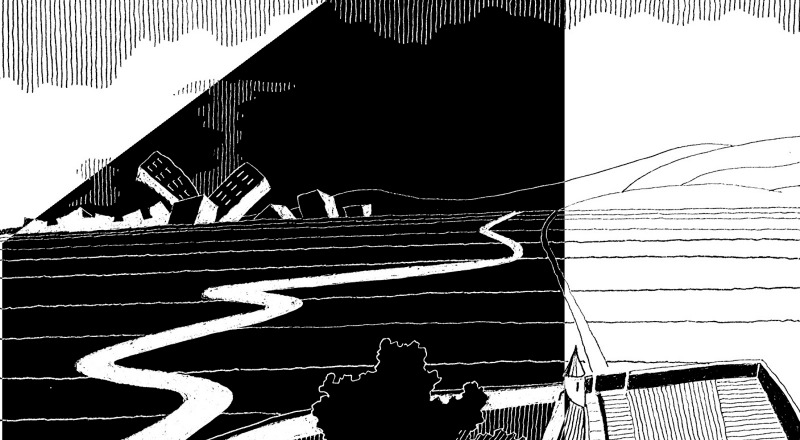
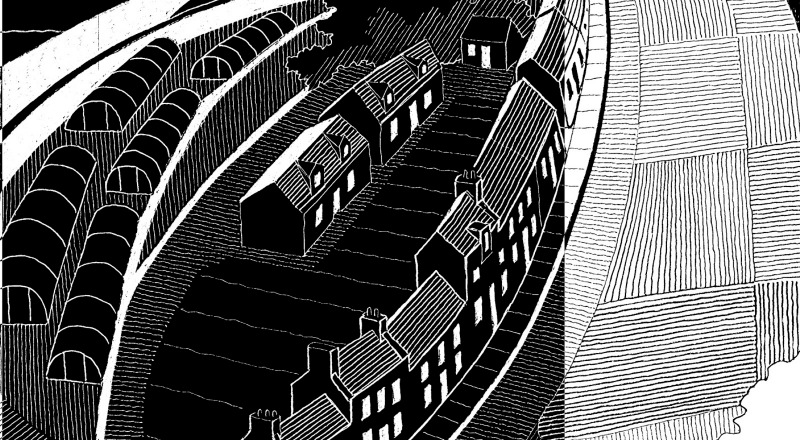
S T O R I E S O F P L A C E
130
S T O R I E S O F P L A C E
The Trees and Squirrels
Demographic
Are people’s responses to trees and wildlife a sign of their own deeper natures? What might a tree and squirrel hater do in a crisis? Here are some thoughts.
Some people just don’t like a tree, anywhere near their houses, or their neighbours’ houses.
The REAL reason is, they want to keep an eye out on who is coming and going. They don’t want to miss any of this ‘action’, whatever the cost to the surrounding foliage. But they come up with various excuses. Leaves falling onto the road or into other gardens. Too much shade.
Trees will attract squirrels, which will then try to
‘steal’ food set out for the birds, or break into bins. It’s amazing the middle-class hatred for the grey squirrel here in the UK – on the basis of it being an invasive species. The equally mischievous, but native, red squirrel is now the innocent victim of atrocities carried out by the greys. Then again, I’m not sure that the serious squirrel-haters really make too much of a distinction. As for me, I embrace all squirrels.
I visited one of our old stone tenement buildings here in Edinburgh not so long ago. They’re 131
substantial buildings, but most of them aren’t especially attractive. However, at the heart of this one there was a beautiful green lawn and a magnificent old tree. This being a ground floor apartment that I was visiting, I suggested to the owner that they open out the property to give access to this internal garden. No interest from the owner – and then, the awful statement –
wish we could get rid of the tree. Huh?
Presumably so as to be able to see into the windows of the neighbours?
Something dodgy there, if you ask me. Or perhaps it was the old squirrel issue again? Or they didn’t like the birds singing in the branches of the old tree? I didn’t ask.
And of course it’s these tree and squirrel haters who are the ones that dig out their front gardens and put in concrete parking for their cars. In their back yards there might be a bit of decking and some fake grass – astroturf. At the very most, a few fake miniature trees in pots and some fake ‘topiary balls’ hanging from angle-brackets around the deck. (Are you thinking
of
the
inevitable
jokes
here?)
Substantial garden furniture sits out all year round, like an outdoor lounge. But no-one ever sits out.
No birds bother to visit a yard like this. No worm or bug around, because to them the astroturf is an almost boundless arid desert.
The squirrels stay away and even any nearby trees, one suspects, would happily uproot themselves and move elsewhere, if only they could.
But hey, perhaps you’re thinking, some folk like trees and wildlife, some folks don’t. What’s the big deal? And besides, maybe I’ve painted things a bit too black and white. Maybe the ‘no 132
trees – no squirrels’ folk are just tidy-minded and they also love the idea of abundant nature thriving somewhere unspoilt, far away. Perhaps they watch nature documentaries! Perhaps they even visit rainforests! Meanwhile, maybe the
‘tree-and-squirrel’ types are just lazy, untidy folks who need to organise themselves a bit better, have a wash and get real!
My street has both types of folk – and all shades in between. (I’m at the lazy, dirty, untidy end of the spectrum, as you might have guessed.
Trees and squirrels, plus other ‘rodents’ and critters and all the birds twittering in the branches around the house.)
At the other end of the spectrum – well, we don’t ever see these guys out on foot. They just drive past my house in their large cars that are too wide for other vehicles to pass if anything is coming by in the opposite direction. So I sometimes wave to them as they are reversing.
To be fair, they wave back – friendly enough.
So far, only a few requests for me to cut down my trees.
In fact, when I first moved here, someone came around with a chainsaw and took out two trees.
One was my own. The other, a neighbour’s, which he had loved and cared for since I don’t know how long. I never found out who it was.
Well, anyway, what I wonder about my street is, what would happen if there were some really big disaster in the world – let’s say, the global economy collapses, the banks run out of money and the shops run out of food. Who would survive and who would perish? Who would stay and who would try heading off somewhere else?
I guess you’re thinking I’m going to say that it would be us tree-and-squirrel folk who would do best, eh? But I’m not so sure. Perhaps we are 133
just too soft-hearted. Perhaps such a disaster would call for folks who are more ruthless.
My guess though is that things would be less obvious than that. A crisis would surprise us, perhaps most of all about ourselves. Perhaps there is a tree-squirrel person who is actually ruthless and calculating.
Some years back there was a car crash in the street. We all came out of our front doors to see this vehicle crumpled into railings, with smoke billowing out of it. I have to say I just stood their, speechless and paralysed. Not frightened exactly, just shocked. Someone shouts out that they think the car’s going to catch on fire. I still stand there stupidly doing nothing. It’s a woman a few doors away who gets the driver of the car safely into her house and shuts the door in case of an explosion. Meanwhile, another neighbour starts to get organised. It’s him who calls the cops and the ambulance and then checks everyone, to see who might have witnessed what had happened. (Is he a tree-squirrel neighbour, you may be wondering?
Well, actually half-way along the spectrum.) If there were a crisis, it would be someone like that who would at least set us on the right path to surviving, if that’s at all possible. We’d band together, pool our resources, make plans. Crisis brings out our strengths and weaknesses. And like I said, these might be a surprise to us, not least to ourselves.
Well, what’s the takeaway from all this? I suppose it’s to say that the folk who might seem not to care in the way we do, might in fact be our saviours – if and when push came to shove.
And those who currently seem to care a lot –
and I have to include myself here – might actually prove to be useless and stupid, in the 134
event of a crisis. So, meantime, don’t judge folk too harshly, when they seem not to be caring about the things that you care about. Give them some space. One day, they may just prove you wrong.
135
S T O R I E S O F P L A C E
136
S T O R I E S O F P L A C E
Serious Bonfire People
A night of bonfires on common land leads to thoughts of how our world is changing – and what might be counted as ‘commons’ in the future.
In Invisible Cities, Italo Calvino says:
‘Cities, like dreams, are made of desires and fears, even if the thread of their discourse is secret, their rules are absurd, their perspectives deceitful and everything conceals something else.’
…
A young woman I knew slightly had invited me to a barbecue. Potentially, I’d know some of the other people who’d be there. It was late summer and the weather was mild, although it would be getting dark fairly early.
Well before time I arrive at the venue – a local park. This place is of interest to me as there is a suspicion that it is officially ‘common good land’, which means that, under Scots law, it should hold a special status within the city.
What strikes me first are the cherry trees that line the walkways criss-crossing the park.
They’re loaded with fruit, and clearly no-one seems to be interested in eating it. I cautiously try a cherry, thinking it might be bitter or 137
otherwise unpleasant. But no – soft and sweet!
I collect cherries for a while.
The host of the barbecue arrives and we get to talking a bit about common land in Scotland.
Then
the
subject
moves
on
to
rental
accommodation and private landlords. Others arrive. The food is good. Darkness falls. Most folk head off home, but a few of us stay, gathered around the dim light of the mobile barbecue.
A change comes over the place as soon as it’s dark. This is Friday night and people are now arriving from every direction. They carry logs and tree branches, plus bags of food and drink.
Serious bonfire people!
Before long, substantial fires have been lit in several locations across the park. The people are quiet – waiting for fires to burn down enough so that food can be placed for cooking amongst the hot embers.
I walk around, watching these new arrivals from a distance. I’m probably only accepted in that I have a ‘home base’ in the form of the barbecue.
Thus, I’m one of the participants, not just a bystander.
Has the city become a commons tonight?
When we think of commons, land is what usually comes to mind – and with that the idea of enclosure. There’s a temptation to think –
commons, good, enclosure, bad. But that’s a simplification. Sometimes, for sure, we would be better served if land were back in common hands – whatever that might mean in a modern society. But sometimes enclosure is actually beneficial.
The whole idea of a commons though takes on a wider remit today. There’s the barbecue host and all the injustices facing a tenant of a private 138
landlord. There are the people at the bonfires who no doubt spend the week working for companies that pay them a meagre wage and keep
profits
for
themselves
and
their
shareholders. How do you even begin to think of a commons in these terms – in terms of property, resources, labour, wages and finance?
There’s a tendency to tackle these questions at a very local level. And the appeal of this is obvious. Small groups of people can meet face-to-face. Decision-making is easier. With a bit of empowerment, neighbourhoods could do a lot by themselves. Looking around at the serious bonfire people, there seems to be a latent power here, just waiting to be tapped. It’s something in their attitude. If anyone could make a neighbourhood work, it would be these folk.
But – if we were to take up this idea of local governance – it has to be said that for every successful neighbourhood there would be failed ones, or ones that were just not interested either way.
So, the inevitable conclusion – people would need to change before we would be able to successfully take up that kind of small-scale local democracy.
But change HOW? That starts to get a very awkward question, as it inevitably sounds patronising.
Another point comes to mind though – if the CITY were a commons? The CITY! The city’s not just a collection of neighbourhoods, it’s something different. City-thinking is a different way of thinking. Could city-living be a different way to live?
Think global, act local – so the saying goes. But maybe we skim over the ‘think global’ a bit too quickly and focus in on the local. And maybe 139
it’s cities, especially, that are in touch with the global.
There’s a lot that’s truly global in today’s world.
We might therefore identify a further type of commons, beyond the land, property, capital, labour, finance sort – where we’re failing – and into the field of information and entertainment.
All this has seen a ‘disruption’ in recent years –
the old ways of exchanging information, sharing music, art and literature, have been turned upside-down. And a lot of this, so far, is a commons.
But look out! Enclosures are a-coming!
This time though, the would-be enclosers of the digital commons face a global audience.
Perhaps we need to think a lot more about the
‘communities of interest’ that span continents, rather than just focusing in on the local.
Perhaps this is where the true power lies. And perhaps that whole mindset – a global mindset
– is changing us. Someone has said – it’s the parody of our time that whilst we seek individuality, we must do it in the company of others. So we are not community in the old sense – some have called this individualistic togetherness ‘the multitude’.
So it’s the multitude rather than the community or the commons that should interest us. The multitude is a collection of individuals who think independently
and
maintain
only
those
communities of interest that I’ve alluded to, and not communities of place. Identity is the start of the multitude beginning to realise itself and its potential – and especially identity around gender, race, ethnicity and sex.
Put all that together and we could ask – is the change we’d need to make in order to have a fairer world actually taking place right in front of 140
us? Are we actually being changed by the
‘global commons’ of shared information and entertainment?
Two other things factor into this and give me some hope.
First of all, nature’s commons are global commons. I’m thinking about the atmosphere, the oceans, the biosphere. Concerns over climate change, pollution and loss of bio-diversity already have us thinking globally. And cities are a major part of the possible solutions.
And the second big change and sign of hope?
I’d describe it perhaps as ‘embracing diversity’.
Not ‘tolerating’, or even ‘accepting’, but positively embracing. Likewise, we seem better able to embrace ambiguities of all types – not insisting any more on one definition of truth.
Granted, there’s still a lot more to do, but my point is that this is very much a global phenomenon. News is part of the global commons and when we hear news of prejudice against people anywhere in the world now, we feel solidarity with them. Physical distance no longer matters.
So a city is much more than being a physical place – it’s about being plugged into all of these global changes that are happening around us.
Back at the bonfires, I’m thinking: what would I say to these people, if I sat down beside one of the fires and we got into conversation? Perhaps I’d say: fight any move to close off that new commons – the digital commons. Of course, like the land, there are times when ‘enclosures’ of some sort are beneficial. But suffice to say, the digital commons is where change is happening.
And that change is going to feed back to the local levels – it will transform place, work, possessions, interests, friendships and families, 141
as well as transform our attitudes. Most of all, it will transform the cities. We don’t know what the future will look like, but don’t let it be stolen from us. We have a new commons now, and it’s ours.
Would they be up for that, the bonfire people?
I don’t know, but I think this way lies hope.
142
143
S T O R I E S O F P L A C E
144
S T O R I E S O F P L A C E
Lucky
When the End arrives, it is sudden. One man survives against all the odds…
The one thing that no-one really mentioned much was oxygen – that was, until it was too late. But of course, it was just simple logic.
Plants make oxygen. Kill the plants – oxygen levels start to drop.
Or, as it happened, oxygen levels start to plummet.
Perhaps this was news that was just too bad to share. No way to put a positive spin on that one! But I sure wish someone had told us.
Things were bad enough, but once the oceans died off (aquatic plant life, by then, giving us some 70% of our oxygen) then it was only a matter of a few months before the apocalypse finally arrived.
I was lucky. Or should I say, I cheated death for a while. Needless to say, when the oxygen issue finally sunk in, the manufacturers of oxygen tanks and breathing equipment went into overdrive. Well, at least for a few months, before the end of everything.
I just so happened to be passing a warehouse storing this stuff when a building collapsed nearby. I ran inside and luckily the place stayed 145
up, but was buried under rubble.
Staggering around in the dark for a while, I eventually found a flashlight. After several hours of picking around, I had to acknowledge there was no way I would be able to dig my way out of there. Meanwhile, breathing was getting difficult. I found the tanks of oxygen and the masks and figured out how they worked. And I was lucky enough to find some food – quite a lot of food. Perhaps the place was stockpiling stuff in anticipation of what we all knew was going to happen. I don’t know. But anyway, like I said –
lucky. I sat down to wait to see if I’d be rescued.
Well, there wasn’t really much chance of a rescue. After 12 days or so, I decided help wasn’t coming. But still, I had hope. I set about exploring and gathering up all the stuff that was worth keeping so that it was close at hand. I found a few more flashlights, plus candles and matches, but sooner or later I’d be in pitch dark. It was only a question of which would run out first – the light or the oxygen.
And of course there comes a point when matches won’t strike and candles won’t burn –
they need oxygen too.
After a few more days, I’d done an inventory and made some calculations. About 100 days of oxygen. The food and the light would last longer. So I would probably die gasping for air rather than starving or driven mad by darkness.
Nice. Was it worth staying alive?
Well, I’m a resilient guy, I thought. I’ll try hanging on until the end.
A few days later there’s a faint buzzing noise from somewhere outside. But then, back to silence.
…
146
‘Check the scan again.’
This was the dome’s commander, issuing orders.
Dome 39, as it was called. One of a number of experiments thrown up in the last days in order to try to create a sealed atmosphere with enough plant life inside to provide oxygen for a few humans, plus some small animals, insects, birds and the rest. All species carefully chosen to create a balanced eco-system.
There had been precedents of course. Bio-domes on Earth for decades back. But they hadn’t worked out too well. Either everything started dying off, or it was necessary to ‘cheat’
and bring in some air and water from the outside. Or else, sealed inside, the human community would go slowly insane and start fighting amongst themselves.
The whole bio-dome thing had only really taken off once Mars colonies got going. And at last, it looked like, technically, it had been cracked.
The only problem remaining was the humans going mad bit.
Even so, you had to wonder if Mars was not actually better off now than Earth. No apocalypse for them. And at least the colonists had a few years experience of living in domes.
There was contact with them still, for what it was worth. But whether any space ships would make it between the two planets any time soon, was anyone’s guess.
‘Definitely a sign there.’ This is Clara, who’s running the scans. A search drone is sending back a message about a heat source from the industrial zone. Could it be something alive, after so many weeks?
‘Okay, send in a digger. We’ll try bringing them in’, says the commander.
Only a few survivors had been found, in the 147
aftermath of the End, as it was mostly referred to now. In a away, just as well. The three square kilometres of abundant forest, pools, gardens and greenhouses nestled beneath Dome 39 could only support about seven humans.
And there were five of them now, in total.
Piles of rubble, in a great circle around the dome, act as a partial defence. Clara now sends instructions to a robot digger that needs to clamber over this heap of debris before it can even begin its trek to the industrial zone and the source of the heat signal. It might take days, but there was no other option. No drones left, big enough to lift the digger and fly it to its destination. And of course, no helicopters, planes or anything else that would allow a human to go in person.
The digger has its instructions. It trundles off.
…
Day 101. The flashlights and candles didn’t last as long as I’d hoped. I’ve been in darkness now for ten days, and of course, the oxygen’s run out. I’ve taken to drinking, to try to ward off the struggle to breathe. I don’t know – it probably makes things worse. But I’m mostly so far gone it doesn’t matter anymore.
Then, an ear-piercing sound. It’s only a few feet away. Drilling!
It seems to go on for eternity. But then, at last, the noise stops. There’s blinding light and scratching,
whirring
sounds
to
follow.
Something has broken in, like an enormous dog, with headlamps for eyes and drill-bits for teeth.
Somehow it manages to clamp a mask over my face. I’m flooded with 100% oxygen. I pass out.
…
‘We got him, sir!’ Clara, with the news.
148
‘What we got, Clara?’
‘A man. Middle-aged. Looks like a drunken bum.’
‘He’s made it through hell somehow.’
‘Coming back in the digger’s trailer now sir.
Five days’ journey, all being well.’
…
Daylight. I’ve woken up in some kind of wheelbarrow, bumping along through piles of rubble – some of it smouldering. But at least there’s a sky!
Grey sky, just a dull, blank grey. You can’t even tell where the sun might be. And cold!
I think about trying to stand up and perhaps jump off the trailer. But obviously no place to go. I have the mask and there’s a huge pile of tanks in front of me, all hooked up somehow, so that, presumably, the gas keeps flowing. I can’t even see what’s pulling us along.
The journey goes on and on, but luckily there’s food and water in the trailer. I eat and drink between gasps. Each day the same blank sky.
Each day, on our road to somewhere, across heaps of rubble. Whatever pulls the trailer is picking its way carefully, finding places where it doesn’t need to climb too steeply, or descend too sharply. I try calling out to see if it’s a person up there somewhere, in a vehicle, pulling the trailer along. But no reply. Eventually I get a glimpse as we turn a corner. It’s the robot digger that’s pulling us. We plough on through the night.
All this time, in the trailer, I’m thinking, how come no-one is around? Okay, so the city’s a total ruin, but, no-one? Absolutely no-one?
Maybe they’d made it somewhere. Maybe. But it was suspicious nonetheless.
But now, we seem to be arriving somewhere.
149
One of those domes they built looms ahead of us. Look’s like that’s where we’re headed.
…
‘Bringing him in now, sir.’
‘Thank you, Clara.’
The commander walks over to the multiple complex of doors that seal Dome 39 from the outside world. He makes his way through them and stands in the last room that still holds air.
The doors on the other side have opened and slammed shut and then finally the intervening door opens and the digger and its cargo come through.
A man lies in the trailer, filthy, exhausted and dripping blood. But alive.
‘Welcome to Dome 39’, the commander says, and shakes the man’s hand. ‘You made it.’
…
Something about the guy that welcomes me.
Something I don’t like. I’m not sure if this dome is really a safe place. But I guess I’ll find out soon enough.
150
151

S T O R I E S O F P L A C E
152
S T O R I E S O F P L A C E
There Are Bubbles – and then
There Are Bubbles
A Brief History of the Solarpunk Revolution circa.
2300.
It was back in the 21st century that things started to get really bad – or, depending on how you look at it – started to get good! To be honest though, and like most changes, things had been brewing for quite a while before that.
What makes a revolution? It starts with some very mundane and boring stuff! Perhaps a way of looking at it is through ‘infrastructure’.
Infrastructure, for most of us, might be described as all the things we don’t see, or don’t think about, or take for granted (as long as they don't go wrong). The infrastructure issue gets difficult when it comes to technology. The thing about technology is that it seems so remote from the infrastructure that lies behind it.
Hence, once we have a new gadget or whatever, then us ordinary folk see the gadget and not all of the infrastructure that must be there to make it work. Very often – and perhaps this was the crucial thing for the revolution I’ll be talking about – very often that infrastructure starts off as a public utility but ends up a private 153
company. Governments of all stripes seemed to hanker after this marketisation of commodities –
and the bigger the infrastructure the more the temptation to hive it off onto some private company and hope it will stay profitable! THAT, you may say, was the first seed of change – and as I say, already lurking in the background, some time before the 21st century.
Something else that was proceeding at the same time was a fascination with a thing called ‘the singularity’. Not, especially, a ‘singular’ thing, as the name suggests, but rather the idea that eventually technology (and especially computer-learning and robotics) would one day be developing so fast that it would be beyond human ingenuity to understand it. We laugh at all this now of course, but, at the time, this was something of a scary proposition, at least for some. For others, it offered exciting prospects and opportunities. Two prospects seemed to suggest themselves especially. One prospect was based on the idea that consciousness is
‘substrate neutral’ – in other words, it could exist with any kind of underlying structure to support it. It could exist, for instance, in computers. So we might create consciousness by ever-more advanced computation – or, perhaps even more exciting – we could upload our minds to machines.
The other exciting prospect was that we could find a cure for any kind of disease – including the ‘disease’ of old age. So one prospect was technical, we might say, and the other was biological. Together these were the second seed of the revolution. The contrast between the technical and the biological aspirations was sometimes described as ‘cyberpunk’ versus
‘solarpunk’. Cyberpunk had always a dystopian 154
flavour to it – all those anxieties about computers taking over the world. Meanwhile solarpunk was forced to throw its efforts into understanding biology. And we all know, of course, that biology won out in the end –
solarpunk.
And Mars was the third seed of revolution – in particular, the terra-forming of Mars. That was the real game-changer. Because, of course, by that time we were also having to think about terra-forming the Earth.
Terra-forming proper would of course mean a viable biosphere – and we are not quite there yet for Mars. And we have not quite got back to that with Earth. Instead, big enclosed bubbles of nature – that had been the first idea – an idea again that has its roots well into the past.
At first the big bubble just tried to replicate the bio-diversity of nature. It was a struggle, but we got good at this. Just in time really, as actual nature was by that time getting severely stressed. And here is where our first seed – that issue of infrastructure – started to make its presence felt. Because, you see, big bubbles –
big domes – and the biota they contain, could really be considered as big infrastructure – the biggest, in fact, that humanity had been obliged to design in order to meet its needs.
As things grew worse in the outside world, the reliance on domes – the big infrastructure of the planet – grew evermore pronounced. And then the inevitable temptation of all governments –
marketise the domes! Besides which, there was something a bit too communal about having to share a
dome.
Something
a
bit
too
claustrophobic – especially as ‘going out’ (and eventually this just meant going to another dome) became more and more difficult and 155
expensive.
Meanwhile, our second seed of revolution was coming into play. Knowledge of biology was racing ahead. As more domes were built there was the inevitable temptation to try out different combinations of species to achieve a viable
‘micro-biosphere’, and to tweak the biology to get the maximum food production, oxygen production and beauty. The dome became a designer product, and as they were marketised and privatised there were increasingly smaller bubbles, until today we have just our own bubble ‘houses’.
So yes, there are bubbles, and then there are bubbles! The big communal domes of the 22nd century – such as the infamous Dome 39 - and the small private bubbles of today. Whether we could say necessity was the mother of invention, or that the market had invited innovation, it’s hard to say. But people seem happy with the result. All those concerns about people needing to wake up and to change before we could ‘save the planet’ turned out to be unfounded. But then again, I suppose we did change in the end, just not in the way that the campaigners of long ago seemed to think was needed.
Individual domes of course were not the end of it. First, with all the evermore-diverse types of micro-biosphere created for the ever-growing number of domes, the problem of ‘mixing’
became an issue. Would the biota of one dome, for instance, simply take over a less resilient bubble? Or would they happily co-exist? Or would they blend in some way? As knowledge and experience has grown, these problems have become less pressing. But of course there are still the occasional problems, when whole swathes of bubbles have to be cleared of all the 156
life they support, as things have gotten out of hand. The glazed tunnels and ‘public’ bubbles still face these worries today, as we all know.
But on a brighter note there are the changes to us. No-one is born of a mother now, of course.
We are ‘grown’. And grown with a whole lot of genetic modifications or sometimes clonings and all the rest of it. And (often overlooked) it is not just the human being that is grown. There are whole colonies of creatures that live in us and on us that need to be considered. We've got good at this – very good. Everyone can expect to wake up in the morning nowadays full of energy and health. We take it for granted, but should remember that history tells us it was not always so.
People long ago – and I’m sure this is a surprise to folk today – would be horrified at the thought of spending their whole lives inside a bubble –
even bubbles as luxurious and filled with such amazing trees and plants as our own. But then again, nowadays, we cannot help but shudder at the thought of what it must have been like to have ‘wild nature’ all around us, left to ‘evolve’
in its own unpredictable ways. We shudder too at the thought of humans out in the ‘rain’, ‘wind’
and ‘snow’ (these were terms used for what was collectively known as ‘weather’) and with only their clothes to offer them protection. Without bubbles and full control of biology, what are we?
But, as I’m sure we’ve all been aware for at least a couple of decades now – after 450 years of increasing CO2 and increasing temperatures –
Earth’s climate is stabilising. And I’m sure we’ve all noticed a few things starting to grow in that world outside our bubbles – a few creatures scuttling past. Current estimates indicate a timeframe of only 50 years before Earth will 157
have a breathable atmosphere of its own once more, and a bio-sphere comprised of the remnants of its original (grass, cockroaches, lichen, bacteria, rats) plus all the ‘escapees’
from millions of massively diverse private bubbles. Ironically, the timescale is the same as the terra-forming projects of Mars and Venus –
except on those planets the ‘outside world’ has been carefully planned. Will we, one day, the people of Mars, Venus and Earth, choose to step outside? Terra-forming was the dream of history, but now it seems a daunting prospect.
But perhaps it’s time – perhaps it’s time that our bubbles could be whole worlds.
158
You may also like...
-
![Dead Man Walking II [ER]](/2d_covers/large/1784736989.jpg)
Dead Man Walking II [ER] Short Stories by Robby RichardsonDead Man Walking II [ER]
Reads:
20Pages:
100Published:
Jul 2026An unapologetic collection of poems and a short story that cut deep into people who have shaped and scarred my life. Each piece is written with sharp honesty,...
Formats: PDF, Epub
-

Runaway Short Stories by Pete BertinoRunaway
Reads:
0Published:
Apr 2026A sixteen year old from South Philly on the run from the police finds refuge in a world of goblins, wizards and dragons.
Formats: PDF
-
The Invisible Man Series Short Stories by BILAL DADARThe Invisible Man Series
Reads:
31Pages:
62Published:
Dec 2025He is the whisper no one hears, the presence no one sees, and the reckoning no one escapes. InMan moves through the world unseen — not as a superhero, but as ...
Formats: PDF, Epub, Kindle, TXT
-
Writings Near the End of the Human Era: Stories and Book Reviews Short Stories by Peter McMillanWritings Near the End of the Human Era: Stories and Book Reviews
Reads:
11Pages:
157Published:
Nov 2025There are two collections in this book: one of 15 short stories and one of 11 book reviews. Fiction and nonfiction don't usually get combined this way, but, i...
Formats: PDF, Epub, Kindle, TXT