

The Zone Calls (Steamer #2) by Edward Drobinski - HTML preview
Download the book in PDF, ePub, Kindle for a complete version.
Chapter 2 – Best Left Alone
Steamer left his house, shutting the door behind him.

The house was the first one built in the area. It once fit its area quite well, but doesn’t anymore; and that’s quite fine, in fact preferable. The early colonial had quiet authority. Everything about it suggests practical endurance rather than charm seeking accolade.
The tall, steeply pitched roof was built for real weather rather than aesthetics. The shingles were hand laid, slightly irregular in a most attractive way.
The two story form is straight forward; a central door, flanked by evenly spaced windows, with another row above. It's the kind of symmetry that comes from classicism and necessity, not “expert” taught modern design school.
The walls are wooden and weathered, the boards grayed by time rather than paint, allowing one to feel the grain.
The windows are small, square, and plain, suggesting the pre-1830 build, when glass was expensive and insulation mattered more than views. Their repetition gives the house a steady, unblinking expression, like a face that has watched decades pass without reacting.
A large tree in the foreground partially obscures the right side, its trunk thick, reinforcing the sense of age. The tree isn't ornamental; it's simply part of the land the house grew into.
It feels rural, self-contained, and slightly withdrawn, the kind of place that has accumulated stories simply by remaining in place while everything around it changed.
Steamer walked out to immediately be greeted by the niceties of his suburban/non-suburban area inhabited by custom houses, built with different facades at different times, the most recent most easily detected by their use of unnatural materials, cheaper, and designed to necessitate early, costly replacement.
Steamer steps into the neighborhood that believes it has no zones at all. The contrast hits him immediately; not as shock, but as a quiet, structural recognition. Zones rearrange reality; this place rearranges materials.
He moves along the sidewalk, and the houses reveal themselves in chronological layers, like tree rings made of ambition and compromise with the ugly, disgusting, maggoty termites. The early custom builds are the ones from the 70s and early 80s; still holding on, still honest in their materials. They have deep eaves that actually serve a purpose, windows framed in real wood, slightly swollen from decades of rain, and rooflines that follow the land rather than defy it.
The middle-era expansions are the houses from the 90s and early 2000s; bigger, louder, more uncertain of themselves. They have stone veneers glued onto plywood, pretending to be load-bearing, turrets that serve no function except to signal "custom," metal garage doors with fake carriage cross supports, and landscaping that tries to hide the fact that the house was designed from the driveway inward.
The recent builds have siding made of composite polymers that imitate wood grain with the same sincerity as a theme park, trim boards that are perfectly straight because they're extruded, not cut, roof shingles that look like asphalt trying to cosplay as slate, and windows that are technically energy efficient but feel like screens between worlds rather than openings. These houses are built to be temporary, but priced as though they were eternal.
He passes bark mulch that still smells like the Home Depot parking lot, lawns cut to a uniformity that suggests HOA bylaws rather than human preference, mailboxes that lean slightly, each in its own direction, like tired sentries, and driveways patched in different eras, each layer a record of a winter that cracked something.
Then there is the faint hum of heat pumps, the identical LED porch lights, the trash bins lined up like a municipal parade, and he sense that everything here is both “new” and already rapidly aging.
This place distorts reality through cost engineering.
And as he walks, he feels the quiet, almost comic dissonance of stepping from a place where physics bends into a place where vinyl bends.
Steamer doesn’t notice any of that. He offers no thought or opinion as he was spaced out and currently doesn’t give two wet farts about it or what others may think; his mind trapped in some sort of internal monologue, usually called an internal dialogue; of interest, more or less, only to him.
Steamer thought about magic; or more precisely, that it was vanishing. When you try to describe the magical events of the past, you invariably do not. You render it flat and ordinary; like an emotionless AI; an injustice of sorts; at least insofar as your inadequate description is read; which is likely not much. However, every coin has two sides. Despite you not being over-read, that same detritus absolves you from the overdone scrutiny given all the big influencers. Further, understanding that it doesn’t matter; on a personal only level, the only remaining question, which is sophistry, which needs no answer is; “Is this attribute attributable to nature; or is this an acquired taste?”
An unexpected answer came. Search and ye will find, indeed. When someone tries to describe a "magical" past event, the description inevitably collapses it. It becomes flat, ordinary, procedural. The act of describing is itself a kind of anti-magic. This flattening resembles the way an AI speaks when it's not paying attention to proportion or tone; technically correct, experientially dead. Hear the precise words; the description collapses; the event itself is untouchable. Happy days.
Somewhat tangentially, if an inconsequent audience doesn't matter in any consequential way, that is consistent with the belief that a tree falling which no one hears makes no sound.
And what is this flattening? Is it: nature; an inherent limitation of language and memory; or acquired; a habit formed by living in a world that rewards summary over texture.
Memory is compressive. Language is compressive. The past is always richer than the words that try to retrieve it. This is structural. People learn to narrate their lives in ways that fit the expectations of their culture, their peers, their own self-image. They learn to sand down the strangeness. They learn to speak in the idiom of the present, not the texture of the past. So the flattening is partly built in, partly trained.
Describing the past removes qualities that made that moment feel alive. The description becomes ordinary because language cannot reproduce the original sensory and emotional density. The smallness of the audience removes the responsibility to avoid misrepresentation. The tendency to flatten is partly natural; a limit of memory and language and partly learned; a habit shaped by culture and personal preference. The result is an inevitable mismatch between lived experience and narrated experience.
Having said that, it is also recognized that most people don't know how to preserve strangeness without turning it into performance. They either sentimentalize it or sterilize it.
Steamer’s mind attenuated to things less abstract. Some quality types of furniture don't exist anymore; but they should. In 1923, the height of the Art Deco era, Robert Frost wrote “Nothing Gold Can Stay,” which essentially implies that all extraordinary things will come to an end. Though it may seem like a pessimistic take on beauty, the American poet had a point. With each passing decade, we've seen some of our favorite pieces of furniture; fainting couches, marble bathtubs, and telephone chairs, to name a few, disappear in favor of more convenient and cheaper replacements that have adapted to a more modern world which worships “big coupled with cheap.”
Consider this a plea to bring such nostalgic pieces back. They may not serve our contemporary way of life as well as their newer counterparts, but they last forever and certainly are beautiful. And what’s so bad about having one’s environment beautiful? Plus, they recall a simpler time, and what's better than that?
In his head, Steamer rounded up his favorite furniture pieces of the past to indulge in what lauded though inferior philosophers and poets have dubbed "Golden Age syndrome." As its name implies, “Golden Age syndrome” is a notion that a different moment in time; typically earlier, is better than the present. The moniker carries a negative connotation as far as wholesale longing for ages past, but Steamer thought that a little yearning for certain relics is healthy. From ornate 18th century secretary desks to Murano glass ashtrays, there's plenty of near extinct furniture and decor that he'd love to see make a return.
The Secretary Desk - Plenty of people skip going into the office to work from a home office, but their setup doesn't typically involve an authentic secretary desk because, aside from the fact that they aren't very practical for anyone with a monitor, they aren't really made anymore. These desks were most popular throughout the mid-18th and 19th centuries. Unlike more contemporary desks, secretaries boast compartments and drawers, and, most prominently, a hinged door that unfolds to provide a small work space.

Flavio Poli for Seguso - The Formal Ashtray - Ashtrays certainly still exist, but people don't use them as much as they did in the early 1960s, when this Flavio Poli designed one was made. It wasn't until the middle of the decade when scientists discovered how detrimental cigarettes supposedly were to our health. Before that realization, though, nearly 70% of adult men in the US smoked cigarettes, so you can bet that there were more than a few ashtrays in people's homes.

The Traditional Armoire - Like ashtrays, more than a few people still have wardrobes to house a few pieces of clothing, but back in the nineteenth century, an armoire was pretty much the entire closet, not just extra storage. Armoires had a section for hanging pieces, drawers for undergarments, and cubbies for shoes. In the days before clothing stores with universal sizing, people's wardrobes were custom made, so they often didn't have clothing collections as big as ours in the twenty-first century. With that in mind, it's easy to believe that an entire wardrobe would fit in one or two of these ornate armoires.

The Telephone Chair - Telephone chairs are charming pieces of furniture that have no use in today's world, unless you get creative. Though they were designed in myriad styles, every telephone chair featured the same shape; a chair attached to a small table, where the telephone would live. Even with long wires, people weren't able to take the receiver into another room, so they were often confined to a small area. Telephone chairs found themselves in many American homes between the 1930s and 1950s. People would take a seat on the chair and stay there for the duration of the call.

The Rotary Telephone - Steamer couldn't include a telephone chair and leave out the telephone itself. Enter this punchy turquoise rotary dial phone from the 1950s. These kinds of devices were popular until cellphones unofficially took over in the 2010s. In 2022, few people still have and use a landline.

The Fainting Couch - Fainting couches are much like daybeds and chaise longues with one key difference; the purpose. Fainting couches are low profile beds with a curved wooden frame that is raised on one end. They were popular during the Victorian era when women would often pass out from painfully tight corsets. They would either collapse or feel as if they're about to collapse and make their way to the fainting couch to recover. Luckily, women's beauty standards have drifted in such a way that eliminated the need for a fainting couch.

The Vanity - Vanities still exist, but they're not nearly as popular now as they were during the early twentieth century. These days, women tend to get ready for the day or a night out in their bathrooms or dressing rooms. This Louis XVI style vanity and matching chair were made between 1900 and 1920, and bear the original soft gray paint.

The Stone Bathtub - A marble bathtub may seem like an extravagance today, but before heated water was so easily accessible, such a basin was necessary. Marble, more so than any other natural stone, retains heat, making it ideal for baths. Even then, they were luxuries that only the rich enjoyed. One of the most famous marble bathtubs in the US is on the upper level of the Vanderbilt's Newport mansion, known as The Breakers.

Early American Furniture, etc.

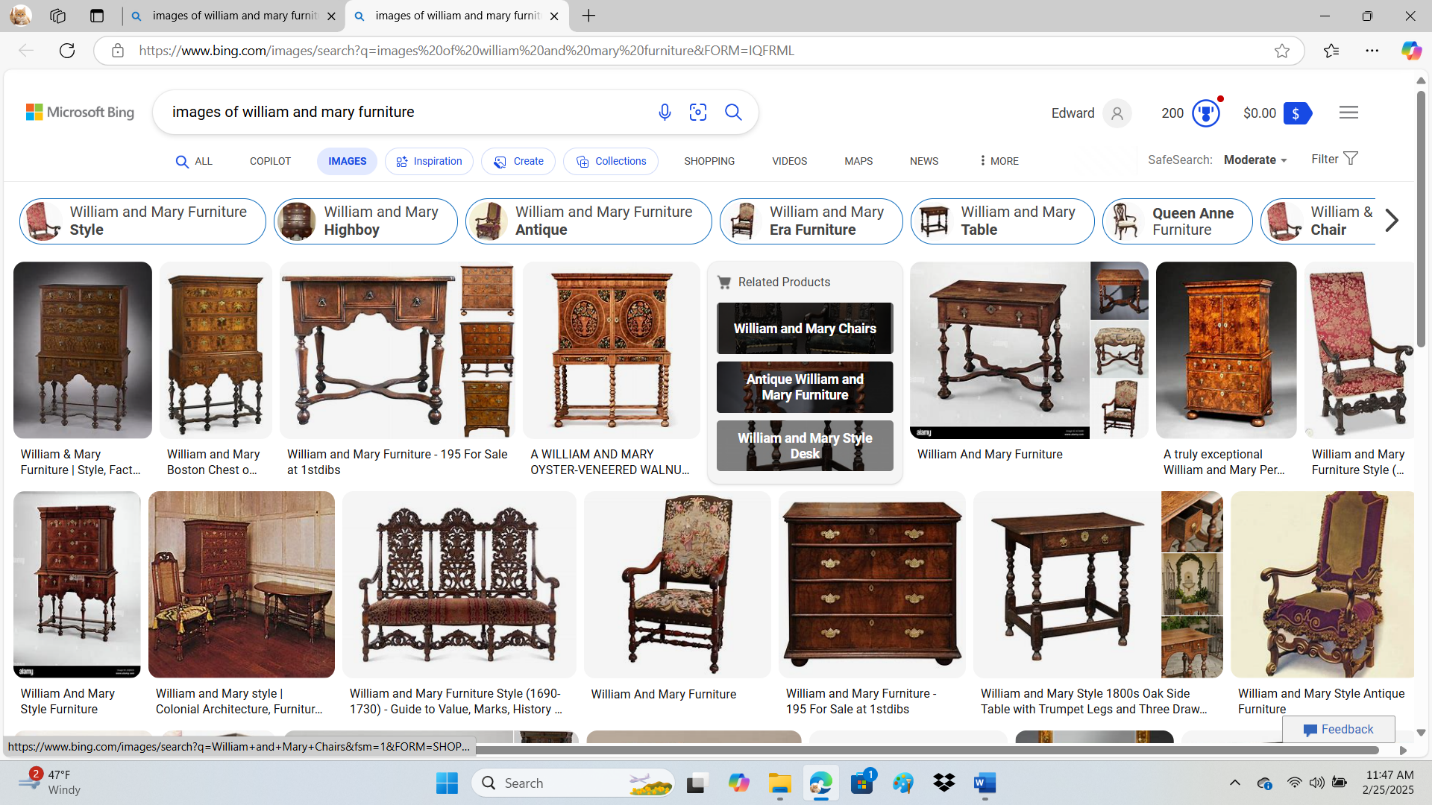
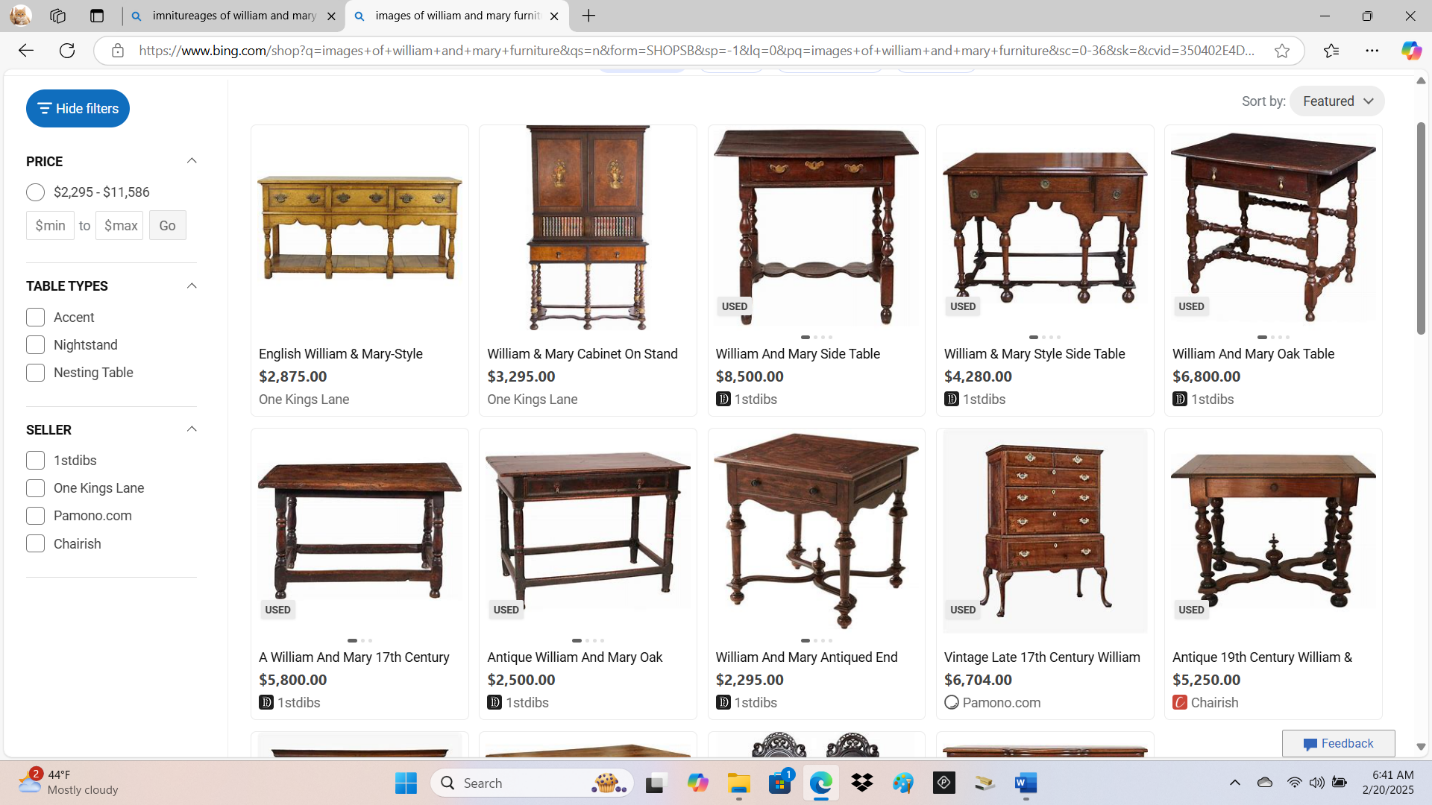
Steamer’s intent is to mentally chronicle the marvelous period wherein American furniture was made to be both functional and beautiful. The time covered is roughly from 1620 Jamestown to 1830 or 1840, depending on how much degradation one can tolerate before saying “enough,” when condescensions were increasingly made to accommodate machine made items, which became rampant, advancing like an aggressive cancer of the armpit.
Early American furniture actually covered seven distinct periods as follows:
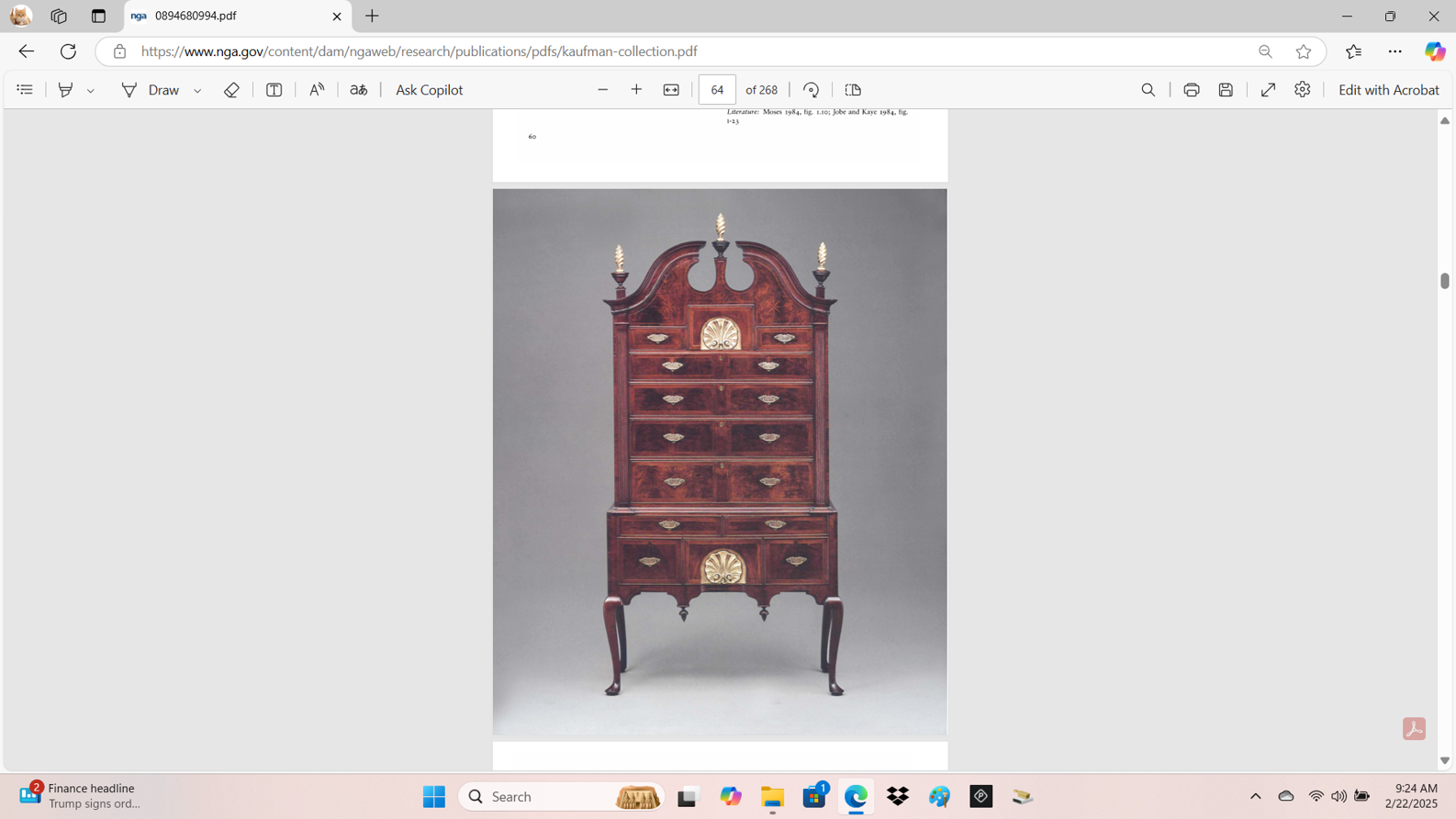
The images floated through his mind, unencumbered by debilitating words. More visuals can be seen in Wallace Nutting’s wonderfully comprehensive “Furniture Treasury.”
Highboys





Presses


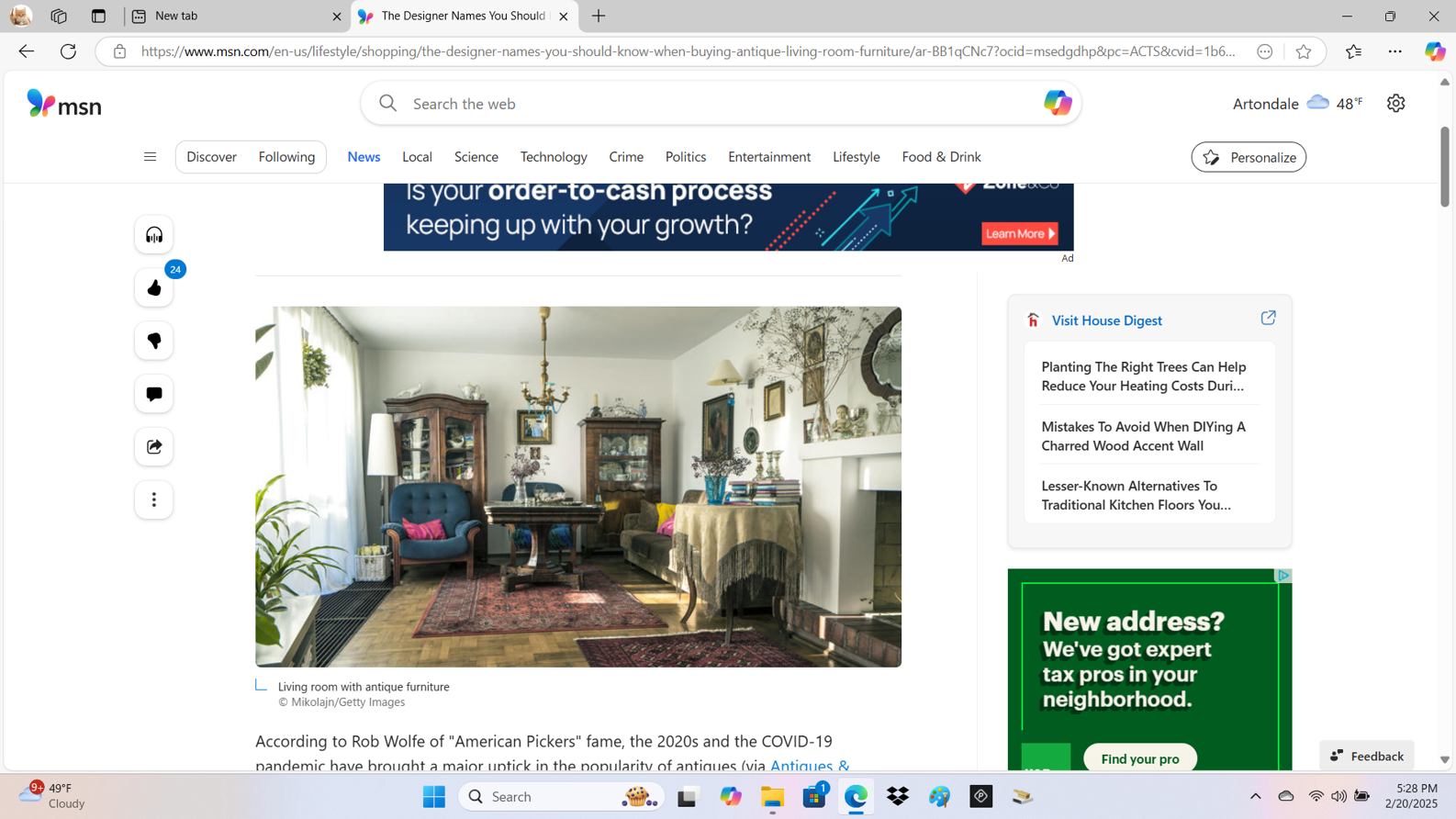
Room Settings


Houses





$
$$
$$$
$$$$
Gone. Lost. Never to return.