

TEMPORAL AGENT by Michel Poulin - HTML preview
Download the book in PDF, ePub, Kindle for a complete version.
CHAPTER 8 – VILLE-MARIE
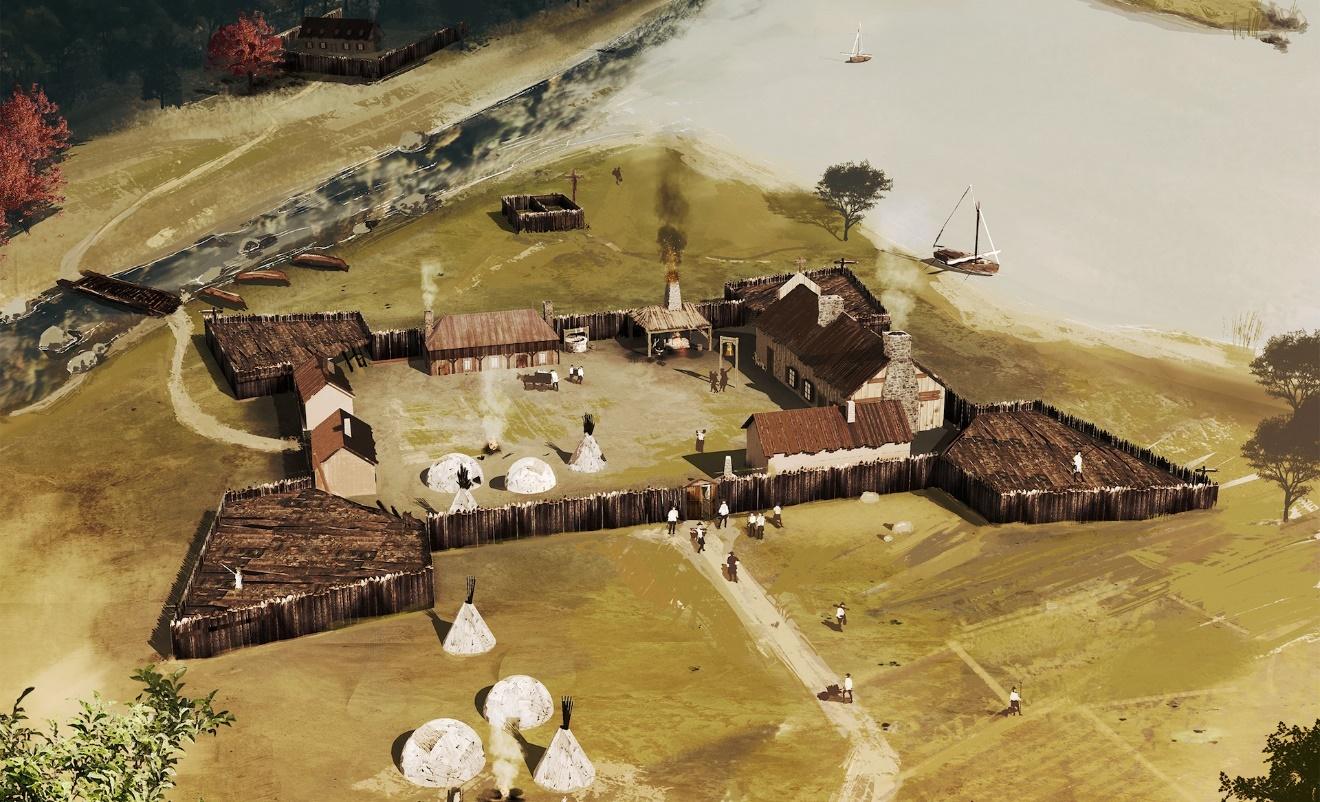
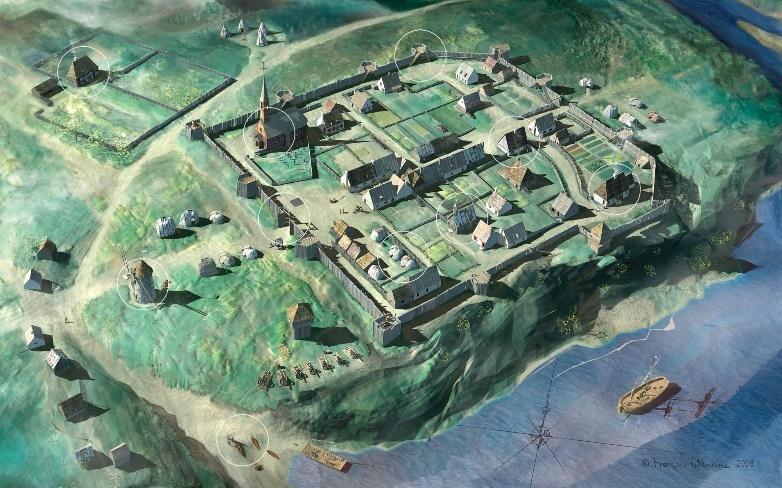
The initial fort of Ville-Marie, at the Pointe-à-Callière, on the Saint-Laurent River, in 1654.
08:52 (Paris Time)
Tuesday, June 16, 1654
Harbor of La Rochelle
Atlantic coast of France
The clerk sitting at a small table set on the quay in front of the three-mast cargo ship ‘L’ARC-EN-CIEL’ watched with curiosity a large chariot approach him. Driven by a mature man, the chariot carried as well three men and three women, along with a goodly number of wooden chests, canvas bags and a few wooden kegs and barrels. The driver stopped his chariot in front of the ramp giving access to the ship, with the men and women jumping down except for two of them, who stayed aboard to start passing down the luggage and barrels in the chariot. The clerk was soon joined by the captain of the ship, who eyed critically the newcomers before going to their apparent leader, a tall man in his thirties. The latter saw him approach and turned around to tip his hat to the captain.
“Good morning, Captain. I hope that we are neither too early nor too late.”
232
“You are just fine as timing goes, Monsieur Bonnet. As you can see, your whaler boat was winched aboard and stored on deck yesterday, as you requested.” The said Bonnet glanced briefly at the nine meter boat lashed to the weather deck of the cargo ship and nodded with satisfaction.
“Excellent! With all the luggage my group is bringing, that boat will be mighty useful to get us from Quebec to Ville-Marie. Talking of luggage, could I abuse the muscles of your sailors in order to store all this between decks? You can tell them that I will be distributing a few deniers in compensation.”
The captain laughed briefly then and grinned to Bonnet.
“You just said the right words to wake up those lazy bastards, Monsieur Bonnet.” A few shouted words from the captain then made eight sailors run down the access ramp and start hauling aboard the group’s possession. The captain patted one of the wooden barrels as it was being rolled past him and up the ramp.
“I see that you brought your own travel provisions with you, monsieur.” Bonnet shrugged then while smiling to him.
“Why travel across the ocean while living solely on sea biscuits and salted fish? Let’s say that I like setting a good table.”
“You will probably make the other seven passengers I have jealous, monsieur: all peasants, including five young women and girls, and as poor as they come.” Bonnet’s smile faded somewhat at those words, his jovial air replaced by a look of concern.
“If they are in need, we will be more than happy to help them out. Are those seven others aboard yet?”
“No! I am expecting them between now and noon. You should have plenty of time to store away all your things before they show up. You talk like a good Christian, monsieur.”
“Hey,” said Bonnet, a smile returning to his face, “one can be a merchant and businessman and still be a good Christian, even if that’s rare.” The captain roared in laughter with Bonnet, then walked back on his ship to supervise the storing away of the cargo.
As soon as the chariot was completely unloaded, Bonnet dismissed the chariot’s driver, giving him a gold coin, then went with his five companions to see the clerk still
233
sitting at his table. The latter grabbed his pen and opened his ink bottle and bowed politely his head at Bonnet.
“Good morning, monsieur. May I have your name, occupation and destination?”
“Certainly, my good man! I am Fernand Bonnet, merchant and businessman on my way to New France to open an inn in Ville-Marie. I am from Tours.”
Bonnet then passed his right arm around the waist of one of the women, a pretty brunette in her mid-twenties. Fernand Brunet aka Fernand
Bonnet
“This is my wife, Claudette Bussière, who will help me run my inn.”
The clerk noted down their two names and occupations, then looked up at another couple which had approached his table. The man was tall and athletic and looked like he could be a tough customer indeed, while the young blonde beauty besides him could have made Claudette Besson aka Claudette Bussière most men mad with desire.
“And you are?”
“Henri Bruage and Françoise Vinier. I am an associate of Fernand Bonnet, apart from being a handyman. Françoise will work at our future inn as a maid. We are from Strasbourg, in Alsace.” Heinrik Braun aka
Henri Bruage
The Alsatian couple was followed by the younger man of the group, who was however as fit-looking as the two other men. His clothes showed that he was not as wealthy as the two others.
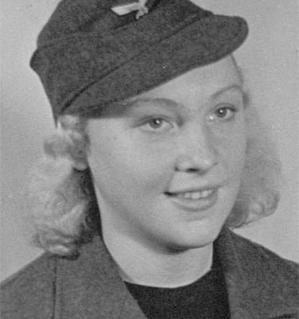
“My name is Michel Lorrain. I am a hunter and am working for Monsieur Bonnet. I will provide venison and furs to his inn. I am from Haguenau, in Alsace.” Frida Winterer aka Françoise

vinier
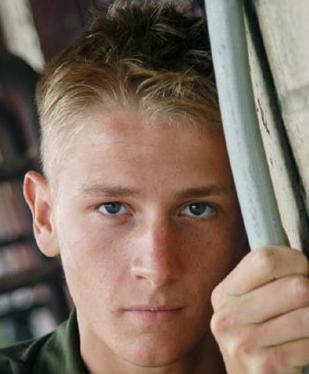
The clerk nodded his head at that while scribbling down that information. To have a professional hunter at your service while maintaining an inn in such a wild country as New France made a lot of sense. On the other hand, if all the stories about the ferocious local inhabitants were true, that young man was going to have one dangerous job indeed. The last person of the group turned out to be by far the most interest. Michel Hofmann aka Michel Lorrain Nearly as tall as Henri Bruage and apparently as athletic as him,



234
the young woman was beautiful and sported long black hair. She was dressed in a simple enough dress, linen cap and soft leather shoes but those clothes were brand new. Even more, a large hunting knife and a pistol were holstered from her belt, which also supported a large leather purse, a water bottle and a gunpowder flask Nancy Laplante ‘B’ aka Nancy Sommers-Laplante Her tone of voice was friendly enough but the clerk
understood that this girl would not stand for any nonsense.
“I am Nancy Sommers-Laplante, born in New France. I am employed by Monsieur Bonnet as a guide and translator.”
“You were born in New France, mademoiselle?” said the clerk, frankly surprised. This had to be the first native from across the ocean he had ever met. On second look, the girl did have a deep tan and had the look of an outdoors person.
“My grandmother was an Amerindian.” replied laconically the girl. The clerk let it at that and scribbled her name in his registry. As the three men and three women were grabbing their personal bags and bedrolls to board the ship, two teenage girls dressed in near rags and carrying each a small bundle showed up at the registry table. One was around eighteen, the other maybe fourteen. The older one then spoke anxiously to the clerk.
“Is this the ship for Quebec, monsieur?”
“It is! Do you have a place reserved aboard?”
“Yes! Me and Marie signed a contract with the Notre-Dame Society to go to New France and find husbands there.”
“And your name is?” said patiently the clerk, accustomed to deal with poor peasants who had never traveled far before.
“Catherine…Catherine Lorion, from Saint-Soulle.
The clerk wrote that down, then looked at the younger girl, a pitiful-looking and thin one.
“And you, my child?”
“Marie Renaud, monsieur. I am from Saint-Paul d’Orléans.”
“Very well! You are both in fact on the list of expected passengers and your passage and rations for your trip have already been paid by the Notre-Dame Society. In return, I have to remind you that your are both expected to find a husband in Ville-Marie within a reasonable delay.”
“And once in New France, where do we stay? Who will feed us?” asked in a tiny, timid voice Marie Renaud. The clerk shrugged his shoulders in answer.
235
“That I don’t know, mademoiselle. I believe that there are some nuns in Quebec. If you run into trouble, you can always go see them, I guess.”
“That won’t be necessary.” suddenly declared the tall Nancy Sommers-Laplante, who had listened to the exchange and had approached the table discreetly. She then draped her arms around the shoulders of both poor girls. “I will make sure that they arrive safely in Ville-Marie.”
“Uh, you should ask your employer first about that, mademoiselle.” said the clerk, not accustomed to see a girl take decisions like this. As if he had heard him, Fernand Bonnet came as well to the table and, after whispering with Laplante, faced the clerk.
“Nancy was correct, monsieur. My group will protect and provide for those two girls until we arrive in Ville-Marie.”
“As you wish, monsieur.” could only reply the clerk. Bonnet and Laplante then escorted Marie Renaud and Catherine Lorion up the access ramp, presenting them next to the four other members of their group. Still unable to believe her luck, Catherine Lorion eyed the six strangers, all taller and stronger than the average person in France.
“Why such generosity towards us? You don’t know us and we have nothing.”
“Wrong on one count, Catherine.” said Fernand Bonnet while smiling to her. “You now have a job at my future inn as a maid if you accept it. I offer food, lodging, basic clothing and three sols a day. The same goes for you, Marie.” The younger girl couldn’t help shed tears then, so unexpected this was.
“Why do you help us like this, monsieur? We are strangers to you.”
“But you are also good Christian girls in need, which is enough for me.” Claudette Bussière, who was looking out towards the quay, then smiled and spoke to her husband.
“How many maids are you ready to take in, Fernand? I see two more prospects approaching the ship.”
All heads snapped in that direction and targeted two young women in poor, tattered clothes heading towards the table of the registrar clerk. Next thing Catherine knew, Fernand Bonnet was walking down the access ramp, returning a few minutes later with the two newcomer girls.
“Say hello to Mesdemoiselles Marie Lorgueil and Jeanne Rousselier, guys!” A new round of introduction was then made, after which the four destitute girls were led by Claudette Bussière to a quiet corner of the ship’s deck, where she spoke to them in a low voice.
236
“Look, girls. Some of you may be wondering about this being too good to be true, so I will tell you what we are about. Me, my husband and our four associates are heading to Ville-Marie to open an inn there. I understand that there are none there at the moment so competition will not hurt our business. On the other hand, a good inn needs a fair number of hands to run it properly. Michel and Nancy will be busy most of the time hunting, fishing and trapping to provide fresh food and furs to our inn, while Henri Bruage will take care of the building’s maintenance and of constructing more annexes as we go, so that left only me, Fernand and Françoise free to work inside the inn. Believe me, your help will be more than appreciated. Now, you may have heard some awful stories about traveling conditions on ships, which are mostly true. However, we have brought some provisions of our own to supplement the ship’s reserves, so at least the food won’t be that bad. Our biggest problem will probably be personal hygiene, due to the lack of facilities on the ship and strictly rationed drinking water. Me and my husband are however experienced travelers and have some tips which should help you stay healthy. If you all follow our counsels, then your trip should be bearable.”
“Mon Dieu, madame, you make it sound as if such trips are like traveling to Hell.” exclaimed Jeanne Rousselier. Claudette eyed her somberly.
“They could be, for the travelers who don’t know what they do. Now, let’s see what kind of quarters we will live into on this ship.
Followed by the four girls and enlisting the guidance of a senior sailor, Claudette then went down one deck to a dark, stinking space where a number of rickety wooden bunk beds were lined up. The head clearance was also strictly limited, adding to the claustrophobic nature of the passengers’ quarters. Claudette, using a lantern to help her see around, folded away one of the straw mattresses of the bunk beds and swore when she saw a number of crawling insects that had been lying under and on the mattress.
“Damn! Lice! This is a nice start indeed.”
She then turned to face the senior sailor, showing him the critters.
“Hasn’t this ship been washed and scrubbed after its last trip?”
“Of course it was!” lied the sailor. “We however can’t guarantee that vermin will not come back while at quay.”
“Great!” said Claudette, who then sighed. “Alright, girls, we will have to initiate a complete scrub down of our quarters. First, though, we get rid of those infested mattresses.”
237
“What do you mean, madame?” said the sailor, suddenly alarmed. “You are not going to thrown away all those mattresses? They belong to the ship’s owner.” Claudette gave him a no-nonsense look.
“Maybe we should bring them to the house of your ship owner, monsieur. Don’t worry, though: we will simply pile them somewhere away from our quarters. First, I will have to go buy some cleaning stuff in town before departure.”
True to her word, Claudette went off the ship at once with Françoise Vinier and Henri Bruage, returning one hour later with two kegs of vinegar, extra buckets, mops and brushes. By then, another teenage girl and two young peasant men had joined the other passengers of the ship. While Jeanne Merrin, Jacques Morin and Jean Simon proved to be as poor as the four single girls that had first arrived after Bonnet’s group, they were seemingly good people and connected well with the others. All of them, including Fernand Bonnet, then worked hard to clean the passengers quarters and make them as livable as possible, which was still not much. They ate collectively lunch out of a pot of pork and vegetable stew Claudette went to buy at a nearby inn, washed down with cider, then resumed their cleaning work until the ship undid its mooring lines and started moving from the quay. All the passengers then lined up on the weather deck to have one last look at France. Seeing young Marie Renaud quietly crying as the ship left port, Nancy went to her and gently wrapped her arms around her, resting her chin on the girl’s head.
“Don’t cry, Marie. You may be leaving France for good but you are about to find a new, fascinating country.”
“But I know nothing about that country and I’m scared.” wailed Marie before turning around to face Nancy and clinging to her, tears on her young face. “I also don’t know what kind of man I will meet there, if he will be kind or mean with me.”
“Marie,” said Nancy softly, “if it can reassure you, know that I was born in New France and that I know it well. I can tell you about it.”
“You…you were born there?” said in a strangled voice Marie, looking up with surprise at her. Nancy nodded once while smiling.
“Yes, I was. My father was a trapper and his own mother was an Amerindian.”
“An Amerindian?”
“The correct name for the original local inhabitants. ”
238
“Please, tell me more.” pleaded Marie, her tears drying somewhat. Nancy patted her back.
“I will, later. I might as well tell my stories to all our group, so that all could learn about New France. Now, let’s keep watching France one last time together.”
07:22 (Paris Time)
Thursday, July 16, 1654
L’ARC-EN-CIEL, middle of the Atlantic
Françoise Vinier, a.k.a. Frida Winterer, stepped out of her bunk in the dark, unable to sleep more. The way the ship was rolling and the pounding noise of the waves told her that the sea was rough today, again. With the rare skylights closed tight to prevent seawater from pouring in, the stench of the crowded compartment was too much for her. She could barely stand herself by now as well, being mostly unwashed for a month and wearing day and night the same dirty clothes. She had tried at first to wash at least her underwear with seawater but had then quickly developed painful rashes from the salt left in them, which had started to rub against her groin and inner legs, so that solution towards staying clean had gone out the window quite fast. Swearing to herself, Frida grabbed her cape and found her way in the dark to the steep ladder leading up to the open deck. The fresh sea wind that greeted her was like perfume for her compared to the stale air in the passengers quarters. She found Fernand Bonnet, a.k.a. Fernand Brunet, her ‘husband’ Henri Bruage, a.k.a. Henrik Braun, Nancy Laplante, Catherine Lorion, Jeanne Rousselier and Marie Renaud already on deck, watching the rising Sun and the sea. Joining them at the ship’s side, Frida watched for a moment the sea with them, finally looking at Fernand.
“Is Claudette up yet?”
“Yes, she is. She just went to the ship’s galley to get our rations of sea biscuits and water for our breakfast.”
Frida wrinkled her nose at that: the so-called fresh water had been on the brown side lately. Soon they would be down mostly to cider, beer and the occasional cup of wine. Claudette Bussière, a.k.a. Claudette Besson, then came back on the weather deck, a pile of large biscuits and a jug of water with a cup overturned on top of it in her hands. Her companions took one biscuit each and were about to bite in them when young Marie looked wide-eyed in horror at her biscuit and threw it on the deck.
239
“It…it’s full of maggots!”
Frida froze immediately, her mouth open and a biscuit in front of her face. Examining her own biscuit, she saw with a jump of her stomach a few small white maggots moving on it. Nancy Laplante ‘B’, all of eighteen years old now, then attempted a sick joke, beaming and exclaiming with false joy.
“Goodie! Proteins!”
She then bit heartily in her biscuit, making Jeanne Rousselier and Marie Renaud turn green. Frida gave a dubious look to Nancy as Jeanne ran to the ship’s side to throw up. Frida knew that Nancy’s spirit had once been that of a British boy named James Sommers, who had served at the end of this century as a ship’s boy on a Royal Navy frigate and thus had extensive experience of life at sea, but her joke was still hard to swallow.
“Nancy, stuff it!”
“Well, that’s what I am doing!” protested Nancy, her mouth full. Fernand smiled to her while presenting her the pitcher of water and the cup.
“Well, if you like sea rations so much, how about being the first to drink today’s water, Nancy?”
“Sure!” replied the tall teenager. She then pulled out a handkerchief and placed it over the top of the cup, holding it there as a filtering membrane while pouring herself a cup of water from the pitcher. Frida looked with disgust at the maggots now twisting and moving on top of the handkerchief and turned green. The water in the cup was also brownish in color.
“We…we are not going to drink this, are we?”
Nancy, now most serious, looked at her companions with resignation.
“This is the only water available for the rest of our trip, my friends. I know that this is disgusting but we can’t drink only beer and cider for another month, or we will dehydrate.”
Then giving the example, Nancy pinched her nose and drank her cup of water quickly. The horrible grimace she made did nothing to encourage her friends, but they all drank their water in turn, with Nancy’s hidden headband camera filming their reactions. Frida beat her chest once to make the water pass, her stomach churning around in protest.
“God, this is vile! I will never make a good sailor.”
240
“You haven’t eaten your biscuit yet, Françoise.” Nancy then reminded her. “Just knock your biscuit hard a couple of times against the deck: it will make most of the maggots fall out.”
Throwing Nancy a murderous look, Frida did do as she had been told, knocking her biscuit a few times and then biting in it while closing her eyes. Surprisingly, the taste was not really bad. Her surprised expression as she munched on her biscuit made Nancy ‘B’ beam at her.
“You see? It ain’t as bad as it looks.”
“Claudette, do you have a frying pan nearby with which I can beat Nancy on the head?”
Frida’s retort made young Marie laugh just as she had swallowed her water ration.
“You girls are crazy!”
“Of course we are!” replied Nancy with a big grin. Shouting a whoop, she jumped up and did a full back flip, landing upright on the deck with the grace of a cat. Everybody then broke out in laughter, including the few sailors and the captain present on the deck. With the spirits now back up, Claudette searched in a little purse hooked to her belt and produced a few orange pills.
“Well, how about some fruit-flavored candies to make you forget the taste of that water?”
“Yes, I like them!” exclaimed Marie, eagerly taking one orange-flavored vitamin C pill and chewing it down. Claudette had been distributing such vitamin pills at intervals, passing them as candies, in order to avoid cases of scurvy on their ship. After they had all chewed on their ‘candies’, Nancy looked at her travel companions while smiling.
“How about some more lessons in Algonquin language and customs to keep us busy?”
“I suppose that it beats scrubbing decks.” replied Jeanne Rousselier with little enthusiasm. Claudette, seeing the faked looked of indignation that came to Nancy’s face, slapped lightly her bum before she could say something.
“Come on, you tall boy chaser, we will pretend to listen to you. Right, girls?”
12:46 (Quebec Time)
Wednesday, August 5, 1654
Grand Banks, South of Newfoundland
241
“LAND! LAND!”
The yell from the topside lookout made the passengers and crewmembers not already on the weather deck rush out through the deck hatches.
“At last!” exclaimed happily Jeanne Rousselier as she stared at the brown line on the horizon. “We will soon be able to get off this damn ship.”
“Yes, that and finally be able to wash.” replied Claudette Bussière, standing beside her along with Françoise Vinier and Catherine Lorion. Françoise scratched her head vigorously, trying to get rid of some of the lice infesting her hair.
“I hate this! It’s making me crazy!”
Claudette looked at her sympathetically: every passenger on the ship had been infested by lice and other parasites for the last two weeks despite all their precautions and scrubbing. That was probably thanks to their contacts with the sailors of the crew, who had been infested from the start of the trip and had passed on their parasites to the passengers.
“Be patient, Françoise. Once in Quebec and off this parasite box we will be able to boil our clothes and thoroughly delouse ourselves.”
Catherine Lorion then cut in hesitantly.
“What do we do when we have no spare clothes to wear while our clothes are being cleaned?”
By the expression on Jeanne Rousselier’s face, Françoise could guess that she was in the same predicament as Catherine.
“Don’t worry, Catherine. You too, Jeanne. Me and Claudette can lend you something to wear once in Quebec.”
Instead of replying with words, Catherine started crying quietly, prompting Claudette to come close to her.
“What’s wrong, Catherine?”
The teenager shook her head slowly then.
“Nothing is wrong. It is just that nobody has been this nice to me in a very long time.”
“Catherine,” replied softly Claudette, “I am sure that a nice girl like you will find a kind man to marry in Ville-Marie. In the meantime, let’s watch our new country together.”
A few minutes later, both Michel Lorrain and Nancy Laplante went briefly down to the passengers compartment, to return topside with fishing rods in their hands. The
242
others watched them stick pieces of meat on their hooks and then throw their lines over the side, with Jeanne Rousselier going to Nancy, curious.
“Uh, why are you confident that this would be a good time and place to fish, Nancy? I didn’t see the sailors of our ship fish yet during our trip.”
“First, Jeanne, the sailors on this ship are on the lazy side, if you haven’t noticed. Second, this is the Grand Banks, the richest cod grounds in the World. Also, with the low speed we are traveling at now because of the weak wind, our ship’s wake is not strong enough to disturb the fish around us. I thus have a good hope that…” A sudden jerk on her fishing line then interrupted her and made her pull up her rod.
“I think that I have one already! Hold firmly my fishing rod while I pull in my line, quick!”
Nancy handed Jeanne her rod only after grabbing with one hand the fishing line, not trusting Jeanne’s strength at this time. She then pulled quickly on her line with both hands until she grabbed and threw on the deck the biggest fish Jeanne had ever seen.
“My God, what is that?”
“A Grand Banks cod. FRANÇOISE, GRAB MY CATCH AND GUT IT WHILE I TRY FOR ANOTHER ONE.”
Reacting speedily, her companion took out the knife she was always wearing at her belt and stuck it in the 150 centimeter-long cod, then expertly gutted it while it was still thrashing around. In the time it took her to do that, Michel Lorrain had also caught and pulled in a big cod, while Nancy’s line was back overboard. Two sailors ran to help, gutting the second fish as Nancy was already pulling out a third fish. Under the disbelieving eyes of Jeanne, Catherine and now Marie Renaud and Marie Lorgueil, Nancy and Michel ended up catching nine big cods before they decided that they had more than enough to feed well everyone in the ship for supper and stopped their fishing. Jean Simon, the young peasant land clearer, came on the deck as the nine cods were being proudly lined up by Nancy and Michel in front of an ecstatic ship’s cook. The young man looked at the fish with wide eyes.
“Tudieu! If the trees of New France are as big as those fish are, then I will have one tough job ahead of me.”
“They are, Jean.” replied Nancy. You will be able to see that soon.”
The next days saw the passengers stare tirelessly at both coasts of the Saint-Laurent River’s delta, marveling at the thick, ever-present forests and at the rich animal
243
and marine life visible around them. Jean Simon in particular seemed enthusiastic about the land he was now admiring.
“This is the richest land I have seen yet in my life. We should be able to make a good living out of it.”
The big ploughman, Jacques Morin, standing besides him against the guardrail, nodded his head in approval.
“The first years will make for hard work, what with all those trees to clear first, but it will be worth it. We certainly will have all the wood we will ever need. As for fishing and hunting, this land seems to be made for that.”
“They say that there is good money to be made with the fur trade.”
“You can try it if you want, Jean. There is no way I’m running around those woods, not with those blood-thirsty savages who are killing our people living in those same woods.”
Jean looked nervously around at those words, then spoke back to Jacques in a low voice.
“Be careful about that. We have one of those savages traveling with us, remember?”
“Ha! Nancy, a savage? Come on, Jean! Yes, she was born here but she still is French.”
“What about all her knowledge about the local savages? She didn’t pick that up while living with Frenchmen. She said herself that her grandmother was a savage.”
“Jean, you should know Nancy better than that by now. Now, relax and just enjoy the view.”
10:16 (Quebec Time)
Monday, August 10, 1654
Quay of Quebec Harbor, New France
The passengers were greeted on the quay by a crowd of curious onlookers as they walked down the access ramp of l’ARC-EN-CIEL. The crowd was predominantly male, with the female passengers being immediately targeted for close visual scrutiny. There were more than a few admiring gasps on the passage of Françoise Vinier and of Nancy Laplante. A nobleman and his retinue of followers who were waiting on the quay saluted them, bowing down and waiving their wide felt hats.
244
“Welcome to New France, good people! I am Jean de Lauzon, Governor of this colony.”
Françoise, who was in the lead with her husband Henri, made a curtsy and smiled to the governor.
“Thank you, Your Excellency. You will excuse us if we stay out of flee-jumping range from you and your officers.”
The governor laughed and smiled back to her.
“Your attention is commendable, madame. Since you must be anxious to clean up and rest after such an arduous trip, I will not delay you and your companions further. My Aide will escort you to an inn at once. Do not worry about your heavier baggage: soldiers will be posted on this quay overnight to protect your ship from any possible thieves.”
“You are too kind, Your Excellency. It was truly an honor to meet you.” Françoise, like the other women and girls, curtsied again before following the governor’s aide, the rest of the passengers in tow. Jean de Lauzon, spotting the captain of l’ARC-EN-CIEL on the quay, signaled him to join him. The merchant marine officer came at a run, bowing deeply and waiving his hat once in front of him.
“Captain, I was led to believe that we could expect more passengers from your ship.”
The tone of the governor’s voice clearly showed his displeasure, making the captain reply meekly.
“I know, Your Excellency. Unfortunately, a number of scheduled passengers either didn’t show up at all or changed their minds at the last moment.” De Lauzon tightened his fists in frustration at those words.
“This is nonsense! We are trying to settle an immense, rich land and France keeps sending people here drop by drop.”
Shaking his head, the governor then stormed off the quay, realizing that there was little he could do to change the present policies, which were set by the King’s ministers.
12:09 (Quebec Time)
Inn of Lower Quebec
New France
245
“God, I never thought that I would enjoy a simple cabbage soup this much.’’ said Françoise Vinier between spoonfuls. The other passengers of her ship, sitting around her in the hall of the inn, all nodded their heads while slurping their own soups. They were already wearing clean clothes, their dirty and lice-infested clothes being washed in hot water by the maids of the inn in exchange for a few extra coins. Their next move would be to start the involved process of getting rid of the lice still infesting their hair, something that could take days. The only one not present in the main hall was Nancy, who had insisted on starting right away to wash with vinegar her long, flowing hair while taking a hot bath. The unloading of their whaler boat and of their heavy luggage would start as well no sooner than tomorrow.
Nancy joined them half an hour later, her hair wrapped in a long towel which smelled strongly of vinegar. She sighed as she sat at her group’s table, wearing a very simple peasant’s dress and sandals.
“I feel like a pickled herring right now. So, how’s the soup?”
“Great!” replied Michel Lorrain, a.k.a. Michel Hofmann. “You have to try some.” Nancy nodded, then ordered soup as well from the waitress. Pork ribs were next on the menu. Fernand Bonnet looked at the five girls and two young men who had traveled with his group and spoke to them.
“Our boat and heavy baggage will be unloaded tomorrow and we should depart early the next day. You are still welcome to travel with us to Ville-Marie, all of you.” The seven looked at each other, then quickly accepted Fernand’s offer, prompting a toast from Claudette.
“To our new country! For Christ and the King!”
“For Christ and the King!” The seven replied, downing their cups of wine afterwards.
The group was about to finish their meal and go delouse themselves when a tall, thin man in his forties approached their table timidly. He was dressed in well cut but worn clothes and saluted them, looking at Fernand Bonnet.
“Please excuse my indiscretion but I couldn’t help overhear your plans to leave for Ville-Marie in two days in a boat. Would you have enough space left for three extra passengers?”
Fernand looked briefly at the others, then smiled to the man.
246
“I don’t see a problem with that, monsieur, as our boat is a thirty foot whaler able to take quite a heavy load. Do you have much luggage with you?”
“Only three bags and a travel chest, monsieur. My wife Marguerite and our five month-old son are traveling with me. My name is Nicolas Hubert, master tailor, also known as Lacroix.”
“Then consider yourselves included on the trip, Monsieur Hubert. I am Fernand Bonnet. This is my wife Claudette and these four others are my associates and employees. I am going to Ville-Marie to open an inn there.” Fernand then saw Nicolas Hubert hesitate.
“Uh, Monsieur Bonnet, how much would you charge us for our passage to Ville-Marie?”
“The same as to those seven other passengers, monsieur: nothing! I will be content with your labor as a rower during our trip. Since my boat has a mast and sail, I may not be asking much of even that. As for food, we intend to hunt as we go up the river. Feel free to bring some provisions if you like, though.” Nicolas Hubert couldn’t repress a smile of satisfaction at those words. While not penniless, he was not exactly rich either.
“Then we have a deal, monsieur. Where should we meet for the departure?”
“Right here after breakfast in two days.”
“We will be here then. Thank you again for your generous help.” Nicolas Hubert then left them, going upstairs, probably to his room. Fernand finished his meal, then paid for the whole group, making Jacques Morin protest meekly about that. Fernand dismissed his objections with a friendly wave of the hand.
“Do not worry about my purse, Jacques: I have ample funds with me. Now, if you will all excuse me, I will go bathe my hair in vinegar.”
“Me too!” Echoed his wife Claudette, imitated soon by all the others except for Nancy, who had taken some advance in that matter.
05:41 (Quebec Time)
Wednesday, August 12, 1654
Inn, Lower Quebec
247
Frida was awakened by a vigorous shake from Claudette. Opening her eyes with difficulty, she saw that Claudette was already fully dressed. As for Catherine Lorion and Jeanne Rousselier, they apparently had left already their small room.
“Come on, you sleepyhead!” said Claudette. “You better get up if you want to have time to eat breakfast before leaving Quebec.”
“Yeah, yeah!” replied groggily Frida before pushing away the rough woolen blanket covering her, then swinging her legs out of the straw mat bed. Once up, she grabbed the gray wool gown lying on top of a nearby stool and slipped it over her linen shirt. Woolen socks and brown leather shoes went on her feet, while an Alsatian style white linen cap went on her head. Her leather belt was last on, with its belt purse, knife and pistol hanging from it. Packing up the rest of her things in her leather travel bag, she then went down to the inn’s main hall, where she joined the others for breakfast. Nicolas Hubert and his wife, Marguerite Landreau, were there as well as promised, with Marguerite holding her son Jean in her arms while eating. As Frida served herself some bread and cheese, young Marie Renaud looked towards the stairs leading up to the rooms.
“Nancy is not coming down yet?”
“She is already out of the inn, Marie.” answered Fernand. “She took the last watch of the night to check on our loaded boat.”
“Is that a proper job for a woman?” said Jacques Morin, snickering, making Fernand raise an eyebrow.
“When we are talking about Nancy, yes! She may be young and female but there is a lot you don’t know yet about her.”
“Like what, Monsieur Bonnet?” asked Jeanne Merrin, curious. Fernand smiled enigmatically at that.
“You will see. By the way, we bought an Amerindian birch bark canoe yesterday to supplement my whaler boat. The whaler is fine for heavy loads but we needed as well something lighter, something that is easy to take in and out of the water and to carry on one’s back when crossing rapids. Nancy and Michel, being the designated hunters of our group, will travel in that canoe alongside our whaler boat.”
“That girl is a hunter, Monsieur Bonnet?” said Nicolas Hubert, surprised.
248
“She is! Furthermore, she has experience of hunting here in New France, or
Canada as she prefers to call this country. Her father was a coureur de bois7.”
“A girl coureur de bois? That’s a new notion to me.”
“And it is only one part of her story, monsieur. Now, I need to know who here doesn’t know how to swim.”
All of the people following his group raised their hands except for young Marie Renaud and Catherine Lorion.
“Uh, I see. Who here knows how to fire and reload a musket or a pistol?” This time Nicolas Hubert, Jacques Morin and Marguerite Landreau raised their hands, bringing some relief to Fernand.
“That’s better! We are now heading in potentially hostile territory, where bands of Iroquois warriors could be roaming, so we will need to be vigilant at all times and be ready to defend ourselves. If you have weapons, have them handy during our trip. If you are all ready, then let’s go down to the harbor.”
The walk to the harbor area was short indeed, Quebec still being only a big village. Fernand’s passengers opened wide their eyes when they saw Nancy, who was sitting in the whaler boat, a musket in her hands. Apart from her customary embroidered headband, she wore leggings and a sleeveless short top made of buckskin, a red linen loincloth and soft leather moccasins. She also had a leather haversack and a water flask slung over one shoulder and a leather belt around her waist which supported a steel war axe, a gunpowder flask, a hunting knife, two pistols and two small belt pouches. A very long bow and a quiver full of arrows sat in the boat besides her. On the approach of Fernand and his group, Nancy got up and climbed out of the boat to greet them, making the twenty or so curious people staring at her from the quay step back from a mix of fear and suspicion. She ignored their stares and greeted her companions with a smile.
“Weather is cooperating with our trip today: there is a good wind blowing upstream which will nicely fill our sail.”
“Then, you and Michel will ride in the whaler and we will tow your empty canoe.” Decided Fernand. “No sense in making you row while we all sit down and relax.”
7 Coureur de bois: Popular name in New France for the French who practiced trapping and the fur trade. Those men in turn were known to have frequent contacts and interactions with local Amerindians.
249
“A fine idea with me, Fernand. Nobody approached our boats during the night.”
“Good!” replied Fernand, eyeing the many crates, wooden chests, kegs and bundles already loaded in the whaler boat. “Then let’s load up and go, my friends.” Fernand had each person step in turn in the whaler boat, making sure to distribute the load as evenly as possible. An intrigued Nicolas Hubert pointed at the three wooden crates which took a fair portion of the space aboard the boat.
“What is in those crates, Monsieur Bonnet?”
“A dismounted still and two iron stoves for my future inn.” answered proudly Fernand. “I brought with me many luxury items needed for my inn which are not available here in New France, including quite a few well wrapped glass plates for the windows.”
“Well, if you always plan this well, Monsieur Bonnet, your future inn should be a success.”
“I do hope so, Monsieur Hubert.” replied Fernand with a grin.
With all fifteen persons and one baby aboard and sitting in their place with their luggage, Fernand untied the rope tying the boat to the quay and pushed, making the boat separate from the quay. With the other five men and Nancy manning oars and with Claudette at the rudder, the whaler backed off from the quay and pivoted on the spot to head upriver, the empty canoe trailing behind a short rope. As soon as their boat was well on its way, Fernand raised the sail of its single mast. The sail filled with wind at once, accelerating the whaler to a most decent speed within a minute and allowing the oars to be stowed away for the time being. While most watched with intense curiosity the scenery of their new country, Nicolas Hubert, who had been in New France for two years now, started conversing with Fernand.
“Monsieur Bonnet, you said that you had a still for your inn but what will you use to produce alcohol?”
“Wild berries. Someone who came back recently from Ville-Marie to France told me that berry bushes abound around this country.”
Nicolas made a grimace at those words.
“Yes, and so do Iroquois warriors. Berry picking in the woods could be dangerous business. A goodly number of our people who went in the woods for various reasons were either killed or taken captive by those savages, with those captured
250
destined to be tortured slowly to death. Be careful when you or your people will venture away from your inn or from the fort.”
“We intend to be careful, Monsieur Hubert. As you could see, we are well armed and know how to use our weapons.”
“Including your young Nancy?”
“Especially Nancy.” replied firmly Fernand. As the leader of one of three ground assault sections of the Time Patrol, he had helped train and form Nancy ‘B’ and rated her as a true elite trooper with tremendous potential. Nancy was further assisted by her unusually high number of previous incarnations as a warrior through her 9,000 years of past lives, something that gave her a vast experience of war and combat for her tender age. Adding Nancy’s top physical fitness, stamina, agility and courage to all that made her one dangerous girl indeed in combat. He however couldn’t tell that to Hubert, of course, so he kept it at that.
They sailed up the river until noon, passing an unbroken and dense forest on both shores, with much evidence of a rich animal and marine fauna to be seen all around them. At about noon, Fernand had the whaler boat close in on the North Shore, finally making it run safely aground on a small pebble beach where they tied the boat to a dead tree trunk on the shore. Nancy, Michel and Henri ran at once inside the forest bordering the narrow beach, their muskets at the ready, prompting Jean Simon to question Fernand.
“Where are they going?”
“They are making sure that no Iroquois party is nearby in the woods, Jean. Once they declare the surrounding area safe, we will eat lunch. For those of you who need a comfort break, Françoise will escort the women inside the woods, where you will have some privacy. As for the men who need to go, follow me! Claudette, you may start setting lunch. No fires!”
“Understood, Fernand.” replied Claudette. She had time to prepare portions of cheese and bread bought in Quebec, while the others who needed to had the chance to go relieve themselves in the woods before their three scouts came back at a walk. Henri reported at once to Fernand with military precision.
“Nothing within 300 meters, Fernand, except for one black bear heading away from the shore. I will post Michel out as a sentry during lunch.”
“Good! Come eat with us, then.”
251
After a quick, frugal lunch, the sixteen travelers went back in their boat and rowed away from the shore before raising again their sail and resuming their course towards Ville-Marie. After five more hours of navigation and with the Sun low on the horizon, Fernand made the whaler boat beach again, this time for the night. Again he sent Nancy, Michel and Henri check the woods first, then had his two tents put up just inside the tree line, where they would be less visible to someone on the water or the opposite shore. By then Catherine Lorion, like many of the other teenage girls, was starting to think of Fernand Bonnet and of his associates as soldiers rather than merchants. Nancy, with her past as the daughter of a coureur de bois, could be explained to a point but Françoise and Claudette were showing themselves experts at many things which were atypical of the common French housewife. At one point, Catherine couldn’t resist asking Françoise later in the evening about that, getting an amused look from her friend.
“Catherine, France just came out of years of civil war and is now at war with the Spaniards. Me and Henri are from Alsace, where mercenary companies and other various groups of soldiers have been constantly marching through, looting, raping and murdering their way as they went. Henri was part of our local militia defense force, while I had to learn how to shoot and reload a musket just to protect our home from marauding soldiers and deserters. I even got to shoot one such deserter as he was trying to break down our door while Henri was absent. You can’t simply play the timid housewife and pretend that nothing is happening around you in those conditions, so I got an uncle of mine who was a soldier to show me a few tricks which would help me survive. They did help me and now I’m here, trying to find a better life in this new country with Henri.”
“And Claudette and her husband?”
“You will have to ask them but I suspect that their story will sound much like mine. Catherine, aren’t you tired of having about everyone push you around and either exploit you or outright steal from you while you have to meekly accept all that without fighting back? I certainly was. Here, we may have to face the Iroquois but at least we have the full right to defend ourselves from them and don’t have to worry about whole armies repeatedly marching through. Also, you won’t have the soldiers of our own French nobles loot and rape at will here, the way they did all the time during the Fronde in France.”
252
Catherine instinctively looked around her, as if looking for spies, then looked back at Françoise, speaking in a low voice.
“Be careful about what you say, Françoise. If the Governor gets word of the way you speak, he could have you flogged for disrespect towards the nobility.”
“Ha! I only said the truth and he would know it. The King certainly knows what his nobles are capable of, since he had to beat them into submission.” Catherine was silent after those words, troubled. An uneducated girl from a poor family, she had taken for granted the authority of the nobility and of the King to do as they wished all her life. To hear someone mock like this the nobility was most disturbing to her. Her friend was however right, which made things only more disturbing. With her mind in turmoil, Catherine went to help Jeanne Rousselier collect dead wood for their fire, escorted by Nancy Laplante.
18:35 (Quebec Time)
Thursday, August 13, 1654
Six kilometers downstream from Trois-Rivières
Fernand was getting increasingly worried as the Sun was getting lower and lower on the horizon: they were still not in Trois-Rivières, even though he knew that they were close to it, and darkness was about to fall. If they arrived at night at the French outpost, that would represent a tempting opportunity indeed for any Iroquois war party wanting to attack them. Musket fire would in fact become mostly ineffective at night due to the lack of proper sights on them and would thus permit the Iroquois to engage at once in hand-to-hand combat, something they excelled in. Nancy seemed to think likewise, as she looked at him with concern visible on her face.
“The Sun will set in maybe half an hour, Fernand. We will soon need to take a decision about whether we continue towards Trois-Rivières or if we stop now for the night.”
“But, camping overnight in the wild could be dangerous.” objected Nicolas Hubert. Fernand nodded grimly.
“True, but not as much as doing it close to Trois-Rivières. That outpost is one of the places where you could strongly expect parties of Iroquois warriors to lay in ambush, waiting for an easy prey to show up. A group of Frenchmen arriving at night would constitute such a prey. We either go all the way to the outpost before nightfall or stay
253
away from it overnight. Monsieur Hubert, you have been to Trois-Rivières before. How far from it do you think that we are now?”
The tailor thought furiously as he surveyed visually the nearby shores, looking for landmarks he remembered.
“We must be no more than a few miles, five at most, from the outpost. In fact, I believe that we should see the fort past that next bend in the river.”
“Then we press on with all haste.” decided Fernand at once. “Take out the oars, people! The wind is too lazy to my taste right now.”
The others didn’t waste time obeying him, spurred by the fear of an Iroquois attack. They had barely started rowing in cadence when Claudette, still manning the rudder, shouted a warning.
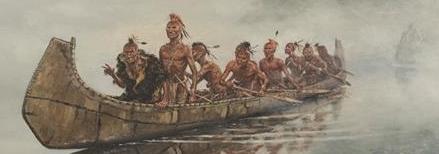
“FOUR CANOES
HAVE JUST LEFT THE
SOUTH SHORE TO OUR
LEFT!”
Fernand, who was rowing
with the other men and
with Nancy, eyed quickly
the four canoes now visible: they contained a good twenty Amerindian warriors who were paddling hard towards the whaler boat. He doubted very much that their haste was motivated by the wish to welcome the French.
“FRANÇOISE, REPLACE NANCY AT HER OAR! NANCY, START ENGAGING THOSE CANOES FROM LONG DISTANCE! THE REST OF YOU, ROW LIKE HELL!” The five French teenage girls and Marguerite Landreau couldn’t help whimper in fear at the sight of the warriors approaching them: the Amerindians looked as fierce as their reputation had made them. Furthermore, it was already evident that the light canoes, each with five paddlers, would easily overtake the heavily loaded whaler boat. Nancy then surprised the girls by grabbing her big bow and quiver instead of her musket. She then transferred to the rear of the boat, next to Claudette, standing fully up in the boat and shouting to her friend.
“CLAUDETTE, HOLD ME BY MY BELT AND KEEP ME STEADY!” Claudette obeyed at once, grabbing with one hand Nancy’s belt while still holding the rudder with her other hand. Thus secured, Nancy quickly placed an arrow on her English longbow and, in one smooth motion, raised her bow over her head and then
254
lowered it to her front while pulling its string at the same time, using the same technique used by the English archers who had defeated the French knights at Crécy and Poitiers. With the 55 kilos of pull of her longbow she could reach a maximum effective range of nearly 250 meters and thus easily outranged the short bows used by local Amerindians. She could even shoot accurately past the effective range of most muskets. The great advantage of her longbow right now was however its rate of fire. A well-trained archer, which she was, could sustain a rate of fire of up to fifteen arrows per minutes, compared to the two shots per minute delivered by a good soldier armed with a musket. Her first arrow flew off as the nearest Amerindian canoe was still over 200 meters away. A second arrow was already on its way when the first arrow penetrated the thin birch bark bow of the leading canoe, not wounding any of the four warriors aboard but unsettling them while creating a minor water leak. The Iroquois, as Nancy was now sure that they were, whooped war cries and redoubled their efforts in closing in with the whaler. The second arrow then struck a warrior in the leading canoe, wounding him in his left shoulder and making him shout with pain. Twelve more arrows followed in the first minute of shooting, killing or wounding five more warriors and damaging three of the canoes. One warrior then tipped overboard, an arrow in one eye, upsetting his canoe and sending his four companions in the water. With the whaler boat still out of effective range of their own weapons, the surviving Iroquois soon gave up the chase in disgust, turning around to help their comrades in the water. That prompted a round of triumphant cheers from the French, who were however reminded at once by Fernand Bonnet that they were not safe yet.
“RESUME YOUR ROWING AT ONCE! WE DON’T KNOW HOW MANY MORE IROQUOIS ARE AROUND.”
That was more than enough to entice everyone in rowing even harder. The rowers were nearly spent physically when Nancy, who had moved to the bow, shouted happily.
“I SEE THE FORT OF TROIS-RIVIÈRES LESS THAN A MILE AHEAD. WE WILL SOON BE SAFE.”
Despite their fatigue and being
covered with sweat, the six men
and two women manning the oars
kept on, rowing hard until the
whaler boat entered the mouth of
the Saint-Maurice River and
255
beached itself on a sandy beach less than fifty meters from the wooden palisade of the French outpost of Trois-Rivières. By then the Sun was gone and only the poor light from the dusk illuminated the area. As Nancy, who had jumped out on the sand first, was helping the girls get out quickly from the boat, a party of nine armed Frenchmen coming from the fort joined them, led by a solidly-built man with long curly black hair. The latter stared for a second at Nancy, apparently put off by her Amerindian outfit, then pointed the open gate of the fort to the girls coming out of the boat.
“Follow my men inside, mesdemoiselles: they will escort you inside the fort.” He then went to Fernand, who was giving directives to the men in the boat about what to carry out. Fernand stopped speaking when he approached and eyed him calmly.
“I am sorry to bring this much excitement to this place, monsieur. However, the Iroquois didn’t give us much of a choice.”
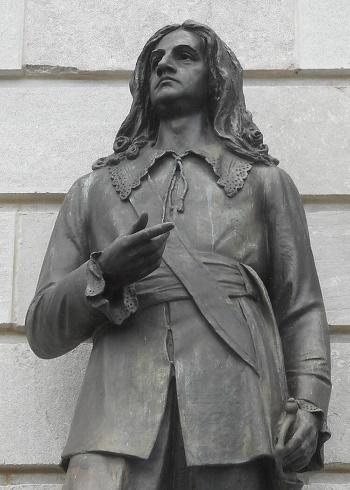
“Don’t be sorry: we go through this constantly. I am
Pierre Boucher de Grosbois, Governor of Trois-Rivières. Were any of your people hurt?”
“Fortunately no, monsieur. They chased after us on the
river but Nancy was able to keep them at arm’s length with her longbow.”
“Who?” said Pierre Boucher, thinking he had
misunderstood. Fernand smiled to him in the growing darkness.
“Nancy is the tall girl you just passed by, the one in Amerindian clothes.”
“Is she French?”
“Half French, half English, with a bit of Huron thrown in, but you can count on her fully, monsieur. She is also one of my associates. By the way, I am Fernand Bonnet, future innkeeper in Ville-Marie.”
“You are not under contract from the Notre-Dame Society?” asked Pierre Boucher, referring to the society that was sponsoring the settling of Ville-Marie with the avowed goal of evangelizing the Amerindians living in that area.
“Of course not! I love too much making good business. Me and my five associates, which include my wife Claudette here, are however escorting to Ville-Marie five single teenage girls, a couple with a baby and two young single men, all under contract from the Notre-Dame Society.”
Pierre Boucher politely bowed to Claudette, then returned his attention to Fernand.
256
“We will talk more at length once you are safely inside the fort. Your boat should be safe overnight while this close to the palisade.”
“Then just give me ten minutes, monsieur, time for us to get our personal luggage out and to cover our boat and canoe.”
Pierre Boucher nodded in understanding, then helped a beautiful young blonde get out of the boat with her canvas bag. To his shock he saw that she had a knife and a pistol at her belt, like the wife of Fernand Bonnet.
“My God! Is this an Amazon invasion?”
The blonde grinned to him as she jumped down on the sandy beach.
“Let’s just say that we put all the chances on our side for this trip, monsieur. I am Françoise Vinier, associate and maid of Monsieur Bonnet for his future inn. This big guy there is my husband, Henri Bruage.”
“Pleased to meet you, madame, and you as well, monsieur. I will be most happy to offer you the hospitality of my outpost for the night.”
The blonde smiled as he gallantly kissed her hand.
“Hmm, I love gallant men, monsieur, and you certainly appear to be one.”
“You will be able to repeat that to my wife later on, madame.” replied the governor, malice in his voice.
As the newcomers followed Pierre Boucher and his men towards the fort’s gate, they passed in front of a cemetery located just outside of the palisade. Françoise hesitated and stopped then, staring at the dozens of crude wooden crosses lined up in the plot.
“My God! So many dead for such a small community.”
Boucher’s face filled with momentary sadness as he reviewed the names on the nearest crosses.
“Life has indeed been harsh at the hands of these damn Iroquois. We lost 22 people to them in the last two years alone, but we intend to stay and prosper.”
“Monsieur,” replied Françoise in a subdued voice, “with people as brave as the people of Trois-Rivières, I am certain that you will build a great city here.” The governor bowed, saluting her with his hat.
“Your compliment truly warms my heart, madame.”
Resuming their walk, the group entered the gate of the fort. Inside, the newcomers saw that the palisade actually enclosed a full blown village, with maybe thirty houses and one
257
church lined along a few streets running in a checkerboard fashion. A growing crowd of men, women and children stared in turn with curiosity at the newcomers. Catherine Lorion suddenly jerked back in fear as an Amerindian man started detailing her from up close. Pierre Boucher made a reassuring gesture to her then.
“Do not worry, mademoiselle. Attikwata here is an Algonquin, an ally of us. The Algonquians have suffered as much as we did from the Iroquois. The Huron, another nation of good allies, have unfortunately been massacred and dispersed by the Iroquois in the last few years.”
Reluctantly at first, Catherine let Attikwata touch the fabric of her dress, then the small silver chain around her neck which had been given to her as a gift by Françoise Vinier. Nancy Laplante then stepped forward and said a few soft words in Algonquian to Attikwata, who nodded in understanding and left Catherine alone, instead starting a conversation with Nancy. Pierre Boucher eyed for a moment Nancy as she spoke with Attikwata, then spoke in a low voice to Fernand.
“Your Nancy can speak Algonquian?”
“Along with Iroquois and Huron, monsieur. I use her as interpreter and hunter, as she is the daughter of a coureur de bois who was the son of a Frenchman and of a Huron woman. She was in fact born here in New France.” Boucher looked at Nancy with wide eyes.
“This girl is decidedly fascinating. You will have to tell me more about her.”
“Uh, I would rather let her tell her own story, monsieur. She is a bit touchy about her private life.”
“As you wish, Monsieur Bonnet.” said the governor while watching Nancy show her longbow to a fascinated Attikwata.
20:13 (Quebec Time)
South shore of Saint-Laurent River
Near Trois-Rivières
Tsinapas, himself wounded to his left shoulder, could only watch helplessly as his brother and companion, Kahnehadas, breathed one last time and died, surrounded by his comrades. A lump in his throat, Tsinapas then started singing a song for warriors killed in combat, accompanied by the other eleven survivors of his group. As a result of their disastrous encounter with the French in the big boat, three warriors were now dead,
258
while five more were wounded to various degrees, including Tsinapas. Once they had finished their song, the Agniers Iroquois took the time to hastily bury their dead, hoping to be able to return later to collect their bones and return them to their clan. Sitting back around their campfire, they looked at each other in silence for a moment, with a warrior finally addressing Tsinapas, who was their leader.
“What do we do now, Tsinapas? With five of us wounded, we are not in a state to attack the French again. In fact, we should bring Kehkakwitas back home if we want to see him survive.”
Tsinapas eyed briefly Kehkakwitas, who was resting besides the fire, a nasty chest wound making his breathing laborious.
“You are sadly right, Tsotehaka. As much as I wish that I could avenge my dead brother, our warring season is over for this year, at least for many of us.” Tsinapas then grabbed the long arrow extracted from his shoulder and made a point of examining it.
“I have never seen arrows reach this far before, nor have I seen a bow as tall as the one handled by that Frenchman, or was it a Frenchman?”
“I could swear that it was actually a woman,” volunteered Tsotehaka, “a woman wearing traditional clothes. I don’t think that she was French. The French don’t let their women fight.”
“Neither do we! Nor do the Huron or the Algonquians.”
“A Metis then?” proposed another warrior. “She was taller than normal French women or even men, as tall in fact as most of us. Half-breeds sometimes result in persons outside of the norms.”
“Your idea has merit.” recognized Tsinapas. “That woman, whoever she is, is however a clear threat to our warriors with her giant bow. Niotsaeton and his group of
warriors are operating upstream, near Hochelaga8. They have to be warned about these French and that woman. Kenawanda, Tsotehaka, I want you to take our remaining intact canoe and to leave now for the prearranged meeting point with Niotsaeton’s group. Paddle hard and get there as quickly as you can to pass the word to our fellow warriors, then stay with them to reinforce their group. As for the remainder of us, we will head back home with our wounded as soon as our canoes are repaired.”
8 Hochelaga: Iroquois name for Ville-Marie/Montreal
259
The two designated warriors nodded and got up to gather their meager personal belongings. The remaining warriors accompanied the two men to the shoreline, wishing them well before they departed in their canoe. Tsinapas, his left arm immobilized in a sling, then looked at the seven warriors surrounding him, two of which also sported arrow wounds.
“Let’s not lose any time, my friends. We better start repairing our canoes tonight.”
14:23 (Quebec Time)
Sunday, August 16, 1654
Saint-Laurent River, three kilometers downstream of Ville-Marie
Frida, squinting her eyes to look at something in the distance, then screamed out in joy, making young Marie Renaud jump nervously.
“VILLE-MARIE! WE ARE FINALLY ARRIVING!”
Catherine Lorion, her heart beating faster now, strained her eyes to see their new home. A wooden fort was the most prominent sight along the shore of the river, with a few houses dispersed between the trees of the forest surrounding the fort. A few clearings marked cultivated fields, while a windmill stuck out of the trees at a short distance from the fort. She could still see no quays or other obvious place to land their boat and canoe. Her companions cheered as well at the sight of the fort and proceeded to put the oars in place in order to row to the shore.
On the same shore, level with the whaler boat and hidden in the bushes and trees lining the river’s shore, Niotsaeton and his group of eight warriors watched with interest the French boat as it passed in front of them, towing behind an empty canoe. The boat was too far for either musket or bow shot, so Niotsaeton took out a telescope he had bought at a high price from Dutch merchants in Fort Orange and examined in turn the sixteen occupants of the boat. One young woman near the bow attracted his fancy for a moment: apart from being beautiful, she sported the longest blond hair he had ever seen. Her scalp would make a prized trophy indeed on his return from this scouting and raiding expedition. Looking then at the remaining occupants, Niotsaeton saw a tall teenage girl dressed in buckskins. Examining her in detail for a few seconds, he then passed his telescope to the warrior hiding next to him.
260
“Look at the third person from the front in that boat, Tsotehaka. Is she the one who shot the giant bow?”
Tsotehaka took only a moment before he nodded and gave back the telescope to Niotsaeton.
“It’s her alright! Her long black hair will make a fine scalp when I will get close to her. Even better, we could capture her and make her die slowly, to make her pay for the brothers she killed.”
“All in good time, Tsotehaka.” replied calmly Niotsaeton. His face then reflected sudden dismay, prompting an alarmed question from Tsotehaka.
“What’s wrong?”
“One of the French girls, the one with the long blonde hair, is now looking straight at us with a telescope.”
Swearing to himself, Niotsaeton lowered his scope and looked at his warriors: they were all under cover and well hidden. How could the French girl have spotted his group? Completely spooked by this, he signaled his companions to retreat further into the woods, then followed them at a half-crouch.
“They are now retreating in the woods. The path to Ville-Marie is now clear for your group.”
Frida Winterer smiled as she silently received the radio message from the scoutship WALKÜREN, in which she normally worked as the copilot and weapons officer. The WALKÜREN was the ship charged to discreetly follow her research team under cloak and had detected the group of Iroquois warriors via its thermal imaging sensors. Frida thought her response, using the micro-radio implanted at the base of her skull.
“Thanks for the warning, Hanna. We will keep an eye out for these guys.”
A steadily growing crowd was gathering on the shore just outside of the fort as the whaler boat approached under oar power. A rudimentary wharf that had been hidden behind a dead, fallen tree, was now visible and Claudette, sitting at the rudder, steered for it at once. About a dozen men went down the embankment, using a rough trail, and helped tie the boat to a pillar of the wharf, to which a number of rowboats and canoes were already tied. A man wearing a
261
sword and a pistol at his belt stepped forward as Frida got out of the boat, but waited for Henrik to get out before going to him and shaking his hand.
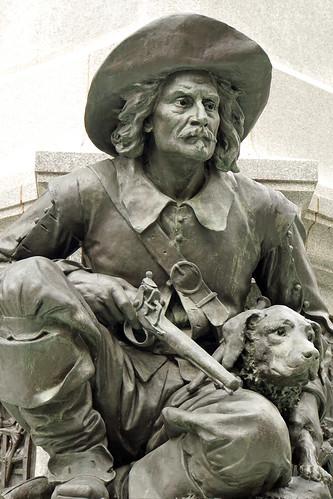
“Welcome to Ville-Marie, monsieur! I am Lambert Closse, Sergeant-Major of the town’s garrison.”
“And I am Henri Bruage, associate of Monsieur Fernand Bonnet, who is the leader of our group.”
Closse looked at Fernand, who had been pointed to by ‘Henri Bruage’, and went to shake his hand.
“Monsieur Bonnet, I am happy to see you arrive with so many new souls for our small community. Are you all under contract from the Notre-Dame Society?”
“Not all of us, Monsieur Closse. Me, my wife and four associates came to Ville-Marie on our own to build an inn. The rest are however under contract.”
“Then we will sort this further after you are able to unload your things.”
“In that case, just let me unload what we immediately need. I will leave the heavier pieces for later, when I know where we will live.”
“Fair enough, Monsieur Bonnet.” said Closse, who then watched the occupants of the boat disembark. While the five teenage girls in French dresses attracted a lot of attention from the numerous single men present, Nancy made many recoil with suspicion when she stood up in the boat and became fully visible. Seeing Closse’s hand instinctively go near his pistol, Fernand interposed himself and looked down into the eyes of the soldier.
“Nancy is one of my associates, Monsieur Closse. Furthermore, she has French blood in her veins. I use her as interpreter and guide, as she was born in this country.”
“A native white girl from New France? This is rare indeed, especially when that said girl is so heavily armed.”
“That girl already saved all our lives near Trois-Rivières, monsieur, when she kept at bay four canoes full of Iroquois with her bow. She is the daughter of a coureur de bois.”
“I see!” said Closse, relaxing a bit then. The coureurs de bois were known around New France for frequently associating with the local Indians and to also often dress and live like them. This was however the first time he had seen a female coureur de bois, something that was probably going to scandalize Father Pijart. Closse gave dubious looks at the two other women wearing knives and pistols, then looked back at Fernand.
262
“My men will guard your boat while I escort you to the governor’s office. Please follow me.”
Going up the small trail, Closse led them inside the fort, past a central courtyard with a pillory and a wooden head collar, then into a stone and wood building larger than the houses surrounding it. All along the way a crowd of curious but friendly people stared at the newcomers, with a few shouting greetings as well. The inside of the fort contained a number of apparently hurriedly built huts and houses lining the inside of the palisade, while other houses and huts were dispersed around the fort proper.
Still led by Lambert Closse, the sixteen newcomers were introduced into a small, sparsely furnished office where a nobleman rose from behind his work desk. In his forties, he had an honest face and a robust body. The nobleman scanned quickly the group, his eyes stopping for a moment on Nancy. That was when Closse whispered for a moment in his ear. The nobleman then spoke up in a firm voice.

“Welcome to Ville-Marie, good people. I am Paul Chomedey de Maisonneuve, Governor of this post.” He then looked at Closse.
“Have my secretary report in at once.”
As Closse hurried away, the Governor came from behind his table and shook hands with the men of the group, who presented themselves in turn. De Maisonneuve next kissed the hands of the women and girls. Closse came back with a Jesuit priest as the Governor returned to sit behind his desk.
“Father Pijart is my secretary, apart from being our community priest.” explained de Maisonneuve. “I would like you in turn to state your full name, place and date of birth, your occupation and, if applicable, the date and place of your marriage.” The newcomers, starting with the younger girls, executed themselves, with Father Pijart writing down that information. Fernand Bonnet’s declaration, which was second to last, made de Maisonneuve raise an eyebrow.
“Monsieur Bonnet, while we already have a few drinking places in this post, I agree that we could use an inn, especially to lodge passing travelers and newcomers in Winter. I will thus grant you a license to sell alcohol in your inn, as long as you don’t serve it to natives. Do you intend to cultivate land as well?”
263
“Yes, Your Excellency! My wife will grow vegetables around our future inn, to help provision it.”
De Maisonneuve nodded his head and referred to a rough map of Ville-Marie laid on top of his work table.
“Father Pijart, take note of this: I give to Monsieur Bonnet the lot along the shoreline to the southeast of the Hôtel-Dieu.”
“Thank you, Your Excellency!” said Fernand as he bowed in salute. “Er, would you permit the production of alcohol as well, sire?”
“Production? How? With what?”
“I brought a small still with me, Your Excellency. I intend to pick wild berries at first to run it.”
De Maisonneuve smiled in amusement as he stared at Fernand.
“I see that you intend to make a generous profit by cutting the grass from under the producers in France who keep selling us Brandy at such dear prices. Very well, monsieur. As long as you pay the relevant taxes on the sale of your alcohol, I will grant you a license to produce alcohol as well.”
De Maisonneuve looked next at Nancy, who was last in line.
“Time to present yourself to Father Pijart, mademoiselle.”
“Yes, Your Excellency! I am Nancy Sommers-Laplante, daughter of Pierre Laplante and of Lady Suzanne Sommers. I was born in the month of June of 1636 along the south shore of the Saint-Laurent River, near the northern tip of Lake Ontario. I am an interpreter and guide for Monsieur Bonnet.”
“Your mother was a noblewoman, mademoiselle?” asked Father Pijart, having a hard time believing his ears. Nancy nodded once, then looked straight at the Governor.
“Your Excellency, I would wish to wait until we are in private before going into more detail about me. By in private, I mean strictly you and me.” De Maisonneuve looked back at her with suspicion: that girl was already too strange and her mother’s name sounded definitely English.
“Who was exactly your mother, mademoiselle? Surely you can tell us that, if you don’t have anything sinister to hide.”
Nancy hesitated for a second, then answered de Maisonneuve.
“My mother was an English woman of low nobility who had been captured and taken as a slave by the Hurons. My father, a coureur de bois, bought her from the Hurons and later married her.”
264
“And how did you end up in France, mademoiselle?” asked the Governor, with the new settlers listening on with avid interest to this exchange, thirsty to know more about the enigmatic Nancy.
“When my parents died a few years ago, I took a ship to Europe in New Amsterdam and visited my mother’s family in England. From there I then crossed into France, where I worked for the King’s cause during the Fronde uprising. I came back to visit my land of birth.”
From suspicious, de Maisonneuve then grew nearly hostile.
“You have English blood in your veins, mademoiselle? And what tells me that you are not a spy for the English?”
While Fernand Bonnet and his associates looked incensed by that accusation, Nancy simply searched in her haversack while staring back at the Governor, finally pulling out and presenting to him a leather folio.
“This should explain to you who I am, Your Excellency. I however ask that this information be kept from all others, even from your secretary.” Deeply suspicious, de Maisonneuve opened the folio, extracting from it a folded parchment bearing a large red wax seal and ribbon and reading it. His face reflected nearly at once surprise and he snapped his head up after a few seconds to stare with disbelief at Nancy, his face pale.
“You…”
“Don’t say it, Your Excellency! The signature on this document should tell you what would be the consequences for you of being indiscreet about me.” De Maisonneuve swallowed hard, then folded back the document and slipped it back inside the leather folio before handing it to Nancy.
“Very well, mademoiselle. Your secret will be safe with me. Father Pijart, erase the entry concerning Mademoiselle Sommers-Laplante from your registry.” The Jesuit looked at first as if he had just heard a heresy, then obeyed the Governor with clear reluctance as the teenage settler girls and peasant men watched on with disbelief. Still shaken, de Maisonneuve looked back at his map of Ville-Marie.
“Monsieur Jean Simon, I grant you the lot adjacent and to the north of Monsieur Bonnet’s lot. Monsieur Jacques Morin, I grant you the lot directly to the northeast of the Hôtel-Dieu. I am confident that you will both be able to make those lands productive.”
“Your Excellency, you can count on my arms and back.” said proudly Jacques Morin, who was finally seeing his dream of a land of his own fulfilled.
265
“On mines too, Your Excellency.” added Jean Simon.
“Monsieur Hubert,” then continued the Governor, looking at the master tailor, his wife and his baby son, “since you have a young child with you, I believe that you are in a more urgent need of lodging than the others. However, with the large group of newcomers which arrived last year, all the housing in and near the fort is taken. The only thing I can offer you is a damaged, abandoned house to the northwest of the Hôtel-Dieu.”
Nicolas Hubert raised an eyebrow in surprise at those words.
“If housing is so tight, Your Excellency, how come nobody grabbed that house yet?”
“Superstition, monsieur.” replied de Maisonneuve, frustration on his face. “The previous occupant, Jean Boudart, was killed by the Iroquois three years ago, along with his two young children, while his wife, Catherine Mercier, was last seen being led away into captivity. Since then, nobody has accepted to live in their house, on pretext that Boudart’s ghost is in it.”
“Dear Mother Mary!” said softly Jeanne Rousselier, touching the crucifix hanging from a chain around her neck. “What do you think happened to that poor woman, Your Excellency?”
Immense sadness seemed to fall on de Maisonneuve’s shoulders at that question.
“At best, the Iroquois made her a slave and will eventually make her die through overwork, employing her at the hardest and dirtiest work around their camp. At worst, they tortured her to death for their entertainment. She was a nice, brave woman. May God have mercy on her soul.”
The newcomers exchanged looks of sorrow and horror, then Nicolas Hubert cleared his throat.
“Your Excellency, I will take that house if it is still available.”
“Good man! There is also a four acres lot that comes with the house. It is yours as well, Monsieur Hubert.”
De Maisonneuve next smiled to the five single teenage girls who were part of Bonnet’s group.
“As you may have noticed from the lecherous looks around you, mesdemoiselles, there are a lot of single men around this post. I suspect that fending men off will be a main part of your occupations until you find a suitable husband for each of you. In the meantime, since you have no relatives here, I need to know where you intend to stay.”
266
The five girls didn’t take long to make their minds, having already discussed that subject during their trip from Quebec.
“I will live with the family of Monsieur Hubert, Your Excellency.” announced Jeanne Rousselier. “I already worked as a seamstress and I could be of use for his tailoring business.”
De Maisonneuve nodded approvingly at that: with Nicolas’ wife and child living in the same house, the risks to Jeanne’s virtue were minimal.
“What about you, mademoiselle Lorion?”
“I will stay with Monsieur Bonnet for the moment, Your Excellency. He has two tents, one of which will be reserved for the women of his group. Monsieur Bonnet has offered us jobs as servants and maids in his future inn and we will also help his wife cultivate their vegetable plot until we each find a good man to marry.”
“Excellent!” exclaimed the Governor, rising from his chair. “Lambert, please go with our new citizens and mark with them the boundaries of their allocated lots of land. Now, if you will excuse me, I have some paperwork to do.”
“Uh, what about Mademoiselle Laplante, Your Excellency?” asked Father Pijart, clearly uncomfortable about Nancy. The Governor gave him a no-nonsense look.
“I am sure that Mademoiselle Laplante will manage by herself around Ville-Marie, Father Pijart.”
Following that, the group left the Governor’s office, then the fort, and was led through a half-deforested area by Lambert Closse. After a five-minute walk they arrived at a dilapidated house bordering a field overgrown with weeds. They were about to enter the house through its half-opened front door when a noise inside made everybody stop where they were. Nancy, who was closest to the door, drew her two pistols at once, cocking their hammers before pushing the door wide open and rushing inside. On their part, Fernand Bonnet, Henri Bruage and Michel Lorrain crouched down while also drawing their pistols without hesitation. A shout from Nancy then echoed from inside the house.
“CLEAR THE DOOR!”
Closse and the others with him had only time to react and step out of the way before a small animal ran out through the door, avoiding them and disappearing in the nearby bushes. Closse then broke out in laughter.
“A raccoon! We nearly got scared away by a raccoon.”
267
They all laughed at that, then entered Nicolas Hubert’s new home. The house clearly showed the three years of neglect it has suffered, having been opened to blowing winds and snow through the broken windows and door. Climbing to the attic via a ladder, Fernand Bonnet soon shouted from upstairs.
“THE ROOF SEEMS INTACT, AT THE LEAST: I SEE NO LIGHT AT ALL THROUGH IT.”
“That’s a start.” said Nicolas Hubert, partly relieved. Testing the floor under him, the tailor saw that a few planks were half rotten and would need to be replaced soon. Marguerite Landreau looked around sadly at what had been the home of a now destroyed family.
“This place certainly can use some sweeping. Jeanne, pass me that broom.”
“Well,” said Closse after a last look around him, “I will let you to your cleaning job and will guide the others to their own lots, Monsieur Hubert.”
“Meet us at our tents for supper, Nicolas.” added Fernand. “We can lodge you all until your place is livable. We will also lend you a hand in bringing your things to your new home.”
“That is most generous, Fernand. We will be there by six.” Fernand then looked at Jean Simon and Jacques Morin.
“My offer stands also for you two: it will take you weeks before you can build a house of your own.”
“Fernand, you are a real friend.” replied Jacques Morin, giving him a pat in the back that nearly toppled Fernand.
Guided again through the forest to a less densely wooded area by Lambert Closse, the group was shown the boundaries of the lot given to Jacques Morin, with Closse planting improvised stakes to mark them. Closse then did the same with the lots given to Jean Simon and Fernand Bonnet. All three lots bordered the shoreline to the northwest of the point of land where the fort of Ville-Marie sat and were close to a stone house with a barely started wooden annex still under construction.
“What is that building, Monsieur Closse?” asked Jacques, now standing with the others on the now marked lot of Fernand. “I saw very few houses made of stone here up to now.”
“That’s the Hôtel-Dieu hospital. Sister Jeanne Mance is doing admirable work there, taking care alone of our sick and wounded. A most exceptional woman indeed.”
268
“Maybe we should visit her later.” suggested Claudette, getting a nod from Fernand.
“A good idea. Let’s get ourselves established here first, though.”
Going back to the wharf near the fort, they retrieved their boat and canoe and rowed them down the stream to the shoreline of Fernand’s land lot, then solidly tied them to a large tree. The five men then started the arduous task of hauling the biggest and heaviest items from inside the whaler boat and up the riverbank to the chosen site of their camp, while the women took care of the smaller things. Everyone was sweating profusely in the hot, humid summer air as they dropped their first loads by the camp site. Françoise Vinier looked at a young man cultivating his field in a nearby lot, dressed only in his linen shirt.
“The hell with it! I’m not going to dirty one of my only two nice dresses for nothing.”
She then quickly removed her dress under the bulging eyes of Jacques Morin and Jean Simon, ending up only with her linen shirt and moccasins on. She however put back on her belt with knife and pistol before returning to the boat for another load. Fernand, Michel, Henri and Claudette quickly followed suit, prompting the others to look at each other in indecision. Catherine Lorion looked at Nancy, who was not shedding her clothes like her associates.
“You are not going down to your shirt, Nancy?”
“Hell, Catherine, I have no shirt under my buckskin tunic. Do you want me to go around topless?”
“Jean and Jacques would love that.” said Jeanne Merrin, giggling. Catherine Lorion then took a decision and removed her dress, followed in this by the four other teenage girls. They then continued their hauling work for half an hour, emptying completely the whaler boat before putting in place its covering tarp and overturning their canoe on the narrow beach. With both boats solidly tied in place, they returned to their camp site. By that time, everybody’s shirt was clinging to their bodies, soaked with sweat. Jean Simon couldn’t help have an erection at looking at Françoise Vinier, whose outrageously short shirt now stuck to her young, shapely body. Catherine Lorion blushed but kept silent on seeing Jean’s reaction, while Jean eyed discreetly her breasts, which were clearly outlined by her soaked shirt. Fernand, apparently oblivious to this, looked at the pile of crates, barrels, kegs, chests and bundles.
269
“Alright, here is what we are going to do now: Nancy will go with Michel to the river to catch our supper, while Jean and Jacques will cut and collect small wood for our campfire. The rest of us will erect our two tents.”
The two large canvas tents, with the campfire between them, were up and solidly fixed to the ground by stakes when Nancy and Michel came back, two big pikes in their basket fishnets.
“Ah, goodie!” said Jacques Morin at the sight of the two fishes. “I’m starving!”
“Then you can cut and gut them while I go wash myself in the river.” replied Nancy. “I can’t stand myself anymore.”
“I’m coming with you!” said at once Françoise, grabbing a spare shirt from her personal bag. All the women and girls ended up following them to the river, leaving the men alone around the fire. Fernand then smiled to Jacques.
“You better stop thinking about the girls and start cutting up those fishes if you want us to eat, Jacques.”
“Uh, right!” said Jacques as the other men broke out in laughter. Fernand then spotted the Hubert family and Jeanne Rousselier approaching.
“Hey, Marguerite, how is the cleanup going?”
“Nearly done.” answered Marguerite Landreau, her baby in her arms. Nicolas Hubert looked with amusement at the men wearing only shirts around the fire.
“I see that you adopted quickly one of the more popular customs of New France, despite the rantings of the Church against it.”
“I think that I should adopt that fashion while working tomorrow.” Said Jeanne Rousselier, making Jacques Morin raise an eyebrow in interest. “I didn’t expect this country to be so hot in summertime.”
“Then grab a spare shirt from your bag and go join the other girls in the river.” offered Fernand.
“I’m coming too!” said quickly Marguerite, handing her baby to Nicolas before searching in her travel chest and grabbing a folded shirt, then following Jeanne towards the river. Nicolas watched her walk away, then grinned to the men around him.
“Well, it seems that we have now firmly established who is in charge around here.”
A wail from his young son then made him sniff audibly.
270
“On the other hand, count me out for a while: I have a little boo-boo to take care of.”
“You’re in charge alright, Nicolas.” said Jacques, laughing hard while gutting the pike in his hand.
10:53 (Quebec Time)
Tuesday, August 18, 1654
Ville-Marie
Lambert Closse did a last scan of the forest surrounding the fort, then gave back the telescope to the militiaman on lookout duty before climbing down from the southeast tower of the palisade and walking through the open gate. The day promised to be another hot, sticky one and he was already starting to sweat under his leather jacket. Holding the hilt of his sword with his left hand, he started doing his periodic roundabout inspection of the settlers living outside of the fort, talking briefly to each of them and exchanging greetings with the people he met on his way. The settlers appreciated those rounds of visits, being in need of feeling cared for and protected in this hostile land.
Arriving at the house assigned to Nicolas Hubert, Closse then had to repress a smile: Nicolas and his wife were clearing out wild growth from their field while Jeanne Rousselier was sweeping the front porch of the house. All three wore nothing but their shirts, which were sticking to their bodies because of sweat. Lambert admired for a moment Jeanne, who had her back to him and was bent over while picking up something. With her graceful body and agreeable face, she should have no trouble finding quickly a husband in the large pool of single men in the fort. Looking away from Jeanne with difficulty, Closse walked to Nicolas and Marguerite, who greeted him with wide smiles. He noticed with satisfaction that Nicolas had a musket slung across his back, while his wife had a pistol hanging from a strap passed across her chest. With the handful of soldiers and militiamen he had, Closse needed the settlers to be ready to defend themselves.
“Good day, Monsieur Closse.” said warmly Marguerite Landreau.
“Good day, madame, monsieur. Is everything going well here?”
“Everything is just fine, monsieur.” answered Nicolas. “I need only to repair the door and the windows before our house is fully fit to live in. Jeanne was of great
271
assistance in helping clean it, while Monsieur Bonnet is feeding and lodging us in the meantime.”
“Feeding you? Did he bring so much provisions with him?”
“Oh no, Monsieur Closse! He and his associates are simply first class hunters and gatherers. If there is something edible around, you can be assured that they will either pick it or catch it. Nancy and Michel in particular are really good at it.”
“Really?” said Closse, interested about the young but mysterious Nancy Laplante. That business of the secret document shown to the Governor had truly lit up his curiosity about that girl, who was quickly becoming the talk of the town in Ville-Marie, if only for her uncommon size and Amerindian clothes. “I have to say that this tall girl is a most strange one.”
“Not if you think of her as a true coureur de bois, monsieur. During my two years in Quebec, I saw quite a few male coureur de bois pass by and I have to say that some of them looked and acted quite strange. Mind you, if I had to go deep into the woods, I would want one of them with me, and that’s not to warm up my bedroll.” The last words opened a subject Closse exploited at once.
“And this Nancy, is she acting, uh, strangely?”
“It depends what you would qualify as strange, monsieur.’’ said Marguerite Landreau. ‘’She certainly cares about her physical fitness and can seemingly run forever. She also is obsessed about body cleanliness, bathing every day in the river. I tried to tell her that doctors say that contact with water can bring diseases, to which she replied to me that the doctors in France are ignorant incompetents. Monsieur Bonnet and his other associates also share that last opinion and bathe as frequently as Nancy. That in fact caused a small incident yesterday, when they had to chase away a young man from the fort who had tried to peep from behind a bush while Françoise and Claudette were bathing in the river.”
Closse’s smile disappeared at those words: one of his functions in Ville-Marie was to enforce the law and attempts against the modesty of a woman of good virtue was certainly covered by the law, with a fine being the normal punishment.
“Do you have the name of that young man, madame?”
Marguerite slowly shook her head, herself becoming serious.
“No, Monsieur Closse. I believe that Henri Bruage already dealt with the miscreant himself.”
“Did he beat him up?”
272
“I don’t believe so, monsieur. He told us that he simply scared him into not trying to peep again.”
Closse nodded at that: Henri Bruage, being a tall and strong man standing a good 185 centimeters, certainly could scare most men if he wanted to. Still, this business of young women bathing in the river could create a lot of social disturbances if the word went around about the habits of the female associates of Fernand Bonnet.
“Well, it seems that I better talk to Monsieur Bruage about this. I certainly don’t want the young men of Ville-Marie to make a habit of peeping at naked married women.”
“Can you really blame them for trying, monsieur?” asked Marguerite with a malicious smile. Closse thought about that for a second.
“Not really, but social order must be kept. Maybe the female associates of Monsieur Bonnet could be more discreet too about their bathing habits. Well, I have to continue my inspection now. Have a good day, madame. You too, Monsieur Hubert.”
“And a good day to you, Monsieur Closse.” replied Nicolas, pausing for a moment from his work.
Closse next visited two more families nearby before arriving at the lot given to Fernand Bonnet. He found the latter busy with Henri Bruage cutting down the trees which still cluttered his lot, while his wife Claudette and three of the teenage girls they had escorted to Ville-Marie were digging and turning over the top soil of a two-acre deforested surface with spades. As for the young Marie Renaud, she was watching an iron pot set over the campfire by the group’s two tents. Everybody was wearing strictly shirts and moccasins or shoes, making Closse laugh silently at the futility of the priests’ rantings against that practice: Father Pijart was not the one who had to swing day-long an axe or a spade in the Sun of a hot, sticky day.
“Hi, Monsieur Closse!” shouted enthusiastically Claudette, stopping her work on spotting his approach. Lambert licked his lips before answering: she was an appetizing young woman, while he had not touched a woman for over a year now. Dismissing the sinful thoughts from his mind, he waved back at her.
“I thought that I would pay a visit to see how you and your husband were doing on your new land, madame.”
“Everything is going fine, Monsieur Closse. It is hard work but it will pay off soon enough. We were about to have lunch. Would you care to join us?”
“I would be delighted, madame.”
273
Closse was in fact quite hungry by now, apart from being thirsty. Going to a wooden chest lying close to the campfire, Claudette took out a number of wooden bowls and tin cups and told the other girls to break work for lunch. She then served Closse a goodly ration of some kind of meat stew, along with pouring him a cup of wine, before serving the girls. Closse had a taste of the stew and nodded his head in appreciation.
“This is good! Hare meat, I believe?”
“Mixed with wild roots, mushrooms and herbs.” answered Claudette. “Nancy is very good at finding such edible roots and plants. Mind you, I added some salt and pepper to the stew for the taste.”
“And were is actually your Nancy?” asked Closse, looking around him.
“Gone hunting with our Algonquin neighbor, Ononkapis. As for Françoise, she went into the woods to pick wild mushrooms, with Michel as escort.” Closse nodded, knowing well Ononkapis: he was a lone Algonquin hunter who had lost his wife two years ago and who lived in a teepee in the woods, maybe 600 meters from here. Ononkapis was overall a good man who had made himself useful to Closse on a number of occasions.
“While I am here, madame, I would like to talk about an incident that I heard about. I was told that some young ruffian tried to play peeping tom at your expense.” The teenage girls around him giggled as Claudette smiled to him and spoke calmly.
“That problem has already been dealt with, Monsieur Closse. I believe that the ruffian in question won’t come back.”
“But others could follow his example, madame. Maybe you should consider being more discreet about your bathing habits.”
Claudette’s smile faded somewhat at those words.
“Monsieur Closse, me and my husband believe strongly in cleanliness as a way to avoid diseases, contrary to the opinions of the so-called doctors in France. The spot we bathe in the river is surrounded on three sides by trees and bushes and one has to be quite deliberate to spot us there. If it can reassure you, we decided to keep from now on a woman out on watch when other girls are bathing, with that woman armed with a musket. Will that be enough to reassure you, monsieur?”
“That should be sufficient.” recognized Closse before putting a spoonful of stew in his mouth. He then switched to small talk while eating his stew with the girls and Claudette as Fernand Bonnet and Henri Bruage joined them for lunch.
274
As they ate together around the fire, Marie Renaud suddenly beamed and waved her hand high while shouting.
“Nancy is back with Ononkapis. They got a deer!”
Everybody looked in the direction where Marie was looking and saw effectively Nancy and Ononkapis walking out of the forest, a pole on their shoulders and a dead deer hanging by its tied legs from the pole. As the two got closer to the camp, they saw that a few ducks and hares also hung from the pole. That sight made Fernand beam with satisfaction.
“It seems that Nancy and her new friend had a good hunting indeed. We will have plenty of meat for the next couple of days, plus a deer hide to scrape.”
“Maybe too much for us to eat all before it goes bad, unless we smoke some of it.” said Claudette, prompting Henri to suggest something.
“Since Nancy is so successful with her hunting around here, we will probably end up constantly with some surplus meat. While we can and should preserve some meat reserves for Winter, we could also give away what surplus are left to people who are in need in Ville-Marie. Would you have suggestions about that for us, Monsieur Closse?” Closse was thoughtful for a moment. While Henri’s idea was a credit to him, most people in Ville-Marie were eating quite well indeed, except maybe…
“How about giving your surplus food to Sister Jeanne Mance, at the Hôtel-Dieu. She is practically alone to help the patients there and mostly depends on donations from the families of the patients to run the place.”
“A very good idea, Monsieur Closse.” agreed Claudette. “In fact, we could start right away, with the leftovers of this stew. Once Nancy and Ononkapis are served, I will go bring what’s left to Sister Mance.”
“Don’t forget Jean and Jacques, Claudette.” cut in Catherine Lorion, making Claudette smile with embarrassment.
“You’re right, Catherine. Since you raised the subject, would you mind bringing a portion to both of them?”
“With pleasure, Claudette.” replied Catherine, getting up and grabbing two bowls and two spoons, then filling the bowls close to overflowing with stew. That prompted Marie Lorgueil in getting up as well and hurry to her, taking one of the full bowls from Catherine.
“I’ll carry one, Catherine: you could spill the stew if you try walking with both full bowls.”
275
“Thanks, Marie! You are too kind.”
Closse watched both girls walk away as Nancy and Ononkapis dropped their load near the fire. Nancy sniffed at once the stew with delight.
“This smells good! I have to say that I and Ononkapis were getting quite hungry.”
“Then sit down and eat, both of you.” replied Claudette, who fetched two more bowls for them, along with spoons. Once she had served them, she filled a small clay pot with stew and announced that she was bringing it to Sister Mance, then left the campsite. A few minutes later, the Hubert family and Jeanne Rousselier showed up and were promptly served by Fernand Bonnet. By now impressed by the Christian spirit of mutual help and charity of the newcomers, Closse finished his stew and, excusing himself, left to continue his inspection tour.
As the afternoon was getting quite advanced, Michel and Françoise returned from their picking excursion in the woods, tired but with their haversacks full of mushrooms. They made Claudette even more satisfied when they showed to her and Fernand one haversack full of wild raspberries.
“We found a large, albeit dispersed patch of raspberry bushes deep in the forest, near the river shoreline. Since our bags were already nearly full of mushrooms and we were about to turn around, we could pick only this much but there is much more left to pick. We would need to return in good numbers there tomorrow to do a decent harvest.”
“We will, Michel.” replied Fernand after tasting one of the raspberries and finding it sufficiently ripe. “These berries could help us produce our first batch of locally-produced alcohol. Me and Henri will stay here to continue cutting down trees, while the rest of us will go pick raspberries. Well done, guys!”
Then checking that none of the contemporary French were close, he lowered his voice to a near whisper.
“Claudette, it is time we collect some data about Ville-Marie from inside the fort. Playing settlers may be interesting but it is not our primary goal.”
“I needed to go buy some bread anyway. Let me wash my hands and face quickly and I will go to the fort.”
“Good! Use your special cap.”
By that, Claudette knew he meant one of her linen caps which featured a micro-camera and microphone camouflaged in its front flap. That cap would allow her to film what she
276
looked at inside the fort, thus supplementing nicely the spy probes already used and controlled by the scoutship WALKÜREN.
Half an hour later, clad in a red dress, brown corselet, white shirt, brown shoes and white linen cap, Claudette left the campsite for the fort, a covered wicker basket in one hand. In her basket were hidden a pistol and a knife meant for protection against the Iroquois. With those hidden away, Claudette was hoping to appear like a more run-of-the-mill French woman to the people of Ville-Marie, something Nancy was having a lot of trouble with due to her cover story. Claudette tried to think of a way for Nancy to blend in more while walking to the fort, some 500 meters away. She shouted greetings on her way to the few settlers living like her along the shoreline, with those settlers answering her politely. An idea about Nancy came to her just as she walked through the opened gate of the fort. Keeping that idea in the back of her mind, Claudette started going around the vending stalls dispersed around the central courtyard of the small fort, which sheltered maybe 120 people at the most. Making a point of trying to converse in turn with each merchant or vendor, Claudette did her best to get them to tell their names and identify themselves, something a spy probe couldn’t do. This way, the Time Patrol would be able to put names on all the faces filmed up to now in Ville-Marie. While the people of the fort were a bit reserved with her at first, she being associated with Nancy, her easy manners and friendly chat soon broke the ice and she was able to talk and listen at length, playing the role of the bored housewife in search of the latest juicy or entertaining gossip while doing some shopping. The news from her that Fernand was planning to open an inn actually helped a lot to fuel the conversations.
By the time that she arrived at the baker’s shop she had bought a dozen fresh eggs, bartered for with two cups of the raspberries just picked by Michel and Françoise. The baker, a jovial man, looked with hope at her basket.
“Excuse my indiscretion, madame, but I saw you sell some raspberries to Le Minime’s wife. Would you happen to have some left still? I love raspberries but they are so hard to get with those damn Iroquois running around the woods.”
“You are in luck, Monsieur…?”
“André Charly, also known as Saint-Ange, madame.” answered the man, shaking her hand.
277
“And I am Claudette Bussière, wife of Fernand Bonnet. We arrived on Sunday. To answer your question, I do have some raspberries left in my basket. They were picked just today.”
Claudette then produced from her basket a large bowl covered with a piece of cloth. Uncovering the bowl, which was still half full of raspberries, she presented it to Charly.
“I wanted to buy a couple of loafs of fresh bread from you, monsieur. Could I use those raspberries as partial payment? I do have coins with me as well.”
“For those raspberries and two sols, I will give you your two loaves, madame.” answered the baker, an offer Claudette accepted at once. The pleased baker
transferred the precious raspberries into a bowl of his own and took her money, then gave her two big loaves of bread still warm from the oven. Charly eyed Claudette with interest as she put the loaves in her large basket, lowering his voice next.
“That wild girl which goes around dressed like an Indian, she works for your husband, right?”
“Uh, yes.” said cautiously Claudette. “She is actually more like an associate than an employee to us. She is our guide and interpreter around here and also hunt to provide us fresh meat. She is quite useful, actually.”
“And she has noble blood in her veins?”
“Only from her mother’s side, monsieur, which doesn’t make her a noblewoman according to French law. Mind you, she couldn’t care less about being a noble or not. Besides, she is planning to return to France next year.”
“She is not staying?” said the baker, seemingly shocked by that news. “Then, what they say about her could be true.”
“Who is saying what?” asked Claudette, playing ignorant. Charly in turn lowered further his voice, sounding conspiratorial.
“That she is a spy for the King. You didn’t know that?”
“Uh, no! For me she is just a métis girl who wanted to visit again her country of birth. Why would anyone think that she is a spy, and one working for the King on top of that?”
“But you were supposedly there when she showed to Monsieur de Maisonneuve a secret document signed by the King, madame.”
Claudette shrugged at that, appearing to have been ignorant about this.
278
“I only saw her show a document that seemingly made the Governor take notice but I didn’t know that it was signed by the King, Monsieur Charly. Besides, would the King really use a girl as a spy?”
“Hmm, true! Still, she is one strange girl, wouldn’t you agree?”
“That I can agree with but, as long as she makes herself useful the way she does now, I won’t care about that. In fact, I will miss her when she will go back to France.” Claudette then excused herself with the baker and walked out of the fort, her mind preoccupied. For the people of Ville-Marie to know that Nancy’s document had been signed by the King meant that the Governor had revealed at least that detail to someone else, a someone that was probably his secretary, Father Pijart. This was not good, as seeing such a juicy rumor appear in the historical archives from Ville-Marie would clearly go against the Time Patrol’s preference for discretion. The way things went, the Time Patrol was probably going to have to erase or rewrite a few incriminating documents from the archives of Ville-Marie at the end of their mission.
09:48 (Quebec Time)
Wednesday, August 19, 1654
Woods near Ville-Marie
Niotsaeton repressed his frustration as he and his seven warriors watched from their hiding places the group of French who had now been picking raspberries for a good hour. He had to give to those French that they were fully alert and seemingly a lot more skilled in woodcraft than most other French people. For one thing, four of the eight settlers, including the tall girl in Huron clothes, were heavily armed and constantly sweeping visually the woods around them while staying behind good cover. Furthermore, they supported each other the way they were scanning the woods and, worst of all, for some reason kept returning their attention to the area where Niotsaeton and his men were hidden. Any attack in those conditions would guarantee that at least two or three warriors would be killed by the French, a scenario Niotsaeton found unacceptable. His war party was after all many days from Iroquois territory proper and he could not afford such heavy losses unless the gains were well worth the risks, which was not the case now. At one point, Niotsaeton thought that an opening would appear for him to attack, when the four French girls doing the picking moved to a new area to pick more fruits. Their four armed escorts however countered by moving their security
279
perimeter accordingly, changing positions by pair under cover from the other pair. They were definitely a far cry from the usually sloppy and flatfooted French soldiers and militiamen from the fort. Their picking completed after two hours of work and with their bags bulging with raspberries, the seven French women and girls and one man retreated in good order towards Ville-Marie, the tall girl with long black hair providing tail cover. Tsotehaka then looked at Niotsaeton, visibly frustrated and angry.
“Are we going to let them go like this, without trying anything?” he asked in a near whisper.
“And lose three or more braves before we could even close in on those French? Foolhardiness and bravery are not the same, Tsotehaka. We will find worthy but easier targets another time soon, I promise you.”
“The target I want is that tall girl, nothing else.”
“You will get your chance at that, my friend.” said Niotsaeton while eyeing the girl in question as she kept covering the retreat of her comrades.
08:51 (Quebec Time)
Friday, August 21, 1654
Fernand Bonnet’s campsite
Ville-Marie
Nancy watched for a moment the working still set over the campfire, its boiler full of raspberries mashed in water. Drops of liquid were already condensing and collecting in the still’s smaller pot, set off the fire. With any luck, their first batch of raspberry liquor would be ready for tasting this afternoon. She then went to Fernand, who was cutting the branches off a tree he had just felled. There was now a respectable number of logs accumulated near the spot chosen for their future inn and they would soon be able to start the construction work proper. Fernand smiled on seeing Nancy’s dress: it was limited to a loincloth, a short and sleeveless buckskin jacket laced up on its front and that left her belly button uncovered, plus a pair of moccasins and her leather belt. She also carried her haversack, water flask, longbow, quiver full of arrows, musket, two pistols, war axe, hunting knife and, last but not least, her blunderbuss scatter gun.
“Going for war or for hunting, Nancy?”
“For hunting, if Ononkapis feels like accompanying me, for war if the Iroquois provoke me.”
280
“Then let’s hope for the Iroquois that they don’t try to piss you off today: you have enough on you to repel a small army.”
“That’s the idea.” replied Nancy with a grin before walking away from the campsite, heading towards Ononkapis’ own camp in the nearby woods.
Nancy was maybe 300 meters inside the woods and still about 200 meters from Ononkapis’ camp when she received a radio message from the scoutship WALKÜREN via her implanted radio.
“Heads up, Nancy! We have eight thermal signatures converging on you from the West. They are now 110 meters from you and closing.”
“Thanks for the warning, Hanna.” said mentally Nancy at the same time that she broke into a sprint across the woods. A quick glance to her left showed her movement between the trees: her pursuers were also running by now. Seeing Ononkapis’ teepee through the trees, Nancy shouted a warning in Algonquin towards it.
“ONONKAPIS, IROQUOIS WARRIORS ARE APPROACHING!” After a few seconds, she saw Ononkapis emerge from his teepee, a musket and an axe in his hands. To Nancy’s shock, the head of a teenage Amerindian girl also came out, fright visible on her face.
“TELL YOUR FRIEND TO STAY INSIDE! WE WILL MAKE A STAND
TOGETHER AT YOUR CAMP!” shouted again Nancy as she was getting close to her friend’s camp. Two musket shots rang out at nearly the same time a bullet whistled by her ear, while a second bullet splintered the trunk of a birch tree nearby. Crouching down while keeping running, Nancy arrived safely at Ononkapis’ camp, dodging a third musket ball in the meantime. Ononkapis fired back with his own musket, downing the nearest Iroquois warrior, who was now less than thirty meters behind Nancy. Jumping behind the dead tree used by Ononkapis for cover, Nancy turned around and pointed quickly her musket, firing it at another Iroquois. Her opponent went down like a log, killed instantly with a ball in his head. However, six more Iroquois were still running straight at her and Ononkapis, wielding either axes or clubs while screaming ferociously, and were by now way too close to allow time to reload. While Ononkapis let go his musket and grabbed his own axe, Nancy switched to her blunderbuss and, pointing it at three closely grouped Iroquois running at her, discharged it in their faces. The blast and muzzle flash stunned everybody around her for a second, while her nearest opponent was literally projected backward, peppered by over six lead balls. A second opponent
281
also went down with a ball in his groin, while a third screamed with pain, hit in his right upper arm. The three remaining intact Iroquois then fell on Nancy and Ononkapis, two of them concentrating on Nancy. She just had the time to pull out her war axe and deflect with it a tomahawk aimed at her head, then sidestepped her second attacker. She grinned during the second or so she faced at a standstill her two opponents, speaking in Iroquois to them.
“Come on! Show me how good you are.”
Enraged by her taunt, one of the Iroquois stepped forward, swinging his axe at her while screaming a war cry. She jumped back, avoiding his swing, and slashed in a lightning-quick move at the second Iroquois, who was also coming at her. That warrior, his throat slit wide open, slowly fell to his knees, a gurgling sound coming from his mouth while he stared at Nancy with eyes full of surprise. The first warrior then swung his axe again, grazing Nancy’s belly and drawing blood.
“Looks like I’m good enough after all.” he said to Nancy, a fierce grin on his face. Nancy, facing him in a combat stance, laughed briefly to his face.
“Ha! One cut doesn’t make a victory. It is now strictly between you and me. What name should I put on your grave?”
“It will be Niotsaeton who will walk away with your scalp, girl.”
“You can call me Nancy…while you still can speak.”
“Then die, Nancy!” replied the Iroquois before swinging furiously his axe, forcing Nancy to back off by a couple of steps before she could attack herself. Both axes clashed together, with Nancy and the Iroquois now one against the other in hand-to-hand combat. The Iroquois was a strong man but showed surprise at her own strength as she fought to keep his axe away.
“You would have made a good warrior, if you were a man.” he spat, his face mere centimeters from hers.