

CODENAME: ATHENA (2025 Edition) by Michel Poulin - HTML preview
Download the book in PDF, ePub, Kindle for a complete version.
CHAPTER 21 – OUT OF REACH
07:46 (GMT)
Wednesday, December 04, 1940
Home Office Building, London
“My God, listen to this front-page article in the Daily Telegraph.” said Jennifer Collins to
Mary Miles as they were having their first tea of the morning. Jennifer then read aloud the article in question.
“Fifteen German submarines sunk by British and Canadian troops. In the early morning
of last Sunday, a mixed force of British Royal Commandos and of Canadian soldiers raided the German submarine base in Lorient, on the French coast of Brittany. Using an amphibious ship and light armored vehicles, the raiders blew up fifteen submarines which were in port at the time, on top of causing heavy casualties to the Germans, at the price of five killed and four wounded. Major Nancy Laplante, Special Military Advisor to the Prime Minister, was part of the raiding force, along with a Canadian Army female nurse. Both Major Laplante and Nurse Patricia Wilson, along with five other members of the raiding force, are due to be decorated for bravery at Buckingham Palace tomorrow. While many still think that Major Laplante owes her special status to unspecified political favors, this newspaper believes that she is a genuine Canadian Army officer, apart from being a time traveler from the year 2012. Her uncommon military abilities are more proof that she is a lot more than simply a woman in the good graces of the Prime Minister.”
Jennifer looked at Mary with sparkles in her eyes.
“Count on Nancy to show these men that women are more than simply office
decorations.”
“Yes, but listen to this crappy editorial in The Times. They say, and I quote, an impostor
is about to be honored again. Miss Nancy Laplante and a Canadian nurse are going to be decorated for bravery in combat tomorrow. What was the General Staff thinking when they let not one, but two women participate in a combat mission in France on Sunday? How many additional risks did our brave Royal Commandos had to take in order to protect two women who had no business in combat? Furthermore, on what grounds are these women going to be decorated? As usual with Miss Laplante, the War Office refused to provide any details about
283
her, invoking military secrecy. This is too convenient an excuse, especially when used repeatedly to cover the numerous irregularities concerning Miss Laplante. Women never were and never should be allowed as combatants in any army worth its salt. Fighting is for men, not women. Someone should remind Miss Laplante of her proper place and status before she endangers more men by running around the front lines.”
“May I see this?”
Nancy’s voice from behind her back nearly made Mary Miles jump out of her skin: that Canadian woman could be as quiet as a cat when she wanted to. Without a word, Mary gave the newspaper to Nancy, then sat at her desk and started typing a letter, not daring to look at the Canadian. Jennifer cleared her throat, trying to deflect the conversation.
“By the way, Nancy, you are to attend a meeting at the Prime Minister’s cabinet room at
nine O’clock. They are going to discuss the status of your thing on an air skirt, whatever its name is.”
“It’s called a hovercraft, Jennifer. I will have to pay a visit to the editor of The Times
soon. They have gone too far this time. Any messages for me in the last two days?” Jennifer looked at a notepad and ripped off one of the pages before giving it to Nancy.
“One call only, from somebody named Perkins at A.V. Roe Aircraft Company. He called
twice actually.”
That information got Nancy scrambling for her telephone.
“Damn, I hope that this is about what I think!”
She dialed the number written down by Jennifer and waited impatiently for an answer. She finally had the person she wanted to speak with after one transfer.
“Mister Perkins? Hi! This is Nancy Laplante. How are you? … Fine! How did the rotor
test go? … Really? … What about the incidence control system for the blades? … Super! Do you feel ready to go to a full-scale prototype? … Excellent! In that case, use two Hercules XV engines. I will clear our project with the Prime Minister this morning. Thanks, you did a great job. Goodbye!”
Jennifer and Mary exchanged befuddled looks as Nancy cheerfully put down her telephone receiver and started working at a furious pace on her laptop computer. This was not the first time that they had their minds muddled by strange technical terms or even totally unheard-of words proffered by Nancy.
284
At a quarter to nine, Nancy left for the meeting with her computer carrying case.
Crossing the street to Number Ten, Downing Street, she returned the policemen’s salutes and went to the cabinet room, where a number of ministers and high-ranking officers already sat around the big conference table. The welcome she got was out of proportion with her meager rank of major, but that was something she was getting accustomed to by now. Anthony Eden showed her the seat next to his, giving her a wide smile.
“Please, Major, would you sit beside me for this meeting?”
She gratefully accepted and took out her laptop, activating it while scanning discreetly the occupants of the room. The admiralty was out in force this morning, starting with the First Sea Lord, Admiral Pound. Three seats to his right was Commander Bennett, the officer who had certified LCMAC-1’s sea trials. They exchanged smiles briefly before Winston Churchill entered the room. Everyone rose from their seats, sitting back at his signal.
“Major, gentlemen, this meeting has been convened to review a few defense and war
production matters needing decisions. First off, I am pleased to announce to you that Mussolini has secretly contacted us through our embassy in Spain to request an armistice. He is ready to withdraw progressively to pre-war positions and to stop immediately all hostile acts towards us and our allies. In exchange, he requests that we do not take any further actions against Italy and that we be ready to assist him in case the Germans attack him. What do you say to that, gentlemen?”
The ecstatic looks around the table said it all: while not a very lethal adversary, Italy, by its actions around the Mediterranean Sea, had forced Great Britain to keep precious military resources there which could have better served elsewhere. Anthony Eden spoke then, curious.
“Sir, may I ask what prompted the Italians to offer an armistice?”
Churchill took out a sheet of paper from one pocket, unfolding it and showing it for all to see.
“This prompted them to throw the towel, Anthony.”
A wave of exclamations and whispered comments went around the table as Nancy blushed: the paper was the ‘wanted’ poster with her picture. Air Chief Marshal Portal, chief of Bomber Command, looked in puzzlement at the Prime Minister.
“The poster of a woman made the Italians surrender? I knew that they are the
passionate lover type, but this is ridiculous. What does this poster say anyway?”
“It describes Major Laplante as a very dangerous time traveler from the year 2012, to be
handed to the Gestapo if ever captured. It seems that, while we are still officially denying her true origins, the whole of occupied Europe has known about her for three weeks now. The
285
Italians got hold of this and, not being stupid, realized the extent and seriousness of her knowledge of this war and connected that to the Luftwaffe debacle over London. Mussolini now knows that he and the Germans can’t win this war, so he has decided to minimize the damage to himself and Italy as soon as possible. It certainly makes me wonder about the need to hide further Major Laplante’s origins if it can scare away one of our adversaries.”
“Sir,” said Nancy firmly, “it was my knowledge that did this, not my physical person.
Anybody from 2012 and with the right historical information could have achieved this.”
“But not everybody from 2012 would have confronted a German armored column at night
with the help of only two soldiers and destroyed single-handedly three medium tanks and one armored halftrack. Major, your bravery sometimes borders on folly. What if we had lost you that night? What if the Germans had captured you? From now on, you better have a hell of a good reason before I will let you risk capture or death like this.”
“Sir, I am a soldier!” replied vehemently Nancy. “If Sir Pound decided to go to sea in his
flagship and participate in a sea battle, would you stop him, sir?” Admiral Pound nodded his approval at those words.
“She has a point, Mister Prime Minister. Nobody should be excused from combat
because of his or her rank or position. Commanders are supposed to lead by example. Major Laplante’s conduct is a credit to her qualities as an officer and I can say that, at least as far as the Royal Navy is concerned, her actions have boosted morale tremendously.”
“Mister Prime Minister,” insisted Nancy, “if losing my knowledge scares you so much,
then give me assistants I could train and pass my knowledge to.”
“You don’t have assistants, Major?” asked Admiral Pound, surprised. Churchill raised
one hand, stopping the exchange.
“Alright, I give up! In fact, I have been mulling about this business of assistants for Major
Laplante for a while already, especially considering the dizzying number of projects she has initiated. This raises a contentious point, though. General Ismay, would you not agree that a commander should be at least one rank above that of the subordinates he or she commands?”
“That is a given, sir.”
“Then, Major Laplante, as of this day consider yourself promoted to the rank of lieutenant
colonel. General Ismay will see to it that you be properly dressed before the end of the day.” Nancy sat speechless for a moment, stunned by her good fortune, as Eden and others shook her hand to congratulate her. Churchill soon called the meeting back to order.
286
“Gentlemen, we have unfinished business here. First off, we still have to decide how to
react to the Italians’ offer of an armistice. Suggestions?”
Anthony Eden was the first to speak.
“Sir, an armistice such as this would suit me fine, but do we have the forces to protect
Italy from the Germans? Personally, I doubt it.”
Sir John Dill, Chief of the Imperial General Staff, nodded his head in agreement.
“I concur with the War Minister, sir. We should agree to this armistice but we can’t
promise any military help to the Italians: we are already stretched too thin.” Churchill, seeing Nancy’s right arm shoot up, nodded to her.
“You have a suggestion for us, Lieutenant Colonel, as always?”
A few polite laughs echoed around the table as Nancy smiled in embarrassment at Churchill’s deadpan joke.
“Gee, Mister Prime Minister, am I that pushy at meetings?”
The laughs became widespread.
“Let’s say that you have strong opinions. What do you have on your mind?”
“Well, Sir Dill and Minister Eden are right about us not being strong enough to stop the
Germans from attacking the Italians, so why not make the Germans believe that the Italians are still in the war?”
“And how would we do that?”
“By having the Italians announce a major reorganization of their forces which would force
them to suspend all offensive operations during the period of the said reorganization. You know how long and involved such a project could take. In the meantime, we would do our maximum to keep the Germans busy, notably by making more efficient our bombing raids on Germany.” Air Chief Marshal Portal seemed irritated at once by her last sentence.
“Don’t you think that we are not doing our best right now, miss?”
If she was intimidated by his rank, Nancy didn’t let it show one bit.
“The aircrews, yes! But our choice of targets and tactics frankly sucks, sir. What are we
doing still bombing German cities, which are purely civilian targets? I will tell you why, sir: because our navigation and bomb aiming is so inaccurate that our bombers can’t hit anything smaller than a medium size city with any certainty, since they fly at high altitude. Have you tried low penetration flights supported by radar suppression aircraft, sir?”
“But flying in low would be murderous to our bombers.”
287
“Would it, sir? Why then is low penetration used so much in 2012 against fighters often
twice as fast as the bombers?”
“It’s easy to criticize when you are not flying those bombing missions, miss. You may be
a good intelligence specialist, but an aircrew you are not.” Nancy stiffened in her chair, stung by the criticism. She then looked straight at Winston Churchill.
“Sir, I believe that our bombing policy is in dire need of change if we are to hurt the
German war effort to the maximum. I request your permission to plan and execute a bombing mission on a target of my own choosing, following tactics decided by me. Furthermore, I request your permission to direct that mission from the lead aircraft, sir.” A stunned silence followed her twin request. Churchill stared at her, then showed her the German poster with her face on it.
“Did you forget about this, Colonel? You must know what you are risking if you go on
this mission. Do you really want to finish your days strapped to a torture table?”
“Sir, that is an acceptable risk in view of what is to be gained. If we are to win this war
quickly, we must then find out now what works and what does not. The right tactics could save thousands of our bomber crews.”
Churchill looked at Sir Portal, who still appeared skeptical about this.
“For that reason alone, I would authorize her to do that bombing raid, Air Marshal. In
view of the skills she has already demonstrated in the past in planning combined operations and of her detailed knowledge of future warfare, I would also give her a complete veto in the preparation of this mission. She is risking a lot more than you would.”
“Alright, sir!” replied Portal impatiently. “I don’t like this one bit but she can have her
mission.”
“Excellent! Then, we will accept the armistice offer from the Italians and promise in
exchange to keep the Germans busy. Lieutenant Colonel, you have my full backing to plan and execute a bombing raid on your initiative. General Ismay will issue the warning orders for you.”
“Thank you, sir.”
“Now that this is cleared out, please present the status of your various projects.”
Nancy thanked the Prime Minister, then passed around copies of a summary she had prepared earlier on in the morning.
“If you look at your copy of the summary I just passed around, gentlemen, you will find a
list of my various projects, along with their present status and recommendations from me if any.
288
Four of those projects have been completed and are now at the production stage: the bullpup rifle; the bullet trap rifle grenade; the disposable anti-tank launcher and the directional parachute. The next item is, I believe ready for mass production but needs approval of this cabinet to do so. I am talking about LCMAC-1, our hovercraft project. LCMAC-1 has achieved a recorded top speed of 65.5 knots on trial on its normal engines and has a proven range at high speed of over 600 nautical miles. It can lift up to fifty tons of vehicles or equipment in the amphibious assault role, where it can move as well over the ground as over the water. The production model will have uprated engines, a sixty-ton cargo capacity and longer range, as well as a slightly beefed-up armament. The decision is yours, gentlemen.”
Admiral Pound looked at his subalterns, then at Nancy.
“Could your hovercraft be adapted to other roles apart from amphibious assault?”
“Yes, Admiral, even though it is at its best in its initial role. Hovercrafts can be used for
coastal patrols, anti-submarine patrols and even for minesweeping work. This model is however not well adapted to high seas long-range work: it is too small and has insufficient range. If you are looking at something to do fast patrols in the mid-Atlantic, another design I had in mind would be much better suited.”
Nancy then passed around copies of the picture of a strange ship.
“This is a picture of the SES-100B, an experimental ship built in 1971 by the Americans.
It is a surface effect ship, a kind of hybrid between a hovercraft and a catamaran. Compared to a pure hovercraft, a SES is more stable and more maneuverable in a rough sea and has more endurance. It is however not amphibious like a hovercraft, although it has a very shallow draft when operating on its air cushion. The SES-100B displaced one hundred tons and reached a record speed of 89.48 knots in 1976.”
“NINETY KNOTS?” Shouted Sir Pound, his eyes sparkling. “I hope that you have been
thinking about such a design for us, Colonel Laplante.”
“Fear nothing, sir! Here is a preliminary study by Bristol Company for an 800-ton SES
Hunter-Killer Ship, or HKS. It will be capable of doing over 55 knots on cruise engines, plus will be able to reach a dash speed of over ninety knots on pulse jet boosters. It will have oceanic range and will specialize in anti-submarine patrol, coastal patrol and in fast surface attack. It would be armed with two twin four-inch guns, eight 20mm cannons, one anti-submarine multiple rocket launcher, eight torpedo tubes and two depth charges racks.” Admiral Pound and the other naval officers gave her a blank look.
“Er, what is this anti-submarine multiple rocket launcher?”
289
“Another new weapon in the design stage, Admiral. Do I have a buyer for the LCMAC
and HKS designs, sir?”
Admiral Pound conferred with commander Bennett, then with two other admirals before answering her.
“The Royal Navy certainly has a pressing need for as many LCMACs as can be
produced, in order to fill our needs in amphibious lift and coastal patrolling. As for your HKS, we will certainly be most interested in it if it fills its promises.”
The Royal Navy order was quickly worked out and approved by the cabinet, with Lord
Beaverbrook taking charge of production arrangements. Feeling ecstatic by now, Nancy went down her list of projects gingerly, with all of them being approved by the cabinet, including the heavy helicopter project. The meeting finally concluded just before noon. A jubilant Nancy returned to her old office, only to find her desk gone.
“Where the hell is my desk, Mary?”
“In your new office, of course! Didn’t the P.M. tell you about it?”
“Well, not really. Where is that office anyway?”
“Just down the hallway, Nancy. Jennifer is already there with your four new assistants.
By the way, Jennifer is now officially your administrative secretary.”
“Hey, I like that! Could you show me the way?”
“Sure! Follow me!”
Mary Miles led her down the hallway and stopped in front of an open door just twenty yards from the old office.
“Here is your new kingdom, Nancy: the Athena Section.”
A chorus of male voices greeted Nancy when she stepped inside the large central office of the suite.
“GOOD MORNING, MISS NANCY!”
She covered her face with her hands in mock despair.
“Alright! Who let in those four clowns?”
Sitting around with their feet up on desks and grinning like idiots at her were Peter Stilwell, George Townsend, Douglas Wilson and Doctor Reginald Jones.
290
09:41 (GMT)
Wednesday, December 11, 1940
Briefing room, 7 Bomber Squadron
R.A.F. Station Oakington, Cambridgeshire
England
The pilots, aircrews and ground crews of 7 Bomber Squadron were surprised to see the
bitter expression on the face of their commander, Squadron Leader Mark Shannon, as they filled the squadron briefing room. This was supposed to be the preliminary briefing on their first mission since they had reequipped with the new Short Stirling Mark I heavy bomber. The fact that their new bombers had just been retrofitted with strange booster engines should have announced an exciting mission. Yet, Shannon looked like the Squadron was about to be disbanded again. His voice was none too cheerful either.
“Alright, gentlemen, pipe it down and take your seats. Our briefer is about to arrive.”
His bombardier/navigator couldn’t resist his curiosity and went to him.
“Is something wrong, sir?” he whispered to Shannon.
“Yes: our briefer! I got a message saying that someone from the Prime Minister’s Office
is coming with the orders for our first mission on our new Stirling. I’m told not to argue with that staff weenie or dispute his orders in any way. I smell a political scam.” Flying lieutenant Charles Berresford winced at that: bomber crews liked to have some leeway when planning their missions. The missions were already dangerous enough without having to contend with political interference, which usually meant botched planning and unreasonable expectations. Berresford sat back besides sergeant Mac O’Neil, the nose gunner of their bomber. He was about to whisper in his ear when the room fell eerily silent and everybody snapped their heads towards the main door. Looking himself, he saw a tall, beautiful woman walk in with a briefcase in one hand and a roll of maps under the other arm. She also was wearing a Canadian Army battledress with the crown and pip insignia of a lieutenant colonel on her epaulettes. Before Shannon could recover from his surprise and call the room to order, she smiled left and right and spoke in a clear voice while walking towards the lectern.
“At ease, men! Let’s keep this informal and to the point.”
291
Returning Shannon’s hesitant salute, she then put down her briefcase and gave her maps to two airmen, instructing them to pin them on the display board behind the lectern. She then faced the sitting aircrews.
“Good morning, gentlemen! You are probably thinking three things now. First, what is a
Canadian pongo11 doing here? Second, what is a woman doing here? Third, how can I manage to get her into my bed tonight?”
Raucous laughs greeted her joke.
“To answer your third question, you will first have to pass by my six-foot four-inch hunk
of an American boyfriend. About your two first questions, I am Lieutenant Colonel Nancy Laplante, VC, DSO, CBE, MC, Special Military Advisor to the Prime Minister. I also happen to be from the year 2012.”
She let the excited whispers die down before continuing.
“The world is a very different place in 2012. It has advanced in many ways, especially in
military technology, tactics and doctrines. It however didn’t progress much in other ways, with hunger for power, greed and intolerance still too much in evidence. There are still wars in 2012, many wars, vicious and bloody. I have been experiencing and covering those wars for years, both as a soldier and as a military affairs correspondent. Women can be soldiers in many countries in 2012, including Canada and Great Britain. You may laugh now at this notion but I can assure you that the Nazis are not laughing about me presently. I planned Operation Counterpunch, the defense of London on September 7. I jumped over France to help get back our pilots held there by the Gestapo. I planned the recent raid on Lorient and landed with the Royal Commandos there. I initiated the project that produced the booster engines now mounted on your bombers. Now, I am not telling you all this to flatter my ego, gentlemen. I simply want you to have confidence in my military abilities, so that we could execute the next mission together as a team, not as rivals.”
Nancy then pointed at the map now pinned on the board behind her.
“Our targets will be the Germania and Deutsche Werke submarine yards in Kiel. We will
attack low and fast, using the new bombs you received recently.”
“We?” said Squadron Leader Shannon, rising from his chair. “Yes, we! I will be in the lead bomber, Mister Shannon.”
“Out of the question, Colonel! You are not a qualified R.A.F. aircrew.”
11 pongo: Airforce derogatory term for army soldiers
292
“That point is not open to discussion, Mister Shannon. I am here to show you tactics
from 2012 which will help this squadron fulfill its next mission with maximum success and minimum risks. I won’t do that by staying behind on the ground.” Shannon glared as he and Nancy stared at each other in silence, watched by the tense aircrews.
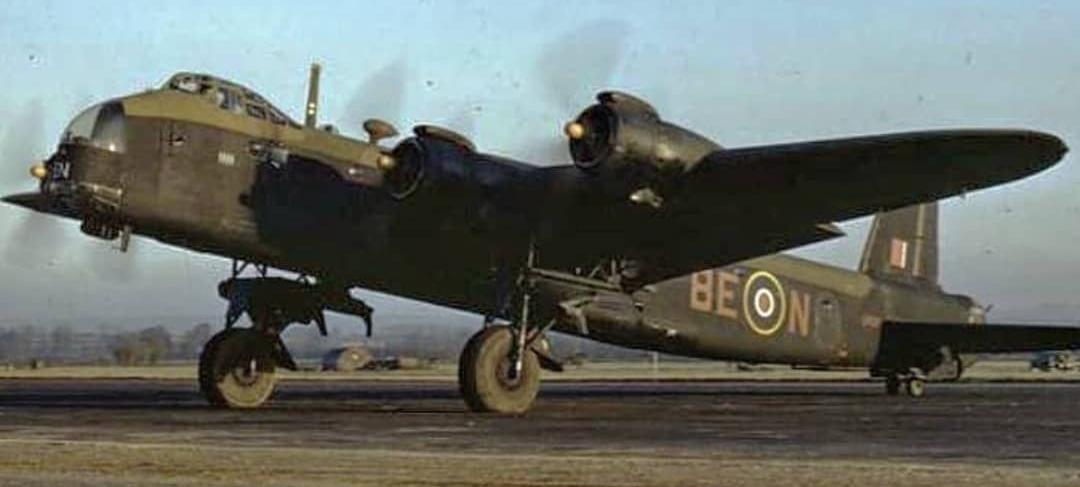
07:51 (Berlin Time)
Friday, December 13, 1940
Short Stirling MG AU
Flying low over the North Sea
“What is our altitude, Mister Shannon?”
The pilot of the Short Stirling four-engine bomber looked quickly at his altimeter, afraid of losing sight of the surface of the sea for more than a fraction of a second.
“Two hundred feet, more or less. Our altimeter is not very accurate this low.”
“You call this low?” replied playfully Nancy, sitting behind the copilot and wearing a bulky
Irvin thermal suit and a parachute, like the rest of the crew. “In the Persian Gulf War of 1990, the British Tornado fighter-bomber aircrews considered anybody flying over fifty feet as being wimps. And that was while flying at 500 knots.”
“Christ! They must have had nerves of steel.”
“Not really: that close to the ground you are flying on top of the ground effect created by
your aircraft’s shock wave. You basically float on a cushion of compressed air.” Mark Shannon looked briefly at her with newfound respect: the more he knew of her, the more he found her to be both competent and articulate.
The sixteen Short Stirling bombers of the Seventh Squadron were now sixty miles West
of the coast of Jutland and 125 miles away from their objective: Kiel. Flying lower than they had ever dared during training, the heavy bombers didn’t seem to have been detected yet. The radio operator suddenly spoke on the intercom.
“Sir, our submarine is transmitting its beacon signal, heading 084. The diversion force
has also just sent the codeword for commencement of radar jamming operations.”
“Good show! Altering course now to heading 084.”
As Shannon was steering his bomber on its new course, followed by the other fifteen Stirling, Nancy smiled to herself in satisfaction. The submarine, operating at periscope depth in view of
293
an easily identifiable landmark on the coast, would give them an accurate initial point to start their final run on Kiel. Meanwhile, the Wellington bombers feigning a raid on Cologne would first attract the attention of the German air defense system, then confuse it by releasing in midair tons of strips of aluminum foils which would create massive false echoes on German radar screens. A squadron of Beaufighter fighter-bombers were also due very soon to destroy half a dozen German coastal air defense radars, thus adding to the confusion.
Suddenly feeling an urge to empty her bladder, she asked the copilot where to go and
headed down from the cockpit. Her indignant scream made Shannon and his copilot laugh. Nancy came back in a flash.
“How am I supposed to use a funnel on a bulkhead to relieve myself?”
“I’m sorry, Colonel, but that is all we got as facilities on board bombers: after all, the
aircrews are supposed to be all male.”
She gave him a dark look, then headed back down again. The bombardier/navigator came up to the cockpit shortly after. Shannon looked at him in puzzlement.
“What are you doing up here, Berresford?”
“Well, the colonel wanted privacy while she relieved herself, so she ejected me
temporarily from downstairs. As for Mac O’Neil in the forward turret, she threatened to shoot him if he looked aft. In view of her reputation, I don’t think that Mac is about to risk a peep.”
“So, she found a way to use the funnel after all?”
“You bet she did, sir. She’s using your cup right now.”
“WHAT?”
The copilot’s laugh strangled in his throat when Shannon stared angrily at him. The pilot barely had time to cool down before Nancy came back up and sat back without a word, a grin on her face. Shannon shook his head but decided to leave it at that: she had won that exchange fair and square after all.
A few minutes later, as the coast of Jutland was clearly visible, the voice of the radio
operator came back on the intercom.
“The beacon heading has turned 180 degrees, sir: we just overflew our submarine.”
“Alright, send the codeword for starting the final run. Here we go boys… and girl!”
294
“Final heading 091, time to target at 220 knots: 15 minutes.” reminded the
bombardier/navigator. Nancy switched on her portable radio scanner and started sifting through the German communications.
“I think that I have their air defense net now, Mister Shannon. Nothing about us yet.”
“Good! Let’s see now how many cows we can scare to death between here and Kiel.”
Still followed by the rest of his squadron, Shannon, as instructed by Nancy before the mission, started flying barely high enough to avoid trees and the occasional buildings. Nancy’s stomach soon felt like she was in a roller coaster now. Twelve minutes later, the Kiel Canal came abruptly into sight. Nancy then tapped on Shannon’s shoulder.
“Time to pick up speed, Mister Shannon, but stay low.”
The squadron leader nodded and spoke on the squadron’s frequency.
“Doberman callsigns, this is Doberman one: light up your booster packs now!”
He then smiled at Nancy.
“Time to see how your gadgets perform, Colonel.”
The flight engineer sitting beside Nancy took hold of the makeshift control box connected to the two recently retrofitted underwing booster engines and flipped a switch. The intake and exhaust cover panels on the rectangular section pods lowered, letting air through the pulse jet engines. Another flip of a switch and a push on a large button started the engines. The additional ten tons of thrust shoved the crew of the Stirling against their seats. Shannon yelled in delight over the deafening motorcycle noise of the pulse jet engines. Actually a German invention intended to propel the V-1 flying bomb, a pulse jet engine was nothing more than a tube with venetian blind-like flaps at the entrance and fuel injectors in the middle. When fuel was injected inside and ignited, the pressure from the detonation closed the front flaps and forced the gases to escape through the rear, creating thrust. The front flaps opened again when pressure fell inside the tube and the sequence repeated itself. While a pulse jet engine could not work at zero airspeed, it was a very simple design to build and made a good booster engine. Nancy had the booster packs designed with their own built-in fuel tanks inside their support pylons. The only thing you had to do to install a pack was to bolt it to an appropriate point of an aircraft and to pass a set of control wires through to the cockpit.
The heavy bombers were doing over 380 knots by the time their objective was in sight,
faster than any German fighter in service at the time. The second of ‘Nancy’s gadgets’ on board was now about to be used.
295
“Doberman nine through sixteen, split up and line up on your targets now.”
While seven Stirling stayed with Shannon’s bomber to attack the Germania submarine yards, the eight other bombers formed up and headed towards the Deutsche Werke submarine yards, situated in another part of Kiel.
“Open the bomb bay!”
A pull on a lever by the copilot, Jeremy Snyders, exposed to daylight ten 500-pound bombs. The tail sections of those bombs were however of a new design imported from 2012 by Nancy. They would permit what was impossible to do with 1940-era bombs without blowing your own aircraft to bits: low level, high-speed straight bombing runs.
“Objective in sight! Bombardier, get ready!”
“Arming the bombs now!” answered Berresford on the intercom. Nancy suddenly jerked
her head up.
“They are giving the alert now on the Stade Luftgau radio net. Use those buildings as a
shield. Stay low!”
Jumping over the last row of buildings, with only fifty feet to spare, the heavy bombers flashed by bemused German air defense gunners who never had a chance to point their 88mm guns: the British were not playing by the usual rules today. The eight Stirling, chased by a few 20mm cannons firing in desperation at impossible targets, were soon about to overfly the Germania yards at an altitude of one hundred yards.
“BOMBS AWAY!” yelled Berresford, releasing the ten bombs in quick succession. As
soon as they cleared the aircraft, a timer in the bombs’ tail sections blew open the valve of a small compressed air bottle. The pressurized air then activated a piston which deployed four airbrakes around each tail sections, like the opening petals of a flower. Their aerodynamic drag suddenly increased over tenfold, the bombs quickly fell behind their bombers. Eighty 500-pound retarded bombs landed in the midst of tightly packed submarine hulls in various stages of construction and exploded. While their effects on the steel hulls were devastating, the blasts and fragments caused nothing short of a slaughter among the highly specialized yard workers and technicians of the morning shift.
Looking back at the explosions rocking the yard, Nancy yelled in the intercom. “Turn back now for a bomb damage assessment, Mister Shannon.”
The pilot complied, having already been briefed on that part prior to the mission. Taking out her Sony digital camcorder out of a canvas bag, Nancy filmed the scenes of destruction as they
296
overflew again the Germania yards before doing the same over the Deutsche Werke yards. By then, the air defense gunners were starting to get their wits back. Two 20mm shells slammed in the fuselage, but without causing any real damage. As they overflew the German naval base area of the port of Kiel, Nancy opened a side window of the cockpit and emptied in the airstream the content left in her canvas bag.
“Hey, we are dumping some papers or what?” yelled the tail gunner on the intercom.
Shannon looked with surprise at Nancy.
“What did you just do, Colonel?”
She smiled like a kid who had just made a good prank.
“Don’t worry, I was just returning something to the Germans.”
She then told Shannon about the wanted poster produced about her by the Germans. The pilot looked at her with a mixture of horror and admiration.
“You are marked for torture by the Gestapo and you still insisted on going on this
mission? You must be crazy!”
“No, just pig-headed.”
One of the papers falling from the sky was picked up on the quay by a submariner, who
then ran to bring it to his commander. KapitanLeutnant Gunther Prien, who had watched the bomber raid from the conning tower of his U-47 docked at quayside, looked at the paper and had a sardonic smile. There was a copy of the same poster prominently displayed in the submarine’s tiny officers’ mess. This one however had hand writing in German and a signature in red ink on it. He read it aloud to his men in the conning tower.
“Back with love, from Nancy.”
Prien looked in the direction where the British bomber had disappeared.
“This woman has a lot of gall. But then, I admire gall. I wish I could meet her one day.”
His first officer read the poster again.
“182 centimeters tall, black hair, green eyes. I bet you would want to meet her, sir.”
Prien shook his head as the sailors around him laughed at the crude joke.
“Hans, did you ever wonder what Germany would be like in 2012?”
“Er, not really, sir.”
“That is why I would like to meet her, Hans.”
297
19:21 (North American Central Time)
Thursday, December 19, 3383 A.D.
Campus of New Lake City University
Great Lakes area of North America
Farah Tolkonen looked at her computer screen with frustration. In all the records left
behind by Pran Osef and Telvi Ran about their time machine, she could not find the schematics for their time distorter, a key component. They must have intentionally left it out of their records so that somebody else could not duplicate their invention. However, they must have kept it on another data file, but where? She had no choice: either she found the missing schematics quickly or she would have to start designing from scratch the missing part. The way that timeline distortions were increasingly playing havoc with spacetime, she doubted that the latter solution would be attained fast enough to avoid some disaster. A number of ships had already suffered damage from spacetime ripples while traveling through the Solar system. With a sigh, Farah started the long, methodical search of the laboratory.