

The Chief by Joseph F. Roberts, ThD, PhD - HTML preview
Download the book in PDF, ePub, Kindle for a complete version.
Chapter Forty
The Chief
The Trip to Rome
Acts 26:30-32 KJV 30 And when he had thus spoken, the king rose up,
and the governor, and Bernice, and they that sat with them: 31 And when
they were gone aside, they talked between themselves, saying, This man
doeth nothing worthy of death or of bonds. 32 Then said Agrippa unto
Festus, This man might have been set at liberty, if he had not appealed
unto Caesar.
Introduction
Paul had finished his defense. With his defense presentation, he almost persuaded Agrippa to become a Christian. Almost, but not quite. When Agrippa made this statement, Paul answered that his desire was that Agrippa would be like him except for the fact that he was bound as a prisoner. With the completion of that statement, Agrippa, and court, rose and left the room.
In a later conversation between themselves, they all agreed that Paul had done nothing worthy of death or even for being imprisoned. Agrippa even stated that Paul would have been set free if he had not appealed to Caesar.
This appeal had been made, publicly granted, and therefore could only be dismissed by Caesar in Rome.
Albert Garner, quoting from Schaff, had this to say:
The result of this trial was a complete vindication of Paul before the world. Festus no doubt wrote such a favorable view of the prisoner's case as eventually brought about his
acquittal and freedom from his first Roman imprisonment. It
certainly procured him kindly treatment after his arrival in the capital (he was allowed to dwell in his own hired house
and even to receive a large number of friends and pupils there, Ac 28:17-23,30,31). From this time a kindly feeling
328
seems to have sprung up in the king's heart towards that strange Nazarene sect. Stier, in his "Words of the Apostles,"
calls attention to the fact of this Agrippa, at the outbreak of the great Jewish war, some eight or nine years after the scene at Caesarea, protecting the Christians, giving them succor, and receiving them kindly into his territory.1
Acts 27:1-13 KJV 1 And when it was determined that we should sail into
Italy, they delivered Paul and certain other prisoners unto one named
Julius, a centurion of Augustus' band. 2 And entering into a ship of
Adramyttium, we launched, meaning to sail by the coasts of Asia; one
Aristarchus, a Macedonian of Thessalonica, being with us. 3 And the next
day we touched at Sidon. And Julius courteously entreated Paul, and gave
him liberty to go unto his friends to refresh himself. 4 And when we had
launched from thence, we sailed under Cyprus, because the winds were
contrary. 5 And when we had sailed over the sea of Cilicia and Pamphylia,
we came to Myra, a city of Lycia. 6 And there the centurion found a ship
of Alexandria sailing into Italy; and he put us therein. 7 And when we
had sailed slowly many days, and scarce were come over against Cnidus,
the wind not suffering us, we sailed under Crete, over against Salmone;
8 And, hardly passing it, came unto a place which is called The fair
havens; nigh whereunto was the city of Lasea. 9 Now when much time
was spent, and when sailing was now dangerous, because the fast was
now already past, Paul admonished them, 10 And said unto them, Sirs, I
perceive that this voyage will be with hurt and much damage, not only of
the lading and ship, but also of our lives. 11 Nevertheless the centurion
believed the master and the owner of the ship, more than those things
which were spoken by Paul. 12 And because the haven was not
commodious to winter in, the more part advised to depart thence also, if
by any means they might attain to Phenice, and there to winter; which is
an haven of Crete, and lieth toward the south west and north west. 13 And
when the south wind blew softly, supposing that they had obtained their
purpose, loosing thence, they sailed close by Crete.
329
Beginning the Trip to Rome
Beginning with Acts Twenty-seven, the account of Paul’s journey to Rome takes place. Beginning with chapter twenty-seven, Luke again begins to write using the first person, meaning that he was once again with Paul. I would suppose that he had unable to be with Paul because Paul was bound, meaning in prison, for the majority of time with Felix.
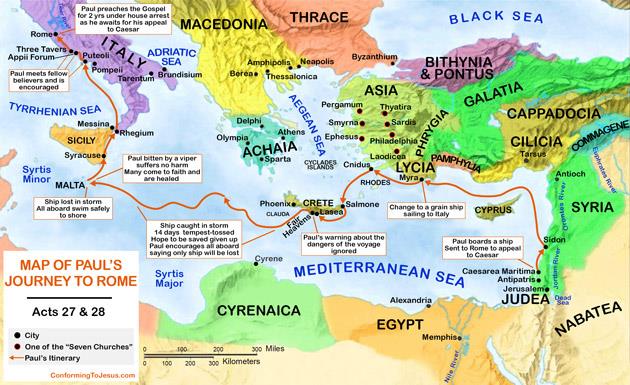
I like the account of this portion of the journey that is given by the writer on the website, conformingtojesus.com.
Paul's Fourth Journey to Rome is recorded in Acts 27 and
28.
The circumstances of Paul's Voyage to Rome were far different from his earlier travels. Before, he was a free man; this time, he was a prisoner of the Romans.
The Journey to Rome began in early fall of 59 A.D. and ended the following spring of 60 A.D. after a shipwreck in
the Mediterranean Sea near Malta.
After Paul's arrival in Jerusalem at the end of his Third Missionary Journey, he went up to the Temple where some
"Asian Jews" stirred up a riot against him and he became involved in a serious conflict with them, but a Roman officer arrested him and took him to safety saving his life.
The conflict eventually led to Paul being detained by the Romans and imprisoned in Caesarea for two years.
From that moment on, Paul remained in custody, until he invoked his right as a Roman citizen to appeal his case to Caesar himself. So the governor arranged for Paul to be taken by ship to Rome under escort and as a prisoner on charges of sedition and causing serious unrest in Jerusalem.
330
Paul, along with some other prisoners, was delivered to a centurion of the Augustan Regiment named Julius and
boarded a ship of Adramyttium.
The winter season was approaching, but this did not prevent
it from setting sail from Caesarea; the route skirted Sidon and the island of Cyprus, Cilicia and Pamphylia, with transshipment on an Alexandrian ship at Myra in Lycia (modern day Turkey).
Along the way, they stopped at the southern coast of Crete,
off Salmone, for safe harbor. The centurion and the owner of
the ship chose not to wait out the weather at Fair Havens, near the city of Lasea, as they should have, and headed for
the port of Phoenix, a harbor on the island of Crete. Paul warned them that the journey was going to end in
catastrophe.
Acts 27:10 - "Paul advised them, saying: 'Men, I perceive that this voyage will end with disaster and much loss, not only of the cargo and ship, but also our lives'."
However, the centurion did not listen to Paul, he chose to listen to the owner of the ship and the helmsman instead and
the ship set sail.
331
THE CHIEF
Shortly after, a catastrophic storm took control of the ship and after about fourteen days tossed at sea, losing the entire cargo, the ship was driven to wreck in Malta. There they swam to land and Paul, the crew, the soldiers and all the prisoners on board, two hundred and seventy-six people total, were all saved miraculously.
In Malta, they stayed for three months until the arrival of spring, so Paul had a chance to spread the Gospel message
there, as well, and healed many of their sicknesses and diseases.
Finally, the following spring, Paul sailed from Malta in an
Alexandrian ship to Italy after the shipwreck.2
332
We find from all this information that Paul and his fellow prisoners were turned over to the authority of a centurion by the name of Julius. Julius seemed to be on a detachment duty that worked out of Rome, for Caesar into the various Roman provinces. Julius treated Paul with special courtesy throughout the voyage to Rome. Because of the location and timing, it is possible that he had heard Paul give his defense before Agrippa.
Dr. Garner has this to say concerning Julius, the Centurion of Augustus’
band.
"Of Augustus' band." … "Of a Roman cohort or band of Augustus Caesar," referring to distinguished troops belonging to the Emperor, thought to be working for Caesar
on confidential business matters, traveling between the imperial city of Rome, and various Roman provinces, men
of high secret intelligence kind, and serving as a body-guard band for Caesar on special occasions.4
This cohort of Roman soldiers would be Paul’s escort to Rome. Besides these, Aristarchus, a Macedonian of Thessalonica, once called “Paul’s companion in travel,” in Acts 19:29, was also with Paul. We are not told just why except that he had been with Paul in several places, in Ephesus, his fellow-laborer, Philemon 1:24, and his “fellow-prisoner” in Rome, according to Colossians 4:10. He, along with Gaius, was also seized by the mob in the uproar in Ephesus, according to Acts 19:29. Is it possible that he was also now a prisoner like Paul, but under different circumstances than Paul? Unfortunately, we have no means to determine definitively.
Some seventy miles north of Caesarea, the ship docked at Sidon. It is thought that there was some merchandise to be taken on and maybe even off-loaded at this port. Regardless of the reason, there was an amount of time for Paul to leave the ship and visit with his friends in Sidon. The scripture uses the phrase "to refresh himself.” This was probably for the purposes of cleanliness, bathing, a haircut, clothing, and or medical needs 333
for himself. We really do not know what Paul’s needs were at this point, but he had time to fellowship with the disciples located at Sidon for a short time.
They changed ships at Myra. Apparently, Julius had the responsibility for securing safe travel for all the prisoners under his authority for the trip to Rome. Regardless, he found a ship from Alexandria that was sailing to Italy. Luke uses the pronoun “us” indicating that in addition to the other prisoners, Luke and Aristarchus were included in the number.
Concerning this ship, Albert Garner had this to say:
The continuous story told by these verses is not seen till they are thus combined. We find that the vessel was a ship of Alexandria, sailing into Italy. We read of the lading; it was therefore a merchant vessel. The cargo, whatever it was (we
do not discover this till afterwards), was so valuable that it was only cast overboard in the last extremity. By-and-by we
discover that that cargo was wheat. One by one these circumstances drop out "at intervals in the course of the narrative,
unarranged,
unpremeditated,
thoroughly
incidental; so that the chapter might be read twenty times, and their agreement with one another, and with
contemporary history, be still overlooked." Now how does this consistent narrative coincide with known facts of history? Thus: - Egypt was the great corn-producing country
of antiquity. It sometimes grew corn enough in one year to
last for two, and supply other countries. The famine-stricken Israelites went down to the valley of the Nile to buy corn in the days of Joseph. In the days of Paul it was the granary of Rome. It was from the Egyptian port of Alexandria that this
vessel sailed. Suetonius tells us that in times of scarcity the vessels coming from that port to Italy were watched with intent anxiety as they approached the coast. What was by no
means usual in the vessels of that day, these merchant ships
of Alexandria were in size almost equal to our old men-of-
334
war, and might therefore well accommodate the centurion and his numerous party, in addition to its own crew and lading.5
Conclusion
We will continue our look at the journey in the next part.
1 Albert Garner, Power BibleCD, 3.8a, his comments on Acts 26
2 https://www.conformingtojesus.com/charts-maps/en/paul's_journey_to_rome_map.htm 3 Map, IBID
4 Albert Garner, Power BibleCD, 3.8a, his comments on Acts 27:2
5 IBID, his quote from Bible Lore
335