

The Chief by Joseph F. Roberts, ThD, PhD - HTML preview
Download the book in PDF, ePub, Kindle for a complete version.
Chapter Thirty-Five
The Chief
The Threat
Acts 23:16-35 KJV 16 And when Paul's sister's son heard of their lying
in wait, he went and entered into the castle, and told Paul. 17 Then Paul
called one of the centurions unto him, and said, Bring this young man
unto the chief captain: for he hath a certain thing to tell him. 18 So he
took him, and brought him to the chief captain, and said, Paul the
prisoner called me unto him, and prayed me to bring this young man unto
thee, who hath something to say unto thee. 19 Then the chief captain took
him by the hand, and went with him aside privately, and asked him, What
is that thou hast to tell me? 20 And he said, The Jews have agreed to desire
thee that thou wouldest bring down Paul to morrow into the council, as
though they would enquire somewhat of him more perfectly. 21 But do
not thou yield unto them: for there lie in wait for him of them more than
forty men, which have bound themselves with an oath, that they will
neither eat nor drink till they have killed him: and now are they ready,
looking for a promise from thee. 22 So the chief captain then let the young
man depart, and charged him, See thou tell no man that thou hast shewed
these things to me. 23 And he called unto him two centurions, saying,
Make ready two hundred soldiers to go to Caesarea, and horsemen
threescore and ten, and spearmen two hundred, at the third hour of the
night; 24 And provide them beasts, that they may set Paul on, and bring
him safe unto Felix the governor. 25 And he wrote a letter after this
manner: 26 Claudius Lysias unto the most excellent governor Felix
sendeth greeting. 27 This man was taken of the Jews, and should have
been killed of them: then came I with an army, and rescued him, having
understood that he was a Roman. 28 And when I would have known the
cause wherefore they accused him, I brought him forth into their council:
29 Whom I perceived to be accused of questions of their law, but to have
nothing laid to his charge worthy of death or of bonds. 30 And when it
was told me how that the Jews laid wait for the man, I sent straightway to
288
thee, and gave commandment to his accusers also to say before thee what
they had against him. Farewell. 31 Then the soldiers, as it was
commanded them, took Paul, and brought him by night to Antipatris. 32
On the morrow they left the horsemen to go with him, and returned to the
castle: 33 Who, when they came to Caesarea, and delivered the epistle to
the governor, presented Paul also before him. 34 And when the governor
had read the letter, he asked of what province he was. And when he
understood that he was of Cilicia; 35 I will hear thee, said he, when thine
accusers are also come. And he commanded him to be kept in Herod's
judgment hall.
Introduction
In the last part we saw where forty Jews who vowed not to eat or drink until they had killed Paul, asked the leaders of the council to ask for Paul to be brought down to the council meeting area so that they could question him again. These potential assassins would then ambush Paul and his soldier escorts, killing Paul. The plans of men may be simple or complex, but God has His own plans that may or may not coincide with man’s. In this case, He overrode the plans of these evil men.
The Plot
16 And when Paul's sister's son heard of their lying in wait, he went and
entered into the castle, and told Paul.
Paul had a nephew that is believed to have been in school in Jerusalem. Dr.
Albert Garner has this to say.
"Then when the son of Paul's sister (his nephew) heard of the treachery, conspiracy, or devious plot," of those lying in wait by the castle, fort, or barracks stairs. Very little is often known of relatives of great men, but the quiet servants will
too be rewarded one day… "He went and entered directly into the castle-fort," where Paul was being held in security barracks, under supervision of the centurion. He went of his
289
own volition, care, concern, and of his own life. That he was able to see Paul indicates that Paul was more a man under
protection of the law than a prisoner in custody. "He reported it (the plot) to Paul." He gave to Paul the report of a collusion for his death, by means of a trial or tripartate conspiracy of: 1) The more than forty Jews who vowed under a curse to be
the trigger men, 2) The chief priests and elders who were to
call for Paul to come down, be brought down from the fort
to them, and 3) The chief captain who was to be influenced
to lead Paul down on the "death march." It is believed that Paul's nephew was in school in Jerusalem, as Paul had been
a generation before, and that some of the students were monitoring actions surrounding the council, and found out about the conspiracy, then related it to Paul's nephew, who
secured access to visit Paul in the castle for the above disclosure.1
When Paul heard what his nephew said, he called the centurion who was on duty at that time and asked him to take his nephew to see the chief captain because he had some news that fell under the chief captain’s authority. The nephew was then taken to the chief captain and gave him the information that he had given Paul.
The chief captain took the young man aside so that they could speak privately and encouraged him to tell him the message. The centurion did not know what the conversation was and was still in the dark concerning the situation. Paul’s nephew related the information to the chief captain.
Ac 23:20 And he said, The Jews have agreed to desire thee that thou
wouldest bring down Paul to morrow into the council, as though they
would enquire somewhat of him more perfectly. 21 But do not thou yield
unto them: for there lie in wait for him of them more than forty men,
which have bound themselves with an oath, that they will neither eat nor
290
drink till they have killed him: and now are they ready, looking for a
promise from thee.
The chief captain let the nephew go making him promise that he would not tell anyone that he had let the chief captain know about it. He then commanded two centurions to prepare two hundred soldiers to go to Caesarea, and seventy calvary, and two hundred spearmen to accompany them. They were to depart at approximately 9:00 PM (at the third hour of the night). This number of 470 escorts was designed to guard against any unexpected surprise attack that might be attempted. It is apparent that one centurion would command the calvary while the other would be in charge of all the foot soldiers. They would only travel by night and would make their first stop at Antipatris. A horse, or mule, would be provided for Paul and his belongings for the trip. He was to be taken to Felix, the governor.
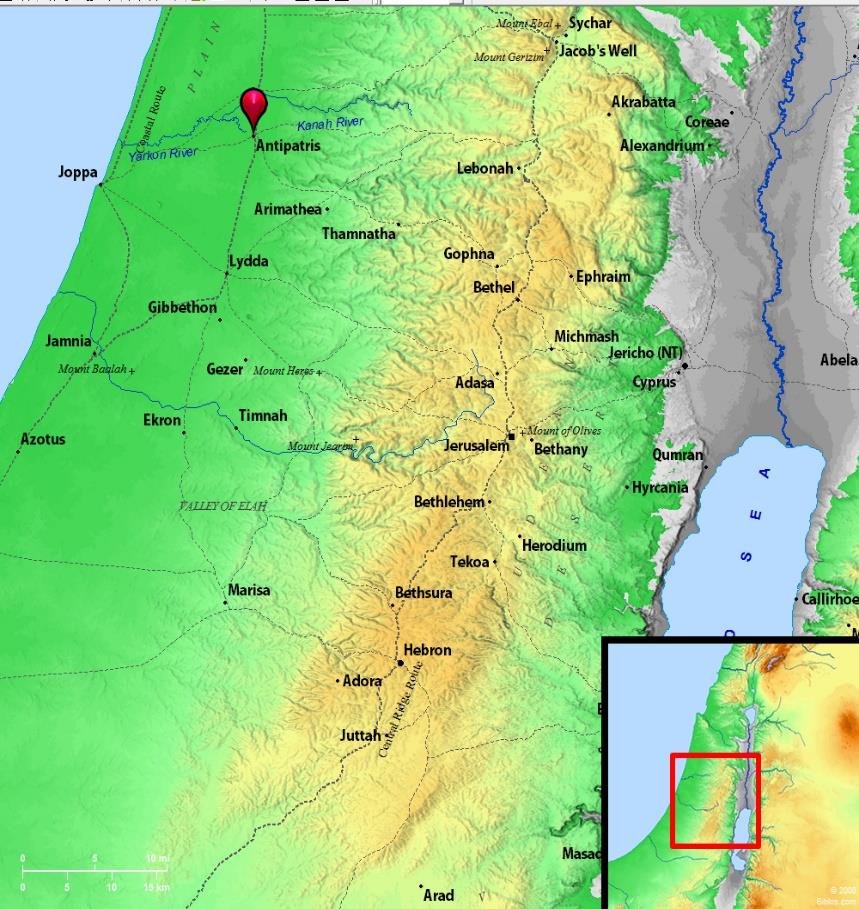
Antipatris Is mentioned in Scripture only once, in connection with the descent of Paul from Jerusalem to Caesarea (Acts
23:31). References will be found in Ant, XIII, xv 1; XVI, v, 2; BJ, I, xxi, 9. It was a town built by Herod the Great, and called after his father Antipater. It is probably identical with the modern Ras el-Àin, "fountain head," a large mound with ruins at the source of Nahr elÀujeh, in the plain to the Northeast of Jaffa. There are remains of a crusading castle
which may be the Mirabel of those times.2
291
THE CHIEF
Antipatris and surrounding region3
The chief captain wrote a letter to the governor, Felix, as to why Paul was being sent to him.
Acts 23:26-30 KJV 26 Claudius Lysias unto the most excellent governor
Felix sendeth greeting. 27 This man was taken of the Jews, and should
have been killed of them: then came I with an army, and rescued him,
having understood that he was a Roman. 28 And when I would have
known the cause wherefore they accused him, I brought him forth into
their council: 29 Whom I perceived to be accused of questions of their
law, but to have nothing laid to his charge worthy of death or of bonds.
30 And when it was told me how that the Jews laid wait for the man, I sent
292
straightway to thee, and gave commandment to his accusers also to say
before thee what they had against him. Farewell.
Paul would remain in Felix’s prison for some two years. Here is what history would say concerning Felix.
Antonius Felix was formerly a slave but was promoted by
Claudius Caesar to the office of governor. The Roman
historian Tacitus described Felix as “cruel, licentious, and base.” While in Judea, Felix was attracted to Drusilla, a daughter of Herod Agrippa I. The fact that Drusilla was already married made no difference to Felix. He enticed her
away from her husband, Azizus, and they later married.
Felix was the governor of Judea and Samaria when the apostle Paul was arrested in Jerusalem for preaching the gospel (Acts 23:35). Because a mob was planning to kill Paul before he could come to trial, the Roman commander
hustled Paul away in the night, accompanied by two hundred
soldiers, to Caesarea so that his case could be heard by Governor
Felix
(Acts
23:23–24).
When Paul arrived in Caesarea, Felix the governor read an
explanatory letter from the Roman commander who had sent
Paul there, asked what province Paul was from, and then postponed his hearing until Paul’s accusers could be present
(Acts 23:33–35). Five days later, a company arrived; it included Ananias the high priest, some Jewish elders, and a
hired lawyer named Tertullus. Once the proceedings had begun, Tertullus and the Jewish leaders accused Paul of being a troublemaker who had attempted to desecrate the temple (Acts 24:5–6). Given his turn to speak, Paul politely
denied the charges against him. He also pointed out that his
actual accusers, Jews from Asia, were not present and that
293
he had not been found guilty of any crime before the Sanhedrin
in
Jerusalem
(Acts24:17–21).
Felix was well informed about this new sect of Jesus’
followers called the Way, and when he heard that Paul’s case
involved questions of religion, he adjourned the hearing until the Roman commander who had arrested Paul could be
present (Acts 24:22). Paul’s words must have intrigued Felix, because a few days later he summoned Paul to hear
more of his teaching. Felix and Drusilla both “listened to
[Paul] as he spoke about faith in Christ Jesus” (Acts 24:24).
But when conviction came through Paul’s words, Felix grew
afraid and ordered him to stop talking. Although he gave Paul some freedom by allowing his friends to tend to his needs, Felix kept Paul in jail for two years, ostensibly waiting for a more “convenient” time (Acts 24:25). In reality, Felix was hoping for a bribe from Paul, but one never came. When Felix was replaced as procurator, he left Paul in
jail for his successor, Porcius Festus, to deal with.
It could be that another reason Felix left Paul in jail was that he was reluctant to pronounce judgment on a man who was
clearly innocent. Or possibly he did so to please Drusilla. A fear of political backlash from the Jews was also a factor (Acts 24:27). Upon his loss of the governorship, Felix was
summoned to Rome where certain of his former Jewish
subjects accused him of cruelty and corruption. Felix was found guilty but was spared the death penalty.4
The foot soldiers left Paul and the calvary at Antipatris and returned to Jerusalem while the remainder traveled on to Caesarea. The calvary delivered Paul into the custody of Felix, the governor.
294
When Felix read the letter from Lysias, he questioned Paul as to where he was from originally, Felix stated that he would hear Paul’s case but only when his accusers also come to Caesarea. Paul was then detained in Herod’s judgment hall.
Conclusion
In the next part we will see the trial of Paul before Felix.
1 Albert Garner, Power Bible CD, his comments on Acts 23:16
2 W. Ewing, International Standard Bible Encyclopedia,
https://www.biblestudytools.com/dictionary/antipatris/
3 https://bibleatlas.org/full/antipatris.htm
4 https://www.gotquestions.org/Felix-in-the-Bible.html
295