

The Chief by Joseph F. Roberts, ThD, PhD - HTML preview
Download the book in PDF, ePub, Kindle for a complete version.
Chapter Thirty
The Chief
Paul Continues His Journey
Acts 20:1-6 KJV 1 And after the uproar was ceased, Paul called unto him
the disciples, and embraced them, and departed for to go into Macedonia.
2 And when he had gone over those parts, and had given them much
exhortation, he came into Greece, 3 And there abode three months. And
when the Jews laid wait for him, as he was about to sail into Syria, he
purposed to return through Macedonia. 4 And there accompanied him
into Asia Sopater of Berea; and of the Thessalonians, Aristarchus and
Secundus; and Gaius of Derbe, and Timotheus; and of Asia, Tychicus
and Trophimus. 5 These going before tarried for us at Troas. 6 And we
sailed away from Philippi after the days of unleavened bread, and came
unto them to Troas in five days; where we abode seven days.
Introduction
We have seen previously that Paul had left to go to Macedonia. He travelled through those parts giving much exhortation to those churches. Several of the men who were currently travelling with Paul were sent ahead to await him and Luke in Troas. These men were also involved in the collection of funds that were designated for those needy brethren in Judea.
It is believed that the book of Romans was written during those three months that Paul spends in Corinth in Greece. Paul had to make a change in his plans when word reaches him that the Jews were laying a trap for him if he sailed to Syria. Therefore, he went through Macedonia, where he departed from Philippi after the Passover was observed.
Luke records that it took five days to make the sea voyage from Philippi to Troas. Normally, a trip like that would only take two or three days. We are not told why, but probably because contrary winds and sea conditions caused the extra time to arrive.
248
The Incident at Troas
Troas was the meeting place for Paul and the rest of the company travelling with him. They remained in Troas for seven days. During those seven days, Paul preached, taught, and fellowshipped with the brethren of the church there.
Acts 20:7-12 KJV 7 And upon the first day of the week, when the disciples
came together to break bread, Paul preached unto them, ready to depart
on the morrow; and continued his speech until midnight. 8 And there
were many lights in the upper chamber, where they were gathered
together. 9 And there sat in a window a certain young man named
Eutychus, being fallen into a deep sleep: and as Paul was long preaching,
he sunk down with sleep, and fell down from the third loft, and was taken
up dead. 10 And Paul went down, and fell on him, and embracing him
said, Trouble not yourselves; for his life is in him. 11 When he therefore
was come up again, and had broken bread, and eaten, and talked a long
while, even till break of day, so he departed. 12 And they brought the
young man alive, and were not a little comforted.
There is in Troas a practice that was to become a standard for churches throughout the centuries. The church at Troas met on the first day of the week, namely Sunday, to worship, observe the Lord’s Supper, etc. Paul planned to leave Troas the next morning to resume his journey to Jerusalem.
As such, he was asked to preach to them that evening.
The meeting was in the evening, and they gathered in a building that had at least three stories. It was well lit, verse eight stating that there were “many lights” in the upper chamber. This could well indicate that the crowd was large. Paul, since this would be the last time that he would ever see these disciples until they were all in heaven, waxed long in his message. Verse seven gives us the information that Paul preached until midnight. The windows were open, there being no glass or lattice, or shutter of wood, being open no doubt for ventilation. On the third floor, a young man by the 249
name of Eutychus, sat in an open window, went to sleep, and fell out of the it. Verse nine indicates that the young man was dead as a result of the fall.
These passages, verses nine and ten, present a dilemma. Was Eutychus actually dead or was he just knocked out and needed a little time to recover?
From examining the Greek words used, it would seem that he was indeed dead.
The concern is that normally a disciple or apostle, who had the God-given ability to raise someone from the dead, would only do so that it would prove to those who were witnesses that the disciple or apostle was indeed of God and that those who were witnesses would come to know Jesus as Saviour.
We are not told, but there is a strong possibility that Eutychus was a believer and a member of the church there at Troas. Additionally, the members of the church were there in attendance and were witnesses to the event. Paul was supposedly well known to the church at Troas, so he did not need to establish himself as to who he was and who he represented.
During the time of his ministry, Paul had not cured anyone of their sickness who were disciples. He did not heal Timothy who was his fellow servant and traveling companion. There was another disciple who he did not heal, but instead was forced to leave that disciple because he was ill. As far as I can determine, this was the only time that Paul raised someone from the dead.
Therefore, that leads us to only Biblical explanation reasonable: that there were those present who were not believers nor disciples and did not know Paul as many, if not most, of the members of the church did. Otherwise, Paul and others would have violated the use of their God-given miraculous powers. Since we know from Scripture that they did not, then we must conclude that there were those present, and possibly even Eutychus, were not believers nor disciples. This incident would have solidly proven that Paul was the genuine item.
The Journey Continues
250
THE CHIEF
Paul, after the incident with Eutychus, went back to the facility and continued to talk with many until it was daylight, after which, he departed.
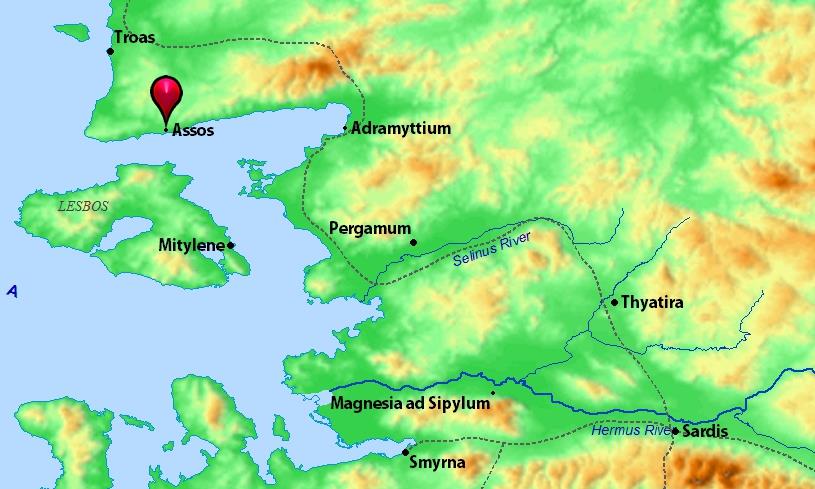
His traveling companions boarded a ship and sailed to Assos. Paul did not accompany them because he wanted to go overland to Assos instead of sailing aboard ship. We are not given a reason why he wanted to walk some twenty miles rather than sailing, but that is what he preferred to do. This would have been approximately a day’s journey.
Map by BibleAtlas.org.
Regardless of the reason, Paul soon met his companions in Assos. From the sentence construction of verse fourteen, his party seemed to have arrived in Assos before him. When Paul arrived, Luke relates to us that they then went to Mitylene.
251
From Mitylene, they sailed to Chios, an island in the Aegean Sea just five miles off the coast of Asia. From Chios, they sailed to Samos. Samos was another island in the Aegean Sea. From there they arrived at Trogyllium.
Apparently, they spent the night there because verse fifteen states that the next day they arrived in Miletus.
Paul was determined to reach Jerusalem by the day of Pentecost, according to verse sixteen. Because of this, they did not stop at Ephesus but continued on to Miletus.
Asian Elders
Acts 20:17-27 KJV 17 And from Miletus he sent to Ephesus, and called
the elders of the church. 18 And when they were come to him, he said
unto them, Ye know, from the first day that I came into Asia, after what
manner I have been with you at all seasons, 19 Serving the Lord with all
humility of mind, and with many tears, and temptations, which befell me
by the lying in wait of the Jews: 20 And how I kept back nothing that was
profitable unto you, but have shewed you, and have taught you publickly,
and from house to house, 21 Testifying both to the Jews, and also to the
Greeks, repentance toward God, and faith toward our Lord Jesus Christ.
22 And now, behold, I go bound in the spirit unto Jerusalem, not knowing
the things that shall befall me there: 23 Save that the Holy Ghost
witnesseth in every city, saying that bonds and afflictions abide me. 24 But
none of these things move me, neither count I my life dear unto myself,
so that I might finish my course with joy, and the ministry, which I have
received of the Lord Jesus, to testify the gospel of the grace of God. 25
And now, behold, I know that ye all, among whom I have gone preaching
the kingdom of God, shall see my face no more. 26 Wherefore I take you
to record this day, that I am pure from the blood of all men. 27 For I have
not shunned to declare unto you all the counsel of God.
From Miletus, Paul sent a message to Ephesus for the Elders to come and see him. Dr. Albert Garner has this to say concerning the meeting.
252
"He summoned (called ahead for) the elders of the church;"
The term "the church" is used in institutional sense, it appears in this context. The phrase "the elders of the church"
refers to the elders, plurality of ordained leaders, not only in the church at Ephesus, but also likely those of other nearby
congregations, to come and meet him for his special final address to them, as overseers of congregations in Asia…
An Elder was a Bishop or overseer, only when elected to the
office of Bishop, or overseer of a church. The terms are not
synonymous, as asserted by Protestants and protestant-
baptists. All Bishops are elders, but all elders are not bishops, just as all fathers are men, but all men are not fathers, and as all mothers are women, but all women are not
mothers, and as all army officers are soldiers, but all soldiers are not army officers.1
Concerning the subject “Elders,” Dr. Garner gives this further explanation.
The term "elder," as used in the New Testament relating to ordained workers for a local congregation, involves persons
ordained to be set in either the office of bishop (pastor) or the office of deacon, as described in 1 Timothy 3 and Titus
2. Only these two New Testament church offices are
mentioned in the Scriptures.
A plurality of elders, ordained church leaders, in the matter of teaching and worship, is appropriate in every church. The
elders who ruled in word and doctrine (as pastors or bishops) were to be considered worthy of double honor, 1Timothy 5:17. The necessary inference is that there were some elders
who ruled in other areas, than specifically that of the Word
and doctrine.
Let it be noted that no bishop or pastor was ever spoken of
as or commanded to rule over the church of the Lord, as a
253
ruler, in the singular, alone. While the bishop, (pastor, episcopia) is the overseer of the congregation, those who rule are continually referred to in the plural,…
As Paul and Timothy ordained "elders in every city," it is believed that it is still wisdom to have a plurality of ordained, set apart, qualified elders in every church to serve as teachers, leaders, and rulers, by power of Christian influence and positional honor placed upon them by the vote and confidence of the congregation.2
Conclusion
In the next part, we will consider the final address that Paul gave to the Ephesian brethren while at Miletus. We will also see his journey continued as he presses on toward Jerusalem.
1 Albert Garner, Power Bible CD, his comments on Acts 20:17
2 IBID, Introduction to 1 Timothy
254