

THE LITTLE WAY of Thérèse the Little Flower by Samuel Bastian - HTML preview
Download the book in PDF, ePub, Kindle for a complete version.
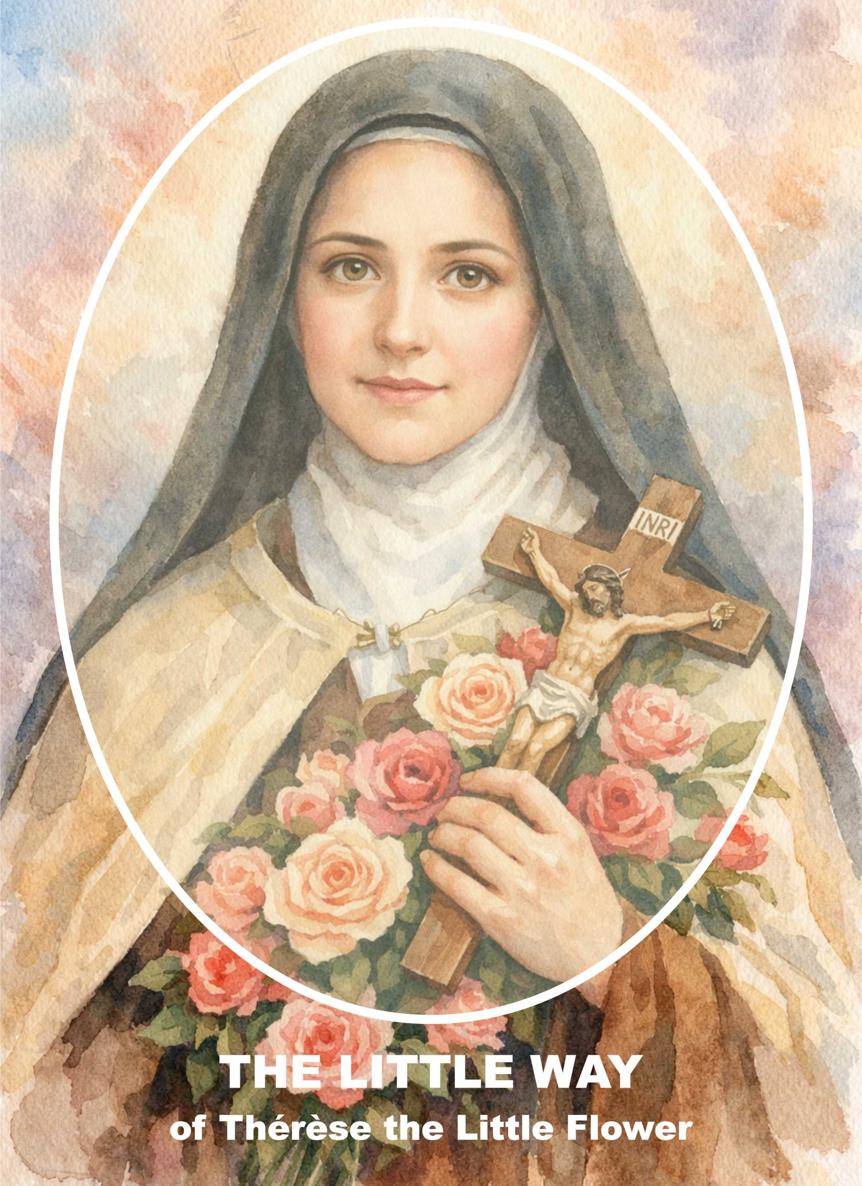
St Thérèse of Lisieux is affectionately known as St Teresa the Little Flower because in art she is depicted holding roses along with the crucifix. The flowers symbolize her promise to “let fall a shower of roses” after her
death—her way of expressing that she
would continue to send graces and blessings from heaven. (AI GENERATED IMAGE.)
Cover Design by Ita Digital Artsource
Thérèse of Lisieux
The Gospel of Littleness
Spiritual Childhood
Founded on the Gospel
Humility
Poverty
Trust and Confidence
Love -PART 1
Love -PART 2
Holy Abandonment
Zeal
Innocence and Simplicity
Act of Offering to Merciful Love
I will come down” she said
(To the Original French edition by Fr Gabriel Martin MDP—1923)
▢
If Thérèse of Lisieux had lived, she would have turned fifty this year, 1923—the same year she is being beatified.
It’s true that other young saints have reached holiness and been raised to the altars in a short time. What makes Thérèse’s story unique, however, is the remarkable worldwide movement her cause has sparked. From every corner of the globe—developed and developing nations alike, from people of every social class—countless heartfelt petitions have poured into the Vatican, asking the Church to honor this humble Carmelite nun who died quietly in Lisieux on September 30, 1897.
At the time of her death, she had done nothing outwardly remarkable and was virtually unknown beyond her own monastery.
This astonishing response can partly be explained by the extraordinary number of favors and miracles attributed to her intercession. But those graces themselves call for an explanation. God does nothing without purpose,1 and he does not grant miracles so abundantly without serious reason.
In God’s plan, a miracle serves as a letter of recommendation that authenticates his messengers. The ‘shower of roses ’
Thérèse promised before she died—and has been faithfully sending for the past twenty-five years—is the visible sign that she truly has a divine mission.
1
"So shall my word be that goes out from my mouth; it shall not return to me empty, but it shall accomplish that which I purpose, and shall succeed in the thing for which I sent it." (Isaiah 55:10–11) Grace is the living proof of this: Christ accomplished salvation, and the grace poured out through Him continues to achieve its purpose in and through every soul that receives it.
Shortly before her death, she explained that mission clearly:
“I feel that my mission is about to begin—to make people love God as I love him… to teach souls my little way. I will spend my heaven doing good on earth. I won’t rest until the end of the world. Only when the angel announces ‘Time is no more!’ will I finally rest and rejoice, because the number of the elect will be complete.”
When asked what this “little way” was, she replied:
“It is the way of spiritual childhood, the way of trust and complete self-surrender. I want to show others the simple means that worked so well for me. There is only one thing to do on earth: throw flowers—that is, perform little acts of love and sacrifice—
before Jesus, and win him with caresses. That’s how I won him, and that’s why he will receive me so well.”
°°°
This book is written to make Thérèse’s little way of spiritual childhood better known. It is intended for all serious Christians, but especially for the little souls she loved so much—ordinary people who are not called to imitate the dramatic achievements of the great saints, but who can still walk the path of holiness through the simple, everyday way.
The greatness of this Little Way is that it brings the heights of Divine Love within reach of anyone who truly desires it.
I wrote this book for two main reasons. First, to offer a new, very easy and very clear path to heaven for souls who long for perfection but often feel discouraged because the spiritual life seems too complicated and difficult. Second, out of deep gratitude.
Thérèse prayed and suffered greatly for the sanctification of priests while on earth, and I joyfully acknowledge her as my heavenly benefactress. This book is my heartfelt thank you.
I was initially hesitant, worried I might not faithfully express her true spirit. But those who knew her best—her family and the sisters who lived with her from childhood until her final hours—have kindly assured me that I have captured her heart and thoughts accurately. Only with their encouragement have I decided to publish this work.
My goal was not to write a complete treatise on the spiritual life, but simply to highlight an especially accessible path to holiness.
This book therefore focuses directly on the little way of spiritual childhood.
To truly absorb Thérèse’s spirit, I strongly recommend going back to the source and carefully reading her autobiography, Histoire d’une Âme [STORY OF A SOUL]
For even richer insight, I also highly recommend the beautiful collection recently published by the Carmel of Lisieux: L’Esprit de la Bienheureuse Thérèse de l’Enfant Jésus, d’après ses écrits et les témoins oculaires de sa vie [THE SPIRIT OF BLESSED THÉRÈSE
OF THE CHILD JESUS, DRAWN FROM HER WRITINGS AND EYEWITNESS
ACCOUNTS]. It gathers her thoughts and sentiments like precious gems in a treasure chest. Spending time with it will bring great spiritual fruit. ■
“Here, then, is a way which, without giving to everyone assurance of reaching the heights to which God has led Thérèse, is not only possible, but easy for all. As St Augustine remarks, not everyone can preach and perform great works, but who is there that cannot pray, humble himself, and love?” (Homily of Pope Pius XI at the Canonization of St Thérèse of Lisieux, 17 May 1925)
▢
The thoughts and reflections contained in the Forward and the main Book were originally written in French in 1923 by Fr Gabriel Martin MDP under the title The Little Way of Spiritual Childhood. 2
That same year, the Carmelites of Kilmacud, Dublin, Ireland produced an English translation. While faithful to the original, their version reflects the style of its time—rich, but often difficult for modern readers to grasp and flow with the thoughts of the writer.
°°°
Fr Martin’s work appeared in the very year St Thérèse of Lisieux was beatified in April. Probably, inspired by this event, he sought to illuminate her Little Way for the wider Church, offering a guide to spiritual childhood at a moment when devotion to the saintly Thérèse was blossoming. His book was published in September of that same year, carrying forward the fragrance of her sanctity.
In preparing this edition, I have taken Fr Martin’s translated text and rendered it in contemporary language. [This has resulted in a shorter book than the original English translation.] My purpose has not been to change his thought, but to make it accessible and beneficial to today’s reader.
2
A spiritual guide that emphasizes a simple and humble approach to holiness. It draws inspiration from the writings of St Thérèse of Lisieux, focusing on key virtues such as humility, poverty, and complete trust in God's mercy. The book encourages readers to live a life of love and surrender to God, making it accessible to anyone seeking to deepen their spiritual journey. It includes extensive quotations from Thérèse's writings and poetry, and aims to foster a deep intimacy with God through everyday actions and practices.
Every idea, every reflection, every spiritual insight remains his; only the style has been reshaped so that his contemplation on Thérèse thoughts and life may be known more clearly in our time.
This book then both faithful and fresh: faithful in preserving insights of Fr Martin, yet fresh in its expression. It stands as a bridge between the year of Thérèse’s beatification and our own time—when she is honored now as a Canonized Saint, the Patron of Missionaries and a Doctor of the Church.3
My own original contribution to this volume consists of this Preface, the Brief Biography of Thérèse, the Footnotes, the Prologue, the Epilogue and the Overview.
My hope is that you will not only enjoy reading these pages but will also be enriched by the life and teachings of St Thérèse, who, through God’s merciful love, has shown us the simplest pathway to eternal life—a pathway marked not by greatness or achievement, but by littleness: the humble trust of a child, the hidden acts of love, and the quiet surrender that lead us along the little or narrow way 4 to eternal life. Only small souls can pass through, not the bloated ones. For it is in the stripping away of pride, ambition, and self-reliance that the soul becomes little enough to enter.
Fr Martin’s original footnotes are referenced within [ ]. ■
3
A title bestowed by the Catholic Church upon certain saints whose writings or teachings hold universal importance for guiding Christian faith and doctrine. Such saints are recognized for their profound theological or spiritual insight, fidelity to Catholic teaching, and outstanding holiness, and their teaching continues to benefit the universal Church across time and cultures.
4
"Enter through the narrow gate. For wide is the gate and broad is the road that leads to destruction, and many enter through it. But small is the gate and narrow the road that leads to life, and only a few find it."(Matthew 7:13-14) In John 14:6: Jesus declares, "I am the way, the truth, and the life. No one comes to the Father except through me," linking the narrow way to love of Jesus.
Thérèse of Lisieux
▢
St Thérèse of the Child Jesus and the Holy Face, lovingly called the Little Flower, was born on January 2, 1873 in Alençon, France, the youngest of nine children of Louis and Zélie Martin.
Both parents were deeply devout and would themselves be canonized in 2015.
Of the nine children, only five survived to adulthood, and all five daughters became nuns. Four—Pauline, Marie, Céline, and Thérèse—entered the Carmelite convent in Lisieux, while Léonie joined the Visitandines in Caen.
This remarkable family of saints lived lives of consecration, prayer, and sacrifice.
Thérèse’s childhood was tender and sensitive. When her mother died in 1877,5 the family moved to Lisieux, where her sisters helped raise her. She was affectionate but fragile, prone to tears and easily wounded. Yet she had a deep love for God from her earliest years.
A decisive turning point came on Christmas Eve 1886, when she experienced what she later called her “conversion.” Hearing her father’s irritation at her childish excitement, she resisted her usual tears and instead felt a sudden grace of strength. From that moment, she was freed from her excessive sensitivity and became more mature, ready to give herself wholly to God.
5
Thérèse’s mother, Zélie Martin, died of breast cancer in August 1877, when Thérèse was just 4 years old. The loss was devastating for her. She later described it as the “darkest period” of her childhood. She became very sensitive, and deeply attached to her father and sisters for comfort. This grief shaped her spirituality: she leaned on God as her true Father and Mary as her Mother. Later, she would say that the Blessed Virgin filled the role of the mother she had lost. This early wound of loss contributed to her Little Way—
trusting God with childlike dependence, because she knew human love could be fragile and fleeting.
She described it as Jesus accomplishing in an instant what she had struggled to do for years.
At just 15 years old, Thérèse sought to enter the Carmelite convent in Lisieux. Because of her age, she needed special permission, which she boldly requested from Pope Leo XIII during a pilgrimage to Rome.6
Permission was granted, and in 1888 she entered Carmel, taking the name Thérèse of the Child Jesus and the Holy Face.
Her life in the convent was hidden and simple, marked not by extraordinary deeds but by her Little Way—a spirituality of humility, trust, and love expressed in small acts of kindness and sacrifice.
She believed holiness was not reserved for the great, but attainable by anyone who loved God in the ordinary moments of life.
Her health began to fail in 1896 when she was diagnosed with tuberculosis. Despite intense suffering, she embraced her illness as a way to offer herself for souls.
She continued to write, producing her autobiography STORY OF A SOUL, which became one of the most influential spiritual works of the 20th century. On September 30, 1897, at the age of 24, she died peacefully, whispering, “My God, I love You.”
After her death, devotion to Thérèse spread rapidly. Pilgrims flocked to her tomb, and reports of miracles multiplied.
6
In 1887, during a pilgrimage to Rome, Thérèse—then fifteen—boldly requested permission from Pope Leo XIII to enter the Carmelite convent before the canonical minimum age of sixteen. Kneeling before the Pope, she said: “Most Holy Father, I have a great favor to ask you… permit me to enter Carmel at fifteen.” Pope Leo XIII replied gently: “Well, my child, do what the superiors decide.” When she pressed further, he added: “You will enter if God wills it.” Eventually, Bishop of Bayeux granted the dispensation, and Thérèse entered Carmel on April 9, 1888, at age fifteen.
Among the most notable was the healing in 1908 of Reine Fauquet of Lisieux, a 4-year-old girl, born blind, who regained her sight after visiting Thérèse’s tomb and said she had “seen the Little Flower.”
Another decisive miracle was the cure of Maria Pellemans of Belgium in 1919, who testified that Thérèse appeared to her before her sudden recovery from tuberculosis.
Soldiers during World War I also reported visions of Thérèse protecting them in battle. Other healings, such as those of Charles-Anne, a seminarian cured of tuberculosis, and nuns like Sr Louise de Saint-Germain and Sr Gabrielle Trimusi, reinforced her reputation as a heavenly intercessor.
Her cause was initially rejected by the Congregation of Rites, as her short life seemed too ordinary. But in 1914, Pope Benedict XV reopened the cause, praising her Little Way as a universal path to holiness.
She was declared Venerable in 1921, Beatified in 1923, and Canonized in 1925 by Pope Pius XI. Just two years later, she was named Patroness of the Missions, despite never leaving her convent—a recognition of her spiritual zeal for souls. In 1997, Pope John Paul II declared her a Doctor of the Church, affirming the depth of her teaching.
Today, St Thérèse is loved worldwide. Her Little Way continues to inspire millions who seek holiness by transforming everyday acts into offerings of love. She famously said: “Pick up a pin for love, and you may save a soul.” ■
The Gospel of Littleness
▢
At the very heart of the Gospel lies a surprising and beautiful truth: God has a special love for what is little, weak, poor, and unnoticed. While the world chases greatness, power, and success, the Gospel quietly reveals that the Kingdom belongs to the small. This is the Gospel of Littleness.
▀
Its deepest root is found in Jesus himself. The eternal Son of God did not come in splendor or force his way into the world.
Instead, he became little. He emptied himself, taking the form of a servant (Philippians 2:7).
He was born not in a palace but in a manger, laid in a feeding trough among animals. The ONE through whom all things were made chose to begin his human life as a helpless infant, completely dependent on his mother Mary, and Joseph.
Later, he washed the dusty feet of his disciples and allowed himself to be mocked, spat at, beaten, stripped, and then nailed to a cross.
Jesus embraced the ultimate littleness at the altar of humiliation, giving up everything, even his life, out of love for us.
This divine self-emptying into littleness sets the pattern for the entire Gospel.
Mary, his mother, understood this immediately. In the Magnificat she sings not of her own greatness but of God’s preference for the humble:
“... he has brought down the powerful from their thrones, and lifted up the lowly; he has filled the hungry with good things, and sent the rich away empty.” (Luke 1:52-53)
Mary, a simple young woman from an obscure village, becomes the perfect model of this littleness.
Jesus makes this teaching unmistakable when he places a child in the midst of his ambitious disciples and says:
“Truly I tell you, unless you change and become like little children, you will never enter the kingdom of heaven.” (Matthew 18:3) He does not ask us to become clever, strong, rich or influential.
He asks us to become like little children—trusting, dependent, without pretense. A child knows it needs everything from its father. That honest dependence is the doorway into God’s Kingdom.
We see this littleness lived superbly in the poor widow who drops her two small coins into the temple treasury (Mark 12:41-44). Jesus did not praise the generous offerings of the rich but praises her instead. Why?
Because she gave the little that she had out of love and trust. In God’s sight, her tiny little offering was greater than all the rest.
Littleness, joined to love, becomes greatness.
The Gospels are filled with such littleness: shepherds, simple, uneducated workers, are the first to hear the news of the Savior’s birth.
Tax collectors and sinners, not the religious elite, receive Jesus’
attention.
A mustard seed, the smallest of seeds, becomes a great tree.
A lost sheep, one among a hundred, receives the shepherd’s full attention.
Time and time again, Jesus shows that God is not impressed by size, status, or self-sufficiency. He draws near to the small.
This Gospel of Littleness reached its fullest expression in modern times in the life and teaching of St Thérèse of Lisieux. In her autobiography STORY OF A SOUL7 she calls it her “little way.”
Unable to do great things, she decided to do small things with great love.
She offered her weakness, her daily duties, her little sacrifices, and even her imperfections to God. In doing so, she discovered that littleness is not a barrier to holiness—it is the shortest and surest path to it.
The beauty of this Gospel of Littleness is that it is open to everyone. You do not need to be talented, influential, or spiritually advanced. You only need to be small enough to trust, poor enough to ask, and humble enough to let God carry you.
In a world that pressures us to prove our worth, Jesus invites us to stop pretending and simply be little children again—held, loved, and led by the Father.
The Gospel of Littleness is the good news that God’s strength is made perfect in weakness (2 Corinthians 12:9), and that our small human heart, when given to him, can hold the whole world in love.
May our loving Heavenly Father give us the grace to have courage and wisdom to become little imitating Christ. ■
7
St Thérèse left the world her spiritual autobiography, the STORY OF A SOUL. (Histoire d'une âme) Published in 1898, a year after her death at the age of 24, the book gathers together three manuscripts she composed at different moments of her short life. In them, Thérèse traces her journey of faith, recounting the experiences that shaped her soul and her relationship with God. At its heart, the work unveils her little way of spiritual childhood—a path marked by simplicity, trust, and love—that continues to inspire countless believers.
Thérèse herself had called her autobiography: “The Story of the Springtime of a Little White Flower”
Spiritual Childhood
Founded on the Gospel
▢
ne of the most comforting truths of our Christian faith is OthatBaptismgivesusanewlife.ItsharesGod’slifewithus and makes us His children.
"See what great love the Father has given us, that we should be called children of God—and that is what we are! " (1 John 3:1) This truth—that we are God’s children—stands at the center of how we relate to Him under the New Covenant. The Gospel repeats it again and again. Jesus always calls God “Father,”
whether speaking to His disciples or to the crowds. 8
The Church has always noticed this. That is why, during the Mass, when we pray the OUR FATHER, she reminds us that we dare to call God Father only because He Himself taught us to do so. This gives us confidence to say, “Our Father, who is in heaven…”
So there should be no doubt: God presents Himself as the Father of the whole Christian family. He wants each of us—not only when we pray, but in every part of life—to see ourselves as His children and to live as such.
°°°
8
Jesus addressed God as “Father” around 170+ times across the four Gospels. This emphasis highlights the intimacy and centrality of the Father-Son relationship in Jesus’ teaching.
Jesus uses “Father” not only to speak of His unique relationship with God but also to describe God’s universal Fatherhood about 65 times. In these cases, He teaches that God is the Father of all who obey, trust, and enter His kingdom, not just His own Father.
What attitude should we have toward this Father in Heaven?
When we call Him Father, should we refuse to give Him the same loving qualities that make an earthly father dear to his child—tenderness, care, and attention to everything that touches his child’s well-being?
Or should we think of God as distant and unreachable, cold in His majesty, barely allowing us to call Him Father out of condescension or at most pity, while remaining unmoved?
Our Father in Heaven—far away from us? That cannot be true.
As Scripture says: “For in him we live and move and have our being… We are his offspring.’” (Acts 17:28) Faith goes further. It tells us that through Baptism, the Holy Trinity dwells in our souls as in a temple. God is present in us as a loving Father in the home of His child. Jesus Himself said: “If anyone loves me, my Father will love him, and we will come to him and make our home with him.” (John 14:23) Since He is so close, always present in the depths of our being, and since He is infinite love and goodness, how could He ever treat us with indifference?
His fatherly care reaches even the smallest details of our lives.
He has numbered every hair on our heads, and not one falls without His permission (Matthew 10:30).
Everything that makes a father lovable in the eyes of a child comes from God’s heart. The love we see in earthly fathers is only a spark of His goodness. What is a spark compared to a blazing fire? What is a pale reflection compared to the sun?
Someone might object: “But God doesn’t show His tenderness the way humans do.” The answer is that God became man so He could love us with a human heart.
His death and resurrection did not take away any of that tenderness. Today in Heaven, and in the Eucharist, He is still what He was on earth—meek, humble, compassionate, and endlessly desiring the happiness of His children.
In Jesus, divinity does not lessen humanity, and humanity does not weaken divinity.
That is why we should see our Heavenly Father not only as the most loving earthly father imaginable, but as infinitely better—
infinitely wise, infinitely powerful, and always ready to use His wisdom and power to help us because of His great love.
So we can see clearly who our Father in Heaven is. The question is: how should we, His children, respond?
°°°
In any family, children are not all the same. Some are older, some younger. Some stay close to their father, others keep a distance. Some turn to him often, others rarely.
God wants us to relate to Him not as grown-ups, but as very small children—sicut parvuli [Latin: like little children]. This is Our Lord’s teaching, repeated with great tenderness in the Gospel:
"Amen, I say to you, unless you change and become like little children, you will not enter the Kingdom of Heaven." (Matthew 18:3)
"Let the little children come to me, and do not stop them, for the Kingdom of God belongs to such as these." (Mark 10:14)
"Whoever is the least among you all is the greatest." (Luke 9:48) Jesus backed up His words with actions. The Gospels show how much He loved to be surrounded by children. He drew them close and blessed them. By His words and example, He showed a special love for little ones.
He loves not only those who are children by age, but also those who become children through grace.
For him, the two were inseparably linked: he cherished the little children of Judea because they embodied spiritual childhood, and he loved spiritual childhood because it mirrored the innocence and simplicity of natural childhood. That is why He said:
“Let the little children come to me… for the Kingdom of Heaven belongs to those who are like them.” (Matthew 19:14, Luke 18:16-17) When a teacher repeats the same lesson in many ways, it shows its importance. By stressing this truth so strongly, Jesus makes it clear: spiritual childhood is necessary for eternal life.9
°°°
This is what St Thérèse meant by her Little Way. To follow it means to adopt, deep inside, the way little children think and act, and to relate to our Heavenly Father as they do to their earthly father. It means bringing the simple qualities of childhood into our spiritual life and living before God as small children live before their parents.
The natural traits of a child are littleness, weakness, poverty, and simplicity. By themselves, children have nothing and can do almost nothing. They depend entirely on their parents. This dependence creates deep confidence.
They rely on their parents for everything. They live without worry, surrendered to their care. In return, parents surround them with love and attention. The children respond in the 9
Paraphrased from the proclamation by Pope Benedict XV of Sr Thérèse of the Child Jesus as ‘Venerable,’ August 14, 1921. (READ THE FULL TEXT)
simplest way: they love with all their heart—sincerely, openly, and completely.
To live the Little Way is to do the same before God: to recognize our littleness and weakness, to go to Him with confidence, to surrender fully, and above all, to love Him with all the love we can give, showing it at every opportunity.
°°°
This is how the children of God should live. This is the path St Thérèse walked and invites us to follow. All that is asked of us is to embrace the natural spirit of childhood and to live before God as little ones, no matter our age.
What truly matters is the childlike life within: a heart of sincere love, a soul of unshaken trust, and a will surrendered completely to Him. By practicing these virtues, we enter the very heart and secret of the Little Way.
°°°