THE LITTLE WAY of Thérèse the Little Flower by Samuel Bastian - HTML preview
Download the book in PDF, ePub, Kindle for a complete version.
CHAPTER X
Act of Offering to Merciful Love
(Acte d’Offrande à l’Amour Miséricordieux)
[Thérèse was concentrated on June 9, 1895, she wrote this in two days, June 11.] 65
▢
my God, Most Blessed Trinity, I desire to love You and to OmakeYouloved.IlongtoworkforthegloryofYourChurch by saving souls still on earth and by helping to deliver those
[64] COUNSELS AND REMINISCENCES
65
June 9, 1895 (Trinity Sunday): During Mass, Thérèse received the grace and inspiration to offer herself as a “victim to Merciful Love.” That same day, after receiving permission from her prioress, Mother Agnes, she and her sister Céline made the consecration together before the Blessed Sacrament. Two days later, June 11, she wrote out the Acte d’Offrande à l’Amour Miséricordieux in full. Presented here is a faithful translation from the original French to modern English.
who suffer in Purgatory. I desire to accomplish Your will perfectly and to reach the degree of glory You have prepared for me in Your Kingdom. In short, I desire to be a saint. But I know I am powerless, so I beg You, O my God, to be Yourself my holiness.
Since You have loved me so much as to give me Your only Son to be my Savior and my Spouse, the infinite treasures of His merits are mine. I offer them to You with joy, asking You to see me only in the Face of Jesus and in His Heart burning with love.
I also offer You all the merits of the saints in heaven and on earth, their acts of love, and those of the holy angels. Finally, I offer You, O Blessed Trinity, the love and merits of the Virgin Mary, my most dear Mother. To her I entrust my offering, asking her to present it to You.
Your Divine Son, my Beloved Spouse, told us during His life on earth: “Whatever you ask the Father in My Name, He will give it to you” (John 16:23). I am certain, then, that You will hear my desires. My God, I know it: the more You wish to give, the more You make us desire. Immense desires fill my heart, and with confidence I call upon You to come and take possession of my soul.
I cannot receive You in Holy Communion as often as I wish; but Lord, are You not Almighty? Remain in me as in a tabernacle—
never leave Your little victim.
I long to console You for the ingratitude of sinners, and I beg You to take from me the freedom to displease You. If through weakness I fall, may Your divine gaze purify my soul at once, consuming every imperfection like fire that transforms all things into itself.
I thank You, O my God, for all the graces You have given me, especially for letting me pass through the crucible of suffering.
With joy I shall behold You on the Last Day bearing Your scepter—the Cross. Since You have deigned to give me this precious Cross as my portion, I hope to resemble You in Heaven and to see the sacred wounds of Your Passion shining in my glorified body.
After this earthly exile, I hope to enjoy You in our eternal homeland. But I do not wish to store up merits for Heaven; I want to work only for Your love, with the sole aim of pleasing You, consoling Your Sacred Heart, and saving souls who will love You forever.
At the close of life’s day, I shall appear before You with empty hands, for I ask not, Lord, that You count my works. All our righteousness is stained in Your sight. Therefore I desire to be clothed with Your own righteousness and to receive from Your love the eternal possession of Yourself. I crave no other throne, no other crown but You, O my Beloved.
In Your sight, time is nothing; one day is as a thousand years (Psalm 90:4). You can, in an instant, prepare me to appear before You. 66
66 A Plenary Indulgence, once a month, on the ordinary conditions, for those who shall have recited it each day during the month.”
—Given at Rome (Sacra Poenitentiaria Apostolica). July 31, 1923.
The Holy See, by enriching this with indulgences manifestly encourages its recitation.
Nothing, else is capable of belying the presumption that this offering is only suited for a few souls already perfect.
These indulgences are for all the faithful. So, all the are invited to offer themselves as victims through this.
From * here to the end the Indulgences (see footnote 25) are attached in perpetuum to this Act of Offering to Merciful Love . “300 days Indulgence, each time recited by the Faithful with contrite heart and with devotion.
*That I may live in one act of perfect love, I offer myself as a victim to Your Merciful Love, imploring You to consume me without ceasing, and to let the flood of infinite tenderness pent up in You overflow into my soul, so that I may become a martyr of Your Love, O my God!
May this martyrdom, having prepared me to appear before You, break life’s thread at last, and may my soul take flight into the eternal embrace of Your Merciful Love.
I desire, O Beloved, at every heartbeat to renew this offering an infinite number of times, until the shadows fade away and I can tell You of my love eternally, face to face!
✠
Your little child, Thérèse of the Child Jesus and of the Holy Face (Votre petite enfant, Thérèse de l’Enfant Jésus et de la Sainte Face)
°°°
“I will come down” she said
▢
The story of St Thérèse of Lisieux did not end with her death in 1897. Her little way of trust and love has continued to blossom across the Church, reaching souls far beyond her Carmelite cloister.
One of the most striking confirmations of this came through another saint of the twentieth century: St Faustina Kowalska, the Apostle of Divine Mercy.
During her novitiate, Faustina endured trials of soul and spirit.
Seeking consolation, she prayed novenas to various saints, but found no relief.
At last she turned to Thérèse, the Little Flower. On the fifth day of her novena, she dreamt of Thérèse as though she were still alive. The young Carmelite spoke to her gently, assuring her that she too had suffered much, and promised Faustina that difficulty would be resolved in three days.
Then came the prophetic exchange: Faustina asked if Thérèse was truly a saint, and Thérèse revealed she was. Faustina asked if she herself would one day be a saint. Thérèse replied: “Yes, you will be a saint just as I am, but you must trust in the Lord Jesus.”
This vision is a living witness that the Little Way is not confined to one soul or one century. Thérèse’s path of spiritual childhood—of littleness, humility, and trust—was handed on to Faustina, who in turn became the herald of Divine Mercy for the modern world.

The Little Way and the message of Mercy converge: both call us to abandon self-reliance, to rejoice in our nothingness, and to entrust everything to God moment by moment.
In this encounter, we see the flowering of Thérèse’s promise: “I will spend my heaven doing good on earth.” She did not cease her mission at death, but continued it by strengthening another saint, ensuring that the fragrance of her Little Way would mingle with the rays of Divine Mercy.
Together, Thérèse and Faustina remind us that sanctity is not about spiritual riches stored up like coins, but about daily dependence on God’s love.
And so, the Little Way is not a path that ends—it is a way that continues, passed from soul to soul, generation to generation, until the whole Church learns to live not like it, but to truly live it. To be small, to be humble, to trust, and to love: this is the Gospel of Littleness, the Gospel of Mercy, the Gospel of Christ Himself. ■
▢
Chapter 1 to 9
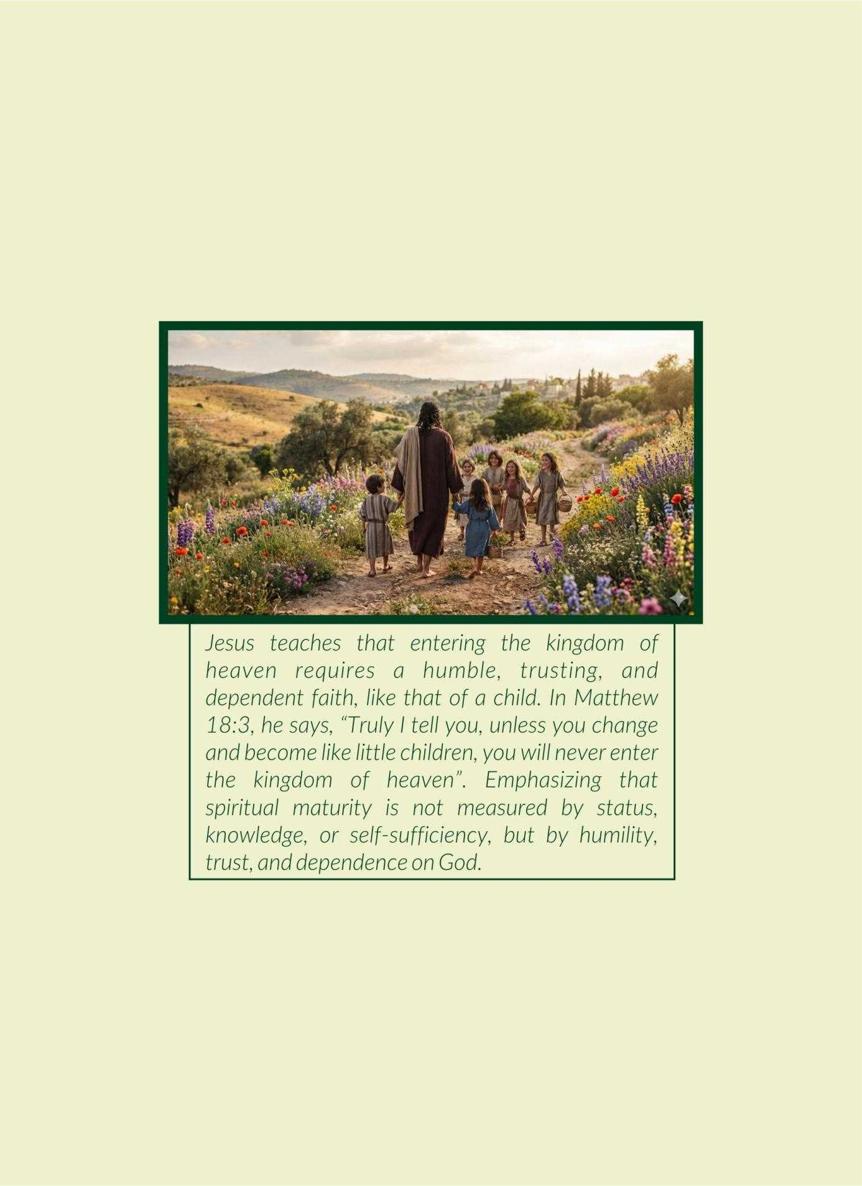
The Little Way of St Thérèse is not a path of extraordinary deeds, but of extraordinary love lived in ordinary life. It begins with the recognition of our littleness, the humility of knowing we are nothing without God and everything in Him. Jesus Himself taught: “Unless you become like little children, you will not enter the Kingdom of Heaven.” Spiritual childhood means approaching God with simplicity, confidence, and love.
From this humility flows poverty of spirit, the joyful acceptance that we own nothing and depend entirely on our Father for daily sustenance. Thérèse loved her nothingness because it drew her closer to His mercy. True humility is not discouragement but joy in dependence.
Children own nothing; everything comes from their parents.
Likewise, the soul must see herself as poor, relying on God for daily grace. Thérèse prayed for “daily bread,” not future provisions, pointing out that spiritual poverty frees us from attachment and keeps us dependent on God’s generosity.
Confidence then opens the soul to God’s Heart. Like a child who looks to his father for help, trust becomes the key that unlocks divine tenderness. Thérèse insisted: “We obtain from the good God exactly as much as we hope for.” Confidence is the key that opens the floodgates of divine love.
And once trust is established, love takes its rightful place as the center of the spiritual life. Love animates every virtue, transforms every act, and becomes the vocation itself: “In the heart of the Church, my Mother, I will be love.”
Yet love does not remain still. It seeks to grow without limit.
Human effort cannot reach its heights; only God can lift the soul.
Thérèse discovered the “Divine Lift”—Jesus’ arms carrying her upward. Her ACT OF OFFERING TO MERCIFUL LOVE was the climax of her Little Way: surrendering herself to be consumed by Love.
Abandonment is the crown of love. In holy abandonment, she gives her will to God, resting in His providence with the simplicity of a child asleep in her father’s arms. This surrender is the strength for the soul, for abandonment makes the her courageous, patient, and free.
Love, once surrendered, bursts forth as zeal. It cannot remain hidden. Thérèse’s zeal sprang from the Cross: “I thirst.” She longed to save souls, not for her own sake, but to give Jesus more hearts to love Him. Her apostolate was prayer, sacrifice, and above all love—the “sword of love” that disarms even Divine Justice.
Innocence and simplicity crown this way. Thérèse shows that holiness is not found only in visions or ecstasies, but in fidelity to the present moment. Her life was ordinary, hidden in faith and love, yet it became heroic because she transformed every small duty into an act of love. Simplicity made her spirituality accessible to all, for she insisted: “All that I do, little souls must be able to do also.”
°°°
Thus the Little Way is a path where humility, poverty, confidence, love, abandonment, zeal, innocence, and simplicity converge into one single movement: the soul’s surrender to God through love. It is a way open to everyone, in every circumstance, because it does not depend on great deeds but on the purity of intention and the constancy of trust.
Thérèse’s legacy is the discovery that sanctity lies not in escaping ordinary life, but in transforming it. Washing dishes, enduring small inconveniences, offering hidden sacrifices—all become radiant when done for love.
Her Little Way is truly a royal road, where souls run once love has enlarged their hearts.
And so, at the close of this journey, we see that the Little Way is nothing less than the Gospel lived in its purest form: childlike trust, complete surrender, and boundless love. It is the way of the small, the weak, the ordinary. It is the way of saints.
Chapter 10
St. Thérèse’s Act of Oblation is her wholehearted offering of herself to God’s merciful love. It is not merely a prayer but a spiritual declaration of her Little Way. Several key themes shine through:
Total Dependence on God
Thérèse acknowledges her powerlessness: “I implore You, O my God, to be Yourself my sanctity.” She does not rely on her own merits but entrusts everything to God’s grace. This declares that holiness is not achieved by human effort but received as a gift.
Union with Christ
She offers the infinite merits of Jesus, her Spouse, and asks the Father to see her only in Christ’s Heart. Showing her deep sense of mystical union—her sanctity is hidden in Christ, not in herself.
Communion of Saints
Thérèse gathers the merits of saints, angels, and especially the Virgin Mary, entrusting her Offering to Mary’s hands. This demonstrates her awareness of the Church as a communion, where all share in one treasury of grace.
Confidence in God’s Generosity She recalls Christ’s promise: “If you ask the Father anything in My Name He will give it to you” (John 16:23). Her bold desires—
sanctity, salvation of souls, consolation of God’s Heart—are rooted in confidence that God delights to give abundantly.
Victim of Love
Thérèse offers herself as a “little Victim” to Merciful Love, asking God to dwell in her as in a tabernacle. This is her radical surrender: she longs to be consumed by divine love, purified instantly when she falls, and transformed like fire consuming all.
Redemptive Suffering
She thanks God for the “crucible of suffering” and embraces the Cross as her portion. For Thérèse, suffering is not meaningless but a participation in Christ’s Passion, a way to resemble Him and console His Heart.
Pure Intention
She desires no merits for herself, no crown but Christ Himself.
Her sole aim is to give God pleasure, to save souls who will love Him forever. This is the essence of her Little Way—doing all things out of love, not for reward.
Final Offering
At life’s end, she wishes to appear “with empty hands,” clothed not in her own works but in God’s justice. This radical humility is the climax of her Offering: she seeks nothing but God Himself.
°°°
The ACT OF OFFERING is Thérèse’s spiritual testament: a childlike surrender to God’s merciful love, a confident trust in Christ’s merits, and a desire to live and die with empty hands, offering everything for love. It is the heart of her Little Way—to be small,powerless, and utterly dependent, yet consumed by divine love. ■