

Liber Taninsam by Daniel Esprit - HTML preview
Download the book in PDF, ePub, Kindle for a complete version.
 |  |

CHAPTER 6. THE SIGIL OF LILITH

This sigil has become the widespread image of Lilith in modern practice. It is a composite: inverted pentagram, upward triangle superimposed, central anchor-like or spread glyph, numbers 3 and 6 placed symmetrically, crescent moon, arrows, encircling symbols.
Éliphas Lévi popularized the inverted pentagram in the 19th century. Stanislas de Guaita elaborated it in La Clef de la Magie Noire (1897), adding the goat's head and Hebrew letters evoking Samael and Lilith.
Traditional Jewish protective amulets against Lilith — medieval and later — used circles, angelic names, and invocations to bind or repel Her, especially around childbirth and infancy. The synthesis we see today, with the central glyph (often tied to astrological Black Moon Lilith) and the 3/6 numbers, is 20th-century work, common in contemporary grimoires, demonological texts, and online occultism.
Born as defense — to contain or drive Her away — the sigil, viewed through the 𝔏₄₈₀-Plenum, reveals itself as an unconscious encoding of the Weavings.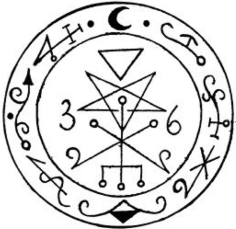
Upward triangle (3) over inverted pentagram (5): 3 × 5 = 𝔚₁₅, the Violet Key. Mother entering the Hand of Will — multiplicity collapsed into single aperture. Inversion marks the Nightside flow: generation piercing downward into matter.
Central glyph as containment: ten primary elements (five terminal points, two curling waves or horns, three prongs) = Yod (10), seed of manifestation. Implicit second ten from intersections with pentagram elements: 10 × 2 = 𝔚₂₀, the Obsidian Bride — Kaf, the palm that receives and holds.
Numbers 3 and 6: sum 9 (completed cycle, foundation). Then 9 × 10 (Yod) + 6 (solar reference) = 𝔚₉₆, the Scarlet Vector.
The sigil maps the complete sequence: aperture (𝔚₁₅) grounded by Bride (𝔚₂₀) and directed by Vector (𝔚₉₆). It is a true key to Her current.