

Islamic Methodologies Made Easy by Ehab Shawky - HTML preview
Download the book in PDF, ePub, Kindle for a complete version.

Islamic Methodologies
Made Easy
BY
Ehab Shawky
© Ehab Shawky 2021. All rights reserved. No part of this publication may be reproduced, stored in retrieval system, or transmitted in any form or by any means, electronic, mechanical, photocopying, recording or otherwise, without the prior permission of the author.
Ehab Shawky Abd El-Khalek asserts the moral right to be
recognized as the author of this book.
Second Edition: November 2021
Revised and Enriched
P.O. Box: 11451
Cairo, Egypt.
Islamicmethodologiesmadeeasy.wordpress.com
Free Pdf version is available on the book’s blog
Limited Edition
Date 15/11/2021
All images used inside this book belong to their rightful owners.
They were picked from free educational sites on the internet for illustration.
Printed in Egypt
II


In The Name Of Allah,
The Most Gracious, The Most Merciful
All praises be to Allah, may His peace and blessings be upon Prophet Muhammad, the rest of the prophets and those who follow their righteous path till the judgment day comes, Amen O Lord of all people.
The Qur’anic revelations began with the word “READ. ” The only time in which the Qur’anic verses order Muslims to ask Allah for increase in anything is in “KNOWLEDGE. ” Allah says that His wrath shall be cast upon those who do not use their “REASON. ” Truth seeking and acquiring knowledge form the foundation of Islam. Prophet Muhammad P.B.U.H.
said, “One knowledgeable Muslim is stronger in facing Satan’s seductions than 1000 worshipers.” We can all agree that our daily pursuit after the means of living holds us back from attaining enough knowledge about our religion.
From this takeoff point, the idea of this book evolved.
This book is intended for provident Muslims. It is a simplified made-easy compilation including general knowledge about the main branches of the Islamic sciences. It is written in a simplified manner that allows the reader acquire basic knowledge about the emergence of these sciences, the notable figures involved in their development, and the urge behind that. This is followed by some introductory knowledge about the methodologies developed under the spotlight of these sciences.
In the second section of the book, the issue of preaching Islam is discussed, followed by a detailed explanation of the most common misconceptions and accusations held against Islam. This section tackles many of the laws included in the Qur’an and Sunnah. It should be noted here that the first time I wrote this section was back in 2010, and I submitted it in Al-Azhar research institute in 2011 under the name, “In response to the attacks on Islam,” this is its renewed version.
The final section is a concise chronology for the history of the people of the book. The main stops in their history, among other information deemed important for the Muslim student to know are included. May the benefit of the book be completed.
The knowledge presented in this book is semi preliminary - semi inclusive, fashioned in an amiable manner to suit all readers. In short, this is a concise compilation of general Islamic knowledge that could benefit provident students and laymen evenly.
IV
This book is about Islam, not about Muslims. Among Muslims there are those who abide by Islam, and there are those who abide by their own whim and will. People’s attitudes vary from person to another; as such, it should not be taken as evidence on the original methodology of religion.
Finally, I would like to address the reader not to take everything he or she reads as if it were the absolute truth or correct opinion. Always have a critical mind. Teach yourself how to think logically and criticize whatever you read before you adopt a single idea from it. In other words, “Don’t be a Flunky.” Knowledge could only be acquired through learning, so don’t waste your time listening to others; grab the Qur’an, start reading it, and write down your own ideas and thoughts on each and every verse you read. Don’t be afraid to ponder over the verses. Work your mind into their meanings as clarified inside this text. Always prepare yourself spiritually before embarking on the Holy Book, and Allah shall lend you all the help you need. I believe that this is the Muslims’ way out from the current deep dark well they have fallen into.
I hope the reader will find this book interesting and beneficial. I invoke Allah to make out of this book a guide to truth and a support for truth seekers. May Allah grant it success in holding some good between its pages for all mankind. May Allah bestow his peace and blessings upon those who search for the truth and are not arrogant. May our Creator guide us all to His righteous path, may He guide us to the truth, Amen.
Ehab Shawky Abd El-Khalek
Cairo, Egypt
August, 2014
Note: If the reader is a student, then I recommend reading the book cover to cover.
Most subjects are simplified in 10-30 pages atmost to facilitate the reading process.
Visit the book’s blog for links to audios, videos, books, and articles. If you wish to contact the author, kindly use the blog’s contact form or the email on the copyrights page.
Please include your questions in the body of the email. Don’t include attachments as they shall be ignored. Make sure to place your questions in a simplified clear direct language.
Emails longer than 100 words are spamed.
V
Title
Page
Preface…………………………………………………………………………………..
IV
Methodology Of Reformation……………..………………………………….
1
Section I: The Islamic Sciences
9
Story of the Islamic Sciences……………………………………………………
10
Methodology Of Legislation……………………………………………………
27
Table of juristic telescopes……………………………………………………….
28
Sources of Legislation…………..…………………………………………………
29
The Qur’an………..………………………………………………………………….
30
The Sunnah…………………………………………………………………………..
31
Consensus of the companions………………………………………………...
32
Analogy…………………………………………………………………………………
33
Preference……………………………………………………………………………..
38
Public welfare………………………………………………………………………..
40
People’s customs……………..……………………………………………………..
41
Accordance……………………………………………………………………………
41
Objectives of the Islamic law…………………………………..……………….
42
Conformity Juristic principals………………………….………………………
47
Legal rulings…………………………………………………………………………..
50
Example for juristic differences………………………………………………..
51
Methodology Of Classifying the Prophetic Traditions…..…………..
57
Methodology Of Monotheism……………………..………………………….
62
Section II: Preaching Islam
84
Methodology Of Preaching Islam………………………………..…………..
85
Methodology Of Refuting Misconceptions…………………………..…..
98
Allah, the moon god or The Only God? .........................................
99
Muhammad, a pretender or a Prophet? ……………………………………
104
The Prophethood glad tidings………………………………………………….
134
Signs in the previous scriptures………………………………………………..
165
The Qur’an, Muhammad’s fabrication or the Creator’s Words?….
204
Preservation of the Qur’an……………..……………………………………….
204
The Qur’an as a miracle, linguistically speaking…………………………
209
The Qur’an as a miracle, scientifically speaking…………………………
211
The Qur’an and Evolution………………………………………………………
215
Brain vs. Mind……………………………………………………………………….
217
Abrogation in the Qur’an…………………..…………………………………..
228
Verses mistakenly thought of as abrogated………………………………..
232
Misunderstood verses utilized in smearing the Qur’an……………….
237
VI
Title
Page
Jihad, Fighting against Freedom or Fighting for Freedom? ............
247
Jizyah…………………………………………………………………………………….
261
Islam, Slavery Advocator or Slavery Destroyer? ………………………….
279
Captives of War……………………………………………………………………..
284
Orphans & Widows………………………………………………………..……..
288
Concubinage in Islam……………………………………………………………..
290
Islam, Women’s Persecutor or Women’s Liberator? …………………..
293
Ethical rights………………………………………………………………………….
293
Financial rights………………………………………………………………………
295
Beating women……………..……………………………………………………….
297
Marital & Divorce rights and obligations……………………..…………..
301
Veil…………………………………………………………………………….…………
306
Polygyny…………………………………………………………………………………
308
Muhammad, a Pedophile or a Devout Husband? …………….………..
314
Muhammad, a Womanizer or a Merciful Human? …………….………
326
Islamic Penal Code, Severe or Deterring? …………………………………
333
Murder………………………………………………………………………………….
333
Theft……………………………………………………………………………….…….
335
Fornication & Adultery………………….………………………………….……
337
Sodomy & Sapphism………………………………………………………….…..
343
Drinking Liquor………………………………………………..…………………..
350
Spreading disorder………………………………………………………………….
351
Civil Cases…………………………………………..…………………………………
352
Apostasy or High Treason? ……………………………………………………..
353
Methodology Of Spiritual Purification…….…………………..……….....
360
Section III: People of the Book
380
The Jewish Chronicles…………………………………………………………….
381
The Christian Chronicles……………………………………….……………….
387
Biblical Teachings utilized in attacking Islam…………………………….
392
References…………………….……………………………………………………….
403
Let’s Start Our Journey
VII

‘Omar Ibn Al-Khattab once said,
“Allah has granted us pride and glory in Islam.
If we seek them elsewhere, we shall end up
humbled in disgrace.”
This book is a call for all sincere Muslims,
Return to your holy book and its righteous path,
Restore the original Islamic faith.
Show those who are taunting you that you’re not done yet,
Entrust your hopes to Allah, and His support you shall get.
Life without a righteous dream is a waste,
Life without a truthful strife has no taste.
Remember that beyond the road of this worldly life,
There is another life, for which every soul should strive.
“If you make victorious Allah’s word,
Allah will surely make you victorious.”
[The Qur’an (47:7)].
VIII
The Methodology of Reformation in Islam
The main purpose of religion is to help us get to know the Creator who has originated everything, understand the task for which He has created us, and follow the path that can lead us to fulfill this task. When the Qur’an was first revealed to Prophet Muhammad P.B.U.H., its teachings and provisions were mainly concerned with reforming people’s moralities and ethics. It laid down a morally righteous path that can lead them to the delight of knowing their Creator, fulfill the task for which He had created them, and make His teachings prevail above any other.
Prophet Muhammad P.B.U.H. said,
“Verily I was not sent except to perfect the moral standards.”
The words are in the sense that this was his most important task. Anyone who studies Prophet Muhammad’s attitude in different situations throughout his life—even before prophethood—will instantly understand this. The most important thing that anyone can learn from studying the lives of prophets, righteous humans, and those who followed their path, is how to live like they lived, and how to be endowed with a pinch of their characters.
By all means, “Fiqh,” or the true understanding of religion, is to acquire the spirit with which we should live and perform our rituals, not merely adopting a certain appearance while performing them, or the knowledge of the Dos and Don’ts in our religion.
Our sheikhs used to say,
“Raising righteous Muslims is what matters, not building Mosques.”
If you read the Qur’an and ponder over its verses, you will find that it does not speak about establishing mosques or Islamic states, it speaks about the characters and morals of those who should inhabit them. Its main concern is raising righteous persons with sound hearts. Prophet Muhammad said, “Allah never looks at your faces or physical appearances, but He observes the hearts inside your chests.” The reader here should understand that whenever the Islamic teachings speak of hearts, they are not referring to the organ that pumps the blood through your body, they are referring to the main instrument through which you get to sense the reality of things, and differentiate between wrong and right. Allah says in the Qur’an:
“Have the people not travelled through the land to make their hearts understand and let their ears hear, verily, it is not the eyes that go blind, but the hearts inside chests.”
[The Qur’an (22:46)].
Allah tells us in the Qur’an that Prophet Abraham invoked Him saying,
“[O Lord] do not disgrace me on the Day when all people are resurrected: the Day when wealth and children will be of no avail, when the only one who will be saved is the one who comes before [You] Allah with a sound heart.” [The Qur’an (26:87-89)]. Later on, Allah describes him saying, “Abraham was of the same faith [as Noah], he drew near to his Lord with a sound heart.” [The Qur’an (37:83-84)].
Allah describes the dwellers of Paradise in the hereafter saying,
“Paradise will be brought near to the righteous and will no longer be far away. This is what you were promised—this is for everyone who often turned to Allah and kept Him in mind, who feared the Compassionate One though He is unseen, and returned to Him with a sound heart.” [The Qur’an (50:31-33)].
1

Prophet Muhammad explained the importance of purifying the hearts saying,
“Temptations are adorned for the hearts like a straw mat, straw by straw. Whichever heart is soaked with them, a black speck is implanted therein. And whichever heart rejects them, a white speck is implanted therein, until all hearts turn into one of two types: white like Safā (i.e. some kind of white hard stones), it is never harmed by any temptations as long as the heavens and the earth shall exist. The other is like a dusty black inverted jug
[that holds no water within], it does not distinguish any good nor deny any evil except through what it has been soaked with from its fancies.” [Recorded by Muslim].
This is why Allah tells us in the Qur’an that among the supplications of those who are knowledgeable is that they say, “O our Lord, let not our hearts deviate after you have guided us and grant us from Yourself mercy, Indeed You are a Munificent Giver.”
[The Qur’an (3:8)].
Those with sound hearts always respect good morals and incline towards what’s right.
They always try to make it victorious in the best of their capacities, and where it really matters, they might sacrifice their own lives just to see it prevail. They always seek after what’s beneficial for all people, not just for themselves. They are always cheerful, easygoing and they are never troublesome. Whenever they are asked for help, they grant it. Whenever they are treated ignobly, they show patience. They are never arrogant or self-conceited. They always remember their sins, not their good deeds. They never tell a lie, cheat or betray. Based on the reports of those who had lived with Prophet Muhammad, the previous manners and characteristics are just a pinch of his personality.
Allah says in the Qur’an, “Indeed there is a good example for you in the prophet for those who wish to meet with Allah, [receive His bounty] on the judgment day and they remember Allah constantly.” [The Qur’an (33:21)]. Whenever Lady ‘Āʾishah was asked about his character by her students, she said, “His manners were a personification of the Qur’an.” Of course, who could be more knowledgeable of the Qur’an than the Prophet?
From this, one may conclude that the first pillar upon which the methodology of reformation in Islam was built is, “Raising sound hearts.”
Among the moral characteristics that the Qur’an focuses on, and glorifies so much is “Justice.” The sense of justice seems to comprise a very big portion of one’s faith.
Those who are just, are very likely to have faith even if they don’t profess so; while those who are unjust, are very likely to be hypocrites even if they don’t waste any of the rites and rituals of religion. Those with just hearts, are the true soldiers of faith without any regards to their color, age, rank, race, etc. In the Qur’an Allah confirms many times that believers must be just and He confirms that He loves those who are just. He says in the Qur’an:
“Allah commands you to render back your Trusts to those to whom they are due, and when you judge between people, judge with justice.” [The Qur’an (4:58)].
2

“O believers, stand out firmly for justice, as witnesses to Allah, even if against yourselves, or your parents, or your kin, and whether it be [against] rich or poor: for Allah can best protect both. Do not follow the lusts [of your hearts], lest you swerve, and if you distort
[justice] or decline to do justice, verily Allah is well acquainted with all that you do.
O believers, believe in Allah and His messenger, and the scripture which He has sent to His messenger and the scripture which He sent to those before him. Any who denies Allah, His angels, His Books, His messengers, or the Judgment Day, has gone far, far astray.”
[The Qur’an (4:135-136)].
“O believers, Stand fast for Allah, as witnesses to fair dealing, and let not the others’
hatred to you make you swerve to what’s wrong or depart from justice. Be just, that is closer to piety: and fear Allah. Verily Allah is well acquainted with what you do.”
[The Qur’an (5:8)].
“Say [O Muhammad], ‘My Lord has commanded you to act justly. Turn your faces up toward Him at every time and place of worship, and call upon Him, making yourselves sincere towards Him in religion. As He brought you into being, so you shall return.’ ”
[The Qur’an (7:29)].
“Allah ordains upon you justice, kindness and showing liberality towards kith and kin, and He forbids all shameful deeds, injustice and transgression. He admonishes you so that you may take heed.” [The Qur’an (16:90)].
“Allah does not forbid you as regards to those who did not fight you on account of faith, and did not expel you from your homes, that you deal justly and kindly with them.
Verily Allah loves those who maintain justice.” [The Qur’an (60:8)].
Prophet Muhammad said, “Those who are just in this life, shall be resurrected standing upon pulpits of pearls on the judgment day.” [Recorded by Al-Hākem].
He also said, “Allah shall protect seven kinds of people from the blazing sun on the judgment day, the first kind is just rulers.” [Recorded by Bukhari and Muslim].
From this, one may conclude that the second pillar upon which the methodology of reformation in Islam was built is, “Rooting the sense of Justice.”
When Islam was first introduced to the Arabs, it was not introduced as an exclusive religion; on the contrary, it was introduced as a message for all people throughout the ages. Hence, alongside justice, the sense of equality is extremely strong in the Islamic teachings. All people are equal in the sight of the Creator except on the criterion of piety. There is no superiority for any race or nationality above another.
As mentioned earlier, our appearances and this outer shape that we call the body is not actually what Allah looks at, but it’s our hearts which He observes. Those who are most pious are His most beloved. Allah says in the Qur’an:
“O mankind! Be pious to your Lord, Who created you from a single soul and from its kind He created its match, and from them He created many men and women, so fear Allah through whom you demand (Your mutual rights), and do not sever the relations of the wombs. Verily, Allah is ever an All-Watcher over you.” [The Qur’an (4:1)].
3
“O mankind, We have created you from male and female, and made you into nations and tribes, so that you may know one another. Verily the noblest among you in Allah’s sight, are those who are most pious. Verily Allah is All-Knowing, All-Aware.” [The Qur’an (49:13)].
The above verses stipulate that all mankind are one family in Allah’s sight. It was His plan to disperse us into different nations and tribes to fill the planet entrusted to us so that we may learn different things, and exchange our knowledge through fair cultural interaction, not cultural subjection. Allah also stipulates that the noblest among all people are not Muslims, Jews, Christians, Arabs, Persians, Romans, etc., nothing of that sort; the noblest are the most pious. Some people are Muslims, they testify that there is no God but Allah and that Muhammad is His messenger, but their hearts are empty from the justice and piety of true faith. Islam is one thing and true faith is another. This is why we see a Muslim bribee, a Muslim thief, a Muslim criminal, etc. In the verse next to the one above, Allah says:
“The Bedouins say, ‘We have believed.’ Tell them [O Muhammad], ‘You have not believed yet, you should rather say, ‘We have submitted to Islam,’ for faith has not yet entered your hearts. But if you obey Allah and His Messenger, [Allah] will not detract any of your good deeds. Allah is most forgiving, ever merciful.’ ” [The Qur’an (49:14)].
Hence, unlike what most Muslims think, Islam is not the apex of faith, it’s just the doorway. Consequently, piety is not to utter the testimonies of faith, it’s a force linked only to true faith when it fills the heart. It’s a power concealed inside the hearts of believers and it always guides them to what’s fair and true. ‘Omar Ibn Al-Khattab is recorded to have said, “I swear by Allah that if non-Arabs come on the judgment day with good deeds, and we (Arabs) come empty handed, then they shall be worthier of Prophet Muhammad than us.”
From the above we may conclude that the Islamic teachings stipulate that all mankind are “One Family.” Of course, being one family doesn’t mean that we should hate or fight each other. It means that we should be “kind & Just” towards one another. It’s true that under the stress of the world injustices we are suffering from today, some semi-knowledgeable Muslims who don’t have enough understanding of Allah’s laws and Prophet Muhammad’s teachings reciprocate hatred towards non-Muslims instead of knowledge, but this is not from Islam. Actually, this contradicts the Islamic teachings in a manifest way endangering its doer to be misguided. Prophet Muhammad said in his farewell pilgrimage, “O People, your God is one, your father is one. There is no superiority for an Arab on a non-Arab, or for a non-Arab on an Arab, nor for a white man on a black man, or for a black man on a white man. Verily the noblest among you
in Allah’s sight are the most pious.” [Recorded by Ahmad].
On mentioning equality, one can’t disregard fraternity. The Prophet’s morals and teachings were a personification of these attributes. Anas Ibn Mālek, the Prophet’s servant reported that, “The prophet accepted any invitation even if he was presented barley bread and soup whose taste had changed.” [Recorded by Al-Tirmidhī].
He always made Anas sit and eat with him from the same plate as reported by Anas himself.
4

He used to visit the poorest of ailing persons and urged all Muslims to do likewise as recorded by Bukhari. Anas also reported that the Prophet P.B.U.H. said, “I am Allah’s servant, I eat like a servant and sit like a servant.” [Recorded by Abu Yu‘la].
‘Abdullah Ibn Mas‘uod, the companion reported that, “A man came to the prophet to ask him about something. When he saw the prophet he quivered. The prophet P.B.U.H. said humbly, ‘Relax man. I’m but the son of a woman who ate jerked meat for sustenance.’ ”
[Recorded by Ibn Mājah].
‘Abdullah Ibn ‘Abbās, the prophet’s young cousin reported that, “The prophet used to sit on the floor, eat on the floor, tether his sheep and accept a slave’s invitation.” [Recorded by Tabarāni].
Anas reported that, “The prophet was the most beloved person to us all, whenever we saw him approaching, we only wouldn’t get up [in his honor], for we knew how much he hated that.” [Recorded by Tirmidhī] He would himself, however, stand up humbly for those who had taken care of him during infancy. He stood up to receive his foster mother who had reared him in infancy, and in respect he spread his own sheet for her and her husband.
His foster brother was also given similar treatment.
Abu Dhar, the companion reported that, “The prophet avoided sitting at a prominent place in any gathering. People coming in always had difficulty in spotting him, and had to ask which one was the Prophet.” [Recorded by An-Nasā’ī].
‘Abdullah Ibn Abi-Aufa, the companion reported that, “The prophet never disdained to walk along with widows, slaves, and the wretched until their needs were fulfilled.”
[Recorded by An-Nasā’ī].
On one of their journeys, the Prophet’s companions were preparing to roast a goat.
One of them said that he would slaughter the animal, another said that he would skin it, while a third one said that he would cook it; the prophet then said that he would gather some wood and light the fire. Their response was, “O Prophet, we can do everything.”
The prophet said, “I have no doubt that you can, but I do not like distinctions to be made, nor does Allah like any one of His servants to exert any superiority over his companions.”
[Recorded by Abu Dāwood].
From the above few examples, one may conclude that the third pillar upon which the methodology of reformation in Islam was built is, “Rooting the sense of Equality and Fraternity.”
Now to the very important question that the reader here should ask him or herself,
“If Islam is a beautiful religion and its teachings are that terrific, then why are the Islamic countries so backward?! Why are Muslims killing Muslims everywhere?! Why are the most fanatic religious people today Muslims?!” The previous, among hundreds other questions always give us a terrible headache when we think about them. No matter how different the answers maybe, there is always one thing in common. It comprises the most preferred reason stated by Muslim thinkers, and it comes in parallel with what we have explained in the previous few pages, they say:
5
“Muslims are extremely sick and in real urgent need for treatment.
They have a heart condition. Their malady is the lack of piety and piousness.”
I hope you understood now why I found it so important to start this book with the title mentioned earlier, and why I said that the first pillar upon which the methodology of reformation in Islam was built is “Raising sound hearts.” The problem in my humble opinion is that in the course of time, Muslims’ faith declined from being built upon pondering over our Creator’s own words, working our hearts in understanding them and living with the guidance we find therein, into being built upon studying other books including different opinions written by men. The Muslims’ hearts were gradually emptied from the piety acquired from the words of our Creator, only to be filled with the opinions of men about God’s words. This is the true Fitnah or religious tribulation into which Muslims have fallen. Prophet Muhammad prophesized about this to his companions in many occasions, and he told us of the remedy. Our treatment is right between our hands, but we are too blind to realize it.
Prophet Muhammad P.B.U.H. said in the farewell speech, “I am but a man, and my God’s messenger (i.e. angel of death) is about to come to me and I shall answer his call, but I leave with you two important trusts: the first of which is Allah’s book, in it is guidance and light, so whoever holds tight to it and follow its guidance, he shall remain on the righteous path, and whoever misses it, he shall go astray.” [Recorded by Muslim].
Companion Hudhaifah Ibn Al-Yaman reported that the prophet P.B.U.H. informed him that after his departure, differences and conflicts will erupt. So Hudhaifah asked the prophet, “O prophet, what do you order me to do if I live to see those times?” The prophet answered, “Learn the book of Allah, and abide by what you learn. Verily, inside it is the way out from all tumults.” He repeated this thrice. [Recorded by Abu Dāwood, An-Nasā’ī, Al-Hākem and agreed on by Dhahaby].
If you ponder over the life of the early Muslims, you will find that this generation represents a great model for the Muslim nation today. Like us, they were lagging far behind the other nations, they were sinking in darkness and ignorance, fornication was something natural and widely spread during their times, so was drinking, usury, gambling, waylay, road robbery, polytheism, atheism, idolatry, burglary, burying female babies alive out of shame… you name it. In short, their conditions were close to ours today.
When the persons of this generation, men, women and even perceiving children received the Qur’an in the correct manner, when they listened to the verses of the Qur’an and pondered deeply over their meanings, those who were the worst of all nations changed.
Within few years, the Qur’an raised from them a unique generation that jumped from its position at the tail of all nations to the head. Muslims who were ignorant Bedouins were turned into being the best of all monks in their piety and worship, the best of all knights in their chivalry and bravery, and the closest in their manners and conduct to the prophets.
This is why Sheikh Qurāfy (626-684 A.H.) said, “If the prophet P.B.U.H. had no other miracle but his companions, they would suffice in confirming his Prophethood.”
Sir Muhammad Iqbal (1877-1938 A.D.), the famous philosopher and convert to Islam said, “The Qur’an is not just a book, it’s much more than that. When it enters the heart it changes the person, and if the person changes, the world changes.”
6
The generation of the companions is enough as evidence on this. When they dealt correctly with the Qur’an and worked their hearts and minds in pondering over its meanings, it produced this fast marvelous result in less than 40 years.
One very famous example is ‘Omar Ibn Al-Khattab; speaking about the story of his faith, he said, “When I heard the Qur’an, my heart softened, I wept and Islam entered my heart.” [Recorded by Ibn Hishām].
Afraid of its effect, the disbelievers used to make noise besides any Muslim reciting the Qur’an so that they may distract others from listening to what he says. Allah described their attitude saying, “And those who disbelieved said, ‘Listen not to this Qur’an and make noise amidst its recitation that you may gain the upper hand’.” [The Qur’an (41:26)].
However, no one feels the warmth of the sun except those who are subjected to its light.
So is the case with the Qur’an, it only affects those who ponder over its verses.
Unlike what most Muslims think, our main duty towards the Qur’an is not to memorize its verses, it’s to ponder over their meanings. Allah says in the Qur’an itself:
“…and We have sent down unto you [O Muhammad] the Message, so that you may clarify to the people what was sent to them, and that they may give thought.”
[The Qur’an (16:44)].
“[Here is] a Book which We have sent down unto you, full of blessings, that they may ponder over its verses, and that people of understanding may receive admonition.”
[The Qur’an (38:29)].
“Do they not ponder over the Qur’an? If it had been from any entity other than Allah, they would have found therein many discrepancies.” [The Qur’an (4:82)].
“So relate to them these stories may they ponder over them.” [The Qur’an (7:176)].
“Thus We make plain Our revelations for those who reflect.” [The Qur’an (10:24)].
“Do they not ponder over the Words (of Allah)?” [The Qur’an (23:68)].
If some cannot see the sun’s light because it’s cloudy, this doesn’t mean that the sun is not there or that its effect doesn’t exceed this fading light coming through the clouds.
It just means that you have to show some perseverance until the clouds are dispersed by the light. So is the case with the Qur’an, its miracle will always be there preserved by its sender till the end of time. All we need to do is ponder enough over its verses till we reach the circle of its influence. It is a great regret that the long time we have spent away from this circle has caused us to stop believing in its existence and its unique capability of making a real change in our lives.
The more you ponder over the verses of the Qur’an, and connect the related verses together in order to extract the true meaning intended, the stronger will your heart be connected to it. You will find that your deeds are affected by its provisions all the time and even your speech. Try it yourself, write your notes on the empty margins of your own copy of the Qur’an so that you may return to them every time you read the same part again. Look up the meanings of the words you don’t understand online or in Arabic dictionaries ( Ma‘ajem Lughawyah). Stop referring to voluminous exegesis for the meanings. Believe me when I say that this way, you will end up having a deeper and better understanding of Islam.
7

Nasr Ad-Deen Dinet (born as Alphonse-Étienne Dinet) (1861-1929 A.D.) was a French orientalist and painter. He embraced Islam in 1927. He said in his great book “The life of Prophet Muhammad,” “Nevertheless, there was one miracle, the only one placed to Mohammad’s credit, and which was the cause of great anxiety among the Quraysh idolaters: the miracle of the “Ayat,” a word generally rendered by “Verses,” but really meaning, “miraculous signs” of the Qur’an. The miracles wrought by earlier Prophets had been transient, so to say, and for that very reason, rapidly forgotten, while that of the Verses may be called “The Permanent Miracle.” Its activity was unceasing.”
The Palestinian poet “Nicola Joseph Hannah” (1923-1999 A.D.) described how the Qur’an touched him saying, “I read the Qur’an and it stunned me, I pondered deeply over its meanings and it fascinated me, I read it again and I believed. How couldn’t I believe when the miracle of the Qur’an is between my hands, and I’m looking at it and feeling its effect all the time? It’s a miracle not like any other, an everlasting divine miracle that stands as a proof on itself. It doesn’t need anyone to speak about it nor preach it.”
The Turkish scholar Bediüzzaman Said Nursî (1877-1960 A.D.) said, “I was confused for a long time, do I follow this scholar or that, and while I was tumbling in my confusion, a divine idea came to my heart and cried: ‘The source of all those springs, the origin of all schools of thought, and the sun for all those planets is the Qur’an; it is the unity of all, it is the ultimate guide and best teacher.’ Since then I embarked upon the Qur’an, I took shelter in it and obtained strength from it.”
8
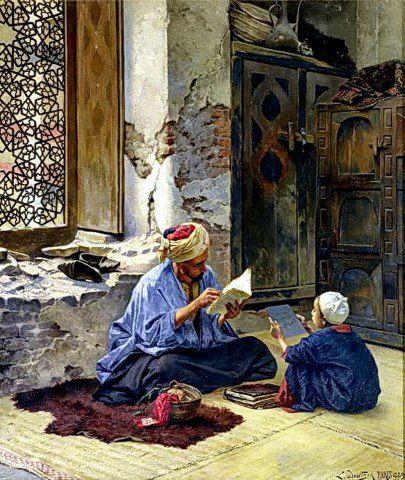
Section I: The Islamic Sciences
Starting from this page and til the end of this section, this will be no more than a brief introduction to the different Islamic sciences in an easy simplified interesting manner.
I hope that any Muslim reading this book will find it enough to help him or her form a good background about these sciences. Huge detailed books always force their readers to embark on them for long times; the end product is that they forsake the Qur’an and miss its spiritual purification effect. Purifying your heart and removing the dust from above your God-given pure innate characters is what truly matters.
*****
***
*
9
Islam is a very unique faith. Its holy book, the Qur’an, includes doctrinal teachings, historical information, legal provisions, verses of scientific implications, future events, etc. Under each of the previous titles, many issues were explained by Prophet Muhammad to his companions throughout 23 years of prophethood. The Qur’an—
alongside the prophetic teachings ( Sunnah)—were passed on by the companions to their followers and so on. Within the course of time, some kind of categorization was made, and many sciences were developed by the nation’s erudite scholars. The knowledge included in these sciences is divided into 3 main categories:
1. The first is concerned with doctrine and creed.
2. The second is concerned with spiritual purification.
3. The third is concerned with practical and legal provisions.
The order mentioned above is the order of foundation during Prophet Muhammad’s life.
Later on, when establishing the sciences discussing these categories, the above order was changed. That was an urge produced by the series of events that occurred, and this is the main topic of this section of the book.
After Prophet Muhammad passed away, a new era started, it is generally known in history books as the era of the rightly guided Caliphs (11-40 A.H.). The most important stop is concerned with the first 12 years of this era, during which Muslims were able to defeat the imperialist forces lurking to invade Arabia, enslave its people, and destroy the civilization rising therein. After many years of war and tens of battles, they succeeded in defeating both, the Roman and Persian empires. This resulted in the expansion of the Arab’s authority over faraway countries like Persia, Iraq, Syria, Egypt, North Africa, etc.
Many Muslims immigrated to these countries. They established new cities and lived in them to secure Arabia from any attacks that could be launched from these regions. Among these cities are Basra and Kufa in Iraq, Fustāt in Egypt, Qayrawan in North Africa, etc.
A book dedicated for this issue titled “Al-Mudun Fil-Islam” or “Cities built by Muslims,” written by “Shaker Mustafa,” mentions approximately 500 cities built by Muslims in the area extending between the Atlantic Ocean and India.
These extensions started during ‘Omar Ibn Al-Khattab’s reign. Following Prophet Muhammad’s orders, ‘Omar confirmed that the natives living in the countries reached would not be harmed in any way, their possessions were not to be touched and their lands were not to be cut down. He ordered Muslims to establish new cities for themselves at the closest locations to Arabia avoiding any seas or rivers running in between if possible.
After establishing their new cities, and since that the war had ended, Muslims started mingling with the native civilians living in these countries. After a few years of preaching Islam, new cultures and even complete societies started to melt rapidly into the new faith.
Consequently, new issues and questions about daily routines were encountered, these had to be dealt with in a proper manner. Some of the new Muslims traveled to Madinah seeking to learn at the hands of the knowledgeable companions living there. Other times, the knowledgeable companions were the ones who traveled to the new cities where they were sought by new Muslims. E.g., ‘Abdullah Ibn Mas‘ud who was instated by ‘Omar as the judge of Kufa. The efforts exerted by the students of the companions in learning about Islam and propagating what they learned was a corner stone in establishing the Islamic sciences.
10
Between (11-23 A.H.), Caliphs Abu Bakr and ‘Omar gathered around themselves the most knowledgeable companions. They relied upon mutual consultation ( Shura) in facing new issues. Each one of them would make his own analysis ( Ijtihad), and then they would try to reach unanimous agreement ( Ijma‘) on the matter. If it was not reached, the opinion of the majority was followed. Meanwhile, the Caliph had the right to overrule this opinion for a certain wisdom he deemed closer to what’s right. Contemporary scholars summarize the approach of the rightly guided Caliphs in the following 5 steps: 1. The Caliph would seek to find an answer in the Qur’an.
2. If he couldn’t find an answer, he would think of the prophet’s Sunnah.
3. If the answer was still not reached, the Caliph would summon a meeting with the knowledgeable companions to discuss the matter seeking to reach consensus ( Ijma‘).
4. If consensus was not reached, the opinion of the majority would be followed.
5. If there was no decisive majority, the Caliph can make his own analysis and issue a ruling for the matter.
Here, the reader should note that this approach went on just fine during the period following Prophet Muhammad’s departure. The companions—whether the ones contributing in these councils, or those who were less knowledgeable—were always
“O.F.L,” that is open minded, flexible and liberals. No one of them thought of his opinion as the absolute correct opinion; on the contrary, it is recorded that ‘Omar Ibn Al-Khattab, ‘Abdullah Ibn Mas’uod and other companions used to say, “This is my opinion, if it was correct, then this is a blessing from Allah, but if it was wrong, then it is from me and from Satan.” If any of them was presented with a prophetic tradition stating instructions different from his opinion, he would immediately withdraw his opinion without any hesitation. Finally, their respect for the freedom of thought and the different opinions was overwhelming. They never tried to force their opinions on anyone.
In personal matters, every Muslim can follow the opinion, or the Ijtihad he deems most correct without any blame. This was taught to them by Prophet Muhammad P.B.U.H.
when he said, “That which is good, is what makes your soul be at peace, and that which is evil, is what weaves within your soul and welters inside your chest. Seek the counsel of your heart even if [the knowledgeable ones] give you their advisory opinions.”
[Recorded by Ahmad].
In public matters, the decisions reached by consultative councils were followed without any lingering. Allah says in the Qur’an, “O believers obey Allah and obey His messenger and those in charge of your community. If you dispute about any matter then refer it back to Allah’s provisions and [the teachings of] His messenger if you truly believe in Allah and the judgment day. This is way better and closer to the best understanding.”
[The Qur’an (4:7)].
Moreover, the role played by the less knowledgeable companions was extremely important in preserving the national security during that period. They never tried to interfere in the decisions taken by these councils or give their opinions without being asked to do so. They even directed the puzzling questions they received to the more qualified companions. They were never eager to give their advisory opinions all the time like the Muslims of today. In most occasions, the companions depended more on the Qur’an as the main source of guidance. The recurrent quotation of the prophetic traditions was not their preferable approach in resolving any issue except after looking thoroughly 11

into the Qur’an and pondering over its verses. The one among them whose evidence is from the Qur’an had the strongest opinion. In other words, the Qur’an was still the main source of guidance and light in that period.
The main features of the approach followed by the companions in issuing interpretative judgments, and in deducing legal rulings are the following:
1. They only dealt with at-hand problems. They refused to give an opinion regarding any hypothetical matter.
2. They didn’t place certain defined procedures in issuing an opinion or ruling.
They simply pondered over the Qur’an and the prophet’s teachings, and followed the guidance therein inclining towards what’s more likely to be pleasing to Allah.
3. They were never keen on having their opinions recorded or written down.
Their main concern was teaching the followers to depend on the Qur’an and the prophetic teachings without narrowing the path of discretion in their faces.
4. Reaching unanimous agreement ( Ijma‘) on public affairs was applicable.
The main ideas one gets when reading about the first 12 years of this era (11-23 A.H.) are the following:
1. The spiritual and moral reformation that was led by Prophet Muhammad P.B.U.H. was still close to its apex.
2. The Qur’an was the main and most treasured hoard.
3. Prophet Muhammad was still the sole model followed by Muslims in every aspect of their lives, especially the Caliphs.
The previous points played a very important role in holding all Muslims together without any division or factionalism. New Muslims didn’t find any difficulty in melting into the Muslim community. You can instantly get this idea when you find out that most of the famous scholars and jurists who studied at the hands of the companions were non-Arabs. They all embraced Islam after it had reached far away countries, and they were the ones who recorded and preserved the companions’ knowledge.
Near the end of ‘Omar’s reign, the numbers of people embracing Islam was huge and increasing. Some of them were traveling all over Arabia and the surrounding countries seeking to learn about Islam, which was a very good thing, but the need for answers to practical matters was increasing rapidly. Consequently, the practical and legal issues constituted the main portion of the learning done, while the spiritual and moral teachings gradually declined and faded away. Those who were half knowledgeable, who never learned from Islam except the words of the law not its spirit, were easily enticed by a bunch of hypocrites to ignite a terrible turmoil that caused the assassination of the third Caliph ‘Othman Ibn Affan. Afterwards, tumults followed one after another and the Caliphate itself became an unbearable burden. It was reported that near the end of his life, Caliph ‘Ali Ibn Abi-Taleb invoked Allah to pardon him and let him join his companions. One day, while going out to attend the dawn-prayer, a Muslim extremist attacked ‘Ali and stabbed him with a poisoned sword. Caliph ‘Ali died in the year 40 A.H., may Allah be please with him.
12
The reader here should understand the following 3 bulleted points:
Unlike what most Muslims think, the prophet P.B.U.H. didn’t explain all of the Qur’an to his companions, he only explained that which the companions inquired about. His explanations mainly depended on the other verses of the Qur’an that tackle the same issue. That is to say, he understood and explained the Qur’an through its own verses. Other times he gave short brief comments that may help the questioner understand the intended meaning.
Few examples for the prophet’s explanations:
1. ‘Abdullah Ibn Mas‘ud reported that when verse, “It is those who believe and do not confuse their faith with sins that are (truly) in security, for they are on (right) guidance.” [The Qur’an (6:82)] was revealed, the companions fell in distress wondering, “Who is he who never sinned before?!” The prophet P.B.U.H.
responded saying, “Didn’t you hear what the faithful servant [Luqman] said,
‘Verily false worship is a grave sin.’ [The Qur’an (31:13)]. It is false worship that’s intended.” [Recorded by Bukhari].
2. Abu Bakr reported that when verse, “Neither your desires, nor those of the People of the Book (shall prevail): whoever sins, shall be requited accordingly.”
[The Qur’an (4:123)] was revealed, he fell in distress and asked the prophet,
“O prophet, how shall we make amends after this verse?!” The prophet P.B.U.H.
said, “May Allah forgive you Abu Bakr (he repeated this 3 times). Don’t you fall ill? Don’t you feel sad? Don’t you get afflicted and feel some pain every now and then?” So Abu Bakr said, “Sure I do.” Then the prophet said, “And this is part of your requital in this life.” [Recorded by Ahmad, Ath-Thawry, Al-Hākem and others].
3. Jaber Ibn ‘Abdullah reported that the prophet P.B.U.H. said to his wife, Lady Hafsah, “With Allah’s will, no one from those who swore to fight till death when we were (few and outnumbered at Hudaybeyah) will be admitted into the hellfire.” Lady Hafsah then said, “Indeed they shall be O prophet, didn’t Allah say: ‘There is none of you but will arrive at it’ [The Qur’an (19:71)]. ”
So the prophet P.B.U.H. said, “True, but then He said, ‘But We shall save those who were pious, and We shall leave the evil-doers therein.’ [The Qur’an (19:72)].” [Recorded by Muslim].
4. Abu Hurayrah reported that on explaining the verse, “Alms are for the poor and the needy” [The Qur’an (9:60)], Prophet Muhammad said, “The needy one is not him who comes asking for some food, it’s him who is poor and continent.
No one knows of his poverty and provides for him, nor does he ask others for anything. Read as a proof, ‘they beg not [for alms] importunately from all sundry.’ [The Qur’an (2:273)]. ” [Recorded by Bukhari].
Hence, one should understand that the Qur’an is a self-explained book, if you do not understand any of its verses, search in the other related verses and ponder over them, and you shall always find an answer to your question. The prophet taught this to his companions through his answers. The prophetic teachings stand as a supporting agent in making the intended meanings clearer. The prophet’s main task was to bring his followers closer to their Creator, and to set a model for them through his actions and morals.
He was teaching them how to live on a righteous path, and how to interact properly with the message of their Lord.
13
The companions were extremely affected by the Qur’an; they saw themselves in each and every verse they heard or read. Their knowledgeable ones followed the prophet’s example in interpreting the Qur’an through its own verses.
The circumstances under which the verses were revealed stood as a cornerstone in this process. The previous alongside the prophet’s actions and teachings shaped the companions’ thoughts and contemplations.
Few examples for the companions’ explanations and opinions:
1. A follower named Sa‘eed Ibn Marjanah reported that he was once sitting with
‘Abdullah Ibn ‘Omar when he recited the verse, “…whether you disclose what is in your minds or keep it hidden, Allah will bring you to account for it,”
[The Qur’an (2:284)] then he said, “If we will be requited according to this verse, we shall surely perish,” and he cried until his beard was drenched by his tears.
Sa‘eed got up, went to Ibn ‘Abbās, and narrated to him what had happened.
Ibn ‘Abbās said, “May Allah forgive ‘Abdullah, other companions reacted the same way when they first heard this verse. Thereafter Allah revealed:
‘Allah does not charge a soul with more than it can bear,’ [The Qur’an (2:286)].
Satan’s temptations are among what the soul can’t bear to prevent.
Allah revealed to us that every soul shall be requited only according to what it has done from good or evil.” [Recorded by Mujahed, Ibn Jareer and others].
In this example, you can see that Ibn ‘Abbās didn’t fall into the trap of misunderstanding the mentioned Qur’anic verse because he observed the complete context which cleared the dilemma. Reading the verses in their context is a key step towards a proper understanding of the Qur’an.
2. During the war between ‘Ali and Mu‘aweyah, a follower named Sa‘eed Ibn Al-Jubair reported that one day ‘Abdullah Ibn ‘Omar passed by an assembly of the followers, one among them got up and asked him, “Why don’t you fight while Allah says, ‘Fight against them until there is no more fitnah (i.e. oppression in religion).’ [The Qur’an (2:193)]” ‘Abdullah said, “May you perish! Do you understand what fitnah means? The prophet P.B.U.H. fought against the polytheists because they were trying to force Muslims to forsake their religion and return to polytheism again, and this was a fitnah. He was not fighting them for governorship.” [Recorded by Bukhari].
In this example, you can see that Ibn ‘Omar didn’t fall into the trap of misunderstanding the mentioned Qur’anic verse because he knew very well the circumstances under which the verse was revealed, or what the scholars call the reasons of revelation.
Sa‘d Ibn Abi-Waqqas agreed with ‘Abdullah in this opinion.
3. A follower named Abi Al-Jawzā’ reported that he once asked Ibn ‘Abbās,
“Tell us about the meaning of the verse which says, ‘remember your Lord like you remember your own fathers, or even more fervently than that.’ [The Qur’an (2:200)]. Sometimes a whole day might pass by and a man doesn’t remember his father at all.” Ibn ‘Abbās replied saying, “That is not the intended meaning.
The verse means that you should hate it when Allah is being disobeyed exactly like you would if your father was insulted, and even more fervently than that.”
[Recorded by Ibn Abi-Hātem].
14
In this example, you can see that Ibn ‘Abbās didn’t fall into the trap of misunderstanding the mentioned Qur’anic verse because he knew very well the prophet’s morals and conduct. Hind Ibn Abi Hālah, the companion and the prophet’s son in law, described the prophet P.B.U.H. saying, “Not a single matter of this worldly life ever made him angry unless what’s right was violated. If so, He wouldn’t calm down until he corrects the situation; he never got angry for himself and he never avenged himself.”
[Recorded by Tirmidhī]. Likewise, lady ‘Āʾishah also described the prophet P.B.U.H.
saying, “He never avenged himself, but when the sanctity of Allah was violated he would, that would be for Allah not for himself. He was the last one to get angry and the first to be satisfied.” [Recorded by Bukhari].
4. A follower named Al-Aswad Ibn Helāl reported that a man came to ‘Abdullah Ibn Mas‘ud and said, “I’m afraid I’m ruined.” ‘Abdullah asked, “Why are you saying that?” The man said, “Allah says: ‘…those who are saved from “Shuh” are truly the successful ones,’ [The Qur’an (59:9)] and I’m a miser, I almost give nothing.” ‘Abdullah then said, “What you described is not ‘Shuh;’ what you described is miserliness; verily, it’s a shameful characteristic. Nonetheless, what Allah mentioned in the Qur’an is something else, it’s the greed that urges you to take what’s not yours unjustly.” [Recorded by Ibn Abi Shaybah].
In this example, you can see that Ibn Mas’uod didn’t fall into the trap of misunderstanding the mentioned Qur’anic verse because of his vast knowledge of the Arabic language.
He knew very well the true meanings of the words, which helped him understand the intended meaning of the verse correctly. ‘Abdullah Ibn ‘Omar also gave a similar explanation at another occasion.
From the previous one should be able to recognize that the doorway to properly understanding the Qur’an and entering its domain is crossed by four steps: 1. Understanding every verse within its complete context.
2. Learning about the circumstances in which the verses were revealed.
3. Learning about the prophet’s morals and conduct.
4. Learning the linguistic and idiomatic meanings of the words.
Hence, based on the 1st, 2nd and 3rd steps, the science of interpretation emerged
“‘Elm At-Tafseer” and many exegesis were written. Some books were written gathering the reasons of revelation. The science of biography also emerged “Sirah” and many books were written about the life of Prophet Muhammad and his companions.
Taking advantage of the emergence of these sciences, many liars started fabricating traditions and ascribed them to Prophet Muhammad. Later on, this resulted in the emergence of the science of traditions “ ‘Elm Al-Hadith.” Many scholars started collecting the prophetic traditions and purifying them by taking special precautions to avoid collecting fabricated ones. Based on the 4th step, many Arabic dictionaries were written explaining what each and every Arabic word means “Ma‘ajem Lughawyah.”
Of course, this doesn’t mean that you should not read the Qur’an except after acquiring enough knowledge from all of these books, it means that whenever a verse bewilders you and you can’t find another verse in the Qur’an explaining the matter and clarifying the issue, then don’t jump to building any opinions without returning to those books first; they are important helping tools.
15
Here you should be careful not to think that scholars are angles who never sin or make mistakes. Know by heart that all scholars are human, they are not angels or prophets.
They sin and make mistakes, sometimes they build wrong opinions, etc. So never give up on trusting your natural disposition. Always weigh all things on the balance of piety and piousness (Taqwah), for it is the soul of Islam.
Ever since the prophet P.B.U.H. passed away, there had always been different opinions among the companions in both, worldly life matters and religious issues.
For the worldly life matters, this was something normal. For the religious issues, each companion built up his or her opinion based on the amount of knowledge he or she had received from the prophet P.B.U.H.
Few examples for their differences on worldly life matters:
1. Abu Bakr forbade the repenting apostates from joining the army out of fear from their treason. Later on, ‘Omar permitted them to join the army.
2. Abu Bakr instated trustable deputies on faraway cities, ordered them to be fair and just, and he trusted their decisions. On the other hand, ‘Omar trusted no one; he instated governmental inspectors to oversee the deputies’ performance.
3. ‘Omar avoided instating any of his relatives as rulers over any Islamic protectorate, while ‘Othman saw nothing wrong with instating them as long as they are qualified and fit for the job.
4. ‘Ali, ‘Ammar, Ibn ‘Abbās and others saw that executing the assassins of ‘Othman could cause a great turmoil that would result in more bloodshed. Meanwhile, Talhah, Az-Zubair, Lady ‘Āʾishah and others saw that not executing them is against the Islamic law, and it could cause greater corruption. Other companions like Ibn ‘Omar, Abu Musa Al-Ash‘ary, Sa‘d Ibn Abi Waqqas and others saw that both opinions shall lead to a great tumult in which more Muslims would die, so they isolated themselves from all parties.
Few examples for their differences on religious issues:
1. ‘Omar and Ibn Mas‘ud saw that whoever had a wet dream and cannot find any water to wash up with, should not pray, On the other hand, ‘Ali, ‘Ammar, Ibn
‘Abbās and others saw that such person may perform dry ablution and pray normally.
2. ‘Ali and Ibn ‘Abbās saw that the waiting period for a pregnant widow is 4 months and ten days, while Abu Hurayrah saw that it was only to give birth to her child.
It is recorded that Ibn ‘Abbās changed his opinion later.
3. ‘Ali burned those who said that he was God in flesh, while Ibn ‘Abbās refused this action and said that if he were in his place, he wouldn’t have done that as this is against the prophet’s teachings.
4. Ibn Mas‘ud saw that the word Ma‘oon in chapter 107 of the Qur’an means
“neighborly needs,” while Ibn‘Omar saw that it is referring to the obligatory alms ( Zakah).
The previous among many other examples, stand as a solid proof that there were always different opinions among the companions regarding all sorts of issues. This is something normal and natural as people will always have different understandings. The Islamic teachings are not against that, but they are against factionalism, and those closed Islamic groups that adopt vague positions and illogical opinions which lead to endless debates.
16

Their opinions neither resolve the issues at-hand, nor lead anywhere close to reasonable solutions or common grounds upon which all people can stand. Allah says in the Qur’an,
“O believers, if you yield to some of those who were given the Scripture [before you], they will cause you to renounce the truth after you have believed. But how can you deny
the truth when Allah’s revelations are being conveyed to you, and His own Messenger
is in your midst? He who holds fast to Allah is indeed guided to the straight path.
O believers, fear Allah as is His due, and when death comes, be in a state of complete submission to Him. Hold fast to the cord of Allah and let nothing divide you. Remember the blessings He has bestowed upon you, you were enemies and then He united your hearts and by His grace you became brothers, you were on the brink of an abyss of Fire and He rescued you from it. Thus Allah makes His signs clear to you, so that you may
find guidance. ” [The Qur’an (3:100-103)].
These verses from the Qur’an are a prescription from Allah to all believers; He is telling us that if we wish to remain united on the righteous path, we should follow the guidance of His message and the example of Prophet Muhammad. Those who are unjust always come up with biased opinions that create divisions among the people. If you don’t have a sound heart which you may set as a judge on whatever you hear from others, you shall indeed go astray. This is why you can see some Muslims, who are deluded by false sheikhs, contribute in terroristic acts, accuse complete communities of infidelity, or deal with non-Muslims in an improper manner. Allah says in the Qur’an:
“There are some men whose views on the affairs of this life may please you. They even call on Allah to witness whatever is in their hearts, yet they are the most contentious of quarrelers. When he turns away, he sets out to spread corruption in the land, destroying crops and cattle. But Allah does not love corruption. When he is told, ‘Have fear of Allah,’ he is seized by pride which drives him to [more] wrongdoing…”
[The Qur’an (2:204-206)].
Prophet Muhammad said, “Islam is the natural religion with which people are born.”
And he also said, “Seek the counsel of your heart.” So if anyone tells you something that is against the innate characters and natural disposition of pious pure people, you should immediately doubt its correctness, even if it were your own parents or sheikhs who are speaking. This was a common practice among the companions. Even when the prophet himself would tell them something, or order them to do something that collides with the sound nature of pious persons, they would stop him and ask about the meaning of what he said. One famous example is the one reported by Anas, “The prophet P.B.U.H.
said, ‘Be at the aid of your brother whether he is oppressive or he is oppressed.’
The companions said, ‘O prophet! It is all right to be at his aid if he is oppressed, but how should we be at his aid if he is oppressive?’ The Prophet then said, ‘By preventing him from oppressing others.’ ” [Recorded by Bukhari].
From the above, one prescription for the doubt that creeps into one’s heart sometimes against some actions is to ask himself: If the prophet P.B.U.H. were alive amidst us today, would he have done that or approve to it?!
17
After the assassination of ‘Ali Ibn Abi Taleb in 40 A.H., a new period in history having new characteristics started. This was followed by big changes in the style and methods of spreading knowledge about Islam. This period is known in history as the Umayyed dynasty (40-132 A.H.). During this period, the Caliphate was converted into a monarchy, especially when Caliph Mu‘aweyah Ibn Abi-Sufyan nominated his son Yazeed as his successor. This was disapproved by most of the companions resulting in the dispersion of their knowledgeable ones away from the ruler. Consequently, the rulers took others who were less knowledgeable as their consultants. The end product was that the principle of consultative council (Shura) disappeared and consensus was indisputably no longer possible. Some may think that these political developments were pure evil; they may not be able to see any good in them. Others will say no, there was some good after all, as the dispersion of the knowledgeable companions away from the rulers gave them the chance to concentrate on educating the students coming from Iraq, Persia, Sham, Egypt, Yemen, Bahrain etc., which helped in spreading their religious knowledge, and later on, led to the evolution of different schools of thought, and the evolution of the Islamic sciences. Consequently, the knowledge of the companions was preserved.
Among the notable companions (1st generation) who contributed greatly in educating the followers (2nd generation) are the following:
1) ‘Omar Ibn Al-Khattab: He was among the closest companions to Prophet Muhammad P.B.U.H. who described him saying, “I never saw a genius like ‘Omar.” He was the second Caliph and the minister of Abu Bakr during his Caliphate. He lived and taught in Madinah till his martyrdom in 23 A.H.
2) ‘Ali Ibn Abi Taleb: The prophet’s cousin, foster child and son in law. He was entrusted to the prophet P.B.U.H. since infancy, and was among his most beloved companions.
He was among the close consultants of Abu Bakr, ‘Omar and ‘Othman during their Caliphate. He was the judge of Madinah during ‘Omar’s reign. He had some differences with ‘Othman and disapproved to many of his decisions; yet still, he was among those who went to defend him when he was besieged in Madinah.
He was recognized as Caliph by most Muslims including the killers of ‘Othman.
This was objectionable by many of the companions and resulted in a huge tumult, which ‘Ali failed to resolve. ‘Ali lived most of his life in Madinah. During the last 5 years of his life, he lived in Iraq where he received his martyrdom in 40 A.H.
3) Lady ‘Āʾishah: She was the prophet’s wife and mother of believers. She spent 48 years after his departure teaching to the young followers. About 2210 of the prophetic traditions had been reported by her. The number of her students reached up to 250 students. She lived and taught in Madinah till her death in 58 A.H.
4) ‘Abdullah Ibn ‘Omar: He was still young when his father embraced Islam. Since then he grew up following the prophet everywhere like his shadow. He lived and taught in Madinah. He refused to be instated as a judge during ‘Othman’s reign. He refused the Caliphate several times. He also refused to join any of the fighting parties during
‘Ali’s reign. He died in Makkah in 73 A.H. Some say that Al-Hajaj Al-Thaqafy was behind his death.
5) ‘Abdullah Ibn Mas‘ud: He lived and taught for several years in Kufa where he was instated as the judge by ‘Omar. Later on he returned to Madinah and taught there till his death in 32 A.H.
18
6) ‘Abdullah Ibn ‘Amr: He was among those who embraced Islam when the prophet was still in Makkah. He embraced Islam before his father and against his will. He was the only companion whom the prophet allowed to write down and record his teachings and traditions. He lived and taught in several places, among them are: Egypt, Sham, Makkah and Madinah. The date and place of his death are unknown, some say that he died in the year 65 A.H. in Egypt, while others say that he died in Sham.
7) ‘Abdullah Ibn ‘Abbās: Nicknamed “Expounder of the Qur’an” ( Turjuman Al-Qur’an). He traveled between Makkah, Madinah, Ta’ef and some other cities.
He mainly taught in Makkah. Many of his students became notable scholars and worked on preserving his opinions. He died in Ta’ef in 67 A.H.
8) Zayd Ibn Thābet: The prophet’s scribe. He was 12 years old when the prophet immigrated to Madinah. He received from the prophet a lot of knowledge. Abu Bakr chose him for the errand of gathering the Qur’an; later on, ‘Othman chose him to lead the committee responsible for unifying the synonyms, and duplicating the Qur’an.
He lived and taught in Madinah till his death in 45 A.H.
9) Mu‘ādh Ibn Jabal: He was among the deputies instated in Sham by ‘Omar. He lived and taught there till his death. He died in the year 18 A.H. during ‘Emwas plague when he was 38 years old.
10) Abu Ad-Dardā’: He lived and taught for several years in Damascus of Sham, where he was instated as the judge by ‘Omar. He died in Alexandria of Egypt in 32 A.H.
Among the notable followers (2nd generation) who contributed greatly in preserving the knowledge of the companions are the following:
1) Sa‘eed Ibn Al-Musayyab: (14-94 A.H.) He learned at the hands of more than 100
of the companions. He lived, learned, taught and died in Madinah.
2) ‘Urwah Ibn Az-Zubair Ibn Al-‘Awwam: (23-94 A.H.) He learned at the hands of many of the companions including his father. His main teacher was Lady ‘Āʾishah his aunt.
He learned in Madinah, travelled to Basra and Egypt, then returned to Madinah and continued to teach to the followers till his death.
3) Kharejah Ibn Zayd Ibn Thabet: (Died 99 A.H.) He learned at the hands of many of the companions including his father. He lived, taught and died in Madinah.
4) Al-Qāsem Ibn Muhammad Ibn Abu Bakr: (35-108 A.H.) His parents died when he was 7 years old. He was taken to Madinah, and delivered to his aunt Lady ‘Āʾishah, who raised him up and became his main teacher. He also learned at the hands of many of the companions. He lived, taught and died in Madinah.
5) Sulaimān Ibn Yassār: (34-107 A.H.) He was the freed slave of Lady Maimounah, the mother of believers. He learned from her, and at the hands of many of the companions. He lived, taught, and died in Madinah.
6) Salem Ibn ‘Abdullah Ibn ‘Omar: (Died 106 A.H.) He learned at the hands of many of the companions including his father. He lived, taught, and died in Madinah.
7) Abu Salamah Ibn ‘Abdur-Rahman Ibn ‘Awf: (26-104 A.H.) He learned at the hands of many of the companions including his father. He lived and taught in Madinah.
8) Mujahed Ibn Jabr: (21-104 A.H.) He learned at the hands of the most knowledgeable companions. His main teacher was Ibn ‘Abbās. He lived, taught, and died in Makkah.
9) ‘Ata’ Ibn Abi Rabah: (27-114 A.H.) He was a Yemenite. He learned at the hands of Lady ‘Āʾishah, Lady ‘Um-Salamah, Abu Hurayrah, Ibn ‘Abbās, Ibn ‘Omar and others. He lived and taught in Makkah till his death.
19
10) Tawous Ibn Kaisan: (11-106 A.H.) He was a Yemenite. He learned at the hands of more than 30 of the companions. His main teacher was Ibn ‘Abbās. He was a traveler, but he mainly lived and taught in Makkah where he died.
11) Al-Hassan Al-Basry: (21-110 A.H.) Some say that he met more than 500 of the companions, and learned at the hands of many of them. In his mid-thirties he moved to Basra and taught there till his death.
12) Muhammad Ibn Seereen: (30-110 A.H.) He learned at the hands of more than 30
of the companions. He was among the scholars of Basra and he died in Iraq.
13) ‘Alqamah Ibn Qays Al-Nakh‘ey: (Died 62 A.H.) He was among the elders of the followers. He learned from many of the companions. His main teachers were Ibn Mas‘uod and ‘Ali. He lived most of his life in Kufa.
14) Abu Idrees Al-Khawlany: (9-80 A.H.) He was among the elders of the followers.
He learned at the hands of the companions. His main teacher was Abu Al-Darda’.
He was instated as the judge of Sham where he taught till his death.
15) Yazeed Ibn Abi Hubayb: (58-128 A.H.) Originally, he was a Nubian from Sudan .
From the date of his birth you can notice that he was among the minor followers.
He learned from ‘Abdullah Ibn Al-Hareth Ibn Juz’ the companion, and received the rest of his knowledge from the older followers mentioned above. He lived in Fustāt in Egypt where he continued to teach till his death.
Towards the end of the first century A.H., all of the companions had departed except one or two. Their students were scattered all around in many countries extending from India in the east to Spain in the west. Scholars in major cities were mainly following the teachings and opinions of the most knowledgeable companions who lived and taught in their cities. Some scholars traveled to the famous learning centers ( Makkah, Madinah, Kufa, and Basra) seeking to learn from the followers living there. Later on, they returned to their homelands and transferred the knowledge they acquired. The end product was a huge scattered unclassified compilation of prophetic traditions, alongside explanations and opinions given by the companions and their students from the 2nd generation.
Many discussions were made about all sorts of things: verses from the Qur’an, prophetic traditions, rituals and rites, obligations and prohibitions, spiritualties and materialism, and finally, the creed of faith. It was during one of the lessons given by Al-Hassan Al-Basry that one of his students debated with him about the Muslim who commits major sins (i.e. Adultery, backbiting, etc.), whether he or she should be considered a Muslim or not, and whether he shall be admitted into heaven or not. Al-Hassan saw that this person is still a Muslim and shall be recompensed according to all of his or her deeds, the good ones and the bad; if Allah wills, He shall forgive him, and if He wills, He shall punish him and later on admit him into heaven for being a believer. The student whose name was Wāsel Ibn ‘Ata’ (80-131 A.H.), rejected this opinion and said that the Muslim who commits major sins is a dissolute, he is neither a Muslim who has sincerely submitted to Allah nor a non-Muslim who disbelieved in Allah, but in a middle rank between having faith and disbelief; if he or she dies without sincere repentance, then he shall be admitted into the hellfire and shall never be forgiven. After rejecting his opinion, Wāsel retired from Al-Hassan’s educational class, and formed a group along with those who accepted his creedal views. They were called “The Nonconformists” ( Al-Mu‘tazilah). Their creedal opinions were later on highly accepted by many Muslim scholars, and became the officially adopted opinion of the state during the first century of the ‘Abbāsid Caliphate.
20

Meanwhile, with the rapid increase in the numbers of Muslims, the issues and questions about the Islamic rituals and the daily life practices increased. Whenever the need for advisory opinions from well learned jurists increased, the people sought the most notable and promising scholar in their city. Families started sending their children to learn about Islam at scholars’ hands; consequently, coteries started to form and grow inside almost every Islamic city. These coteries grew into communities, and the fame they scored depended on the number of their members and their efforts in spreading the opinions they learned from their Imams. Now the evolution of different schools of thought ( Madhāheb fiqheyah) was something inevitable. Before the middle of the 2nd century, several schools of thought had already been formed by the intelligent scholars of the 4th generation.
Among them are:
The school of Imam Abu Hanifah (80-150 A.H.) was domineering in Kufa.
The school of Imam Mālek Ibn Anas (93-179 A.H.) in Madinah.
The school of Imam Al-Awza‘i (87-157 A.H.) in Sham.
The school of Imam Al-Layth Ibn Sa‘d (94-175 A.H.) in Egypt.
Other schools of thought were formed during that time but they didn’t have a huge number of followers and were never domineering. E.g., the school of Imam Zayd Ibn ‘Ali (76-122
A.H.), and the school of Imam Sufyan Ath-Thawri (97-161 A.H.).
During the last three decades of the ’Umayyed dynasty, several attempts were made pursuing to collect Prophet Muhammad’s traditions in one book so that it could be kept as a reference which people return to when they have questions. This started during the reign of Caliph ‘Omar Ibn ‘Abdul-Aziz (61-101 A.H.) . The earliest attempt was that of Muhammad Ibn Shehab Az-Zuhry (58-124 A.H.), a minor follower. He collected 2200
traditions, but his book did not reach us although hundreds of his narrations did. The most famous early attempt was that of Imam Mālek Ibn Anas. He collected the traditions upon which he built his jurisprudential opinions in one book which he named Al-Muwatta’, (i.e., that which has been made easy). About 1850 traditions were gathered in that famous book. It was the prototype for the books that followed. Meanwhile, many attempts were also made pursuing to tamper with the teachings of Prophet Muhammad. Some fabricators started attributing to the prophet what he never said, did or even approved to.
Near the end of the ’Umayyed dynasty, the ‘Abbāsids were making their underground efforts preparing to seize the Caliphate from the ’Umayyeds. The ’Umayyeds were known of their inclination to the Arabs in running the affairs of all Islamic states, they didn’t instate Muslim Persians or Turks in the leading positions, they saw that they represented a threat to Arabia. Hence, when the ‘Abbāsid movement took Iraq as its main headquarters, many Persians joined it longing to recapture some of their lost prestige.
In need for all the help they can get, the ‘Abbāsids took the Persians as their allies until they seized the Caliphate in 132 A.H.
21
The 5 centuries of the ‘Abbāsid Caliphate (132-656 A.H.) witnessed the rising of many competing powers: Persians in the east, Turks in the North, Fatimids in the west, etc.
The end product was the dismantling of the caliph’s authority bit by bit. Within 300 years, many lands were seized and ruled by these rising powers. Finally, after another 200 years of declination, the ‘Abbāsid Caliphate fell under the attacks of the Mongols and was destroyed. This book is only concerned with the first 200 years of the ‘Abbāsid Caliphate for they witnessed huge events in the emergence of the Islamic sciences.
During the early period of the ‘Abbāsid Caliphate, the profession of fabricating Hadith peaked. By that time, all of the companions and their followers were dead, and so the opportunity was much bigger than before. The reasons behind fabricating Hadiths were various. It started emerging very early ever since the war between ‘Ali and Mu‘aweyah flared. The political changes played a very big role in this. The supporters of ‘Ali fabricated many hadiths glorifying ‘Ali, Lady Fatimah and their progeny, raising them to the level of infallible prophets. Of course, their blood relation to the prophet helped in this. Some Qur’anic verses were misinterpreted to support this view. In response, some hadiths were fabricated supporting the other team as well. Within the course of time, this entailed more fabrications with every quarrel rising between two or more Muslim groups.
Each group would try to come up with what supports its opinions and actions. Also those who sought leadership, or a prominent place among their society, fabricated many hadiths and mingled them with other authentic ones so that the people would believe, respect, and follow them. Even some ascetics fabricated hadiths urging Muslims to read certain chapters of the Qur’an more than others, this later on contributed in destroying people’s understanding of the Qur’an as their interest was concentrated on certain parts of the book aside from the others. Actually, this continues till the moment of writing this.
The greatest fabrications of all were made in Iraq. It is recorded that Lady ‘Āʾishah said,
“O people of Iraq, the people of Sham are more faithful than you. Many of the prophet’s companions lived among them, and their students never reported to us what we don’t know. While to you, a small number of companions traveled, but yet, their students reported to us what we know and know not.” [Recorded by Bukhari].
Since that the Qur’an had already been collected during the reign of Abu Bakr and could not be tampered with; and since that there were no books of exegesis, jurisprudence, spiritual purification, etc., written yet that could have been used to infiltrate the pure teachings of Prophet Muhammad; therefore, hadith was the only remaining doorway.
The previous made the compilation of the prophetic traditions a necessity and the Science of “Hadith” evolved. This resulted in the splitting of jurists into 2 main groups:
The people of reason ( Ahl Ar-Ra’y): Its main capital was Kufa. It was established by Imam Abu Hanifah and his students. They depended on logical reasonable thinking in responding to the questions that had no answers in the Qur’an, or the hadiths that had reached them. The reason behind this was that the grand compilations of hadiths and their authentication did not take place except after the departure of Abu Hanifah. The scholars of this school depended only on widely spread hadiths ( Mash-hoor) circulated in the region where they lived. Meanwhile, Iraq was turning into a global center in which many cultures melted together producing a vast number of situations and events that had never been faced before. This increased the need for “interpretative judgment” ( Ijtihad Ar-Ra’y) in every particular case.
22

The people of traditions ( Ahl Al-Hadith): Its main capital was Hejaz.
Hejaz held the majority of the companions and their students for a long time; their knowledge and teachings was preserved there. Also the transfer of the Islamic capital from Madinah to Kufa then to Sham then to Baghdad helped in keeping Hejaz a very calm place, which is the perfect environment for learning and spreading knowledge. Besides the Qur’an, jurists of this group depended on the prophetic traditions in issuing an opinion. The problem with this approach in resolving any case is that traditions were always short quotes from the prophet’s sayings. In most cases, those quotes were recorded out of context. Consequently, the proper and correct understanding of the quote at hand becomes extremely difficult and needs a lot of research and analysis. This is why Imam Al-Layth Ibn Sa‘d used to say, “Traditions drive those who are not knowledgeable astray.”
With the increase in the centers of learning, the spread of debates and discussions was immense. Based on the availability of traditions in the cities where they lived, the acceptance and employment of traditions in analytical deductions differed from one jurist to another. For example, Imam Abu Hanifah accepted widely spread well known traditions ( Mash-hur), while Imam Mālek stipulated that the tradition must not contradict the deeds and practices of the people of Madinah. Since that the analytical deductions and opinions of prominent scholars were extremely important in winning off debates, preserving them became a necessity. These opinions were either written down by the scholars themselves or by their students. We have already given a hint about Imam Mālek’s Muwatta’, it was mainly a compilation of the prophetic traditions upon which Mālek built his jurisprudential opinions. The traditions were recorded after stating their chain of narrators, which made the book one of the most authenticated books during its time. On the other hand, Imam Abu Hanifah dictated his opinions and their explanations to his students, and ordered them to write down their opinions as well.
After the departure of the two great Imams, their students took a different path. The most famous student of Imam Abu Hanifah was Judge ( Al-Qady) Ya‘qoub Ibn Ibrahim Al-Ansary (113-182 A.H.), nick named Abu Yousef Al-Qady. He wrote a book named Al-Kharaj. In his book, he tackled several matters concerning judicial and financial issues.
This book clarified the methodology of the Hanafists (i.e. Imam Abu Hanifah and his followers) in building their jurisprudential opinions. Many traditions were mentioned to support each opinion, but the chains of narrators were mentioned in a simplified unclear manner. Another very famous scholar was Muhammad Ibn Idris Ash-Shāfe‘i (150-204
A.H.), he was one of Imam Mālek’s students. He also studied at the hands of Muhammad Ibn Al-Hassan Ash-Shaybany (one of Abu Hanifah’s most famous students) among other scholars in Hejaz and Iraq. He wrote several books explaining both, the sources of jurisprudence, and his jurisprudential opinions. Among the books he wrote were two very famous ones, “Al-’Um,” in which Ash-Shāfe‘i explained his jurisprudential opinions; and “Ar-Resalah,” in which he explained the methodology he followed in deducing his opinions. Imam Shāfe‘i only accepted authentic traditions (i.e. traditions having continuous chain of narrators) in building his opinions alongside the “mursal,”
or ascribed traditions of Sa‘eed Ibn Al-Musayyab, whose narrations were highly authentic, and was known to have learned at the hands of more than 100 companions in Madinah.
23
An Ascribed tradition is a hadith whose chain of narrators lacks the name of the companion who reported the tradition from the prophet.
Later on, some scholars began to think of gathering all of the prophetic traditions scattered all over the countries to which the companions traveled and taught in. Their main concern was to end the debates among the Muslims. The first famous scholar to start this task was the Arabian-Iraqi scholar, Imam Ahmad Ibn Hanbal (164-241 A.H.). He collected nearly 30,000 hadiths in one book and named it “Al-Musnad.” The traditions compiled in this book were reported by approximately 900 of the companions. The book contained all of what the Imam accepted to be describing the prophet’s Sunnah; a portion of these traditions were later on classified as weak, or even fabricated by liars. Imam Ahmad considered weak traditions to be admissible in his deduction of legal rulings. (This shall be discussed in more details later on.)
After the Imam’s death, his students carried forward his mission. They started the process of authenticating the prophet’s Sunnah. Among those were the two famous traditionists, Muhammad Ibn Isma‘il Al-Bukhari (194-256 A.H.) from Uzbekistan, and Muslim Ibn Al-Hajaj Al-Naysaboree (206-261 A.H.) from Nishapur in Eastern Persia. They were both among the students of Imam Ahmad. Their approaches in authenticating the traditions were similar. Al-Bukhari’s method was more cautious, this is why his book is considered by most scholars as the most dependable book describing the prophet’s teachings.
It contains approximately 7500 traditions. When neglecting the repeated narrations implying the same meaning, they are reduced to about 2200 traditions.
As stated earlier, traditions are short quotes from the prophet’s sayings. In most cases those quotes were recorded out of their context, meaning that the complete conversation or story behind the quote is unknown. Consequently, the proper and correct understanding of the quote becomes extremely difficult, and needs a lot of analysis. This is why you can find many traditions that apparently contradict each other. Scholars have taken different paths in resolving these contradictions. Some gave preference to the more authentic traditions ( Tarjeeh). Others combined those traditions in one acceptable sense ( Jam‘).
Imam Abu Ja‘far At-Tahawy (239-321 A.H.) wrote two very important voluminous books which he named “Sharh Ma‘any Al-Athar,” (Explaining the meanings of traditions) and “Mushkel Al-Athar,” (The Problematic traditions). In those books, he tackled most of those traditions, and explained them according to his “interpretative judgment”
( Ijtihad Ar-Ra’y) resolving the contradictions between them. Those two books are considered two of the most important books in the Hanafist literature.
Within the course of time, other books of jurisprudence were written by the scholars of each school of thought. The end product was that the students of every school became more attached to the opinions rather than the legal text ( Al-Nas Al-Shar‘i) of the Qur’an and the Sunnah. Consequently, futile debates evolved among scholars, and the seeds of rigid thinking were sowed. Later on, this led some scholars to make extensive studies in comparative jurisprudence ( Fiqh Muqaran), comparing the different opinions of jurists, and stating the evidences that support each opinion. This approach was, and still is highly noble; it gave Muslims a chance to understand the jurisprudential issues in a deeper manner, work their minds into analyzing them, practice their own interpretative judgment, and decide for themselves which opinion to favor; or as the prophet said,
“Seek the Counsel of your heart even if all people deliver to you their advisory opinion.”
24

This approach clarified that building different opinions is something normal and healthy; but it must be done in accordance with a certain sequential manner which instigates objective thinking, and helps in concluding what’s more correct and useful in facing the new cases which evolve in Muslims’ daily life.
Some might say that this was something good as it helped in acquiring a deeper understanding of the texts of Shari‘ah. Others will say that this was destructive as the nation ended up scattered between different schools of thought without any consensus.
A third opinion will say that understanding the texts of Shari‘ah and the proper manner of applying them is way different from being a sincere Muslim having a sound heart; there is a huge difference between the practical application of the law and the spiritual adoption of these applications. Our nation should be united spiritually even if they differ on understanding the proper manner in which the laws should be applied.
We spoke earlier about the Mu‘tazilah and how the development of their creedal views started. Caliph Al-Ma’moon (170-218 A.H.) was the first caliph to adopt the Mu‘tazilah’s creedal opinions. Among those opinions was the very famous one: that the Qur’an was “Makhlouq,” i.e., brought into being (The explanation of this view shall be discussed in the section speaking about the monotheistic creed). In 212 A.H., Al-Ma’moon decided to declare his conviction about the Qur’an. He even held some court debates with several scholars who rejected this opinion, and he left the final decision for the people to decide for themselves which opinion to follow. Later on, in 218 A.H., seeing that debates ensued, Al-Ma’moon made an interpretative judgment and decided to gather all people on his creedal conviction. He ordered that all scholars must be cross-examined in this issue. If they yield to what he thought was the truth, then they may continue to teach and spread their ideas. If they refuse, then they should await punishment for their blasphemy. After many debates, most scholars accepted this opinion except two, one of them was Imam Ahmad Ibn Hanbal. He was cuffed in chains and led to Al-Ma’moon—
who was at war with the Romans—in his camp near Tarsus, but Caliph Al-Ma’moon died that same year before meeting with the Imam and discussing the issue with him.
This tribulation did not end with the departure of Al-Ma’moon, but it deflagrated.
Al-Ma’moon’s successor was his brother Al-Mu‘tassem, who was not a man of vast knowledge like his late brother, but a brilliant military commander. He left the philosophical and creedal debates in the hands of those whom his late brother favored.
The end product was a torture campaign led against their opposition, mainly Ahmad Ibn Hanbal. Because of this unjust campaign, Ibn Hanbal’s ideas and opinions were later on highly appreciated and accepted by many scholars.
The creedal views were now divided into two main doctrines, the Hanbali doctrine, and the Mu‘tazilahs’ doctrine. Hanbalis are usually referred to in modern times as “Salafists,” a word that indicates that its holder follows the pure creed of the early Muslims, or at least claims to do so. It’s worth mentioning here that the issue of bringing the Qur’an into being was never discussed during the prophet’s life, not even during the reign of the rightly guided Caliphs and their companions.
25

In the early years of the fourth century A.H., a famous Mu‘tazily scholar named Abu Al-Hassan Al-Ash‘ary (260-324 A.H.) ascended the pulpit of the mosque in Baghdad, and declared his repentance from adopting the Mu‘tazilah creedal views. Thereafter, he started writing about these views and refuting them. His followers were named
“The Ash‘aries” ( Al-Asha‘erah). Meanwhile, another scholar from Persia named Abu Mansour Al-Matureedy (258-333 A.H.) also wrote many books explaining the correct creed of the Muslims based on his vast knowledge and understanding.
His followers were named “The Matureedies” ( Al-Matureedeyah). The previous four doctrinal schools are the most notable in the Islamic history; for centuries, they found a wide base of acceptance among main stream Muslims. Many other doctrinal schools rose alongside those four, but they never prevailed, nor were they ever widely accepted among Muslims.
I guess it would be interesting to have a summarized background about all of the previously mentioned schools of thought, doctrinal opinions, methods of collecting the prophetic traditions, etc., how and why they differed, in addition to tackling some of the scholarly opinions for better understanding.
26
The Methodology of Legislation in Islam
During the era of Prophet Muhammad, the science of Jurisprudence ( Fiqh) was founded. Linguistically, Fiqh means true understanding, grasp of knowledge, complete apprehension, etc. Idiomatically, the term Fiqh refers to the correct understanding and practice of the Islamic teachings as intended in its legitimate sources.
Technically, the science of Fiqh is defined as the science that deals with deducing the Islamic provisions, and their practical application from their legitimate sources in the Islamic law ( Shari‘ah)—namely, the Qur’an and the prophetic teachings—
based on the understanding of the erudite scholars ( Fuqaha’). This is why jurisprudential opinions ( Ra’y fiqhy) differ, while Shari‘ah is fixed. It’s exactly like how the understandings of people for the same book differ, while the book itself remains unchanged. This is also why Shari‘ah is general, while Fiqh is detailed.
During Prophet Muhammad’s life, the only sources of legislation were the Qur’an, alongside his explanation and practical application of its provisions and injunctions ( Sunnah). The Qur’an was not revealed as one unit altogether, but its verses ( Ayat) descended upon the Prophet throughout a period of 23 years. Some verses were inspired to the Prophet circumstantially based on the different incidents which faced Muslims.
According to the situation at hand, the verses brought answers, new obligations, legal rulings, stories of previous nations and their Prophets, etc. Whenever Muslims faced a new situation, or directed new questions to the Prophet, Qur’anic verses were revealed holding answers amidst their context for the developing nation.
Throughout the Qur’an, you can read verses that startup with, “They ask you
[O Muhammad] concerning,” then the thing about which the Muslims were asking is mentioned followed by the words, “Say [O Muhammad],” and the answer is mentioned.
Other times the answer is mentioned directly without the previous approach based on the textual context. Likewise, the Sunnah also includes many answers and explanations given by Prophet Muhammad P.B.U.H. All these issues form the foundation of the sciences of jurisprudence ( Fiqh) and traditions ( Hadith).
Allah says in the Qur’an, “He (i.e. your Creator) has ordained for you of the religious laws what He enjoined upon Noah and that which We have revealed to you and what We enjoined upon Abraham, Moses and Jesus, that you setup the religion and do not be
scattered therein.” [The Qur’an (42:13)].
He also says, “We then sent you [O Muhammad] on a juridical path, so follow it and do
not follow the whims of those who know not.” [The Qur’an (45:18)].
Understanding the Qur’an is the peak of all knowledge in Islam. It gathers under its umbrella full knowledge of our Creator’s injunctions, and their interpretation through Prophet Muhammad’s explanation and illustration in different situations. He or she who has strong understanding of the Qur’an is considered an erudite scholar ( Faqih).
People turn to him or her for religious counsel and worldly advice. In the previous section we took a glimpse at how the jurisprudential schools of thought emerged, and we alluded to the reasons behind the division of Islamic jurisprudence into different schools of thought. Now let’s indulge further into the methodology of legislation in Islam, and get to know a bit more about the scholars’ opinions.
27
When a jurist states an opinion, he states the evidence on the correctness of his opinion.
The stronger the evidence, the higher is the probability of its correctness. This evidence must be a lawfully accepted one, derived from the sources of the Islamic religion, or what jurists call a “legitimate evidence” ( Daleel Shar‘y). They categorized any legitimate evidence with regards to its authenticity or credibility ( Thuboot) into one of two kinds: Decisive or Speculative. The authenticity of the Qur’an and recurrent traditions ( Mutawāter) is agreed upon to be decisive ( Qat‘y). All other reports, even the ones having highly reliable chains of narrators like widely-spread traditions ( Mash-hur), are considered speculative ( Thanny).
Jurists also used the same categorization with regard to the evidence’s meaning ( dalalah), the meaning of the evidence itself could either be decisive or speculative.
Decisive evidence from the Qur’an is like the verse which says, “Allah instructs you concerning your children, for the male twice the share of the female” [The Qur’an (4:11)].
There is no way to understand this verse in different ways; therefore, it has a decisive meaning. Speculative evidence from the Qur’an is like the verse which says,
“Let the divorced women wait for three periods (Qur’s)” [The Qur’an (2:228)].
Here the word ( Qur’) has a shared literal meaning, it could either mean “Purity period,”
or “Menstrual period.” Consequently, the verse has a speculative meaning.
It should be clear now that any evidence is categorized to be decisive or speculative with regards to 2 characteristics: its authenticity and its meaning. For decisive evidences with speculative meanings, the meaning intended could properly be sought through further search and analysis of the related legitimate evidences. Every jurist will build his own opinion based on the related evidences he finds most fitting for the issue at hand, but his opinion shall remain speculative based on his understanding and intellectual capabilities.
Jurists are like astronomers, every one of them is trying to reach the most accurate results through his measurements and calculations. In this process he builds up a telescope which he deems most fitting for the job. He places lens after lens until he gets the best view possible. The following table will make this easier to understand: Table of Juristic Telescopes
Imam Abu Hanifah’s Juristic Telescope
Imam Mālek’s Juristic Telescope
Lens 1: The Qur’an.
Lens 1: The Qur’an.
Lens 2: Widely spread prophetic
Lens 2: Prophetic traditions.
traditions.
Lens 3: Practices of the Madeenites.
Lens 3: Consensus of companions.
Lens 4: Consensus of companions.
Lens 4: Individual opinions of the
Lens 5: Individual opinions of the
companions.
companions.
Lens 5: Analogy ( Qiyas).
Lens 6: Analogy ( Qiyas).
Lens 6: Preference ( Istihsān).
Lens 7: Individual practices of
Lens 7: People’s Customs ( ‘Urf).
Madeenites.
Lens 8: Public welfare ( Masāleh
Mursalah).
Lens 9: People’s Customs ( ‘Urf).
28
Imam Zayd’s Juristic Telescope
Imam Shāfe‘i’s Juristic Telescope
Lens 1: The Qur’an.
Lens 1: The Qur’an.
Lens 2: Prophetic traditions.
Lens 2: Authentic prophetic traditions.
Lens 3: The opinions of ‘Ali Ibn Abi-
Lens 3: Consensus of companions.
Taleb.
Lens 4: Individual opinions of the
Lens 4: Consensus of companions.
companions.
Lens 5: Analogy ( Qiyas).
Lens 5: Analogy ( Qiyas).
Lens 6: Reason ( Al-‘Aql).
Lens 6: Accordance ( Istishāb).
Imam Ahmad’s Juristic Telescope
NOTE
Lens 1: The Qur’an.
Scholars agreed on 2 primary sources
Lens 2: Prophetic traditions.
for legislation, they are the Qur’an
Lens 3: Consensus of companions.
and the Sunnah. They also agreed
Lens 4: Individual opinions of the