

The Hart of Faith Vol 1 by D.A. Sanford - HTML preview
Download the book in PDF, ePub, Kindle for a complete version.
Volume 1
by Daniel A Sanford
2007
2
Dedicated to
My wife Rae E (Yarrison) Sanford
My sons Ray and Dan
My mothers Caroline E (Blake) Sanford and Lititia C (Stratton) Yarrison My fathers in heaven Burton L Sanford and Raymond E Yarrison And especially
My Heavenly Father
I would like to gratefully acknowledge the Connecticut State Archives for granting me permission to publish their collection of Reverend Luther Hart’s sermons.
Copying of this book is allowed for religious use but only for study purposes.
Any copying for resale use is prohibited. A dated registered mail copy this is on file. If you copy this book, I may not find out but God will know.
Daniel A. Sanford
2007
3
4
Table of contents
Page 7 How I met the Reverend Luther Hart
Page 9 Reverend Luther Hart
Page 12 An interview with the Reverend
Page 17 Sermon 15 What is a man profited, if he gains a whole world and lose his own soul?
Page 27 Sermon 271 You are directly related to Christ Page 33 Sermon 110 Are you a lion or do you flee?
Page 41 Sermon 102 There is no such thing as neutrality in religion Page 48 Sermon 738 How much do you love the right God?
Page 58 Sermon 739 Do you love yourself?
Page 65 Sermon 338 Did you return to the flock or were you brought back by the good shepherd?
Page 72 Sermon 301 Render unto Caesar or Understanding your “God’s Time”
Page 80 Sermon 44 Am I pardoned or am I justified?
Page 90 Sermon 97 Will you be waiting for voices from the dead?
Page 97 Sermon 65 You have to love one another to love me.
Page 106 Sermon 347 Peace declared with England. How about peace with God?
Page 113 Sermon 268 Speak boldly when you preach the truth Page 119 Photo Copy of Sermon 15 with table of common abbreviations 5
6
How I met the Reverend Luther Hart
I grew up in the 1950’s and 60’s. My mother, a life long member of the First Congregational Church of Plymouth, CT, insisted that all her children went to Sunday School. I was, and in some ways still am, a bare foot child. I thought that this was at best an imposition, but mom insisted, so we went.
Regular school was a chore, and bore, for me, more so as a teen in high school. The only subject I was any good at was history, I still love history. Sunday school and church in general gradually faded away, I was working, going to trade school and also started dating my wife. I had more important things to do.
It was the 60’s, hippies, flower power, folk and heavy metal music. It was also the beginning of the new age of self awareness. Alternate, “New Age” religions and beliefs were main stream. Witch’s, Self Divinity, even Satanic worship are acceptable to society but Christian religion was “not cool” Going by today’s news it seems that Christians are still “not cool.” As with most people, we go through life’s stages. I was bordering on the fence of “higher power,” but no idea of what it was and the total belief that this is it, no higher power or guiding light, we die and that’s it.
My wife and I were both brought up in the church and were married in the same church on August 6, 1971. I was in the Navy and was on my way to Naval Air Station Miramar in San Diego, CA. with my new bride. My military pay, a whopping $60.00 every two weeks, living off base, with a wife, apartment, utilities, etc. Need I say that there wasn’t much left over. I remember that there were times that we made due with almost nothing. We even had the power cut off once, so I had more important things to do.
For reasons that are personal, I became disenchanted with most organized religion. I have found that most traditional religions were only interested in money, politics and adapting, if necessary rewriting, the bible to accommodate their opinions. There is only the “Gospel ministries” that hit closest to the old time religion. For a long time I was not even interested in religion, I still had other more important things to do.
In 1988 my mother started looking into the Sanford family genealogy and I got the bug. I would spent countless hours pouring over town hall files. Most of the older records are hand written. I had to learn how to read old handwriting. Believe me when I say that I thank God that there are word processors, my hand writing also is almost impossible to read. Probate records, copies of wills, births, marriages and deaths all hand written, all different styles of writing needing to be transcribed.
During that time I had become computer literate, starting with an 8088’s and upgraded whenever financially possible. It helped with the genealogical research. I was now able to scan old documents into a picture file, and then enlarge to help read what was written.
By the summer of 2006, my mother had been the church historian for quite a few years.
She asked me if I could do something with early church records because she found it hard to answer requests sent to the church for births, marriages and deaths from the early records. I went with her to look at what they had.
I am now in my fifties. My belief system has come full circle. I believe in God and his son Jesus Christ but the drive was still not there. Something was missing and I did not know what it was. Mom showed me what was in the church archives. They had photo copies of the early church records and I knew that all that was needed was a simple data file. We looked at what else they had. There in the archive box’s were eleven hand written, 7
hand bound documents. I looked at them and found out that they were sermons that Reverend Luther Hart had written.
Each had the date and town where he had given them. They looked interesting so I was allowed to borrow them. Growing up in the church, I, like all people, saw the list of ministers who preached in the Plymouth Congregational Church, most have pictures or drawings of each. I never noticed them, but we went into the sanctuary and there he was.
Underneath the drawing was Reverend Luther Hart 1811-1834, a face for the name.
I started reading the first sermon numbered 15. This man started talking about how anything done for the body and not for the soul is a wasted effort. Reading further, I knew that I had to show my mother but she has a hard time so I would transcribe it. The more I transcribe, the more I believed that this man’s words and thoughts were timeless and needed to be brought to the public.
As said before, the computer age is wonderful. A search of the web, gave me some of the reverend’s history. It also gave me the Connecticut State Archives. Someone, in the past had the generosity to donate over 400 of his hand written sermons to the archive. It is with their permission, I will be able to bring to the public more of Reverend Harts sermons.
I say that I believe, I do believe, but there needs a recap of my life. I had a religious upbringing. I had doubts and tribulations that drove me from the church. In the interim, I learned to read old hand writing, learned computers and like history.
Before I was asked to look at the church records, I wanted to believe with all my heart, but did not know if I did. I finally said to God, “I admit that I don’t know what I feel but I will open myself to your will.” Shortly after that these sermons fell into my lap. Every thing I had been learning and doing has led me to this task. I was being prepared all my life for the blessing and privilege of bringing Reverend Hart to you.
The reverend said, when talking about when Jesus said “render unto Caesar what is Caesar’s and unto God what is God’s,” that talents we have are God’s. We need to render unto God our talents. You can not present me with anything that will convince me that there is not a guiding God. I have no more important thing to do than this.
8

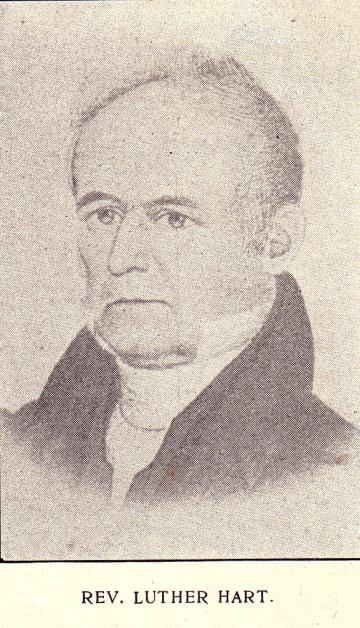
Reverend Luther Hart
There is very little known about the day to day life of Luther Hart so all I can give you is some bare facts and second hand accounts.
Luther Hart was born July 27, 1783 in Goshen, Ct to David and Hanna (Hudson) Hart.
He attended Yale Seminary and was graduated in 1807, of which institution he was afterwards a fellow. He taught at the Litchfield Academy for a year. Luther began to study to become an ordained minister in 1808, as part of the first class of the Andover Seminary, being taught by the Reverend Ebenezer Potter, of Washington, Connecticut. He graduated in 1809.
The Plymouth Congregational Church was called by many names, but in 1810 they were called “The Church of Christ in Plymouth.” According to church records, Vol. 3 pg 20
“June 11th 1810
At a meeting of the members of the Church of Christ in the Town of Plymouth duly notified – Signed Deacon Camp Moderator –
Voted to give Mr. Luther Hart A Call to take the Pastoral Charge of this Church – voted that Deacon David Smith Samuel Camp Jacob Hemingway Esq. Requested to present this vote to Mr. Hart and Request his answer. Voted to adjourn this meeting until the Society Meeting on this. Shall close - - Lake Potter Scribe”
9
The three met with Luther and, after careful consideration, on August 13, 1810 he responded,
“To the Church of Christ in Plymouth
Dearly beloved in the Lord
Having on the eleventh day of June AD 1810 received A Call to settle among you in the work of the gospel ministry and having deliberated on the same with serious and prayerful attention I have concluded to comply with your request – wishing that grace and peace may be multiplied unto you. I remain Gentlemen with sentiments of due respect and esteem your humble servant and brother in Christ.
Luther Hart”
He was ordination was on September 5, 1810 as pastor of the Church of Christ in the Town of Plymouth, Connecticut. The reverend came to Plymouth when it was at his ordination that he found that it was common to have a “sideboard” with different libations.
Luther did not abide intemperance so he soon put a stop to this practice and liquor was banned from all church functions. He also gave sermons on “temperance.”
In Plymouth he met Minerva Potter, born 1790 to Daniel and Martha (Mumiston) Potter in Plymouth, Ct. They were married in Plymouth on September 18, 1811. Unfortunately they did loose their only child, Luther Potter Hart on Aug, 28, 1829. He was 17 month old.
Minerva became the proper minister’s wife and was well respected in the community. It is recorded that Minerva, even after Luther’s death, was active in the community and was well respected for her works.
The Reverend was known to preach against the secret society of the Masons as was the sentiment of the day that they were secretly in league with the devil. The ironic thing is that the cemetery behind the church has a grave stone adorned with Masonic symbols.
A town leader, Eli Terry Jr. pushed for rules and regulation on how the church would handle known Masons. The church adopted regulations and any person who was a mason and wanted to stay a member of the church had to swear an oath, renouncing the Masons.
The church records show that Eli Terry Jr. brought many intemperate and immoral persons before the congregation for judgment. Reverend Luther Hart would be the moderator for these “trials” before the congregation. If found guilty, the person would have to confess to and ask the forgiveness of the church. Once recorded as forgiven, the person was now able to rejoin the congregation. This practice of public confessing was later changed by Reverend Hart to just appearing before the Deacons. This continued until the turn of the 1900’s when it went out of favor.
Luther Hart died while he was preaching a revival April 25, 1834. If anyone had a choice of their appointed time of death and what you are doing at the time, I feel that the Reverend crossed over doing what he felt was the most important thing in life, preaching for the awakening of all the un-renewed. The only outright humor you will see in this book is that I hope that he did not just finish the famous sentence, “If this isn’t the truth, may God strike me dead!”
During his ministries he wrote down his sermons and hand bound each. Each sermon being numbered, annotated where and when he gave each sermon. A side note, the titles 10
given in this book are my addition. This way you will know the general subject of that sermon. The Plymouth Church has 11 of these, earliest number 15 and latest numbered 770. The State Archives of Connecticut have over 400 of these bound sermons but sadly most of the sermons from 1 to 99, 400 to 599, 700 and above are missing and most must be lost. Sermon 770 was dated September 1822, since he died in 1834, there must have been far more than this. What a loss to the world.
In an attempt to bring him to life and let you know some of his feelings, I have created an interview with Reverend Hart based on some problems of the day and will use quote from his sermons for his answers. There will be mixing due to him covering a subject in several sermons. His words though will not be taken out of context. The quotes will be taken from the complete sermons included in this book so you will be able to see in what context.
My hope is that you get the same delight and inspiration from his words as I have. I truly believe that he is a guiding voice from the past.
1930’s WPA project was to record every gravestone in Connecticut – Plymouth, CT.
616-9 Old cemetery in behind the Church pg 87 Gravestones present 1935
Hart, Luther Potter, son of Reverend Luther & Minerva, died Aug, 28, 1829, age 1 yr 5 mo Hart, Reverend Luther, born July 27, 1783, died April 25, 1834
Hart, Minerva Potter, wife of Reverend Luther , born Jan 2, 1790, died Feb 12, 1882
11
An interview with the Reverend
Today, it is the custom to base our life on what the physical world presents us. We are constantly being told, by television, news media, politicians and all other means of public communication, what we should do, think and say. We are constantly aware of political correctness, don’t say this or that because one might offend.
Reverend Luther Hart was a man who was most concerned with a spiritual renewal and your eternal life. He would constantly be aware of the tragedy of dying with out a rebirth and preach of our potential loss. This interview is meant to give the reader a basic understanding of the philosophy of a man, who in his time, had over 400 active members in his church and also frequently preaches at neighboring towns.
There are a lot of people that do not believe in the existence of the eternal soul, that this life is the only existence that we have. What would you say to those people?
Luther – Before God induced him with a soul, Adam was complete in his form, the machinery was perfect, but as inactive, as useless, as mean as the dust of the ground. But as soon as life is kindled, as soon as the entrance of the soul excites the pulsation of the heart, and invigorates the nerves. Then he is fit for action, then he assumes his dignity.
If my soul were not immortal, I would pray for instant death. My soul would escape from these sorrows, and find refuge in everlasting insensibility. I would say, I might well say to my Maker at death, now I sleep in the dust; then shall seek me in morning, but I shall not be. If in this life we have hope, we are of all “beings” most miserable”
God has not created the body of man without giving him air to breath; nor his eyes without furnishing objects of sight. For every natural appetite there is an object of gratification and can God have been less bounteous to a soul? Is that dignified principle which constitutes all our worth, doomed to abstinence and poverty, disappointment and death?
It is the soul which stamps upon us intelligence and humanity. Such dignity belongs not to dust and ashes. So unimportant are these vile bodies of flesh and clay that our Savior left them entirely out of view when he asked the question in a text, “What shall a man give?”
The excellence of its nature is apparent from a part that a soul of man is necessary to his animal existence. A body without a soul; what is it but a lifeless inactive mass of flesh, fit only for the coffin and the grave! What is death but the departure of a soul, and what is the residue, but a lump of clay.
The impression that most people have of your era is that the sermons were filled with
“Hell-fire and brimstone” to scare people into the faith. Most of you sermons talk about sinners but there is little of burning in hell. Why is that?
Luther - It is impossible to frighten men into religion. You cannot frighten them into a conviction of any truth. There can be no solid and proper belief of the truth, without the full and sober exercise of reason. But you command the full exercise of reason, when the whole soul and body are agitated with fear. But even though one should rise from the dead, and not frighten us by his appearance, his testimony respecting the eternal world, would not of itself overcome the obstinacy of our unbelieving hearts.
12
The same disposition which induces men to desire more evidence than the bible contains, would endure them to demand the testimony of another and another, and even of all who have ever departed this life. If they hear not Moses and the prophets, neither would they be persuaded though one, or several thousand million rose from the dead. If a degree of evidence fully sufficient for the proof of a fact, will not gain our belief, a 100 degrees of the same evidence will not do it.
How then can we be saved?
Luther - . The Almighty is absolutely opposed to our salvation except we receive it as a free gift from him. He will forever exert his power against our procuring it any other way.
It is infinite condescension that he will permit us to reach heaven at all; then surely it belongs to him to mark out the path. His way is the best way. While it humbles the sinner, it prepares him to relish the blessedness of heaven which without humility would be to bring a plane of indescribable torment. All that Christ asks of us is to accept of what he has done, and more freely offers, and be thankful. This is all the mystery of conversion, to despair in ourselves, and regain through hope in Jesus.
You must be moved by the power of God only. But I cannot describe those joys or sufferings. Language is inadequate. Yet you must be influenced by argument and reason.
You must be persuaded to preserve your limbs, although I cannot describe to you the anguish of a broken bone.
You can take a motion to obtain salvation though you cannot comprehend its blessedness; and to escape the pains of hell though you cannot comprehend the full measure of its woe. None but the Christian can form any idea of the loss of heaven, for none but he has ever tasted of its joys.
It is not indeed our righteousness, it is only counted to us for righteousness. No man is holy, only as he is made so by Christ, and that which Christ forms in us cannot be called absolutely and exclusively ours. When a sinner is converted, he is justified not because there is anything good in him, which he can call his own, but because Christ sees in his heart his own image which by divine grace he had planted there. Christ sees nothing in humbled soul which he himself did not plant it.
Through the ages, men have surfaced saying that this cause or that is Holy and the will of God. They have claimed divine revelation, a vision or a dream. How do we know what the will of God actually is?
Luther - The will of God it to be performed by man, no further then it is made known, and the Sacred Scriptures contain all that God has been pleased to reveal concerning his and our duty. The will of God is not to be learned from dreams, visions, impulses, and new revelations. Every truth which is necessary for us to know, may be found in that Sacred volume which is complete in all its facts, and to which if any man shall add, God shall add to him all the plagues which are written in it.
Dreams and sudden impulses, if relied on as pointing out the will of God are but fruitful sources of enthusiasm and delusions. To do the will of God then is to perform all that he has commanded in his word. And all his commands their made known respect either our hearts, or our conduct.
13
Love is the fulfilling of the law; for he who cordially loves God and man will necessarily be a practical Christian. Love is an active principle. It secures obedience to the law of God.
It is the will of God that our faith should not be merely speculative, for with the heart, man beliveth unto righteousness. In short it is the will of God that we should be born again; not of blood, not of the will of the flesh, nor of the will of man, but of God – that we should be renewed in the spirit of our mind, putting off, concerning the former conversation, the old man, which is corrupt according to the deceitful lusts; and putting on the new man which after God is created in righteousness and true holiness.
The whole will of man must be in subjection to the will of God. We must do the will of God as well by our inward, as by our outward exercises. In short it can be performed only by being Christians and by living like Christians.
I have a personal question. You know my background and questioning of my religious beliefs, how did I return to religion and God?
Luther - The only answer that can be given is that the good Shepherd himself went after you and brought you back. For had you not been brought, you never would come back.
You came into the world with your faces set towards hell, and you never would have stopped, if he had not gone after you and brought you back in his arms. All this is virtually expresses in the text, which says For ye were as sheep going astray, but are now returned.
It is not affirmed actively that ye returned, but positively, ye are returned: not actively, Ye came back yourselves but possibly, ye are brought back. No sinner ever came back to the fold, of his own accord. And no one ever will come unless he is brought.
Some scholars have gone on record stating that the bible is nothing but a book of tales that were created or borrowed from other cultures. They say that since there has not been actual proof found of Jesus that even he may have been a collection of ideas rather than a real person.
Luther – The saved penmen, could have no endearment to record the events mentioned in the Sacred Scriptures had not those events taken place; for they knew when writing their several histories, that they were exposing themselves to persecution and death. And they suffered martyrdom, not for recording falsehood, but for recording the truth. Men could not possibly exist together in society if they were not compelled, as it were by a law of their nature, and by particular circumstances which they cannot alter, to speak the truth.
The world would soon go to ruin if all human testimony were henceforth to be laid aside as amounting to no proof in any case what ever. We have just as conclusive evidence to believe there is such a place as London, as if we had seen it with our own eyes. And yet the whole of this evidence is derived from the testimony of others. We acknowledge that the testimony of some men whose interest or passions would lead them to falsify the truth, but there are cases in which the very worst of men could have no temptation to relate and record a falsehood.
14
With all the miracles described in the bible, why aren’t there miracles today to show people that God does exist?
Luther - If we grant that three quarters of those who publicly profess Christianity, are down right hypocrites or even knaves, still the remainder, collected from all the churches with which we are acquainted, would far exceed all the miracles which Christ wrought while on earth: and the conversion of this remainder we may justly consider as so many miraculous effects of divine agency.
A “New Age” religion involves channeling, messages from the dead and even the occult is commonly accepted. Can we gain a better vision of what it is like in heaven from these studies?
Luther – A messenger from the dead could say no more than what is said in the scriptures.
The same God who dictated the scriptures would not suffer him to reveal more than the bible contains. God intended it for a perfect book. Accordingly all that it is any importance for us to know; and it is manifest he would not suffer any unimportant communications to be made.
What greater or more momentous truths can be related by any tongue than are recorded in the Sacred Scriptures. An angels tongue could not express were these with more perspienity and force. Or if it could it would be of no service for us to listen; for in that case the angel must employ something more forcible than human languages; but mortals cannot understand the language of another world. If the revelation of more and different truths had been necessary, they would have been revealed to us as the Sacred Scriptures were by the pen of inspiration; for it would be preposterous to suppose that God would raise so many millions from the dead as on that hypothesis would be necessary to give intelligence from the other world to all the inhabitants of this in every age.
Your words are bold and you have a strong religious conviction. Why is this?
Luther - It is for the Christian only to triumph over death. He may look with bold face on any evil which can befall him in this life, and on death, for it his last enemy. But the wicked have nothing which can rationally allay their fears. All before them in the eternal world is dark and dreadful and every thing which notifies them that their departure is at hand, fills them with alarm.
Wicked men are often disheartened at a view of approaching troubles. But he who puts his trust in the living God need fear no disasters; for let him be assailed by adversity, the Lord will soon appear for his deliverance or will give him grace to bear the cross with resignation.
True religion will discover itself in the open countenance and bold resolutions of those whom it actuates. It makes a man take his stand both as to sentiment and practice. The truly righteous heartily despise the idea of conforming ones actions and opinions to those of the world, for the sake of avoiding censure.
They will show their boldness in strenuously opposing the current of vise and damnable doctrines which aims its whole force at the destruction of all religion. The righteous will 15
not be afraid reprove those who need rebuke, even though by administering it they should incur the ill-will of the guilty.
No boldness is so effectual to drive away all fear from the soul, as that which religion inspires, for it not only has everlasting basis, but is tempered with prudence, affability and kindness. It does make a man daring only to boast of his courage. It does not induce him to climb a steeple only to surprise and pain others by a recital of his dangerous exploit. Nor does it make him prodigal of his blood and life, that he may gain the reputation of a hero.
No all the arts of his boldness will bear the inspection of his conscious. The motives which govern him and make him resolute while others shrink from danger and from the eye of good men are virtuous as well as officious. And under the influence of such motives, he can wake and sleep, sleep and wake fearless of harm for God is his defense.
End of the interview.
Daniel Sanford
16
What is a man profited, if he gains a whole world and lose his own soul?
Sermon 15
This sermon is the first that is still around. A copy of the original is in the back of this book. This is the sermon that I transcribed first and it is the one that really got me interested in the Reverend.
In this sermon, he takes the simple but very complicated question from Mathew 16:26
“What shall a man give in exchange for his soul. He shows that we very freely and with little thought, sell our soul for a very small price. He shows that not only is there a soul, but gives the consequences of loosing ones soul.
The thought that the same dilemmas we experience today existed not only in his time but the advice he gives us is as applicable today as it was then. There is no reason that it should not be because, at least to me, proves that the gospel lessons are timeless.
My view is that God gave all of us free will. We must all chose our moral and spiritual paths. It was proven that forcing your opinion and values on someone that does not agree will only harden their heart and strengthen their resolve to do what they want. See sermon 338 on “Brought back to the fold” Reverend Hart addresses just that issue.
With our free will comes the consequences of the action. The Reverend states, in this sermon that a young life lost is like crushing an acorn. Not only do you loose the acorn, but you loose the mighty oak it could have become. At the final judgment, there will be an accounting for the lost life and the potential that was also lost. No harder judgment can be dealt on this earth.
The sermon puts forth the idea that we sell our soul at a very cheep price, a half truth here, a look the other way, in all our actions we give away our most precious possession.
We lavish such attention to our mortal bodies to such a point that we have disease’s related to self starvation for nothing other than vanities sake.
Contemplate the price that you have put on your own eternal happiness. Please enjoy Sermon 15 and I know that you will come away with at least a better value of your soul.
Daniel Sanford
17
Luther Hart Sermon 15 Dated 1810
Wilmington
Salisbury
S Farms
Torrington
N. Goshen 1810
Plymouth 1810
Mathew 16:26
“What shall a man give in exchange for his soul?”
This solemn question of our Savior must be answered, for it reminds us of the death –
bed, and an eternity. I say it must be answered; for it refers us to that momentous period at which we must all arrive. When the world is behind us and its harms are forever fled.
When the soul is trembling for the issue of the last gasp, and when at the next instant its irrevocable doom for eternity must be announced.
We shall then have done with fancy and fiction. Our attention will be absorbed by realities. I wish I could lead you a little forward to the contemplation of those solemn scenes from which some of you will probably look back to the present moment with amazing anguish; and some of you with unalterable joy.
If it might have the virtuous influence on your heart; I wish I could paint in lively colors, some of the events of the final judgment, when, instead of sitting as you now do in this mingled form, you must be separated forever. Yes; there must be separations, painful and long, painful and eternal, between husbands and wives, parents and children, brothers and sisters.
Thou fond mothers; perhaps thou couldst sustain the shock of consigning thine infant to the grave. Perhaps thou couldst endure the thought of nevermore beholding and caressing thy child. Its body thou couldst possible spare forever. But I will not insult thy parental tenderness by supposing it possible for thou to bid an everlasting farewell to its soul.
It is the soul which stamps upon us intelligence and humanity. Such dignity belongs not to dust and ashes. So unimportant are these vile bodies of flesh and clay that our Savior left them entirely out of view when he asked the question in a text, “What shall a man give?”
It is not sufficient that the soul condescends to inhabit, in this world, a frail body, without being over anxious what shall become of its humble tenement when it must be exchanged for the scenes of another world?
I ask you My Hearers, if you do not know that at the hour of death, you will feel infinitely more solicitude for the welfare of the inhabitant about to remove to unknown regions, than for the fate of the almost ruined and forsaken mansion.
When you have reached the verge of life, it will be the last of your reasonable concerns to know what shall become of the worn out vehicle in which you traveled and from which you are about to step upon the land of eternity.
By these realities I would divert your attention from an outward moment. I would diminish ardor of your love for those bodies upon which worms are soon to feed. I would weaken your attachment to these bodies of sin which, while unimpaired by sickness or age, are pressing you towards the precipice, and calling on you for criminal gratification at the 18
expense of your everlasting interest. I would induce you to cease bestowing so much labor on a building which must fall, on a plant which must die. For a little while, then let us lose sight of these tabernacles of flesh.
Let us retire within ourselves and learn the value of the soul.
I. from the excellence of its nature
II. from the Provisions made for its future felicity.
The excellence of its nature is apparent first from a part that a soul of man is necessary to his animal existence. A body without a soul; what is it but a lifeless inactive mass of flesh, fit only for the coffin and the grave! What is death but the departure of a soul? And what is the residue, but a lump of clay! And the Lord God formed man of the dust of the ground, and breathed into his nostrils the breath of life, and the man became a living soul.
But before God induced him with a soul, Adam was complete in his form, the machinery was perfect, but as inactive, as useless, as mean as the dust of the ground. But as soon as life is kindled, as soon as the entrance of the soul excites the pulsation of the heart, and invigorates the nerves. Then he is fit for action, then he assumes his dignity.
My young friends, you whose cheeks flush with health, whose bodies are strong with active fibers, who move from place to place at your pleasure, whose hands can readily accomplish the purpose of your hearts; you are all indebted for your distinction from a dust on which your head, to that breath of the Lord which animates, and prompts your actions.
Why heaves the bosom of a new-born infant? Why pants it for breath? Because it is animated by a human soul. Whence the sprightliness and activity of the youth? He derives his vigor from the soul which resides within him.
Where the faltering step, and the palsied hand of old age? Oh My Hearers, the organs of their mortal frames are performing their last offices; but yet the kindred soul, on the eve of departure trims the pale lamp of darling life. It is this life giving, and life sustaining principle, this spirit that binds us to eternity, which constitutes the vigor and excellence of our bodies.
In this view of the soul, How great would be the loss of the soul? Even if there were no future world. If it were only for only for living here forever, who would not offer worlds to purchase an exemption from oblivion and annihilation? Oh the horrid thought of losing our existence – of becoming a blank, of being blotted from the universe! Existence, What should not a man give in exchange for his soul?
2nd ly The soul is intelligent. Conceive of a man devoid of intelligence, and you have the image of a brute. It is not my business here to inquire into designation of idiots. From the most learned disquisition respecting them I should rise in perfect ignorance, I must therefore refer them to the disposal of him who is wonderful in counsel, whose glory is manifested in all his works.
If I could live, and act without knowledge, what would it avail me? The body of a man, walking about the earth destitute of reason, is a frightful spectacle. He extorts from us more commiseration than a brute, because he is destitute of that ornament which 19
constitutes his glory; because he is devoid of intelligence the only real dignity of character.
Without this facility, man would be less than the beast of the forest.
They are directed by instinct and peculiar sagacity in their mode of living, but man is not degraded with these instinctive faculties. He is formed in the image of God. From that eternal fountain, he drinks in that intelligence wh. In greater degrees fills the bosoms of angels and seraphs and God.
In this would he has access to the sciences. From brinks edge already acquired, he sees that the field of science is boundless. He contemplates the works of God, and is astonished at their immensity. He has within him the consciousness of his existence, his exercises, and his pleasures.
You may judge of the value of a soul from circumstance that, when the mind is strongly energized in the contemplation being, it is in a sense annihilated. While the mind is absorbed, how noble is its employment. Then while it is out of sight, the body is in its proper place of inferiority.
Fasten your view upon an individual, whose mind is so absorbed in the contemplation of God and his works, as not to know whether he is in the body, or out of it. At the same time remember that his body, a lump of clay, is preserved from disposition by the dependence on that noble faculty which has now deserted it, and feasts on richer and sublime objects of contemplation.
While you behold him in this pasture of profound thought, do you blame him for having forgotten the body which must parish? Do you blame him for seeking entertainment in objects boundless in immensity, as lasting as the throne of God?
Suppose while he is in the midst of his mental enjoyment, his soul should be at once annihilated; must you not then off your eyes from a painful sight of a body in which all that animated dignified it has become extinct? Yes, if you extinguish his intelligence, you blast him into non-existence, and all he ever enjoyed or suffered are considerations as useless to him as the joys or sorrows of a being that never existed! In this view of the soul is not the loss of the soul, an immeasurable loss?
I have lost my taste and what do all the dainties of the earth profit me? Have lost the sense of hearing and why do you attempt to charm me with music? I have lost the facility of seeing, have what beauties has a field of nature born? But these are losses which pertain to my worthless body, do not affect my existence. Take away an intelligent soul, and you blot me from the page of eternity.
My Hearers, the joys of heaven are intellectual, but all those unattainable pleasures are lost, by a extinction of the soul. Were a man called upon by Jehovah, to bid an everlasting farewell to the intelligent universe, what would not the hapless despairing mortal give in exchange for his soul?
3rdly The soul is improvable. Thus far, we have considered the value of the soul only in its inferior capacity. We have not noticed its increasing dignity, as it progresses in strength and knowledge.
Who can contemplate its worth while in the cradle of infancy? Its value even in the lowest possible degree of improvement exceeds all computation. Surely then we cannot hope to ascertain its worth in future ages of its progression.
As in astronomy the further we extend our view into the heavens, the more stars we discover; so the field of general science, the farther we push our researches, the more 20
objects of curiosity and importance multiply, and the more mind expands with fresh accessions of knowledge. It is this intellectual food which nourishes the soul, promotes its growth and hastens its progress towards the eternal fountain of knowledge. Even in this world, where all things are imperfect.
How much has a bud opened from infancy to manhood. But 40 or 50 or 70 years is smaller than a point, when compared to its march through eternity. Yet how has the bud opened! How many odors has it exhaled! How valuable as the soul which, although its constant residence is in the breast of man, can yet in an instant send its through back to the years eternity which preceded the existence of the world. How valuable the soul, which in twinkling of an eye can pass over the regions of immeasurable space with the same ease as it can reach the nearest object before us? How valuable the soul, ever panting for more knowledge, often winging its way from terrestrial objects to the contemplation of more exalted themes, grasping at objects beyond the reach of mortal eyes.
Have you ever My Hearers, in total forgetfulness of your bodies, of the world and all its concerns, endeavored to conceive of God, and to trace, in your imaginations, the ages of endless duration? And although by searching you cannot find out the Almighty unto perfection, nor fathom eternity, yet does not the thirst for such vast subjects stamp the dignity on your souls in which the body can have no share? All this while the body is insignificant, for it forgotten; is at it were dead, for its vital principle has transferred its self to objects more worthy of its dignity. But how does the value of the soul rise, when we consider that objects so distant and so vast, will ere be long present and the veil which now obscures our knowledge, will then be, in the degree removed? How infinite the loss not simply of intelligence, but of intelligence ever increasing, ever advancing towards perfection!
Destroy the tender bud as it shoots from the acorn, and you destroy that which should have become the mighty oak. Strike out of existence the soul of an infant, and you have annihilated that principle of excellence which elevates it in the world, to the human being; and which in the world, may be invested with robes of righteousness, and unattainable knowledge and glory.
The moment the soul takes flight from things terrestrial, how is it instantly magnified?
How has it fled from our conceptions? How has it left behind its former discoveries? It sails with the swifter gale on the ocean of eternity. How awful the thought of losing not only our present knowledge, but that boundless field of knowledge which is spread before us, and reaches into scenes of futurity! Dreadful, insufferable is the idea of burying in the same grave of oblivion, our consciousness, our intelligence, our dignity, and the blessings of our existence! What shall a man give in exchange for his soul?
4th ly The soul is susceptible of extreme happiness or misery. It belongs essentially to its dignity, that it was created for enjoyments, goldenness, and happiness are intimately allied to each other.
Adam was holy and therefore necessarily happy. But man fill this holiness has departed and left nothing in its stead, but disaster and woe. The soul was then emphatically lost, not by annihilation; but by an exposure to infinite suffering. But the Savior has appeared.
The soul may yet live and be happy, may be renewed in knowledge after he image of him who created him. It is through the merits of Christ, that every sensation of our bodies is not pain and anguish, and that this world is not divested of all its comforts.
21
We are situated between heaven and hell, and our souls susceptible of the joys the former, and the miseries of the latter. My heavens, what would it avail, to describe to you the pleasures which flow at the right hand of God, or the pains of endless burnings? Could I hope to move you by the description of sensations which you at present do not feel? By such a description, would I animate the zeal of one Christian, or drive a single sinner from the stronghold of Satan?
No My Hearers you must be moved by the power of God only. But I cannot describe those joys or sufferings. Language is inadequate. Yet you must be influenced by argument and reason. You must be persuaded to preserve your limbs, although I cannot describe to you the anguish of a broken bone.
You can take a motion to obtain salvation though you cannot comprehend its blessedness; and to escape the pains of hell though you cannot comprehend the full measure of its woe. None but the Christian can form any idea of the loss of heaven, for none but he has ever tasted of its joys.
Since heaven is secured to the saint I will not mar his joy by a valuation of its loss. Nor shall not I attempt to affect sinners by estimating the loss pleasures which they never enjoyed. They must be taken on another ground. They have all suffered pain; and what is the loss of the soul, but constant inexpressible anguish.
My fellow sinners, if you morn not the loss of eternal happiness, you will indeed shudder at the though of endless torment. Think on the horror of that doleful prison where every sense is an inlet of pain. Now you are bent on the gratification of that body whose power of receiving pleasure shall then become the capacity of indescribable suffering. You must then rush into every danger which you now so studiously avoid.
Imagine, if you can, every part of your bodies to be once afflicted with all diseases which are incident to it in this life. Can you support the united effect of these maladies?
Can your heart endure or your hands be strong, when you are thus made to drink the vials of God’s wrath? Yes, you must endure those sufferings, with the overwhelming consciousness that they shall never end. More than this, inconceivably more: The soul having fallen so far beneath heaven, must ever be stung with remorse- must endure the gnawing of the worm that never dies, Do I exaggerate?
I appeal to the word of God. I appeal to the reason of that man who has had only the glimpse of the evil of sin, and the purity of the divine law. How awful the thought: the soul is lost whose value, at the season when it might have escaped ruin, was beyond all price.
That soul is lost, which kindly sustained the sinners existence on the day of hope; but now since hope is forever fled, it prolongs his miserable body in the midst of flames and despair. That soul is lost, which was intelligent and would understand the language of the Savior assuring the sinner.
Now is the day of salvation, but since that salvation is rejected, he is intelligent only to bemoan his folly and realize his anguish. That soul is lost, which might have improved in knowledge and virtue and happiness; but since he despised instruction and hated reproof, he is doomed to improve in the knowledge of sin, and the consciousness of increasing torment.
Oh My Hearers, cast your eyes on the death bed of an impenitent wretch. You see him gasping, and do you not tremble for the results of his last breath? Just as his sprit goes, do you not cringe under the consideration that he now enters eternity in the horror of surprise, and that his first discovery the loss of all he carries with him, of all he can wish to save?
22
One moment since, and he was a candidate for a far different world; for while life remained, he needed not to despair, Yes by one sigh of penitential sorrow, he might with the pardoned malefactor, have risen to glory. But his dignity as the probationer fled with his last breath, the he falls to the bottomless pit, with nothing to console him but the consciousness that his soul is irretrievably lost. With what earnestness might our Savior urge the question; What shall a man give in exchange for his soul?
5th ly The soul is immortal. If the soul be not immortal, why is it not sinless to? As man now, diminutive sphere of action this side of the grave? Why should it ever have cast a thought beyond the concerns of the body which must perish? If the soul must die, whence this universal desire for future existence? Is God malevolent? Has he set before us objects which we cannot reach, and encouraged expectations on purpose to cross them?
My Hearers, these reflections are the benevolence of our Creator are impious. Our desires for immortality are rational, and will be gratified. The eternal duration of the soul is not a farce. The hopes of the just, and the fears of the guilty are not groundless.
Those misgivings of conscious are founded on realities, which deter the sinner from the commission of crime, by the apprehension of future punishment and those incitements to virtue which are derived from the hopes of future felicity, are founded on truth and reason.
God has not created the body of man without giving him air to breath; nor his eyes without furnishing objects of sight. For every natural appetite there is an object of gratification and can God have been less bounteous to a soul? Is that dignified principle which constitutes all our worth, doomed to abstinence and poverty, disappointment and death?
If this were true, I should envy the happiness of the reptile and the brute. All their view centers on the present moment, they aspire at nothing noble; all their wants are satisfied, for every appetite meets its object. But if the soul of man be not immortal he is the wretch; tormented with anxieties for the future, when it is certain that he must be down with the brute in death no more awake.
These anxieties are unavoidable, they are interwoven in the fibers of the heart. Before we are aware of it, our thoughts fly from things seen and temporal, and are busy in the contemplation of nobler scenes and a wider world. And must we be disapproved? Shall we at last shrink into nothing?
My Hearers, this world does not meet the wants of the soul? You visit the palaces of kings; you mingle with the jovial throng, you gratify every craving appetite; you live in splendor; your ear ring with applauses of the world; and what is it all, but vanity and veneration of spirit? It is all tumult and discord to the soul and must this soul sick of all these miserable enjoyments, and longing for something more substantial, must it die in hunger, must it be obliterated as it grasps for immortality! But away these horrid ideas, this insult to God.
If my soul were not immortal, I would pray for instant death. My soul would escape from these sorrows, and find refuge in everlasting insensibility. I would say, I might well say to my Maker at death, now I sleep in the dust; then shall seek me in morning, but I shall not be. If in this life we have hope, we are of all “beings” most miserable”
My Hearers, the resonances of Plato on the immortality of the soul were just. Your ardent desires are well founded. God will not sport with your hopes of immortality, he will 23
not rob you of all your worth. He has confirmed the value of the soul by the gift of the gospel which brings life and immortality to light.
Yes all uncertainty is removed, you are born for eternity, your fears are dissipated; you are confident. But in the midst of your transport, remember that if you lose your souls, your immortality will be loaded with curses. Your existence will be preserved only to perpetuate your pain; your sensibilities will be kept alive only that you may realize the severity of your torment.
If you lose your souls, your desires of future existence will be gratified, lust in wrath!
You will reach the eternity hoped for but it will be an eternity of despair! Ah my immortal soul! My body I can destroy, my animal life I can extinguish, but thee I cannot affect, thou art beyond my reach, thou must endure forever! What shall a man give in exchange for his soul?
II We learn the value of the soul from the provisions which are made for its future felicity.
We have noticed the soul’s susceptibility of happiness. I now turn your attention to the happiness procured for it, and the expense of the purchase. I have now come to the stand. I have no adequate ideas of heaven nor language by which to describe its joys.
I must refer you to the word of God. Hear that St. Paul says on this sub. “Eye hath not seen, nor ear heard, neither have entered into the heart of man, Things which God hath prepared for them that love him” Thou Christians! Thou whose bosom has kindled with rapture at a sound of Jesus’ name, thou whose pious soul is often raised from this world to the contemplation of the divine glory, what will thou think, what will thou enjoy, when thou art in the arms of thy Savior?
When thou art refined from the dross of sin, when that holy flame within thee shall burn without interruption, and increase in fervor & brightness. When thine ears are attuned to the music of the heavenly host, and when thou hast left this abode of sorrow no more to return?
My Hearers when your thoughts dwell on heaven, you need not fear that your imagination can carry you beyond the reality. You need not therefore fear everlasting the value of your souls. As you value external felicity, you must depreciate its loss. To the motive of infinite dignity and joy, need I add another taken from eternal infamy and pain?
Let the love of Christ constrain you rather than the fears of hell!
2nd ly The expense of the purchase. The happiness of the saint we have now been contemplating, was purchased by the suffering of a God! The groans of the Savior on the cross, were substituted for our shrieks in the bottomless pit. This divine sacrifice was not made for equals, for we could then more easily comprehend it, nor for sinless inferiors, for then it would not have been needed, but for beings insignificant and vile, whom we ourselves should despise, could we see the blackness of their hearts.
At the recital of such wonders is on sit unmoved! You have been too often told of the sufferings of Jesus to be affected at the rehearsal, Suppose then a new event; but of infinitely less importance. Suppose that for your salvation the rocks should instantly rend every mountain become a volcano; the stars rush together, the sun and moon be extinguished, and this house burnt asunder, would you not be alarmed at the awful catastrophe?
24
Yes, you would tremble but it would be comparatively for nothing, you would be frightened at a shadow, you would be alarmed at the falling of the leaf. At the expense of a breath, God could effect this mighty convulsion of nature. But while you are panic struck at the tempest, angels are astonished at the work of redemption.
They gaze with wonder, not on the tempest, but on the condescension and sufferings of that God who rides in the storm the walks on the wings of the wind. I wish you could for once be elevated to the throne of an angel, and look down to the humiliation and disgrace of the Savior on the cross. But the throne of angels and the throne of God are farther asunder than the extreme points of the universe.
My Hearers, the blood of Christ has meaning. It did not flow from his wounded side at so cheap a rate as in expressed by the language of your (our) insensibility if you would behold a glory of his character, cast your eyes towards heaven, to the worship of angels and seraphs.
Behold the thousand thousands ministering unto him, ten thousand times ten thousand standing before him. If you can measure a height of thee throne from which he descended; if you can fathom the mystery of God manifest in flesh, if you can conceive of his sufferings or comprehend his divinity, then can you ascertain the value of your souls. We are bought with a price. We are redeemed from your vain conversation, not with corruptible things as silver and gold, but with the precious blood of Christ.
A few thoughts shall close this momentous subject. Not withstanding the infinite value of a soul, what multitudes of the human race lose it forever! How many careless wretches will awake in hell without having considered that they had the soul to save!
Judging from the conduct of men, I should suppose that a soul was valued only as an article of traffic. Many barter it away for opulence and splendor, many for the breath of fame. Behold that youth; he has parted with his soul for “The art of swearing expertly”
Look at that old man with hairy locks; he sold his for the art of lying and cheating without being detected. The drunkard parts with his soul for one draught of poisonous liquor. And the libertine parts off his for the moments sensual gratification.
Go where we will, we find souls exposed for sale, at the cheapest rate. A horrid thought!
How irrational are beings whose only dignity is that they are endowed with reason! While this madness is before me, I seek for no further evidence of entire depravity. But I would hope that none of you, My Brethren, are among that ill-fated number.
It is no compliment to men of sense, that they stoop to the level of those abandoned wretches who reject their reason and ruin their souls. You would not sacrifice your property, because others have become bankrupts. If I could draw an argument from reason or revelation, from duty of interest, from heaven or hell, I would press that argument upon your consciouss.
If you lose your souls you lose your all, and sorrowful scenes await you. “If thou scornest, thou alone shall bear it, yes, bear it, when the wide universe shall be emptied of all hope in your case. If you duly appreciate the worth of your souls, I need not urge the motive for you to secure them. Your breast will be full of motives, and you will fly to Jesus the ark of safety.
The life of the Christian is not only warfare, but it is the race. And while you are hastening your souls towards heaven with diligence and zeal, regard not the cry enthusiasm! Enthusiasm! Oh My Hearers wish your bosoms were now full of that 25
enthusiasm which should prompt you to seek heaven with the zeal half proportional to a value of your souls.
You would then be as anxious as the lawyer when pleading before the human court, yes, as anxious as his client, who is full of solitude about the result of his cause. Yours is no common cause, It is for your life. You stand before the court of heaven. The time is short, and you are soon to learn the decision which can never be recalled. Remember that when you stand before the judgment seat, this world and all its appendages, its riches, and honors, and delusions will have forever fled. When you shall thus stand naked before God, you must exclaim, “What is a man profited, if he gains a whole world and lose his own soul? Or what shall a man give for his soul?”
END OF SERMON 15
26
You are directly related to Christ Sermon 271
I must say that I found this sermon one of the most moving sermons that I have read to date. Reverend Hart has based this sermon on Mark 3:35 “doing the will of God. He shows us how, by doing the will of God we are more related to Jesus that we are to our own families. By Jesus’ declaration that his followers were his family over his earthly family he is telling the would that if you do the will of God you are his spiritual relation.
Reverend Hart explains that there is not an earthly bond more strong than that of your family, but he also shows that spiritual family will be thousands of times greater of a bond.
By doing his will, god will be your father also and as a good parent, he will see to all your needs. Like a parent he will comfort and protect, he will guide and advise, and he will be everlasting. The rewards being immeasurable, so is the sorrow of the loss of the eternal family.
I have placed this as the second sermon for you to read only because sermon 15 is the first we have. You need to see that in the years since he was ordained, he had grown in the spirit. To date I have only read the sermons that I have transcribed. The elation of the knowledge that there may be even greater things to come in the sermons to be read. Rest assured that, as long as I am on the earthly side, I will follow up this volume with as many of the 400 known sermons as I have time.
Since this sermon was given in December 1819, and he only gave this once, I will say that consider this a true Christmas message, because it represents your spiritual rebirth.
What a greater gift than being born to be brother, sister and mother of Jesus.
Daniel Sanford
27
Reverend Luther Hart Sermon 271
Plymouth Dec 1819
Mark 3:35 “Whosoever shall do the will of God, the same is my brother, and my sister and mother.”
Christ’s kindred, according to the flesh, appear to have often been connected but he should labor beyond his bodily strength. He had now been a long time employed in confronting the blasphemy of the Pharisees respecting his casting out devils.
Probably his bodily strength was somewhat exhausted by so long a course of reasoning and probably also, this was the reason why his mother and brethren came standing without and called him. But he was too intensely engaged in his Father’s business, to notice them with much attention.
For when the multitude that sat about him, said unto him “Behold thy mother and thy brethren without seek for thee, he answered them, saying, who is my mother and my brethren? So anxious was he to bring the perishing Pharisees into the kingdom of God that his mind seems to have soared above all earthly relations.
Not that he was destitute of natural affection, for he was surely subject to Joseph and Mary, and gave the man convincing proof that he ardently loved them and his brethren.
The Pharisees being pressed hard by his arguments, were unquestionably forward to notify him that his kindred called him from without, hoping that the information would induce him to lay the subject aside. But that he changed the subject he touched upon one no less unwelcome to those self righteous beings.
He looked round about them which sat about him, his disciples doubtless, and said,
“Behold my mother and my brethren! For whosoever shall do the will of God the same is my brother, and my sister and mother.”
I shall
I. Show briefly what it is to do the will of God.
II. Show why those who do it are divinely related to Christ. And III. That it is the most desirable of all relations.
I am to show in a concise manner what it is to do the will of God. The will of God it to be performed by man, no further then it is made known. And the Sacred Scriptures contain all that God has been pleased to reveal concerning his and our duty.
The will of God is not to be learned from dreams, visions, impulses, and new revelations.
Every truth which is necessary for us to know, may be found in that Sacred volume which is complete in all its facts, and to which if any man shall add, God shall add to him all the plagues which are written in it.
Dreams and sudden impulses, if relied on as pointing out the will of God are but fruitful sources of enthusiasm and delusions. To do the will of God then is to perform all that he has commanded in his word. And all his commands their made known respect either our hearts, or our conduct.
28
Few are the instances in which a man thoroughly acquainted with the Sacred Scriptures can be at a loss with respect to external duty. The great principles of holy being are so frequently and plainly stated, if not drawn out into detail that no man need on there in. Do unto others as ye would that they should do unto you is a rule ground in its construction but safe in its application to every possible case. From the Sacred Scriptures we learn that it is the will of God that we should keep his Sabbaths and reverence his sanctuary, pray in our families and in secret, visit the widows and the fatherless; feed and cloth the poor, be charitable and give not grudgingly, and be thoroughly furnished unto all good works.
Nor does the will of God respect our external actions only. It extends to the thoughts of the heart and secret intents of the heart, as well as the words of the mouth, and every outward act. The tree must be good before he can accept the fruit. He therefore requires us to love him with all our heart, mind, will and strength. He requires us to exercise that faith which works thy love and purifies the heart. He complains of those who honor him with their lips, while their heart is far from him, of those who hear his words but will not do them, and those who belove but will not love.
Love is the fulfilling of the law, for he who cordially loves God and man will necessarily be a practical Christian. Love is an active principle. It secures obedience to the law of God.
It is the will of God that our faith should not be merely speculative, for with the heart, man beliveth unto righteousness. In short it is the will of God that we should be born again; not of blood, not of the will of the flesh, nor of the will of man, but of God, that we should be renewed in the spirit of our mind, putting off, concerning the former conversation, the old man, which is corrupt according to the deceitful lusts; and putting on the new man which after God is created in righteousness and true holiness.
The whole will of man must be in subjection to the will of God. We must do the will of God as well by our inward, as by our outward exercises. In short it can be performed only by being Christians and by living like Christians.
II. I am to show why those who thus do the will of God are divinely related to Christ.
Because they possess his spirit. The same mind is in them which is also in Christ, for it is nothing but this holy temper which disposes and enables them to do the will of God. It is this solely as a radical and active principle which distinguishes them from the impious and from what they themselves were antecedently to the renovation of their natures.
As the tree must be good and furnished with a supply of proper juices before its fruit can be good, so the heart must be furnished with a holy disposition, before the sinner can bring forth the fruits required. But no sooner does he drink into the same spirit with Christ, than he becomes divinely related to him. The branches are related to the vine only because their nature is the same and because they participate of the same juices.
Parents and children are related because blood of the same kind, and of the same temperament flows in the veins both of the former and the latter. The animal and mental nature of the parent is immediately transfused into the child. The natural constitution of both is usually very much the same.
There the relation, which exists between Christ and his disciples, grows out of their being like him in the spirit of their minds, meek, lowly in heart, watchful for giving, patient under injuries, weaned from the world hungering and thrusting after righteousness. If there were nothing in families which rendered their several members alike in the constitution of 29
their bodies and minds, there can be no more real relation between them that there is between two men of different nations and different colors. So if the moral image of God, which was lost in Adam’s fall were not re-stamped on the heart in conversion, there would be no moral relation between God and saints.
How much several children of the same family may differ from each other in their outward appearance; in their complexion, features and size, yet it is manifest that their natural relation is founded on resemblance whether it be apparent or not. They are derived their essence, however much their external appearance may differ from that of their parents, and this is the foundation of all animal relationship.
So Christians derive their spiritual essence, the sanctified temper which actuates them from Christ and when they pass from death to life, they all changed into the same image with Christ, from glory to glory, even as by the spirit of the Lord. The relation therefore between Christ and believers is founded therefore on the resemblance of their new natures to his. So far as they are sanctified they have the same views and feelings that he has, and conform in all things to his perfect example. Like the members of any well regulated family on earth, they are concerned to promote the interest of the great whole.
They pray for the peace of Jerusalem, are rejoiced to hear the extension Christ’s kingdom and are equally rejoiced to be furnished with an opportunity of lending the helping hand of charity and prayer. They are one with Christ in disposition, in design, and in exertion. For as the body is one and hath many members, and all the members of that one body, being many, are one body; so also is Christ.
For by one Spirit are we all baptized into one body whether we be Jew or Gentiles; Whether we be bond or free, and have all been made to drink into one spirit. This union between Christ and his followers, is more perfect than that which exists between the members of any human family on earth. It is a union as intimate as that which exists between the body and limbs of the same man; because one and the same spirit reigns throughout the whole. Or it is a union as intimate as that which exists between the several parts of the same building.
Not only does one part touch another, but every part fade in with the design of the whole, and ministers to the general effect. So Christians possessing the spirit of Christ are built upon the foundation of apostles and prophets. Jesus Christ himself being chief cornerstone, In whom all the building, fit by framed together, growth unto an holy temple in the Lord.
2. Christians are divinely related to Christ because he provides for all their wants. How careful are parents to anticipate and supply all the necessities of their children. They have a feeling for them of which no adequate idea can be communicated by language or feeling which spontaneously prompts them to notice and relieve the wants of their offspring.
Though it be at the expense of much treasure and ease.
It is the call of nature that they obey, a call which they cannot refuse to hear. But this native propensity in parents to provide for their children, is weak compared to that which actuates the wakeful shepherd of Israel. In every circumstance of affliction and want he recognizes them as his own, and when they cry he hears, when they ask, they receive. It is by his strength, that the weak are made strong and from his fullness that every want of their souls is supplied.
Are they tempted, he who is at hand, and before him even the devils retire, and leave the humbling objects of their malice in the hands of their Savior. He will not suffer them to be 30
tempted above that they are able, but will with the temptation also provide a way for their escape. So they in various ways meet the buffetings of Satan?
Are they called to face an army of inward lusts and outward fears? The Savior is at hand to provide them with a breast-plate, a helmet, a shield and a sword, and says, My grace is sufficient for thee. Are they born down under a sense of guilt and trembling under apprehension of wrath to come, the Savior appears and says Come unto me all ye that labor and are heavy laden, and I will give you rest. Wherefore lift up the hands which hang down, and the feeble knees. And make straight paths for your feet, lest that which is lame be turned out of the way; but let it rather be healed.”
He is often the nearest at hand, when the doubting and disconsolate soul, thinks him farthest off. His cherished provisions are often made known just when his dejected followers are ready to despair of relief. He takes a lively interest in all their circumstances; to none of their wants is he indifferent, but for them all he is faithful and generous to provide. And while he is ministering to their necessities here below he is preparing mansions for them on high. And this affection of Christ for his saints transcends every other affection, how strong must be the cords of that relationship which binds him to see those who do the will of his father in heaven?
3. Christians are divinely related to Christ because he communes with them in all their troubles and joys. Enter every human family on earth, and you will find a no husband or wife, brother or sister, parent or child, on terms of so great intimacy as that which characterizes the nobler familiarity which exists between Christ and the believer.
As nothing strengthens the bonds, and heightens the joys of the marriage relations, so much as religion in the heart of the partners, so there can be no communion like that between the believers and Christ. For it is Christ, that imparts religion to the soul, and in imparting it, bestows himself. Prayer is the Christian’s breath and he loves to breathe, but when he prays, Christ is present. He never has greater enjoyment than when he is on his knees. It is then therefore that he has the most perfect fellowship with the Father, and with his Son Jesus Christ.
There is no possible way in which you could make an affectionate disciple of Jesus so unhappy, so profoundly wretched as to cut off all his intercourse with heaven by prayer.
This intercourse is none other than his intimacy with his best friend. And surely where the intimacy is so great, the relation must be near.
III. The relation between Christ and those who do the will of God is the most desirable of all relations. Christ himself esteemed it so. What earthly relative can be dearer to us than a mother, a brother or sister? Truly we have no mortal friend that lies nearer our hearts that she who bore us, she who watched our cradle by night and by day, and who by ten thousand acts of patience and self denial, guarded us in our childhood, instructed us in our youth, and now worn out with duty and with years, leans on us for support in our manhood. Even the partners of our bosom have few superior claims to our affectionate regard.
But even his own mother Jesus seems to have viewed with comparative coldness and neglect, when as she stood calling with out, he asserted his divine relation to men redeemed by his own blood. He multiplies names of relationships and with an emphasis at 31
the command of him only who spoke as never man spoke, turns away from his earthly kindred and claims affinity with the humble saint as his brother, and sister and mother.
What greater proof than this can we have of the desirable of this heaven born relation between Christ and his followers? We have the sentiments of Christ himself on this subject and he will know on what objects to bestow that love, which many waters could not quench, nor floods drown.
Much as our hearts are drawn out in love towards our dearest companions, and much as our children esteem themselves about our inmost souls, we can enter into a relation as much higher, as the heavens are higher than the earth. Our earthly relatives are often deficient in the duties which they owe us. But faithful is he that hath promised. They by their ill conduct often grieve us great mortification and sorrow. But in our divine brother who hath passed into the heaven, we may ever glory, and even boast. So far is he from giving us any unnecessary sorrows, that he gives us every joy we receive. They are taken away by death, he ever lives to make intercession for us, And when we die, it is by his assistance that we, in faith yield up the ghost, and into his arms that our un-bodied spirit take their flight. Many an earthly relationship, will be broken up at the day of judgment, that day which shall try men’s hearts.
It is by no means improbable that some of us will be everlastingly separated from our bosom companions, and our darling children. Alas! Who can tell if there are not in this house many brothers and sisters, who after a few days or years, are to be related to each other no more forever! But Jesus forever abides. Whom he loves, he loves to the end. What though some of our dearest connections on earth, shall then be torn from our last embraces and sent down to dwell in everlasting burnings, it will not evasion us even a momentary pang, for then will our relation to the Son of God be consummated in eternal glory. Where he is, we shall be also. The connection will not only be without end, but endlessly growing more perfect and endearing. No wonder then that an aged saint, with a comparative indifference to all earthly objects of affection, should have exclaimed, None but Christ, none but Christ.
Now My Hearers, what is the highest relationship that we can boast? Have we no spiritual kindred in heaven? Is there no object there that we love more than our father and mother, husband, wife and children? What wretches then are we. While no earthly friend can give us relief in the hour of death, it would be easy to breath our last on the bosom of him who loved us, and give himself for us. But if we have no transforming and saving connection with Christ, we surely have none with either the inhabitants of happiness of heaven. After death we shall form an everlasting intimacy with that world which in the temper of our hearts we shall most resemble, with God and angels and saints, or with devils and damned spirits. This is the world in which we are to choose our kindred and companions for the next. Therefore let us not defer the choice to which we are directed by the words of wisdom.
END OF SERMON 271
32
Are you a Lion, or do you flee?
Sermon 110
We have all experienced times when we were uncomfortable talking about a subject because it brought up bad memories, old ghosts and voices from the past that make us feel uncomfortable. More often it is a guilty conscious that causes this.
Why do some people stand fearless in the face of danger? Reverend Hart explains that this is due to a solid religious belief in the fact that God is their protector. He has told us many times in the bible that the righteous will have an everlasting life in the next world and will be our protector in this world.
The sermon starts with Proverbs 28:1 “The wicked flee when no man pursueth but the righteous are bold as a lion.” The basis of the text is that if you are guilt free and live by God’s word, we should have no fear of life or death.
It is with the belief of God’s word that he will not give us a burden that our shoulders can not handle. God also has said that there is an eternal life that all that believe in God and has accepted his son as Savior, are welcome. With this and a guiltless conscious, anyone can stand, in the sun or darkness against evil.
As Reverend Hart points out that David told us, “Yea though I walk through the valley of the shadow of death I shall fear no evil for thou art with me; thy rod and thy staff, they comfort me.” David’s conviction and faith in God gave him the courage to face the mighty Goliath with only his sling. He new that God was watching out for him.
At the end of this sermon you will know what you are and if needed what is needed to become a lion.
Daniel Sanford
33
Reverend Luther Hart Sermon 110
Plymouth April 1811
Proverbs 28:1 “The wicked flee when no man pursueth but the righteous are bold as a lion.”
Solomon taught well by precept, if he did not by example. He was doubtless a good man, although addicted, in the latter part of his life, to sinful pleasures. But with emotion of disgust, he repeatedly pronounced them all vanity and vexation of spirit. He was wicked enough to know his own cost, that the pleasures of sin leave a sting in the heart, and he was saint enough to know that nothing but piety can afford the conscious any rational quietude.
His testimony respecting the effect of virtue and vice, on the conscious, must be admitted, for he spoke from experience, and could have no interest in deceiving the world.
If he had not some experience of the courage and fortitude which religion inspires, it is not probable that this unqualified declaration, the righteous are bold as a lion, would ever have fallen from his lips.
Men who know nothing about vital piety are not apt to make such open and friendly acknowledgement in its favor. Such an acknowledgement cannot be sincerely made, without at the same time speaking diminutively and in terms of disapprobation, respecting vice and all its effects.
But I will hasten to the object of this discourse which is to show I. That sin naturally creates fear – and
II. That true religion inspires confidence.
Sin naturally creates fear. It is true man may become so old and hardened in sin, as scarcely to feel, in the perpetration of the most flagrant acts of villainy, any misgivings of conscious. Owing to their long custom in vice, and to the repeated blows which they given an accusing conscious, they may have become both brazen hearted and brazen faced.
The principle of fear, is implanted in the breast of sinners, as a blessing, if they will not eradicate it by the force of vicious habits, but will endeavor to cultivate it, that it may deter them from sin. But this principle is not infrequently eradicated to a very great degree, if not entirely.
The conscious of sinners is often seared as with a hot iron, and to all appearance they are given over to believe a lie, and even to rejoice in the conquest they have gained over a conscious which once so frequently disturbed them with its palling reproach. They have no fear of God or man before their eyes, but rush heedlessly on the thick brasses of the Almighty’s buckles with no apparent concern about consequences.
But wretches hardened in the awful degree, are comparatively few. Most sinners have many restraints, and it is fear of some sort which constitutes those restraints. It is no easy thing to strike an amusing conscious dumb forever. It may cease its reproaches for a reason, but the interval being passed away, that internal monster, will again raise its voice, and fill the soul with fear every time it is heard, till by repeated acts of wickedness it is reduced to a whisper, scarcely audible.
But I am now addressing men whose conscious cannot have been rendered quite extinct, for those whom conscious has been forever ceased to upbraid, are seldom if ever found in 34
the house of God. There are comparatively few robbers or thieves, or drunkards or swearers or slanderers, or even libertines, who are so far gone in their respective vices, as not to hear reproaches from within, which often alarm them, and make them unhappy.
Select your individual. Take a man whom you know to be addicted to some of the most infamous vices and you read his guilt, and his in ward disquiet in his face. His countenance is pitched down, to the ground. Look at him with the boldness and decision of a righteous man and his eyes turn away. He looks at you only by the glance. And it is that glance which betrays his guilty fear rather perhaps than his native bashfulness.
It is not to be denied that bashfulness which cannot always be overcome, will sometimes render the appearance of an innocent person, similar to that of a man who is known to be guilty. It is the natural tendency of guilt not carried beyond a certain degree, to make men timid in the company of the virtuous.
We are all of us acquainted with persons who have lost their reputation and who on that account are looked upon as pests of society affront to the earth. Now it is apparent in the countenance and uneasy motions of such characters that they are abandoned to vice and dread your company. Turn your backs, and they can use their eyes and can steal with the boldness of a hero. But your face disconcerts them and by their restlessness and timidity you are certain that those workers of ingenuity long for darkness where they may hide themselves.
It is not the dread of human laws and their penalties solely which induce villains to retire from the view of the world to plot and perpetrate their mischief, In their souls they dread the face of virtue more than the threats of the most ridged laws.
What vicious child is there, being conscious of his guilt, does not fear the face of a virtuous father, more than the lash with which he corrects him? The rod is not half so sore a punishment to him, as the eye and forcible expostulations of the kind parent.
Those who are most abandoned to vice, can not but despise themselves. They are conscious that they deserve to be despised by others, and especially by all good men. They know that their vices thrust them down into the vale of inferiority and meanness, and that it is virtue only which elevates the good to the eminence of real honor and worth.
And they associate with wretches of the same mean cast, not because they love them, or expect any real satisfaction from their company, but because they know they deserve to associate with no better, and if they could associate with better companions, they are sensible that a sight of their virtue and consequent enjoyments would only increase a sense of their own guilt and the infamy which it occasions.
You never saw a punished villain happy. The sourness of his temper corrode all the poor comforts that his dishonesty procures, and to enjoy the least morsel of quiet, he must flee from the eye of the virtuous, into darkness or the solitary woods, and there feed himself as it were on his body, in a den with beasts of prey.
If he comes out into open view he is apprehensive of detection. He is so conscious of his guilt himself, that he construes every look of a good man into discovery of it. But I would not confine myself here to those who pass for knaves. The same fears, though in much less degree torment those who one not so far abandoned to vice.
There is a very important distinction to be drawn between the righteous and the wicked generally. Unconverted men may be very moral in their public and private walk. Their conscious may not reproach them for any dishonesty in their dealings; still they have at 35
times awful forebodings of the future. Certain that death and judgment are at hand, and that they are not prepared for them, they must shudder.
The bible offers them no consolation, remaining as they are. Their conscious will not suffer them always to doze over the pit of wo without alarm. The truth of religion is demonstrated to them by so many solid arguments that they cannot deny it. And it pains them to yield their assent to a religion which when assented to, looks down with a sever frown on them and all their vices.
By admitting the bible to be the word of God, they virtually condemn their selves for they admit that all it says respecting their criminality and exposure to future woe, must also be true; yet their intellectual belief of the gospel while it condemns them for their sins, does not weaken their attachment to vice. There is a perpetual conflict between what they believe and what they relish.
Many times they fear to take up the bible, but their eye fall on some same demonstration of heaven against them. Sometimes also you see them reluctant to associate with the righteous lest they should converse with them on a subject which has already filled them with gloom and alarm.
They are frequently so fearful of death as to avoid if possible every enumeration calculated to make them reflect on their own mortality. It is this dread of finality which makes many reluctant to attend a funeral. The solemnity of the scene increases their fears of death. Fear produces pain and in order to avoid the pain, they often endeavor to avoid whatever has a tendency to excite that fear.
It is for the Christian only to triumph over death. He may look with bold face on any evil which can befall him in this life, and on death, for it his last enemy. But the wicked have nothing which can rationally allay their fears. All before them in the eternal world is dark and dreadful and every thing which notifies them that their departure is at hand, fills them with alarm.
My Hearers, sin unrepented of, is the sole cause of this fear. If there were no sin in the world, there could be fear of evil. When men perceive themselves to be in danger, it generally brings them to a sense of their sins, which exposed them to it.
A thunderstorm will often compel sinners to pray to God for mercy, and so long as the storm lasts they will most seriously confess their guilt, and implore the Lord to deliver them from the danger to which it exposes them.
Moral evil is the only source of all natural evil. This is the voice of reason, as well as of inspiration. And when the wicked are apprehensive of calamity, especially while they suffer it, however thoughtless they may have been before, they generally acknowledge that their sins are the procuring cause of their misfortunes.
On a sick bed this acknowledgement is almost always made, and made too with many distressing fears that their illness will prove fatal. Go where they will they carry with them an uneasy conscious if it have not been stifled by a long cause of the most daring impiety.
In the text it is said “the wicked flee when no man pursueth.” This is true in some respects. Some are so conscious of their guilt as to be impresses with the idea that almost every other man has a knowledge of it or are so racked with fear that the arm of justice will overtake them, that they betake themselves to a refuge in cases when in fact, there is no probability that they would be detested.
Their crimes are not public, yet their conscious which continually whispers ruin in their ears, frightens them to such a degree that they apprehend as much from the civil law, as if 36
they really knew their works of darkness had been discovered. Thus they many times flee when no man pursueth.
Again, the wicked flee also, when they are certain that no man pursues them, but an incensed God. Adam and Eve, immediately after the first sin, ashamed to stand before the eyes of infinite purity, “hid themselves from the presence of the Lord God, among the trees of the garden.”
The trees of the garden could not obscure the view of him whose eyes as a flame of fire run to and fro through the earth beholding the evil and the good. But however silly that incident was, it proves that when the wicked are in no fear of being pursued by man, they chose to hide themselves from an avenging. Adam was afraid and nothing but guilt was the cause of it.
When God sternly said “Where at thou?” Adam faintly replied, “I heard thy voice in the garden and I was afraid because I was naked; and I hid myself.” It was guilt which makes sinners sensible of their nakedness, and which induces them to flee from the presence of the Lord.
But flee where they will, the penetrating eye of Jehovah follows them. Civil magistrates can take cognizance of external actions only, but God pursues the wicked in anger for every evil thought, and they have reason to fear him who hath power to cast both body and soul into hell.
II. True religion inspires confidence. It was well expressed by a wise man, “The righteous are bold as a lion.” So far as they are holy they have no reason for fear of any sort. Every man whether a saint or sinner is guilty in God’s sight and the more holy a man is, the more sensible he is of his vileness. But ever with this affecting sense of his guilt he is in a situation ten thousand times more eligible in this world than others who perhaps are more guilty, but less conscious of it.
The motives by which he professes to regulate his life are all such as a pure conscious can approve. He does not habitually indulge in any known sin, and of course is not haunted night and day by a conscious which allows him no rest. There is a satisfaction resulting from faithful discharge of duty peculiar to good men, and as noble as it is peculiar.
The righteous need not be ashamed to look other men in the face. They have a right, if any being on earth have, to feel a sort of independence and boldness which will not desert them either in prosperity or adversity. Conscious of their innocence in the sight of human law, they are not every moment tormented with a suspicion that a pursuer is after them.
Natural men may have a sort of boldness in the field of battle, but it generally proceeds either from an ambition to be distinguished for their bravery, and to render themselves subjects of applause, or from a kind of enthusiasm enhanced by the heat of sever action, or from a spirited resolution to endure if possible what they cannot avoid. But the Christian may be expected to be a much more braver man, and from a much nobler and more officious principle. Not only one they prepared to meet death, however suddenly it may come, but, from principles of the purest benevolence, regarding the public welfare, a sense of duty will make them bold and active.
Piety doubtless made David a more heroic warrior than he otherwise could have been. He says, “Though an host should encamp against me, my heart shall not fear; though war should rise against me, in this will I be confident.”
37
You remember how he fought with the proud champion of the Philistines. Surely it was something more than natural courage which emboldened the young stripling of Israel, to fling down the brazen helmet of Saul, and meet the giant Goliath alone in the open field, with no defense but a sling.
His confidence was in the God of armies. It was duty, not proud constitution which called him into the field of combat. When his father’s expostulation with him, not to jeopardize his life, he said with a divine heroism “The Lord delivered me out of the paw of the lion, and out of the paw of the bear, he will deliver me out of the hand of this Philistine, seeing he hath defied the armies of the living God”, and when the Philistine looked down on him with contempt, and tauntingly said, “come to me, and I will give thy flesh unto the fowls of the air, and to the beasts of the field”, the little shield of Israel replied in the true dignity and boldness of a righteous man, “Thou camest to me with a sword, and with a spear, and with a shield, but I come to thee in the name of the Lord of hosts, the God of the armies of Israel whom thou hast defied. This day will the Lord deliver this into mine hand, that all the earth may know that there is a God in Israel. And all this assembly shall know that the Lord saveth not with sword and spear, for the battle is the Lord’s.”
It is true David was confident of victory, but if the issue had been doubtful, his piety would have armed him with resolution and boldness. On another occasion he said, “In God have I put my trust, I will not fear what flesh can do unto me. I will not be afraid of one thousand set against me.”
Wicked men are often disheartened at a view of approaching troubles. But he who puts his trust in the living God need fear no disasters, for let him be assailed by adversity, the Lord will soon appear for his deliverance or will give him grace to bear the cross with resignation.
True religion will discover itself in the open countenance and bold resolutions of those whom it actuates. It makes a man take his stand both as to sentiment and practice. The truly righteous heartily despise the idea of conforming ones actions and opinions to those of the world, for the sake of avoiding censure.
They will show their boldness in strenuously opposing the current of vise and damnable doctrines which aims its whole force at the destruction of all religion. The righteous will not be afraid reprove those who need rebuke, even though by administering it they should incur the ill-will of the guilty.
In defense of the truth, they will take their ground and resolutely maintain it against a host of opposers as Paul did when, at Jerusalem, he spoke boldly in the name of the Lord Jesus and disputed the Grecians, while they were preparing to slay him.
They remember this command from heaven, and in the hour of persecution, or any trials from their enemies, it inspires them with fresh courage. This is the command, “If ye suffer for righteousness’ sake, be not afraid of their terror.” But in the closing scene of life, we witness the most illustrated displays of their fortitude.
All are not equally fearless of death. Some good men have trembles at the near prospect of dissolution but even they were more firm and undaunted than if they had been strangers to the power of religion. But we have some eminent examples of pious fortitudes in the solemn hour of exchanging worlds.
We have read of multitudes, and probably most of us have seen some, who on their dying beds were tranquil and firm, and earnestly wished the moment to hasten on when the eternal world should open to their view. If religion could in no instance make men bold in 38
death as well as in life, I should much doubt whether it could be of any service to us after death.
If it belongs to its nature to desert us when we most need its support, it is capable of affording us but little assistance. But this is not its character, it is a friend to its possessor in the hour of trial. It will not leave him to struggle alone and without hope in the midst of adversity and distress.
From the disruption we have of the efficacy of religion in the bible, we might know ever if we never otherwise heard of its consoling and emboldening a dying saint, that such would be its tendency. It has alleviated the sorrows and refreshed the spirit of millions when in health, and if its author be God will it abandon the humble saint, to dispersing fears just when he most needs firmness and consolation.
I am reasoning from nature and design of religion. I speak of its natural tendency only. I might recite to you the supernatural boldness of many a dying saint, whose names are recorded in the scriptures, and point you to the thousands and thousands of martyrs who were undaunted while writhing in the agonies of expiring nature, but religion was it that emboldened David in his last moments, for have we any reason to believe he did with less resolution of soul than would comport with the declaration which he previously made?
“Yea though I walk through the valley of the shadow of death I shall fear no evil for thou art with me; thy rod and thy staff, they comfort me.”
In every sense of the word My Hearers, the righteous, so far as they feel the power of religion are bold as a lion. Endeavoring to keep a conscious void of offence, they can look a man in the face. While multitudes of the wicked flee, only because they are afraid some one will pursue them; the righteous stand fast.
While traveling in the darkness of night, those awful ghosts that haunt in the imaginations of the guilty, come not near to trouble them. Surely a man must be bold in executing what a pure conscious approves.
While executing it, he is not making work for future repentance. He is confident that the steps he now takes will never need to be retraced, for God will accept all the humble services rendered by the righteous.
My Hearers you are sensible that all men wish to be thought brave and resolute. A coward is not generally considered as being more than half a man. Courage and fortitude to a certain degree are very necessary ingredients in every finished character.
If then they are so necessary, for surely all of us in our turn must be called to face danger and death, how desirable must it be called that confidence and firmness which results from piety of heart?
No boldness is so effectual to drive away all fear from the soul, as that which religion inspires, for it not only has everlasting basis, but is tempered with prudence, affability and kindness. It does make a man daring only to boast of his courage. It does not induce him to climb a steeple only to surprise and pain others by a recital of his dangerous exploit. Nor does it make him prodigal of his blood and life, that he may gain the reputation of a hero.
No all the arts of his boldness will bear the inspection of his conscious. The motives which govern him and make him resolute while others shrink from danger and from the eye of good men are virtuous as well as officious. And under the influence of such motives, he can wake and sleep, sleep and wake fearless of harm for God is his defense.
39
There is no neutrality in religion
Sermon 102
40
Sermon 102 is based on Luke 11:23 “He who is not with me is against me. This sermon deals with the fact that neutrality amounts to indifference. True neutrality is an absence of feelings, you neither love nor hate.
What the text deals with is showing that neutrality, in religion, is an impossibility of the nature of man. What we try to pass as neutrality is just an attempt to “not offend” anyone or not to take a stand. If you take a stand, you can be held accountable. If you take a stand, you may not be with the prescribed thinking of the day and risk being an outcast.
Regardless of how you think yourself free, as far as religion is concerned, you must serve a master. With most of the basic tenets of any religion there is the good master and the evil master. Reverend Hart shows that you belong to one or the other.
What he is saying in this sermon is, is that if you do not stand with God you must by the natural order of this world be against God. With the nonexistent safe haven of neutrality taken away from you, you must decide which master is yours.
The fact that you are reading this, or any of the sermons in this book, means that you have found God or are opening yourself for him. By the time you are done with this book you’ll know which master is yours.
Daniel Sanford