

Sci-Fi Film Fiesta, The Swingin' 60s - Volume 6: Spaced Out Magic Carpet Rides by Chris Christopoulos - HTML preview
Download the book in PDF, ePub for a complete version.
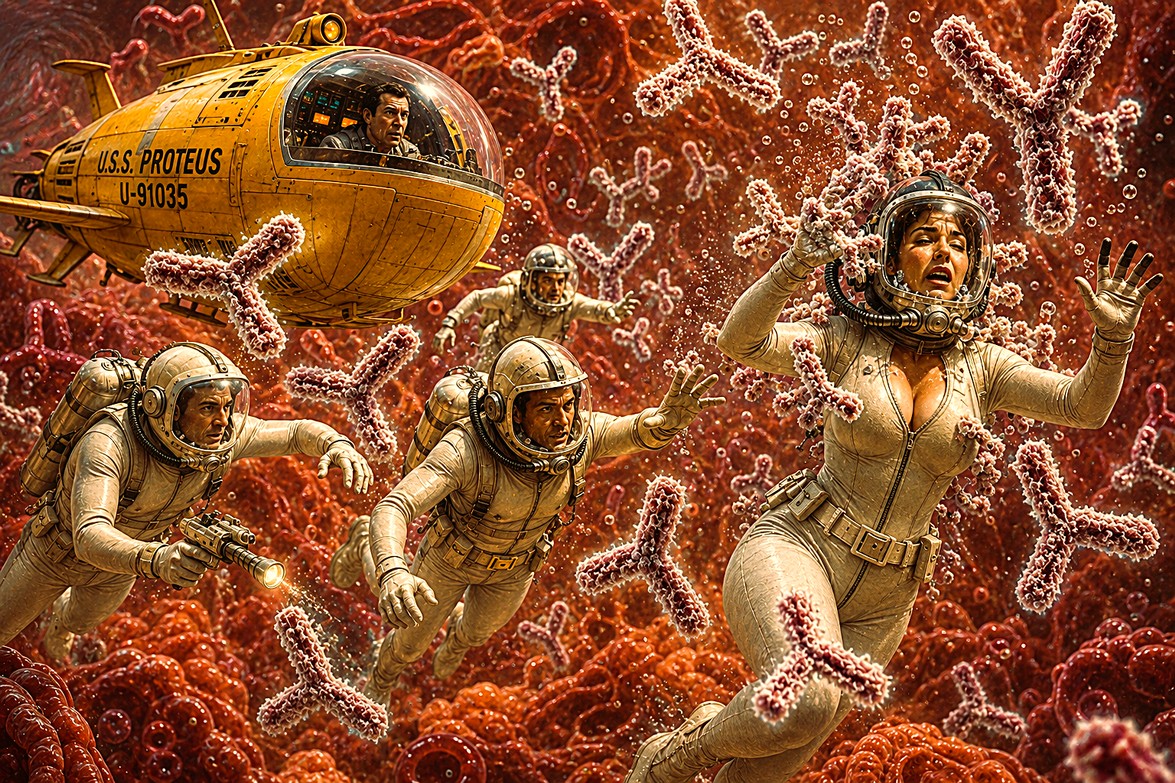
Attack Of The Antibodies!
While waiting for the airlock to re-flood, antibodies attack Cora and fasten themselves onto her body as if she were bacteria. Grant and the others hurriedly and frantically get Cora through the airlock and into the ship where it is apparent that Cora cannot breathe. Grant and the other men find themselves performing the highly enviable task of pulling antibody molecules off strategically affected areas of Cora’s (Raquel Welch’s) body! The structures detach rather quickly as soon they begin crystallizing and Cora is finally extricated from their deathly grasp.
Proteus is once again under way where its passage lies through the middle ear then through the endolymphatic duct and back into the vascular system, before penetrating into the brain and the location of the clot.
With 12 minutes remaining, Carter with coffee in hand reaches for the empty sugar container for his sugar fix but is disappointed to find it empty, protesting in frustration, “of all the time to run out of sugar!” I can’t help thinking of Loyd Bridges’ character in “Flying High” muttering in frustration about what a time it was to give up amphetamines.
Back aboard the Proteus while passing through the inner ear, Cora and Grant discuss Duval with Cora pointing out that he “he's much too innocent, much too involved with his work, to realize what's going on around him” and that “he believes in an absolutely free interchange of information between scientists of different countries” which of itself in the context of the Cold War would be enough to make him be viewed with suspicion.
Just as Grant raises the possibility that Cora’s perception of Duval might be influenced by her fondness or even love for him, Michaels and Duval can be heard arguing loudly about whether Duval, having repaired the laser, should test it. Duval wishes to use the laser at the time of the operation as he does not “want to put any extra strain on the connections by running unnecessary tests.” Michaels puts Duval’s stubborn insistence down to him only wishing to satisfy his “damned ego.” Final Destination
With only 8 minutes remaining, the crew of the Proteus has entered the base of the brain, the realm of the “the human mind.” Grant, Cora and Duval are fascinated by what they are witnessing while Michaels true to form remains at the chart. Duval then goes off into one of his glassy-eyed mystical reveries proclaiming, “yet all the suns that light the corridors of the universe shine dim, before the blazing of a single thought…” which is surprisingly completed by Grant: “proclaiming in incandescent glory the myriad mind of man." Michaels, not one given to appreciating matters of a philosophical and spiritual nature, sarcastically retorts, “let me know when we pass the soul.”
Hollywood just loves these Judaeo-Christian ruminations and homilies concerning the existence and importance of the human soul and the character of Duval doesn’t disappoint by providing the expected trite observation about how “the finite mind cannot comprehend infinity, and the soul which comes from God is infinite.” Michaels, who obviously missed out on Sunday school points out to Duval, “take a close look at your soul, and your infinity, and your God out there and you'll find it's nothing but a combination of atoms, molecules and certain chemicals involving proteins.” In answer to Michael’s rational mechanistic and materialistic view of the universe, Duval points out that he left out one important thing: “The Breath of God!” Well, thanks for clearing that up for us! We’re completely convinced now.
It certainly cleared things up for Grant who by the time they have reached the clot is firmly convinced that someone like Duval does not fit the profile of a fanatic. Someone possessing religious convictions, a deep faith and belief in a supreme God being turning into some kind of a dangerous fanatic? Perish the thought! Never! Couldn’t happen!
Grant now has enough faith in Duval to insist that he and Cora exit the ship and perform the operation with the laser. With 6 minutes to go, Michaels is not surprisingly all for them taking the Proteus and high-tailing it out of there to the “removal point.”
Time is now definitely of the essence because if they overstay, the process of miniaturisation will start and if they grow big enough to pose a danger to the body’s system the white corpuscles will swarm to destroy them as they would any invader. With only two minutes to get to removal point, there will only be four minutes in which to operate.
Grant settles the matter by cutting the ship’s power while Michaels becomes more and more hysterical ranting that he is in charge and that Grant has supposedly allowed Duval the opportunity to carry out his nefarious plan to murder Benes.
Rather than remain on board the ship, Grant decides to venture out to see if he can assist Duval and Cora. Duval successfully manages to activate the laser and begins to clear the clot to allow the blood to flow again and hopefully relieve the pressure on a few key vessels.
Meanwhile, back aboard the Proteus, Michaels convinces Owens to come below to inspect the escape hatch through which he says fluid is seeping. As Owens inspects the hatch and discovers nothing wrong, Michaels knocks him out with a winch crank. Michaels then restores power to the ship and takes the helm.
With time about to run out, Duval is managing to clear an area around the large central nerve, unaware that in the distance the Proteus is manoeuvring into a position that will line it up with the central nerve.
Suddenly, with full power and full speed, Michaels directs the Proteus on a collision course with the central nerve. Just at that point the three crew mates outside the ship notice what’s happening and are dumbstruck, but Grant quickly springs into action and calls for the laser. Grant uses the laser now as a weapon (wide beam and full power) with which to rake one side of the Proteus’ hull propelling her away from the nerve and into an area of dendrites.
Time has now run out with the minute recorder registering “0” minutes, with white corpuscles responding to the impact and with Michaels now physically trapped within the mortally wounded Proteus.
Back in the control and operating rooms, the insistent and urgent sound of a warning siren signals the end of the countdown’s march to “0”, the time at which the crew of the Proteus must be immediately extracted even if “it means killing Benes.” No amount of caffeine, glucose or nicotine can quell Carter’s frustration as he thumps the table and exclaims, “Damn it to hell!”
Realizing that they’ll have to make it out on their own, Duval, Grant and Cora will have to exit Benes’ body via the optic nerve to the corner of the eye. The gravity of their situation is becoming apparent as they witness the stricken Proteus growing visibly larger before their very eyes.
The trio then notice the presence of huge monstrous white corpuscles starting to ooze toward the Proteus where “they'll ingest the ship and everything in it!”
Grant decides to go back aboard the ship by entering through the tear in the hull, to hopefully rescue Michaels and Owens. Owens is only now regaining consciousness, so Grant tells him to suit up as fast as he can. The pinned and trapped Michaels is frantically trying to disengage himself in the bubble helm section of the ship. It is to no avail,however as a white corpuscle (macrophage) engulfs the bubble, breaks through and suffocates Michaels, “the one who's been sabotaging the mission.” (as if we didn’t know!)
Grant and Owens then attempt to abandon ship before the white corpuscles engulf, crush and dissolve it. All the while, Duval and Cora have been employing the power unit and laser to target the white corpuscles and keep them off the sub, but without success.
As Grant struggles against a monstrous white corpuscle, Duval aims the laser and strikes with a direct hit allowing Grant to be released to swim away. Duval then manages to zap another monster when the laser finally gives up the ghost and dies.
While white corpuscles are swarming all over the ship’s hull and are ingesting its remains, back in the operating room preparations are being made for a trephination procedure. Suddenly, Carter is struck with a moment of inspiration by considering what he would do if he “were in their place” and had run out of time. He goes on to explain that “I’d abandon the ship before I grew to dangerous size and use the few extra minutes to get out the quickest way possible, on my own.” With quick realization, Reid completes the thought with, “along the optic nerve to the eye.”
Shortly through a large magnifier Reid looks into Benes' right eye, where he is able to make out the four members of the crew swimming in Benes' tears. He then uses a microscope slide to lift out a teardrop containing the crew. Reid quickly and carefully makes his way to the miniaturization room and sets the slide gently down on the center hexagon.
Carter, from above looks down into the miniaturization room, and observes the four specs on the glass slide continuing to grow until they return to their normal size, if a bit worse for wear after the ordeal of their…..
Fantastic Voyage!
Points of interest
Having the rights for a paperback novelisation based on the screenplay, Bantam Books approached Isaac Asimov to write it. Due to delays in filming, the novelisation was released six months before the movie. Asimov felt that the script was full of plot holes and received the go-ahead to write the book the way he wanted.
Otto Klement and Jerome Bixby came up with the idea for the film and sold it to Fox, which claimed that the film would be "the most expensive science-fiction film ever made."
Bixby delivered several scripts for movies which are featured in this blog such as, “Curse of the Faceless Man” (1958), “It! The Terror from Beyond Space” (1958), “The Lost Missile” (1958) all of which were featured in my “Big Fat Book of Sci-F Films of the 1950s.”
Director Richard Fleischer also directed Disney's first science fiction movie, “20,000 Leagues Under the Sea” (1954) which also is featured in this blog. Fleischer had been a pre-med college student for a time.
The film’s budget was set at $5 million but rose to $6 million, with $3 million going to the sets and $1 million on test footage.
“Fantastic Voyage” was Raquel Welch’s first role at Fox, and was put under contract to the studio after being spotted in a beauty contest. Raquel Welch claimed in her 2013 book that she was infatuated with Stephen Boyd in making this movie, but he apparently declined her advances.
The score was composed and conducted by Leonard Rosenman who deliberately wrote no music for the first four reels of the film, before the crew of Proteus enter Benes’ body. “Fantastic Voyage” is reportedly the first American feature film with no musical score for the opening credits, which featured only electronic pulse and sound effects.
The film won two Academy Awards and was nominated for three more:
• Won: Best Art Direction – Color (Jack Martin Smith, Dale Hennesy, Walter M.
Scott, Stuart A. Reiss)
• Won: Best Special Effects (Art Cruickshank)
• Nominated: Best Cinematography (Ernest Laszlo)
• Nominated: Best Film Editing (William B. Murphy)
• Nominated: Best Sound Editing (Walter Rossi)
“Fantastic Voyage” is included among the American Film Institute's 1998 list of the four hundred movies nominated for the Top 100 Greatest American Movies.
Who can forget the scene where the male crew members remove attacking antibodies from Raquel Welch! Director Fleischer at first allowed the actors to grab whatever they liked. However, the men exercised sufficient self-control and refrained from removing the offending antibodies from Welch's breasts. After a second try during which they all this time focused their efforts at liberating Welch’s breasts, Fleischer decided to resort to a bit of careful choreography with the result that appears in the film’s final cut.
In a move that would surely have sparked many a medical student’s interest in medicine and biology, medical schools showed clips from the movie to illustrate concepts in human anatomy, physiology, and immunology.
The scenes of crew members swimming outside the sub were shot on dry sound-stages with the actors suspended from wires. To create the impression of swimming in a fluid-like environment, the scenes were shot at fifty percent greater speed than normal, then played back at normal speed.
Of course, the real star of the "Fantastic Voyage" would have to be its special effects. Despite not having the benefit of today’s computerized digital effects, the scenes depicting the internal functioning of the human body from the microscopic perspective appear believable.
The special effects were also in keeping with the times in which “Fantastic Voyage” was released: 1960s hippy-groovy-far out man-what a trip-psychedelia.
“Fantastic Voyage” is punctuated by a series of dramatic and suspenseful events in which something inevitably goes wrong such as the scenes involving the temporarily stopped heart, the excursion into the lungs, the passage through the inner ear, the need to remain completely silent and still in the operating room and so on…..
Unfortunately, the characters are somewhat stereotypical and rather wooden and stodgy. For instance, we have the true to type hero, his love-interest token female whose presence is invariably questioned at some point, and the inevitable morally weak and cowardly traitor.
Let’s not forget the usual simplistic mix of politics and religion that mainstream Hollywood likes to indulge in. Take for instance, Duval’s constant babbling on about “the miracle of life” complementing his glassy-eyes stare of wonder and awe at the miraculous nature of what he is witnessing. This is in contrast to the godless, defeatist, traitorous atheism (ie., Communist) of Michaels. Well, such black and white distinctions might appeal to many at something like a Trump rally.
“Fantastic Voyage” is one of those films with which some viewers just love to demonstrate their cleverness by gleefully and seriously pointing out the evident plot or logic holes. They’ll crap on about the size of air molecules, time limits, objects left behind in Benes’ body and so on and so on……It’s just a bloody film! Enjoy it as entertainment - as a piece of “What If?”
I shudder at the thought of “Fantastic Voyage” actually being remade in today’s times. You can be sure that the fun and sense of adventure will be quashed and replaced with a politically correct ‘tick the box’ approach in terms of gender roles, racial and ethnic inclusion and diversity, sexual orientation and on and on. Add to that crammed full forced layer of virtuous goodies, a layer of CGI / AI extravaganza to dazzle the senses and utterly overwhelm the story. Of course, we’ll have all the back-stories of all of the characters whether or not we want it or care. Just keep the box of Kleenex handy for those inevitable syrupy soap-opera moments. As for the morally weak and evil crew member? It’ll be a guy (among a bunch of limp token guys) for sure. Fear not, for all will be well under the leadership of a determined, strong female captain steering the ship along outraged feminist currents. And there you’ll have it: another ruined streaming service sci-fi film! I guess every stupid action eventually results in an equally stupid and opposite reaction – even after nearly 60 years.
Finally, ignoring the unlikely possibility of shrinking human beings, “Fantastic Voyage” raises some interesting considerations concerning the miniaturization of medical technology. I don’t think many of us would be surprised to learn that pills containing cameras and other sensors might one day be routinely used to monitor the internal function and condition of patients’ bodies. Not would it be considered as outlandish to expect tiny molecular-sized nano-bots to enter our systems to perform various procedures or to assist our immune systems by targeting and destroying viruses and bacteria.
It would also be a pretty safe bet that our descendants will be born with micro-chips or implants that will record and contain a life-time’s worth of an individual’s medical information. This will have implications for society in terms of how the personal information will be stored, who will have access to it and the purposes that information could be put to. Could people be judged or assessed or discriminated against based on such information resulting in them being excluded from certain activities and benefits that others enjoy? These are serious matters with potentially harmful consequences. Worth thinking about as technology seeps from our smart watches that monitor our activities, movements, location and the electrical activity of our bodies and eventually leeches into our very bodies in the form of micro-scopic implants and nano-chips – all with our unwitting consent!
As the human race reaches further out into interstellar space, there is another also another universe for us to explore, that of Inner Space through which we will embark on a………
Fantastic Voyage!
***************
Queen of Blood (1966)
A rather cheap hybrid sci-fi / horror film with capable performances, strikingly eerie

and vibrant visuals and haunting atmosphere.
Directed by Curtis Harrington