Sci-Fi Film Fiesta: The Swingin’ 60s – Volume 4: “Purple People Eaters and Trippy Creatures” by Chris Christopoulos - HTML preview
Download the book in PDF, ePub for a complete version.
Points of Interest
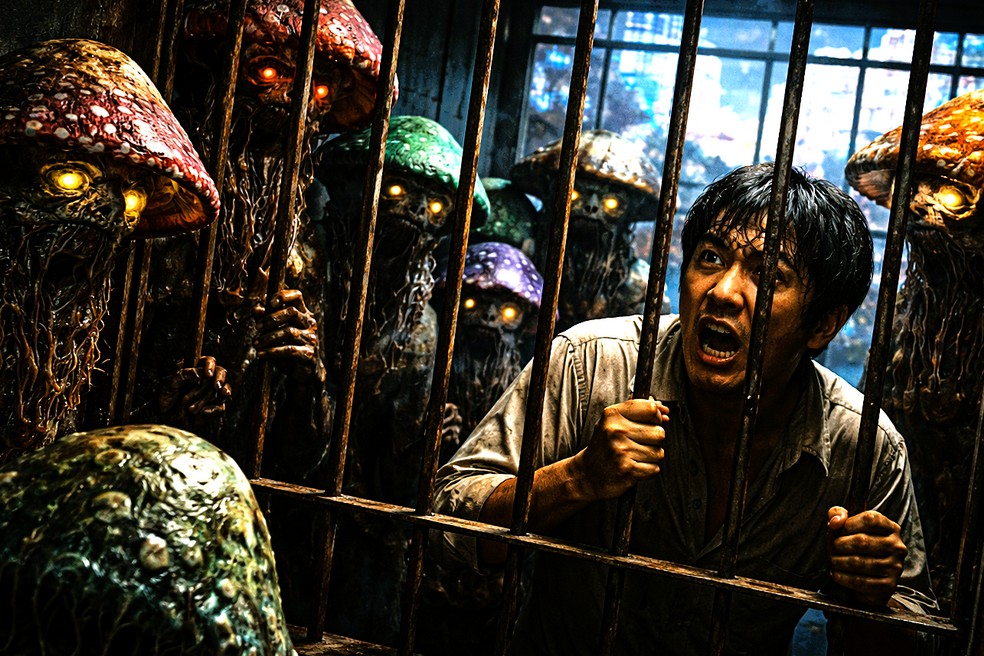
The film’s story was based on William Hope Hodgson's short story "The Voice in the Night", which originally appeared in the November 1907 issue of Blue Book, a copy of which is included with this post. Honda was also inspired by a news story about a group of rich kids who took their father's yacht far into the sea and had to be rescued, as well as on reports of ships and aircraft vanishing in the Bermuda Triangle.
Ishirō Honda is known for his kaiju (giant monster) films as well as horror films with sci-fi elements like Matango such as The H-Man (1958) and The Human Vapor (1960) which feature characters that transform into bizarre beings.
Attack of the Mushroom People is both visually and thematically quite a dark and serious film with a fairly slow and measured pace, focusing quite a bit on psychological and social elements.
This was Honda's first film to use the Oxberry optical printer, which enabled up to five composite shots to be superimposed thereby avoiding the need for costly hand-painted mattes and glass shots.
Apparently Matango was nearly banned in Japan because some of the makeup was uncomfortably similar to the facial disfigurements suffered by those who survived the atomic bombings of Hiroshima and Nagasaki.
Matango was Honda's first science fiction film not to receive a theatrical release in the United States. American International Television released it directly to television in 1965 as Attack of the Mushroom People with a run-time of 88 minutes. By the early 1990s the film had all but disappeared into obscurity for many years.
Ishiro Honda’s film seems to question the direction that society was taking as it emerged from the atomic ashes of the Second World War, foreign occupation and its imperialist and militaristic past. There seemed to be concern being expressed about his society as it forged ahead into a modern Western / American-oriented future while being consumed by its many dehumanizing temptations. The true horror of this modernity is revealed in which people become almost like castaways in mind, spirit and body and can thereby be transformed so easily into hideous monsters under the right circumstances.
In the film, it is not so much the walking mushroom people that pose the main threat. Instead, it is the self-serving and self-destructive impulses and greedy, selfish desires of the human castaways that form the real danger. The film’s fungal monsters represent what these morally weak and corrupt humans ultimately become.
The human castaways represent a cross-section of a modern affluent, liberal society ranging from the wealthy and prosperous, corporate industrial, the arts and academia through to the skilled worker. All manage to find themselves infected by the temptations offered by materialism and the addiction to consumption while being motivated by self-interest with the result that their individual human identities are subsumed into something monstrous. Perhaps we come to recognize something about ourselves: lives cast adrift wrapped within a fog destined to exist in a modern Purgatory from which there is no escape and no alternative can be imagined.
***************
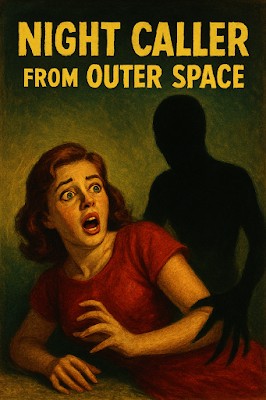
Night Caller from Outer Space (1965)
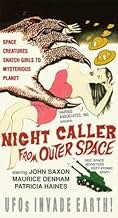
An intelligent well-acted science fiction thriller despite budgetary constraints and a

rather ludicrous plot.
Directed by John Gilling
Written by Frank Crisp (1963 novel)
Screenplay: Jim O'Connolly
Produced by Ronald Liles
Cinematography: Stephen Dade
Edited by: Philip Barnikel
Music composed and directed by: John Gregory Production company: Armitage Film Productions Ltd. Distributed by: Butcher's Film Service (UK)
Running time: 85 minutes
Country: United Kingdom
Cast
John Saxon as Dr. Jack Costain
Maurice Denham as Dr. Morley
Patricia Haines as Ann Barlow
Alfred Burke as Detective Supintendent Hartley
John Carson as the Major
Warren Mitchell as Reg Lilburn
Marianne Stone as Madge Lilburn
Stanley Meadows as Detective Tom Grant
Aubrey Morris as Thorburn
Ballard Berkeley as Commander Savage
Geoffrey Lumsden as Colonel Davy
Tom Gill as Police Commissioner's secretary
Jack Watson as Sergeant Hawkins
Barbara French as Joyce Malone
From the cold void of Jupiter’s moon, Ganymede… comes a
terrifying quest for Earth’s women!… SEE IT… if you dare!
A mysterious sphere crashes to Earth… unlocking a nightmare
beyond imagination that will surely SHATTER YOUR SENSES!
Clawing its way out of the shadows… a hideous creature on a
mission of interplanetary survival!… DON’T LOOK AWAY!
Science cannot stop it… the military cannot contain it… and
young women everywhere… are its PREY!