

The Physiology of Faith by N. Fakhr - HTML preview
Download the book in PDF, ePub, Kindle for a complete version.
Theory of Mind
A 13-month-old human infant looks at their mother and infers from the direction of her gaze that something has caught her attention; the infant then looks in the same direction as the mother. At first glance, this may not seem like a significant phenomenon, but in fact it is extremely important, and the ability underlying it has major consequences for the infant’s future life.
How does a 13-month-old child understand from the direction of the mother’s gaze that she has a mind, and that her mind is currently focused on something that must be located in the direction she is looking? The child has not reached this conclusion through logical reasoning or by constructing a chain of premises and conclusions. It is not as though the child has thought to themselves:
“Given my mother’s movements and behavior, it would be reasonable to assume that she has a mind similar to my own. Therefore, for the time being, it is logical to accept the idea that this presumed mind of my mother’s is focused on something, and consequently, it would make sense for me to look in that direction as well.”
Evidence shows that human infants have an innate assumption that their mothers and other people have minds of their own; therefore, they immediately direct their attention to the same point and, in what is known as “joint attention,” share attention with their mother.
From an early age, humans are capable of forming a theory or hypothesis about other people: that they, like ourselves, possess minds that can experience different states. These minds can become happy, sad, angry, excited, attentive, worried, able to understand someone’s intention, unable to understand someone’s intention, curious, and so on.
This assumption, which develops and becomes more refined from early childhood, is called “Theory of Mind.” This ability allows humans to understand and predict the behavior of others based on their mental states.
As a child grows, this ability becomes increasingly developed, so that by around the age of four, children can understand the meanings of expressions that describe mental states. Concepts such as being in pain, thinking, feeling, believing, fearing, being bored, loving, hating, and so on cannot be understood without having a theory of mind.
If a child lacked a theory of mind, when their mother said, “Your father is upset with you,” the child would not understand what she meant, because they would not attribute a mind to their father whose state of being upset could be understood.
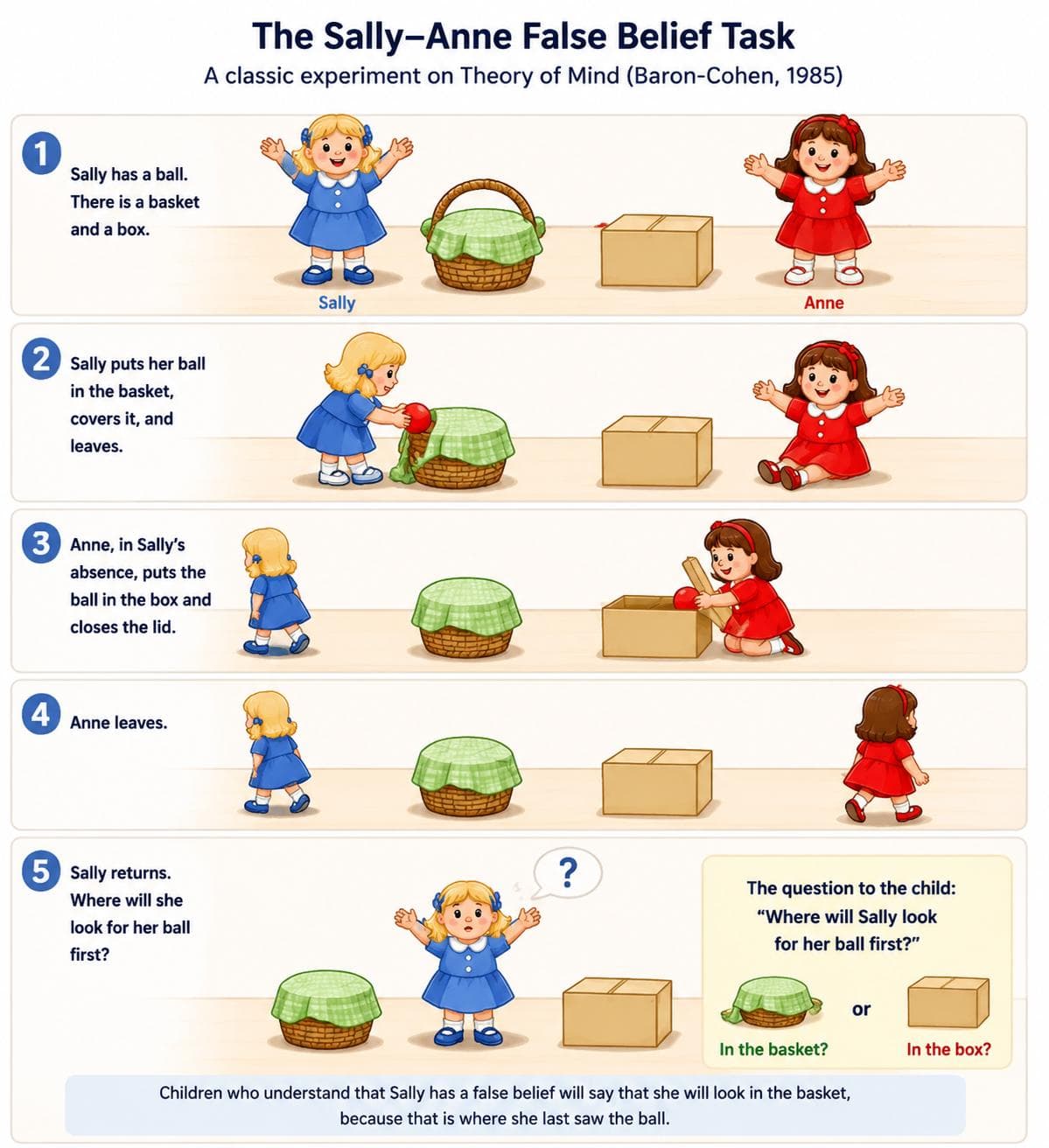
Simon Baron-Cohen conducted an experiment in 1985 related to the Theory of Mind. He presented two dolls, named “Sally” and “Anne,” to the children participating in the study. The dolls were moved by puppeteers. In front of the two dolls, there was a closed box and a basket covered with a cloth.
The doll named “Sally” came in and placed a ball inside the basket, then covered the basket again with the cloth and left the scene. The doll named “Anne” then entered and, in Sally’s absence, took the ball out of the basket, placed it inside the box, closed the lid, and left the scene.
Sally then returned. The experimenter asked the child:
“‘Sally,’ who now wants to play with her ball, where will she look for it first? In the basket, or in the box?”
Three groups of children participated in the experiment: 27 typically developing children, whose Theory of Mind was expected to have developed naturally; 14 children with Down syndrome; and 20 children with autism. In autism, Theory of Mind does not develop in the typical way.
The children who pointed to the basket in response to the question demonstrated an understanding of Theory of Mind, because they realized that although the ball was now in the box, “Sally” was unaware of this fact and would therefore look for her ball in the basket. They understood that Sally must have a false belief about the location of the ball because she did not possess the information available to the children. Sally had left the scene when the ball was moved from the basket to the box; therefore, Sally’s beliefs about the ball’s location were different from theirs.
85% of typically developing children answered correctly and pointed to the basket.
86% of children with Down syndrome also answered correctly and pointed to the basket.
Only 20% of children with autism answered correctly. [1]1
An autistic child knows that the ball is in the box but does not understand that Sally has a mind of her own—a mind that was not aware of the change in the ball’s location—and therefore does not realize that Sally could not know that the ball was no longer in the basket.
In addition to individuals with autism, people with schizophrenia, children with attention deficit hyperactivity disorder (ADHD), individuals under the influence of alcohol or drugs, people deprived of sleep, and those experiencing severe physical or emotional stress may also show impairments in Theory of Mind. People with an underdeveloped Theory of Mind have difficulty understanding the intentions and motives of others, fail to recognize how their own actions affect other people, and often experience difficulties in their social interactions.
The assumption that other beings possess minds can even be extended to objects. Children often attribute minds to their toys, especially dolls, and imagine various mental states for them; they can develop deep emotional relationships with them. Therefore, we can say that children do not logically infer the existence of minds in others. On the contrary, they must gradually learn, through evidence and reasoning, to remove certain objects that they once assumed had minds from the category of mind-bearing entities.
Theory of Mind enables humans, when observing another person’s actions, to think about the intention or purpose behind those actions and try to understand what was happening in that person’s mind that led them to act in that way.
This tendency can extend to changes occurring in the surrounding environment. A person—especially during childhood—may unconsciously attribute a mind even to nature and natural phenomena such as the sea, wind, rain, rivers, and living creatures. They may assign various mental states to these phenomena, such as calmness, anger, kindness, resentment, stubbornness, jealousy, selfishness, attention, or indifference, and search for an intention or purpose behind every change occurring in nature.
Deborah Kelemen, from Boston University, noticed—as we all have—that children begin asking questions about everything around the age of three or four. She conducted a study to determine what kinds of answers satisfy children’s questions. For each phenomenon, she presented children with two possible explanations and asked them which one they thought was correct.
One explanation described the natural cause that brought the phenomenon into existence. The second provided a purpose or goal that could be achieved through the existence of that phenomenon.
For example, she asked children: “Why do you think the edges of rocks on a cliff are sharp?” She then presented two possible answers from two imaginary people:
“One person thinks that small pieces of rock accumulated over a long period of time, causing the cliff to take this shape and producing sharp edges around it. But the second person thinks that rocks have sharp edges so that animals with itchy bodies can rub themselves against these sharp edges and relieve their itching. Now, which answer do you think is correct?”
Most children chose the answer that explained natural phenomena in terms of purpose and goals. In other words, they considered purpose-based explanations to be correct and, in the example above, selected the second answer.
Kelemen conducted this experiment with children of different ages and found that, up until around the age of seven or eight, children tend to regard purpose-based explanations as correct. It appears that when children ask why a natural phenomenon exists, they are not looking for a scientific explanation of its cause; rather, they want to know what purpose or intention led to its existence.
And whenever there is a purpose, the existence of some form of awareness or mind must naturally be assumed—an awareness or mind that created that phenomenon with a specific intention. As children grow older and learn the causes behind natural phenomena, this purpose-based way of thinking gradually diminishes.
Deborah Kelemen wanted to know whether anything from this purpose-based perspective—and from the assumption that there is a mind behind every natural phenomenon—remains in adults.
She conducted the same experiment with adults as well. As expected, adults selected scientific explanations. However, when she greatly reduced the time available for answering and placed participants under time pressure, the number of purpose-based responses increased among adults as well. For example, when asked why the ozone layer exists, they were more likely to choose the answer that “the ozone layer exists to protect us from the sun’s radiation.” [2]
Theory of Mind is not exclusive to humans and has also been observed in some animals, although not to the same level of development as in humans. For example, evidence of Theory of Mind has been found in horses, chimpanzees, and crows. The development of Theory of Mind in elephants and dolphins is particularly notable.
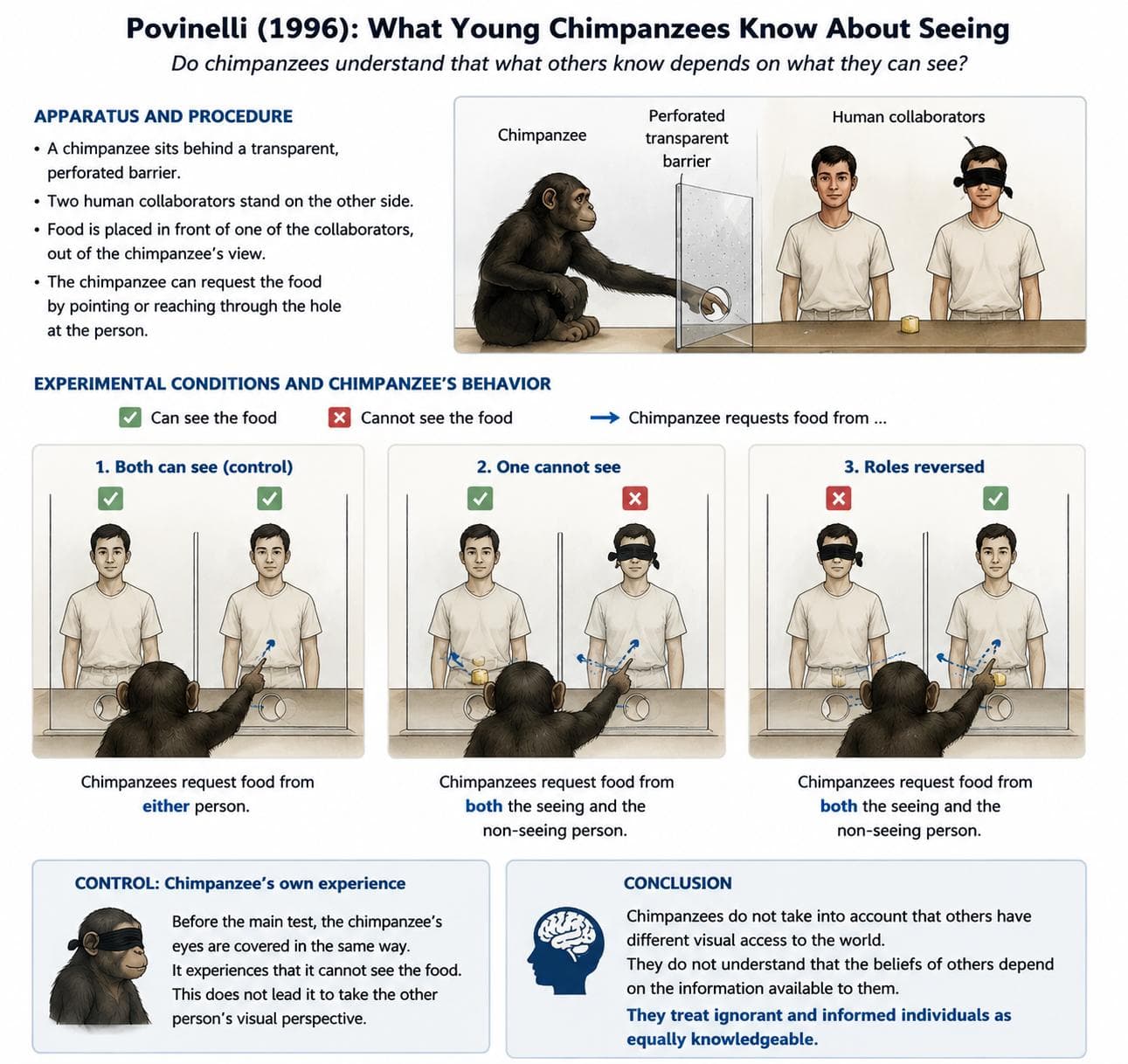
Daniel Povinelli, from the University of Louisiana, conducted a study with chimpanzees in which he placed them in front of two human collaborators. One of the two people was able to see, while the other could not—for example, because their eyes were covered with a cloth. Someone then placed food in front of the two individuals.
The chimpanzees were expected to request food from the person who could see. However, they also requested food from the person who could not see. They did not understand that the beliefs of the two individuals depended on the information available to them: the person with covered eyes had received no visual information and therefore did not know where the food was.
Povinelli had previously covered the chimpanzees’ own eyes in the same way, hoping that this experience would help them understand that someone in such a situation is unable to see. [3]
Bonobos possess a more advanced Theory of Mind, and dogs, despite having lower intelligence than chimpanzees, appear to have a more developed Theory of Mind and are up to two and a half times better than chimpanzees at understanding human intentions. This is also true of dogs that have been raised in the wild.
When a dog’s owner pays attention to a mannequin or a book, the dog shows no particular reaction. However, when the owner pays attention to a toy dog, the dog’s behavior changes, and it attempts to draw its owner’s attention toward itself.
For understanding the direction of human attention and their mental states, the white part of the human eye has also helped us. Humans are unique in having a clearly visible white sclera. The relationship between human attention or intention and eye movements is processed in the superior temporal sulcus (STS) region of the brain.
Research so far indicates that during activities involving Theory of Mind, the temporoparietal junction (TPJ), medial prefrontal cortex (mPFC), and posterior superior temporal sulcus (pSTS) show increased activity.
For example, one study showed that when participants observed another person raising their hand, the pSTS region of their brains became active. However, when they watched the same person while a machine raised that person’s hand without their intention or control, the pSTS showed no activity.
In the first situation, the participants recognized an action accompanied by intention and immediately focused on the person’s mental state in order to understand why they were raising their hand. In the second situation, when a machine raised the person’s hand, there was no need to consider the mental state of the machine, because the participants did not attribute a mind to the machine.
Such experiments, together with studies of individuals whose frontal lobes or TPJ regions have been damaged and who subsequently develop impairments in Theory of Mind, have made the relationship between different brain regions and the functioning of Theory of Mind increasingly clear.
Without Theory of Mind, our species would not have been capable of understanding what was happening in the minds of other members of our own group, or in the minds of members of other groups and other animals. Since we would have had no hypotheses about the mental contents of other beings, we would have been unable to engage in appropriate behaviors.
For example, we would not have been able to plan deception against other humans or animals, pretend to be better than we actually are, find ways to bluff in order to appear stronger than we are, or even develop empathy and compassion toward others, feel the desire to help them, and engage in moral behavior.
Of course, although having Theory of Mind is a necessary condition for moral and compassionate behavior, it is not a sufficient condition. Other mechanisms in the brain must also be activated, which we will discuss in later sections.
However, it appears that having Theory of Mind—and our natural assumption that others possess minds similar to our own—has consequences for us and has led to a unique characteristic of our species, which we will now examine.