

The Physiology of Faith by N. Fakhr - HTML preview
Download the book in PDF, ePub for a complete version.
Insistence on Assuming Responsibility for the Education of Children
It may be said that, except in some contemporary secular countries, the clergy throughout history have consistently sought—and generally managed—to exercise extensive control over institutions responsible for educating children, adolescents, and young adults. In the earlier sections of this book, I explained how installing a “guardian of the mind” during childhood can initiate and facilitate the development of religious faith.
But clergy who deal directly with adolescents can also take advantage of another characteristic of this stage of development to draw them not only toward religious faith, but toward their own sect, denomination, or ideology.
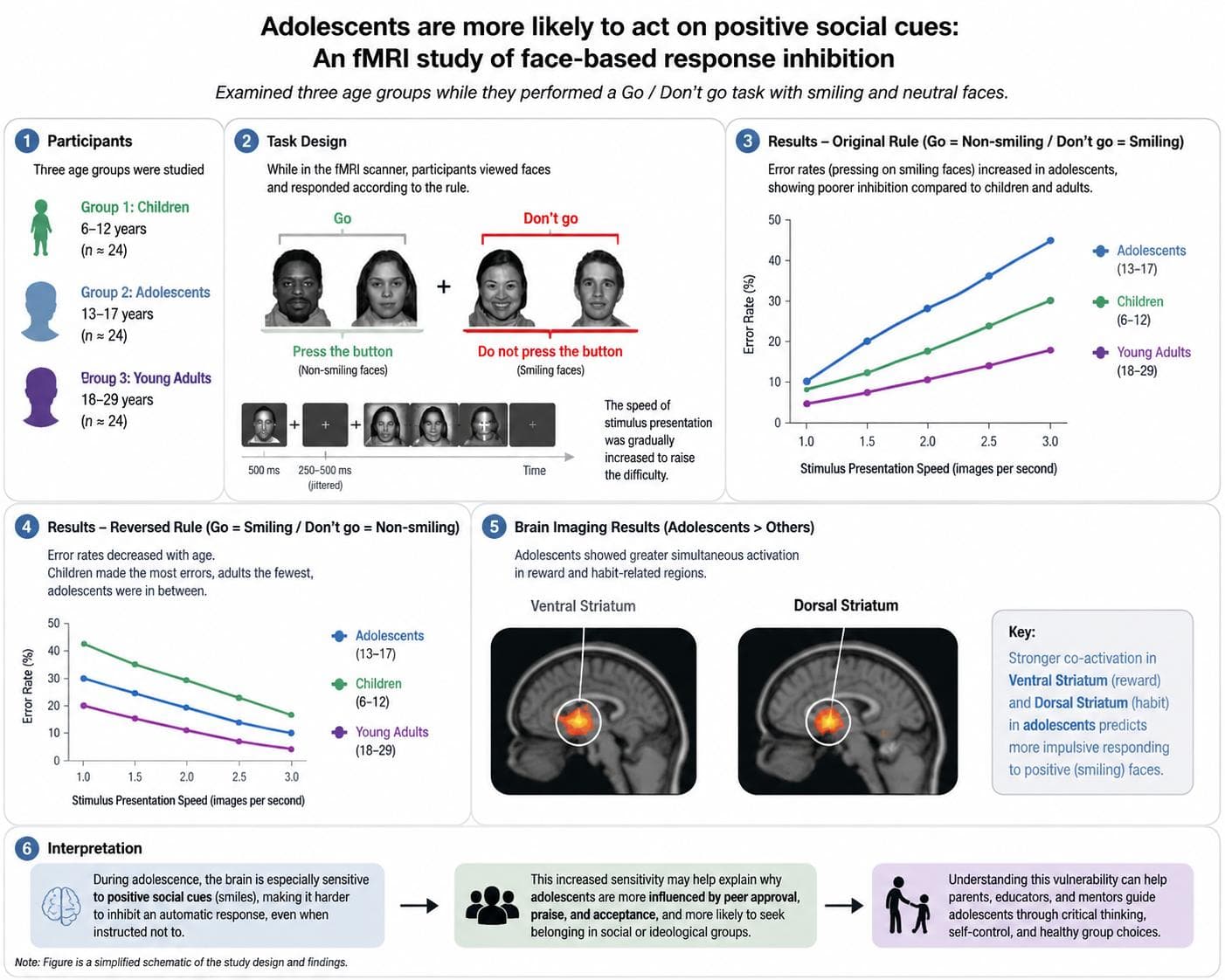
One study examined three age groups:
Group 1: children aged 6–12
Group 2: adolescents aged 13–17
Group 3: young adults aged 18–29
While their brains were being scanned using fMRI, participants were shown images of faces and instructed to press a button when they saw a non-smiling face (GO), but not to press it when they saw a smiling face (DON’T GO). The images were presented at progressively faster rates to determine whether error rates would decline with age. Adults performed better than children. Adolescents, however, performed worst of all. When they saw smiling faces, they showed a stronger tendency to press the button and were more likely to do so despite the instruction not to.
When the instructions were reversed—that is, participants were told to press the button for smiling faces and refrain from pressing it for non-smiling faces—the error rate decreased with age. Children made the most errors, adults the fewest, and adolescents fell somewhere in between. Thus, when adolescents see a smiling face while being instructed to inhibit a response, they perform worse than either children or adults. It appears that adolescents have greater difficulty resisting interaction with positive facial expressions and withholding a response.
The fMRI images indicated that simultaneous activity in the ventral striatum and dorsal striatum in adolescents contributed to this distinctive pattern of performance. These regions did not show the same pattern of activity in either adults or children. [1]
In any case, adolescents at this age tend to want to join groups and gain the acceptance of others. A smiling face that praises them and tells them, for example, what faithful, honest, and pure young people they are may interfere with their critical judgment. When someone smiles at adolescents, or when a group welcomes and accepts them, rather than first examining that person or group with skepticism and a critical eye, they are more inclined to engage with them.
In 1938, when Hitler occupied Austria and annexed it to Germany, Theodor Innitzer, the Archbishop of Vienna, who had previously been a strong defender of Austria’s Jewish community, ordered Nazi swastika flags to be displayed in all Catholic churches and church bells to be rung in honor of Hitler’s arrival. In his welcoming address to Hitler, he declared: “The Catholics of Austria will be the most loyal sons of the Greater Reich, having returned to the embrace of the motherland on such a fateful day” (Hitler himself was Austrian). In his address, the Archbishop placed only one condition before Hitler: that the freedom of the Church be guaranteed and that he “guarantee the Church’s educational role with regard to the youth.” [2]