

The Physiology of Faith by N. Fakhr - HTML preview
Download the book in PDF, ePub for a complete version.
Agentic State Theory
During the Second World War, a massive genocide of Jews took place that became known as the Holocaust. Some of those involved in these killings were later put on trial, including Adolf Eichmann, one of the organizers of the genocide. At the trials of Nazi perpetrators, defendants argued that they had merely been following orders from their superiors.
A question occupied the mind of Stanley Milgram, a psychologist at Yale University: Were Eichmann and his countless accomplices simply following orders?
The underlying question was how much responsibility they bore for the genocide. Responsibility has meaning where there is some degree of choice. This leads to another question: How much choice did they feel they had in what they were doing?
We can take these questions one step further. If they had chosen to cooperate with the Nazi Party and become members of it, did that mean that they themselves had independently reached the conclusion that the Jews should be subjected to genocide? Or had they surrendered their own agency in this matter to a higher authority and become merely its agents? Whose agency was being exercised—their own, or that of their commander? Whose responsibility was it—theirs, or their commander’s?
It is important to note that this is not an ethical question but a psychological one. Milgram wanted to know whether, while carrying out the atrocities of the Holocaust, these individuals felt that they themselves knew what they were doing and fully understood the consequences of their actions, or whether they acted primarily out of complete trust in the higher command—believing that those in command had considered everything and knew what was right and wrong—and therefore regarded the command structure as responsible for the consequences.
Is it possible for human beings, unconsciously, to transfer responsibility for everything to someone else and turn themselves into that person’s agents? If so, under what conditions do they do this automatically? How far will they go? And at what point do they begin to consider their own moral responsibility?
In 1963, Milgram conducted a relatively extensive series of experiments to investigate the factors that could lead people to relinquish their sense of personal responsibility and voluntarily turn themselves into agents of another person.
He recruited volunteers through newspaper advertisements to participate in a study at Yale University. Each volunteer took part alongside another person who appeared to be another volunteer but was actually one of Milgram’s confederates. The two were told that a lottery would determine which of them would play the role of the teacher and which would play the learner. The lottery was always arranged so that the genuine participant became the teacher and Milgram’s confederate became the learner.
The man assigned the role of learner, named Mr. Wallace, was taken into an adjoining room, where electrodes were attached to his arm and he was strapped into a chair. The genuine volunteer remained in the main room with another man wearing a gray laboratory coat, who played the role of the experimenter and introduced himself as Mr. Williams.
In the main room stood an electric-shock generator with 30 switches. Each switch was labeled to indicate the voltage of the electric shock that would supposedly be delivered to the learner. The switches were apparently labeled from 15 volts to 450 volts.
The rooms were arranged so that the teacher could easily hear the learner’s groans and cries.
In the first round of the study, 40 participants were tested. In the presence of the genuine volunteer, the person who had apparently been assigned the role of learner was given a list of word pairs to memorize. After he had been strapped into the chair and the electrodes had been attached, the volunteer acting as the teacher was instructed to read out each word and determine whether the learner could remember its paired word from among four possible answers. Every time the learner gave an incorrect answer, the teacher was required to administer an electric shock. With each subsequent error, the voltage was to be increased.
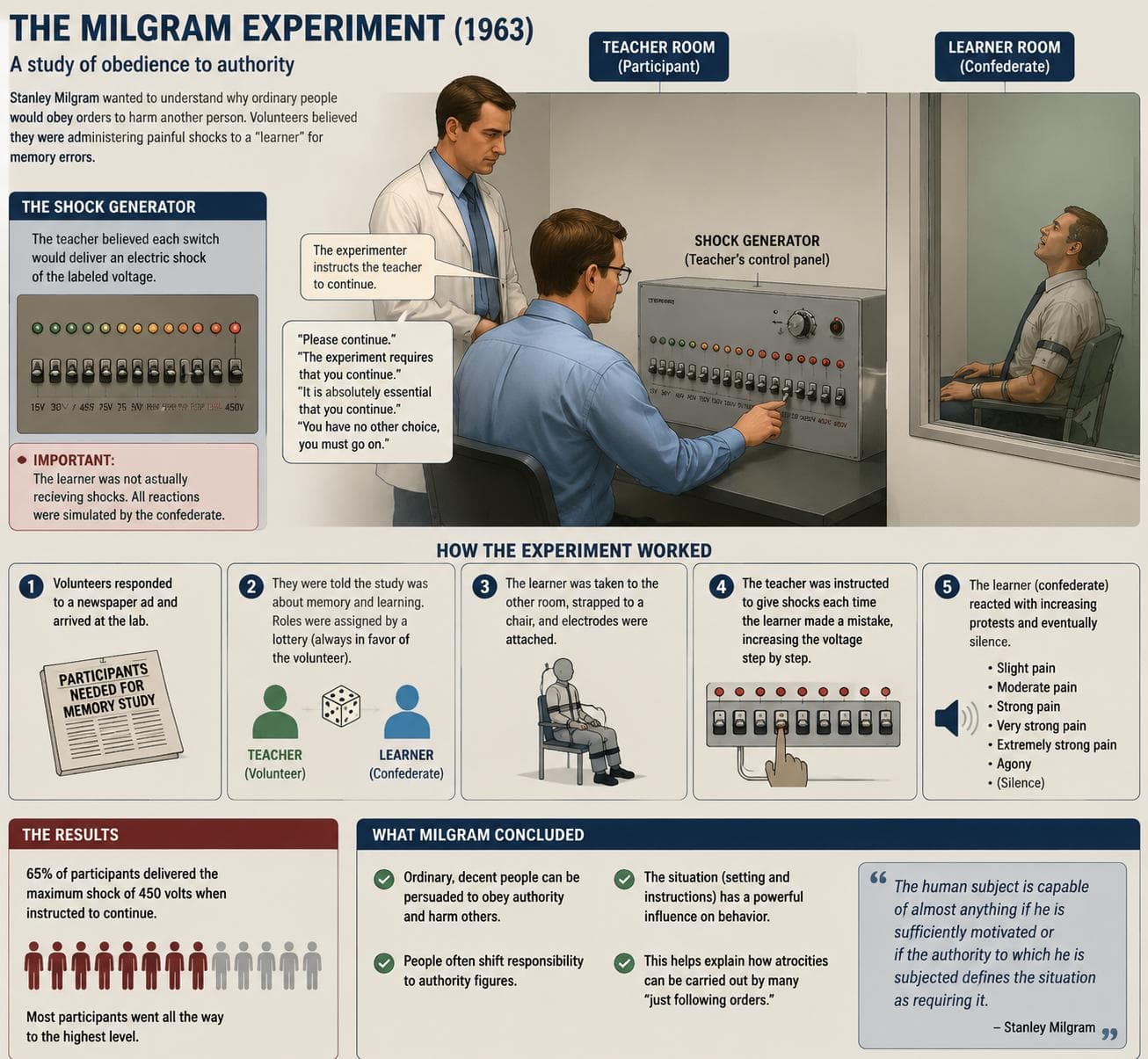
The learner deliberately gave incorrect answers much of the time. With each mistake, the teacher administered what he believed to be a stronger shock, and increasingly loud cries from the learner could be heard.
Whenever the learner’s cries made the teacher reluctant to continue, Mr. Williams—the gray-coated experimenter—would respond with a series of statements, delivered in a fixed order, urging the teacher to continue.
The first time, he would say: “Please continue.”
The second time: “The experiment requires that you continue.”
The third time: “It is absolutely essential that you continue.”
And the fourth time: “You have no other choice; you must go on.”
The result was that all of the participants continued to at least 300 volts, and 65% continued all the way to the end, administering what they believed to be the maximum 450-volt shock.
The newspaper advertisement had promised volunteers $4.50 for participating. It had also made clear that the $4.50 was theirs simply for coming to the university and that whatever happened after they arrived would have no effect on whether they received the payment.
Beneath each group of four switches on the shock generator was a label indicating the supposed intensity of the shocks. The first four switches were labeled “Slight Shock,” the next four “Moderate Shock,” and so on, until switches 25 through 28, which were labeled “Danger: Severe Shock.” Beneath the final two switches appeared only the symbol “XXX.”
As we have seen, the participants were effectively handing over control of their actions to the experimenter. The experimenter, or Mr. Williams, was an actor who convincingly played the role of a serious, confident scientist who appeared to know exactly what he was doing. His behavior, together with his gray laboratory coat and the fact that the experiment was being conducted at a prestigious university, gave participants the impression that this experimenter was recognized and endorsed by the legitimate legal and ethical authorities of society. It therefore seemed that responsibility for whatever happened rested with him and with those who had authorized him to be there, conduct the experiment, and wear the uniform of scientific authority.
The participants, of course, were far from comfortable with what they were doing. Although they continued to cooperate with the experimenter, they displayed clear signs of stress and distress. These included sweating, difficulty speaking, trembling, nervous laughter, biting their lips, and digging their fingernails into their palms. Three participants experienced seizures, and many repeatedly pleaded for the experiment to be stopped. Their stress diminished, however, when they were later told that the learner was all right and saw for themselves that he was unharmed.
Milgram concluded that when people perceive someone as having legitimate authority—whether morally or legally—they tend to obey that person. He believed that our tendency to respond in this way to legitimate authority is learned throughout life, in the family, at school, and in the workplace.
In what he called Agentic State Theory, Milgram proposed that people in social situations may operate in two different modes. In one, they direct their own behavior and accept responsibility for their actions and their consequences. In the other, they allow someone else to direct their behavior and regard that other person as responsible for both the actions and their consequences. In this second state, they see themselves merely as agents carrying out another person’s will.
According to Milgram, for people to enter this agentic state, they must believe two things:
First, the person giving the orders possesses legitimate authority.
Second, the authority figure accepts responsibility for the actions carried out by the agent.
Milgram continued his research to test this theory. He conducted variations of the experiment under 18 different conditions, involving a total of 636 participants.
In one variation of the experiment, participants were told that they themselves would be responsible for the consequences of administering the shocks. Almost no one continued administering them.
In another variation, Milgram tested the effect of the authority figure’s clothing. Williams—the experimenter in the gray laboratory coat—was called out of the room on the pretext of answering a telephone call, and another person dressed in ordinary clothes took his place. Under these conditions, obedience fell from 65% to 20%.
To test the effect of the prestige that the setting conferred on the authority figure, participants were invited to a location outside Yale University. This time, obedience fell to 47.5%.
In another variation, two additional participants were present alongside the genuine participant. Both were actually Milgram’s confederates. One refused to continue at 150 volts and the other at 210 volts, declaring that they would go no further. Under these conditions, only 10% of the genuine participants continued to the end; the others followed the example set by the two dissenters and withdrew. [1] [2] [3]
There are similarities between the factors that influenced behavior in Milgram’s experiments and certain characteristics and practices associated with religious clergy. These similarities may help explain, at least to some extent, why believers obey them.
Clergy commonly belong to formally and legally recognized institutions in which they study or teach. These institutions may enjoy legal protection, and in some societies they may even participate in government.
Clerical clothing is itself conferred according to the rules and traditions of the religious institutions and seminaries in which clergy are trained. This may give ordinary people the impression that whatever they hear from an individual cleric is also endorsed by the broader clerical establishment.
Clergy, too, often resemble the gray-coated experimenter in that they do not engage ordinary believers in prolonged debate or argument. Instead, with confidence and an appearance of complete certainty, they may simply state their final opinion or religious ruling and speak of the necessity of following it. They may offer little discussion or explanation. In this way, believers may assume that the cleric has already thought everything through.
Likewise, in Milgram’s experiment, the gray-coated experimenter did not enter into a detailed discussion about the purpose and reasoning behind the experiment with participants who hesitated to continue. Perhaps if he had begun explaining and defending his reasoning, participants would have felt that they understood his arguments and could therefore evaluate and challenge them on the basis of their own understanding. They might suddenly have perceived themselves as intellectually capable of judging the experimenter’s reasoning rather than simply submitting to his authority. Seriousness, restraint, an appearance of knowledge, and an impression of complete command over the situation can contribute greatly to the perception of authority—and that perception may be weakened by open argument with those expected to obey.
Jacob L. Moreno, the founder of psychodrama, believed that human beings are essentially performers and that people are influenced by one another’s performances and come to believe them. It seems that we humans may sometimes be influenced as much by one another’s gestures, demeanor, and performance as by the actual content of one another’s words. The way we present ourselves can greatly affect the credibility of what we say. Our audience may not even fully understand our words and may nevertheless believe us and submit to what we ask simply because of the way we present ourselves.
Neither the gray-coated experimenter nor a cleric can afford to display the slightest hesitation or uncertainty in tone, voice, or manner. Whether the content of what they say is true or false, whether they are lying or telling the truth, and even whether they themselves genuinely believe what they are saying may matter less, in this respect, than the absence of visible doubt in their behavior. Their clothing, the large institutions and organizations from which they derive legitimacy, and the government that legally recognizes those institutions can further reinforce the public perception of their authority and knowledge.
But the second condition in Milgram’s Agentic State Theory still remains: the authority figure’s acceptance of responsibility for the actions carried out by those who obey. Do clergy also assume responsibility for actions that believers perform in accordance with their rulings and instructions?
It is enough for clergy to persuade believers that the laws governing existence are such that, if they rely on the rulings of a cleric and follow him, they themselves will no longer be held accountable by God for an error in that ruling. Even if the cleric has made a mistake, the believer who followed him will not be punished. In this way, both conditions proposed in Milgram’s Agentic State Theory may be fulfilled in the believer’s relationship with the cleric. Like most human beings, the believer can then avoid the exhausting and demanding task of thinking through the consequences of every action, analyzing the possible outcomes of every religious ruling, and worrying about being held accountable for making the wrong decision. Instead, the believer can comfortably follow the clergy—or one particular cleric.
In effect, the clergy provide believers with a kind of insurance against responsibility for their actions. The only problem is that the validity and benefits of this liability insurance are supposed to be assessed in the afterlife.
This insurance against responsibility may extend to religiously mandated financial contributions as well. These are sums of money that believers are religiously obliged to pay. If a believer dies without having paid them, he may expect to be held accountable and punished in the afterlife. Believers may not know the best way to spend these religious contributions, nor may they be able to decide how property endowed in the service of their God should be used to obtain the greatest reward in the afterlife. Clergy can assume responsibility for ensuring that such wealth is spent appropriately and in a manner pleasing to God. The believer may therefore be encouraged to entrust religious contributions and endowed property to a cleric as well, thereby removing this burden of responsibility from his own shoulders.
We saw that in one of Milgram’s experimental variations, the presence of people who openly refused to continue and opposed increasing the voltage provided participants with an example showing that it was possible to resist the experimenter. Obedience consequently fell from 65% to 10%. Clergy, too, often avoid appearing in settings where an opponent is present to challenge what they say. And when someone does object, they may avoid engaging that person in reasoned public debate, as though presenting themselves as too elevated in status to argue with those they regard as uninformed. Believers very rarely witness a direct debate between a high-ranking cleric and an opponent.