

The Physiology of Faith by N. Fakhr - HTML preview
Download the book in PDF, ePub for a complete version.
Pattern Recognition
One of the ways we arrive at knowledge and understanding is through pattern recognition. Imagine, for example, that I am a cave dweller, like my ancestors. Early in the morning, I leave the cave with the rest of my family to gather food. When we all return in the evening, I notice a bear’s footprint pointing toward the cave. I did not see that footprint when we left. I therefore conclude that something must have happened while we were away: a bear may have approached the cave and might still be inside.
What I observe is organized by my mind into a pattern. That pattern carries meaning, leading me to the conclusion that a bear probably entered the cave while we were away and may still be there.
Then my brother tells me that he had already seen the footprint that morning, before we left. The pattern now changes, because the timing of the footprint has shifted from after our departure to before it. I now perceive a different pattern with a different meaning, which gives me new knowledge—and makes me feel considerably safer.
Recognizing patterns in the events around us, interpreting their meaning, and forming knowledge and beliefs from them are vital to our survival and play a decisive role in our decisions. Yet this same feature of the brain—its constant search for patterns—does not always work reliably. Sometimes, instead of discovering a meaningful pattern, the brain creates one.
Jennifer A. Whitson of UCLA seated each participant in her study in front of a computer monitor. On each trial, two shapes were displayed—for example, the letter T inside a circle and the letter A inside a square. Participants were told that the computer generated these shapes according to an underlying concept and that they had to identify that concept from several possible answers. After each guess, they received no indication of whether their answer was correct or incorrect. As a result, they felt that they were performing the task successfully and that everything was under their control.
They were then shown a meaningless image consisting of visual noise and asked whether they could detect an image within it and, if so, what the image was.
The participants did not perceive meaningful images in the noise—and in fact, there were no meaningful images there.
The same procedure was carried out with a second group of participants. Again, pairs of images were presented and participants had to choose the supposed underlying concept from four possible answers. This time, however, their answers were randomly confirmed or rejected. It did not matter what they guessed: the computer sometimes told them they were right and sometimes that they were wrong, entirely at random. Gradually, they began to feel that they could not understand the concepts behind the images and that they had little control over what was happening, because they kept failing without knowing why.
While they were in this state of mind, they were shown images of visual noise and asked whether they could detect any shapes within them—shapes that, in reality, were not there. This time, many participants reported seeing recognizable images and even identified what they thought they saw. Some said they could see an elephant, a frog, or a chair. [1]
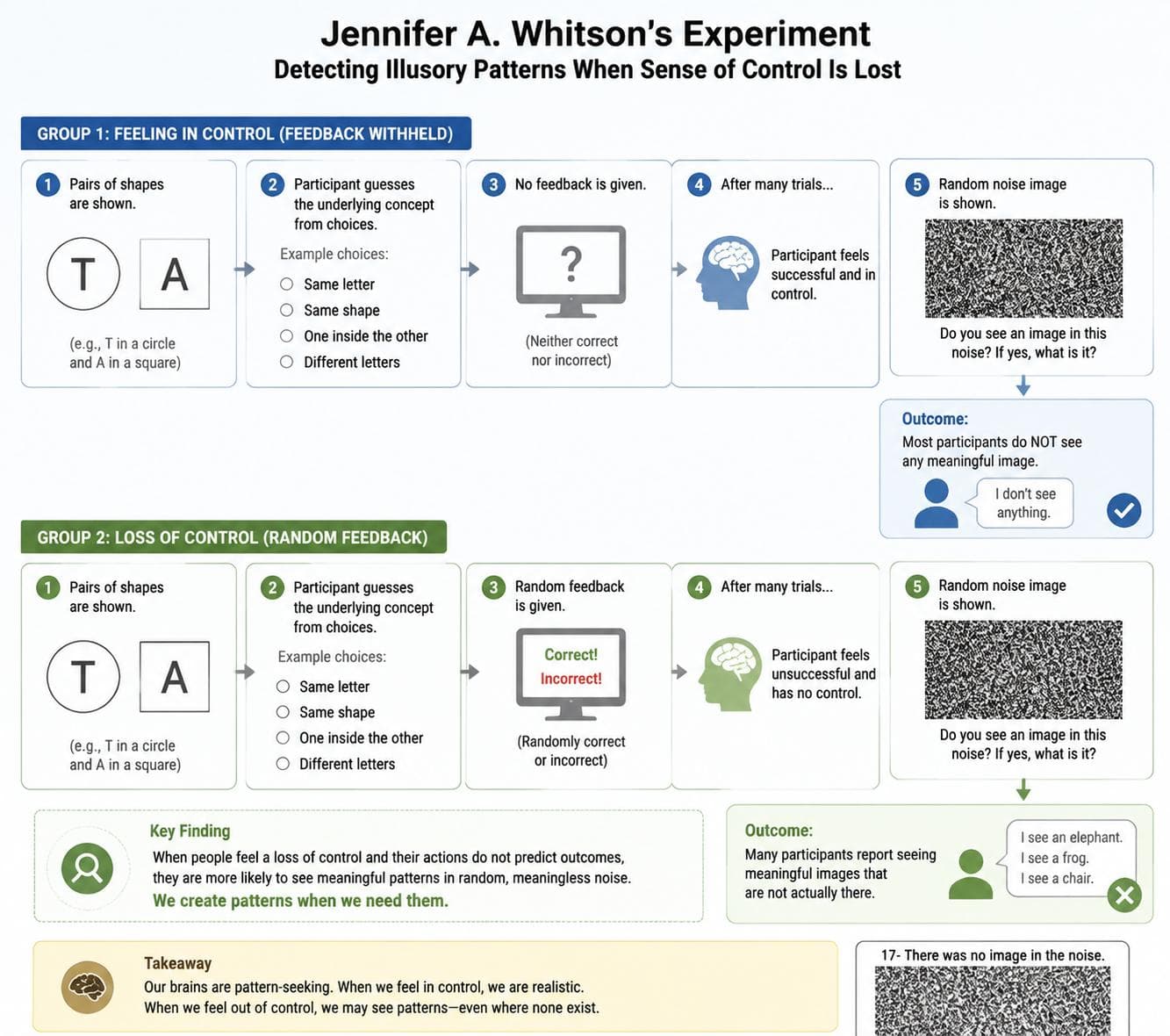
It seems that when we feel that events are slipping beyond our control, we become more likely to discover orderly, meaningful patterns among random and meaningless events around us. Sometimes we see fluctuations in stock prices as the work of economic conspirators. Sometimes we interpret every accidental event in society as the work of a powerful and malevolent group. And sometimes we see the events of our own lives as the deliberate design of a benevolent intelligence seeking to teach us a lesson or put us to a test.
In reality, we do not necessarily reach these conclusions by considering all the available events. Instead, we may select events in such a way that, when placed together, they produce a particular meaning. We prune away the events that contradict that meaning. For example, we may overlook the deaths of dozens of children from disease or accidents, yet focus on a single child who survives an accident and say that God must always assign angels to protect innocent children—otherwise this child would surely have died.
This theory may help explain why conspiracy theories and religious beliefs can be more prevalent among the poor or among people who have suffered severe hardship. Such beliefs may help them feel that they have not simply been abandoned. They perceive a pattern that points to a meaning: that everything remains under the control of either a benevolent mind or malevolent but intelligent and powerful minds. Those malevolent minds may not care about ordinary people, but they nevertheless act according to some rational plan. And because they supposedly exercise such extensive control over social and economic affairs, events will not be allowed to descend completely into chaos. Once those powerful minds have achieved their objective, the familiar order will supposedly be restored.
The attempt to find connections between the movements of stars and planets in the sky and events on Earth may likewise have arisen from this persistent tendency to perceive meaningful patterns in the world around us, eventually giving rise to astrology and similar practices. Astrologers did not conduct impartial investigations to determine whether meaningful relationships actually existed between the positions of the Sun, Moon, Mercury, Venus, Mars, Jupiter, and Saturn and diseases, natural disasters, wars, victories, and defeats among their own people or other nations. Instead, they might select one or two examples that appeared to support their theory, derive a rule from those examples, come to believe in that rule, and add it to the body of astrological knowledge. If they encountered one or two people born in the month of Khordad10 who shared a particular trait, they might conclude—without considering all the other people born in Khordad who lacked that trait—that people born in Khordad possess such characteristics, and then use this false knowledge to judge everyone else born in that month.
Perhaps the reassurance provided by this pattern-making tendency of the brain played a beneficial role in our evolution. In any case, this tendency sometimes seems to lead religious believers to see the hand of their God clearly and unmistakably in an event and to become convinced that the plan, will, or intervention of God—or of Christ, Vishnu, Shiva, Mary, Saint Peter, Abu al-Fadl, or Ali11—must have been at work. In this way, the pattern they perceive produces a sense of knowledge and certainty that may either create religious faith or strengthen the faith they already possess.