

The Physiology of Faith by N. Fakhr - HTML preview
Download the book in PDF, ePub for a complete version.
How Does Memory Work?
At the beginning of childhood, all phenomena around us have more or less equal significance, and our attention is drawn to both important and unimportant things. Everything, including its seemingly insignificant details, can be recorded in our memory for either a short or a long period of time. Our visual memory in childhood can be so powerful that we are able to retain an image together with many of its details. This type of memory is called photographic memory or eidetic memory.
In the 1960s and 1970s, Ralph Haber and Jan Fentress and their colleagues found that a portion of elementary school children in the United States, including both boys and girls, across different racial groups, and regardless of their academic performance, possessed this type of memory. Ralph Haber showed children a colored picture of Alice and the Cheshire Cat from the illustrated book Alice’s Adventures in Wonderland.

The image was shown to the children for a short period of time. After some time had passed, the children were able to answer detailed questions about the image. For example, when they were asked how many stripes on the cat’s tail were visible, their behavior suggested that they were mentally retrieving a kind of image stored in their minds, counting the stripes in that mental image, and then giving their answer. [1]
Remembering such a large number of details provides no evolutionary advantage for humans. As time passes and based on the experiences we accumulate, our brains learn to filter out insignificant details and retain only a small portion of incoming information—sometimes for a short period and sometimes for a long period.
For example, we constantly hear a great deal of noise and many conversations, and much of this information enters our ears but is not even stored in our short-term memory. A city child may remember what type of car each of his neighbors owns, but when visiting a village, he may simply see cows, sheep, trees, and houses, while the details of the rural environment fail to attract his attention. In contrast, a village child visiting a city may notice cars but pay little attention to their models or names. Yet that same rural child may know exactly which neighbor owns how many male and female cows, recognize and remember the names of every bush and tree along a village road, and pay attention to them so that, at the appropriate season, he can wait for the fruits he wants to pick.
We know that, depending on the importance of information, some memories are retained for a short time and others for a long time.
We also know that sometimes we easily forget recent memories, while older memories remain vivid and accessible.
There are diseases that affect memory. In Alzheimer’s disease, which usually appears in older people, the brain of the affected person becomes smaller, and neurons, or nerve cells, undergo structural changes. People with Alzheimer’s disease experience, in a frightening way, the loss of their sense of personal identity and the inability to access the accumulated store of their personal memories.
In another disorder called Korsakoff syndrome, the person’s brain also becomes smaller, and the individual suffers from memory loss, particularly involving recent events. They are unable to perform verbal and non-verbal memory tasks and become incapable of carrying out even very simple activities, although they can still remember distant past memories. In other words, their main problem is with short-term memory.
Events that affect the brain can also influence memory. Sometimes a blow to the head followed by loss of consciousness causes a person, after regaining consciousness, to be unable to remember events that occurred immediately before the unconscious state.
After coma caused by anesthesia, or after disruption of the brain’s electrical activity following electroconvulsive therapy, another type of memory loss known as retrograde amnesia may occur. In this condition, the formation of memories may stop for about 30 minutes.
In 1953, a Canadian patient suffering from epilepsy underwent surgery at the age of 27 as a treatment for his condition. During the operation, parts of his hippocampus, amygdala, and a portion of his temporal lobe were removed. His epilepsy was successfully treated, but afterward he was unable to retain new information in his long-term memory. He could remember everything from before the operation and could hold events in his memory for a short period of time, but nothing remained in his long-term memory. He always estimated his age to be younger than his actual age and could not remember his new neighbors. In the scientific literature, he is known as H.M., after the initials of his name.
These phenomena show us that, in order to understand how memory works and what happens during the processes of remembering and recalling, we must turn to the brain and examine the function of brain cells, or neurons, during learning and memory formation.
Neurons and Memory
Nerve cells, or neurons, which are the basic building blocks of the brain, have the ability to conduct nerve impulses. The movement of electrical currents in neurons is different from the movement of electrical currents in a metal wire. In a metal wire, because of the metallic properties of the atoms that make up the wire, there are free electrons that can move in any direction along the wire. It is enough to connect the two ends of the wire to an electrical source with a potential difference, or voltage, for the electrons to be pushed from one side to the other. Electrons enter the wire from the negative terminal of the electrical source, while electrons on the opposite side of the wire are pushed toward and enter the positive terminal of the source.
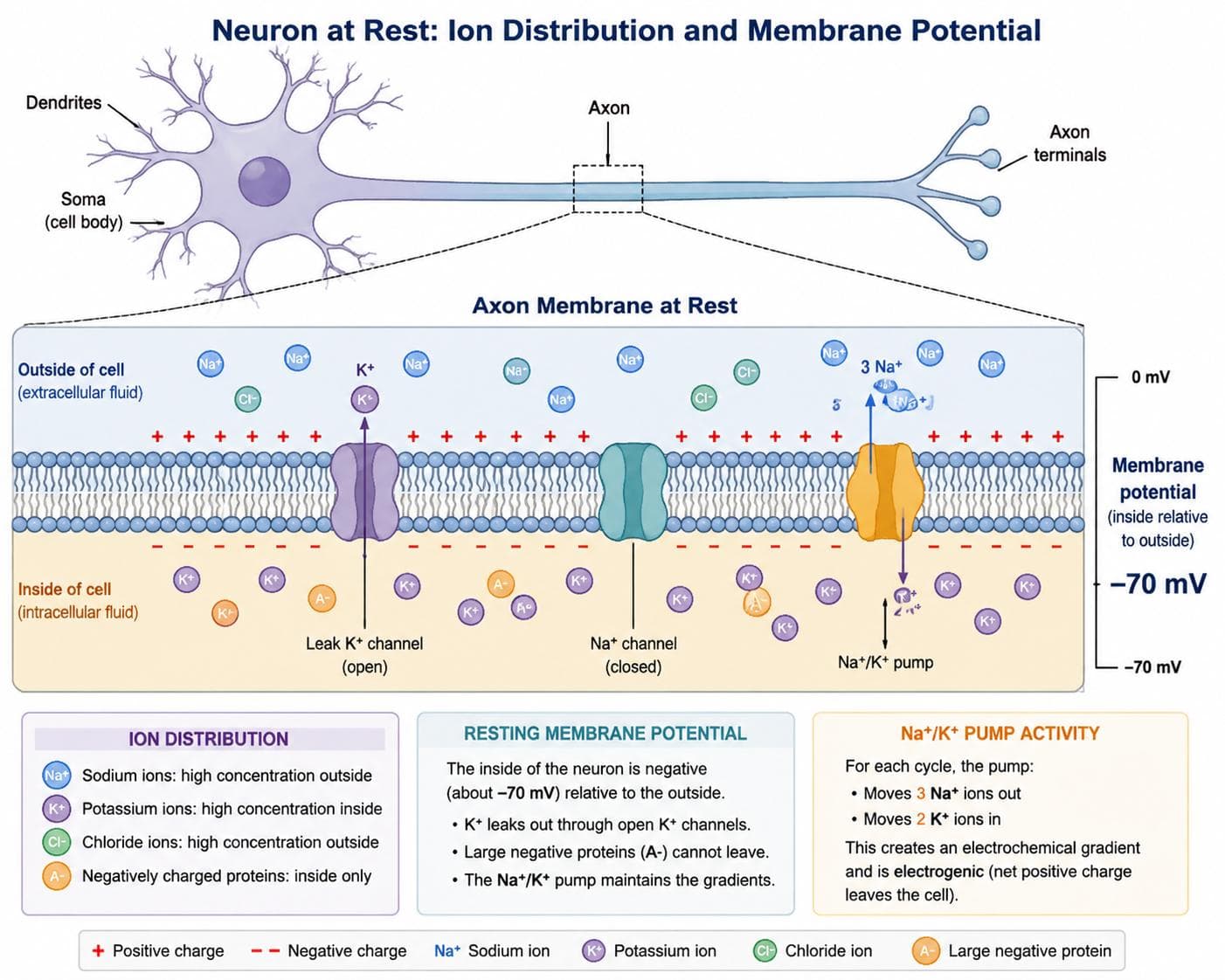
The mechanism of electrical current in nerve cells, however, is different: the membrane, or outer wall, of a neuron acts in a way that prevents positively charged sodium ions from entering while the neuron is at rest. As a result, the inside of the membrane has a negative electrical charge of about 70 millivolts relative to the outside. In other words, there is a potential difference of approximately 70 millivolts between the inside and outside of the nerve cell, meaning that the inside of the membrane is polarized by about 70 millivolts relative to the outside.
It is enough for something, such as a mechanical stimulus, an electrical current, or a chemical substance, to affect the membrane in a way that allows sodium ions to enter the cell. The influx of sodium ions initially causes the inside of the neuron at that point to become 40 millivolts more positive than the outside. In other words, the membrane potential changes from −70 millivolts to +40 millivolts. This change spreads to the adjacent parts of the same cell membrane, creating a wave of change in electrical potential, or depolarization, that travels along the neuron’s membrane. This wave is called an action potential.
The depolarized region quickly returns to its original state by actively pumping sodium ions back out of the cell, using energy, and becomes ready to receive the next stimulus.
A neuron consists of a cell body, which contains the nucleus. On one side of the cell body are branching structures that receive signals from previous neurons; these structures are called dendrites. On the opposite side is a long fiber that carries the received signal toward the next neuron. This fiber is called the axon. The end of the axon branches out, allowing a single neuron to transmit its signal to multiple other neurons.
The junction where the axon of one neuron connects to the dendrites of another neuron is called a synapse. The important feature of this junction is that when an action potential reaches this region, small sacs inside the cell, called vesicles, attach to the depolarized cell membrane and release their contents. These contents include a chemical substance known as a neurotransmitter.
A neurotransmitter can cross the space between the axon and the dendrite, known as the synaptic cleft, bind to receptors on the membrane of the dendrites of the next cell, and alter the permeability of the next neuron's membrane. This change can initiate the flow of sodium ions into the next cell, producing a new action potential.
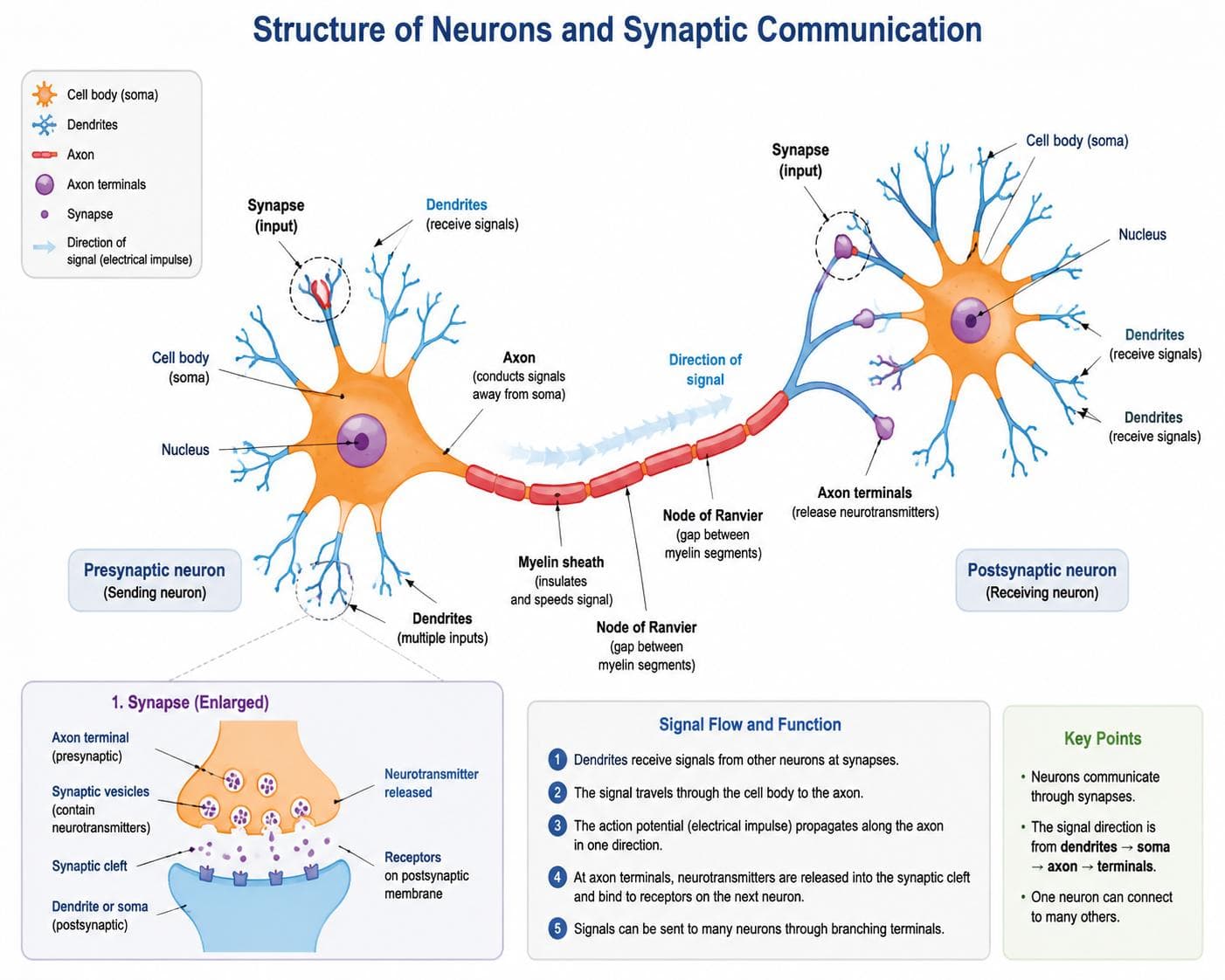
In this way, an electrical signal is converted into a chemical signal, and the chemical signal is converted back into an electrical signal, allowing the action potential of the first cell to be transmitted to the next cell. This property is what makes the flow of electrical information between neurons one-directional: the structure of the synapse allows an action potential to travel only from the axon to the dendrite, not in the opposite direction.
There are different types of neurotransmitters, such as acetylcholine, dopamine, glutamate, and serotonin, each of which has its own specific receptor on the next cell. They must bind to their corresponding receptors in order to produce their effects. Some neurotransmitters, instead of stimulating the next cell, inhibit its activation. One example is GABA (gamma-aminobutyric acid). When GABA binds to its specific receptor on the membrane of the next neuron, it increases the membrane potential from −70 millivolts to −75 millivolts, making it more difficult for that neuron to generate an action potential. Sedative drugs belonging to the benzodiazepine group (such as diazepam), alcohol, and general anesthetics bind to these receptors and "imitate" the effect of GABA, resulting in reduced activity and slower functioning of the nervous system.
Neurotransmitter molecules released into the synaptic cleft either bind to their receptors on the next neuron and perform their function, are rapidly broken down and eliminated, or are quickly reabsorbed by the first cell to be reused.
In general, psychiatric and neurological drugs work through several mechanisms: they may increase the production and release of neurotransmitters; prevent their breakdown and elimination; prevent their reuptake and thereby increase their concentration in the synaptic cleft; bind to specific receptors and imitate the action of a neurotransmitter; or bind to a receptor without imitating the neurotransmitter’s action, blocking the receptor so that the natural neurotransmitter or chemical messenger can no longer exert its effect. Through these mechanisms, medications help treat neurological and psychiatric disorders such as Parkinson’s disease, Alzheimer’s disease, depression, schizophrenia, anxiety, insomnia, and epilepsy. Psychoactive substances and recreational drugs also act through similar mechanisms.
We also know that, in general, brain cells no longer reproduce after the brain has developed during fetal life and childhood and, except in rare cases, are not replaced by new cells. However, the wiring of neurons and their connections with one another can change through the formation of new synapses or junctions between cells.
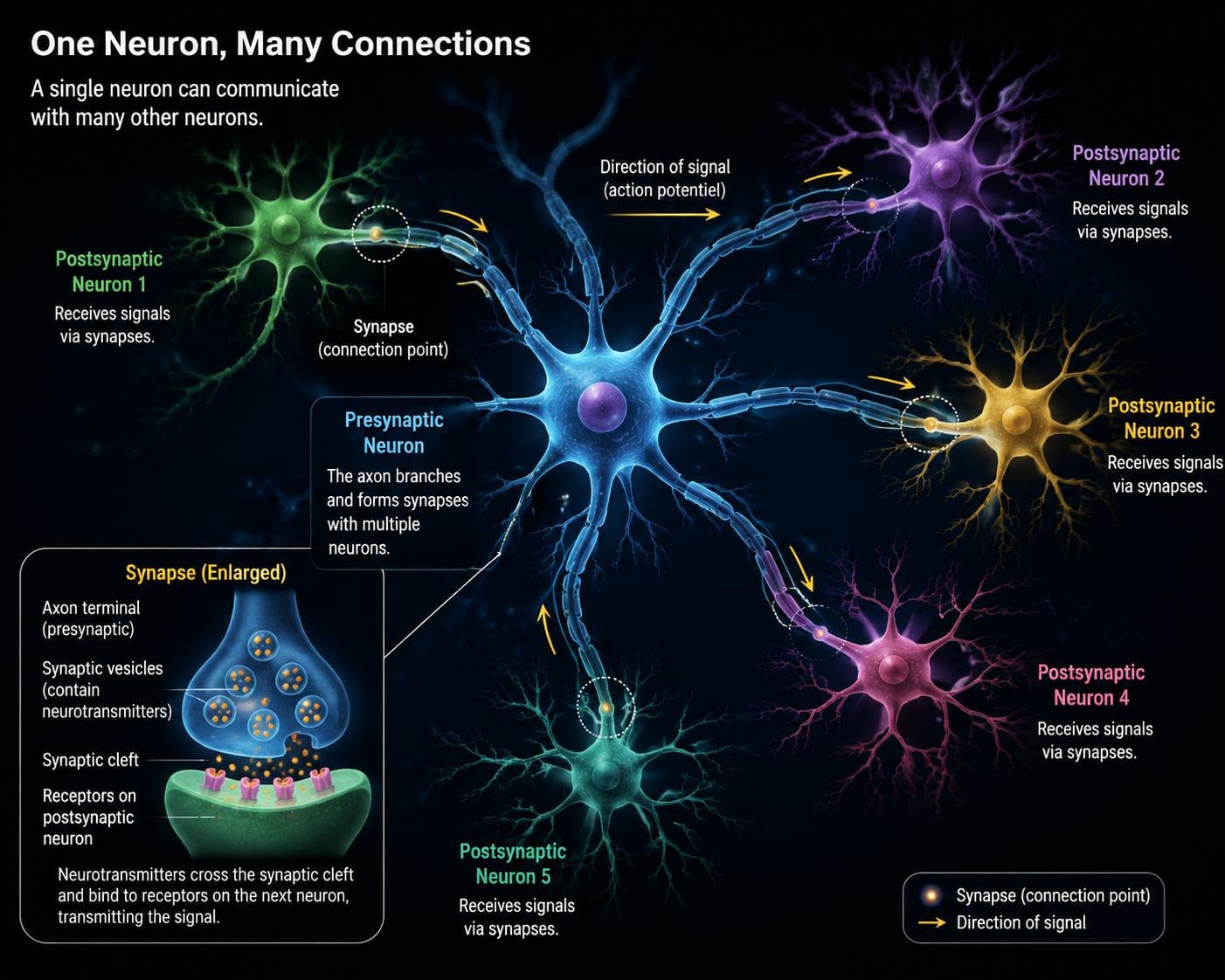
A single neuron can form synaptic connections with many other neurons through branches of its axon, or it can establish multiple synapses with a single neuron.
With these foundations in place, we are now ready to turn to the subject of memory.
Over several decades of research, it has become clear that learning and memory formation are associated, at least in part, with two types of changes in the synapses between neurons.
In short-term learning or short-term memory (such as remembering a five-digit number for a few seconds to a few minutes), a chain of reactions occurs in the neurons involved in retaining that information. These reactions ultimately cause the relevant synapses to release a greater amount of neurotransmitter from the first neuron and to continue releasing it for a longer period. As a result, the following neurons generate electrical currents, or action potentials, for a longer time. In other words, a process called “short-term synaptic strengthening” takes place.
Research into how memory works began with studies of simple animals such as the sea slug Aplysia. Interestingly, the structure and function of the nervous cells and neurotransmitters of these simple animals do not differ significantly from those of more complex animals and humans. In these experiments, researchers observed that blocking any stage of the chain of “synaptic strengthening reactions” with a chemical substance prevented short-term memory from functioning. In other words, the animals were unable to retain even short-lived memories.
In long-term memory, this synaptic strengthening becomes permanent through the formation of new synapses. For example, Craig Bailey and Mary Chen discovered in their research on the studied animal that a single sensory neuron (a neuron connected at one end to a sensory receptor, such as one in the skin, and responsible for transmitting received sensory information in the form of action potentials) forms approximately 1,300 synapses with 25 other neurons. Of these 1,300 synapses, only 40% are active and release neurotransmitters. During continuous and intense stimulation of this sensory neuron, in order to create long-term memory, the number of synapses increases to 2,700, and the proportion of active synapses rises from 40% to 60%. The following neurons also grow new extensions, or dendrites, to establish stronger connections with this neuron.
Over time, as a memory fades and weakens, these strengthened responses gradually return to their normal state, and the number of synapses decreases from 2,700 to approximately 1,500. This is still slightly higher than the original number, perhaps because the animal can learn to respond more easily when it encounters that stimulus again. Some forms of learning require the number of synapses, as well as the percentage of active synapses, to decrease.[1]
When mice were injected with drugs that prevented protein synthesis, preventing them from forming new synapses (which have protein-based structures), their short-term memory remained functional. However, by the following day, they no longer remembered anything about the stimuli and training they had received; in other words, their long-term memory had not been formed. But if the protein-synthesis-inhibiting drugs were injected several hours after training, allowing enough time for the formation of new synapses, long-term memory related to the stimuli and training was established, and the animals’ behavior in the following days showed that they remembered everything. In summary, memory has a direct relationship with the “formation and activity of synapses,” and disruption of synaptic formation and activity prevents the creation of memories.
The findings regarding the mechanisms of memory formation are highly significant and full of detail. The message they provide in discussions such as out-of-body experiences and near-death experiences is that all memories, including memories of such experiences, are formed within our brains and are therefore accessible to recall.
Therefore, we now face two theories for explaining these experiences:
• The first theory is that these experiences are constructions of our own brain activity, which are subsequently converted into memories within our brains. Naturally, whenever the neural circuits associated with these memories are reactivated and action potentials flow through them, these memories and images are reconstructed and recalled.
If, at some point, our brain cells become damaged, or if the synapses associated with these memories are reduced or become inactive, the memories of these experiences will also fade or disappear.
We can hope that any question arising in relation to this first theory can be answered through research into the functions of the brain, its cells, and its different regions.
• The second theory is that we are a non-material entity or substance that, during these experiences, actually leaves the body and travels outside the body or into other realms.
At this point, we can no longer hope to answer questions arising from this second theory through scientific investigation, because we have no method for investigating a non-material entity. For example, how could we answer the following questions?
Why, when we supposedly left our bodies, did we still have eyes for seeing, ears for hearing, and other senses that continued to function? The eyes, ears, and other senses of our physical body had ceased to function. Where did these new eyes, ears, and senses come from, and how did we become equipped so quickly with all the tools necessary for recognizing our surroundings?
Why, when we left our bodies and no longer had access to the memories stored inside our brains, did what we perceived through those senses—which we do not know how we suddenly acquired—still have meaning for us? Is it possible to understand, without access to memory, that what we are looking at outside our bodies is a table, a chair, a bed, a space, or a person we recognize? How, in those moments without access to memory, did we understand the meaning of flying, calmness, a tunnel, light, familiar, unfamiliar, God, length, width, height, time, and so on?
Our consciousness cannot understand anything without memory. Sometimes people who suffer extensive strokes and widespread brain damage appear to remain conscious, but they completely lose their ability to speak, their declarative4 memory, and their personality. They become like a child who must be taught everything again from the beginning and gradually develops a new personality. Given this, is there any way that a person could leave their body while carrying with them their ability to speak, their memories, and their personality—features that are so deeply dependent on the proper functioning of brain cells and the arrangement of synapses between those cells?
If we had truly left our bodies and our brains were no longer involved in the experience, why did this experience result in the strengthening and formation of synapses in our brains, allowing us to later remember those supposed out-of-body experiences through the generation of action potentials in the relevant neural circuits?
Even if we assume that we could see and hear outside our bodies without access to our physical senses, memories, and brain-based memory systems; and even if we could understand what we saw and heard, speak our native language with others, angels, and our gods, and understand their words; then, naturally, after the experience ended and we returned to our bodies, we should not remember anything, because nothing would have been recorded in our brains. Our brains would not have been active. They would have had no information about what was happening to the supposed spirit, and no synapses would have been strengthened or created to store either short-term or long-term memories.
How should we choose between these two theories?
When Logic Is Free to Work
Under ordinary circumstances—when our reasoning is not under pressure from the limbic system and brainstem, and when our cerebral cortex is not being lazy and simply settling for the first theory that comes to mind5—in short, when we are reasoning as fully and rationally as possible in an effort to arrive at knowledge that accurately corresponds to reality, our method is to choose, from among several theories proposed to explain a phenomenon, the one that meets two conditions:
First, the theory should be coherent and consistent with the other things we know about the world around us.
Second, the theory should not force us, in order to prove it—or, in other words, to rescue it—to invent and introduce still more theories. In logic, this second principle is known as Occam’s razor.
Let me give an example of the first principle: choosing a theory that is coherent and consistent with our other beliefs.
I have a neighbor whom I have known for years. Because I have always seen him behave politely and ethically, act conscientiously and compassionately toward others, and live modestly and honorably, I have come to believe that he is an ethical, modest, and honorable man. One day, I look out of the window and see him trying to unlock my car with his key. His car and mine are the same model and the same color. I now have two theories:
1. He is trying to steal my car.
2. He has mistaken my car for his own.
The first theory is inconsistent with the rest of what I believe about him. If I accept it, the structure of my beliefs becomes less coherent. The theory that he is trying to steal my car does not fit with my belief that he is an honorable man. The two beliefs are in conflict.
The second theory is consistent with everything else I know and believe about him. If I accept it, the overall structure of my beliefs remains coherent.
So instead of sticking my head out of the window and angrily shouting, “Hey! Aren’t you ashamed of yourself? You’re trying to steal my car!”, I smile and politely say, “Your car is the other one, parked over there.”
Now let us use the same example to illustrate the second principle: Occam’s razor.
Suppose I say to my wife, “Look! Our neighbor is trying to steal our car.” She might reply, “That doesn’t sound like him. Someone who is a thief could hardly have the character and behavior we have always seen in our neighbor.” In other words, my wife is pointing out that my hypothesis is inconsistent with what we already believe about him.
Now I must either abandon my theory or invent another theory to defend it. I might say to my wife, “Then he must have been pretending all these years just to gain our trust.” But now, to establish this new theory—that our neighbor has been a hypocrite all along—I need to gather new evidence, which may be extremely difficult or perhaps impossible.
If I am in an ordinary state of mind and have no particular feelings toward my neighbor, I will apply Occam’s razor intuitively, even if I have never heard its name. I will not pursue the theory that my neighbor is a thief. I will choose the simpler explanation—that he has mistaken my car for his own—rather than having to invent additional hypotheses. Occam’s razor tells us that, among competing theories proposed to explain a phenomenon, we should prefer the one that requires fewer additional assumptions for its explanation and set aside the alternatives.
But if I harbor resentment and hatred toward my neighbor, the older systems of my brain may push my cerebral cortex toward choosing the theory that he is a thief. I may then readily invent further explanations to defend that theory—for example, that his honorable behavior over all these years was merely a calculated and deceptive performance. I may feel no need to provide evidence for these additional assumptions. Nor may I be troubled by the resulting inconsistency within my overall system of beliefs. Merely witnessing this one scene may be enough for me to develop a powerful sense of knowing that my neighbor is a thief. I may then stick my head angrily out of the window, shout at him, and create a public scene.
Back to Out-of-Body and Near-Death Experiences
Let us return to the phenomena of out-of-body experiences and near-death experiences.
The theory that these experiences are simply products of brain activity, and that no substance, spirit, consciousness, or other entity has actually left the body, is coherent and consistent with the rest of what we know about the physiology of the brain, the operation of physical and chemical laws within it, the effects of drugs, diseases, and brain lesions on our mental and psychological phenomena, the way memory is formed in the brain, and so on. Nor do we need to invent additional theories in order to establish the truth of this theory. We need only continue searching for evidence that could either support or refute the theory itself. This appears entirely feasible, because we are dealing only with the observable world. Investigating and testing this theory can contribute to scientific progress. People anywhere in the world can participate in such research and understand its results. Studies such as Olaf Blanke’s research and the experiments involving pilots and astronauts, discussed earlier, are examples of precisely this kind of investigation and testing.
The theory that a spirit or consciousness leaves the body, however, is not coherent with what we know about the functioning of the brain, memory, the senses, and so forth. To resolve this inconsistency within our system of beliefs, we are forced to introduce additional theories. We might, for example, be asked: Why should our spirit or consciousness—which, until the very moment it left the body, depended so heavily on memory, the functioning of brain cells, and the eyes, ears, and other sensory organs of our present body in order to perceive the world around it—suddenly possess eyes, ears, other senses, memory, and the capacity for cognition after leaving the body and losing its connection with it?
To answer this question, we would have to invent a new theory and place it alongside the theory that the spirit leaves the body. We might say, for example: perhaps the moment the spirit leaves the body, it enters a new body—one that, like our present body, possesses sensory organs, including eyes and ears. At the same time, our entire personality and memory, which depend on the unique arrangement of trillions of synapses in our own brain, are somehow transferred all at once to this new body, enabling us to understand and analyze the information received through its eyes and ears and thereby recognize the world around us. Coincidentally, the eyes of this new body are also sensitive, just like our present eyes, only to the visible portion of the electromagnetic spectrum and cannot, for example, see infrared or ultraviolet radiation. Coincidentally, the ears of our new body also hear exactly the same range of frequencies as our present ears and are deaf to frequencies above and below that range.
But once we have assumed this newly invented and complicated theory, another question immediately arises: if, during that period, we see and hear through this new non-material body, understand what we see and hear, remember it, and store it in the memory of that body, why are those events and observations also recorded in the memory of our material brain when we return to our original body, allowing us to retrieve them afterward? Was our brain not inactive during that time? Had its connection with the spirit not been severed? Now we must create yet another theory and say, for example, that “our God,” “the mechanism of the universe,” or something else performs this transfer in some miraculous way that we cannot understand.
As we can see, these additional theories are not testable in a way that would allow us to determine whether they are true or false and thereby contribute to scientific progress. Moreover, the additional theories and assumptions that different people introduce to defend the idea that the spirit leaves the body will probably arise from their own religious beliefs and conform to their own religious worldview, and therefore may not be acceptable to followers of other religions6. Persisting with the second theory and repeatedly creating new theories to rescue the idea that the spirit separates from the body is not our ordinary method of rational reasoning—unless we are under pressure from the older systems of our brain.
Now let us return to the remaining phenomena that appear capable of producing a sense of direct knowledge and certainty in religious believers.