

The Physiology of Faith by N. Fakhr - HTML preview
Download the book in PDF, ePub for a complete version.
Near-Death Experiences
Near-death experiences have been reported by some individuals who have experienced accidents and events that threaten their lives. Such events include cardiac arrest, suffocation, blows to the head that cause loss of consciousness, shocks leading to unconsciousness, and similar situations.
Various studies indicate that between 10 and 23 percent of patients who experience cardiac arrest report having had such an experience. They describe entering a different realm—a realm without space and time. Their experiences show remarkable similarities. They report the absence of pain, seeing a light at the end of a tunnel, separation from the body, and flying above their body or moving through empty space.
They sometimes report seeing their living or deceased loved ones, or supernatural religious figures such as angels and gods from their own religious traditions. Sometimes they feel that all their memories have rapidly passed before their eyes. Although near-death experiences accompanied by pleasant emotions receive more attention and are more frequently reported, some people also go through distressing experiences, such as terror, loneliness, despair, and anxiety. It appears that many such unpleasant experiences remain unreported because of feelings of shame. [1]
In a 2017 study conducted by the University of Virginia, 129 people who had experienced near-death experiences were asked about their memories of those experiences and other events occurring at the same time. The results showed that memories of near-death experiences had greater clarity and persistence in their minds.
Studying what happens in the brain under these conditions is difficult, because, for example, researchers cannot place someone in an MRI scanner and recreate circumstances such as oxygen deprivation during cardiac arrest in order to observe which parts of the brain are active.
However, during the Cold War years, and through specialized training exercises for pilots as well as astronaut training programs at NASA, detailed observations of this phenomenon were obtained. During these exercises, both groups were placed inside chambers that rotated rapidly around an axis in order to measure their physiological responses under conditions in which they experienced a force equivalent to five times the force of Earth’s gravity.
Under these conditions, the cardiovascular system loses its ability to deliver sufficient blood to the brain, and blood accumulates in the lower part of the body, causing the pilot to lose consciousness. Ten to twenty seconds after this force stops, consciousness returns. For several minutes afterward, the pilot remains confused and experiences difficulty recognizing directions and understanding their position.
What pilots and astronauts have reported experiencing during those moments shows remarkable similarities to the near-death experiences of patients: a tunnel with light at its end, a state resembling waking from sleep, a feeling of partial or complete paralysis, a sensation of peaceful flight, a feeling of leaving the body, feelings of pleasure and euphoria, and brief but vivid dreams that often include conversations with family members.
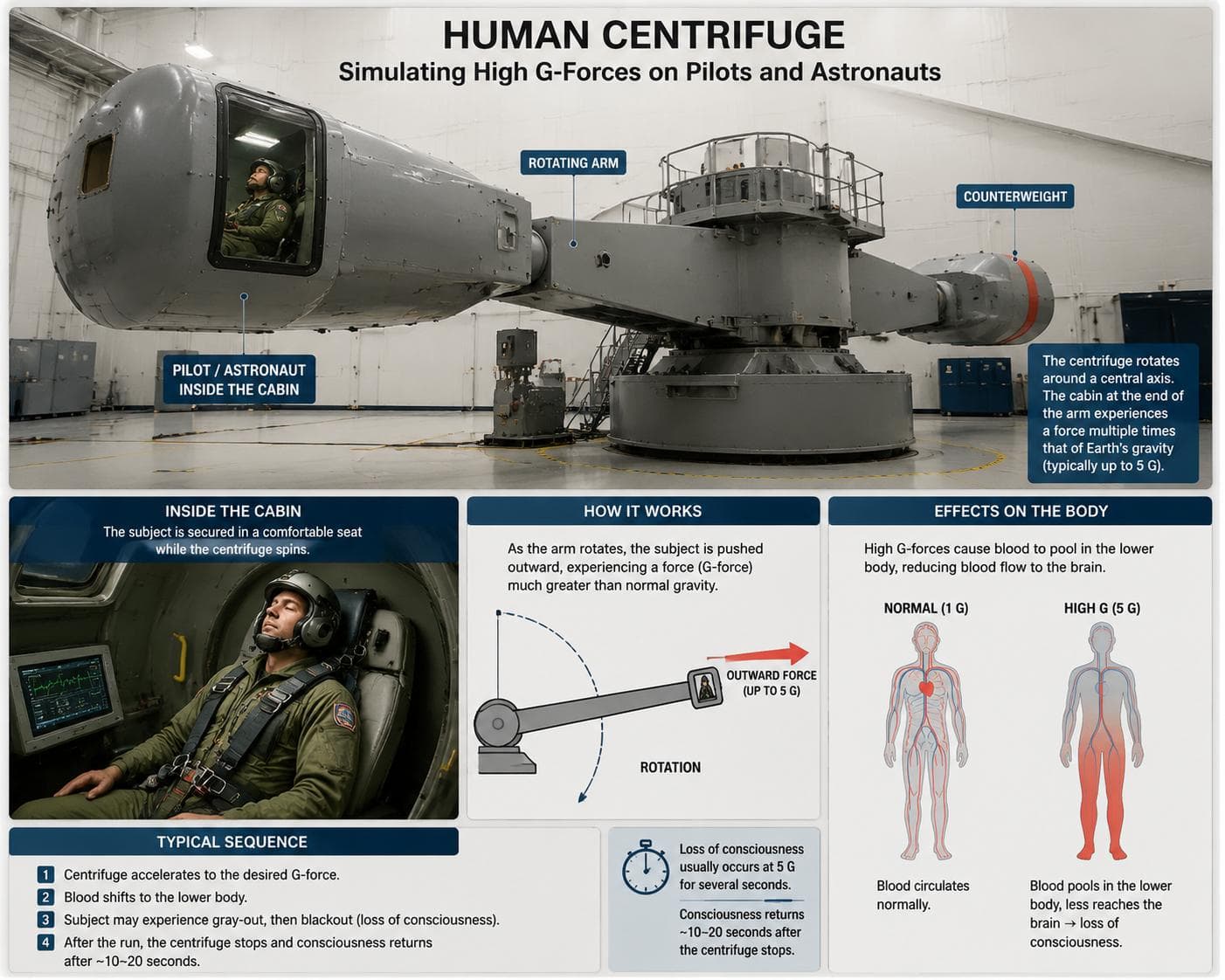
Figure X — Human centrifuge used in pilot and astronaut training. Similar physiological conditions caused by reduced brain blood flow may produce experiences resembling some reported near-death experiences.
The memories of these experiences also remained clearer for years in the minds of pilots and astronauts than their memories of events occurring at the same time. Their experiences did not include religious visions, such as seeing heaven or angels—perhaps because they already knew that they would only be subjected to pressure sufficient to cause temporary unconsciousness, and therefore were not thinking about religion or death. [2]
It appears that reduced blood flow to the brain causes different parts of the brain to gradually shut down one after another. It is possible that, at times, the last parts that remain active are those whose final activity generates these kinds of perceptions and feelings in the person’s mind. Under such conditions, when other parts of the brain are no longer functioning, these remaining areas are no longer controlled or suppressed by those regions and can freely perform their final activities.
For a religious believer, “out-of-body experiences” and “near-death experiences” are perceptions that reinforce an important assumption: the existence of a soul.
Most believers consider their true essence and identity to be an element separate from their physical body—an element that temporarily resides within and interacts with the body, but leaves it at the moment of death. In this view, the soul then travels, without a body, to another world; or after death enters another body and then proceeds to another realm with that new body; or returns to this same world in another body and begins a new life with that new body.
Believers interpret out-of-body experiences and near-death experiences as states in which their essence, soul, spirit, or consciousness has truly left their body. They regard these observations as strong and objective evidence for the duality of soul and body as two distinct entities.
They believe that the fundamental element of their existence—the soul—can travel through the universe without a body and then return to the body while retaining memories of everything it observed outside the body, allowing it to describe those observations to others.
To examine this belief, it is necessary to pause here, before continuing, and discuss the important subject of memory, its function, and its role in creating everything that we are.