

The Physiology of Faith by N. Fakhr - HTML preview
Download the book in PDF, ePub, Kindle for a complete version.
Mystical Experiences
Mystical experiences are usually described at first with expressions such as “indescribable” and “beyond the limitations of language.” Nevertheless, people who have had such experiences have ultimately provided descriptions of the states they went through.
Over the past decades, numerous studies have been conducted to determine the prevalence and similarities of these supposedly indescribable experiences. The findings indicate that such experiences are relatively common and cannot be considered rare or unusual.
In 1979, in a study led by David Hay, participants were asked whether they had ever had a mystical experience. Of those surveyed, 29.4% answered positively. Among them, 20.2% reported an experience involving the presence of a being or essence, while 9.2% reported an experience of unity or oneness with existence or with another essence.
In another study on the occurrence and descriptions of mystical experiences, conducted by the University of Pennsylvania between 2008 and 2013, detailed accounts from 777 participants were ultimately examined and analyzed. These participants had provided responses and descriptions of their mystical experiences that were sufficiently detailed for evaluation.
The data showed that monotheists (Christians, Jews, and Muslims) experienced mystical states relatively less often than followers of Eastern religions (Buddhists, Hindus, adherents of non-religious philosophies such as Taoism, and followers of religions commonly described as polytheistic or idolatrous). The frequency of mystical experiences among atheists was somewhere between the two groups mentioned above.
Analysis of the words used by participants to describe their mystical experiences showed that, although the word “God” was among the most frequently used terms in their descriptions, they generally used fewer specialized words associated with particular religions or traditions. This suggests that they described their mystical experiences less under the influence of the teachings or indoctrinations of their religions.
However, the responses were given in English, and the word “God” represents the deity of each believer’s own religion. In other words, when participants used the word “God,” they were in fact using a concept specific to their own religious tradition in describing their experience. Therefore, given the different and specific meanings of the word “God” in different religions and traditions, it cannot be concluded that this word was the most frequently used concept in descriptions of mystical experiences. [1]
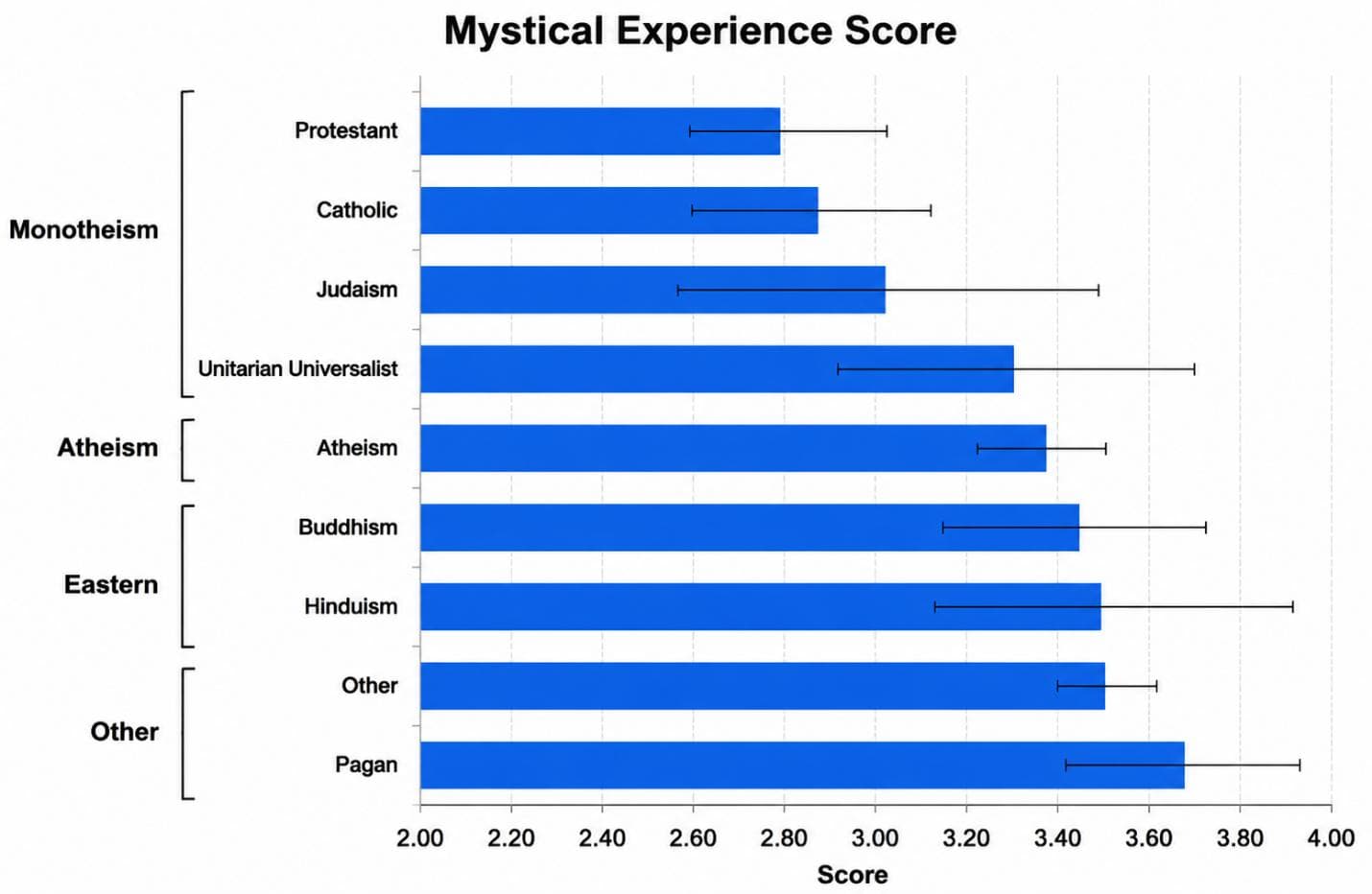
Analysis of the words used by those describing their mystical experiences suggests that their experiences share similarities in some respects. However, they sometimes interpret these experiences in ways that support the beliefs of their own religion.
For example, if they experience the presence of a supernatural being or person near them, they may assign to that being the name of their own God or the sacred figures of their own religion. From that point onward, this experience may become, for them, direct evidence and proof of the truth of their religious faith.
Michael Persinger and his colleagues at Laurentian University investigated the relationship between the sense of the presence of God or other beings and entities, and brain activity. Using a device called the Koren helmet, later known as the God helmet, they focused a magnetic field on different areas of the brain.
We know that changes in a magnetic field at any point in space can cause the movement of electrons and ions. It can therefore be expected that such changes may contribute to electrical activity and the generation of neural impulses in the targeted areas of the brain.
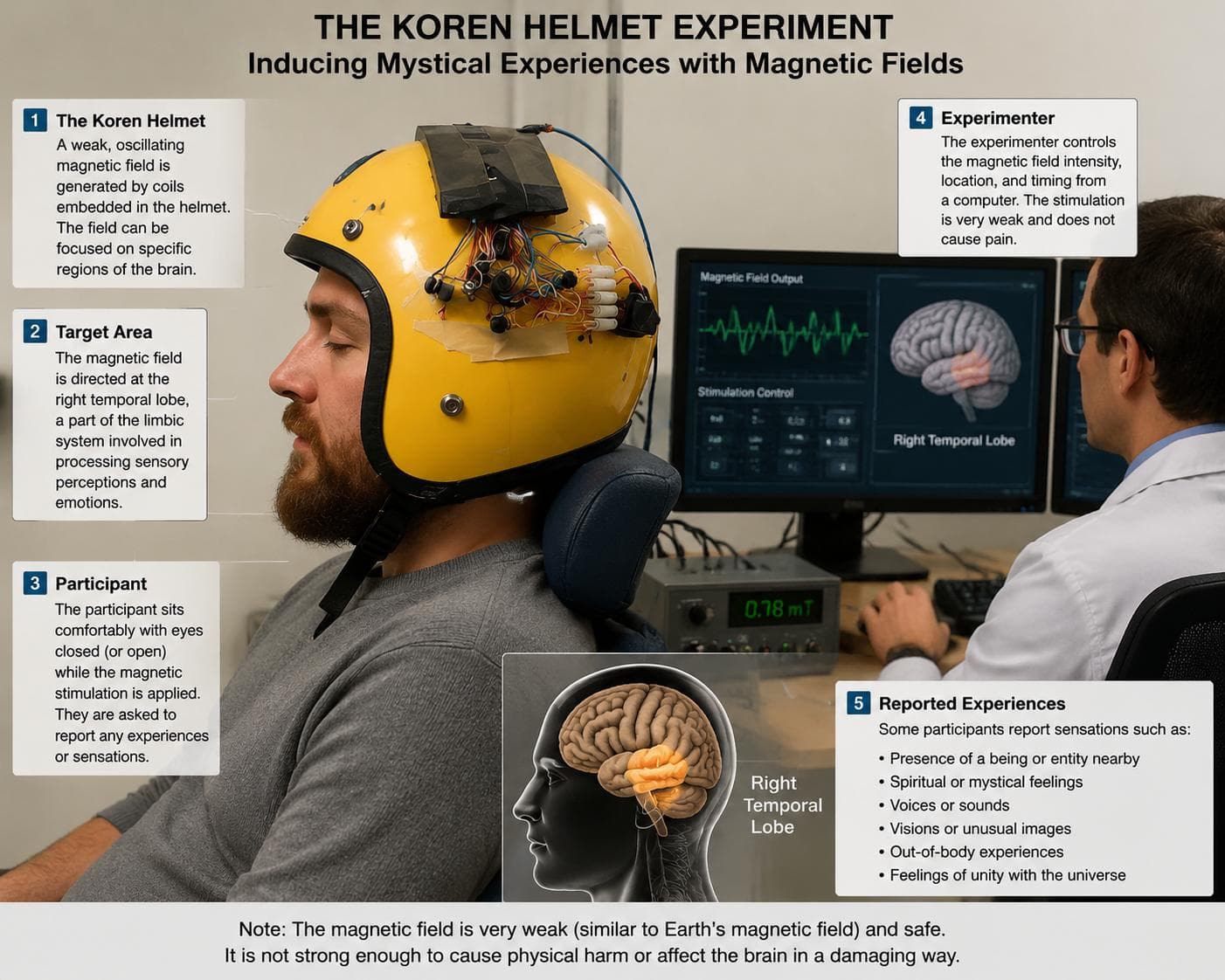
When mild changes in the magnetic field were applied to the right temporal lobe of the limbic system of participants’ brains, it was observed that some of them experienced a sense of the presence of beings or essences without faces or bodies around them. Sometimes they sensed one presence, and sometimes several. They could even identify the location where these presences seemed to exist.
The experiences reported by all participants were not identical. Some stated that they sensed the presence of God. Some reported states of ecstasy and euphoria. Some described a feeling of unity with the universe. Some reported near-death experiences and imagined themselves moving through a dark spiral toward a light at its end.
No two participants described exactly the same experience. Some heard voices. Some saw unusual faces. Some sensed the presence of someone standing behind them, as if staring at them. Some saw familiar people. Some said that they had separated from their bodies and were observing themselves from above.
However, the majority of reports centered on the sensation of another person or other persons being present around them, and in this respect, the experiences were similar: a presence that felt completely clear and vivid, but usually without a body or face. They reported perceiving this presence with absolute certainty. They “knew” that someone or something was present around them.
According to Michael Persinger, in addition to electrical stimulation, chemical stimuli and social experiences may also stimulate the temporal lobe. [2] Perhaps prolonged periods of seclusion and spiritual retreat practiced by mystics may also contribute to stimulating the temporal lobe and the creation of mystical experiences by the brain.
Years before Michael Persinger’s research, Wilder Penfield, a Canadian neurosurgeon, had noticed during brain surgeries on patients with epilepsy that 8% of his patients, when the temporal lobe was electrically stimulated, reported complex experiences.
These patients were conscious during the operation and were not under general anesthesia. They said that it seemed as if someone was speaking words, but the voice was too faint to be heard clearly. One of them reported seeing images of a dog and a cat, with the dog chasing the cat.
Penfield concluded that the temporal lobe must be the location where memories are stored. This theory was later questioned by other researchers. [3]