

The Physiology of Faith by N. Fakhr - HTML preview
Download the book in PDF, ePub, Kindle for a complete version.
Choice Blindness
Human beings usually select evidence that confirms their own views and beliefs, while filtering out disconfirming evidence in such a way that it never reaches their analytical mind. This phenomenon occurs when a person believes that they have arrived at a hypothesis themselves and considers it their own creation—the product of their own thinking and reasoning. In such a state, they see only the evidence that supports their belief.
In fact, this is a “my-side bias” rather than a bias in favor of any particular belief
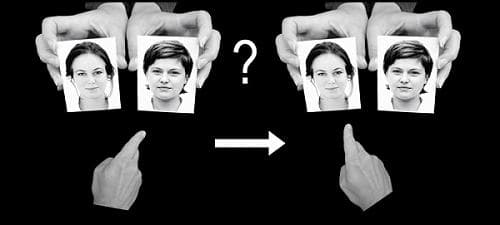
In 2005, Petter Johansson, Lars Hall, and their colleagues conducted an experiment with 120 university students. They seated each participant on one side of a table, while another person sat opposite them and showed them two cards, each containing a photograph of a face. The faces were not very different from each other.
The participant was asked: “Which face do you think is more attractive?” The participant chose one of the two faces. At an appropriate moment, the experimenter skillfully switched the cards and then handed the participant the card they had not chosen, asking:
“Why do you think the face you chose is more attractive?”
In more than 75% of cases, participants failed to notice that the cards had been switched and began providing reasons to justify why that face was more attractive. [1]
In 2013, during the Swedish elections, Johansson and Hall conducted another experiment. They asked participants which candidate they intended to vote for. They then asked about their opinions on public policies associated with that candidate’s political party—for example, whether they agreed or disagreed with various laws and policies, such as the death penalty, the legality of abortion, imprisonment of drug traffickers, and so on. Next to their answers of “agree” or “disagree,” the researchers attached labels or placed marks.
At first, participants had expressed agreement with the policies that their preferred party supported and disagreement with those it opposed. But afterward, the researchers skillfully switched the positions of the labels or marks and asked participants why they opposed a particular policy, even though they had previously said they supported it.
Seventy-eight percent of participants failed to notice the change in their answers, and most of them began reasoning in favor of an opinion that had not actually been their original choice. Interestingly, eventually only 48% of participants considered supporting the opposing party, whose views now matched their newly stated position. [2]
This phenomenon has been called “choice blindness.”
Apparently, for humans, in many cases, “their choice” matters more than “the reason behind their choice.” Human reasoning is usually not directed toward discovering truth; rather, it is directed toward winning:
“My choice must be justified, so I will justify it in a way that makes my choice appear to be the best and most rational one.”
In reality, Homo sapiens is self-serving before it is logical.
Parents, members of a group, teachers, or religious authorities provide reasons for why their religious beliefs are correct, and sometimes they ask children to provide reasons supporting those beliefs. The child repeats the same reasons given by adults and receives encouragement from them for presenting those reasons. From that point onward, the child may come to believe that they accepted the belief through their own reasoning and that the belief is “their own belief.”
Likewise, when a religious believer is asked not:
“Why do your fellow believers hold this belief?”
but rather:
“Why do you hold this belief?”
or
“Why do you think this religious belief is true?”
questions with this linguistic structure implicitly introduce a presupposition: that the belief belongs to the person themselves or is the product of their own thinking and reasoning. This is despite the possibility that they may never have reflected on why they hold that religious belief.
As the observations of Johansson and Hall demonstrated, this alone may be sufficient to motivate a person to begin searching for reasons to prove the correctness of their religious faith.
Perhaps this phenomenon can also be explained through the “endowment effect,” which appears not to be very different from choice blindness.
In 1984, Jack L. Knetsch and Jack A. Sinden conducted a study in which some participants were given lottery tickets and others were given two dollars. After some time, when participants had developed a sense of ownership over what they had received, they were told that they could exchange the lottery ticket for two dollars or the two dollars for a lottery ticket. Only a small number of participants agreed to make the exchange.
Similar experiments have been conducted in various forms. For example, some university students were given mugs while others received nothing. They were then asked to estimate the value of the mug. Those who owned the mug estimated its average value at $4.50, whereas those who did not own one estimated its value at an average of $2.25. [3]
It appears that humans assign greater value than the actual value to anything they consider their own and resist changing it. Many people consider the mountains, forests, and natural landscapes of their own country more beautiful than those of other countries. They also evaluate the scientists, literature, and art of their own country as more valuable than those of others.
This tendency can extend to one’s own religion and beliefs as well.