

The Physiology of Faith by N. Fakhr - HTML preview
Download the book in PDF, ePub, Kindle for a complete version.
The Old Brain Is in Command
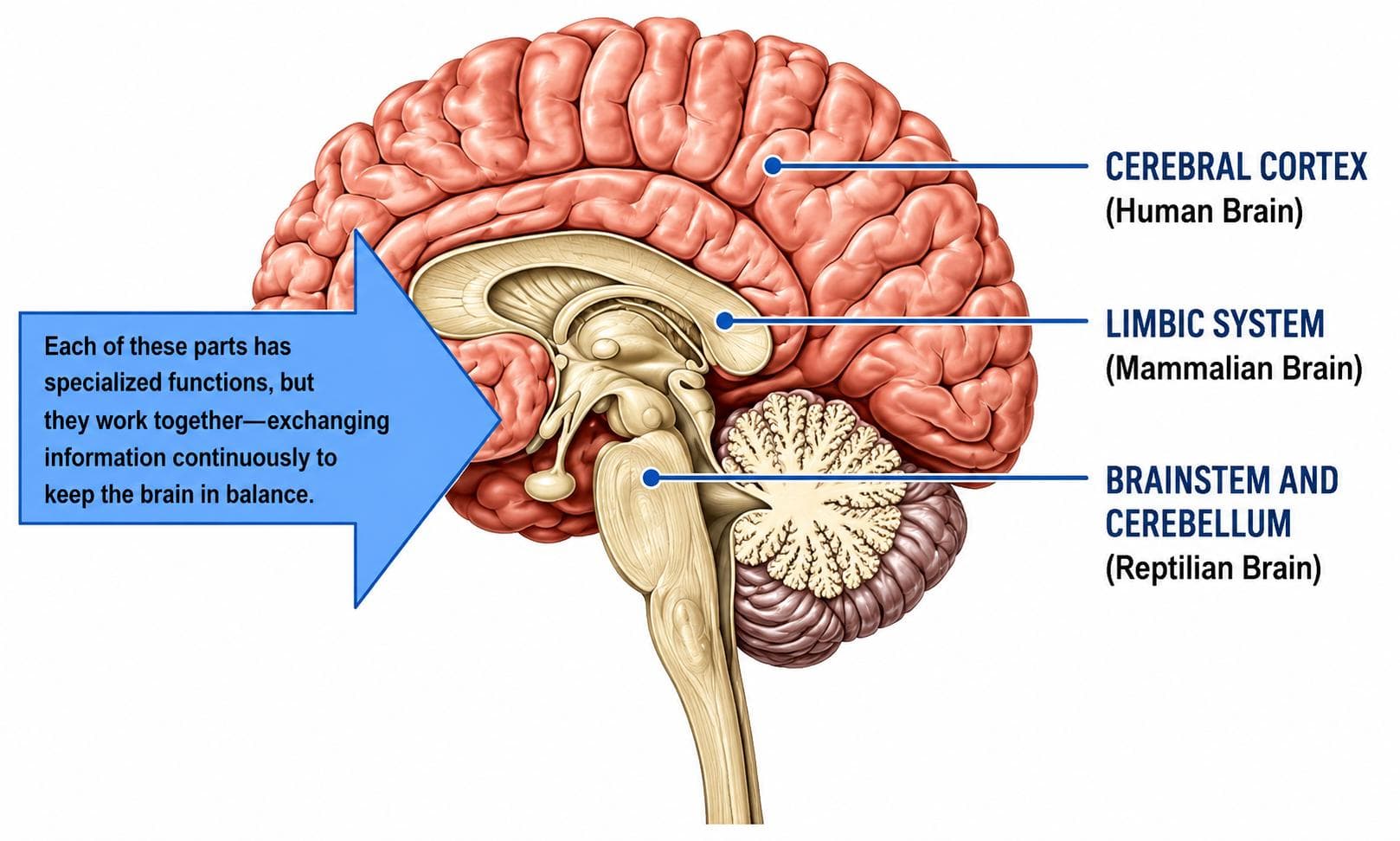
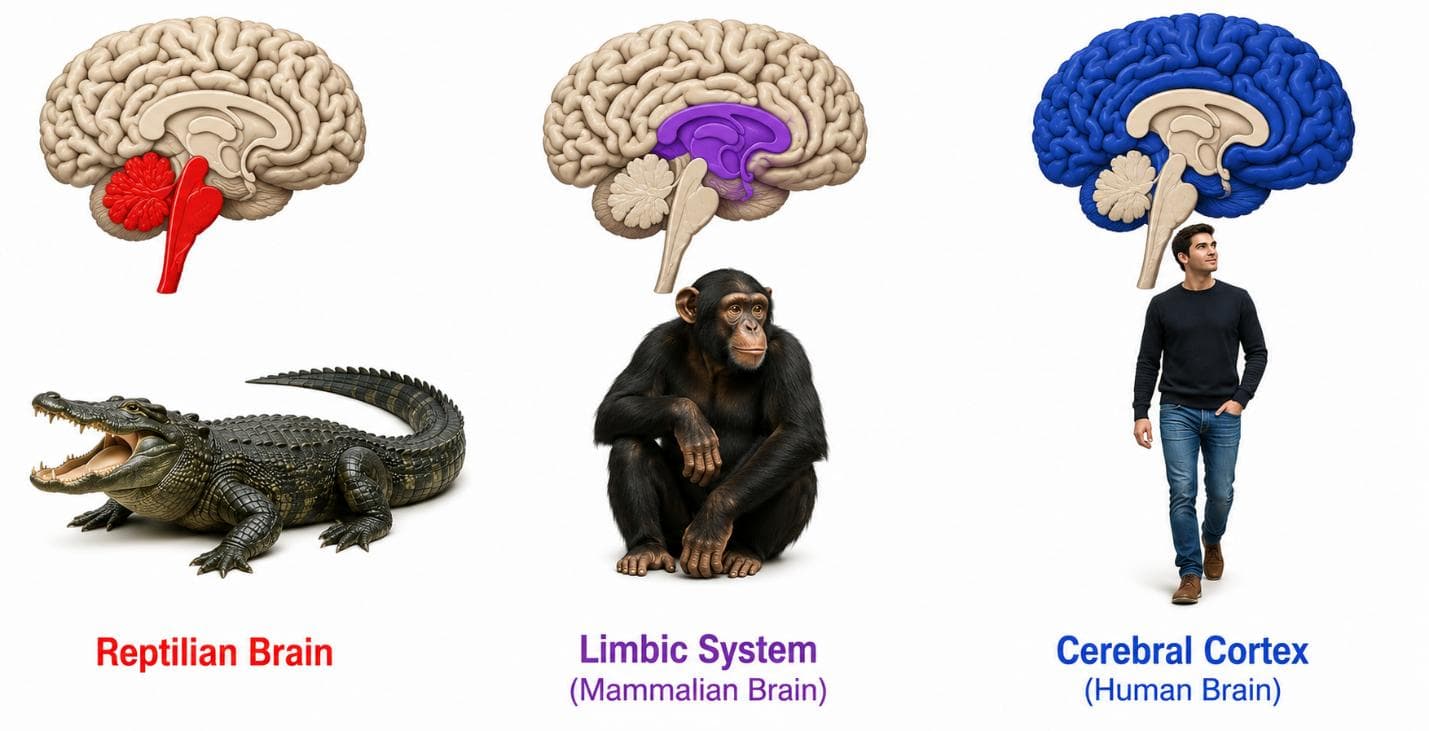
One of the best-known models for understanding how the brain functions is the evolutionary model of the brain. The neuroscientist Paul MacLean proposed this model in the 1960s. MacLean’s model divides our brain into three different brains that emerged and evolved one after another over millions of years, with each new one being added to those that came before it.
The oldest part of our brain is the reptilian brain, which includes the brainstem and cerebellum. This part of the brain began evolving in animals around 400 million years ago. In fact, until roughly 200 to 250 million years ago, the brains of living organisms consisted, at most, of these structures; the higher and more advanced regions had not yet been added.
This part of our brain is responsible for vital functions such as regulating heart rate, blood pressure, breathing, body temperature, balance and movement, sexual arousal, and responses to life-threatening situations, including fighting and fleeing. The operations of this part of the brain are highly precise and reliable, yet largely beyond our control. Or, to put it more accurately, it is this part of the brain that controls us.
When information received through our senses—which, incidentally, reaches this part of the brain first and is analyzed there—indicates that something threatens our life, this part of the brain takes control. Depending on which strategy it considers more appropriate, it commands us to flee or attack, and it rapidly organizes and executes nearly all the movements involved in escape or attack, without requiring any slow and time-consuming calculations by the cerebral cortex.
If we suddenly see a scorpion in front of us, before we can begin wondering whether it is venomous, whether it is real or made of plastic, or whether the situation is serious or merely a prank staged by someone around us, our reptilian brain has already set a rapid response in motion. We might, for example, jump back and move away from the scorpion.
Neither the distance we jump nor the direction in which we move is consciously calculated. There simply is no time for calculation. Using information already stored in the brain about our position and the objects around us, rapid processing determines the direction and route of escape and coordinates the immediate responses that follow.
When our reptilian brain decides to fight, it can override the cerebral cortex, which may previously have decided never, under any circumstances, to use abusive language or engage in physical violence. Those earlier decisions may disappear entirely from our awareness at that moment, and we begin swearing or fighting.
The next part of the brain, located above the brainstem in mammals and thought to be between 150 and 250 million years old, is the limbic system, also known as the mammalian brain. Working together with the brainstem, this part of the brain generates emotions and feelings. Information from our senses enters the brainstem and then the limbic region, where its processing gives rise to emotional responses, feelings, and desires.
The limbic system also plays an important role in storing incoming information in memory. But what is stored is not merely information stripped of meaning. Information acquires meaning within the limbic system according to the sensory and emotional impact it has on us. Whether our behavior produces a pleasurable or painful outcome is stored together with that pleasure or pain, with the help of our limbic brain.
Thus, one of the important functions of the limbic, or mammalian, brain is to give incoming information emotional significance: Is what we see, hear, or feel important or unimportant? Is it good or bad? Beautiful or ugly? Lovable or hateful? Frightening or appealing?
We may see our neighbor every day, and these encounters may have no particular significance for us. But one day we see that neighbor holding a knife, shouting insults at someone, and threatening them. We experience a sense of insecurity and fear. The scene is stored in our brain together with the feeling of insecurity associated with it. From then on, whenever we see that neighbor, the feelings of insecurity and fear are also recalled. The neighbor’s face now has meaning for us; we are no longer neutral, indifferent, or without judgment toward that person.
Our attachment to our children and our sense of connection with others are also associated with the limbic system. The neural circuits involved in reward and pleasure are located within the limbic system as well. We can say that our desires—such as craving a particular food, wanting to have fun with friends, loving others, hating others, or wanting to use drugs—as well as our initial judgments about other people, originate in the limbic system.
Major components of the limbic system include the thalamus, hypothalamus, pituitary gland, amygdala, nucleus accumbens, and ventral tegmental area (VTA).
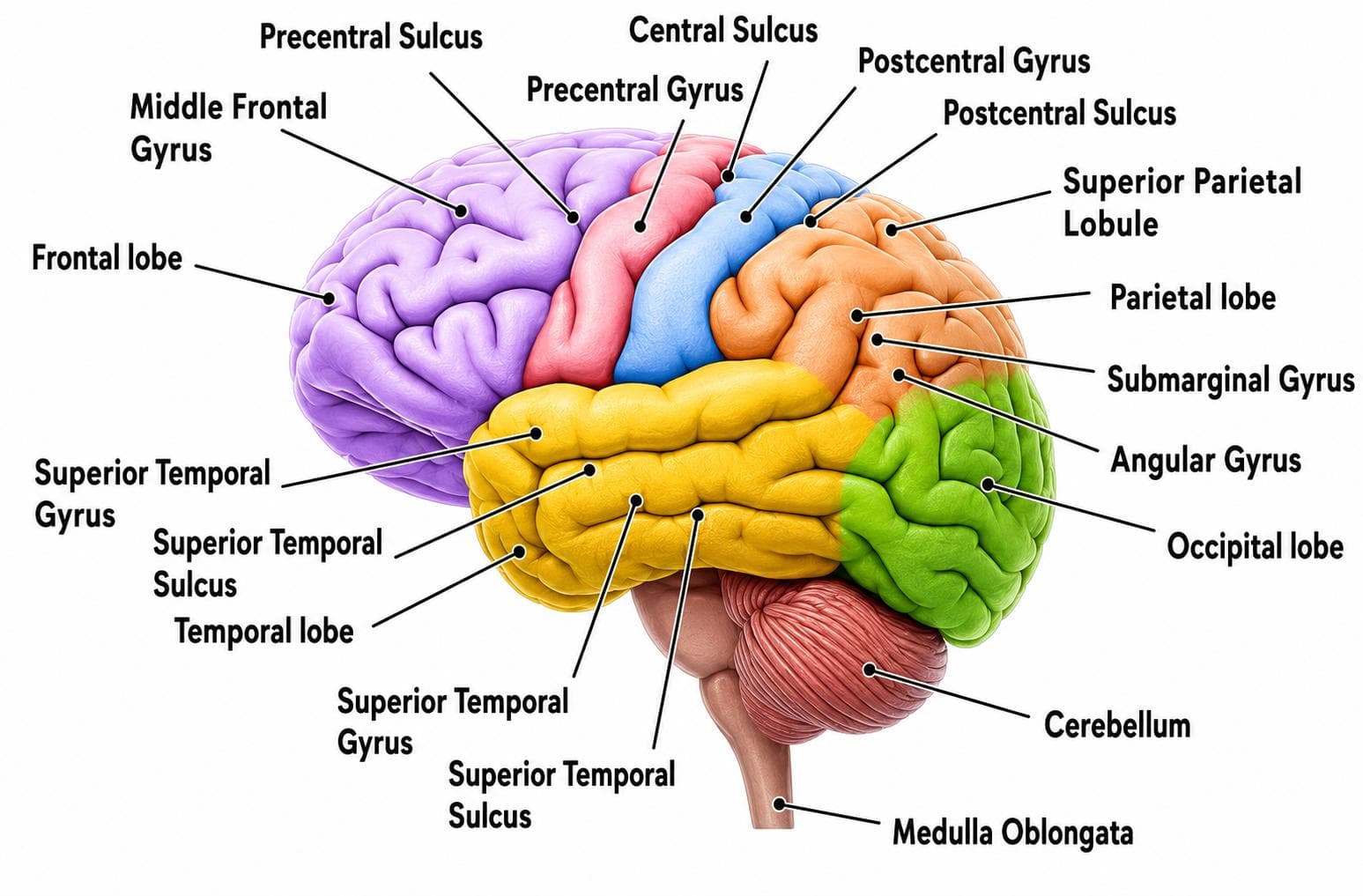
The evolutionarily newer part of our brain is the cerebral cortex, or neocortex, sometimes referred to as the human brain or the neomammalian brain, which is approximately two to three million years old. Different regions of the cerebral cortex perform different functions. These include processing sensory information, constructing spatial maps of the external world, controlling voluntary movement, speaking, thinking, planning and designing, imagining, solving problems, regulating the expression of emotions and feelings, and making conscious decisions.
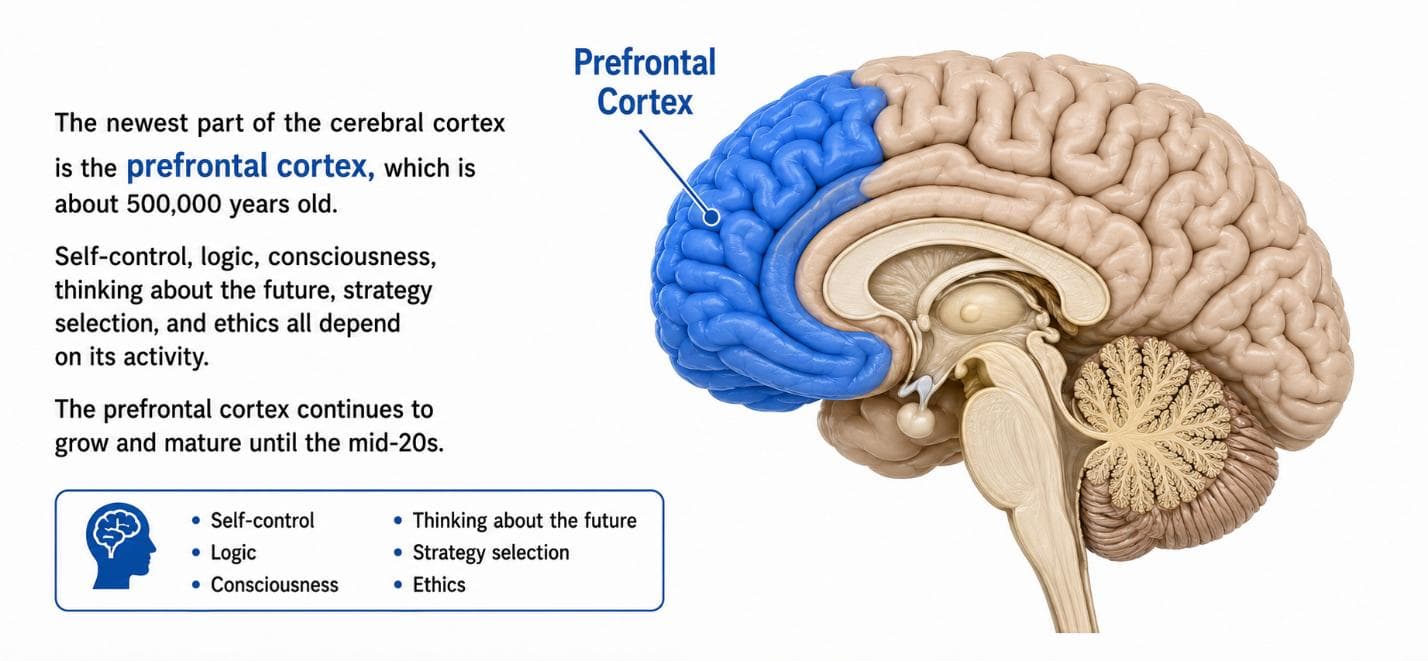
The newest part of the cerebral cortex, in evolutionary terms, is the prefrontal cortex, which is about 500,000 years old. Self-control, logic, consciousness, thinking about the future, strategy selection, and morality depend on its activity. The prefrontal cortex continues to develop and mature into our twenties.
It is important to note that MacLean’s triune brain model, despite its widespread popularity, has been criticized by some contemporary neuroscientists. It is possible that the evolution of the brain did not occur precisely in the form of three completely distinct layers that emerged one after another, as described in this model. In reality, different parts of the brain form a complex and interconnected network, and their functions cannot always be divided into three entirely separate components
.
However, the main idea used in this book—the existence of older neural systems associated with survival, desires, reward, fear, and emotions, along with newer systems that have expanded our abilities for planning, impulse control, and abstract thinking—is consistent with extensive findings in psychology and neuroscience. Nor can we deny, based on our everyday experience, that our vital drives and unconscious emotions can sometimes override our conscious and rational decisions.
Therefore, whether we regard MacLean’s model as an entirely accurate description of the evolutionary history of the brain or as a simplified framework for better understanding brain function, we can use this general pattern of interaction between fundamental desires and emotions and newer cognitive abilities to examine many human behavioral characteristics, including the emergence of sacredness.
The neural circuits of our brain have evolved in such a way that the newer regions largely serve the older regions of the brain and remain under their influence. For example, the prefrontal cortex is influenced by the limbic system more strongly than it influences the limbic system in return. When neural pathways from the limbic system suppress the activity of the prefrontal cortex, resisting the desires and behaviors dictated by the limbic system is no easy task.
Strengthening the prefrontal cortex over the course of our lives can lead to greater self-control and improved life skills. Overall, however, we remain largely under the control of the older parts of our brain, continually using the capacities of our cerebral cortex—thought, language, voluntary bodily movements, the ability to plan, and even logic itself—to fulfill the desires and demands of these older brain regions: the urge to attack or flee, to love, care for our children, eat, take revenge, form friendships, gain acceptance within the group, win, receive rewards, use drugs, and so on.
If you ask whether it is good or bad that our brain works this way, one answer is that, so far, this very mode of functioning has not only enabled the human species to survive and reproduce, but has apparently also placed us in a position of advantage over other animals.
But what does this way of functioning in the human brain have to do with religious faith?