

How to Know Your I.Q. Level without Taking the Test & Brainy Stories by Billy J. Burton - HTML preview
Download the book in PDF, ePub, Kindle for a complete version.
3.The Highly Gifted [HG] (IQ: 145 to 159); The Exceptionally
Gifted [EG] (IQ: 160 to 174) and The Profoundly Gifted [PG] (IQ:
175+): 0.1%. Collectively [VHIQ]
Very High I.Q. people [VHIQ] include the Highly Gifted [HG] presenting an I.Q. score from 145
to 159, the Exceptionally Gifted [EG] with an I.Q. score from 160 to 174 and the Profoundly
Gifted [PG] boasting an I.Q. score above 175 (180 according to certain psychometricians who use a 16-point standard deviation 188).
These people all fall into the gifted category, but their psychology and mental abilities are utterly
different from what is witnessed at the moderately gifted range. With the VHIQs, we are really entering the world of the purely Neuro-atypicals.
At 3 standard deviations (3SD) above the intellectual norm, so roughly above 145 or 150 a
strange phenomenon occurs. People are no longer specialized 180 in a couple of knowledge areas. They display global insights and intuitive356 understanding in all parts of their lives: they are
integrated thinkers138.
The overall emotional and intellectual functioning of Very High I.Q. people [VHIQ] is similar in
many ways. Nevertheless, the higher the I.Q. level is, the greater the brain performance, the stronger the “overexcitabilities”230, the more unusual the behavior, the more prevalent the
cognitive disorders199-343 138 . Apart from an increase in raw brain power, social complications,
and susceptibility to autistic traits193 as one lands further on the right end of the bell curve, these individuals, who show very dissimilar personalities239-314, are nevertheless reasonably
homogeneous in their difficulties, needs, drive, and brain biology compared to the previous
ranges all-together. In a nutshell, PGs have deeper, more intricate thinking and more relational
issues than EGs who also possess stronger abilities to reason and more emotional troubles than HGs.
Their overuse of the brain regions involved in abstraction 191-194 causes VHIQs to be less at ease with words 180 than their MG counterparts. Nonetheless, they are better suited than MGs for
visual and spatial logic180 187 and present stronger skills in patterns discernment and connections.
VHIQs’ reasoning, as well as their sequential, analytic, deductive, and inductive treatment of
information is more effective. Their brain is more potent, it requires less glucose59 to complete the same task, its neurons are faster69, and the connections between both encephalic hemispheres
are more efficient58. When they take traditional I.Q. tests, such as the WAIS for example, unless
stricken with twice-exceptionality121-368, all their subtests homogeneously fall within gifted range
or nearly178.
Understandably, this different brain also translates emotionally and psychologically. To
demonstrate it, I will explore the VHIQs as a whole before addressing the specificities of the
Exceptionally and the Profoundly Gifted Rangers. To sum it up, the higher the range, the
stronger the characteristics234 I’m reviewing in this next chapter.
VHIQ people add up to about only 0.1% of the entire population and about 5% of the gifted ;
their I.Q. score is found above 145.
I will employ situations taken from the lives of members of these ranges: Cameron (HG), Sasha (HG), Dick (HG), Donald (HG), Helen (HG), Zach (HG), Teddy (EG), Tony (EG), Javier (EG), Wilfried (EG), Ezekiel (EG), Walter (PG), Kyle (PG), Joshua (PG) and Nathan (PG).
All the names and situations have been transformed, as usual.
The Extraordinary Mental Abilities of HG, EG and PG Rangers [VHIQs]:
VHIQs are integrated thinkers138 187 with high desire to know who create their own conceptsin a
few or many domains. Integrated thinkers both use analysis369 (from a single concept to many)
and synthesis369 (from many concepts to a single) at the same time: they find patterns in intricate data187, perceiving elaborate connections between what appears as unconnected pieces of
information187. Subsequently, VHIQs create their own matrices to organize data and tend to work
in terms of metaphors, analogies187, and paradoxes.
They resort to holistic180 189 and probabilistic thinking to extrapolate these concepts. Unlike other
ranges, they revel in thinking for the sole pleasure of thinking198, and that, especially in
metaphors 198.
They are endowed with very efficient information processing except when emotionally disturbed. Their interests, thought patterns and humor stack several strata of meaning187;likewise,
their capacity for abstraction191 is tremendous.
Their thinking is deeper, personal, coherent, and generally objective as opposed to MGs who
tend to be both excessive and conformist in their ideas.
Kyle makes a point of remaining as objective as possible whatever the topic.
VHIQ individuals are meta-thinkers180-187, meaning they tend to be mindful of their own mental
processes in order to focus their thinking purposefully: they could be speaking, be attentive to their arguments and their position in space, be analyzing their behavior and the wording used, be
thinking of a counterargument someone could point out, and all the while noticing every possible angles of their opinion as well as a conversation nearby.
Wilfried is aware of the conversation he’s having at the same time as possible counterarguments, and of what the listener may think of his point of view.
An impressive learning aptitude:
Integrated thinking gives VHIQs strong learning capacities but also, prevents them from
recalling distinct pieces 190 189 of knowledge, as, they learn by linking informationto the concepts
they already know.
Thus, they can be oblivious to matters that are of little significance or value to them but may appear paramount to the non-gifted and MGs alike.
Wilfried didn’t remember it was Sunday and drove to work, he noticed something was off when he found out he was the only one in the office .
Kyle believes it doesn’t matter if his theories appear not to be 100% true as long as they work most of the time.
VHIQs are able to understand an explanation before it’s finished, and frequently, heed complex
implications194 187-194-198 or perceive myriads of alternate meaningsin a question, hence their need for great precision. This ingrained functioning increases their perception, as seen from somebody
else’s point of view, all-the-while enhancing nuanced viewpoints.
They show a tendency to be autodidacts 210, able to study better by themselves, at their own pace, than they would with a teacher.
Unlike other ranges VHIQs literally crave knowledge138-180-190 in all their domains of interest.
Wilfried taught himself French as a teenager and quickly surpassed all his classmates and even the teacher.
Sasha learnt a foreign language as a child and speaks it now like a native.
Ezekiel read the greatest authors as a teenager and now wants to understand everything about psychology.
They create their own theories:
One aspect that sets VHIQs apart from people of lower I.Q. levels is the urge to put everything
into a greater theory187 as if every situation, event, or fact existed, as a piece of a jigsaw puzzle, that had to fit together. Aided by their holistic brain functioning180, they are able to see the big
picture more than anyone else. That process involves putting together subjects, events, facts, and
measurements deemed isolated 187.
Whereas Neurotypicals and MGs clarify a situation, or a thought, by expressing details 179 and
particulars, VHIQs present perfectly crafted theories 180-187 to the listener.
Wilfried and Cameron form theories about every interesting topic which they test against reality.
Ezekiel almost always knows why a person behaves in a particular way because he is able to see the link between all the different psychological knowledge areas.
Unlike everybody else, when VHIQs witness a detail that doesn't fit their theory they amend their worldviews 189 to reflect that new information. Consequently, they keep improving and
honing these models all their lives. Since they are able to hold different possible explanations for
a single occurrence in their intricate mind, they simply switch to a more plausible theory to fit
the outcome and toss aside the incorrect interpretation.
Cameron, who is really interested in astrophysics, revamped his whole theory, of the beginning of the universe, when his friend remarked that Dark Energy was pushing galaxies away faster.
VHIQs have a deep-seated need to understand329 nearly everything. Their brains must make
sense of each element of importance. They are in the habit of noticing slights differences or similarities between people, facts, and events while obsessively wondering about the underlying
reasons. That’s how they come up with new breakthroughs.
As children, their gaze looks more inquisitive114-175 180 , they notice their surroundings moreand
make their family ill at ease with their questions or smart comments. They never use baby talk175-
176-207 180-188 , often talking in full sentences at an early age (at 8 months old on average for PGs).
They read earlier than other children188 and some have been known to teach themselves to how read195 (mostly EGs and PGs).
Wilfried, at 3 years old, was told by an adult that a “moo-moo” was in a meadow, a term he didn’t use, he came home thinking the adult had meant a “mammoth”, which word he was familiar with.
At age 4, his parents found out that Teddy had taught himself how to read with his brother’s books.
The Definite Independence of Mind of HG, EG and PG Rangers [VHIQs]:
At these ranges, one exhibits a weaker tendency to blindly repeat facts189, studies, theories …
established by others. Unwilling leaders in their own disciplines of passion, VHIQ people like to challenge commonly accepted beliefs187 even if confronted to the wrath of those comfortable in
the consensus. 194 At the same time, there’s a decreased tendency to revise a questioninto a form
one feels more comfortable answering or more knowledgeable about, thus, leading to more precise and controversial answers.
VHIQs frequently lean libertarian200: they are ready to protect freedom in every shape or form, as
well as in politics, in this way, going against the pure left-wing/right-wing dichotomy.
Sometimes, against all expectations, they choose not to go into intellectual professions 204-206, or elect not to embrace a specific career because, such a choice, would curb their thirst for
knowledge by restraining the time allocated to writing, learning, studying, thinking, reading etc.
Cameron, Sasha and Wilfried have never chosen a high-status career, they hold regular jobs while they study and create on the side.
In addition, VHIQs won't try to fit in204, as would most people, in the hopes of making friends,
but will look for the friends they can learn or gather experience from.
Wilfried tends to choose friends who speak a language he doesn’t speak well, so as to continuously learn from his pals during the course of a conversation.
Still, HGs, unlike EGs and PGs, attempt to adjust to the needs of their family, friends, and co-
workers. In spite of their propensity to think for themselves, they are still very influenced by the norms of society328 as a whole, plus, their values remain closer to those of the general
population.
Even if he tends to think for himself, Cameron still tries to be the person others want him to be.
Donald feels he should follow his family’s inkling to get married and have kids.
The Elevated Intuition Skills of HG, EG and PG Rangers [VHIQs]:
With their finely tuned senses, VHIQs are able to detect tiny details others don’t notice and aggregate them into a theory 320 of what the future might hold. They often get the big picture
right, if not most details.
Dick intuitively knows what’s going to appeal to the customers when he develops his software.
In addition, these individuals are introspective186, seeing themselves as they truly are, with their
flaws and qualities, their strengths, and shortcomings, besides, they frequently reflect on how to improve themselves (particularly for EGs and PGs).
Donald and Ezekiel are able to guess what the future has in store for them just by analyzing the present.
The Elevated Empathy of HG, EG and PG Rangers [VHIQs]:
VHIQs display high capacity for empathy180 185-191 . They exploit some type of self-projection into
somebody else’s psyche to know how that person is feeling, but also, into objects or situations.
This is how VHIQs artists embody their art, so as to produce a more profound creation (for example a writer who lives through the eyes of her characters or a chef who can already imagine
the taste of the dish he is creating).
Cameron and Wilfried, authors, imagine themselves in the shoes of their characters to give them a more lifelike existence.
Wilfried embodies every note he plays, deeply sensing the pitch, the duration, and the harmonies he creates.
These individuals are more tolerant, more compassionate, more interested in cooperation 186 than
the non-gifted and MGs. Unlike the latter, they exhibit more self-esteem180 since they
customarily perceive they understand and know a great deal, therefore, they don’t feel the need to prove their level of intelligence to anyone.
Kyle and Walter are not afraid to acknowledge they were wrong about an issue.
Thanks to heightened empathy180, VHIQs are also better equipped to deeply perceive who others are210, easily identifying intelligence, talent, qualities, and flaws.
Wilfried, Ezekiel, Kyle, Walter, and Javier can intuitively tell people’s intelligence levels. They also know who’s being honest and who’s lying and how people are feeling.
The Intense “Overexcitabilities” and Sensitivity of the HGs, EGs and PGs [VHIQs]:
The term that defines VHIQs’ psychology best is intensity; “overexcitabilities”180-198 (heightened
mental, physical, and emotional tension) are omnipresent in their lives.
Definitely, these people ponder everything very passionately and their emotions run high causing their nervous system to remain on alert61-190. Their intensity, focus, rigorousness, and social
difficulties resemble autistic behaviors208-209 nonetheless these conducts are rarely pervasive
enough to warrant a professional diagnosis193 of autism. To alleviate some of this intensity VHIQs may resort to addictive behaviors180.
Tony, Walter, and Kyle show many signs of ADHD and autism. Wilfried has a few autistic traits.
For many individuals beyond the VHIQ threshold, the senses are inclined to merge331-373, it’s a phenomenon also known as synesthesia192: seeing sounds or numbers in color, feeling their texture etc.… it’s the consequence of a brain endowed with a wider and more elaborate network.
The higher the I.Q. score, the greater the likelihood of these odd, possibly incapacitating, sensations370-371.
Because of these overwhelming “overexcitabilities” certain EGs and PGs prefer to hold low-
stress, low-responsibility positions 180-198 so as to avoid debilitating anxiety in their lives.
Teddy cleans the offices of a law-firm for a living because it gives him emotional stability and time to think.
Cameron holds a menial office job by day and writes during his time off.
Sasha has never wanted to have a real career so he can keep doing what he likes on the side.
VHIQs show more emotional and mental “overexcitabilities”234 (thinking in circle or over-
analyzing) than MGs, hence, a greater disposition to existential depression 180-202. At the same time, they show superior thirst for knowledge190, spending hours on end studying a topic they
consider fascinating.
All gifted people I have ever met show, at least, covert signs of mild depression304-306-310; these usually increase with I.Q. scores.
Bothered by “overexcitabilities” to the point of appearing dumb:
The sensitive nervous system164-306 of VHIQs can easily be overrun by too much information,
creating an overflow of neuronal messages overwhelming the brain 228. Under these circumstances, these individuals have trouble functioning normally. Not being able to focus their
attention properly180, they may appear foolish or half-witted to the uninformed observer. This
condition mimics ADHD symptoms 193-203 in many ways.
It’s not unusual for VHIQs to have a hard time being detected as gifted because of all the
comorbidities 199 (mood and anxiety disorders, ADHD, ASD…) associated with high giftedness.
These people show a higher propensity to be noticed for their negative traits than for their greater
intelligence.
Tony often enters a room without remembering what he came to do in there; he also mixes up words or garbles them, too often sounding like a clueless person.
Donald suddenly becomes overly quiet for no obvious reasons and Zach bangs onto furniture when emotionally overwhelmed.
Crippling anxiety and high sensitivity:
VHIQs demonstrate an important level of anxiety 180 and need for control to the point of, on
occasion, craving to do a task that stresses them as soon as possible, so as to put it behind them, and feel some sort of emotional relief. It is the opposite of procrastination.
Tony is in the habit of blurting out what he needs to say to a person in the first minutes he sees them in order to get it over with.
Moreover, Very High IQ folks tend to be sensitive to violence and negative feelings towards
themselves and others, causing them to feel terrible were they to witness such an incident.
Tony witnessed a verbal clash between two employees at a local supermarket; he felt the negative emotions of these people so deeply that he felt overwhelmed.
Sasha feels terrible when he notices he has hurt somebody’s feelings unpredictably.
VHIQs have a rational approach to life, shunning away from strong emotions 180 that could harm them. Even when that objective is met, emotional peace still seems unattainable. Somatization
runs high 180 180 among this population. This elevated level of anxietytranslates into muscle-
spams, colon troubles, memory loss, attentional difficulties even panic-attacks.
Tony keeps forgetting the words he’d like to use in conversations; his co-workers think he’s not very smart.
Donald shows recurring stomach issues and Helen has skin allergies.
Joshua has ADHD as well as other cognitive issues.
VHIQs are not above addictions, but theirs are not linked, like MGs, to a need for limit testing,
but frequently, to a deep emotions avoidance strategy180.
Joshua is addicted to pain killers.
Wilfried needs a lot of sugar every day to feel grounded.
Cameron loses himself in role-playing videogames for entire weekends.
Afraid of their thoughts and emotions because of overpowering mental processes 164-306, they
subconsciously strive to balance it all with perfectionism187 all the while abhorring repetitive tasks190.
Zach takes an awful lot of time to do his assignments because he checks everything several times.
A deeper connection with themselves and the universe:
VHIQs have a good sense of self-preservation; they are frequently able to sense what’s
happening inside their body180, notice if something's wrong or if a particular food is good or bad
for them. Some of them even notice if a particular type of food, they ingested, is being stored as fat or if they are losing weight. Likewise, they are more mindful of alcohol or caffeine190
wreaking havoc to their nervous system by noticing their blood pressure rising even just a little.
Certain VHIQs are extremely sensitive to substances such as nicotine, caffeine, alcohol which impact the nervous system.
Wilfried and Walter get really anxious and cannot sleep well for several days when they absorb even a tiny amount of caffeine.
For fear of emotional and physical consequences, Sasha, Dick, Donald, Helen, Zach, Wilfried and Walter never drink alcohol.
Consequently, they unconsciously often take better care of their health than the average person
or even MGs.
Their relation to the outside world is similarly intense. They are very aware of subtle changes 320
in the atmosphere of a room or when someone’s mental state is modified due to anguish or
illness. Some of them sense the energy190-191 of animals and plants. They experience the life force of these beings and are capable of emotionally connecting 180 to people so as to understand who
that person is at a deeper level.
They are sometimes prone to a certain level of precognition180-190 of main events or at least future
emotion pertaining to those events.
Cameron can feel other people’s pain when he touches them physically.
Wilfried can sense people’s energy and know exactly who they really are deep down.
High Morality in the HG, EG and PG Ranges:
Omnipresent morality and honesty:
Something really strange happens when you reach the higher realms of intelligence: integrity and morality become more prevalent191. People find it harder to be dishonest, hurt someone or simply
tell a white lie. Some VHIQs become physically ill with guilt and dread when they notice they have wronged somebody else.
They are profoundly conscious of the collective interest. In addition, they are uncomfortable
being less than straightforward with others. They feel they owe their peers an important level of
honesty322 and trustworthiness. It is presumably why, by spluttering what everyone else only dares think, they regularly make the average person uncomfortable.
Unless they find a noble reason behind an unlawful behavior, they will usually remain law-
abiding and respectful191.
Teddy and Tony hate being dishonest; they tell people what they think of them too easily and end up hurting their feelings.
Because speaking his mind has always stirred up trouble, to avoid strained relationships, Wilfried bites his tongue when what he thinks would be disparaging to his co-workers.
Donald and Cameron often get in trouble for being too candid.
Helen avoids dishonest people.
VHIQs embody moral integrity and personal responsibility; these people resist temptation
more211 than members of the previous ranges. They feel their purpose is to make things, easier,
healthier, and better for everyone. Unless they are too harshly treated, they tend to be altruistic
and considerate individuals186 (especially at the EG and PG ranges).
Cameron, Sasha, Dick, Wilfried, Walter, Joshua and Kyle always try to do what’s best for everyone, even if it means more trouble or more work for them.
The truth is stronger than their pride:
Critical thinking180 means being open to new facts, being able to distance oneself from one’s opinions, being ready to reason objectively. This process is more likely to be initiated by VHIQs.
While they are liable to have their feelings hurt by others, at the same time, these people are able to put their ego aside180 in their quest for the truth when exchanging with someone who respect their views and knowledge. It means they are able put their heads together to look for a better
way of understanding the world, while respectfully listening to everybody's argument, changing their minds and sometimes worldviews187-189-190 when sufficient facts have been given.
Dick, Donald, and Zach would rather acknowledge that they were wrong than avoid an interesting and eye-opening conversation.
Wilfried doesn’t mind passing for a nitwit when speaking a foreign language, he wants to learn.
Spiritual beings:
Because of their strong principles and inquisitiveness most VHIQs are spiritual 186 but infrequently religious, on the other hand. If so, they generally view scriptures and rites in a
philosophical and universal manner.
Many are into new age philosophies. Many are theists. All look for answers.
Numerous VHIQs are moved by a higher calling to improve the world, striving to save humanity with arts, science, mysticism etc.
Cameron strives to improve the world with his creations.
Dick endeavors to help the elderly with his software.
Zach wants to bring knowledge to people with his articles on history.
Teddy and Walter want people to know more about giftedness.
Ezekiel wants to make everybody think more deeply about world issues.
Kyle uses spirituality to change the world through his transcendental meditation classes.
The Loneliness of the HG, EG, and PG Rangers [VHIQs]:
VHIQs are lonely outsiders; they are virtually never in synch with anyone. The main reason is known as the threshold of understandability81. Indeed, above a certain level, intelligence is
unfathomable to most people. That threshold is roughly at 140: right under the VHIQ mark.
Above that, almost nobody is able to notice any increase in intelligence 94. Even worse, when
someone's I.Q. level is way above 140 that person’s thinking appears so alien in his or her functioning, that his or her perceived intelligence decreases in the eye of an observer.
The reason is simple: no one is equipped to fully comprehend another person if the I.Q. gap,
between the two, is greater than 30 points (2SDs) 81. As a result, a person with a score of 100 is capable of grasping another with a score between 70 and 130 but can never apprehend a VHIQ's
thinking process because it feels crazy or stupid to an average person.
VHIQs recurrently sound dumb to people of average intelligence; they must truly achieve an amazing feat to be regarded as the intelligent persons they truly are205.
So, while Neurotypicals (score under 130) are understood by 96% of humanity, an HG can only
be fathomed by someone at least in the Superior Range (16%). Similarly, an EG can only
connect with 2% of the population (people with an I.Q. score above 130), a PG with 0.1% (people above 145), it is no wonder they feel lonely.
VHIQs are often engrossed 319 308 in a task or busy daydreaming; they are not always ready to
communicate. During a conversation they may come off as inquisitively curious (if interested) or completely bored190.
Their speech is precise198 372 , intricate, sometimes circumvoluted; besides, due to emotional
difficulties speech impediments may be present. They try conveying all the nuances they feel, never talking in absolutes, always keeping in mind they might not be 100% right.
Many had imaginary friends201 190 and regularly think up parts of their livesto the point of having
make-believe conversations with thinkers or interesting characters.
Zach, Wilfried, Ezekiel and Walter often imagine the interesting conversations they could have had with famous scientists, or creators.
VHIQs don’t necessarily talk a lot, except with I.Q. peers as they delight in exchanging deep thoughts, hard science concepts, unusual opinions198 187 they harbor, holistic theoriesthey came
up with.
In addition to their natural tendencies to isolation, satisfying their knowledge craving 138-180-190
may take up a good part of their free time to the detriment of socialization.
Wilfried spends a good chunk of his time learning science and foreign languages.
To add insult to injury, these individuals tend to lack self-confidence180, oftentimes to the point
of being push-overs. Subsequently, they avoid bullies, everybody who make them feel insecure or pull them down.
Helen avoids people she feels unconformable with. Sadly, that's most people.
Despite looking balanced and often being better accepted than MGs 180-311-312-334, who display sometimes-antagonistic tempers 179-333-334, VHIQs like to keep to themselves a lot for emotional
safety204. They get others talking so they don’t have to divulge too much about themselves, thus
avoiding judgement.
Cameron, Sasha, Dick, Donald, Tony, Wilfried and Walter resort to humor a lot to keep people at bay and avoid feeling uncomfortable.
There are typically 3 strategies used by VHIQs to avoid being rejected and socially isolated
according to Grady Towers81:
1- Getting several PhDs and becoming a renowned scientist, psychologist, or historian etc.
2- Leaving school without graduating and not following the rules of society.
3- Holding a position devoid of responsibility and creating, learning, and researching during one's free time.
Dick, Donald, Helen, Kyle, Zach, and Ezekiel have chosen path #1.
Cameron chose path #2 but has started a writing career now.
Sasha chose path #2 as well but went to live abroad.
Teddy, Tony, Wilfried, and Walter have chosen path #3.
The Otherworldly Creativity of HG, EG and PG Rangers [VHIQs]:
Purposeful creator:
The need to create is something VHIQs have in common with MGs. But whereas MGs are
frequently artistic, VHIQs’ creativity is more ubiquitous 190 and can also be witnessed outside of
the arts. These folks create highly original academic work and spot humorous situations everywhere.
They are tireless workers and learners197-198 in the fields they hold dear and go to great length to
reach their goals. Rarely competitive or interested in praise180-189-206, they solely aim at
improving themselves and the world 180-198 around them.
They strive to leave their mark onto this world one way or another. They relish serving others,
not only by satisfying material necessities, but also, philosophical, and spiritual ones through,
generally unsolicited, advice. They try correcting what they believe is wrong with the world. To do so, they detect the root cause198 of what's actually ailing the globe in a philosophical and
scientific way (mostly PGs).
Dick creates digitally automated processes to help the elderly cope with the modern world.
Helen has written a book so as to help the Gifted understand themselves better.
Zach and Wilfried strive to help everyone see the big picture in every issue.
Ezekiel has authored many philosophical books in the hope of helping humanity.
Walter loves to teach people about learning disorders and their consequences.
They embody their creation:
The specificity of VHIQs’ creativity rests on their capacity to get immersed in their creation 185-
191, to the point of seeing through the eyes of their characters, physically sensing the curvature of
their sculpture, or breathing through their music in mystifying ways. When they feel the urge to
bring something to life, no one can get in the way of that resolve, not even themselves.
Simultaneously, they have no idea how interesting or mundane their creations look to other
people who are only able to realize parts of what the artist felt during the creation process.
Cameron lives through the eyes of his main character when he writes.
Helen embodies her music when she plays piano.
Ezekiel gets engrossed in his writing as soon as he gets a new idea.
Unusual humor:
VHIQs have a unI.Q.ue* sense of humor based on personal reflections, observations, and tiny
humorous details nobody else notices. They are fond of incongruous puns, double entendres, and
intricate brainy jokes196 so as to surprise or get the listener to think. That humor often serves as a
safeguard against uncomfortable social intercourse.
Cameron and Sasha notice hilarious matters everywhere, all day long, and make witty jokes about them.
Dick and Donald’s quip are always unpredictable and creative.
Tony always talks to people in an ironic, tongue-in-cheek kind of way.
*Humor
Safe Adventurousness in the HG, EG and PG Ranges:
VHIQs are as adventurous 325 as MGs, even more if you consider intellectual endeavors, but
unlike them, commonly avoid scary or dangerous ventures180-190 thanks to acute self-preservation
and anxious predispositions.
A need for new experiences:
These people feel they are wasting their time if they are not improving themselves180 by
studying, experiencing, creating, or thinking. Unlike people of lower ranges, who enjoy leisure time tremendously, VHIQs need to be reading an interesting book or to be learning a foreign
language, while at the beach for example, in order to keep from being under the impression of
wasting their time and to keep from being bored 180.
Certain VHIQs even decide to interact with specific persons as an opportunity to learn their
language, their culture, or a craft they know. Superficial reasons for dating someone, such as
physical appearance, are not very much valued321 even by VHIQ teens; personality, like-
mindedness, kindness, understanding are more sought after.
Much like MGs, VHIQs love new experiences. But unlike MGs, instead of being just
pleasurable, these projects must expand their knowledge and further their understanding of the
world.
Cameron looks for any new adventure as long as his “overexcitabilities”” don’t stress him out too much.
Donald and Wilfried travel the Globe to quench their thirst for knowledge and experience.
Wise children:
Because of internal conflicts, VHIQs mature in a more asynchronous way but ultimately more
deeply210-213 190 than previous ranges all the while retaining a childlike wonderthroughout their
lives. They feel no shortage of awe when presented with art or the beauty of nature, very often beholding wonders others barely notice.
They are childlike even in the way they take in new information. VHIQs never try fitting new
information in their worldview, but rather continuously adapt their worldview 187-189-190 to added information as kids do335.
Donald, Dick, Helen and Wilfried are frequently in awe of nature, architecture, animals etc.
The Emotionally based Memory Imprints of the HG, EG and PG Rangers [VHIQs]:
VHIQs display exceptionally good memory skills 308 over a large spectrum of topics, especially when coupled with strong emotions. Their memory is frequently less detail-oriented than that of
MGs190; being more pattern-oriented, they recall whole concepts more easily than specifics.
Because they are regularly more anxious than MGs234, VHIQs' recollection process may be stuck for a while, then suddenly the appropriate memory appears out of nowhere when the person is no
longer focused on what he or she was looking for.
Donald and Wilfried, who speak many foreign languages, frequently have words on the tip of their tongues; in addition, they sometimes forget specific names or titles for a while.
The Different Cultural Approach of HG, EG and PG Rangers [VHIQs]:
VHIQs have hugely different interests, priorities, and preferences299-317-321-324 from Neurotypicals255 191 and MGs. They show extensive knowledge in many fieldsbut not necessarily
in mundane matters such as popular culture, which they may even reject. As learning feels like
leisure to them, many VHIQs are consequently well versed in highbrow fields 315: science very
often, psychology, philosophy, foreign languages... They are also quite fond of new frontier subjects: String Theory, Quantum Gravity Loops …
Some of them, especially EGs and PGs, to a greater extent, may even be polymaths231 (extremely
well-educated across multiple fields).
Zach is extremely learned in both literature and world history but knows nothing about the latest blockbusters or famous artists.
Ezekiel is extremely well-educated in philosophy, literature, psychology, and ancient history, but refuses to watch TV.
Javier does math at the highest level, but he is also a great amateur pianist.
Wilfried and Donald are well-read in astrophysics and speak multiple languages.
The Far-reaching Life Goals of HG, EG and PG Rangers [VHIQs]:
VHIQs’ goals are not only numerous but also challenging and time consuming. If they were to
tell Neurotypicals about those objectives, the latter would think them inaccessible, even insane.
Their ambitions are rarely ordinary; they are supposed to expand collective knowledge and to serve a greater purpose. These individuals strive to elevate the world180-333-334 of science, arts,
philosophy etc… to improve human, fauna, or flora’s conditions on earth.
Cameron wants to share all of the stories he has in mind.
Dick wishes to help the elderly.
Donald and Kyle are truth seekers.
Helen, Walter, Joshua, and Teddy want to help the Gifted.
Wilfried feels pushed to revolutionize the world of physics.
Ezekiel and Zach want to make their countrymen overcome profound civilizational issues.
Javier wants to help the world become more spiritual.
If you belong in one of the HG, EG or PG ranges (VHIQ) most of what’s below reflects who you are: (Pay close attention to the wording before answering yes or no, then count the number of times you answered yes)
1-You have a holistic understanding of the world.
2-You notice patterns and links in seemingly unrelated areas.
3-You were able to talk, read or stand much earlier than the average toddler.
4-You make observations that are totally logical but everybody else thinks they are totally irrelevant or idiotic.
5-You have strong intuition as to what is right or wrong as well as true or false.
6-You have at least one condition such as dyslexia, dyscalculia, dyspraxia, OCDs, ADHD, sleep disorders, ASD traits.
7-You have, at least, a unique “spiritual” ability (healer, precog, empath, lucid dreamer, psychic...).
8-Your mental and emotional “overexcitabilities” are high: your mind is often in alert mode.
9-Your humor is multifaceted, elaborate, and multilayered.
10-You are slightly depressed with no energy except when doing something interesting.
11-You usually feel lonely in groups and have few close friends.
12-You are an avid reader and/or crave knowledge and understanding.
13-You can sense other people’s energy, feelings and harbor a good idea of who they are deep down.
14-You are easily moved to tears by almost nothing (often related to art, kindness, beauty…).
15-You are emotionally hurt by negativity, ugliness, dishonesty, lack of ethics….
16-You are self-taught in many high-brow fields: autodidact.
17-You understand a lot of what’s going on under appearances.
18-You keep wondering about deep existential questions and would like to leave your imprint on the world.
19-You are easily bored with everyday life.
20-Alcohol, caffeine, nicotine, or some types of medicine have a stronger effect on you than on everybody else.
Specifications for The Exceptionally [EG] (IQ: 160 to 174) and Profoundly
Gifted [PG] (IQ: Above 175)
EGs and PGs are extreme VHIQs with greater intensity in everything 234. As, according to
statistics, HGs amount to a much greater percentage of VHIQs, I wanted to provide the reader with a few specifics regarding EGs and PGs.
First of all, both EGs and PGs do not diverge as much in “g” than in non 214-“g” skills, just like
you can’t compare the intelligence of Einstein with those of Dostoyevsky or Chopin. As a consequence, my attempt at a broad characterization of EGs and PGs’ personalities is
challenging as the individuals, in these ranges, who are often experts in particular fields,
drastically differ from each other.
Startlingly, many psychologists215 are in the habit of merging these two levels together and
calling everybody “PG”. This is, in my opinion, linked to sheer scarcity of these individuals and
because EGs commonly exhibit, at least, one specific skill at, or near PG level 215. But this
approach ignores certain dissimilarities I will address further down.
The Intellectual Idiosyncrasies of EGs and PGs :
EGs and PGs grasp complex material intuitively, in a global way198. In everything, they see
patterns 301-373, interconnections, causes and consequences. They are particularly interested in immutable and holistic patterns194, such as those seen in the universe, in physics, or in
mathematics. From that, they can begin to infer new concepts or theories. In that framework,
many details are added later190-198, when specifics are addressed. PGs, particularly, are aware of global theories and quite a lot of details at the same time198-345-346, focusing on both global and
local concepts.
Compared to HGs, EGs and PGs show more divergent thought processes 215 with larger logical
step skipping198-215 198 as well as broader and more numerous intuitive connectionsbetween areas of interest. They grasp concepts much more deeply 198.
They use more personal structures187-194-198-215 103 than HGs; they go beyond their integrated
thinking process by merging many of their own models198 to create very complex concepts. This invariably leads to very unusual and personal opinions 198.
In addition, EGs and PGs show high flexibility of opinions, enough to be willing to change their
mind189-194 if a good enough piece of information, from a trusted source, comes to their attention.
They are able to simultaneously keep in mind many possible explanations 194-198, for each event or development, in this way amplifying mental plasticity.
Contrary to HGs who, on the whole, enjoy leisure time, EGs and PGs feel most fulfilled when learning, discovering, accomplishing or experiencing 227. Free time must always be put to
beneficial use for EGs and PGs to feel appeased and complete, otherwise, doubts and depression
may set in.
A very early onset of reading differentiates MGs/HGs, who generally start at the same age as everybody else, and EGs/PGs who begin deciphering words at an age comprised between 2 and
4-5 years old212 212 . Besides, EGs and PGs start speaking on average at 8 months old.
The Crippling “Overexcitabilities” of EGs and PGs:
Being extremely prone to “overexcitabilities” 108-109, quite a few EGs and PGs choose to avoid stress180-198 and pressure at any cost by avoiding high level careers and even, at times, marriage,
and children. Such a choice gives them enough free time to satisfy their thirst for knowledge 315,
to create, to read, to write, to think, to invent etc.…
Such pronounced “overexcitabilities”, which take a toll on the nervous system 228, may actually
simulate behaviors associated with certain disorders193. Consequently, EGs and PGs are more commonly diagnosed with a couple of cognitive disorders such as ADHD, Autism Spectrum
Disorder, OCDs, dyscalculia, dyspraxia, dyslexia 193… or exhibit many traits associated with
those disorders.
When you consider these higher ranges, the likelihood of running into autistic traits is also
heightened193. Not that these people are necessarily professionally diagnosed as autistic, but they
share many traits with people suffering from what was known as the Asperger syndrome or high-
functioning autism216, namely: extraordinary focus, lack of interest in social conventions, great attention to details etc.
EGs and PGs may also exhibit other impairments such as: prosopagnosia221 (trouble
remembering faces), or difficulty recalling verbal instructions…
Since EGs and PGs feel everything extremely deeply 218 in an empathetic way, they generally
develop strong unwavering integrity and morals198 (it does not appear necessarily as true of
people on the autism spectrum who classically exhibit low emotional intelligence229, but this condition is complex and misunderstood).
At the same time, EG and PG's behavior and speech patterns may appear contrived 180 or lacking
in authenticity to a keen eye. It stems from their lack of ease in social situations and their need to
protect their feelings because of general heightened sensitivity218.
The Challenging Relationships of the EG and PG Rangers:
EGs and PGs’ wisdom, empathy and intuition are extremely elevated 198. They aim to guide
others, using suggestions in the hope of making them question their dubious decisions, often to no avail.
When analyzing most people’s behaviors, they unfortunately notice 318 resistance to change,
social façades, ignorance, overused slivers of knowledge, faulty science, blind gregarious
ideology, false hopes, intolerance, inflated egos…
Unlike MGs and sometimes HGs, because of their personal viewpoints and a natural loathing of
hypocrisy, EGs and PGs don't feel the need to be politically correct198-218 since, to them, the truth matters more than somebody’s ego.
This discrepancy between their behavior and those of most people tends to increase their feelings
of not belonging 204-313. Most times, they cannot speak their minds or confide in someone else
without being mocked or considered odd. As a result, they resort to wearing a social mask374-375 so as to be able to endure some sort of human interaction even if it feels like a lie 218 and an
artificial method of communication.
To circumvent these issues, as children, they often choose to interact with knowledgeable
adults218 218 , with whom they feel on an equal intellectual footing, as well as imaginary friends.
Besides, during a conversation, certain words may cause several alternate meanings 187-198 to
come to their minds. As a result, they strive to utter carefully chosen words from their large
vocabulary 198 187-198 and, at the same time, always need extreme precisionto be able to understand
what the other person is saying. This peculiarity intensifies their feelings of not being on the same page with everyone else and often triggers annoyed reactions from the persons they are
talking to.
Consequently, countless EGs and PGs systematically shun away from social interactions 212; they
suffer from a lack of understanding, linked to the communication gap 81, but also from high sensitivity to rejection, harsh comments, judgments, lack of ethics etc...
Inarguably, a sizable portion of EGs and PGs are loners198, bothered and hurt by many, without
the advantages Neurotypicals or MGs get from their interactions: a connection.
That feeling of not being able to count on anyone, because of a lack of understanding, along with
their strong lucidity210 about the limited potential of their loved ones, further amplify their
sensation of incompleteness.
In addition, EGs and PGs being exceedingly cerebral, they favor deep reflection before they act, think of consequences, plan the future. They are less influenced by egocentric and narcissistic
passions such as money, a beautiful car, a hot fiancée. They definitely are more personal-growth
oriented 180-191.
Often in need of social isolation to be able to be themselves without being judged, many men in
those ranges hardly date198-219-220 323 . At the same time, their highly independent female
counterparts are likely to avoid having children altogether224. To many EGs and PGs, sex in itself, appears uninteresting222-223, as they look for a very cerebral and emotionally authentic
connection while mainly concentrating on their intellectual priorities222-223.
They long for deeper bonds with the rest of humanity, relationships devoid of nastiness,
selfishness, and greed, but rather, full of honesty, warmth, and respect. In a nutshell, they long for unconditional love in a deep spiritual manner341.
3.1 EG (IQ:160-174) Teddy, Tony, Ezekiel, Wilfried, Javier.
The EG range members show all of the VHIQ tendencies virtually at a maximum234. They
resemble Profoundly Gifted individuals in many ways, sometimes to the point of being lumped together into a single category by countless psychologists and researchers 335.
Yet, a few dissimilarities exist between these ranges namely as concerns “overexcitabilities” 230
and conceptual stance magnitude239.
The Exceptionally Gifted Rangers are Limited Polymaths:
At the EG range threshold (I.Q.160), one starts displaying such intellectual curiosity that one
usually no longer specializes in an academic discipline, but rather, endeavors to master several
fields of study315 231 . These individuals grow into, what is known as, polymaths: being well-
versed or even able to master several domains that may appear totally disconnected, such as, history and quantum physics for example.
On the other hand, these people's tendency to be polymaths is more limited than at PG level215
where knowledge is all-encompassing and deeper.
Teddy masters both coding and novel writing.
Ezekiel is a history and literature specialist.
Wilfried masters several foreign languages and knows his way around astrophysics along with music composition.
EGs spend most of their days learning, pondering, inferring 227, their minds are never at rest.
Since, if they stop, they get bored and depressed, they devote a great deal of time to accumulating knowledge and experience. However, rote-learning isn’t their strong suit; they’d
rather invent new immersive191 strategies to commit everything to memory while engaging all senses in the process.
Wilfried has never watched a TV show for the story; he watches them in Spanish, in Italian or German to learn those languages. Sometimes he is even reviewing Japanese lessons while watching TV.
Tony thinks about physics during his daily routine or at work. He thinks about fractals when looking at maps or fluids mechanics while watching a river.
Ezekiel tries to use the quotes of great thinkers in his daily conversations. He also imagines he lives in the Roman era and pictures the type of life he would have had, and the type of food he would have tasted.
EGs are extremely pattern oriented 194-198-232, they sense intricate hidden connections between
almost everything. They may notice similarities between astronomy and medicine or cattle
rearing in a global holistic manner. They sometimes overlook details 190-198 that seemed unimportant at the time and get their theories destroyed by members of the MG and HG
ranges316.
EGs typically hold many probabilistic189 theories, in their minds, for the same fact and amend
them by adding to these concepts301-330 each new piece of knowledge that comes their way.
The Rebellious Minds of the Exceptionally Gifted:
EGs do not try adjusting to society233-239 as MGs or HGs would. They often rebel against the
social order and its ready-made values and habits; on the other hand, they are unable to truly
generate new structures 239-328 for society as do PGs.
Ezekiel writes about humanity's plight in his books and attempts to explain these inexorable processes to the layman.
Teddy, Tony and Wilfried resist social constructs by keeping to themselves most of the time.
Even if they read people very well194, many EGs, being ill at ease in social settings, shun away
from physical and even emotional intimacy204.
Tony has never dated.
Ezekiel has only had one person he has ever felt close too.
Wilfried is celibate by choice.
The Precarious Emotional Balance of the Exceptionally Gifted:
“Overexcitabilities” at the EG level are generally intense225-226-230. Such anxiety and sensitivity
are a liability in everyday life, preventing the person from being well-adjusted. Emotional
disorders are very common193-218 in EGs, typically causing distress and maladapted responses, thus triggering judgement and rejection from peers.
Ezekiel is often viewed as an irrational person.
Tony hides his OCDs and social anguish.
Wilfried spends an awfully long-time choosing articles in supermarkets, pondering which one is best for his health or which one has better value. What if this one isn't good enough for his cat, what if this can isn't easy enough to open…?
There's more empathy for all living things234 at the EG level than at the HG range. EGs may feel awful when compelled to squash an insect or if they ruin a flower. They ordinarily sense other
people's energy190-191 and may feel repelled by shady characters or stressed out if something
awful happened in the room, they are standing in. They commonly relate to everyone as person
to person, regardless of social status, fame, or hierarchy rank.
Wilfried feels for his boss and is able to easily walk in his shoes. When he sees celebrities, he relates to their humanity and forgets about their fame.
EG members often display bursts of hyperactivity 233, regularly eating and sleeping a lot because their brains use a great deal of energy233 198 . Because their awareness of details is high, they tend
to have a tough time making choices. In addition, they absolutely hate being dishonest218 or
conniving even if it's to surprise someone on their birthday.
These people also frequently display incredible memory of their life events, down to colors, scents, feelings…
Javier can still vividly picture intense images of some of his life events, even mundane ones.
If you’re in the EG range, on top of the attributes of the VHIQs in the previous chapter, you are likely to recognize yourself in most of these characteristics:
1-You show several typically autistic behaviors (maybe even also ADHD and OCD traits).
2-You are downright different from everyone you know and have next to no close friends.
3-You are extremely interested in many completely different subjects and show significant competence in them.
4-You are able to hold several possible theories in your mind for the same occurrence or fact.
5-You have already changed entire worldviews because you discovered you had been wrong.
6-You were speaking and reading at a much earlier age than most people.
7-You notice people’s emotional workings, why they run into hurdles and what they should do to avoid those.
8-You have chosen a low stress career.
9-You do not feel the need to be politically correct and dislike telling white lies.
10-You are deeply spiritual (not necessarily religious).
11-You are always actively looking for a way to learn something.
12-Your sensitivity and anxiety occasion great complications in your life.
13-You think a lot before making any choice.
14-You show incredibly detailed memory of certain episodes of your life.
15-You are not that interested in dating or in being physically intimate with another person (unless it’s your one true love).
16-You are bothered by the energy of certain people, and you can sense all living things.
17-The rules of society feel awfully superficial and pointless to you.
If you belong to the VHIQ group and if you answered “yes” to at least 11 of those statements, you are likely to be EG.
If you belong to the VHIQ group but answered “yes” less than 11 times at the EG level, you are likely an HG.
3.2 PG (IQ: 175+) Kyle, Walter, Joshua, Nathan.
PGs are the most intense234, complex and remarkable humans on the planet.
Being much more invested in certain fields, because of an I.Q. level extremely elevated in these areas, gives rise to vastly different kinds of individuals, featuring very dissimilar possibilities and
strong points239-314-327, while still possessing the same I.Q. rank.
Consequently, no two PG person is alike, especially given the PG range knows no official
ceiling.
Members of the PG range are quite rare, but not as rare as previously thought. The normal
distribution appears to be a faulty approximation of the number of people present at that level; there could actually be many more PGs than statistically expected215.
The Mesmerizing Intellectual Workings of the Profoundly Gifted:
The profoundly gifted don’t give the impression of living in our society at all as if they were
watching humanity from a safe distance. At times, they seem to be present in parallel worlds due to the power of their imagination and their natural self-projection into the creations they
spawn185-191.
Their personalities rest on personal values, devoid of social conditioning 238. This is instrumental
in creating new social and intellectual frameworks 239.
Even more extremely than EGs, PGs' divergent thinking234 enables them to project their thoughts
in many directions at once, combining problem-solving stages in one giant step down to the
smallest details198 198-235 . They relish thinking in analogies, expressing complex points intuitively,
interconnecting knowledge215-239 between topics or even entire realms of information. They see probability189 187 , logic and abstract patterns in everything, thus thinking in likelihoods and
potentiality.
The most astounding intellectual feat they are capable of is named “Parallel Processing”: holding
two thoughts at the same time337-339.
Kyle reports he’s in the habit of having one thought and another evanescent one he’s barely aware of at the same time.
PGs require extreme mental stimulation 234-235 187-198 as well as an inordinate amount of precision
in words, ideas, and concepts because of their tendency to consider all possibilities at once. Failure to use the perfect wording may result in misunderstanding.
At the same time, PGs are more likely to be real polymaths with extensive knowledge and ability in a wide array of subjects215-240 while EGs’ erudition frequently remains more centered on
certain interests due to enjoying very few skills within PG range 215 (see “Branching out” diagram).
Noteworthily, PGs typically speak in grammatically accurate sentences before the age of one188-
212, whereas the average child doesn’t link words before 2.
The Isolation of the Profoundly Gifted:
Because of the communication range81-83 issue, PGs only succeed in communicating fully with
very few interlocutors. Assuming they lie at the bottom of the range, they can only be grasped by a population boasting an I.Q. level superior to 145 at the very least. They can feel quite isolated!
To add to that forced solitude, because they are so caught up in their intellectual world, many
PGs ignore important matters328 happening in their lives or in the world.
Kyle, Joshua, and Walter tend to overlook their bodily needs when focused on matters of
interest.
Crippling “Overexcitabilities” at the Profoundly Gifted Range:
With a level of “overexcitabilities”108-109-239 332-340 and mental processing at the extreme, the nervous system of PGs gets constantly overwhelmed 239-340 by too many stimuli. The
consequences are crippling anxiety234 192-331 and often some form of synesthesia: seeing numbers,
colors, symbols, textures in everything, along with a certain intermixing of the senses. This apparent issue helps PGs grasp ideas more deeply, more intuitively and also boosts their
memory376.
Often liable to additional neurodivergent conditions, PGs frequently exhibit many autistic traits193 234-236 and psychological impairments. Even though they are not necessarily medically
identified as autistic, depressed, bipolar, borderline, or with ADHD etc.… extremely high
“overexcitabilities” tend to mimic193 those conditions.
Joshua reports extremely high anxiety with many emotional issues mimicking ADHD.
Extreme Empathy at the Profoundly Gifted Range:
Problem solving skills and creativity, at the PG level, are helped by intense empathy198 and self-
projection185-191 into the core of the issue in a more immersive way than at the EG range. PGs become one with their environment or the question at hand to find a solution; it’s virtually akin
to an emotional embodiment of all that exists.
Walter becomes physically ill when shown a repulsive picture of a situation involving a person or an animal.
The Exceedingly Goal-Oriented Existence of the Profoundly Gifted:
PGs are extremely goal oriented, being able to work tirelessly, in a flow-state, at a project because of an inner drive197-198 to do so. Often aware of a purpose larger than themselves, they
feel connected to seemingly endless energy which propels them towards their goals.
Even bed-ridden, with the flu, Nathan, found the drive to compose an entire classical music piece in very little time.
Being oblivious to their body limits certain PGs may reach physical or emotional exhaustion377,
thus, triggering serious health issues.
If you’re in the PG range, on top of the characteristics of the VHIQs in the previous chapter, and most of those of the EGs, you are likely to:
1-Live as an outsider.
2-Be incredibly gifted in a couple of fields and only really good at others (for bottom PG rangers).
3-Have many psychological and emotional issues, namely extreme anxiety.
4-Be engrossed in your own world.
5-Harbor highly unusual ideas and infrequent concepts.
6-Be in extreme empathy with people, animals, or nature.
7-Hold two thoughts at the same time.
8-Totally project yourself into issues, characters, works of art, science topics, facts etc.….
9-Be able to work tirelessly on a project that’s important to you.
10-Have some sort of synesthesia.
11-Have very profound ideas of what’s wrong with our society and how to improve it.
12-Be able to understand matters globally and in details at the same time.
If you belong to the VHIQ group and answered “yes” to at least 11 of the EG and 8 of the PG statements, you are likely to be PG.
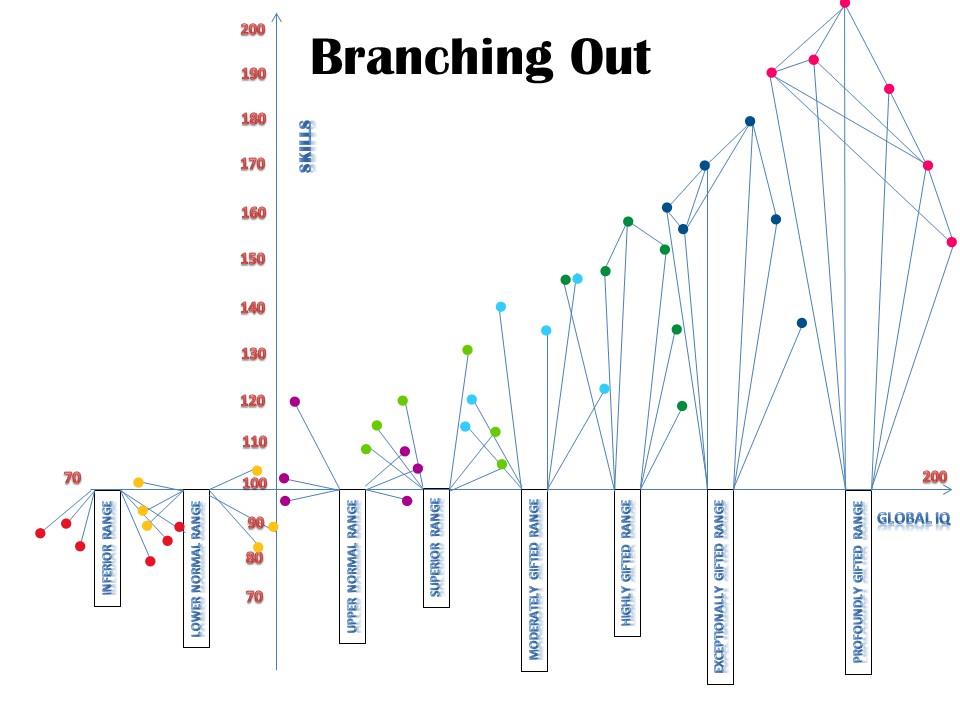
This schematic327 represents the specific spread of the different skills, commonly found in people (for ex: abstract, verbal, emotional, visual, logic etc…but also more specific subjects, such as: math, history, geopolitics, languages, storytelling etc…). It pictures how high/low each skill stands in relation to the others, for each range.
Horizontally, each range is placed according to its Global IQ level.
Vertically, each skill goes as high as the IQ score, a person in this range, would get, were this particular ability assessed on its own. The IQ score of each skill is represented by the tip of the branch237.
This shows that skills arrangements are different for each range, people around average having less amplitude, MGs only having a couple of strong abilities, PGs having most of their strength homogeneously within VHIQ range etc…
As you can see, for each range, one of the branches is higher than one of the branches of the next range on the right. This explains why, at times, a person of a lower range can actually show a stronger skill than a person of a higher range even if his or her Global IQ is lower.
I have linked the branches for the HG, EG and PG ranges to show the cognitive links these people create between unrelated branches because of their integrated thinking103 style.