

How to Know Your I.Q. Level without Taking the Test & Brainy Stories by Billy J. Burton - HTML preview
Download the book in PDF, ePub, Kindle for a complete version.
4.2 Intelligence Can Also Be Noticed in One’s Appearance
The higher the I.Q. rank the more androgynous111-112 the features, the behavior, and the
psychology with a heightened rate of sexual and gender ambiguity113. While people of average
intellect tend to be hyper-gendered, people on the far-right of the Gaussian Curve tend to have more androgynous faces. Likewise, the higher the intelligence the more focused the attention and
the larger the pupil114-115 for the same age and the same lightning conditions.
4.3 The Advantages and the Drawbacks to a Psychological Approach
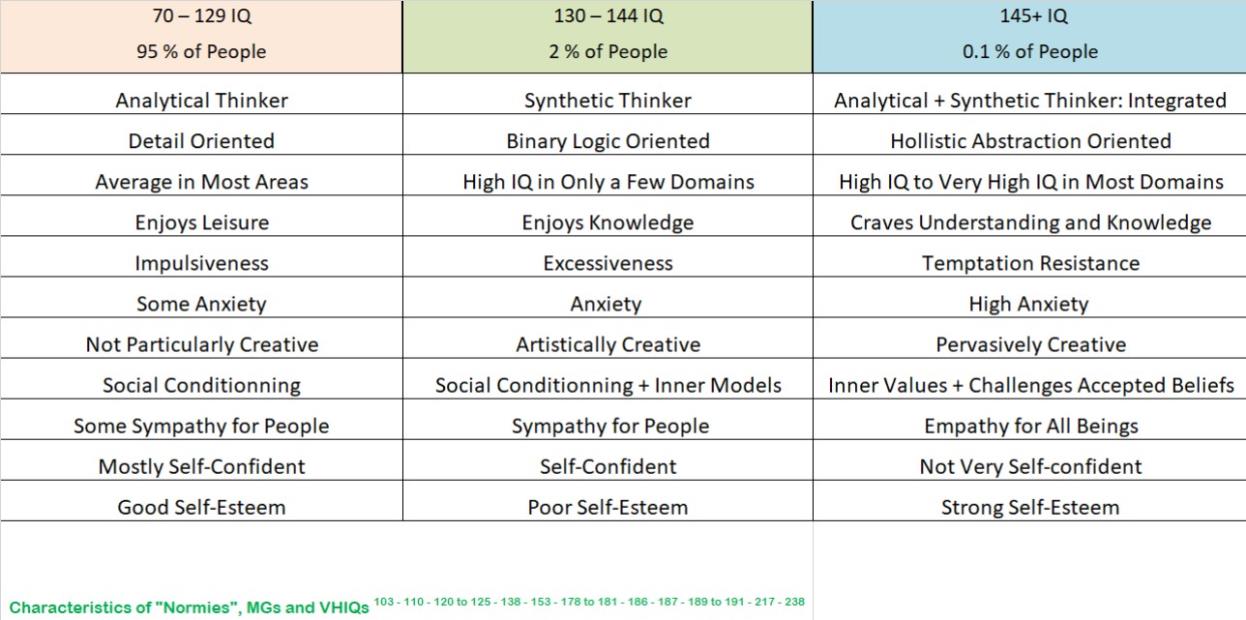
As uncovered in the preceding chapter, there is a progression of a selection of identifiable personality traits in conjunction with the rise of intelligence. Therefore, assessing intelligence by
measuring the intensity of these comportments appears both conceivable and effective.
If two individuals, with the same acumen, display a different array of these traits, albeit with
various intensities, these characteristics will counterbalance one another so as to all merge into a result resembling a global I.Q. score. The more wide-ranging and extended the assessment, the
more precise this result will be.
Apart from the complexity of explaining with precision, to the reader, the intuitive data, I have collected over the years, regarding all the specifics I use to evaluate someone’s intelligence, the
drawbacks to this method are few and mostly related to an outsider’s viewpoint.
First off, the reader won’t be aware of his or her cognitive strengths and weaknesses among
abstract logic, verbal ability, mental rotation, fluid intelligence, crystallized intelligence79, etc. Second of all, with this book, the reader, who scores him or herself, might misunderstand my
logic and estimate an incorrect score (guidelines are supplied to minimize this likelihood).
There will exist no tangible evidence of that score, except maybe in the inner sensation of having
finally discovered yourself. Therefore, entering high I.Q. societies or “gifted education”
programs, is out of the question, for, valid proof is required.
Last but not least, psychometricians will undoubtedly judge this approach to be worthless and
urge you to take a “real” official test.
The advantages in my opinion are many. I have already reviewed them a few paragraphs back
but would like to remind the reader with a quick summary.
The score found here will remain stable even if the test-taker is tired, anxious, stressed out, or
depressed. It will be accurate even in cases of bilingualism, cognitive impairments, or emotional
disorders. It takes all of the test-taker’s intelligence into account (not merely 70% of “g”). Unlike regular tests, which are unreliable above 140, the score, provided at the end of this book, is
reasonably accurate from 90 to 160 (+/- 8 points for the 1st assessment; +/- 5 points for the 2nd
one, +/- 3 points for the 3rd one) and still gives a fairly good idea from 70 to 180.
This test can be taken many times without any loss of precision. You can assess yourself from all
over the world, provided your English is fluent and you’re an adult (younger personalities will
obtain unreliable results).
Last but not least, it won’t cost you a dime, only time and patience.
The second part of this book is based on the observation, verbal exchanges, and interactions with
many people from first-world countries, both in person and online over many years. It is not,
however, a statistically based scientific study with a fixed panel of subjects.
The people portrayed thereafter are merely aggregates of several existing individuals, members
of a particular range, whose names and life situations have been modified so as to be rendered
anonymous.
PLEASE READ:
I have compiled my observations about the psychology of people in every major range. While I
strive to remain as objective as possible, keep in mind that this outlook comes from a person whose I.Q. belongs to the higher ranges and consequently regards lower and average ranges as
puzzling. I apologize in advance for any remark that might seem a tad condescending or
judgmental. I totally think that everyone, in this world, is important, in their own way,
regardless of intelligence.