

The Endgame A Memoir by Maria Victoria Navajas Claros - HTML preview
Download the book in PDF, ePub, Kindle for a complete version.
1987 article:
“AIDS is now the leading cause of death among men in New Haven 20 to 45 years old.”
Text Source: New York Times62
While the documents from the part of the research I discussed do not appear to
have been declassified yet (often and historically the case with unethical research,
especially on the weapons side), there is documentation from that time linking
Yale and the Department of Defense regarding AIDS research under the same
funding umbrella.
62 New York Times, New Haven’s Top Killer of Young Men is AIDS, https://www.nytimes.com/1987/12/13/nyregion/new-havens-top-killer-of-young-men-is-aids.html

Image Source: U.S. Military, Defense Technical Information Center
“AD-A203 587.
Performing Organization: Yale University School of Medicine…

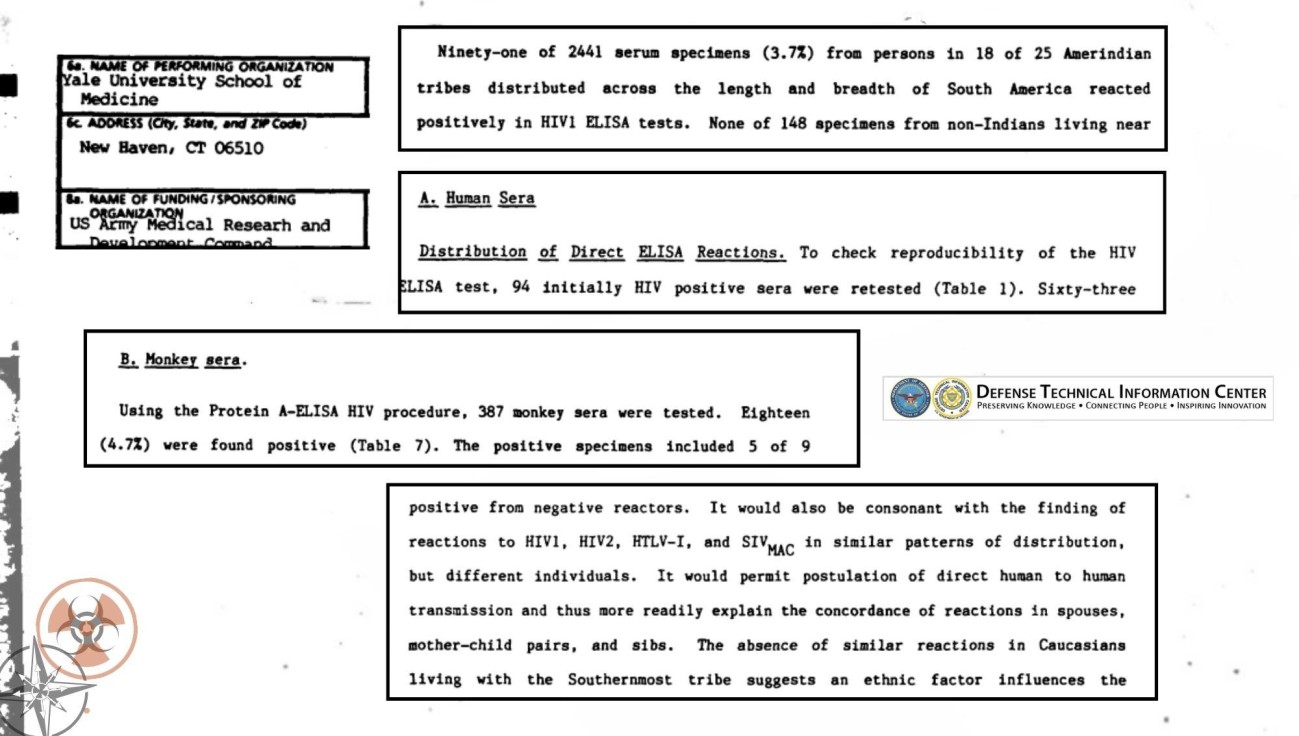
Funding/Sponsoring Organization: U.S. Army Medical Research and Development
Command, Fort Detrick…
Subject Terms: AIDS, HIV1, HIV2, HTVL-I, SIV, South America…”
Text Source: U.S. Military, Defense Technical Information Center63
Image Source: U.S. Military, Defense Technical Information Center
“18 of 25 Amerindian tribes distributed across the length and breadth of South
America reacted positively in HIV1 ELISA tests…Using the A-ELISA HIV procedure, 387
monkey sera were tested… It would be consistent with the finding of reactions to
HIV1, HIV2, HTLV-I, and SIV…”
Text Source: U.S. Military, Defense Technical Information Center64
63 U.S. Military, Defense Technical Information Center, AD-A203 587, https://apps.dtic.mil/sti/pdfs/ADA203587.pdf 64 U.S. Military, Defense Technical Information Center, AD-A203 587, https://apps.dtic.mil/sti/pdfs/ADA203587.pdf
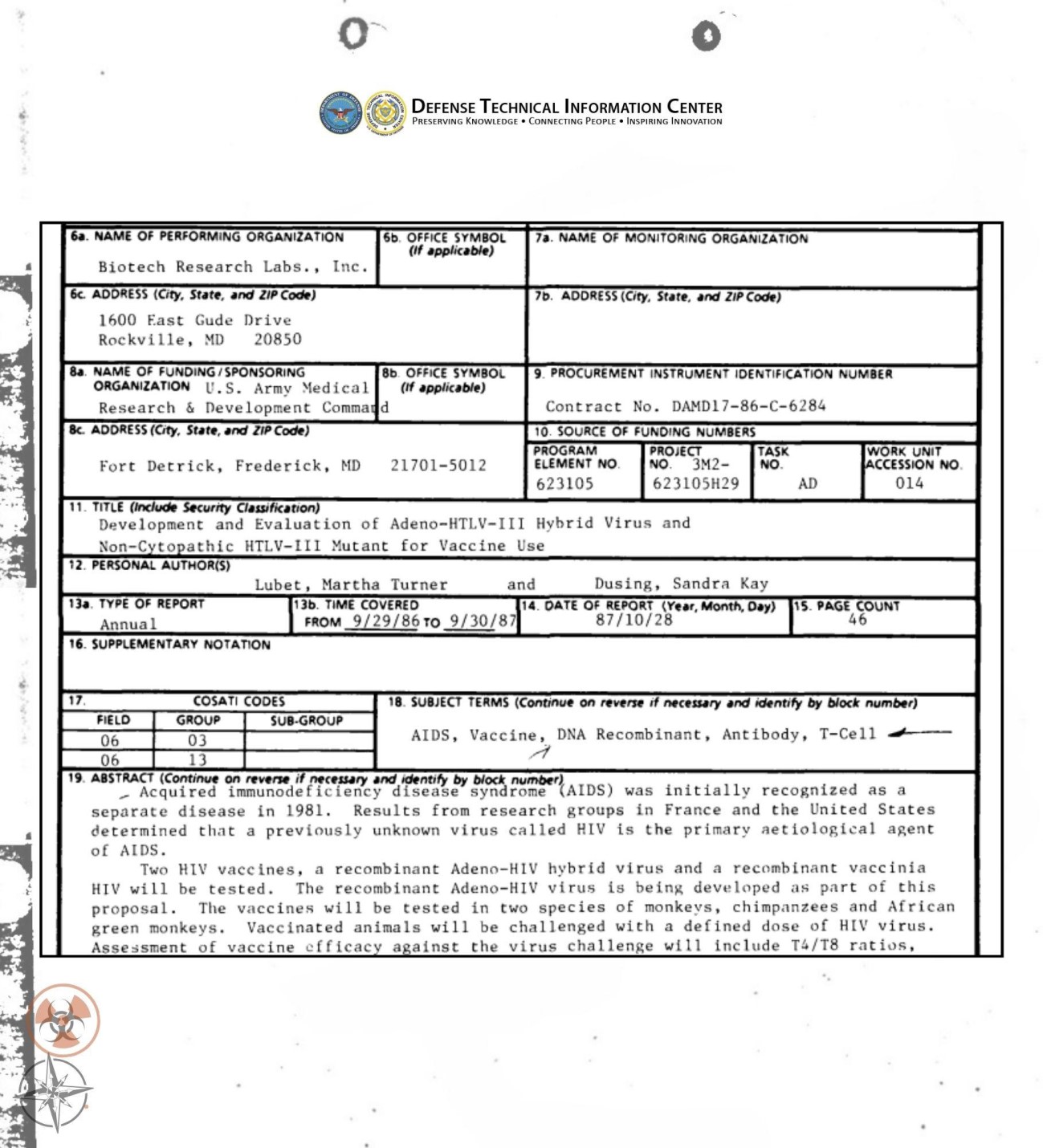
And that same Fort Detrick U.S Army Medical Research and Development Command
was already working on creating a combined HIV and cold virus (adenoviruses are a
common cause of respiratory illnesses) in 1986 and 87:
Image Source: U.S. Military, Defense Technical Information Center

“Performing Organization: Biotech Research Labs., Inc…
Funding/Sponsoring Organization: U.S. Army Medical Research & Development
Command…
Contract No. DAMD17-86-C-6284…
Title: Development and Evaluation of Adeno-HTLV-III Hybrid Virus and Non-
Cytopathic HTLV-III Mutant for Vaccine Use…
Abstract: Two HIV vaccines, a recombinant Adeno-HIV hybrid virus and a
recombinant vaccinia HIV will be tested. The recombinant Adeno-HIV virus is
being developed as part of this proposal. The vaccines will be tested in two species
of monkeys, chimpanzees and African green monkeys…”
Text Source: U.S. Military, Defense Technical Information Center65
The scientists I had grown up with now had their HIV/respiratory illness prototype,
funded by the military:
65 U.S. Military, Defense Technical Information Center, DAMD17-86-C-6284, https://apps.dtic.mil/sti/pdfs/ADA189926.pdf
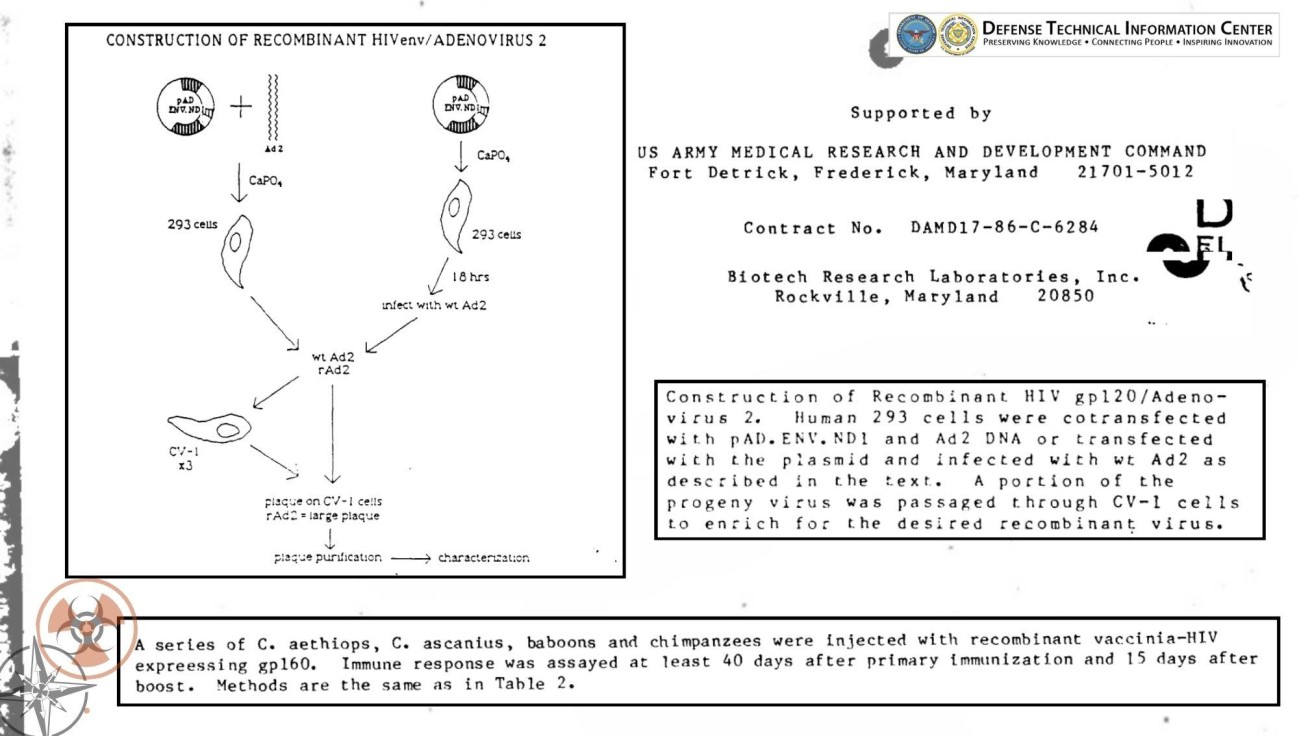
Image Source: U.S. Military, Defense Technical Information Center
“Construction of recombinant HIVenv/Adenovirus 2”
Text Source: U.S. Military, Defense Technical Information Center66
By 1987, Yale Medical School also had a nearly unlimited supply of human AIDS
subjects with a wide variety of opportunistic infections to use for testing and
research:
66 U.S. Military, Defense Technical Information Center, DAMD17-86-C-6284, https://apps.dtic.mil/sti/pdfs/ADA189926.pdf

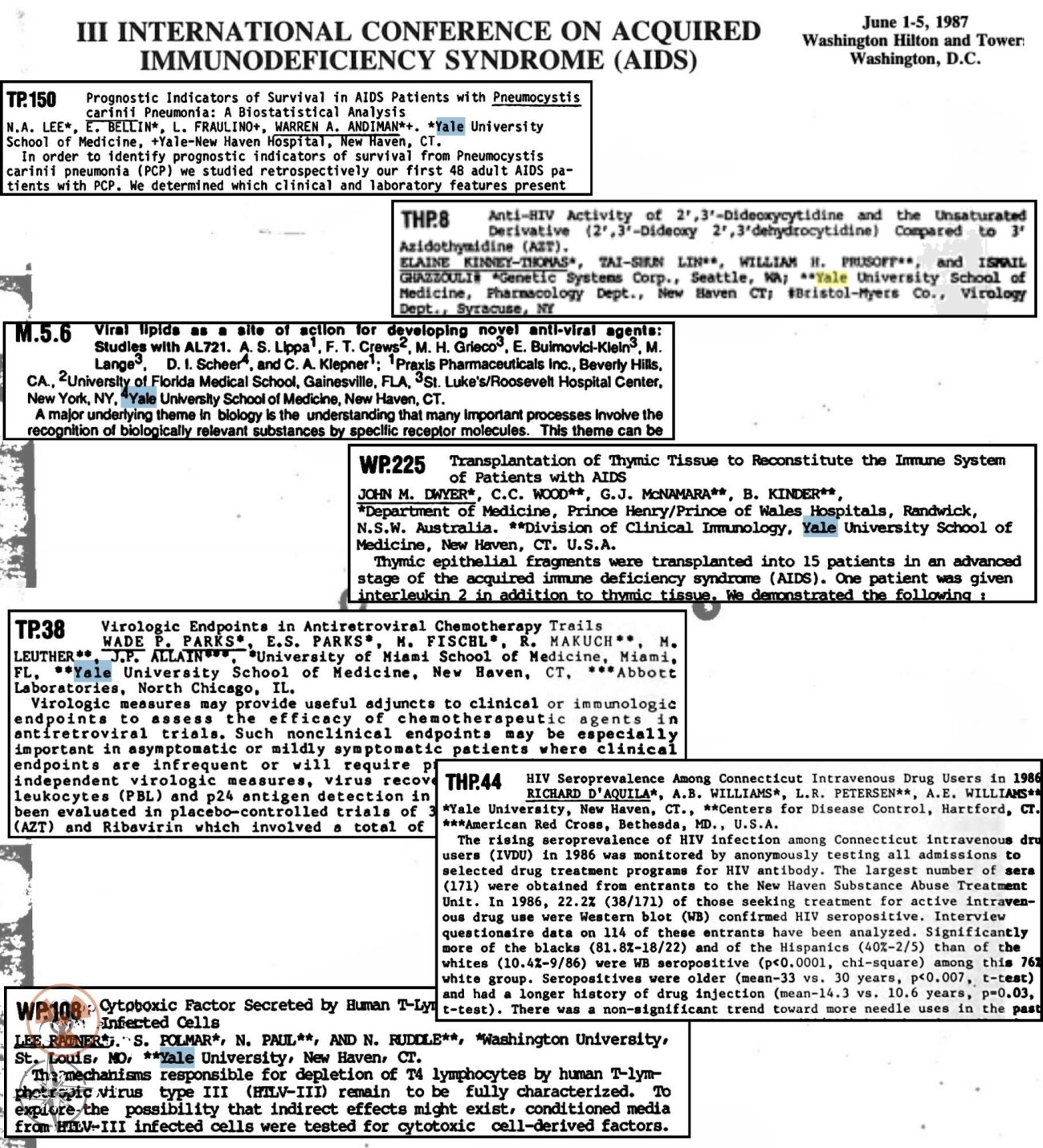
Image Source: U.S. Department of Health and Human Services via Google Books
“Yale University School of Medicine, Yale-New Haven Hospital…
TP.150: In order to identify prognostic indicators of survival from Pneumocystis
carinii pneumonia we studied retrospectively our first 48 adults AIDS patients
(with the pneumonia)...,
THP.8: Anti-HIV activity of…,
M.5.6: Viral lipids for a site of action for developing novel anti-viral agents..,
WP.255: Transplantation of thymic tissue to reconstitute the immune system of
patients with AIDS…,
TP.38: Virologic endpoints in antiretroviral chemotherapy trials…,
THP.44: HIV seroprevalence among Connecticut HIV intravenous drug users…,
WP.106: Cytotoxic factor secreted by human T-lymphotropic virus type III infected
cells…”
Text Source: U.S. Department of Health and Human Services via Google Books67
This was why I waited until George Edwards died to write about his part in it. I’ve
broached the subject of what was happening on Dixwell Avenue many times over the
years with countless people, but I was never comfortable attaching George’s name or
explaining just how messed up his involvement was. He was the only person in the
United States who ever, even temporarily, treated me like a family member. And I
know he didn’t entirely, and I know he risked my life more often than not (I’ll talk
more on that later). But I was an abducted child trapped in an unfortunate situation. I
didn’t get to choose, and he was the closest thing to humanity that I had. I clung to
that. Maybe I shouldn’t have, but I did.
That said, I can’t sugarcoat how bad things were and still are. The place where they
“celebrated George’s life,” played music, and had people speak about how much of an
asset he was to the community? It was at Q-House, a Dixwell Avenue community
67 U.S. Department of Health and Human Services via Google Books, III International Conference on Acquired Immunodeficiency Syndrome (AIDS): June 1-5, 1987, Washington Hilton and Towers, Washington, D.C.,
https://www.google.com/books/edition/III_International_Conference_on_Acquired/bKv9Li26MD8C?hl=en Alternate: https://www.google.com/books/edition/III_International_Conference_on_Acquired/bKv9Li26MD8C?hl=en&gbpv=1

center building. They had the very people he injured, the people he took family
members from, celebrating his life.
That is the culmination of deception. We thank the people who kill us.
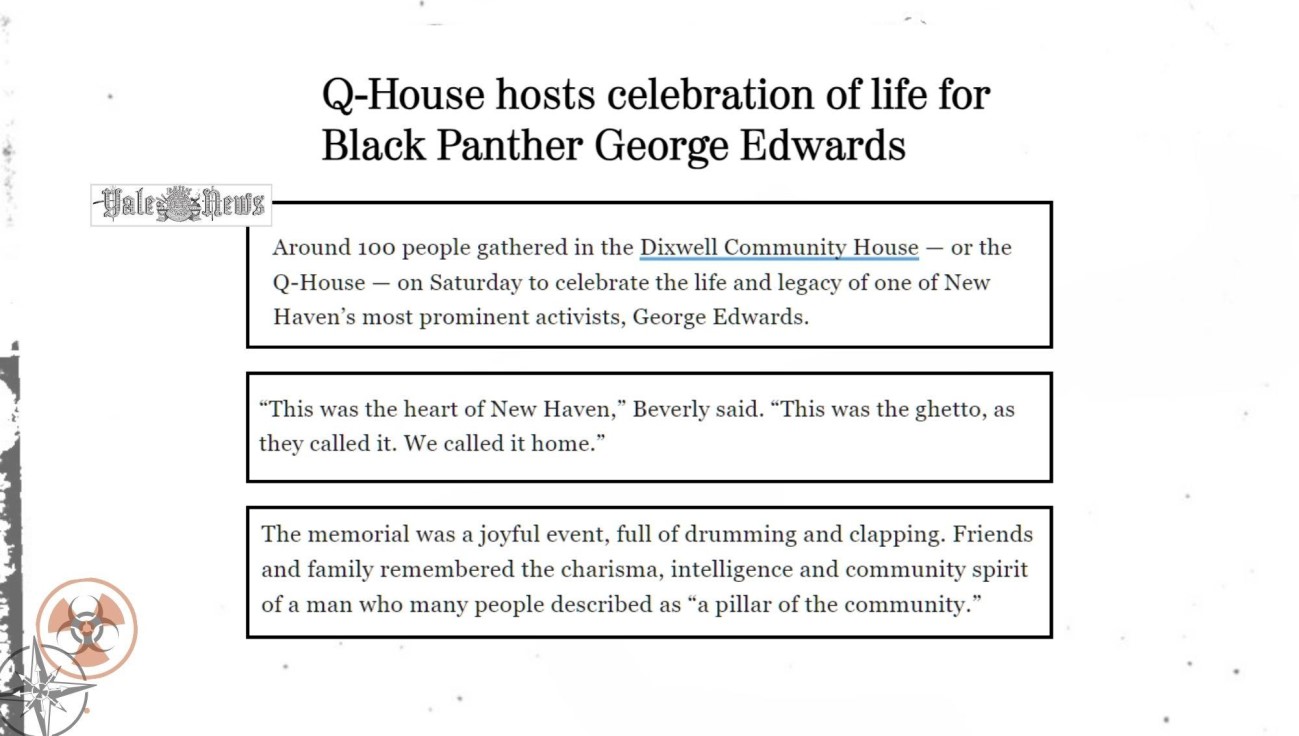
Image Source: Yale Daily News
“Around 100 people gathered in the Dixwell Community House — or the Q-House
— on Saturday to celebrate the life and legacy of one of New Haven’s most
prominent activists, George Edwards….
‘This was the heart of New Haven,’ Beverly said. ‘This was the ghetto, as they called
it. We called it home.’ …
The memorial was a joyful event, full of drumming and clapping. Friends and family
remembered the charisma, intelligence, and community spirit of a man who many
people described as ‘a pillar of the community.’”
Text Source: Yale Daily News68
68 Yale Daily News, Q-House Hosts Celebration of Life for Black Panther George Edwards, https://yaledailynews.com/blog/2022/10/31/q-house-hosts-celebration-of-life-for-black-panther-george-edwards/
The exploitation of that poor community for medical research, and the use of the
promises of help via a biologically poisoned needle, brings back memories of
Argentina…
Occasionally, something out of the ordinary enough would happen in the prison that
it was worth tucking away as a childhood memory. When we went through one of the
main sections on the women's side to get routine vaccines, I remember how loud it
was, filled with the talking and screaming of so many women echoing between those
walls. I recall thinking that I would be safe walking past them; after all, the women
prisoners in my life had all been motherly and wonderful people up to that point. That
faith was quickly extinguished as a woman to my right violently reached out to grab at
my clothing. I tried to pry my clothing loose from her hands. Several in my group had
to help me.
We continued past the women and to a small hallway with a room to our left
containing an ob-gyn chair and the room to our right having a basic physician's
examination table. The chatter of my always-talking friend and the mothers filled my
ears as I learned that we were lining up to get vaccines in the room to the right and
that none of the mothers liked the room on the left nor the doctor in charge of the
often-forced and torturous births that went on there. Then, it was my turn to come
face to face with the doctor in the examination room.
I don't recall if the needles hurt. I can only assume they did.
In all honesty, allowing any type of needle to enter beyond the protective layer of a
child’s skin in that situation should have been prohibited. And, yet, a bland and naive
faith in humanity has propelled national and international policies regarding child
political prisoners and vulnerable populations under any type of government
authority or guardianship. Policy generally dictates that children and disadvantaged
populations receive medical care, food, and education. The suggestions are made
without thoroughly considering how these simple necessities can be forced, poisoned,

and misused with the intention of causing harm when they are in the hands of a
hateful or indifferent enemy or exploiter using deceptive tactics.
When following standard international policies of human rights, an ill-intentioned
government will often use deceitful tactics to save face and appear to be doing the
correct thing on the surface, much like a Munchausen by Proxy mother claiming to
help her child while poisoning them. The United States has a clear history of using
“low value” people within its society for medical experimentation (more on that later,
with citations). Argentina has taken to using its population in another way, as sales
items in human trafficking, but via much the same path, as can still be seen in their
handling and continuing concealment of their kidnapping and reallocation of infants.
Both show signs of a failed society, with humanity and care for their own people
collapsing nearly entirely under the weight of the government they created to crush
them. Healthy nations don’t turn their own people into disposable slaves with no
rights. Other people, yes. Immigrants? Sure. But their own people? Not generally. And
when they go as far as exploiting their own children, that’s usually past the limit of a
salvageable society, even during wartime.
These two nations are, by far, not the only ones to turn covert warfare inward on
their own people. They are just glaringly obvious examples, with all the parts exposed
to highlight with ease. I wouldn’t trust any invasive authority or pseudo-authority
with a needle, a child, or a gun; not when combined with methodologies of
malfeasance and subterfuge. It terrifies me how often people blindly trust them
anyway.
Blind faith is not actually an admirable trait. It’s a concerning one.
The issue with authority and needles would also become more prominent later in
what would become our shared history, in several aspects, and not simply limited to
Buenos Aires or New Haven, but more on that later.
Decay as a Facilitative Tool for Demolition
In those years and the following, I tried to talk to people about what we were doing to
the Dixwell Avenue community. No one cared. It wasn’t them. The victims were
impoverished and with no social value.
I was also young and naive, and often broaching the subject with knowledgeable and
experienced medical professionals from Yale who I knew socially. I approached them
about it because I believed they would be the ones to follow their Hippocratic oath
and they had the internal access to stop the unfolding atrocity. I didn’t know that this
type of research was common in the United States and they were probably more than
aware of it already, especially when working for a prominent research hospital. It
wouldn’t have been a shock to them like it was to me. Even I, despite my experiences,
had fallen for the false lull of comfort that comes with the 50-year classification of
unethical medical research within the country.
From my conversations with the Yale medical staff and others, I began to realize it
was possible that the people I was speaking to only cared if they were personally the
victims, so I tried to appeal to that reasoning. I attempted an appeal to educated logic
and explained that Yale research generally gets used by government, companies, and
major organizations because it is authoritative and high quality, and thus, the
unethical practices would eventually be used on the larger population, including the
people I was speaking to. I didn’t know why those words had no effect. I figured that
maybe they thought they would only receive positive benefits from the research done
at the expense of other human lives. As if humanity is not interconnected at all.
I didn’t fully comprehend that this wasn’t the first time in recent history that U.S.
medical researchers, often at the government’s behest, had given diseases to the
impoverished and socially unwanted while lying to them and claiming to be there for
their benefit.

What was going on in front of me in the 1980s and 90s was simply an echo from a not-
so-distant past:
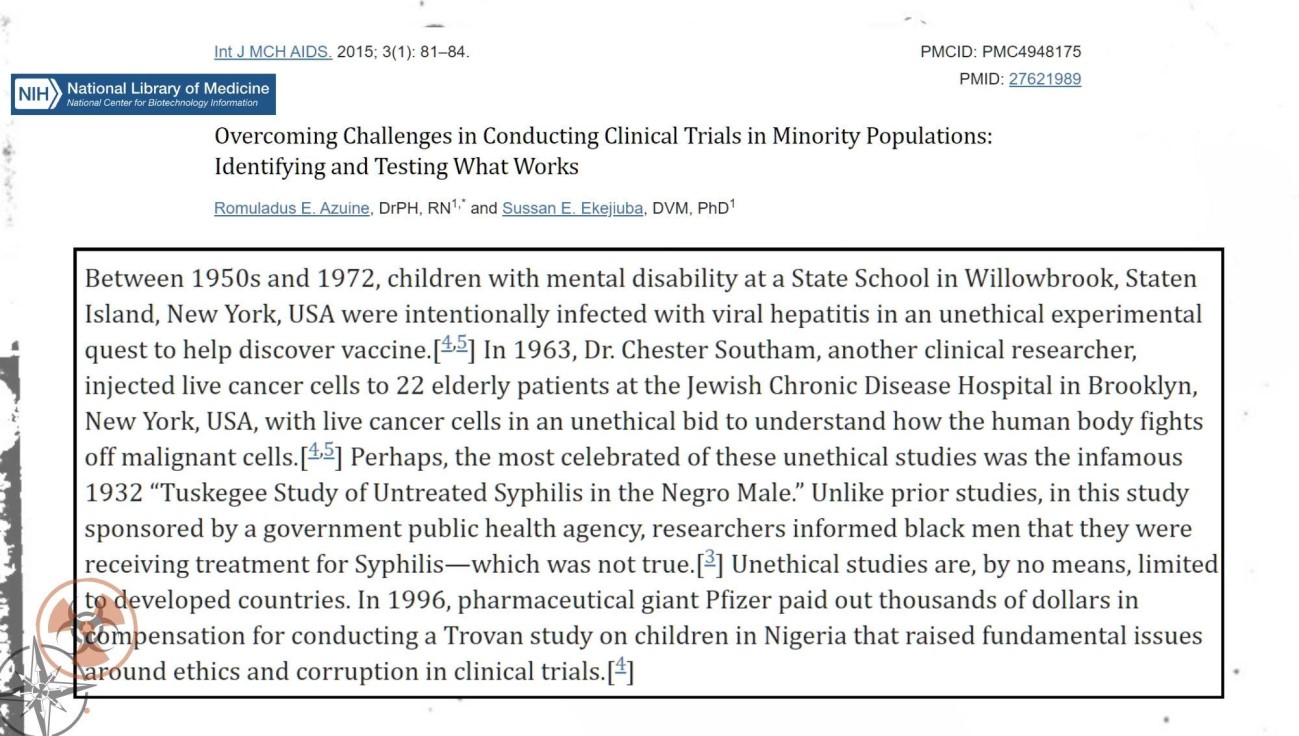
Image Source: International Journal of Maternal and Child Health and AIDS
“Between 1950s and 1972, children with mental disabilities at a State School in
Willowbrook, Staten Island, New York, USA were intentionally infected with viral
hepatitis in an unethical experimental quest to help discover vaccines.
In 1963, Dr. Chester Southam, another clinical researcher, injected live cancer cells
to 22 elderly patients at the Jewish Chronic Disease Hospital in Brooklyn, New
York, USA ( without their knowledge or consent)... in an unethical bid to understand
how the human body fights off malignant cells.
Perhaps, the most celebrated of these unethical studies was the infamous 1932
‘Tuskegee Study of Untreated Syphilis in the Negro Male.’ …In this study
sponsored by a government public health agency, researchers informed black men
that they were receiving treatment for Syphilis—which was not true.
…By no means, limited to developed countries. In 1996, pharmaceutical giant Pfizer
paid out thousands of dollars in compensation for conducting a Trovan study on
children in Nigeria that raised fundamental issues around ethics and corruption in
clinical trials.”
Text Source: International Journal of Maternal and Child Health and AIDS69
I wouldn’t find out about how extensive that recent and continuing dark practice was
until decades later when looking further into the subject. However, the experts at
Yale clearly knew.
In a later interview (in this case about using abandoned and orphaned children in
state care in the 1960s, rather than impoverished black communities too poor to
relocate in the 1980s), a medical history professor at Yale let on how common the
unethical and callous practices were when seeking research grants to experiment on
the unwitting:
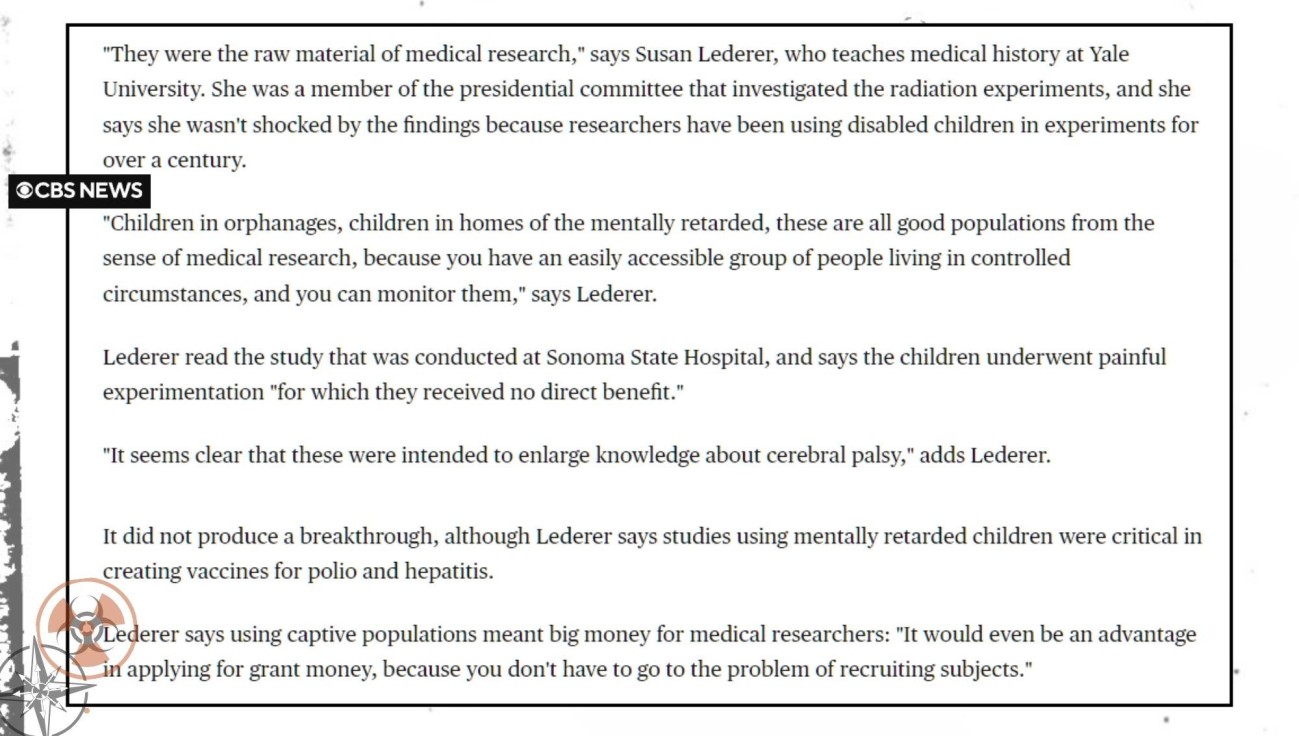
Image Source: CBS News
69 International Journal of Maternal and Child Health and AIDS, Overcoming Challenges in Conducting Clinical Trials in Minority Populations: Identifying and Testing What Works, https://www.ncbi.nlm.nih.gov/pmc/articles/PMC4948175/

"’They were the raw material of medical research,’ says Susan Lederer, who
teaches medical history at Yale University. She was a member of the presidential
committee that investigated the radiation experiments, and she says she wasn't
shocked by the findings because researchers have been using disabled children in
experiments for over a century.
‘Children in orphanages, children in homes of the mentally retarded, these are all
good populations from the sense of medical research, because you have an easily
accessible group of people living in controlled circumstances, and you can monitor
them,’ says Lederer.
Lederer read the study that was conducted at Sonoma State Hospital, and says the
children underwent painful experimentation ‘for which they received no direct
benefit.’
…
Lederer says using captive populations meant big money for medical researchers:
‘It would even be an advantage in applying for grant money, because you don't
have to go to the problem of recruiting subjects.’"
Text Source: CBS News70
They knew. The people at Yale knew how deceptive we were in our practices, in how
we approached medical recruiting, and in how we exploited people while lying to
them. And they did nothing to prevent it, even when they became recruitment targets
for other purposes; and at Yale, in that CIA recruitment box, Yale students and staff
absolutely were Intelligence recruitment targets, and it did not always go light on the
manipulation or coercion.
Even despite that, they still could not see past their egos to understand that it was not
only those with “no value” that our methodologies were being used on. It was those
with “no value” whom we were experimenting on so that we could get the techniques
correct before going after the ones with value - the larger population, those with
70 CBS News, A Dark Chapter in Medical History, https://www.cbsnews.com/news/a-dark-chapter-in-medical-history-09-02-2005/
money, those with land to steal, those with power, and everyone who ever thought
they were “too necessary” to become a target.
But being necessary does make you a target. You have something an exploiter needs
to control and an enemy needs to eliminate.
I still tried. Despite their egos and lack of compassion for others, I still tried to save
them from what the medical experimentation would result in, by asking them to
intervene before it got worse, before it expanded, before it reached them. You cannot
say I didn’t try.
They simply were not interested. They did not realize the chains that were on others
were the same ones on them as well. So, they did not remove the chains of the victims
below them. They did not break the chains.
Their mindset is a large part of why we are where we are today, as I write this to you.
The egotistical and unthoughtful mind often is.
So, with even less hope for humanity than I had previously, I spent more time
hanging around George and the recruiter, blending into the background as they
wove their way not just through grassroots organizations, but also through Yale’s
campus and society. After all, they had both spent their university-age years on
that campus. They were Yalies themselves. In those halls, in their Yale societies
and away from prying eyes, that’s when I became introduced to the culture and
mindset that were the money and power driving a lot of what we had been doing.
Sometimes, I would join the conversation. Why wouldn’t I? I was there.
One time, when I was safe to speak behind closed doors, I asked about why some of
the industry and academic planners there were reducing the ability of doctors to
make truly patient-tailored diagnoses and treatments with thorough analysis. At that
time, the standardization of medicine and education was producing a sharp decline in
fine-tuned analytical and diagnostic skills. It was affecting more than one industry

(and I was deeply concerned that we would lose the genius and detail of thought
necessary to get our civilization out of a mess at a later date). However, medicine was
the area that I felt would cause each of us the most personal damage, especially as the
generations went on and the original knowledge became lost, further complicated by
an increase in difficult-to-treat immune system dysregulation.
When we go to a physician, it’s often because we are damaged. The last thing we want
or need in that moment is for them to damage us more, at least in my opinion.
Their response was disheartening, to say the least. The standardization was being
done because, from a governance and management perspective, a standardized
homogenous industry is much easier to manage and regulate. They wanted less work
for themselves at the government, industry, and regulatory level. They also wanted
fewer unexpected results and actions to contend with. In other words, they were lazy
and afraid of competition. When I mentioned the problem of having to see a doctor
who was less than ideally skilled, someone scoffed at me and said, “We have our own
doctors.” Obviously, they could not comprehend that if you dumb down an entire
society, eventually even your best doctors will be affected and their skills will be
reduced. The less-honed skills and the (lack of) thought processes behind those will
eventually seep into everything, including the Ivy League medical schools.
In the early years, it became obvious that the house of war criminals I was now a
quasi-member of was exploiting the population so hard that entire nations were
getting ready to collapse under the weight. Their thinking was that of a lazy drug-
addicted predator accustomed to being served everything on a silver tray. I would
attempt to reason with them and mention that you cannot take someone for 100%
of their profits and expect them to still keep producing and giving to you year after
year. They didn’t believe me. Every person and group they got their hooks into,
they would eventually take for everything. When willing to tell me why, one of
them stated something along the lines of, “They’ve always managed with nothing,
so they’ll keep managing with nothing.”
That statement alone had so many flaws that I didn’t even have a response. I would
have had to throw out any faith in their understanding and start at the beginning,
much like what I’m doing with this book. If it feels like I’m overexplaining things,
you can blame them. The way I see it, if the pros in charge can’t understand
something as simple as why stealing someone’s food will result in them not being
able to work, why would the people who “voted them in” and put them in charge
understand the bare bones of how things function?
Back then, before I was aware that a larger population outside of the Ivory Towers
even really existed, I was arguing for the sustainability of the recruiter’s Yale
alumni cohort’s criminal enterprise atop government. I was trying to save them,
the same as I’ve tried to save myself, the same as I’ve tried to save you. As it turns
out, I’m a failure when it comes to reasoning with addicts and those who like life to
be easy. They were too high on their own egos and Afghani heroin to care. Their
victims were still happy to cling to the small comforts they were promised they
could keep as long as they were well-behaved victims. And we were all heading for
the cliff we’re now standing on.
They say knowledge makes people unhappy. This is why. Even back then, it was
obvious that we were all heading for disaster while they were the nation’s and the
globe’s chauffeurs.
As for the abundant failures of random politicians, media personalities, and others
to fix the mess made by the war criminals and their thieving cohorts, the concept
of some hero coming to the rescue was made by Hollywood, not reality. One
person cannot save millions. It’s actually impossible. The physics of the model
cannot conform to or function like that. Once they make waves, that one person is
instantly swamped by all the predators who go for the peak prey - anyone with
sway or access to power. There are no superheroes. Either we all pull our weight in
not being bamboozled, or this ship sinks and that’s the end of it. And considering
how many spineless nihilists we have these days, I’m not betting on survival. The
odds are not in our favor. If they were, we wouldn’t be in this situation to begin
with.

While my attempts to create some stability for myself, my world, and the world may
have been paltry, the recruiter’s attempts at her own aims were not much better in
some regards, although she definitely put a lot more funding and effort in. She still
wasn’t happy about my level of obedience, so she started bringing in some of her
buddies from research departments related to the ones she had been directly
supervising. They “invited” me to become a more useful human being. By invited, I
mean they showed up at the safehouse in the middle of the night, driving an
ambulance.
I walked out to the ambulance with the recruiter. There was nothing wrong with me
at all, but she assured a worried-looking neighbor that I was okay and just a little
dizzy. I got into the back of the ambulance and they insisted on putting the oxygen
mask on me. This trip happened several times. I remember because the usual man in
the back of the ambulance was aware of my claustrophobic feeling of suffocating once
the mask was on, and he was kind enough to always use a long rope of cotton along
the edge of the mask to protect my skin and to create a small gap giving me the tiniest
bit of ordinary air to breathe. When he didn’t and it was someone else, she abrasively
put the mask on me directly. That resulted in my feeling panicked in the moment and
with an acne outbreak around my mouth that went on for months after. The man had
been right about the mask’s potential for creating skin irritation.
The oxygen wasn’t just oxygen. It knocked me out every time. On one occasion, I woke
up in the clinic they had brought us to. I say us because I was not the only child there.
There was a teenage boy I had met before. He was screaming down the hall as they
hustled him out. He was screaming to change the meaning of the words. He kept
repeating “knot the not” as they pushed him out the door.
My hospital bed in the clinic was behind a thin curtain. They kept the lights low and
their voices hushed. All of the “patients” were sleeping. The medication made it
impossible to move. We were kept immobile for what felt like weeks. I lost all sense of
time. I’ve always fought anesthesia (a leftover from my survival instinct to fight the
recruiter’s drugging), so my waking up despite the amount of drugs flowing into me
via an IV was not unusual, not for me.
I woke up in agony. Because of the injuries to my spine that I’ve had since Argentina,
being paralyzed on my back without the pillow being in the one position that’s
actually comfortable for me caused every nerve in my body to scream and every
muscle to seize up. I hurt so incredibly badly that all the anesthesia in the world
would not have kept me sleeping. That’s when I became aware of the machine on my
right. It was playing a recording over and over again, the same words, a command. It
made me recall what the boy in the hall had said, “Knot the not.” Suddenly, his words
made sense. The recording started with “I will not know.” I don’t remember the rest.
Between the agony, going in and out of sleep, and my fighting to keep the words out
of my head and change their meaning to make them ineffective, I simply didn’t allow
them to take hold in my memory. I changed “I will not know” to “Eye will knot no.”
The pain, however, was still there. My right calf had become a solid knot and I couldn’t
reach it to massage it. The hours continued to go by. I was fighting the words, I was
fighting the drugs to stay awake so I could fight the words, and then I was in agony on
top of everything. That’s when I went deep in my mind because it was the only thing I
could control in the situation. I found that little pain switch in my head and I flicked it
over from agony to ecstasy. That’s the moment I became a masochist. I’ve never been
able to entirely flip that switch back to its original position. The result of that moment
would be a disaster in my romantic relationships later on. It’s difficult to have a
healthy dynamic when you require a sadist in order to get off, but I digress. We
haven’t hit my adulthood yet, and I’d definitely prefer to compartmentalize that, for
obvious reasons. Let’s get back to 1980s New Haven for now…
At least I was allowed to escape via school and summer camp sometimes. One of the
summer camps was located on a small island off the coast between New York and
Connecticut. The buses would park in a large lot, and from there, we would take boats
with our camp counselors to get to the jellyfish-surrounded island. The amount of
jellyfish there was actually ludicrous. Each day, before we could swim, the counselors
would have to remove over a hundred of them from our small designated swimming
area. Part of the fun of camp was watching the captured jellyfish get dumped on the
beach.

The camp had historical roots. I believe it was the first government-funded boy’s
military camp in the United States. When I was there, I knew none of that. However, I
was in the first group of girls to be in the camp. We were younger than everyone else
and we didn’t have the proper attire because they simply had not made regulations for
girls yet. We stuck out like sore thumbs. But it was camp and I enjoyed it for the most
part. If something was too terrifying (I was afraid of heights and didn’t want to climb
up to attempt to maneuver the ropes they had between trees), I would act scared and
they would invariably let me skip out on an activity because I was a girl. By the second
week, my activity schedule card was mostly full of swimming. They had given up on
involving me in anything else other than camp-wide activities.
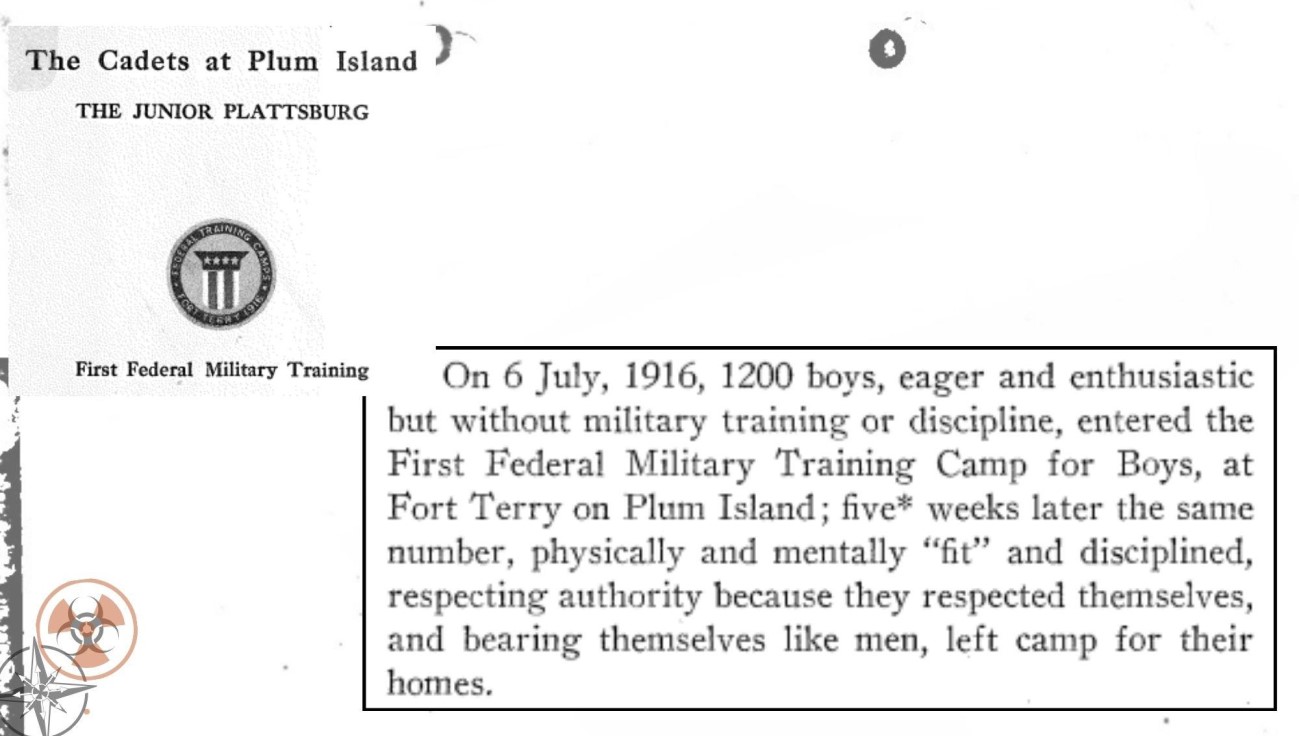
Image Source: Connecticut State Library (PDF automatically downloads)
“On 6 July, 1916, 1200 boys, eager and enthusiastic but without military training or
discipline, entered the First Federal Military Training Camp for Boys, at Fort Terry
on Plum Island.”
Text Source: Connecticut State Library71 (PDF automatically downloads) 71 Connecticut State Library, The Cadets at Plum Island, https://cslib.contentdm.oclc.org/digital/api/collection/p4005coll11/id/39/download Additional Camp Documents: https://carlisleindian.dickinson.edu/sites/default/files/docs -documents/NARA_RG75_CCF_b021_f06_57042.pdf
The experience became comfortable with all of that sorted out, and I was enjoying my
days. Unfortunately for me, I was still connected to the recruiter. Another girl and I
both had “parents” who chose to send us to that camp because they had direct
connections to the research lab on the other side of the island, now known as the U.S.
Office of National Laboratories (ONL) Plum Island Animal Disease Center. We would
sometimes be called to meet them at that lab when they were stopping by the island
or if they needed to pick us up early for any reason. On those days, we would walk
along a path from the beach and enter the lab from the side. As we walked along the
left side of the building, on the dirt path, with the sounds of angry dogs (there was an
ongoing rabies research project at the time) in their path-facing kennels snarling at
us, our ankles were getting eaten alive by fleas.
In the moment, the fleas were simply an annoyance and the dogs were scary but
relatively harmless (no one led us onto the hall where we would have had direct
contact). However, in retrospect, I would like to note that biolab was funded by a
government that supposedly has enough money to keep things professional, sanitary,
and free from lab leaks. And yet, visitors and anyone who walked nearby were being
bitten by the same fleas that were biting ill and rabies-heavy dogs. This is a lab being
run by the same “professional government scientists” the public blindly trusts to keep
them safe.

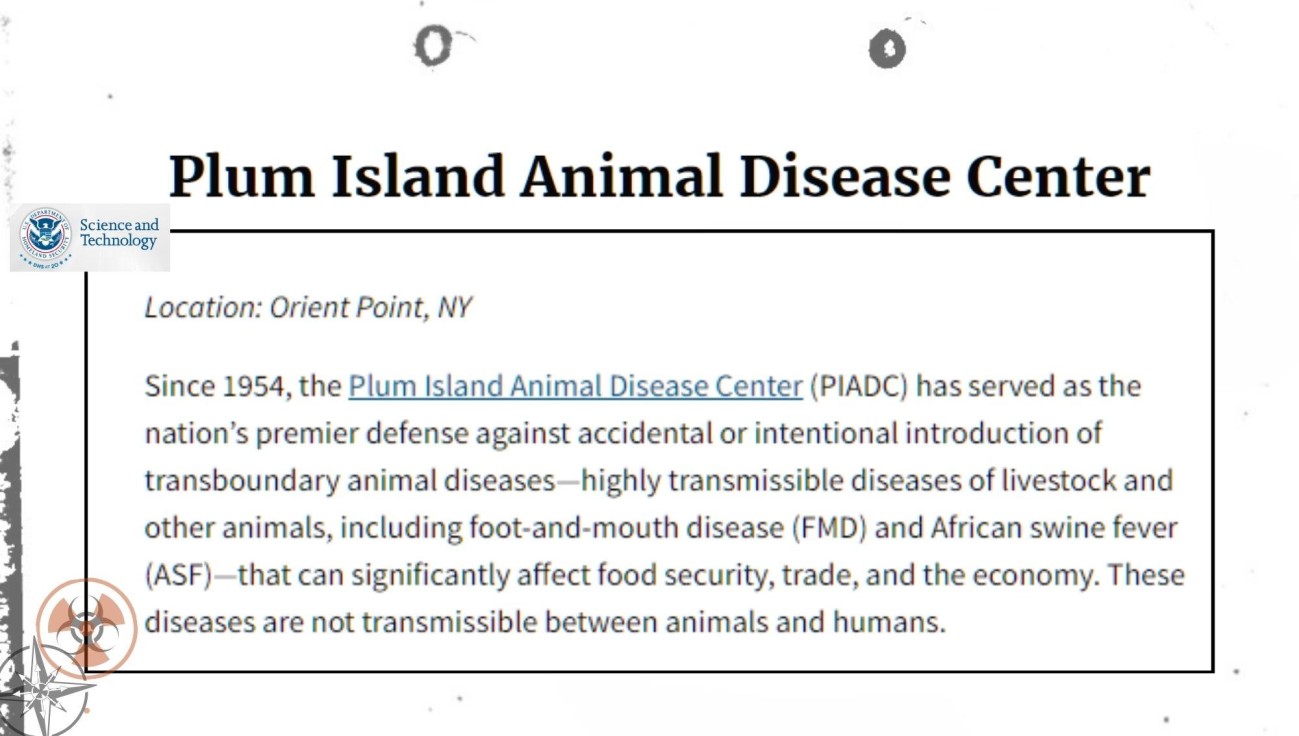
Image Source: US Department of Homeland Security
“Plum Island Animal Disease Center
Location: Orient Point, NY
Since 1954, the DHS S&T Office of National Laboratories (ONL) Plum Island Animal
Disease Center (PIADC) has served as the nation’s premier defense against accidental
or intentional introduction of transboundary animal diseases (a.k.a. foreign animal
diseases).”
Text Source: US Department of Homeland Security72
These “experts” are the ones the public has complete faith in to protect them from
“accidental or intentional” contact with animal diseases, in addition to being happy to
be lied to by them. These same experts who allowed children and scientists to be
exposed to whatever transmittable diseases their actively rabid dogs may have had.
72 US Department of Homeland Security, Plum Island Animal Disease Center, https://www.dhs.gov/science-and-technology/plum-island-animal-disease-center
I have to say, I’m not shocked that many people believe that Plum Island is where the
major tick-carried Lyme Disease outbreak came from. It’s geographically close enough
to Lyme, Connecticut, and campers and scientists who spend time on that island
bring ticks home, to Connecticut and New York, on their clothes every day. While I
have some doubts regarding the validity of the overdone theories about the lab having
created a new version of Lyme Disease in that time frame, I have to acknowledge that
lab may have simply been housing one of the older strains and let it get into the wild.
They had no effective safety protocols in place to prevent spread. In fact, their safety
levels were so low, that I would call them an ideal starting point for uncontrolled
spread of animal-human transmitted illnesses.
The government, its bureaucrats, its scientists, and its workers are not competent,
honest, responsible, or mature enough to handle biological weapons to a high enough
level to contain them, despite their outwardly impressive credentials, badges, and
military brass that could be easily replaced by 1-cent gold-star-shaped stickers
intended to reward a child for cleaning their room by shoving everything under the
bed. They never have been responsible enough. This has been proven countless times.
The unspoken and yet standard policy of glossing over errors and blaming
bureaucracy or unnecessary requirements is born from the level of deceit that
appears to be a requirement for the majority of people in academic and professional
circles if they wish to meet on-paper-only hiring requirements. The desire to attain a
better paycheck and a higher title does not create a positive outcome when it comes
to the sciences.
In fact, their need for personal gain above lab safety limits the likelihood that those in
the labs and imposing the rules will have the actual scope or capability to have honest
conversations about problem areas that need to be rectified. Instead, they bow to
authority and the need for face-saving in order to maintain their pay, ranking, and
status. In doing so, they gloss over problems and errors in a desperate attempt to
appear professional and highly competent without ever attaining the same level of

professionalism or competence that the gloss portrays. Their self-necessitated deceit
causes them to intentionally error, rather than admit to errors. They pile disaster on
top of disaster, thinking that somehow more lies will fix the very tangible problem of
lab failures.
Biowarfare research protocols, when created and maintained within a deep-seated
culture of deceit, simply cannot be attained at a level that will guarantee containment.
Science requires honesty. So does containment. All it takes is one error for a mistake
to become fatal. When you have twenty errors because the people and departments
involved have additional motives other than pure science and containment, and are
capable of using deception to hide the fact that they have given their other motives
priority above safety, global fatalities become guaranteed.
Then the scientists go home and pray their errors don’t follow them. Even that, I’ve
personally seen go wrong.
The recruiter worked with various labs and projects over the years. One was actually
doing cancer research. And, due to lab contamination, she developed tumors up and
down her spine when I was around ten years old. She spent the next year getting
experimental treatments from that same lab (as far as I know, she talked about them
but I never went with her for those) and also ingesting food-grade peroxide right in
front of me, in small but seemingly frequent quantities diluted in beverages. When I
asked why, she said it was because cancer needs an anaerobic environment to thrive.
The more oxygen you push at it, the better your chance of survival. I’ve never tested
that theory, myself. However, her tumors did eventually resolve due to some
combination of what she had been doing.
On the subject of labs under the recruiter’s supervisorial domain, one lab from that
same group was working on what may have been one of the surface projects funding
and providing support and biological materials for the hidden research our tight-knit
group of scientists from the dinner parties was doing with the AIDS virus. The lab in
question’s stated research purpose was to enhance immune systems to increase
chances of survival during nuclear and biological attacks. So, they did just enough
research on immune system enhancement to make the project look legitimate for
their funders. At around the same time, as referenced previously with documentation,
the more blatant walking pneumonia/HIV hybrid research would be hidden in plain
sight under the umbrella of vaccine research.
When I saw what was going on within that immune system enhancement project was
when I first started to worry about everyone’s immediate safety. Not about a future
time when things might snowball out of control, like I was with the AIDS research.
Nope. In the case of the immune system research, I was already concerned for
humanity then and there. The researchers decided that hormones were the key to
unlocking the full potential of the human immune system. As a result of the hormones
they altered to test that theory, every research subject of theirs that I met had
developed overactive immune system dysfunction symptoms ranging from severe
life-threatening allergies to full-blown lupus.
I wasn’t there to witness it as an assistant that time. I was one of the human numbers
in the research subject pool. They had been short on participants and the recruiter
volunteered me to fill one of the spots on the list. As a result, if you so much as
sneezed near me, my immune system would go into overdrive and my skin would end
up covered in a persistent sandpaper rash. I struggled with constant aching, dizziness,
and an overactive immune system for decades after. It was not great for the self-
esteem of someone prone to acne for life - every zit became swollen up to ten times
the size it should have been, due to near-instant, sustained, and systemic
inflammation that could only be halted with long courses of antibiotics. A doctor in
Italy who was treating my skin later on told me that my hormone profile matched that
of a teenager. I was forty when he told me that.
One time, while driving to a pharmaceutical company’s campus, the recruiter told
me not to worry. She said that when she signed me into medical and
pharmaceutical research programs, she always used her influence to make sure
that I would be in the placebo group. At this point, it’s rather obvious that was a lie.

The only thing that makes me feel a little better about it all is that, in my fear of being
seen as weak (I was convinced that the recruiter’s psychopathic instincts would go
into overdrive if she knew how close to death I was and that it would lead her to
finishing me off, so I always did my best to look okay even when I wasn’t), I may have
skewed their early research some as a test subject. There’s a chance that their target
market - the people who were happy to use unwitting test subjects to further their
own survival - were being told the treatment was safe for them to use when it was
not.
Actually, there is one other dark silver lining. The woman in charge of that particular
lab, I can never remember her name. Maybe it was Jody. She wasn’t interested in
keeping soldiers alive or finding cures for the bioweapons we were creating. It is very
likely that she had been recruited from a university campus in the middle of the late
1960s to early 1970s psychedelic drug craze. Yes, she may have had the potential to be
a brilliant scientist when she was in university, but by the time she graduated, she was
full-on Age of Aquarius new-age mantra pie in the sky delusional about what could be
achieved and how she would achieve it. The drugs and insanely unrealistic culture had
altered her thoughts. She was misusing Department of Defense research funding to
attempt what she was really interested in - finding the fountain of youth through
science. She wanted immortality and felt she was “peak human” enough to find it.
That’s all she ever actually worked on. It didn’t matter what a research proposal said
or where her funding was coming from. Achieving a fountain of youth was all she was
ever working on. When I met her, she was convinced hormones were the answer (my
Italian dermatologist might half agree with her - after all, his aging patient did
manage to retain the acne of a fifteen-year-old).
But enough about that portion of the ego-borne insanity. The reason I became
concerned for all of us was because, shortly after witnessing the statistically very
significant symptoms of allergies, lupus, and general overreactive immune system
issues in the research subject group, I started noticing them popping up in the larger
population and in new and unusually high amounts. It wasn’t just funders who were
getting the treatment. Remember when groups of kids started getting peanut allergies
around the same time? Giving a treatment to alter hormone levels to cause an
immune system overreaction at the same time as administering a vaccine that
included peanut oil (a vaccine ingredient at that time), wouldn’t just cause the same
severe allergies and immune dysregulation the research pool was already seeing. It
might actually cause even more.
I’m fairly certain, especially considering what lab I was standing in for that one, that
the U.S. government was experimenting on its own people, possibly for what they
believed to be genuine reasons and in the favor of the citizens for once.
This would have been done without the people’s consent, understanding of the side
effects, or knowledge as to what was being hidden in the standard childhood vaccines
they were permitting to be injected into their children with trust in the medical
system and faith in pharmaceutical companies to produce quality products without
something extra thrown in. Yes, the U.S. still uses its own population as test subjects.
It never “stopped 50 years ago.” That’s just the 50-year classification rule doing its job
of making sure all the victims are dead of old age and bad health before they can sue.
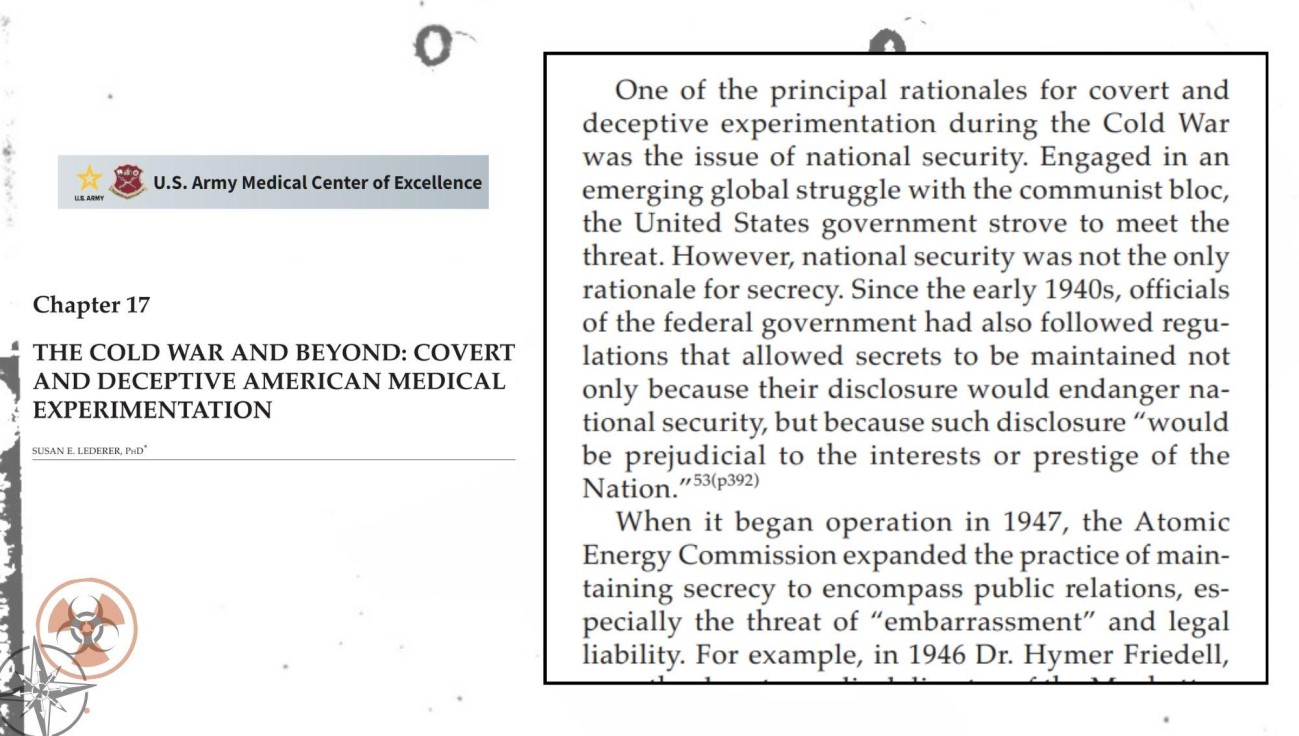
What was that line again, the one from Military Medical Ethics, Volume 2? Ah, right:
Image Source: U.S. Army Medical Center of Excellence

“The Atomic Energy Commission expanded the practice of maintaining secrecy to
encompass public relations, especially the threat of ‘embarrassment’ and legal
liability.”
Text Source: U.S. Army Medical Center of Excellence73
Because the easiest victims to ignore and lie to, and about, are the injured ones. After
all, the injured and disabled have so little value in society that they wouldn’t have
enough of a voice even if the government weren’t burying them to save a few dollars.
That’s just the sad truth about society. It’s a leftover from our herd instincts, back
when we left the weak to be eaten by predators. Sadly, not much has actually changed
despite our moving into the modern day of germ warfare and advanced weapons
research. We still leave the weak to be eaten.
Unfortunately, in doing so in the modern context, we’ve set everyone up to become
the weak. Is there any question as to why the predators among us have, in sensing
weakness, now become brazen and emboldened enough to attack the population?
In addition to what I personally saw, there are too many prior examples of unethical
research to go through them one by one, and the declassified published information
on those within the United States almost all suddenly stops 50 or so years ago. The
practice didn’t stop. I was there for several newer projects, and I’m not 50 quite yet.
Entrenchment at Yale
73 United States Army Medical Center of Excellence, Military Medical Ethics, Volume 2, Chapter 17 The Cold War and Beyond: Covert and Deceptive American Medical Experimentation, Susan E. Lederer, PhD,
https://ke.army.mil/bordeninstitute/published_volumes/ethicsvol2/ethics-ch-17.pdf
https://medcoeckapwstorprd01.blob.core.usgovcloudapi.net/pfw-images/borden/ethicsvol2/Ethics-ch-17.pdf

Take the blindfold off and walk away from the ledge.
Pushing people over it won’t save you.
They’re tied to you.
(And yes, I know this advice is difficult to follow.
There are days I can see the benefit
of pushing all of Argentina off a cliff, myself.)
Back on the ground in New Haven (and sometimes Hartford, Washington D.C., and
other primarily East Coast locations), there was much more going on. Directly in front
of my eyes, politicians were leashed and business owners were harassed. In my
presence, and often with my assistance, healthy children and cancer patients were
manipulated into becoming Department of Defense test subjects for various projects
"for their benefit" and almost inevitably resulting in their injury or death.
It always shocked me how easily the parents of children fell for the fraud. All it took
was promising their children "opportunity," the magic word of America that works
just as well domestically as it does internationally. I will never shake off the memory
of the deceased body of one of those children. She was a beautiful blonde child and a
good friend to me for the short time that I knew her. I witnessed her snuffed out by
scientists before her time in a room accessed from the halls beneath Yale New Haven
Hospital.
I will always mourn her, even though I feel alone in my grief, as if she has been long
forgotten by everyone else.
In the period of time in which she died, the recruiter would have me guide children
from medical lab to medical lab throughout the day for various clinical research

projects and then several blocks away to a local community center to be picked up by
their parents from “camp.” These were generally the low-income children whose
parents the recruiter had conned into giving her medical guardianship. At the end of
one day, I had already collected a Jamaican girl who was roughly my age and we
walked down the hall together to find the blonde girl to bring with us to the “camp”
parent pickup area. The room door was on our right as we walked down that hall. We
entered and there was that girl, on the floor, dead, in front of a small therapeutic pool.
Other than her, the room was void of people. They had just left her body there alone.
The two of us responded quite like you’d assume girls would, shrieking and jumping
around as if we had just seen the biggest spider ever.
Researchers heard our screams and came running. They gave the girl I was with a
small cup of drugs to calm her down or help her forget (I’d assume more the latter)
and the day went on from there. That evening, they crowded most of the parents into
a room in the back of the nearby Jewish Community Center, the building they had
used as a camp front for the research. They told the parents it had been a tragic
accident that had happened while the children were having swimming lessons in a
large pool in that community center, blocks away from the small room where that
child had died alone, other than the presence of researchers. The parents accepted
the explanation, although many reasonably pulled their children from the camp, and
thus the research projects, after that night.
When the deceased girl’s mother entered the room, I tried to say something. I was
never great with emotional things; for me they were too raw to summarize in hollow
and perfunctory statements such as “I’m sorry for your loss.” I had buried my own
feelings so deep to survive through those years that I didn’t know how to adequately
express my deep regret, empathy, and pain. As I was trying to find the words, the
recruiter swept in between us, guided the woman into a dark room, and drugged her.
Within about five minutes, that mother walked out of the dark room, having easily
accepted the lie that her daughter’s tragic end was an innocent death, a swimming
accident. She actually seemed to be unnaturally at peace with the loss.
While much of that mother’s response was due to the drugs, my heart sank when I
saw it. The recruiter had been using strong hypnotics in those years. A suggestion
seeded and formed while on the drugs tended to persist in a person long after the
drugs faded. In fact, it almost always became a central thought and way of thinking.
Those the recruiter drugged were often described as having “changed overnight,” and
many never returned to their prior beliefs.
Before that moment, I thought that a child's death would be enough to wake a parent
from their slumber if nothing else was. I was proven wrong.
As for that Jewish Community Center, according to the Ethnic Heritage Center and
New Haven Independent, the building had already been sold or was in the transitory
hand-off period by that time (the sale was initiated in 1985 and final closing
ceremonies were in the early summer of 1986). I did not first meet the Jamaican child,
who witnessed the body with me, until the summer of 1986. Meaning, that particular
“camp” was either during the end of the transitory period or was falsely running in
the name of the established community center, using their prior reputation, even
though the people who had established that reputation had handed over the keys, left
the sign in place above the door, and had already relocated to another area.
Actually, the history of a Catholic school I went to was much the same - people taking
advantage of a reputation established by a prior administration, but I digress…

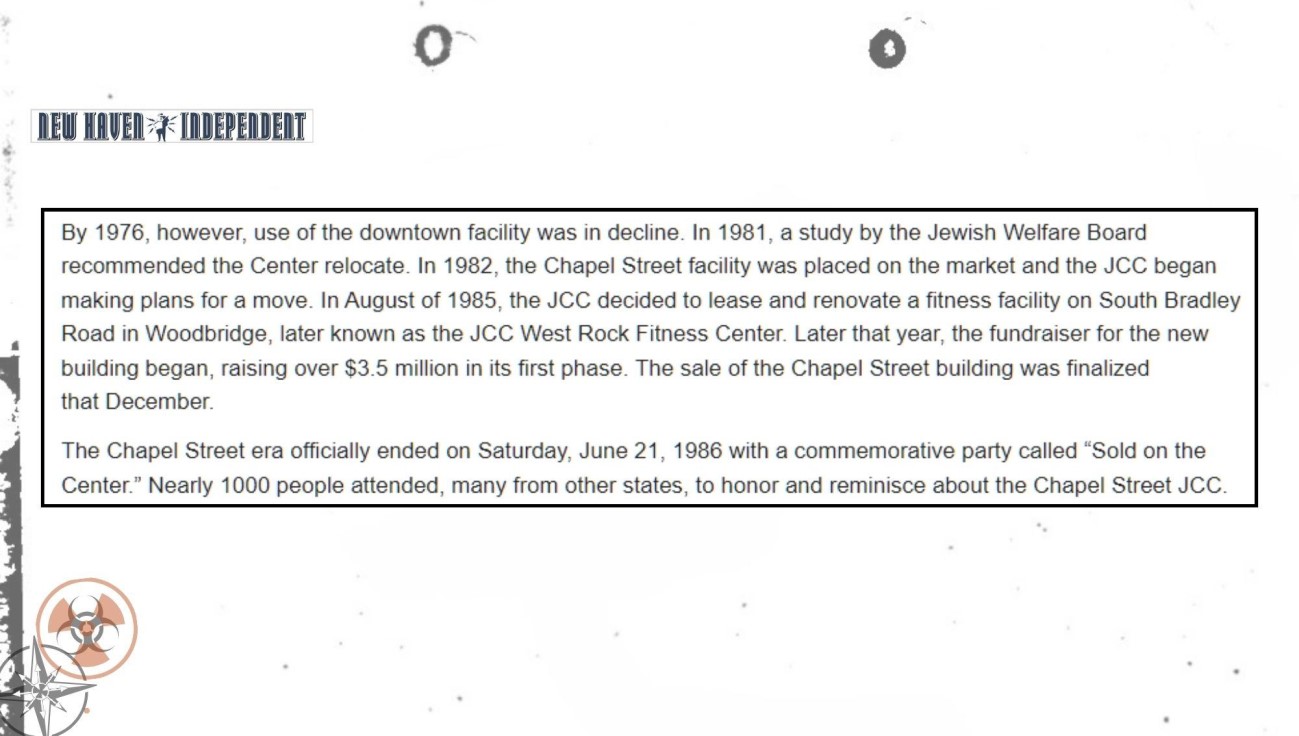
Image Source: New Haven Independent
“New Haven’s Jewish Community Center was downtown on Chapel Street in those
days...It no longer is in that Chapel Street building. (Yale’s art school is.)
In August of 1985, the JCC decided to lease and renovate a fitness facility on South
Bradley Road in Woodbridge...The sale of the Chapel Street (New Haven) building was
finalized that December…
The Chapel Street era officially ended on Saturday, June 21, 1986, with a
commemorative party.”
Text Source: New Haven Independent74
74 New Haven Independent, You Don’t Have to be Jewish,
https://www.newhavenindependent.org/index.php/article/you_didnt_have_to_be_jewish_

Image: Chapel Street Jewish Community Center Building
Source: The Ethnic Heritage Center75
While I was there, they did have a camp in the building, or at least activities, and we
attended once in a while to make the farce seem legit. It was sitting in a gymnasium
room in that Jewish Community Center where I once played the parachute game with
other children. We would sit in a circle and loft a large and colorful parachute into the
air between us. Then, we would run under it, the chaos of our movement hidden
under the material as it fell back to the ground. Beneath that parachute, we would
seek a way out and find a new place to sit. Once everything was over, every spot to sit
was taken, but no child remained in their original place. That is how I see war,
especially as a child of it. In the chaos of war, so many of us change positions, that
within a few rounds, no one knows what side they are on, what side they started on,
or who their enemy is. Have a few generations play that game under a policy of
secrecy and deception, and the chaos becomes complete.
75 The Ethnic Heritage Center, Jewish Community Center, https://walknewhaven.org/jewish-community-center

At least when the recruiter preyed on adult cancer patients, rather than healthy
children, you knew she was probably ending their painful struggle by bringing them to
the mercy of death more quickly. Although, her recruitment tactics were still highly
unethical (and so was giving patients false hope when the only intention was to use
them for the benefit of weapons research for “national security”).
To target some of the cancer patients, she would bring me along for trips on the New
Haven to New York Amtrak train and she carried along a small and relatively discreet
handheld Geiger counter for radiation monitoring. She’d wander through the train
cars until she located someone who had radiation treatment recently enough that
they could cause the numbers on the Geiger counter to spike.
Then she would tuck away the Geiger counter and sit next to them as if she were
simply a fellow passenger in need of a seat. She would strike up a friendly
conversation, which she would quickly steer in the direction of health until they
spoke about their cancer treatment. From there, she would exclaim, “Oh, what an
amazing coincidence!” The recruiter would go on to tell them that she worked for Yale
New Haven Hospital, that she was a cancer researcher there, and that she just
happened to know of an excellent research program that had one remaining available
space.
As far as I know, every single one of those conned cancer patients died.
And her little, “I’m a cancer researcher” spiel she would tell so many of her marks?
Technically, maybe she was early in her career. Those were some of the labs and
projects she would end up supervising as time went on. However, the research
projects I saw her sign off on covered a somewhat wider variety, and not just nuclear
and biological.
When it came to what she told others, her credentials and title seemed to change to
match whomever or whatever her mark was. She once told the public and the Nuclear
Regulatory Commission, in official documents intended to be used in court, that she
had a background in Environmental Sciences.
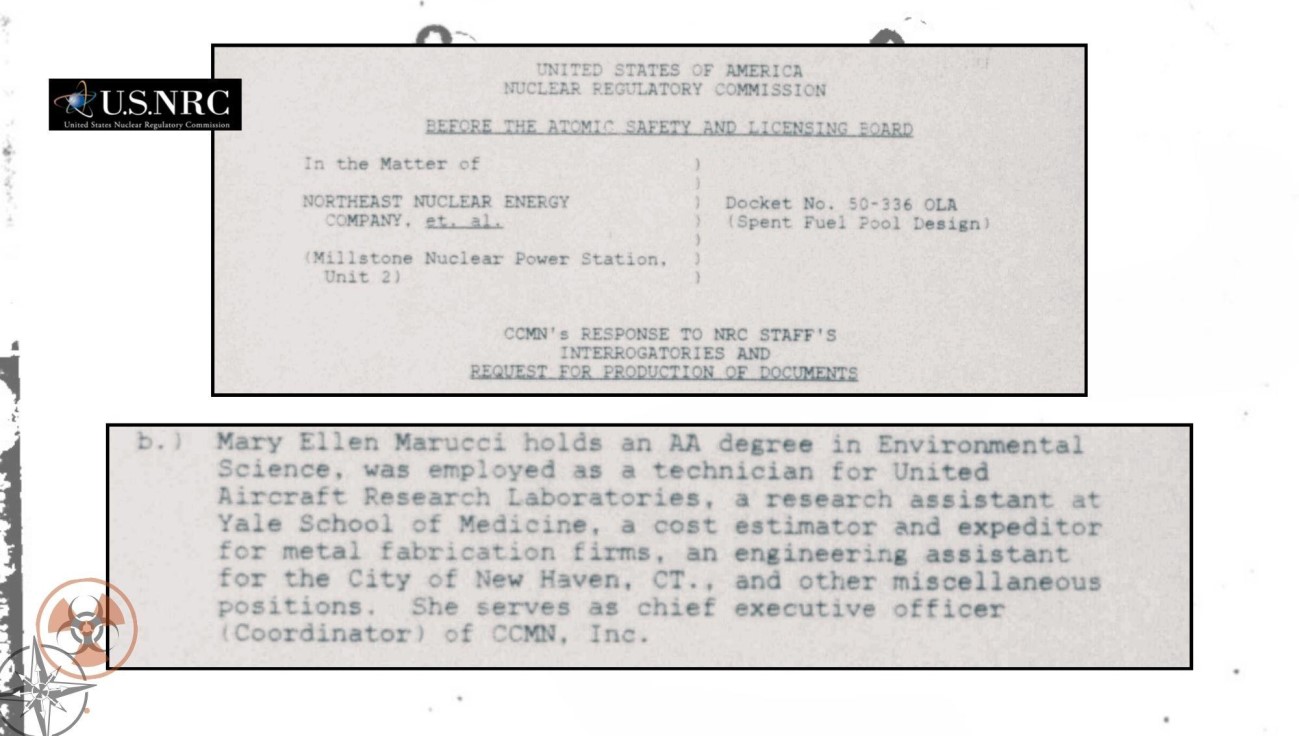
Image Source: Nuclear Regulatory Commission
“.. holds an AA degree in Environmental Science, was employed as a technician for
United Aircraft Research Laboratories… a cost estimator and expeditor for metal
fabrication firms, an engineering assistant for the City of New Haven, CT…. She serves
as chief executive officer (Coordinator) of CCMN, Inc.”
Text Source: Nuclear Regulatory Commission76
It would switch over to nuclear engineering or nuclear medicine when speaking with
antinuclear organizations or potential research subjects.
76 Nuclear Regulatory Commission, United States of America Nuclear Regulatory Commission Before the Atomic Safety and Licensing Board, https://www.nrc.gov/docs/ML2003/ML20034H791.pdf

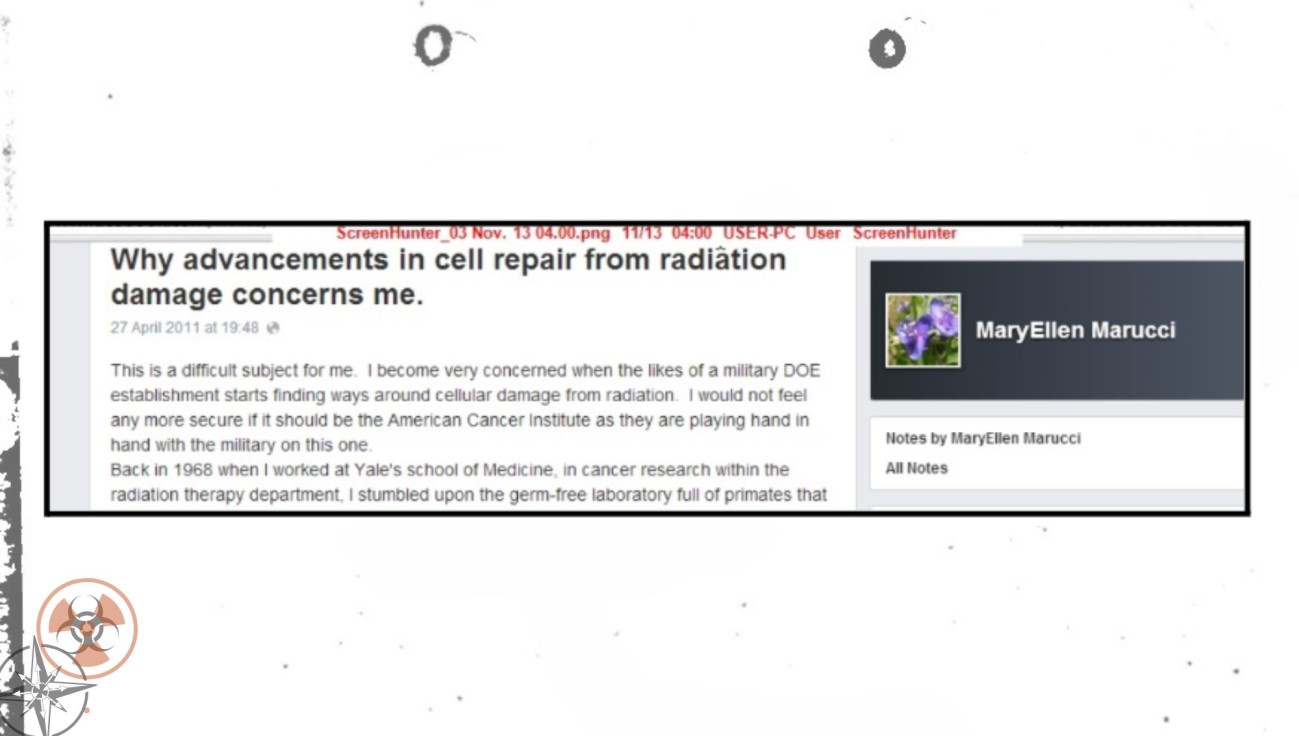
Image Source: 2013 Screenshot Facebook
“When I worked at Yale’s School of Medicine, in cancer research within the
radiation therapy department.”
Text Source: 2013 Screenshot Facebook77
77 Facebook, MaryEllen Marucci Profile, https://www.facebook.com/seedsaver/
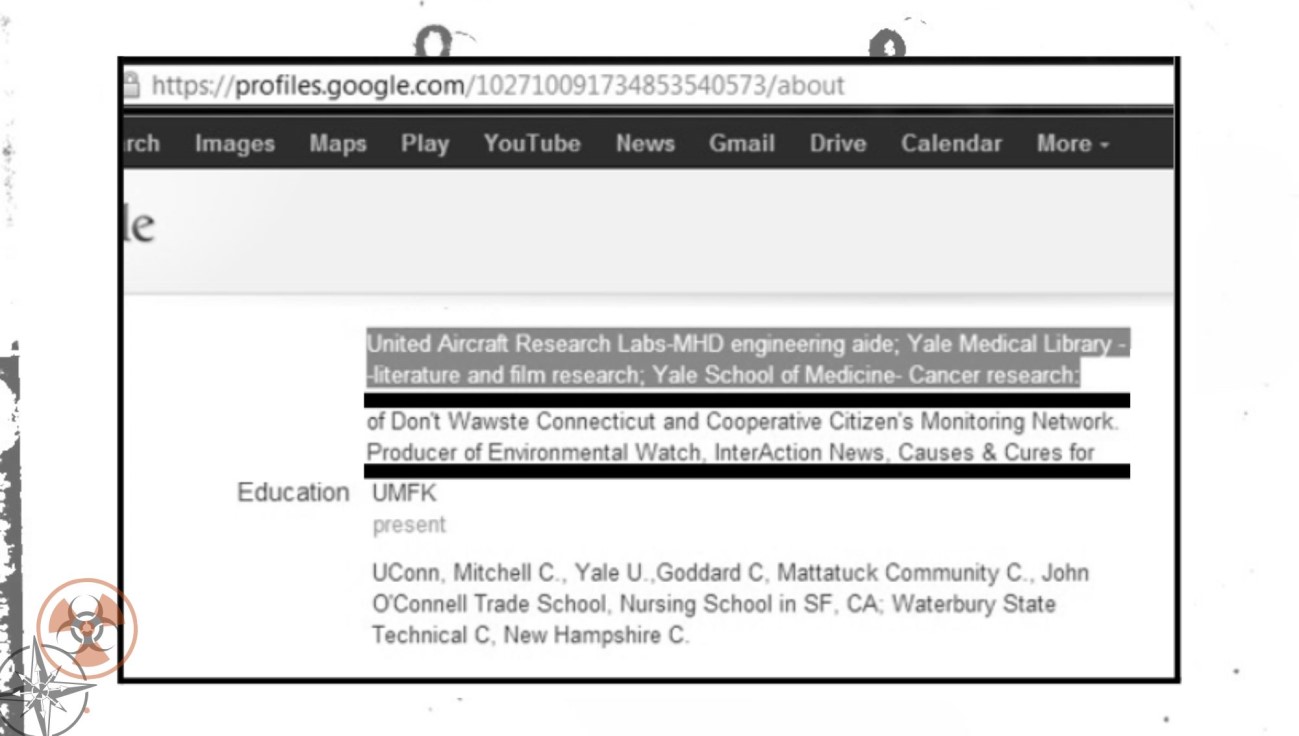
Image Source: Google Profiles 2013 Screenshot
“United Aircraft Research Labs MHD Engineering aide, Yale Medical Library…Yale
School of Medicine - Cancer Research…Yale……UCONN, Yale, Goddard, Nursing
School… ”
Text Source: Google Profiles 2013 Screenshot78
I was growing up in a situation entirely devoid of ethics or honesty, and in which
children were not protected, although we were often there to make a dangerous
situation appear normal and safe. Illusion is not the same as reality.
We were never safe.
And neither was anyone else.
78 Google Profiles, 2013 Screenshot - Mary Ellen Marucci, https://profiles.google.com/102710091734853540573/about

Shortly after our arrival in New Haven, the recruiter started bringing me along to
“Yale movie nights.” They seemed innocent enough, especially if you bring a child
along to manufacture an appearance of the safe and innocent. The York Square
Cinema was a small theater located on the edge of campus back then. On one
weekday per week, the recruiter’s group would rent out the entire theater, barring
anyone else from using it, lock the doors, and only permit Yale students who had
responded to a flyer to enter. The flyers, posted all over campus, had promised a
series of radical movies. The movies highlighted concepts like apartheid, the struggle
of grassroots organizations to fight against corporations to stop the poisoning of
towns by waste runoff, guerrilla warfare, and other topics of interest to young anti-
authoritarian or cognizant students.
We would pile everyone in and start the movie. The theater refreshment stand was
closed (although as a child brought along by the representative of the organization
renting the space, I would still manage to sneak a bag of Twizzlers before everyone
arrived). “Luckily,” the people running the series brought refreshments for everyone
and would have a drink dispenser and a bowl of snacks available on a table they set up
in the back of the movie theater room we would be occupying for the evening. The
beverage in the dispenser was spiked - most likely with whatever expert scopolamine
derivative was coming out of the Yale chemistry lab at the time (I’ll get more into that
later), i.e., a strong hypnotic.
Then, we would watch the movie. Three or four organizers would watch the Yale
students to see what their reactions were throughout the movie. That is how they
would decide which ones to target. It was the same routine every time. They’d slide up
into the seat next to the ideal ones, start a conversation, and lead them off before the
end of the night. I have no idea what happened to the students after that. They were
Yalies, so I can reasonably assume they didn’t go entirely missing or end up sold into
cancer research. But I do know they left in a highly drugged state, with the type of
people who do exploitative, unethical, and blackmail-tinged recruitment. What the
recruiter had been doing at the university and in the prisons of Buenos Aires was
pretty much the same thing she was doing in New Haven, just with a little more tact
since we weren’t in the middle of active state terrorism in 1980s Connecticut.
Did you really think a tiger, or a government, changes its stripes just because it’s in its own neighborhood? That’s where the tiger gets more confident.
It owns the place.
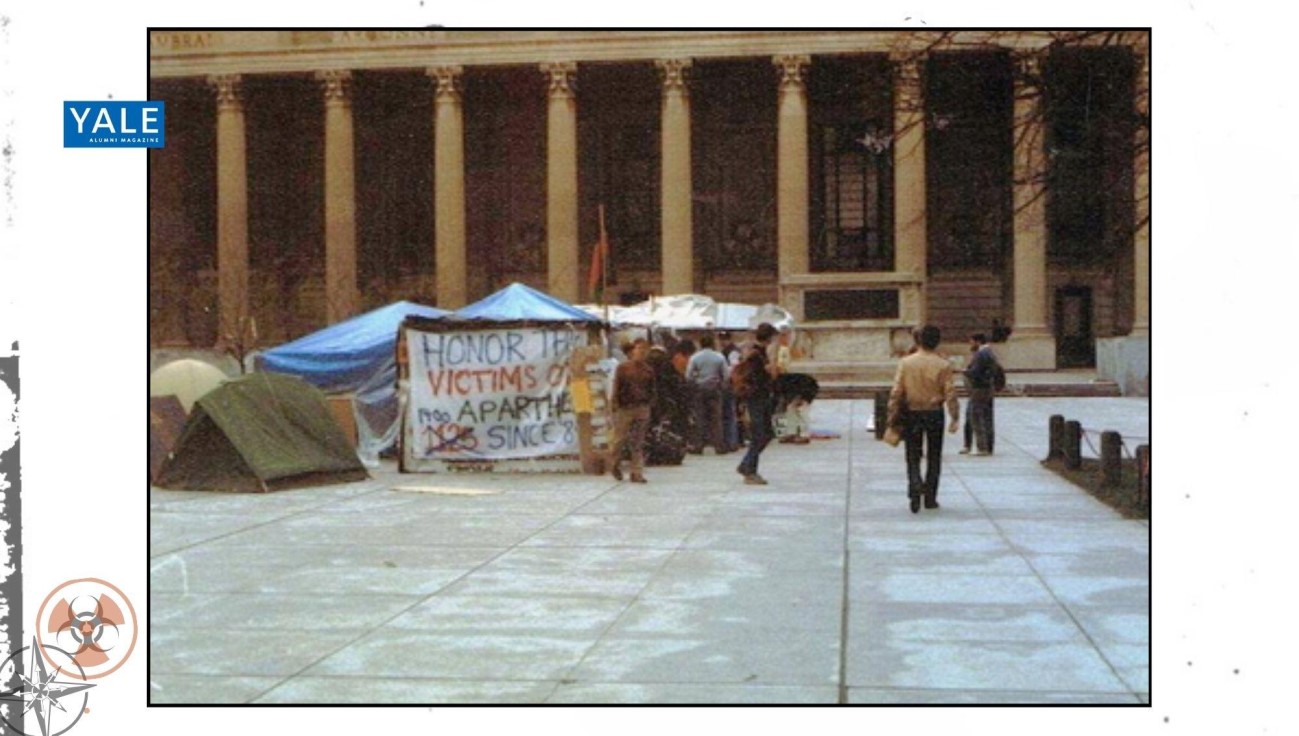
Later, beliefs-based recruitment would come more frequently from the shanty town,
where George Edwards was ever-present. That shanty stood, aesthetically very out of
place, in the plaza between Yale’s Woolsey Hall and Beinecke Rare Book and
Manuscript Library for about two years.
Image: Shanty on Yale Campus
Source: Yale Alumni Magazine79
79 Yale Alumni Magazine, When Yale Activists Targeted Apartheid, https://yalealumnimagazine.org/blog_posts/1649-when-yale-activists-targeted-apartheid

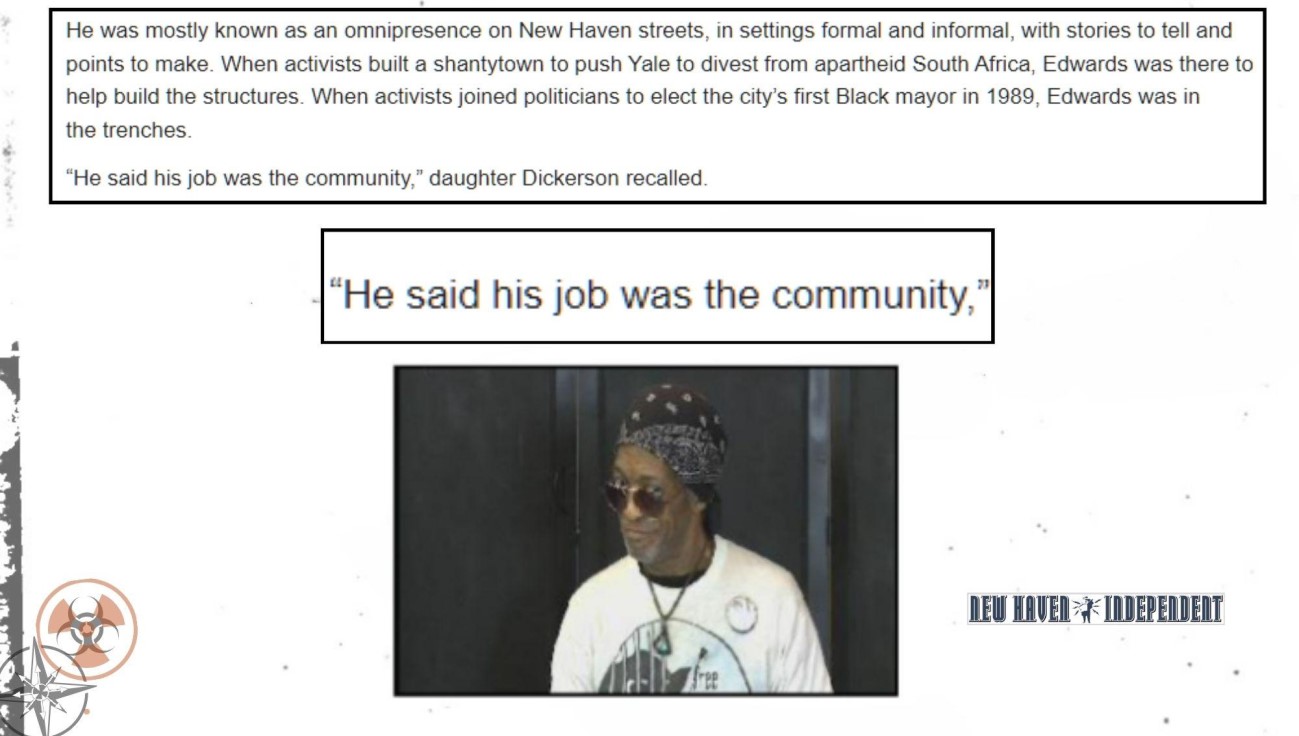
Image Source: New Haven Independent
“He was mostly known as an omnipresence on New Haven streets, in settings
formal and informal, with stories to tell and points to make. When activists built a
shantytown to push Yale to divest from apartheid South Africa, Edwards was there
to help build the structures.”
Text Source: New Haven Independent80
80 New Haven Independent, A Panther Passes On, https://www.newhavenindependent.org/article/panther_passes_on
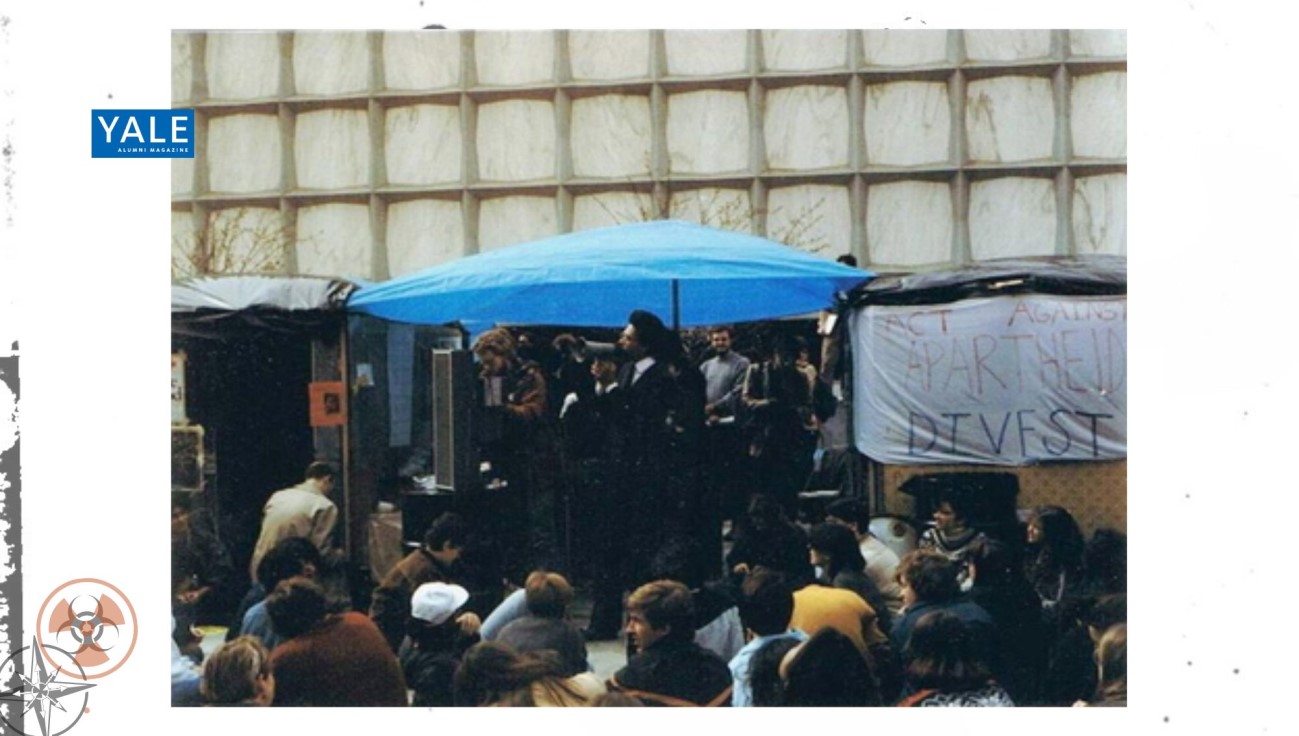
Image: Shanty on Yale Campus
Source: Yale Alumni Magazine81
This type of involvement is standard for the agencies, although it is yet another
classifiable form of “embarrassment.”
81 Yale Alumni Magazine, When Yale Activists Targeted Apartheid, https://yalealumnimagazine.org/blog_posts/1649-when-yale-activists-targeted-apartheid

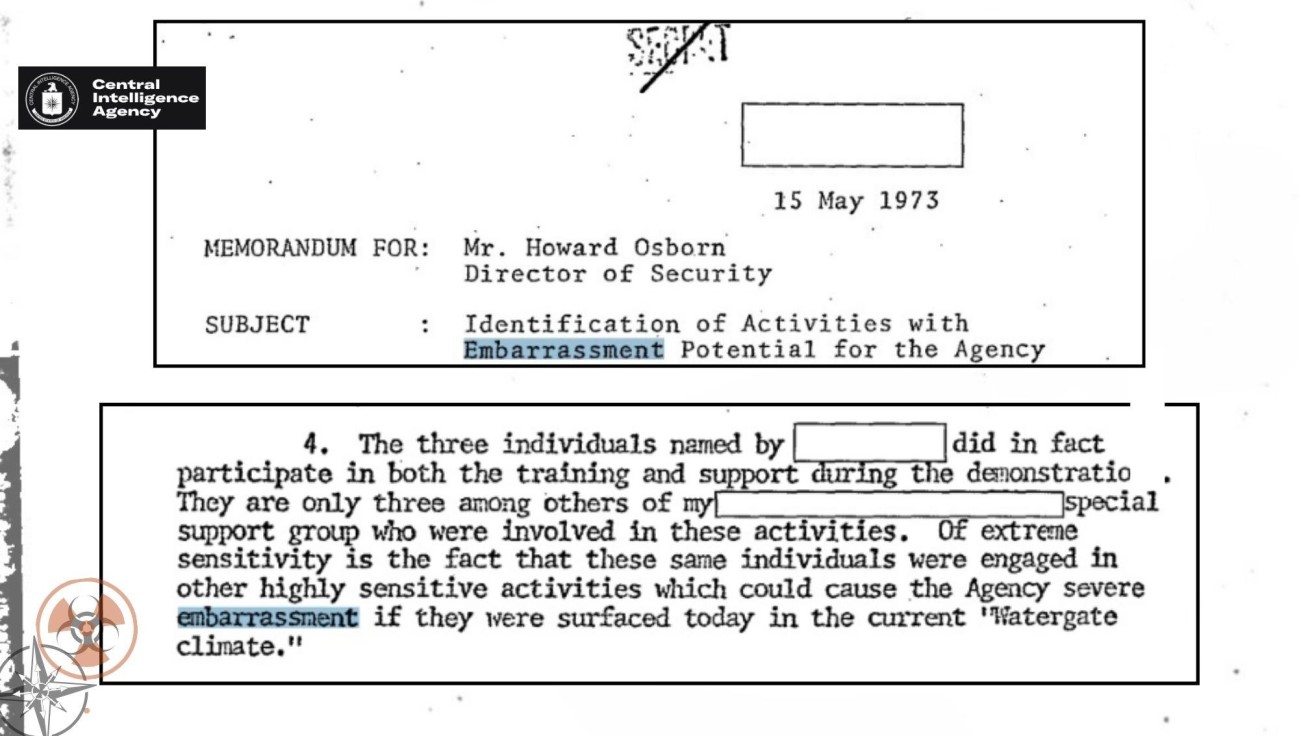
Image Source: Central Intelligence Agency
“The three individuals named by (redacted) did in fact participate in both the training
and support during demonstrations…Of extreme sensitivity in the fact that these
same individuals were engaged in other highly sensitive activities which could cause
the Agency severe embarrassment if they were surfaced today…”
Text Source: Central Intelligence Agency82
82 Central Intelligence Agency, Memorandum for: Executive Secretary, CIA Management Committee, Subject: Family Jewels, https://www.cia.gov/readingroom/docs/DOC_0001451843.pdf
Demolition Crews
The sampling of experiences and highlighted points in history in this book are just
grazing the surface of what I witnessed and was forced to be involved in. To write it
all would require thousands of pages. I saw more exploitative coercion and callous
death in the United States than I ever witnessed anywhere else, possibly because
there is more there, or possibly because I was trapped with the offices that do the
most harm. Both answers being correct is also a valid possibility.
Because I was still unskilled back then and always available for use, there were
occasions on which they quite literally left me to clean it up.
As an example, there was an incident during my freshman or sophomore year of high
school, so roughly between 1991 and 1993. The recruiter and her group had brought
Middle Eastern men with demolition crew experience into the United States on fake
Moroccan passports with marriage green cards, after paying several local women in
New Haven and New York City to marry the men to get them into the country. One of
the women was the recruiter’s sister, a music teacher I had met in my first days in the
U.S. in her tiny Bronx apartment. Another was a cousin with a part-time journalism
job who had been living in an apartment in her parents’ multifamily home. They were
both in their 30s or early 40s at the time. They would both go from having small
apartments (rented and rent-free from parents, respectively) to being owners of nice
homes on large lots in preferred neighborhoods. It is highly likely that they received
funds for the home purchases from their participation in the scheme.
It was clear that the recruiter selected family members because they were close
enough to her to tightly control, and controlling them was necessary. The fake
marriages would be rocky, obviously, because the men had to live with the women
enough to pass Immigration scrutiny. We spent a lot of time in the women’s
apartments in those years, talking them through things and coming up with solutions.
It was sad, in a way, because the cousin had fallen for the fantasy and was actually

upset that her fake marriage wasn’t working out. There were a lot of emotions
involved in keeping up the farce.
However, there were worse conflicts between some of the men, and one of them
ended up murdered, apparently at the hands of another of the men imported for the
planned criminal yet government-funded demolition project. The office at my high
school received a call from the recruiter about an “emergency” with instructions
directing me to an address near her cousin’s house. I took the city bus and arrived in
time to see them working on dragging the body away.
The recruiter’s cousin was still standing there, visibly shaking and in shock. She
nervously talked to me while I ate my sandwich from school in the open kitchen and
watched them haul the dead man away. She asked me how I could eat in that
situation. I just looked at her. I didn’t have a way to respond. How do you tell
someone, whose biggest issues are what to wear and who to fall in love with, that
when you’re always surrounded by chaos, you don’t let the chaos dictate your health,
your hunger, or your well-being? Or at least you try not to.
Eventually, everyone left and I was handed the keys. Alone in the silence of that small
apartment, I cleaned up the blood and tidied up everything else. The entire time, I
wondered if I was dropping hair somewhere, if I’d left a fingerprint, and if I had left
any trace of myself at all. Honestly, I knew I had. I was never a professional crime
scene cleaner. I was thrown into so many insane situations that required a
professional, and I just had to try my best. This was no different. For decades I stayed
silent, partly because I wondered if I would get blamed for a crime because those
were my fingerprints on the cleanup. Looking back at it, I no longer feel the same, not
about that murder. I was fourteen or fifteen, a little too young to be masterminding
events with men who shouldn’t have even been in the country and who were about to
be implicated in something that was much bigger than a young teenage girl with a $5
allowance to buy a sandwich.
I was standing among giants in the intel community, and all I could do was act as if I
was okay with it, as if I were somehow magically unaware of what was going on. On
more days than I can count, I came within inches of death because of it. On several
occasions, it went beyond that line, and I needed to be revived.
And sometimes, I was there for more than the cleanup.
One summer evening, I was standing across the street from the Daily Cafe near Yale,
bored and smoking a cigarette by myself. It was something I had done at least a
hundred times before. Someone a few years older than me, whom I had met a couple
of times before socially, pulled up alongside the curb and started talking to me. He
asked if I wanted to drive with him to the nearby parking lot while he parked his car. I
got in the car since the parking lot was only a block away. It may have been a little
dumb of me. Especially when you consider that we didn’t go to the parking lot.
He kept driving another block or two down Elm Street until we got to a part where
the streetlights had been broken out. In the darkest section, he stopped the car in the
middle of the street. Another car pulled up right alongside us and did the same. He
told me to get into the other car, so I piled into it. It was crowded with several people,
including a woman I had met once before with George, only a few blocks from the FBI
building.
When I met her the first time, George had pulled up in his car with her already sitting
in the passenger seat (entirely unexpected, he’d never given me a ride from classes),
to pick me up on Audubon Street, right as I was walking out from where I was taking
jewelry-making and acting courses through the Creative Arts Workshop and a
basement dance and theater studio in the building across the street. His picking me
up wasn’t so obviously as clandestine of a situation as I would end up in with her next,
but he still seemed nervous and hurried. And, like I said, it was entirely out of
character for him. While in the car together, she seemed overly interested in me and
asked to see my jewelry while we drove. I showed her a pair of metal earrings that I
had made that day. She asked if she could buy them from me.

The next time I saw her, this time in the darkness of the crowded car on Elm Street,
one of the first things I would notice about her was the glinting metal of one of those
earrings dangling from an ear. I don’t normally fixate on women, notice what they’re
wearing, or even talk to them most of the time. After listening to so many females
screaming in the prison when I was little, and then being exploited by a woman since
the moment I left that prison, it has been rare that I can stand their voices, trust
them, or find much in common with them other than the occasional need to learn
something from them about clothing sizes and makeup.
But there she was, and something about her stuck in my mind. Sometimes I wonder if
I saw something familiar in her. Maybe she was an aunt or a cousin of mine. I spent a
lot of life searching for my mother in every face I came across, and in parts of my own
reflection, so it wasn’t unusual that I would consider it when looking at her. The only
difference was it felt like I might have finally found something.
That’s when the driver took a left off Elm Street and headed into an area with off-
campus Yale housing.
We parked and then snuck behind one of the residential buildings and down into its
mostly unfurnished basement. It was summer and the majority of students had gone
home. The building was vacant except for us. There in the semi-darkness stood the
old man the people in the car had wanted me to meet. He spoke for ages and told me
about my family, about aunts and uncles I had never heard the names of before, about
how they were doing and what they were up to. He spoke for what must have been at
least an hour. I had no idea what he was talking about. I acted polite and listened
because he was an old man, but I was sure he was senile and had me confused with
someone else. In retrospect, and considering the situation, that first judgment of mine
may have been incorrect.
Later that evening I would go upstairs to one of the several apartments in the
building. Most of the people from the car were there, plus a few others. One of them
had gotten ahold of my journal after a friend of a friend stole it. The man holding my
journal was a conspiracy theory writer in the making at the time (he would become
published later) and he was absolutely convinced that I was a “high-level Illuminati
mind-controlled slave.” Things got a little weird from there, I’m not going to lie. He
told me that I needed to get in the apartment’s tub to read the journal because “water
breaks the mind control.” I humored him and got in the tub, with my clothes on
because I wasn’t quite willing to humor him enough to strip naked and read to an
apartment full of people while sitting in a tub. I can’t remember what part of the
journal he was the most interested in. Maybe I need to get in a tub with a notebook
and think about it…(that last sentence was a joke).
Not to spoil the fun, but I wasn’t mind-controlled in quite the way he probably
thought. I was primarily silenced by fear, still following the advice of my mother to be
a good victim, and also heavily drugged and pliable on that particular day because I
had run into the recruiter downtown. I’ll get more into the details of that last part
later.
I met with him and parts of that group a few more times over the following weeks in a
different apartment on Park Street. He had a manuscript for one of his books that he
insisted that I read, in order. It was a dull, long, and dry genealogy of at least twenty-
three influential families. I wanted to skip ahead to get to the chapter on the Bush
family, but he insisted I start at chapter one. Did I mention that I’m not good with
names and that it’s useless to make me read a book that is almost entirely names? I
absorbed less than 1% of that reading. It turned out that I would not have the
opportunity to make it to the chapter on the Bush family. That chapter also never
made it into the published edition.
The next time I went to visit at that Park Street building, the recruiter was already
there, waiting for me in front of it. Seeing her resulted in a sudden kick of anxiety. She
led me inside, telling me that everything I was about to witness was my fault (No, I
don’t believe her. It’s more likely this was continuing cleanup from Operation Condor,
since the majority of the people in that room were from South America). Inside the
lobby, most of the members of the group were lined up against the walls furthest from
the door. There were men who appeared to be SWAT (all dressed in black with rifles
that were drawn and pointing at the backs of the heads of three people on their knees
in the center of the room). During all of this, the recruiter continued to berate me and

insist that their deaths were on my hands. That I was responsible. As the first shot
was fired, I turned my head to avoid seeing the result. I still don’t know how many
people died. I left the building and never looked back.
I spent the next week attempting to locate the survivors. I didn’t know what I would
do when I found them, but I had to try something. Finding them was the first step. I
went to the New Haven Police Station, several New Haven Police substations, and the
Yale Police Station. No one knew where they were, until the last one. The officer at
the desk there told me that the group had been taken by the FBI. When I asked what
prison they were brought to, he couldn’t answer. He didn’t know. There was a record
of them leaving a New Haven jail in FBI custody, but no record of where they had been
brought to.
Years later, that would-be author showed back up, alive, in another part of the
country. His books were published but there was something different about them.
Instead of the dry academic and thorough writing about more than twenty families,
he had brought the number down to thirteen families and the pages were full of
ranting religious rhetoric. I think they tortured him until they broke him and he
reverted to religious belief to a manic level, in his mind’s bid for self-preservation and
escape. His father was a minister, so it makes sense that’s the safety his thoughts
would go to during torture. My mind focuses on the pain and turns it inside out into
something else, but I’m another story entirely.
The point is, they broke that man. Is basic information really so dangerous that we
need to destroy people to protect them from it? Seriously. How many people need to
be protected from what is already common knowledge - that rich people with
resources exist, that they have families just like the rest of us, and that some of them
influence the industries and countries they own and live in? And the concept that
some, or even a large percent, of the population might be manipulated and duped - is
that really a state secret? Is it worth destroying lives over?
I found an online live chat he was in years later and quietly listened in, afraid to say
anything that might spook him. He spoke about an execution and still sounded shaken
up by it. There’s little doubt in my mind about what execution he was referring to.


Subversion
You’ve been infiltrated.
You welcomed it in
when it promised an easy path
to short-term solutions
at the cost of everything.
Not every moment was like a slap in the face. Some had to be looked back on to fully
comprehend.
While bringing me along to Washington D.C. to gain easy access to the offices of
legislators (there are documents with their signatures on her behalf later in this
writing), to areas within Yale that even graduate students and most faculty were not
allowed in, and with the smell of her expensive thick wool clothing always filling my
nostrils when she was near - the recruiter would tell me that we were impoverished.
This is the woman who had a large office space in Torrington, Connecticut containing
a professional printing press, aisles and aisles of heavy and neatly organized
equipment on closely stacked professional shelving, and everything of quality -
including her full mahogany desk with a thick marble slab top. That office alone
contained more value than many small museums. And another office she was affiliated
with? Back when I was still small, her address was listed as 150 Windsor Street,
Hartford, a bank processing center inaccessible to customers. I had been to it with
her. She shared access to an office there on the upper level over the processing floor.
She brought me when she was collecting several gold bricks from the large vault in
the bottom level. She needed them for a project. I remember how nervous she
appeared as we exited the back of the building, her carrying them out in an ordinary-
looking canvas bag. I don’t know if the project the gold was for was personal or
business (I assume the latter), but the method of carrying the gold bricks seemed
clandestine and unconventional - in other words, it suited her perfectly.
She even had a nice newer-model car that she would keep parked around the corner
from where she raised me so that she could claim to be without a vehicle, unless she
actually needed to use it. Despite the quality of the vehicle, the area around my feet
was always littered with her empty Coke cans and Snickers bar wrappers when I
entered it. But I digress.
Actual impoverished people tried to explain to me that the recruiter was not poor.
They highlighted their own lives and the quality of their food and furnishings. I
understood there was a difference, but I didn’t listen quite as closely as I should have.
The recruiter had already created a wedge between us and them by telling me they
simply were not educated enough to understand what it was like to be from Yale, and
that their lifestyles were due to a lack of intellect rather than a lack of money. I was
young and she was the authority on things in life, having taken the role of mother, so I
believed her that their choices were simply bad shopping habits.
It wasn’t until I was on my own as an adult that it fully struck me - poverty does not
mean full access to Yale, full access to politicians, and enough equipment and
gourmet food to keep yourself going for a lifetime. Poverty means the discount food
on the lower shelves at the grocery store. It means furniture that will fall apart. It
means not even being able to borrow that piece of equipment, never mind owning
fifty pieces just like it. Poverty is a struggle to get the most out of limited resources.
It’s not a costume to wear like she had.

Distraction & Misdirection
Back in our day-to-day lives while I was still a young teen, the recruiter was bringing
me along to Yale recruitment movie nights, which had moved from the cinema to a
university building beyond Woolsey Hall and down Prospect Street. They would divide
the groups up among various lecture rooms, From what I saw and experienced, either
the drugs varied by room, or the hypnotics simply had a very different effect
depending on the room setting and what type of movie was being watched. The
students who attended were primarily Yale students, as far as I knew, and I believe
most were there to gain extra credit for their classes by volunteering to attend
seemingly innocent college-sponsored social events that were promoted as only
requiring the watching of a few movies.
The first time I went, I was led to a tiny basement room to watch a version of Willie
Wonka and the Chocolate Factory. There were two slightly sketchy students who
smelled like the engineering department. One of them was passing out little pill cups
full of something. Whatever it was, I consumed it. Thanks to the mind-altering
chemicals in it, for many years after, I would have every single part of that movie
burnt into my brain, especially the Oompa Loompa song. While somewhat irritating, it
wasn’t a terrifying or overly concerning experience, at least not by my measure.
Much like the original recruitment movie nights, the nights in the new location were
weekly. On another week, I was assigned to a room that was upstairs with a group
watching Single White Female. General advice: whether you’re safe at home or
surrounded by sketchy recruiters at Yale, don’t watch Single White Female while
tripping. About maybe forty minutes into the movie, I looked to my right and saw
what I thought was a woman being trapped and pulled through a massive tube on the
wall. I decided it was time to take a bathroom break. In other words, on the outside, I
was calmly getting up and leaving to find the ladies' room. On the inside, I was
screaming and thinking I was the next one to get trapped by the tube.
Once in the quiet hallway, I calmed my nerves and took a very slow walk to the
furthest restroom I knew of. I had to pass another movie-night room to do so. It was
towards the end of the building and to my left. From the hall, I could see the students.
They were in the dark, and on the screen was the violent carnage-filled Vietnam War
movie we had been using in several other types of psychological experiments during
that time and in that location. Although, I might note, that after so many years, I don’t
think those were experiments anymore. We were getting the intended results. The
experimental stage was long over. It was psychological manipulation via deceitful
means after the also-deceitful lure of “it’s just a harmless movie night.”
What I saw when I looked in was concerning, more real and concerning than my
temporary hallucination of a tube. The majority of the people in that room were
visibly panicking from being exposed to the movie in the dark while on what must
have been copious amounts of hallucinogens. And the staff and security? They were
blocking the door, not letting anyone leave, and making sure the lights stayed off and
the movie continued. They were actually physically fighting off several of the
students.
I never learned the purpose of drugging and traumatizing a room full of our future
leaders of industry and nations, but I can say I don’t think it was a good one. The long-
term and widespread results have been atrocious and are still snowballing out of of
control as I write this.
One of the staff caught me staring, so I made a little small talk, pretending like
whatever was going on was ordinary. And then, I finally finished my walk down the
hall and into the ladies' room.
While we’re on the topic of drugs, I remember one harvest season when the recruiter
sent me down by a river, on someone else’s overgrown private property, to harvest an
entire field of Jimson Weed (Datura stramonium) she had planted. The landowner had
become suspicious of her and was keeping an eye on the place, so she couldn’t do it
on her own. I’ll admit I went to the library and looked up what the plant was, and

considered using it to get high. But I was too afraid to let loose my grasp on reality, so
I didn’t even try one seed. I simply brought the harvest home to her and handed it
over.
It, or something like it, would end up in my system anyway when she decided I was
more malleable when drugged without my knowledge. A year or two after that
harvest, she found a better supply of drugs via an infamous Yale chemist. The high
school and college students in the area knew him for his LSD. Actually, probably most
of New England knew him for that. People like the recruiter knew him for his unique
and powerful scopolamine and Rohypnol derivatives. Her access to him led to my
waking up exhausted nearly every morning for several years.
For the longest time, I thought I had terrible health and that’s why I was so tired upon
waking after a night of boring dreams, mostly of walking around town with her. Then
little things started painting a larger picture. In the morning, at the city bus stop near
Yale on my way to school, people would approach me who were absolutely convinced
they remembered me from the night before. However, I had been sleeping in my bed
all that night, or I reasonably assumed I was, since I put my head on the pillow at 9 PM
and then woke up to the 5:45 AM alarm in that same bed. According to these
strangers, we’d had long conversations throughout the night, and they would
understandably act offended when I genuinely could not remember them after such
intense evenings together. I told them they had the wrong person.
They were enough to make me wonder, but it wasn’t until a friend was reminiscing
with me about a time he and I were hanging out and having fun with “my mother” (a
time that I could not recall and would not have allowed when sober because I went
out of my way to protect my friends from her by never introducing them) that it
finally hit me. She had been drugging me while I slept, waking me up in that condition,
and dragging me all over town with her until dawn.
I later confirmed it by leaving evidence for myself for the mornings. Any time I felt
like I was drugged and she was there telling me I was dreaming (her usual spiel when I
was high and we were out of earshot of others), I would tear a nail, scrape my arm on
concrete, rip a seam in my clothing, fill my shoes full of sand, or anything else that
logical excuses would not be able to explain. Jumping into pools with all my clothing
on was a favorite. Shoes never really dry after that. The only thing that never worked
was filling my pockets. Those, she always made sure I emptied, and she kept the
contents.
I wasn’t the only target in those years. I was just always close by and, therefore, got
the brunt of it. I never could understand why I wasn’t simply allowed to come along
while sober. I think for her it was about control, and she always wanted a ridiculous
amount of control.
She also controlled my education to an absurd degree, when it was convenient
enough to actually send me to school. I did the math once, and I missed approximately
half of the years of formal education between the first and twelfth grade (senior year).
I was a quick study, but there are some subjects I’ve struggled with because it’s
difficult to just pick up where you left off on things like mathematics when the class
had gone over two years of the foundational blocks of the current lesson while you
were gone. I will never be a genius when it comes to calculus.
As time went on, I went to and participated in several years of discussions and
courses on and related to history, law, and negotiations, primarily via Dwight Hall.
The recruiter was generally there to usher me in. She had plans for my career already.
She wanted me to be the domestic and international negotiator at the table, one more
position to exploit. Having control over one side in a negotiation is good. Owning the
people on both sides is better. But owning the neutral party in the middle too? That’s
perfection from a manipulator’s perspective. At that point, you have the whole table.
No one ever questioned the recruiter about my presence, either because they couldn’t
do anything about it or because they were accustomed to her behavior by that
juncture. She had done something very similar before with her biological sons on
campus in the 1960s and 1970s.

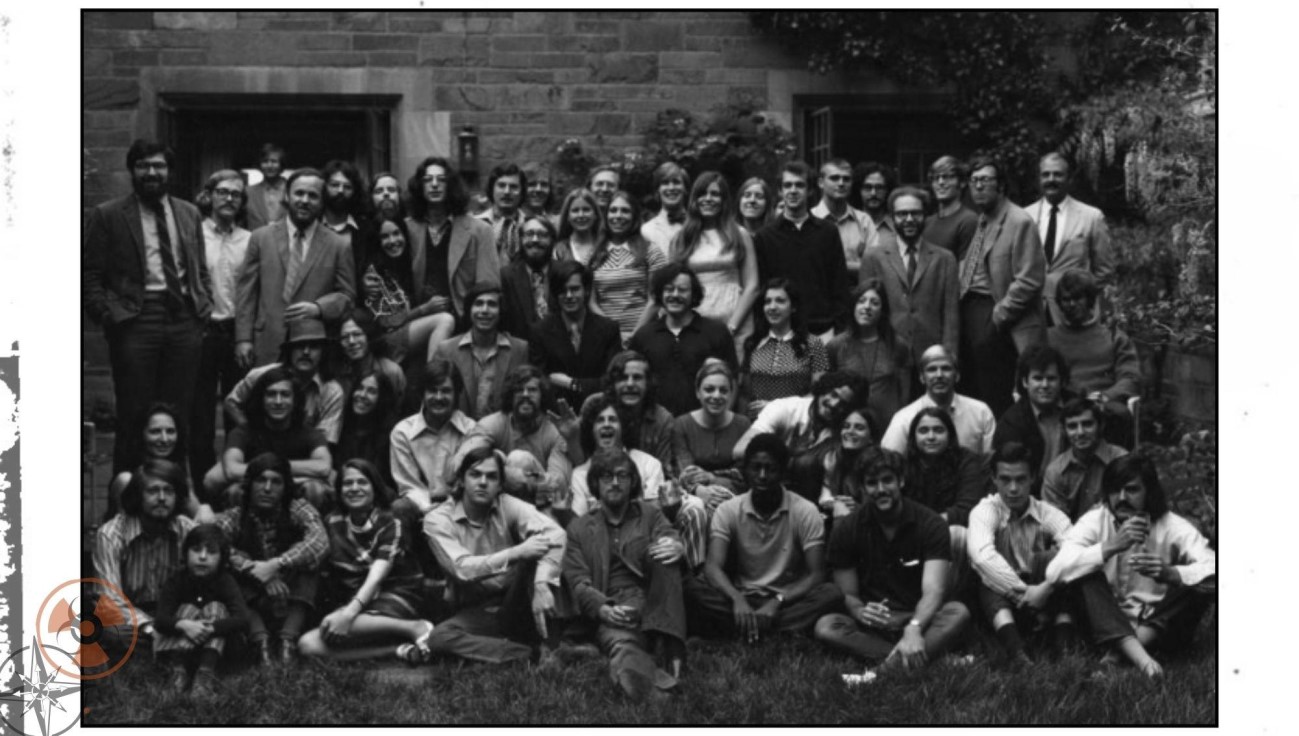
Image: Yale Campus, Group Photo. Recruiter: First Female in the Top Left Portion of the Group. Children: Bottom Left.
Source: Unknown Photographer83
Thanks to her, I’ve spent more time in lectures, discussions, and the stacks at Yale
than most post-grad students have. When I reached out for help years before about
being kidnapped from my mom and was given a heartless response of “But you’ll have
good schools here,” that soulless answer wasn’t entirely wrong. I have an education
from one of the best universities in the country (and, no, it’s still not an adequate
replacement for my mother, my home, my safety, my childhood, my freedom, my
language, my culture, or my country). Later, I would attain a postgraduate degree to
authenticate it, after being railroaded back into the same field I’d been forced to
attend classes on at Yale. I would obtain the documentation from a spin-off
department of Berkeley professors who decided to relocate to a university someone
without a trust fund might actually be able to afford. Unlike the recruiter, I don’t have
to obscure my credentials. I have them. I may not particularly want them, but I have
them.
83Unknown Photographer, Photo on Yale University Campus
Back in New Haven and the surrounding area, I also went along to and was abandoned
for hours and days at endless classes, discussions, and conferences on countless
topics, ranging from nuclear energy to the history of native tribes.
I spent one summer at Wesleyan University in Connecticut, taking a course in
genetics. It was a residential science program for young scholars and had been
covered by a scholarship. In order to be allowed to attend, I had to promise the
recruiter that I would not take any genetics courses. So, they were the first thing I
signed up for. It was a nice reprieve from New Haven and I had an enjoyable time.
They even had us spend a weekend at a military camp I had attended when I was
much younger. I was always the last over the wall of the obstacle course when I was
small. But against a group of mostly unathletic science students? I was the second one
over that wall. It was a nice feeling, even it was almost like cheating.
The only problem that arose during my entire time at Wesleyan was in a genetics
course early on. They asked us to compare our visible dominant and non-dominant
traits with a parent’s, using photographs. The professor was certain I had not paid
attention or done the work correctly because, as he said, “There is no way you could
be related to that person.” The recruiter’s crimes had a way of seeping in and ruining
things for me even when she was far away.
On a different campus in New England, she and I once attended an excellent lecture
by Michio Kaku that coincidentally did not match up with what he would later state in
public media, at the behest of the Japanese government, after the Fukushima incident.
It’s possible that his theories simply evolved through the decades. It’s also more
probable that when on television as a spokesman for the nuclear industry, he was
saying whatever the government and corporate script told him to say. In the lecture
hall, with only a hundred or so sets of eyes on him, that nuclear physicist told us that
it’s not short-term high-level radiation exposure that is the most concerning for
damage on a cellular level (although, obviously, it’s still not safe). It’s sustained low
levels of radiation that do the most damage, such as those that persist in the
environment at industry-determined “safe levels” long after an accident.

I even ended up in an extracurricular course on social engineering taught by people
who were both highly educated and cult-level insane. They combined guided
meditation, visualization with psychedelics, and visual training to enhance their
instructing of us on topics pertaining to mechanisms used in social engineering. We
learned how to guide populations through intended funnels, find squeeze points, and
utilize those as needed until the people moved through the funnels as we intended,
self-sorted into the right areas where they were needed, and agreed to take on extra
costs and responsibilities at their own expense. We did this by using a combination of
societal pressure, fear, need, the threat of law, and financial incentives and
disincentives. Visually, it was a lot like an elaborate hamster maze made of tunnels.
One of the first real projects they allowed us to work on was the early planning for the
public acceptance of what would eventually be named Obamacare.
From a related faculty lecture series I had been dragged along to that was happening
in those same years, here’s a paper exploring the concept of mechanisms in social
engineering (law, in this case):
Image Source: Yale Law School Lillian Goldman Law Library
“The lawyers may be teaching the scientists that the lawyers have invented the
‘perpetual motion machine,’ an elusive apparatus long sought by scientists. It turns
out to be a social rather than a physical mechanism, and in legal circles it usually

goes by the name ‘law reform.’... From any location in the legal system we can
always imagine another point (by which I mean another configuration of the
relevant legal rules) we would prefer. If we were to array these points
incrementally on a graph, they would probably describe a circle. Whenever we
actually find ourselves in a regulatory system, we tend to prefer taxes. Whenever
we are using taxes, we suspect that subsidies might work better. Of course, when
evaluating the use of subsidies, we are strongly attracted to criminal penalties. And
to complete the circle, when we are considering the ineffectiveness of the criminal
law, we long for the strengths of the tort system.
…
We can try to put the pieces of the machine together in novel ways that will
produce better and better results, so that its motion traces an upward spiral
rather than a mere circle. The panel has been given this sort of problem of systems
design. How can we make motion yield progress? The question put to the panel -
’What do we wish from the system?’ - is so broad that the meanings of both ‘we’
and ‘the system’ are unclear. For present purposes, I will imagine that the ‘we’ in
the question is some sort of, if you will forgive the term, a neutral placeholder.
That is, we do not know who we are. We, the system's engineers, might turn out to
have any position in the social system we design. The social ‘system,’ as I imagine
it, should include but not be limited to law.”
Text Source: Yale Law School Lillian Goldman Law Library84
Sitting on orderly mats on the floor of a large room with the lights off, we walked
through the function of each of the mechanisms while visualizing the whole structure
in front of us with the help of the drugs. Looking back at it, I bet something similar
could be done much more ethically, and with less potential brain damage, by utilizing
3D modeling. That said, we probably knew about funnels long before they became a
part of common business terminology, and the lessons are still permanently burned
into my brain. The learning model may have been too new age and potentially
dangerous, but the results weren’t the worst.
84 Yale Law School Lillian Goldman Law Library, A Comment on Causation, Law Reform, and Guerrilla Warfare by Mashaw, Jerry, https://openyls.law.yale.edu/handle/20.500.13051/342
After that course, I started getting invitations to think tank sessions. For the most
part, they all started with the same basic rules. The military brass would break it
down for us:
We needed to create and hone non-standard warfare strategies and tactics that came
with plausible deniability. We were told that in a world in which countries had
effective defenses and in which we did not want outright war due to the risk of
nuclear war, we needed to create penetration strategies that could get through
without triggering a country’s defenses. As for attacks, each and every attack we
planned needed to be attributable to something else. Industrial accidents reached the
top of the list.
As time would go on, long after those sessions in which we worked together to make
sure that each and every flaw was fixed before presenting our final weapons and
accompanying strategies, I would peruse the news to see which, if any, of our ideas
had been used. It turns out, probably quite a few were, and they were being tested in
and/or used against the very country we were standing in. The Deepwater Horizon
oil spill, and the resulting use of Corexit, always find their way to the top of that list of
potential results. Of course, whether it was a result of one of our think tanks or not
will always be something that can be questioned. It was designed to be.
Plausible deniability.


Image Source: Ecotoxicology and Environmental Safety via PubMed
“In 2010, nearly 7 million liters of chemical dispersants, mainly Corexit 9500A,
were released in the Gulf of Mexico to treat the Deepwater Horizon oil spill…
Our results indicate that Corexit 9500A is highly toxic to microzooplankton,
particularly to small ciliates, and that the combination of dispersant with crude oil
significantly increases the toxicity of crude oil to microzooplankton. The negative
impact of crude oil and dispersant on microzooplankton may disrupt the transfer
of energy from lower to higher trophic levels and change the structure and
dynamics of marine planktonic communities.”
Text Source: Ecotoxicology and Environmental Safety via PubMed85
Remember the book about the baby whale I told you about earlier? Its surviving
was unrealistic because the ocean would not contain anything for the whales to
eat. In other words, these are the types of events that can lead to food chain
85 Ecotoxicology and Environmental Safety via PubMed, Toxicity of Dispersant Corexit 9500A and Crude Oil to Marine Microzooplankton, https://pubmed.ncbi.nlm.nih.gov/24836881/
collapse. Combine enough of them, and humanity will start having a very difficult
time finding something to eat.

Normalization of Internal Exploitation
The words that carry the most regret are poignantly short:
“If only I had known.”
I settled into my life and role. What choice did I have? Every time I reached out for
help, people would either act dumb or become targets of the kidnapper I had been
forced to live with. She used blackmail, threats, harassment, drugging, hardcore
interrogation techniques that would leave even Gitmo workers questioning morality,
manipulation, and when that failed – murder.
She truly was the dark shadow that hung over my life. I felt profoundly personally
responsible for each person harmed, and it tore at me. For years at a time, I ceased to
reach out for help. I didn't want to do further harm. It was bad enough when it
happened to me. After all, that was inevitable. But I couldn't stand to watch it be done
to others. I still felt an underlying connection with humanity back then, and I could
feel their pain on a deep and tangible level.
So, I endured.
On a self-preserving and less altruistic level, I was often scared to say anything when I
was asked if I was okay. I would analyze each situation and reasonably assume that
the person asking would not be effective in going against the recruiter to save me,
even if I told them the truth. Their failed attempts and my admitting that I was
uncomfortable with what was going on, at least to some degree, would risk my hard-
earned reputation as completely willing, blind, and accepting of what I was trapped in.
That reputation was important for my safety in the situation I was ”legally” obligated
to remain in as a minor. It made me seem harmless and on the team of those who
owned me, rather than appearing to be an enemy. In addition, more than any
potential would-be savior, that hard-earned status was truly vital for any potentially
effective future exit plans. I was going to have to crawl out on my own, but I was also
going to need to use their activities as a launching pad for my plans, so that they
would let me come along as an assistant, and I could then use the situation and their
weight to get my own objective reached. As a tool, I needed to become a wielder of
tools. It wasn't easy from my position. All I had to work with was their trust in me.
Reputation is always key. During those years, so were endurance and eternal
patience.
I did everything I could to protect the world from the people I was trapped with in
that situation. I insulated strangers from it, I never invited my friends home, and I
sacrificed myself more times than I can count – because I lived with the enemy. I
knew their tactics, and outsiders didn't.
I also did it because I still had faith in humanity, thanks to memories of my mother in
Argentina. Those memories and feelings of connection were the flame of life that kept
me going through the darkness all those years, even as I was intentionally drowned
and revived over and over again in a room beneath Yale New Haven Hospital, drowned
for what purpose I will never understand.
It’s possible that room saw even more human suffering than I did in those years. It
was a large storage room, accessed via a somewhat active lower hospital hallway, and
then a very short hall that branched from that. It was directly at the end of the short
hall. The room was large enough to hold dozens of pieces of equipment. When near
the back wall of that room, especially on the right side, I could hear the cars in the
parking structure it must have shared a wall with.
Because it was officially deemed a storage room, no one had to sign any lists,
documents, or schedules to utilize it for their research purposes. It was an off-the-
books medical lab right on Yale’s campus, in full sight of anyone who walked by. The
best part of it, from a research perspective, was that allocating expensive or heavy

medical equipment to it without approval was incredibly easy. All you had to do was
send the equipment to storage, a process that required no oversight at all.
The research I witnessed there went against humanity. However, not all of it was
quite so dark. The room wasn’t only used by the recruiter’s professional cohort
(although, they definitely had first priority). The paperless loophole that it provided
was also being utilized by some of the university’s graduate students. In order to meet
the unrealistically high expectations and reputation of Yale research proposals being
of an almost clairvoyant level of accuracy in predicted outcomes, they actually needed
to test their theories before asking an ethics board for approval to test them. They
needed to ensure that the result of each proposal would lead to a success. The off-use
lab was incredibly convenient for exactly that. And in all honestly, they may have used
the room more. After all, military research doesn’t require the extra work of gaining
an ethics board’s approval. It’s unethical by nature, and that is accepted because it is
presumed any of the research is for the benefit of national security.
One semi-example of the room’s use would be Charles Morgan’s utilization of it (if you
remember, he was the one who would go on to be cited as a CIA psychiatrist in a
Medscape article later in his career). While he was still a student, he utilized the room
to test his “more humane” military interrogation techniques. He had a (now published)
theory that people of certain ethnicities respond differently to coercive interrogation.
I was there for that one… that or multiple students were fighting for foreigner
interrogation grants during that time and I have him confused with one of the hoard.
Either way, apparently my being from South America and the tiniest bit Iranian was
enough to qualify me as a participant in that earliest research.
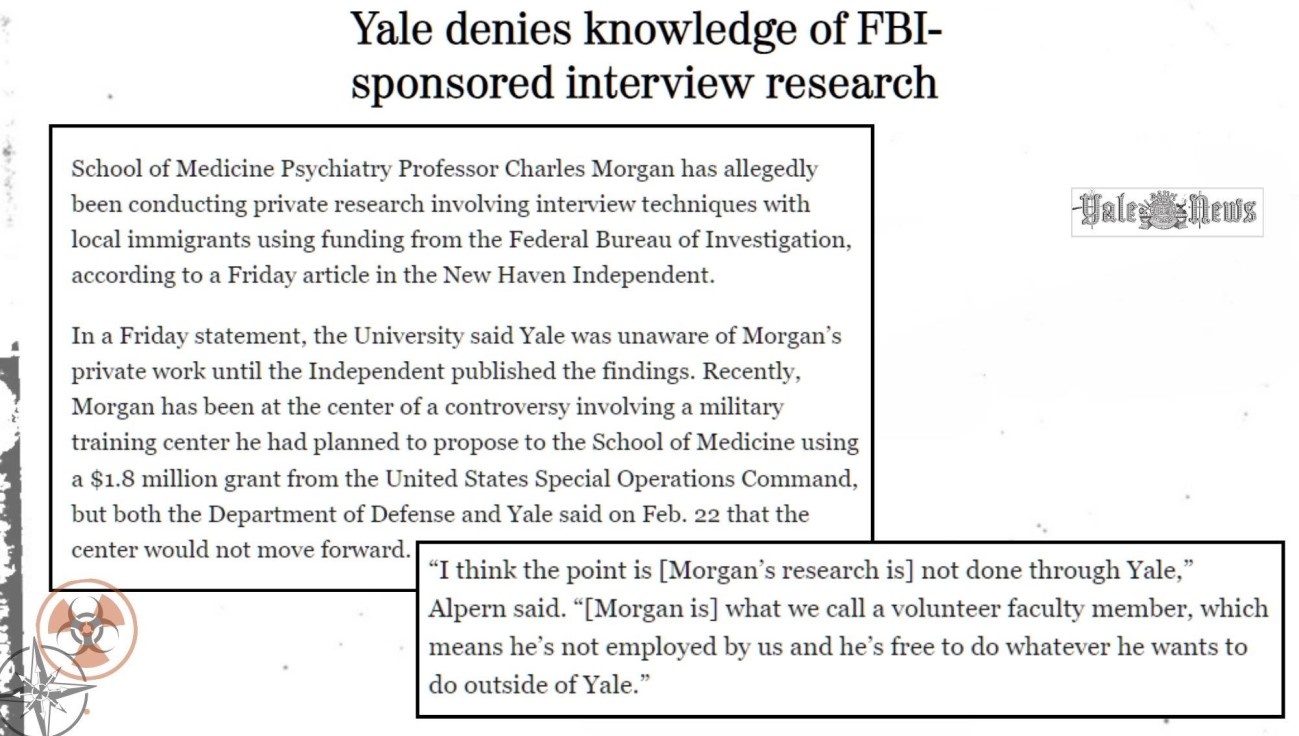
Image Source: Yale Daily News
“School of Medicine Psychiatry Professor Charles Morgan has allegedly been
conducting private research involving interview techniques with local immigrants
using funding from the Federal Bureau of Investigation.
….
‘I think the point is [Morgan’s research is] not done through Yale,’ Alpern said.
‘[Morgan is] what we call a volunteer faculty member, which means he’s not
employed by us and he’s free to do whatever he wants to do outside of Yale.’”
Text Source: Yale Daily News86
Unfortunately for me and my incredibly unlucky timing in life, some of my time at
Yale overlapped with when he was a student at the university.
86 Yale Daily News, Yale Denies Knowledge of FBI-Sponsored Interview Research, https://yaledailynews.com/blog/2013/03/04/yale-denies-knowledge-of-fbi-sponsored-interview-research/

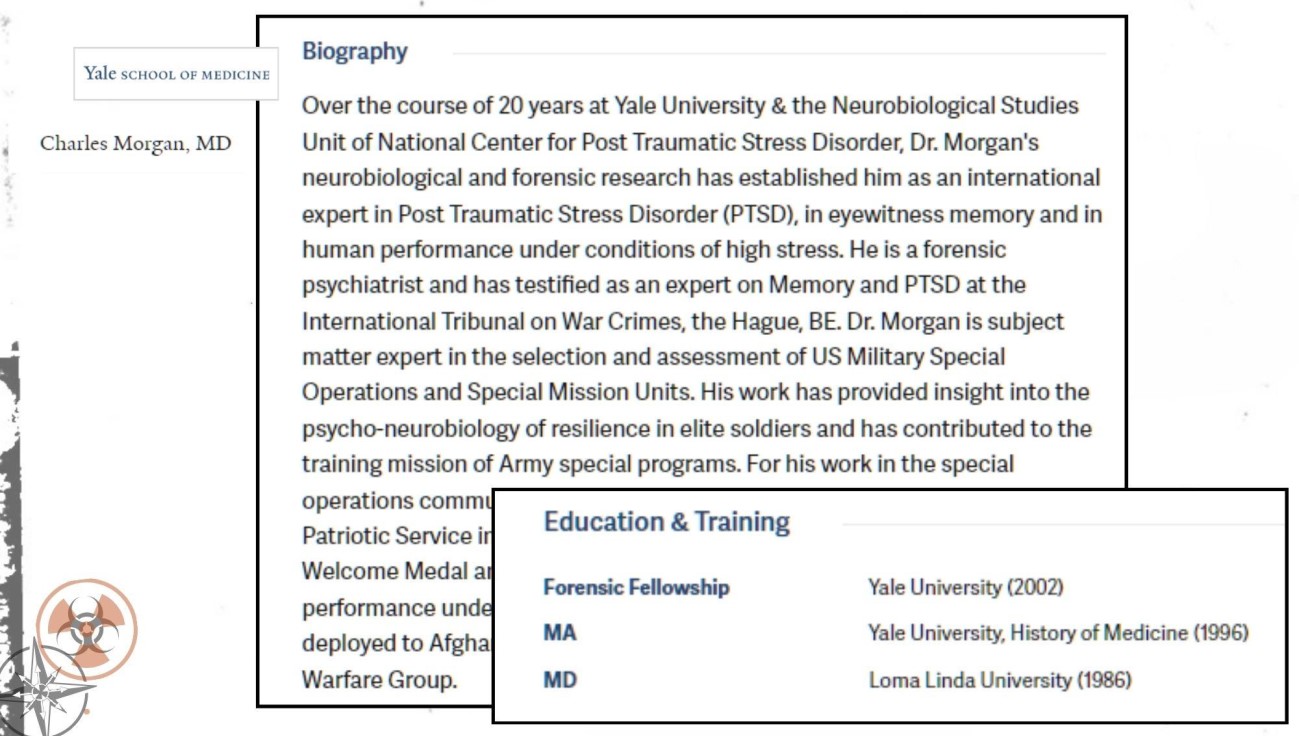
Image Source: Yale School of Medicine
“Charles Morgan, MD
Associate Clinical Professor, Psychiatry
…
Education & Training
Forensic Fellowship - Yale University (2002)
MA - Yale University, History of Medicine (1996)”
Text Source: Yale School of Medicine87
Because of the nature of the research that went on in the off-use laboratory, and the
fact that I was sent down there on my own dozens upon dozens of times to assist and
otherwise be a part of that research (the drownings come to mind, more on that in a
87 Yale School of Medicine, Charles Morgan, MD, https://medicine.yale.edu/profile/cmorgan/
bit), the recruiter felt the need to ensure that I didn’t talk about it. What she would do
had happened hundreds of times before, to the point that I eventually knew each
distinctive part of the routine. This is just one location and one example:
The entrance I used was in a smaller building. It had a security guard and a hall that
inclined down for long enough that it likely extended beyond the footprint of that
building. There, in the sublevel, it met with other halls that would lead to the off-use
lab. One time, the recruiter came with me. She asked the security guard to show us
footage of me entering the building by myself. He complied. He brought us into the
security room with the monitors and found a recording of me entering the small
lobby.
That’s when the recruiter started screaming at me. Her methodology was always to go
at the subject as if it were not real, or as if we were talking about someone else’s
experiences. She berated me and said things along the lines of “That is such an idiotic
thing for her to do. Imagine if it had been you going through that lobby.” Then, as was
standard, she next attempted to make me feel personally ashamed about the
incident/location/being in the location (like I said, she had done this hundreds of
times after bringing me places she didn’t want me to discuss). She would say
something starting with “Who would do that? What is wrong with them?” and
continue on that trajectory. I was then expected to react in shame and side with her,
agreeing that only terrible people would have been there. At which point, I’d start
lying for her, and claim I had not been there, and then attempt to convince her of
such. Obviously, there were drugs in my system… At least, I seriously hope there
were. I’d hate to think that a mind can be that easily broken without them.
The interesting thing, in this case, was that we did it in front of the video recording,
playing on a loop, of me entering that building. An hour or so into her screaming me
down, I had become convinced (in that moment) that I had never been through that
lobby on my own, despite the evidence playing out on the screen right in front of me.

As for the drownings, I would be asked to arrive with a bathing suit and towel for
those days. One day in particular stood out to me more than the rest, because of the
conversation and lack of drugging. As I stood in front of a jacuzzi tub taking up a
fraction of the space in that large room, the researcher there told me to get in and
then she said, “Don’t worry. We won’t be drowning you this time.” I always buried my
reactions to everything, but that? Even I twitched at that. This time? That meant it
had been done before. I got into the tub. Next, she began to lower a plastic sheet until
it was nearly in contact with the water. She told me that I would only be revived if I
behaved and died without a struggle. So, as the plastic sealed to the surface of the
water, leaving no room for air, I submerged myself silently, held my breath, went still,
and prayed they thought I was dead before I really was. My next memories were on
that cement ground, outside the tub, coughing up water as someone stood above me. I
don’t know how close to death I had come or if I had passed that threshold.
The blonde girl I mentioned previously, whose family had been coerced into enrolling
her as a research participant while believing they were signing her in for an
opportunity to participate in camp activities and meet people of influence at Yale, I
witnessed her dead body in a room in those same halls. She had never returned from
beyond that threshold. While I had been revived after they drowned me, they could
not revive her. Sometimes I wonder how many people have died from what I survived,
and why they had to. And why I had to endure. There’s a saying, “There is no rescue
crew.” It’s been incredibly true in my experience.
I could only remember glimpses of those moments of my drowning, other than the
one evening I mentioned, but my body remembered every single second of every
single time. As I went through life, I would randomly feel like I couldn’t breathe, that I
couldn’t get in enough air to breathe. It would hit me at any moment, with no warning
at all. I went to my pediatrician in a panic one day when I was near his office and was
convinced it was asthma. According to him, my lungs were fine, although he noted the
possibility of child abuse when writing in my medical records.
What I was experiencing wasn’t asthma. It was the lingering physical anxiety and
reaction from those moments. I had developed a type of post-traumatic stress
disorder (PTSD) only referenced in literature on waterboarding victims in
Guantanamo Bay. Later on, I actually felt a sense of relief in learning that my response
was normal, despite the situation itself being abnormal. While looking for information
on how to deal with the lingering effects years later, what I first saw was significant
enough to me that I paused and screen-captured it.
Image Source: Wikipedia, 2013 Screen Capture
“The patient…would panic and gasp for breath whenever it rained even years after the
abuse.”
Text Source: Wikipedia, 2013 Screen Capture88
To me, it meant I was okay. My reaction was natural. It was only the situation that was
not. That was something I had needed to hear for an incredibly long time.
88 Wikipedia, Waterboarding, https://en.wikipedia.org/wiki/Waterboarding

Although I was an experienced and skilled swimmer (military camp did something
right), I quit swimming in the year of the drownings. I haven’t enjoyed it since. As of
this writing, the last time I went deeper than my waist was to save someone’s life, and
that was seven years ago.
I became a cigarette smoker shortly after my experiences with being drowned in that
cavernous room. When I had a random unprovoked feeling of drowning, a cigarette
would quickly open my lungs and reduce my anxiety enough for the feeling to fade. I
became a chain smoker and remained one until I was twenty. Time has changed my
response a little but I still reach for something outside of myself to save me from that
sense of drowning. I also experience that panicked sense of not being able to fill my
lungs completely less frequently now. It usually only hits when remembering the
events. I’m currently drinking an iced coffee and praying it stops the coughing
triggered by the memories from writing this, even though I know the only thing that
will truly make the moment stop is to finish writing this section and move on to the
next.
Despite what I was put through, I still dragged through life, discovering that coffee
was my greatest ally by the time I was fourteen years old. I spent my time often in the
halls of Yale and Washington DC, left there to occupy myself while my kidnapper and
others worked. I argued philosophy, ethics, and practicality with the people I met
when it came to topics of control, governance, and exploitation of human resources.
My arguments fell on deaf ears. I tried my best to advocate for the people that I still
cared for. Without a tribe of my own, without a country of my own, I felt everyone's
pain. I wanted to create a better life for them where it mattered and where I was
standing - where policies were formed. I was still young and naive, but I was also
growing a spine due to sheer exhaustion. I could no longer maintain my fear of those
with more power than I had. It took too much energy to do so. In my mind, we were
already on the path to becoming equals.
I had an unparalleled amount of freedom and access, despite being a slave, or maybe
because of it. There was no one there to worry if I came home at 3 AM unless I was
needed for a task. No one told me “Don’t dive that deep!” or “That’s too high to jump
from.” I had a natural survival instinct, but I was also young and unfamiliar with a
conventional upbringing and expectations of caution. Many times, I went far beyond
the traditional limits of safety.
That freedom would eventually lead me to stand on the sidewalk in front of Cutler’s
Records with a friend at a late enough hour to run into the infamous Yale chemist, in
the flesh. He came down the sidewalk, walking backwards. To this day, I have no idea
if he was high on his own drugs or if he was attempting to trick the nearby Yale
surveillance cameras. As he passed by, he slipped a small paper sachet of pills into my
hand. I was never into pills. I didn’t trust them. But this was a chemist who was
infamous, someone whom whispers about could be heard across the entire region. I
kept the pills. He had too much clout. I couldn’t throw them away. What I had just
experienced was the teenage equivalent of having Elvis or God walk by and hand you
something.
I held onto those pills for at least a week or two before finally getting up the nerve to
take one. I was sitting on the grass, in the dark of night, in front of the Law Library
with a friend. We both took a pill. My memory went flat. There’s nothing there. The
next thing I remember was when we were briskly walking several blocks away near
the train station. The moment we stopped walking, there was a memory blank. The
next thing I would recall was walking from the train station to his friend’s house, half
the state away. And that’s how the experience went. If my heart rate was high enough
from anxiety or exercise, it would push me past the amnesia barrier and I’d have a
memory from it. But everything between? Absolute dead space.
That morning, as the sun rose, I came down from the drug and became aware of my
surroundings on the beach. I was in the middle of a lengthy conversation with my
friend. I couldn’t remember what we had been saying or how or when we had gotten
there.
But that experience? Every part of it lined up with hundreds of experiences I had with
the recruiter. The chemist, by giving me the drug so I could ingest it knowingly, had
allowed me to examine its effects and come to realize when I was being drugged and

how to put the memories back together when it was over. He hadn’t handed me the
LSD he was famous for. He had handed me his other prize drug that only the shadiest
people request, the same one he had been disbursing to the woman who had been
exploiting me ever since she had taken custody of me at the age of three.
♞ Stage 3: Deployment
Death is always a possibility.
When you do nothing,
it becomes a certainty.
The recruiter had a few projects going on. One of them was infiltrating the local
grassroots antinuclear organizations. The local antinuclear movement had been
attempting to force the Nuclear Regulatory Commission (NRC) to update its
regulations regarding overly packed spent fuel pools at Millstone Unit 2 and at
other power plants with the same design.
The way the fuel pool regulations and engineering were, they came with the very
real hazard of causing a meltdown in the case of a natural disaster or other major
event. Changes needed to be made and the NRC was the regulatory body in charge
of making sure that happened.
The recruiter was there to make sure the movement’s efforts were not successful.

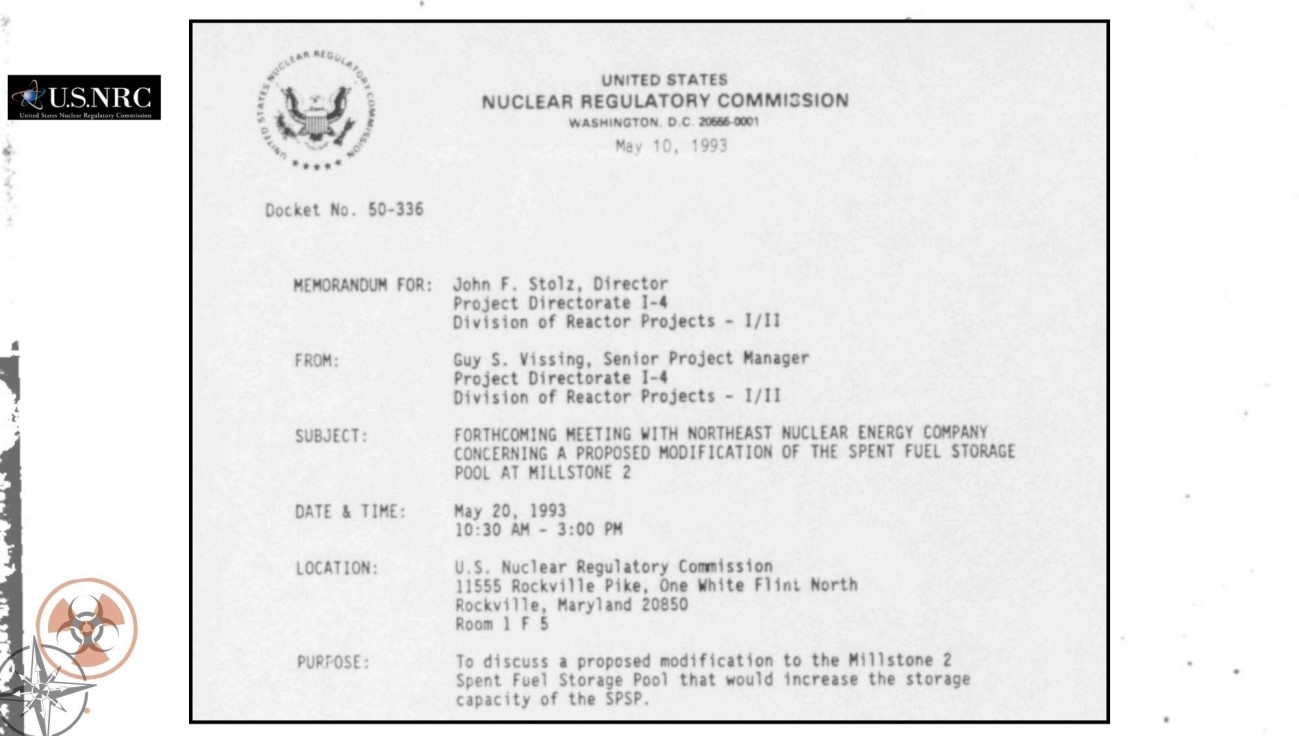
Image Source: Nuclear Regulatory Commission
NRC notice:
“Forthcoming meeting with Northeast Nuclear Energy Company concerning a
proposed modification of the spent fuel storage pool at Millstone 2.”
Text Source: Nuclear Regulatory Commission89
She’d bring me along as a prop when going to antinuclear meetings. My being
there helped to complete her “concerned parent and citizen” act as she told the
actually concerned nuclear activists that she was an ex-nuclear engineer (she has
since moved on to the title “breast cancer researcher” because it gets a more
positive response from people). She had an entire story she would go through,
including that she realized the error of her ways in the 1960s and stopped working
in Department of Defense research (a complete lie). She made sure to drop random
89 Nuclear Regulatory Commission, Docket No. 50-336. Memorandum for Atomic Safety and Licensing Board and All Parties, https://www.nrc.gov/docs/ML2006/ML20062J215.pdf
https://webcache.googleusercontent.com/search?q=cache:6SAEdJsAr2oJ:https://www.nrc.gov/docs/ML2006/ML20062J215.pdf&hl=en&gl=us https://web.archive.org/web/20231111020444/https://webcache.googleusercontent.com/search?q=cache:6SAEdJsAr2oJ:https://www.nrc.gov
/docs/ML2006/ML20062J215.pdf&hl=en&gl=us
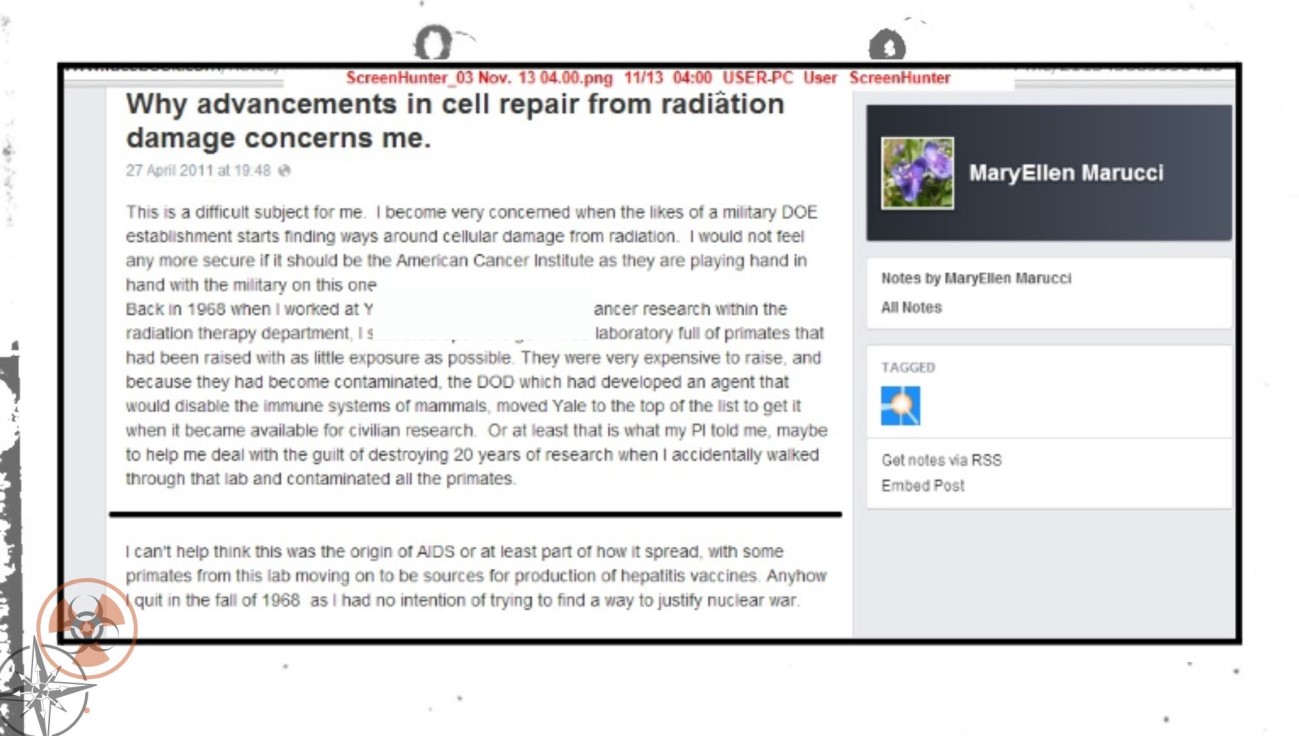
words (spent fuel pools, strontium-90, etc.) to give herself the appearance of a
professional in the field and thus an expert for them to bring into their fold and
utilize. To my silent horror, they fell for it every time.
She would still be found using many of the same lines, decades later, when
working to control the movement online. I’ve also seen her post about being anti-
slavery, something that makes me outwardly cringe after a lifetime of her
exploiting me and others. There’s also the detail of her illegally using state
terrorism to coerce my mother into signing me over.
But I digress, back to the subject at hand…
Here’s an example of how she reels people in:
Image Source: 2013 Screenshot Facebook
“Back in 1968 when I worked at Yale’s School of Medicine, in cancer research…I
can’t help think this was the origin of AIDS or at least part of how it spread, with
some primates from the lab moving on to be sources for production of hepatitis

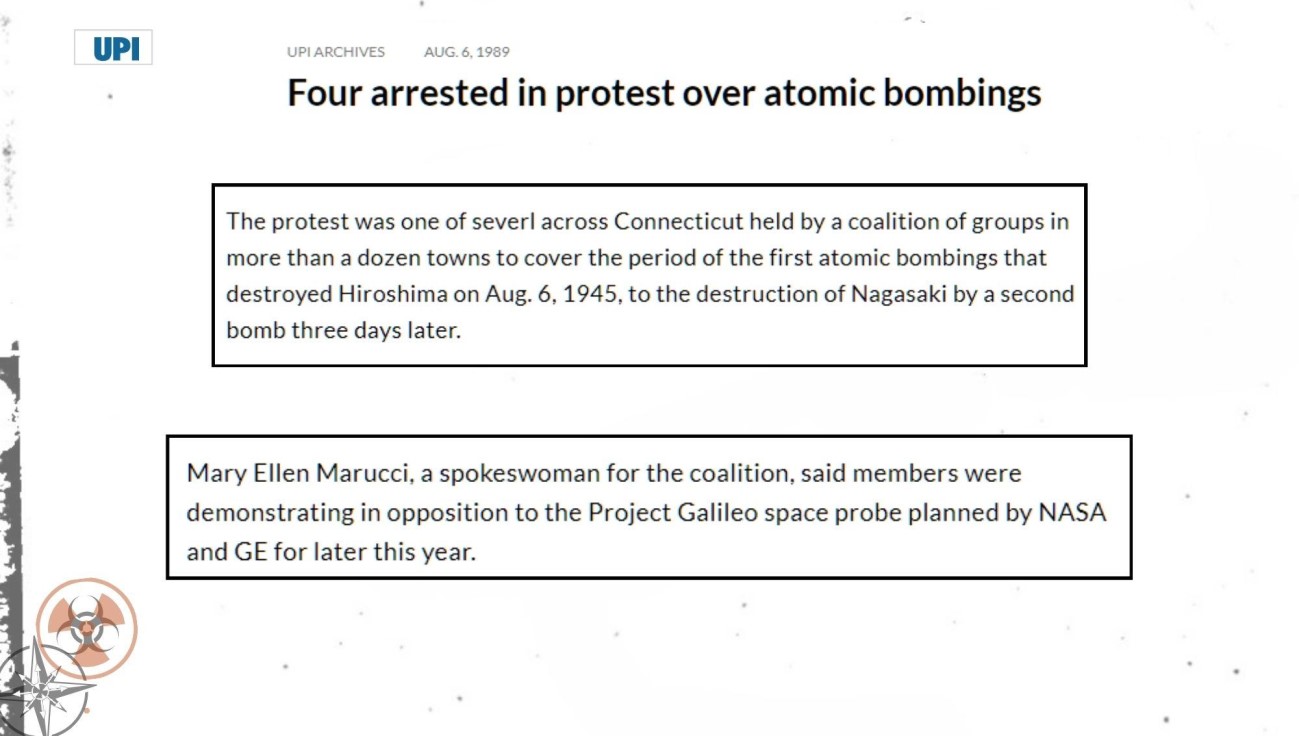
vaccines. Anyhow I quit in the fall of 1968 as I had no intention of trying to find a
way to justify nuclear war.”
Text Source: 2013 Screenshot Facebook90
The recruiter would become a member of the board of a grassroots antinuclear
organization and then force every other member out, one at a time, primarily by
harassment. Slowly, she would become their primary spokesperson and leader.
Image Source: United Press International
“Four Arrested in Protest Over Atomic Bombings…
The protest ….held by a coalition of groups…Mary Ellen Marucci, a spokeswoman
for the coalition…”
Text Source: United Press International91
90 Facebook, MaryEllen Marucci Profile, https://www.facebook.com/seedsaver/
91 United Press International, Four Arrested in Protest Over Atomic Bombings, https://www.upi.com/Archives/1989/08/06/Four-arrested-in-protest-over-atomic-bombings/1559618379200/
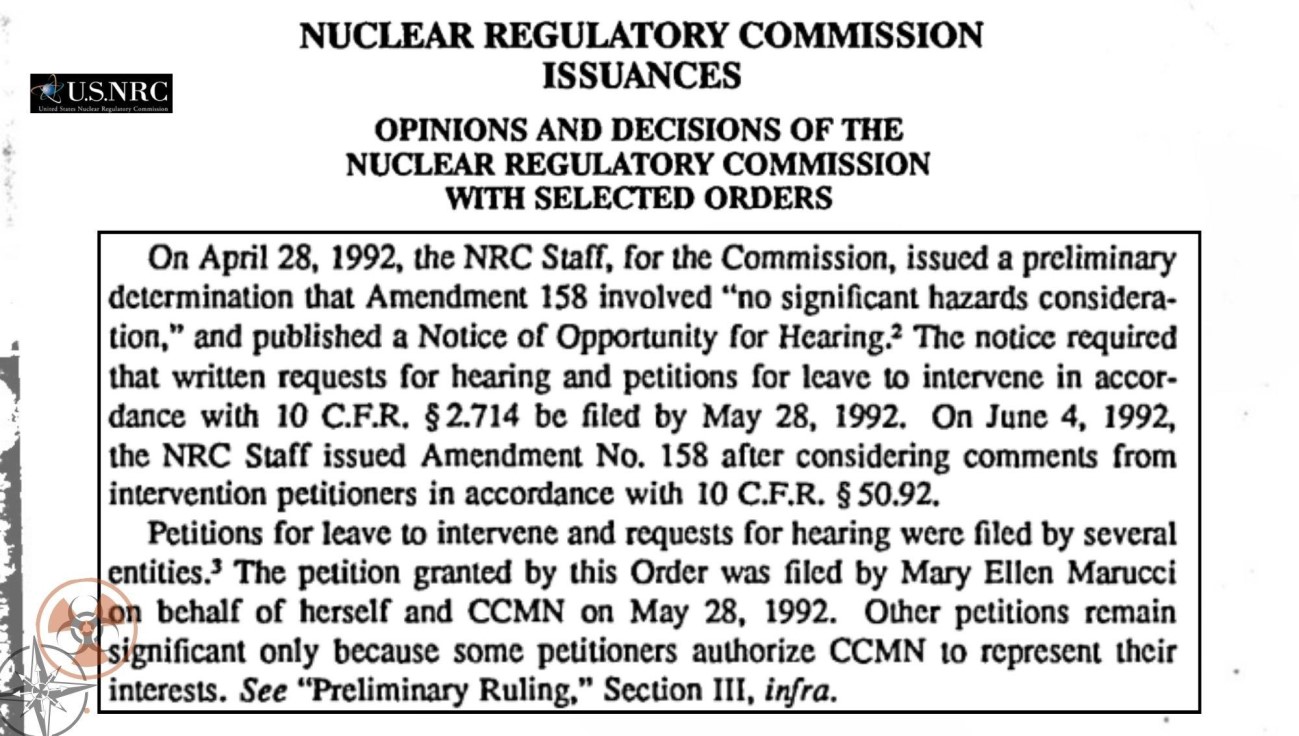
She repeated this process with several anti-nuclear organizations and then
consolidated them under the umbrella of an organization she created on her own,
for which she was the only head. She deceptively named it the Cooperative
Citizens Monitoring Network.
From there, she would take over the court case with the people’s plea for the NRC
to adjust their nuclear power plant spent fuel pool regulations. Updated
regulations were needed in order to prevent catastrophes that were likely to result
from fuel rods packed so tightly together that they were anticipated to melt
together during an emergency situation. Once that type of scenario unfolds, there
is very little, if anything, that can be done to prevent a meltdown.
Over the course of a year, the recruiter kept maneuvering within the courts and
managed to become the sole voice of the people against the nuclear industry and
NRC.
Image Source: p. 204 Nuclear Regulatory Commission

“Petitions for leave to intervene and requests for hearing were filed by several
entities. The petition granted by this Order was filed by Mary Ellen Marucci on
behalf of herself and CCMN.
…
Other petitions remain significant only because some petitioners authorize CCMN
to represent their interests.”
Text Source: p. 204 Nuclear Regulatory Commission92
Much like she had stolen my voice, she now stole the voice of the people and
became their representative in court.
She did this primarily by using the clout, expertise, and influence of others. She
roped in the renowned physicist, Dr. Michio Kaku, to give his expert testimony
(she brought me along to a lecture of his previously to do that, and his testimony
was expert and it very likely would have been accepted by the NRC as reason
enough to change the fuel pool specifications) as well as two senators, Christopher
Dodd and Joseph Liebermann (I was along for those too).
92 Nuclear Regulatory Commission, Opinions and Decisions of the Nuclear Regulatory Commission with Selected Orders, Volume 36, https://www.nrc.gov/docs/ML1635/ML16357A723.pdf
https://web.archive.org/web/20230000000000*/https://www.nrc.gov/docs/ML1635/ML16357A723.pdf
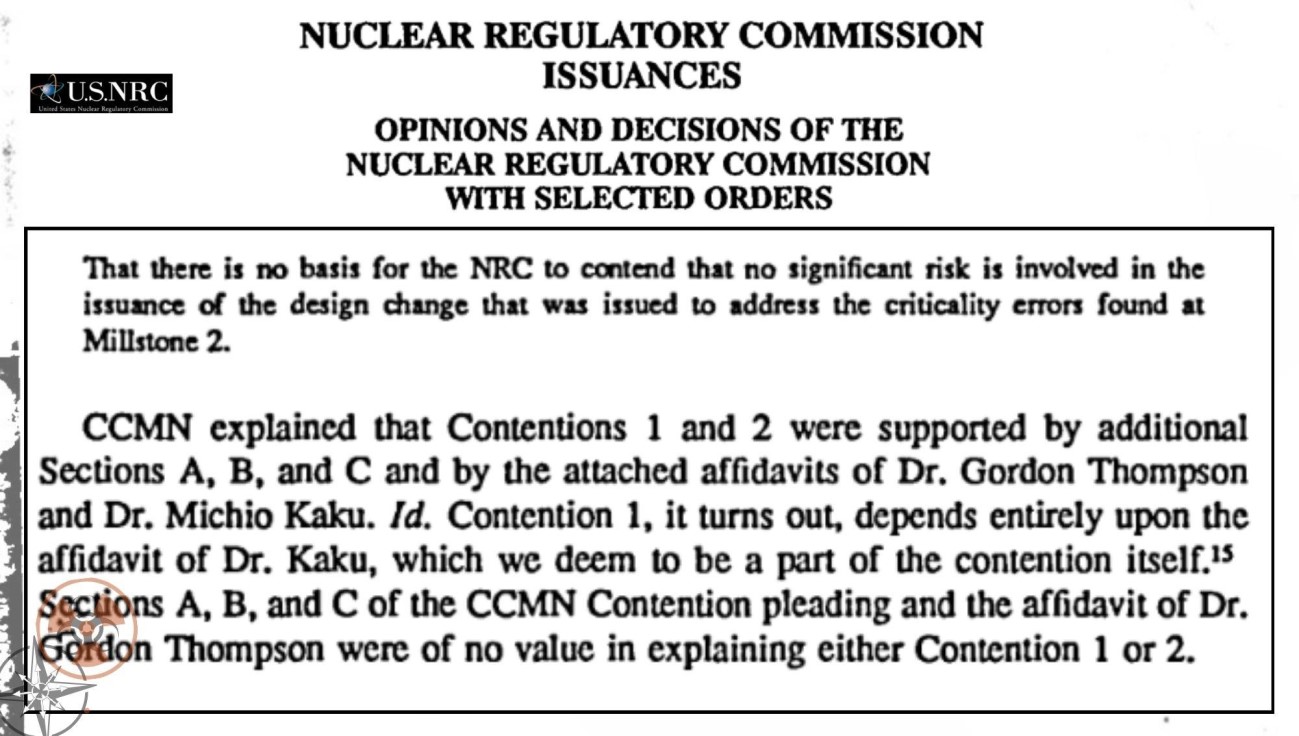
Image Source: p. 215 Nuclear Regulatory Commission
“CCMN explained that…were supported by...the attached affidavits of Dr. Gordon
Thompson and Dr. Michio Kaku.”
Text Source: p. 215 Nuclear Regulatory Commission93
93 Nuclear Regulatory Commission, Opinions and Decisions of the Nuclear Regulatory Commission with Selected Orders, Volume 36, https://www.nrc.gov/docs/ML1635/ML16357A723.pdf
https://web.archive.org/web/20230000000000*/https://www.nrc.gov/docs/ML1635/ML16357A723.pdf

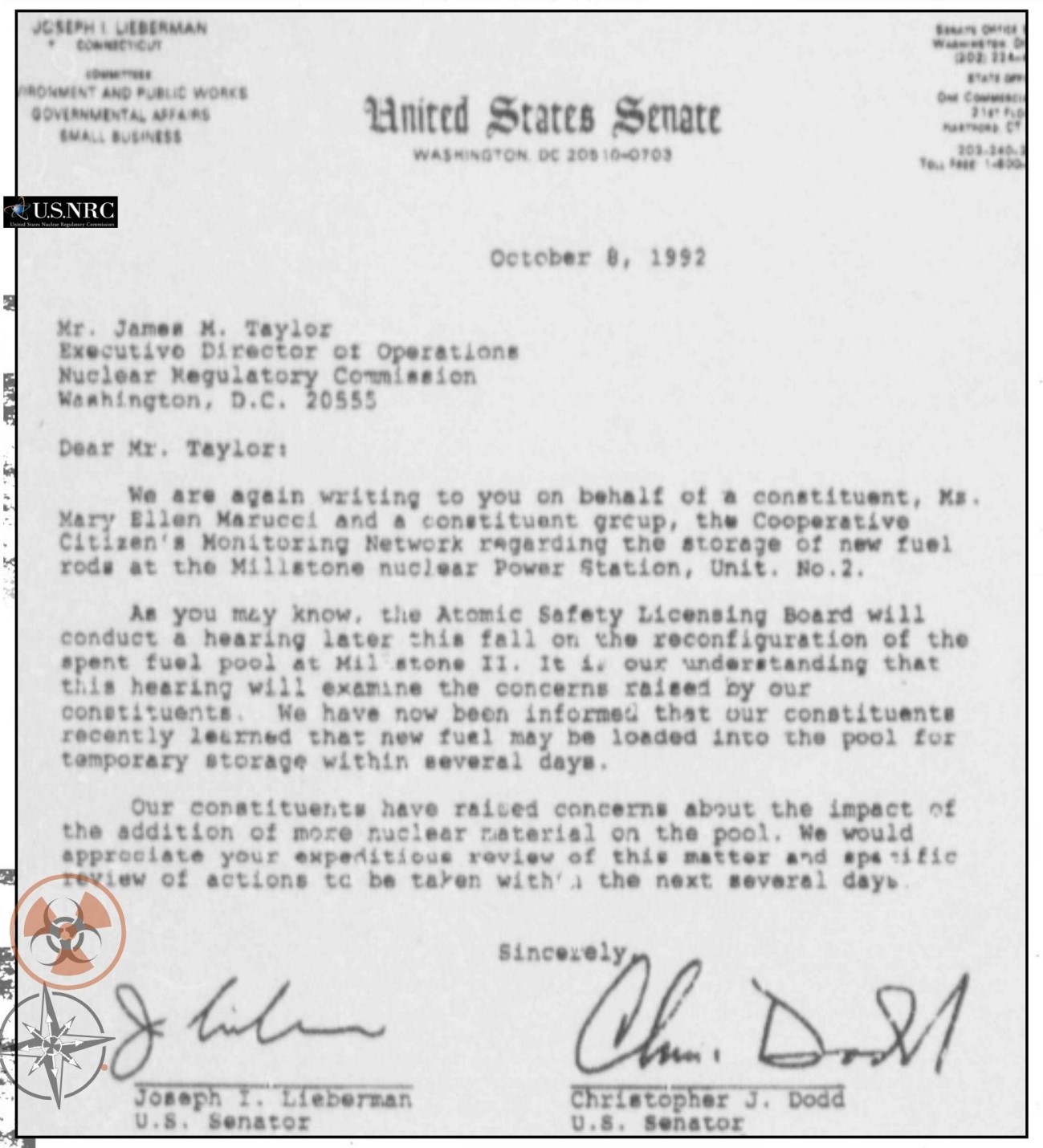
Image Source: Nuclear Regulatory Commission
“Mr. James M Taylor
Executive Director of Operations
Nuclear Regulatory Commission
Dear Mr. Taylor,
We are again writing to you on behalf of a constituent, Ms. Mary Ellen Marucci…
Sincerely,
Joseph I. Lieberman, U.S. Senator
Christopher J. Dodd, U.S. Senator”
Text Source: Nuclear Regulatory Commission94
And then, when the case finally officially reached the courts, she intentionally
dropped it, giving the NRC an automatic win and allowing the public to continue to
be endangered by a spent fuel pool issue that actually did need to be addressed.
94 Nuclear Regulatory Commission, United States Senate Letter to the Chairman of the Nuclear Regulatory Commission
https://www.nrc.gov/docs/ML2011/ML20116D106.pdf
https://webcache.googleusercontent.com/search?q=cache:n6TeRxMP11EJ:https://www.nrc.gov/docs/ML2011/ML20116D106.pdf&hl=en&gl=
es


Image Source: Nuclear Regulatory Commission
“CCMN has not answered the motion…
CCMN Contention 1 was the only contention accepted for adjudication.
Accordingly, the Board terminates this proceeding.”
Text Source: Nuclear Regulatory Commission95
We would all see the results of this intentional 1993 mishandling of the case,
decades later in 2011 when an earthquake and tsunami hit a nuclear plant built in
the same decade, with the same design, and with the same spent fuel pool issues.
95 Nuclear Regulatory Commission, Opinions and Decisions of the Nuclear Regulatory Commission with Selected Orders, Volume 38, https://www.nrc.gov/docs/ML1635/ML16357A718.pdf
https://web.archive.org/web/20220801000000*/https://www.nrc.gov/docs/ML1635/ML16357A718.pdf

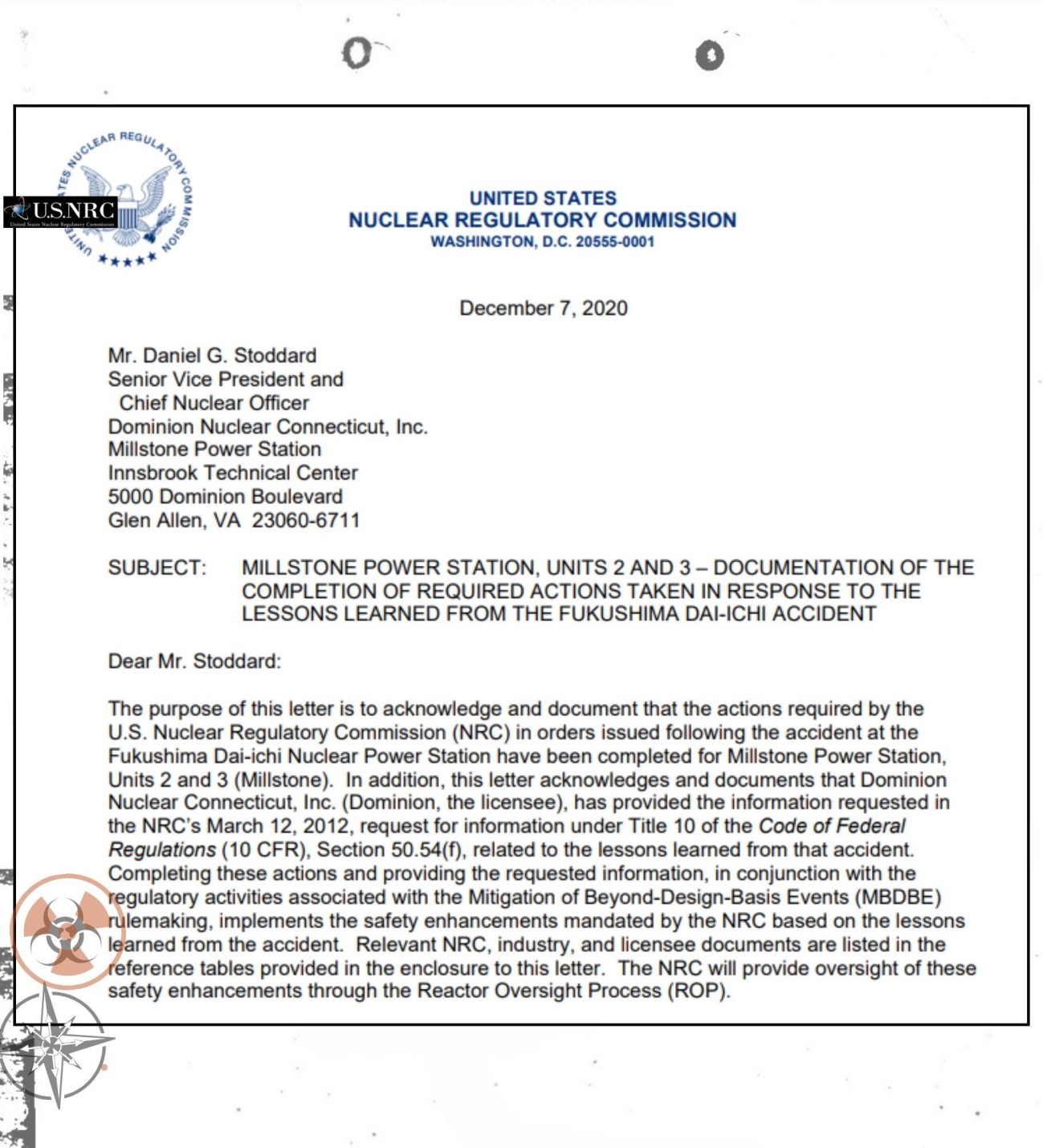
Image Source: Nuclear Regulatory Commission
“Millstone Power Station, Units 2 and 3 - Documentation of the completion of
required actions taken in response to the lessons learned from the Fukushima Dai-
ichi accident.”
Text Source: Nuclear Regulatory Commission96
Millstone Unit 2 was the power plant that was at the center of the court case that
the recruiter had intentionally handed to the NRC at the expense of the people. It
came with the same fuel pool concerns as the units at Fukushima that had been
built around the same time.
Fukushima had a complete meltdown, increasing radiation levels in the Northern
Hemisphere as well as the Atlantic Ocean.
There is a chance some of the catastrophe of Fukushima could have been
prevented if she had not intervened and if the court case had been allowed to
proceed and regulations updated to include suggestions for plants commissioned
at the time both Millstone and Fukushima were built.
And if you ever think it was just an honest mistake. If you start to sink down that
hole back into allowing in deception, I would like you to first see this:
96 Nuclear Regulatory Commission, Letter: Millstone Power Station, Units 2 and 3 – Documentation of the Completion of Required Actions Taken in Response to the Lessons Learned From the Fukushima Dai-ichi Accident, https://www.nrc.gov/docs/ML2033/ML20332A139.pdf https://webcache.googleusercontent.com/search?q=cache:GFOKWGgQrkYJ:https://www.nrc.gov/docs/ML2033/ML20332A139.pdf&hl=en&gl=
es
http://web.archive.org/web/20231111021033/https://webcache.googleusercontent.com/search?q=cache:GFOKWGgQrkYJ:https://www.nrc.g ov/docs/ML2033/ML20332A139.pdf&hl=en&gl=es

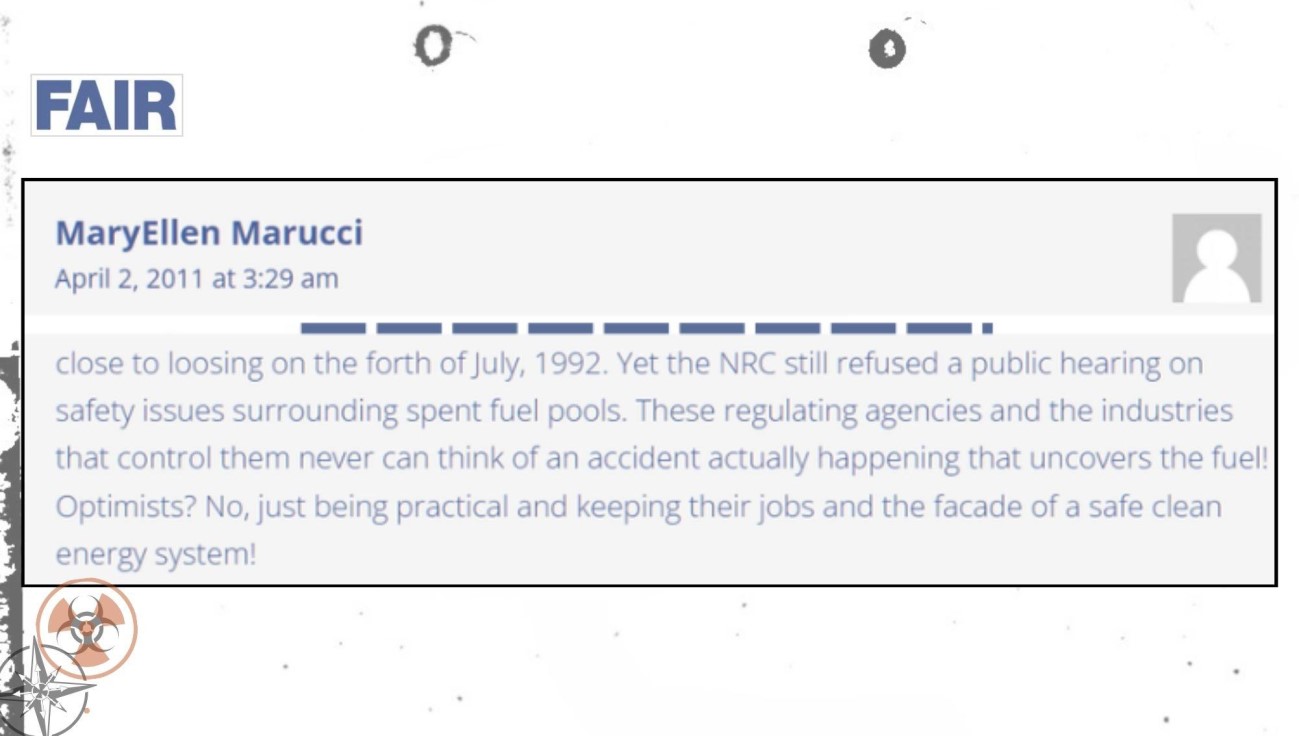
Image Source: FAIR
“Yet the NRC still refused a public hearing on safety issues surrounding spent fuel
pools.”
Text Source: FAIR97
Years later, when continuing her work to infiltrate and sabotage the antinuclear
movement, she claimed in a posted comment that it was the NRC that never held a
hearing, that they were solely the responsible ones. She did so without ever
mentioning the part she played in making sure the hearings closed without the
evidence being considered.
97 FAIR, Comment on:NYT’s REassuring Radiation Reporting, https://fair.org/uncategorized/nyts-reassuring-radiation-reporting/
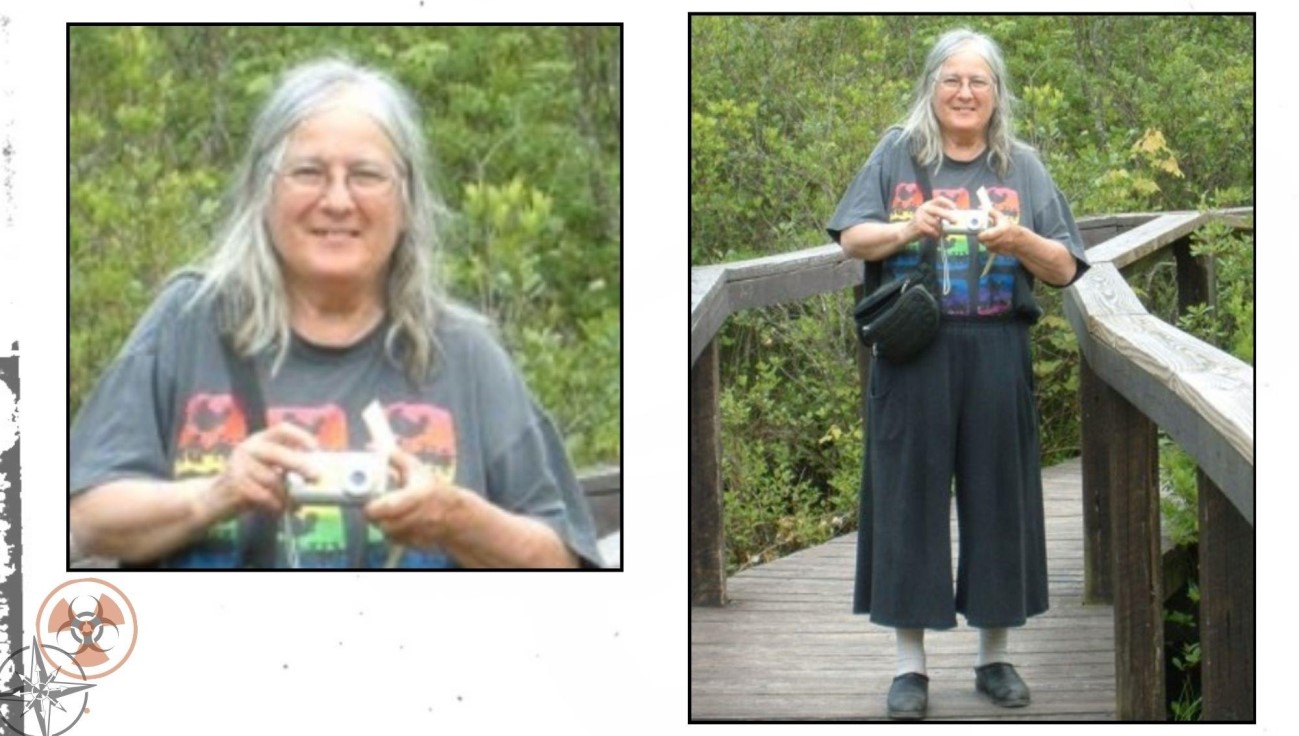
Image: Mary Ellen Marucci
Image Source: Author’s Personal Photos98
She continued to dress in character for her audience, playing one role behind closed
doors and another in public. When she had an audience, she would mix in the
occasional conspiracy theory, tiny bits of truth, radical rhetoric, “for the children,”
and lots of “nuclear expert” credentials. (I’ve known her nearly my entire life and even
I’m not 100% sure what her academic credentials actually are. I can only confirm that
she had enough of them to have full access at Yale.)
When not dressed in a mock-radiation suit, she often wore a hand-tailored and
custom-made wool poncho and knee-high leather boots. One of those winter outfits
cost nearly as much as a mid-size sedan. The outfits were so eccentric that she had
the rich convinced she was rich due to the combination of odd style and quality
materials, and she had everyone else convinced she was insane enough to be
98 Author’s Personal Collection, Photo: Mary Ellen Marucci,

impoverished and not know how to select normal-looking American clothing at a
thrift shop.
Acceptance of grand theatrics, impossible promises, and other forms of deception
has caused an excess of fake radicals and fake politicians, playing off each other
and excluding the public while pretending to represent them. This deception goes
as far as and includes their playacting within the courts and legislative buildings in
Washington D.C., and then their national and international racketeering and
shakedowns going beyond that gate.
This is unsafe for those of us forced to live in the real world where their short-
sighted and self-serving actions have consequences. In other words, it’s unsafe for
all of us, and that includes the misguided operatives, lazy bureaucrats, and money-
hungry individuals who are actively undermining the parts of the system intended
to safeguard us from harm.
Also, after having to dig through countless pages of those NRC documents, I have
to point out that the Nuclear Regulatory Commission’s process is absolutely
ridiculous. Determining and correcting errors in the engineering and maintenance
of nuclear power plants should not be a court carnival with a result that depends
on every clown and money man being there and tossing the correct balloon that
day. It should be a practical and responsible science: examine problems and fix
them.

Deployment, Part Two
Yes, I was in terrible situations with dangerous people.
But it was the crowd that did nothing,
that wandered in circles
making itself dizzy
just to distract itself
so it did not have to do anything.
They are the biggest part of the problem.
Everything could have been solved in minutes
if the populace wasn't weak as shit
and made insane.
Now that the topic of politicians has been fully broached with the signatures of Dodd
and Lieberman, I feel like this is a good point at which to bring up why I’ve been
skirting U.S. politics this entire time.
The truth is, I could easily add another fifty pages on how we leashed politicians with
a combination of blackmail, threats, mutually beneficial camaraderie, bribery, and
more. I could also discuss how one politician in particular leveraged the protection of
being a federal witness - after a large-scale heroin bust in a politically involved legal
office in San Francisco - to have anyone who went to court against her eliminated by
the FBI, allowing her political career to begin and blossom in what is an otherwise
harsh environment, and how the FBI has a history of covering for its witnesses at the
expense of innocent citizens.

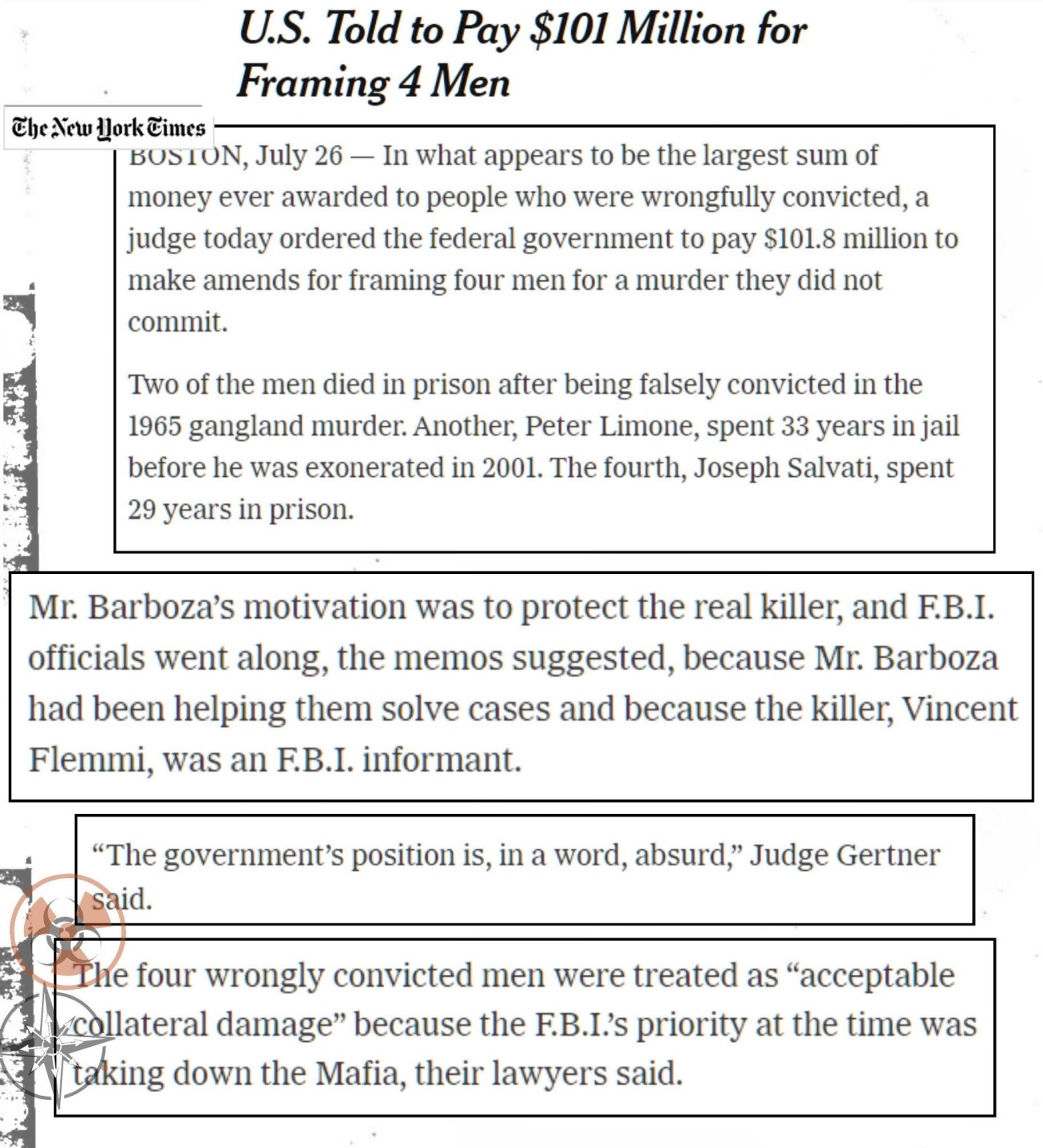
For example:
Image Source: New York Times
“A judge today ordered the federal government to pay $101.8 million to make amends
for framing four men for a murder they did not commit.
Two of the men died in prison after being falsely convicted in the 1965 gangland
murder. Another, Peter Limone, spent 33 years in jail before he was exonerated in
2001. The fourth, Joseph Salvati, spent 29 years in prison.
....F.B.I. officials went along, the memos suggested, because Mr. Barboza had been
helping them solve cases and because the killer, Vincent Flemmi, was an F.B.I.
informant.
In her decision today, Judge Gertner forcefully criticized the F.B.I. and the argument
made by Justice Department lawyers that federal authorities were not required to
share information with state prosecutors, and were not responsible for the results of
a state prosecution. ‘The government’s position is, in a word, absurd,’ Judge Gertner
said.
....The four wrongly convicted men were treated as ‘acceptable collateral
damage’...their lawyers said.”
Text Source: New York Times99
I could talk about backroom deals that sold the entire country more times than once.
Actually, I already mentioned one of those.
I could talk about the political science research project we did that resulted in tapping
two future presidents based solely on what they looked like and their vocations (one
black man and one real estate tycoon), due to what presidential demographics the
research told us would work best for manipulating the public and then keeping them
on the manipulation hook long term. George Edwards’ involvement on that one made
it into the news. The media always did love him.
99 New York Times, U.S. Told to Pay $101 Million for Framing 4 Men, https://www.nytimes.com/2007/07/26/us/26cnd-mob.html

Image Source: New Haven Register
“When the time came to elect John C. Daniels the city's first Black mayor in 1989,
Edwards got involved in that, too.”
Text Source: New Haven Register100
New Haven is a model city. It has been since before I was born. That means Yale
works to keep the city’s population demographic as close to matching the U.S. as
possible in order to use it as a large social and political sciences lab.
100 New Haven Register, Friends, Family to Celebrate Life of Black Panther, Community Activist, George Edwards, https://www.nhregister.com/news/article/Community-mourns-Black-Panther-activist-Edwards-17536370.php
Image Source: ABC News - FiveThirtyEight
“I calculated how demographically similar each U.S. metropolitan area is to the
U.S. overall, based on age, educational attainment, and race and ethnicity. The
index equals 100 if a metro’s demographic mix were identical to that of the U.S.
overall.
By this measure, the metropolitan area that looks most like the U.S. is New Haven,
Connecticut.”
Text Source: ABC News - FiveThirtyEight101
We used New Haven’s mayoral elections as a test, using the campaign of John C.
Daniels (black demographic) and then Mayor John Destefano (white real estate
investor). And, yes, the media caught George with both of them.
101 ABC News FiveThirtyEight, Normal America is Not a Small Town of White People, https://fivethirtyeight.com/features/normal-america-is-not-a-small-town-of-white-people/

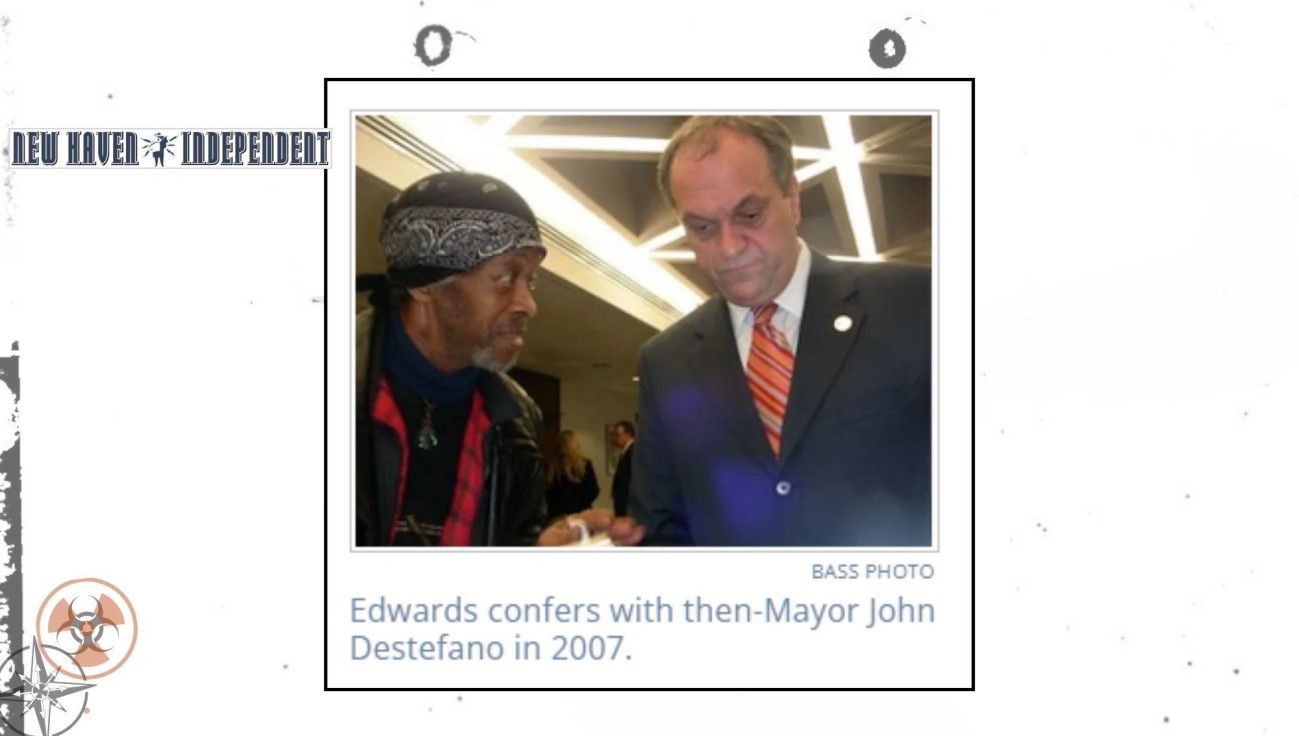
Image Source: New Haven Independent
"Edwards confers with then-Mayor John Destefano.”
Text Source: New Haven Independent102
We ran an entire campaign to kick off that particular research project. I was in the
campaign office of John C. Daniels on some nights, stacking sheaves of collected data
and stuffing envelopes.
I’m deeply sorry for ruining any illusions. I know we all need hope to cling to. That
basic emotional need, and a need for a functioning country, were both exploited by
the people making the country dysfunctional. Those are the people who chose the
presidents. Both U.S. presidents mentioned are individual humans with their own
thoughts, motivations, and personalities. I’m not claiming that they manufactured
102 New Haven Independent, A Panther Passes On, https://www.newhavenindependent.org/article/panther_passes_on
humans, but they did choose them based on what the public manipulation research
said, and there were times when they also manipulated both men.
On a related note, at higher levels on the political stage, methods from research
and/or historical events are generally analyzed and chosen before making a move.
The intent is to get a specific result, so they look for something that has been proven
to attain that result before. What that exact thing is that gets the intended result does
not matter as much. That’s partially why our political landscape is now so scattered
with random madness and parts that don’t logically fit. Each of those things is there to
get an intended result. That’s the only reason they are there. It has pretty much
nothing to do with our shared reality or needs.
I could even go on to discuss how the recruiter’s cohort had people under their
control on both sides of the aisle. Or I could mention how they once drugged an
entire club at Yale, at their own dining table, and then proceeded to blackmail every
single one of them. There are really no limits to the political stories I could tell. None.
Absolutely none. The people I was stuck with did not have limits.
As the recruiter explained, only the people below have the limits of rules, social
norms, expectations, religion, and laws. Those who choose to rule over them, or to
exploit them from behind the curtain of secrecy, do not.
The reason I don’t delve too far into the political topics is simple. People get too
invested in the political media darlings, in their parties, in that last bit of hope of
stability and/or change that they want. If I already struggle to get people to back
away from lies they previously swallowed, why would I want the added task of trying
to pry their political dreams from their hands?
Modern politics contains easy but useful-feeling distractions intended to engage the
populace and avert their attention while the coffers are raided.

Much like holding up a protest sign, the act of being engaged in politics feels like an
action, and people desperately need to feel that. In reality, it is often nothing more
than government actors and organizers, like my buddy George over in COINTELPRO,
leading the populace on a run like a dog until it runs out of energy. It’s a necessity for
running a government without true public interference. However, it’s a necessity for
those running the government. It may not be as advantageous to you. It sure as hell
isn’t to the kids this civilization willingly tosses into the fire of war while everyone
wears their “save the children” buttons and uses angry-face emojis. Don’t even get me
started on the political organization in Argentina that waves “the stolen children”
around as a banner to raise funds for themselves while calling us same children
criminals behind closed doors.
As I said, politics are a distraction. Even I get caught up in them now and then. I
understand the emotional pull and utter distraction. I’m not going down that road.
This is about focusing on our survival. Not the political actors on the theater stage.
Those assholes will keep going until the final curtain. They are not the solution. Their
theatrics and audience manipulation are part of the problem.
And, no, I gain nothing financially from suggesting honesty in how we manage
government. My postgraduate credentials, the money and pay-outs in the field and
career I am educated in and currently refuse to work in, require that politics
combined with deception continue on indefinitely.
The primary premise in my profession at the upper level is that we take two (or more)
leaders, go behind closed doors, find out their actual objectives, and come to an
agreement that meets those while appeasing their citizens with lies and face-saving
measures.
At the mid-level, it requires conning the public of the losing side into accepting
reduced resources and rights while telling them its for their benefit.
In smaller negotiations, the goal is to find out what two (or more) people/parties in a
negotiation are lying about by taking each one aside privately to see what their actual
interests and needs are that they aren't admitting to (or to glean the truth by
interpreting their lies). Then, create an agreement that serves both sides without
letting each party know the secrets of the other party, what their actual needs were,
and why they’ve all come to the resolution and agreement I’ve created for them to
meet the needs that each of them will not reveal to the other side.
In other words, my entire job description is protecting secrets while still making
things semi-function, and often to the detriment of the public and the exploited side,
because those with the resources know the game. That’s how they got the resources.
What would that even look like without all the subterfuge? Hell if I know. I might
have to take up dog grooming as a permanent profession. I'm in uncharted
territory. We all are. We've been in deception for so long. However, I would rather
be a dog groomer in a functioning world than be paid off to make things worse
while wearing a suit.
So, back to my life…
In addition to assisting with grassroots organization toppling for government ease, I
was used for every task you can imagine, ranging from menial to extremely
dangerous. I filed papers in the end-game labs, I visited and collected information
from political prisoners, I worked the overnight shift on the bureaucratic side of a
money laundering operation for a bit, and I assisted with the physical relocation of
protected war criminals for the U.S. government as needed, among other things, some
simply for the recruiter’s profit, and others often directly relating to her work.
They quit letting me do pretty much anything that involved lab equipment after I
sabotaged it more than once while playing dumb. So, much of my lab assistant work

was boring - moving boxes or sorting through stacks of collected information no one
with a decent pay grade wanted to touch. Sometimes, it was interesting.
I once spent a week helping a visiting lecturer at Yale to unpack his office, located on
the short hallway that led to the large storage area and off-the-books medical
laboratory. He was military, and as I understood it, his expertise was somewhere
between strategy and psychology. He had me unpacking boxes and boxes of thick
classified military manuals. I wanted to peek between the pages so badly. I was always
curious - even when what I saw was horrifying, I usually still looked. I was only loaned
to him for a day. I willingly volunteered my time for the rest of the week just to get a
look at the inside of those manuals. I never had any luck. He never even left that office
for long enough to use the men’s room.
Another mundane at the time moment that would be catastrophic in the long term,
was when I was brought to another building at Yale, primarily classrooms, but with
some smaller lab equipment. I was asked to stuff envelopes while the recruiter and a
female scientist spoke. There were several hundred envelopes with addresses all over
the globe. I was sending the conclusion and information about their research to
interested parties from everywhere.
As they spoke, the scientist confirmed they had developed a hybrid virus. It sounded a
lot like the walking pneumonia one I had heard plans for when I was little, and with
the HIV-1 virus that we had moved to New Haven to work with several years prior.
However, she said it would take too long to produce and replicate the virus (the time
mentioned was, at a minimum, several months; she may have mentioned a year or
more). They were shelving the project until technology improved.
Later on, CRISPR technology would come into existence. I can't genuinely say 100% if
I was doing the mundane envelope stuffing that day for a project that would become
the prototype for COVID-19.
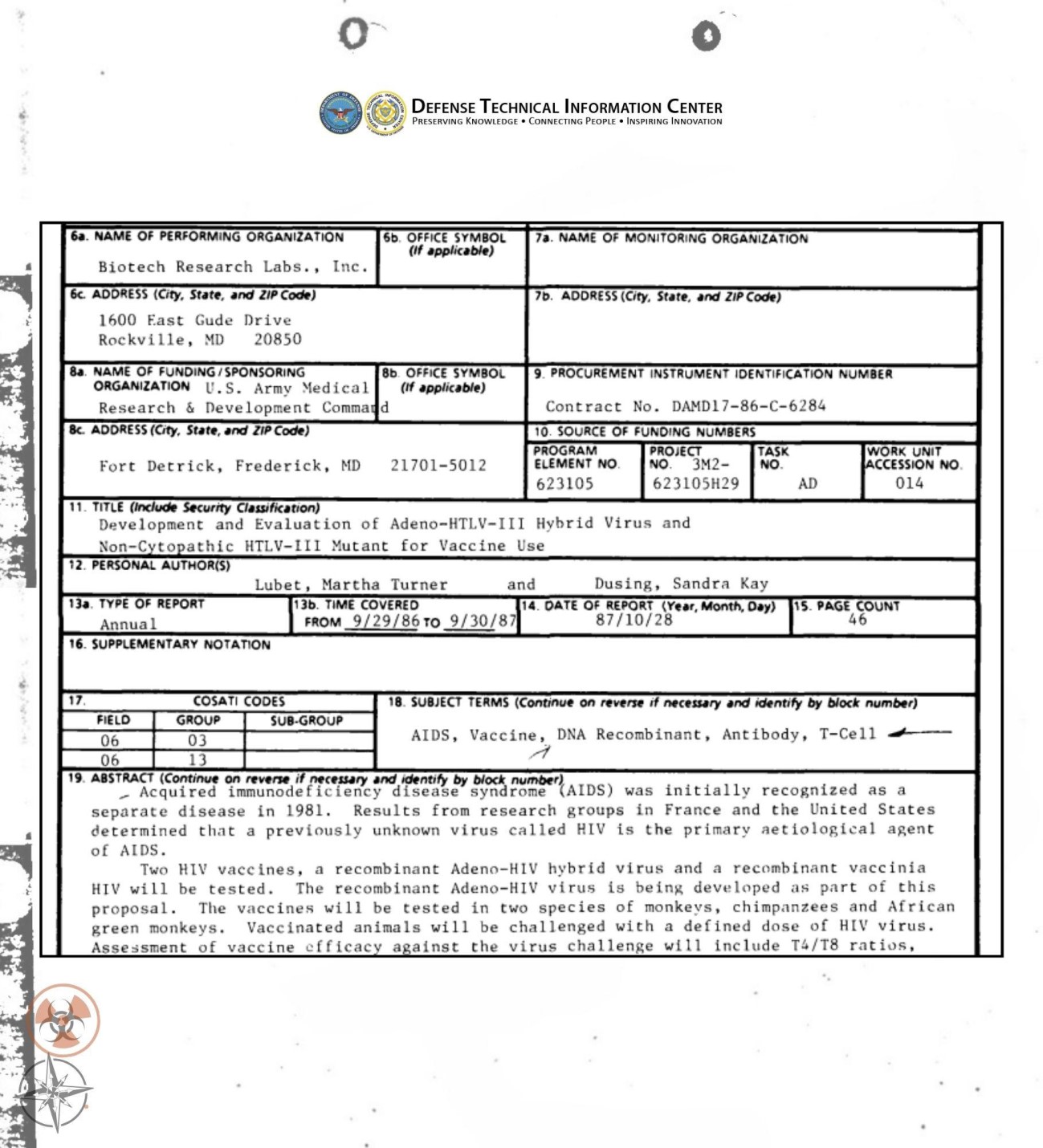
I will say that the previously mentioned military medical research states that the
government was playing around with respiratory viruses combined with HIV in 1986
and 87:
Image Source: U.S. Military, Defense Technical Information Center

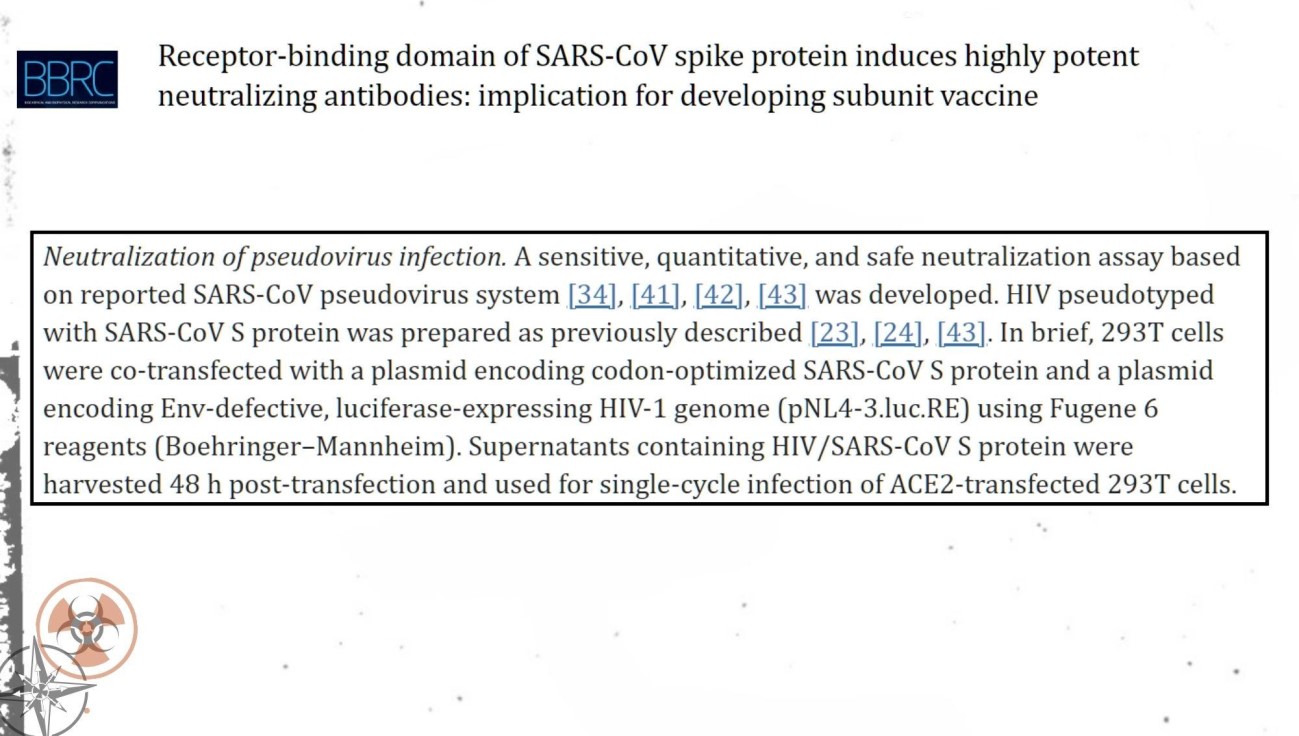
“Time covered: 9/29/86 to 9/30/87…
The recombinant Adeno-HIV virus is being developed as part of this proposal.”
Text Source: U.S. Military, Defense Technical Information Center103
They were doing it under the guise of it being an effective tool for vaccine research
and development. However, just because you can use something, doesn’t mean that
you should. No matter how polished your shoes or how much taxpayer money you’re
funneling, there is no excuse for some things.
I can also state that other labs were publishing their use of a combination HIV-1 and
SARS-CoV pseudotype virus in 2004, according to scientific research articles from
that time:
Image Source: Biochemical and Biophysical Research Communications
103 U.S, Military, Defense Technical Information Center, Annual Report - Contract No. DAMD17-86-C-6284, https://apps.dtic.mil/sti/pdfs/ADA189926.pdf

“HIV pseudotyped with SARS-CoV S protein was prepared as previously described.
In brief, 293T cells were co-transfected with a plasmid encoding codon-optimized
SARS-CoV S protein and a plasmid encoding Env-defective, luciferase-expressing
HIV-1 genome (pNL4-3.luc.RE) using Fugene 6 reagents (Boehringer–Mannheim).
Supernatants containing HIV/SARS-CoV S protein were harvested.”
Text Source: Biochemical and Biophysical Research Communications104
And the Wuhan lab was doing it in 2010:
Image Source: Archives of Virology via Springer
“An HIV-1-luciferase pseudotype virus carrying the SARS-CoV BJ01 S protein,
HIV/BJ01-S, was prepared…
104 Biochemical and Biophysical Research Communications, Receptor-Binding Domain of SARS-CoV Spike Protein Induces Highly Potent Neutralizing Antibodies: Implication for Developing Subunit Vaccine, https://www.ncbi.nlm.nih.gov/pmc/articles/PMC7092904/

We extended our previous study to ACE2 molecules from seven additional bat
species and tested their interactions with human SARS-CoV spike protein using
both HIV-based pseudotype and live SARS-CoV infection assays.”
Text Source: Archives of Virology via Springer105
It was all done in the soothing and calming name of vaccine research. Quite like how
the recruiter used to call everything she did for the military “cancer research.” If a
tactic works, it tends to get repeated.
Biowarfare is government Munchausen by Proxy. They use classification and secrecy
for “the protection of the nation” to hide the making of a weapon, and then advertise
the making of a damaging “cure” for that same weapon (vaccine research, etc.). Then,
much like a Munchausen by Proxy mother, they expect to be praised and rewarded
for their efforts. And much like the child of a Munchausen by Proxy mother, the
citizenry becomes too ill to be independent and they look to the same government
that harmed them to heal them.
Unfortunately, that’s not a response that leads to survival. Of all the forms of child
abuse, Munchausen by Proxy is the most fatal. This is why I was always so concerned
for the public. I barely survived it myself.
I can't say if any of these viruses work how the scientists I knew intended back when
they were first talking about endgame walking pneumonia and incurable illness virus
hybrids in front of me over plates of food at dinner table discussions. I can only tell
you what I saw and heard, and how my heart felt like it jumped into my throat and
stayed there when I first saw researchers noting the HIV-1 insert in COVID decades
later.
If anyone ever seriously looks into this, you may be able to confirm that I was in the
room, if nothing else. Because I was stuffing envelopes, my fingerprints were on the
105 Archives of Virology via Springer, Angiotensin-Converting Enzyme 2 (ACE2) Proteins of Different Bat Species Confer Variable Susceptibility to SARS-CoV Entry, https://link.springer.com/article/10.1007/s00705-010-0729-6
letters that were sent all over the world to let interested parties know how the early
prototype turned out. I was still a child then, assuming I wasn’t drugged on the
recruiter's mortar-and-pestle homemade scopolamine combination to the point that I
simply thought I was a child that day. I'm sure I’ll still hang for it, even if I was
underage. That's just how people are.
If it seems like a badly thought-out decision to leave exploited internationally-
trafficked children with the brunt of deciding which information the public should
and shouldn’t get, I agree. It’s also unreasonable to leave children with the task of
attempting to get that information out there despite their age and lack of education
on how to get the public’s attention regarding sensitive and difficult classified topics.
It would be much more rational to stop hiding endgame research from the
populations it's being tested on and/or will eventually be used on, which includes all
of us. The weight I carried was ridiculous, and there were adults with functioning
minds in those rooms, with family in that country, who all allowed the gross human
rights violations to continue. God knows I tried to warn you, but my voice was not
enough to break through. It is not realistic to leave the weight of this knowledge on a
tiny number of people who generally fall into two categories - profiteers of the
damage or the damaged.
Anyway, let’s get back to the problems of the past, not all of which so directly brought
about our current predicaments, although they have set the larger stage upon which
these things can and do happen.

Test Firing
Just because you hide something
doesn't mean that it no longer has consequences.
In those years, the recruiter continued to use me as a prop to recruit, do cons,
blackmail, extort, etc.
For the blackmailing part, she framed adults with resources (political, police, large
industry, etc., much like Joseph, the sheriff we had moved in next door to with the
sole intention of blackmailing him). She would frame each one by drugging them,
positioning them inappropriately, and including me in the photos when I was young.
When I was older, it got more creative, explosive, and more serious than that.
For grassroots organizations, parents’ organizations, and individuals, she would use
me as a prop so she could claim she was there for legitimate community or family
reasons instead of what she was actually there for, which was primarily to derail their
progress, take them over, or coercively recruit from them.
And then there were the times she would pile me in with everyone else she was
running. For about two or three years, she had developed a seemingly quirky habit of
simultaneously wearing approximately six stopwatches, hanging around her neck, all
in different colors. It seemed like an odd fashion statement. It had nothing to do with
fashion. She would wear them while standing on the New Haven Green, and she had
one for each person she was running through that center of town.
The stopwatches were dual-purpose. The alarm function in them would alert her
when each person was expected to arrive, or would be coming out of a building for a
work break (she was targeting someone from the town hall, and someone from the
government offices above the post office, in addition to a few people taking buses).
The stopwatches also allowed her to time and record how long it took until the drugs
would take effect once she hit someone with them. There were a lot of numbers
recorded. I would know. Frequently, I would collect them from all the devices and
write them down in a ledger for her.
She kept a bag with more than forty bus schedules in it. She had one for every route.
Again, seemingly a little quirky. However, there were some schedules that she had
two of. For those, the second copy contained a processed version of scopolamine and
who knows what else. It was one of the chemist’s specials. It was a white powder,
barely visible on the bus schedules, but powdery and uncomfortable on my already
dry and sensitive hands, which it clung to. It would be lined up in the crevice at the
bottom of the folded paper until you popped the schedule open to read it. And that’s
how she got people. I don’t know the mechanism entirely, if it absorbed through the
fingers or if the dust was inhaled as it flew into the schedule-reader’s face, but it was
effective.
She wasn’t pleasant and most of her victims were tired of her, even if they could not
entirely remember or articulate why. So, when they wanted to end a conversation, she
would say, “Okay. But can you read this bus schedule for me so I can leave and catch a
bus? I forgot my glasses.” And they would invariably read it for her in the hopes of her
going away after that. I know. I fell for it at least fifty times, myself. The one that was
specifically for me was her extra copy of the D bus line schedule. I could never
remember that I had already previously fallen for the ruse until I felt that powder on
my hands and it was already too late.
In what felt like less than 120 seconds, I would find myself following her down the
street, amenably, with my reasonable anger, distrust, and refusal entirely melted
away. I’d remember the walks, and then the drug-induced amnesia wall would come
down when we stopped walking.
Often, she wouldn't even go with a person after drugging them. She would just tell
them where to go, hand them a bus ticket, and point them in the right direction. Many

times it worked effectively. Other times, the intoxicated and thus suggestable people
had trouble. Personally, I once forgot I was supposed to be heading to a paid research
appointment for her, one only a few blocks from downtown, because I stopped to talk
to friends and stared into the display at the Group W Bench, a shop with an inordinate
amount of pinwheels in the window. Every word she told me disappeared from my
mind as I watched those pinwheels spin.
And those lists of numbers I would write for her, collecting the data from the
stopwatches? Once a month, those would be put in a large envelope with the
stopwatches and sent to what she called a lab. Then she would go out, buy six more
stopwatches, and start the process over again.
That was one of the more terrifying realizations I had at that age. That even her most
insane and coercive behaviors might actually be fully supported and funded. It made it
difficult to know who to reach out to, especially within her organization, so I didn’t
except for a few moments of complete and generally regretted weakness.
As I became a teenager, I would also be utilized as a tantalizing young body that got
doors open when no one else could. Once inside, I would complete my instructed
task, or in some cases, unlock a back door to grant the recruiter and others access so
they could complete it themselves. I was always her door opener. The difference was
that the methodology changed as I got older. By the time I was a teenager, I was too
old to still claim “my mom’s inside” to get past security.
To illustrate one of the newer methods, in the early 1990s in New York City, there
were two Muslim roommates whom the U.S. government needed to have framed and
intimidated into working for them. Another girl and I were sent in as escorts, with a
backpack of explosives and instructions to get inside the apartment and place the
backpack in a bedroom. Once we met the men, it didn't take long for them to
"convince" us that we wanted to visit their apartment. The situation was set up to fall into our hands.
When the apartment door closed and we were inside, I was consumed by panic. The
drugs they had given me before the assignment were lighting up all the wrong parts of
my brain, and my decisions were anything but rational. I was to the point that I was
considering scaling the outside of the building to escape.
The other girl convinced me that the stairs were a better option, and as that bedroom
lit on fire, we ran. We were promised that a vehicle would be waiting for us directly