

The Endgame A Memoir by Maria Victoria Navajas Claros - HTML preview
Download the book in PDF, ePub, Kindle for a complete version.
Domestic Breaches and International Infiltration
Entrenchment at Universidad de Buenos Aires
Relics of the Weathermen and World War II
Domestic Research Subject Recruitment
Expropriated Counterintelligence
Decay as a Facilitative Tool for Demolition
Normalization of Internal Exploitation
Internal Sabotage and Entrapment
Indefinite Detainment, Indefinite Wars

The Government of Argentina and the Abuelas de Plaza de Mayo

In the modern context, standard policies of deception result in consequences
much more far-reaching and deadly than the expected government playground
bullying behaviors and corruption that they predictably cultivate.
Weapons research (including nuclear, technological, and biowarfare) and the
subterfuge deemed necessary for their functioning are hidden under an archaic 25
to 100-year classification blanket of secrecy. This is not a viable or safe practice in
modern times.
We now have the volatile mix of advanced weapons research and technology,
combined with a persistent corruption of government and being steered by our
enemies that we have not yet learned how to effectively manage and wrangle
under control.
Due to this highly problematic combination, there is a very significant concern
regarding the implementation of strategies and weapons technology that can
maim or eradicate a majority of the world population before the public has
permission to know and reasonably respond accordingly for self-preservation.
Forget the sanctity of classification. What is going on behind it is thinning us out,
and will only get worse.
To honor, protect, and fund something that is actively harming us is insanity.
Before the rule of government comes the rule of life. If no one lives, there won’t be
a government to protect.

♞ Stage 1: Recruitment
Silencing yourself and living in the dark
leaves you exposed to the type of people
who wander the dark looking for
victims who won't scream.
I didn’t have a mother for long enough for her to gently tie society's blindfold over my
eyes and keep it there. I’ve seen everything coming, unblinking, and in the room with
it. It’s not a pleasant experience, but someone had to live it.
I entered the world shortly after my pregnant mother jumped (or much more likely -
was pushed) off a balcony in Argentina in an attempt to escape officers from a military
dictatorship.
We dropped from that height and hit the concrete below in the midst of heavily U.S.-
sponsored state terrorism in South America under Operation Condor, a written and
signed multinational Intelligence agency agreement that had some of its strongest
taloned roots in Paraguay and Argentina. The written intention was to root out and
eradicate any potential opposition to willing-puppet dictators in the region.
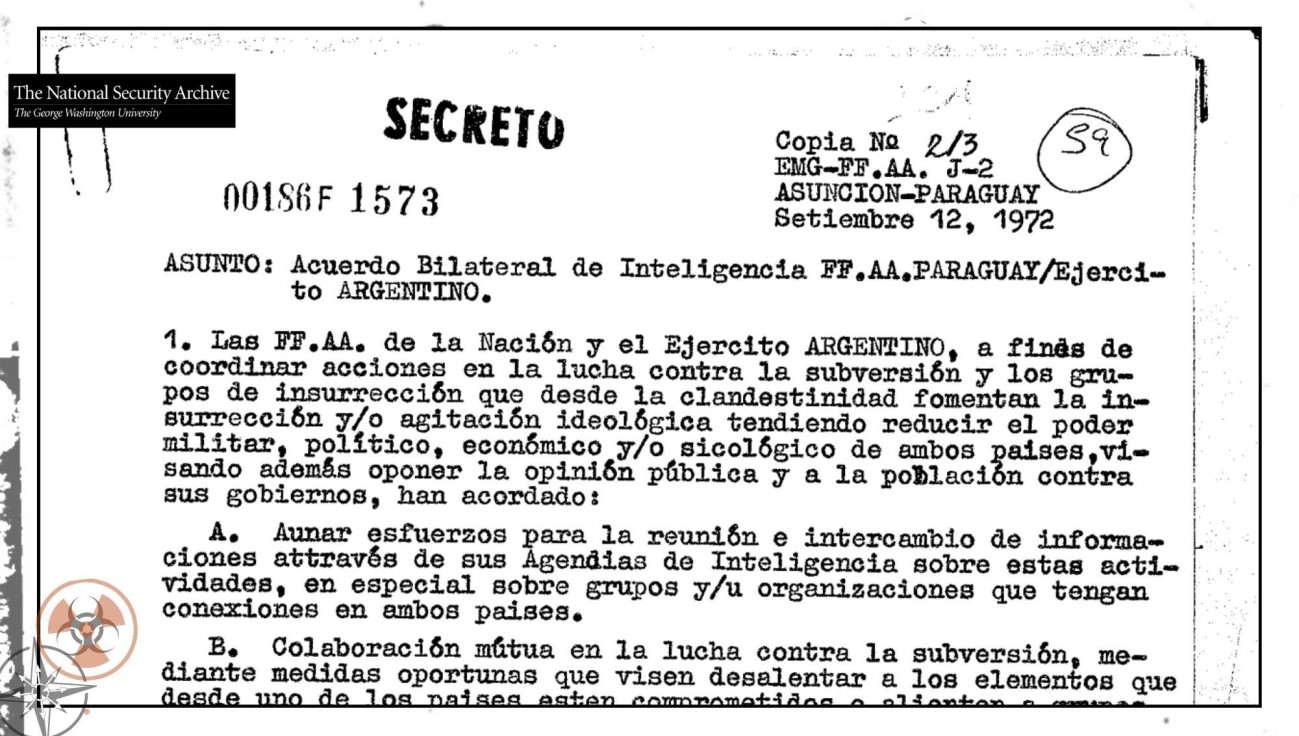
Image Source: The National Security Archive
Translated text: “The Armed Forces of the Nation (Paraguay) and the Argentine Army,
in order to coordinate actions in the fight against subversion and insurrection groups
that from clandestinity promote insurrection and/or ideological agitation tending to
reduce military, political, economic and /or psychological of both countries, also
aiming to oppose public opinion and the population against their governments…”
Text source: The National Security Archive1
In addition to funding, the U.S. gave them the blueprint. The Central Intelligence
Agency was already surveilling their own citizens and using much of the same
terminology that Operation Condor would come to use, just in a different language.
1 The National Security Archive, Asunto: Acuerdo Bilateral de Inteligencia FF.AA. PARAGUAY/Ejército ARGENTINO, September 12, 1972, https://nsarchive2.gwu.edu/NSAEBB/NSAEBB514/docs/Doc%2001%20-%20r186f1573%20-%201580.pdf

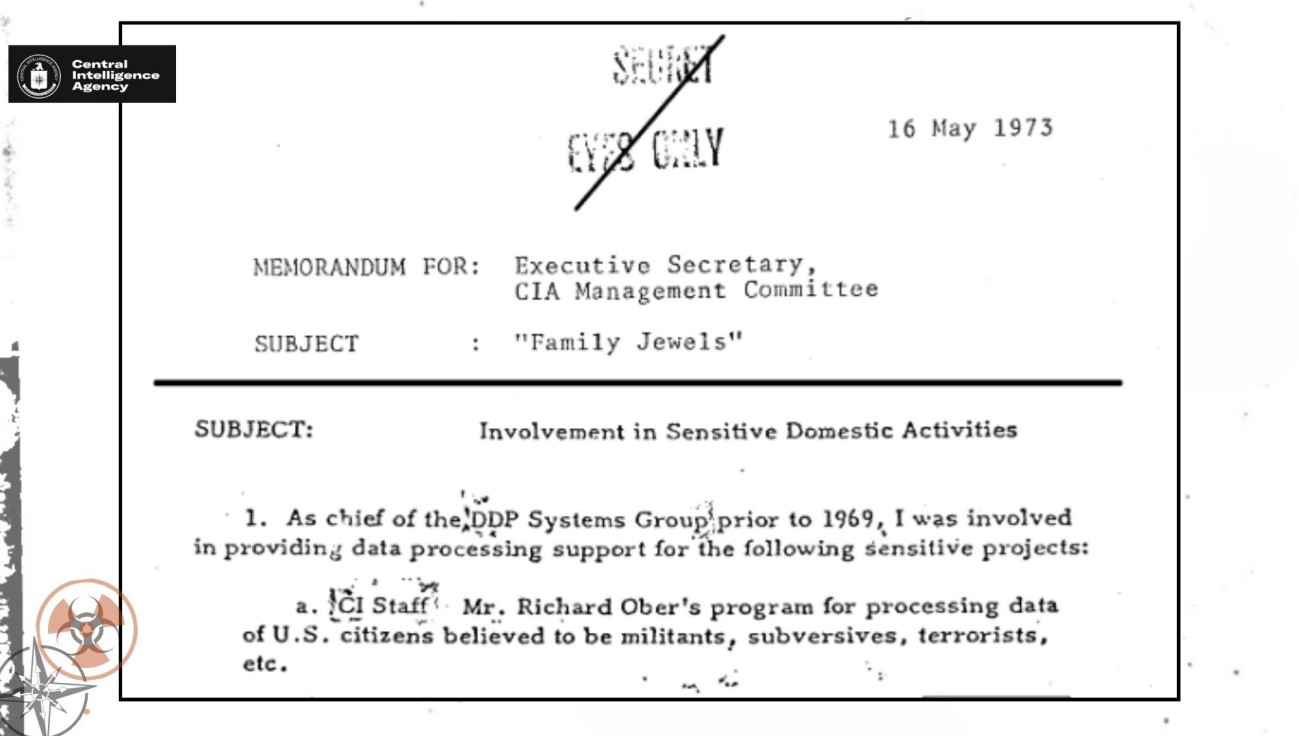
Image Source: Central Intelligence Agency
“Prior to 1969…program for processing data of U.S. citizens believed to be militants,
subversives, terrorists, etc.”
Text Source: Central Intelligence Agency2
The struggle has always been (Military) Intelligence against the citizens it claims to
protect. It is a government’s self-preserving and brutal response against attempts by
the citizens to get a corrupted government back under control and functioning as a
stable and balanced mechanism of promoting and maintaining a healthy, sane,
noncoercive, non-exploitative, and nonviolent stability of infrastructure within a
nation’s borders, in support and protection of its citizens, as all but the most rabid of
us prefer governments to be.
2 Central Intelligence Agency, Memorandum for: Executive Secretary, CIA Management Committee, Subject: Family Jewels, https://www.cia.gov/readingroom/docs/DOC_0001451843.pdf
This becomes most poignant and clear when it's finally our personal day
for them to knock down our door, enslave our children, and kill our
parents for a thinly veiled lie of it being “for the greater good” that no one
in our family, community, and country will collect the benefit of. The only
“greater good” in the vocabulary of liars and country-level thieves is in
the draining of a nation’s resources directly into the pockets of corrupt
politicians in support of arms, human trafficking, hardcore drug trade,
and the exploitation and overburdening of its people, and often while
government mouthpieces insincerely, underhandedly, and disrespectfully
claim to be doing the exact opposite.
The biggest insult is when they claim they are protecting us - from their
own crimes.
These types of actions, and they continue through today, have always been to protect
the financial and political interests of unhealthy governments from the people they
use as an infinite resource to exploit. They are desperate and continuing moves to
stay in power when there is no longer effective governance and it is no longer in the
best interests of the countries being exploited.
It has nothing to do with our survival as a people of a nation. Ask yourself, would you
need to be coerced, manipulated by public policies, and lied to in order to join the
military in fighting a just war to protect your own borders and families? No, you
would not. There is no realistic reason to manipulate the people “for our best
interests.” We are quite capable of making the right choices for our survival when it
comes down to it, even if that survival requires increasing the number of bodies
within the military. The pervasive mass manipulation we all endure is unnecessary. All
it does is make a nation weaker and provide an army of dispirited henchmen for
private interests and corrupt politicians - against our own people and survival.
These damaging and manipulative maneuvers are often allowed because people
mistakenly see Intelligence as a part of their country. But when something is working

that hard in opposition to your basic need to exist and to speak when you are being
crushed by the mechanisms of an overburdening government, it is not a part of your
country. It has been usurped. Frequently in the case of Intelligence and the corrupt,
by agreement and consequences it has become part of a multinational entity and is no
longer yours.
Government policies are most often created with mechanisms deceptively written in
to allow control and power to be easily usurped. In the early stages of a nation or a
party’s control, they are often overlooked because they are seen in a positive light - a
taking control of a nation for the people. But when you create a method of control,
eventually it won’t be you at the helm, even if the new captain is wearing your flag or
your party’s insignia for convenience. Just because we have always known something
to function in a particular way does not mean it is the best way. We have been living
with snakes for a very long time, and seemingly without creating basic methods to
ensure that we can live peaceably with them, without being bitten and then
consumed.
Back in Argentina when I was still a small child, unlike what the news would play on
television screens, the results of the crisis manufactured by Operation Condor would
not stay confined to South America. There’s no way they could have - it was an
international operation that would grow to touch multiple continents.
However, the University of Buenos Aires and surrounding areas had become the
primary at-gun-point forced recruitment area exploited by the U.S. military and
Intelligence during the turmoil of state terrorism. That was ground zero.
With the welcome invitation of Argentina’s military dictatorship, U.S. and foreign
forces walked right in via Operation Condor. They selected the best people from the
academic and scientific communities in Argentina and then framed them as the
political opposition in order to force them into what was very much a coerced “come
work for us or die here” scenario. Quite a few countries were in a post-World War II
phase and wanted as many people as they could get to create bigger and better
weapons and strategies for the next wars. In the West, the U.S. was taking the lead.
How no one ever realized that they always targeted universities is beyond my
comprehension.
Operation Condor opened up one of the largest government-sponsored international
human trafficking funnels of that time, and it was emptying right into government
pockets, offices, and military research labs across more than two continents.
The reality is that it was a resource grab, as all wars are, and was blanketed in divisive
excuses, as wars tend to be. It was the military reaping machine against a field of
people, and they never even saw it for what it was, thanks to the distraction and haze
of well-rehearsed media and political rhetoric.
The U.S. was also doing the same thing domestically, with more subtlety and less
obvious bloodshed. They would entrap their own university-educated citizens, make
them political prisoners, and then coerce them while they were being held in
indefinite detention. The methodology was nearly identical to what the U.S. still does
to imprisoned drug addicts to turn them into informants, but with a heavier hand for
the military and Intelligence.

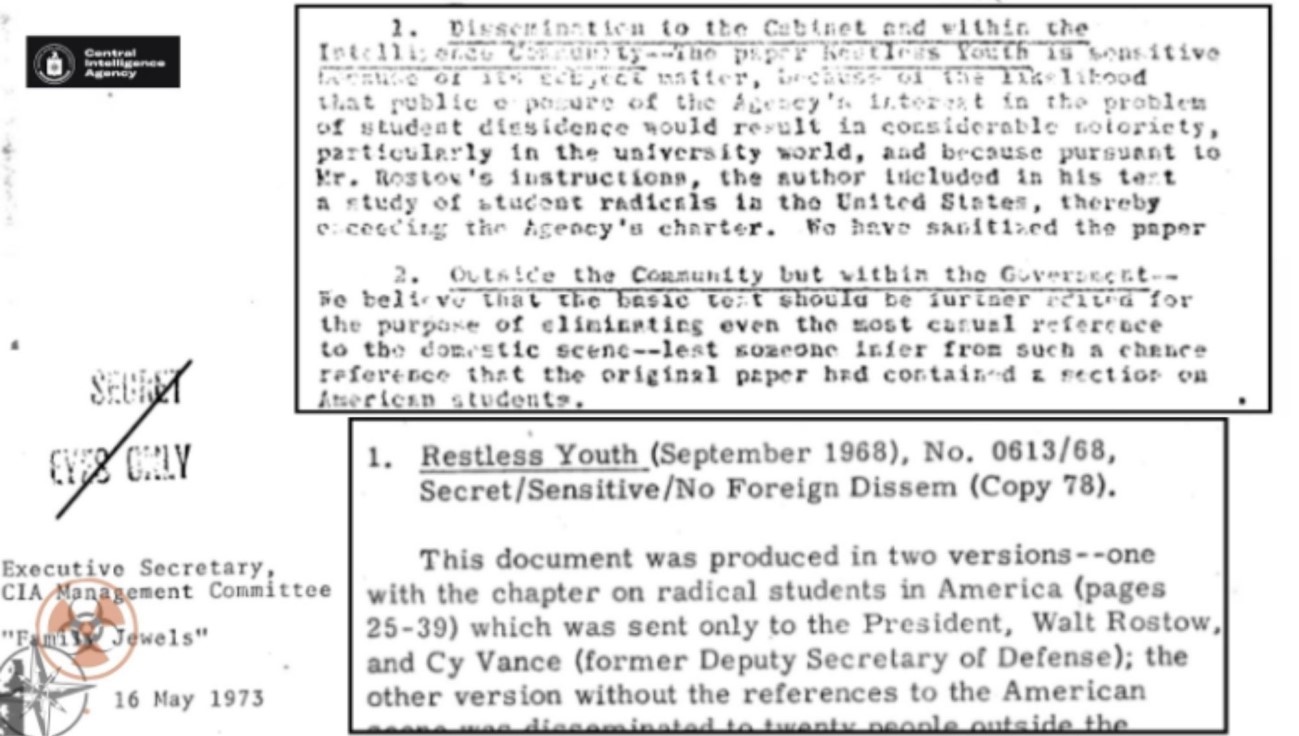
Image Source: Central Intelligence Agency
“...because of the likelihood that public exposure of the Agency’s intent in the problem
of student dissidence would result in considerable notoriety…We believe that the
basic text should be edited for the purpose of eliminating even the most casual
reference to the domestic scene - lest someone infer from such a chance reference
that the original paper had contained a section on American students…
This document was produced in two versions - one with the chapter on radical
students in America… was sent to the President, Walt Rostow, and Cy Vance (former
Secretary of Defense).”
Text Source: Central Intelligence Agency3
In Argentina, they had full reign to forcibly recruit however they wanted, so they
didn’t hide it. They did it in the open and with a combat boot.
3 Central Intelligence Agency, Memorandum for: Executive Secretary, CIA Management Committee, Subject: Family Jewels, https://www.cia.gov/readingroom/docs/DOC_0001451843.pdf
Every person on this planet is living in the aftermath of what would go down over the
next several decades as a result of those manipulative recruitment practices. The
television newscasters simply haven’t been honest about it yet. It’s doubtful that they
ever will be.
There’s at least a decade left on the classified documents from my early years before
they can drag it out into the public view and do their customary song and dance of,
“See, we made inhumane mistakes, but we were less ethical back then. Thankfully,
we’re more modern, evolved, and saintlike now,” all while hiding their current
atrocities under yet another 50+ year blanket of secrecy. Rinse and repeat until
someone in the endgame labs finally gets it right, and we all have more than the
unshakeable sniffles, as if that wasn’t already enough of a nuisance.
On a personal level, if there was anything worse than being jolted into this world by
military thugs, it was in having my records sealed by those same military thugs, so I
would be forced to spend a lifetime feeling as if I were standing alone to contend with
a public, a multitude of people, kept intentionally blind to where I have been or what I
would go through, thus hindering any real chance of unentangling myself and finding
safety.

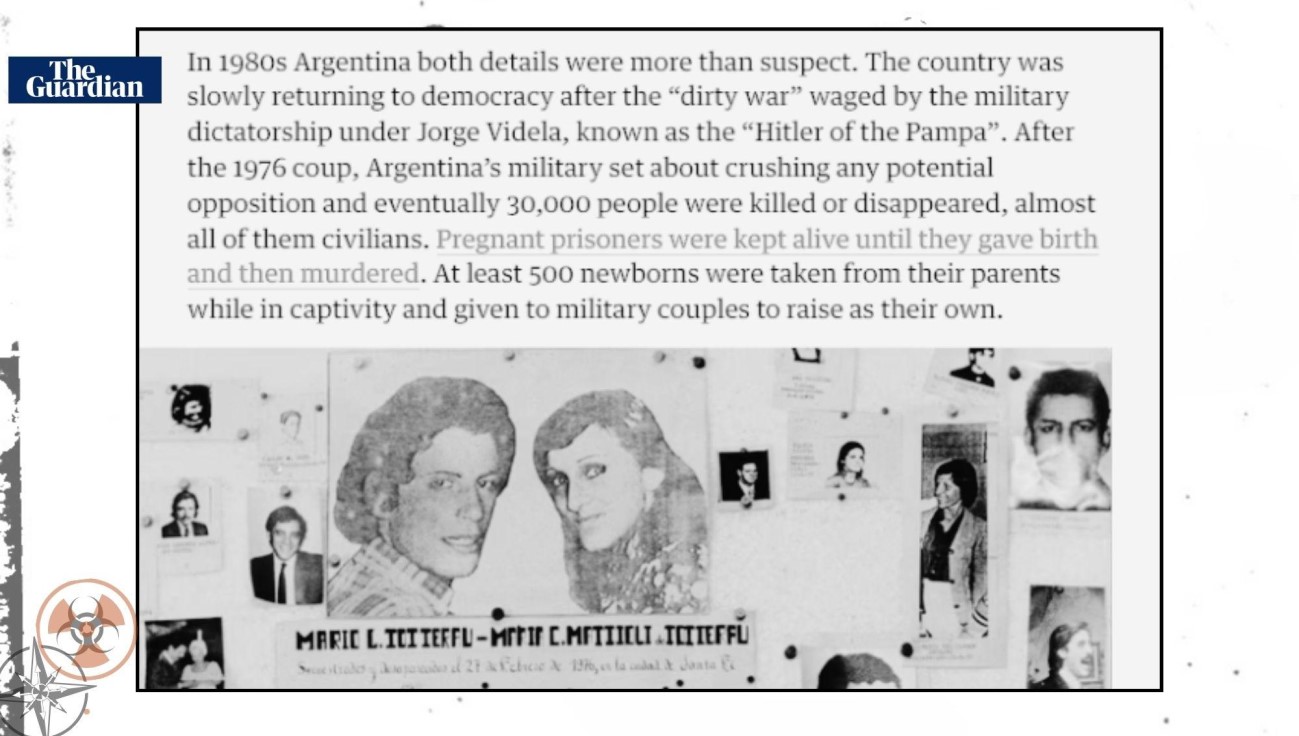
Image Source: The Guardian
“Argentina’s military set about crushing any potential opposition and eventually
30,000 people were killed or disappeared, almost all of them civilians. Pregnant
prisoners were kept alive until they gave birth and then murdered. At least 500
newborns were taken from their parents while in captivity and given to military
couples to raise as their own.”
Text Source: The Guardian4
If there was something worse than that, it was in being forced to stand next to more
of those military thugs, holding their instruments for them, as they methodically
worked on killing both my people and theirs - all under yet another layer of sealed
documents, a seal that for some reason everyone’s more terrified of than the actual
looming threat of death hiding beneath it.
4 The Guardian, Adopted by Their Parents’ Enemies: Tracing the Stolen Children of Argentina’s ‘Dirty War’, https://www.theguardian.com/global-development/2023/jan/16/tracing-stolen-children-of-argentina-dirty-war


And the one thing worse than that? When many of those I tried to warn preferred to
blindly trust in and prostrate themselves to an authority with money, secrecy, and
war as priorities; rather than believe the gravity of the words of a child witness whose
sole need was a civilization safe enough to grow up in.
So, they abandoned us children, living evidence of a war against the people, and forced us
to grow up within the cold hands of foreign enemies, in pain; to watch in horror the slow
grinding carnage of the preparation for the demise of the people of multiple nations,
including the nations that abandoned us and the ones into which we were illicitly
adopted after being moved by military caravans, some of which were manned by people
from our own nations.
That eats at a person.
The recruitment during state terrorism in Argentina wasn’t the first time the U.S. had
used coercive wartime methods to forcibly hire weapons research specialists,
scientists, scholars, and war strategists overseas. It has been documented that they
were doing it in other locations only one decade prior (right before the 50-year
classification secrecy cover comes down on us all). But I’ll get to those prior
recruitments in a bit, with references.
The door for foreign involvement was opened wide by the military needs of Argentina,
a country where most of the carnage would occur. Some of the country’s soldiers
found that rounding up and killing their own people was unsettling, especially when
their victims were primarily in the same age group they were. This was made obvious
by their bizarre methodologies of murder, such as drugging students and then
shoving them out of planes without a parachute. To the uninitiated, that type of
behavior seems incredibly sadistic and evil.

Ironically, the reality is behavior like that is often a sign that no one had the stomach
to shoot their own people at point-blank range. They had to devise a way to do it that
was more removed. Don’t believe me? Ask anyone with a soul who has ever had to kill
a chicken how that first kill went for them. Nine times out of ten, it’s not quick and
clean. They’ll have a story about awkward attempts, feathers flying everywhere, and
the bird escaping at least twice. There’s a hurdle in the human mind that needs to be
overcome first. Now, imagine it's their neighbor’s son and not a chicken.
To manage the mass incarceration, murder, and trafficking of their own citizens in
exchange for a war bounty, Argentina’s government needed help from foreign military
and Intelligence on the ground. The nations and authorities behind Operation Condor
were ready to respond to the expected request. They killed the Argentine citizens
they saw no monetary value in and trafficked the ones, like my injured mother, who
they thought they might be able to use elsewhere. While I know my mother’s fate, I
honestly don’t know what happened to my father after the dictatorship dragged him
away.
Before my heavily pregnant mother jumped from that balcony, my parents weren’t
grungy hand-rolled-cigarette smoking guerrillas in dingy back rooms reading CIA-
made communist propaganda and crafting makeshift bombs, as the dictatorship’s
foreign-Intelligence-run media arm would bizarrely claim all their victims were.
According to the limited public records that exist, my dad was in medical school. My
mother was a history major who volunteered at a local children's hospital.
While their vocations and socio-economic status are not the important parts here,
the fact the government and media lied about it, and absolutely everything else, is.
We were comfortable enough and Argentina still had a thriving economy at that time.
We weren’t clawing from the bottom, fighting some neo-political socio-economic war
between the haves and the have-nots.
And yet, the strategists behind Operation Condor smashed me to the bottom and said
I’d always been there. Then they put on their false crown of a rescuing savior of the
poor and indigent, and would claim me for themselves, never to let go again.
As for my mother, they would keep her for nineteen excruciating years in total,
squeezing every bit of value they could from her before finally taking her life.
They took those university students and graduates because they had monetary and
military value. It was never about rhetoric, philosophies, or political bickering. It has
always been about resources and for the war machine.
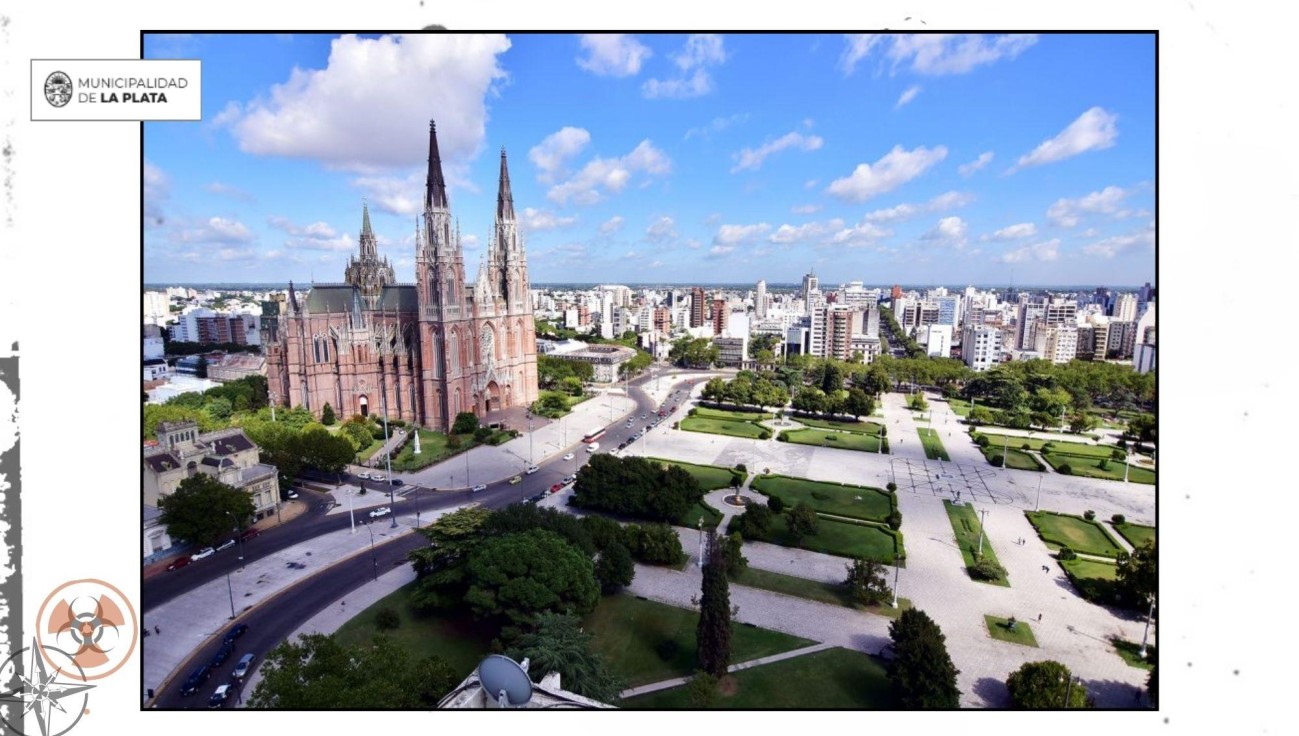
And to help dispel the myth of the United States as the wealthy white knight, here are
the “low-income degenerate communist mud huts they liberated us from.” This was
the neighborhood of Buenos Aires my parents called home:
Image: La Plata, Buenos Aires

Source: Turismo5
Sometimes, I wonder if where my parents grew up is why I always seek a city near
the sea: to be a little closer to the family I lost. I’ve often situated their photo
frames in my home with the water seen behind them, so I can still share it with
them.
As for why they were taken from me:
My mother’s crimes: knowing history and my father.
My father’s crime: not wanting to coerce, corral, or experiment on and kill his own
people for the military.
My crime: being their child and thus “the next wave of the enemy.”
I would become a child political prisoner in one of the most dangerous prisons on the
planet (most dangerous according to a Guardian journalist). I grew to call it home.
5 Turismo, Ciudad Soñada, https://turismo.laplata.gob.ar/sobre-la-plata/
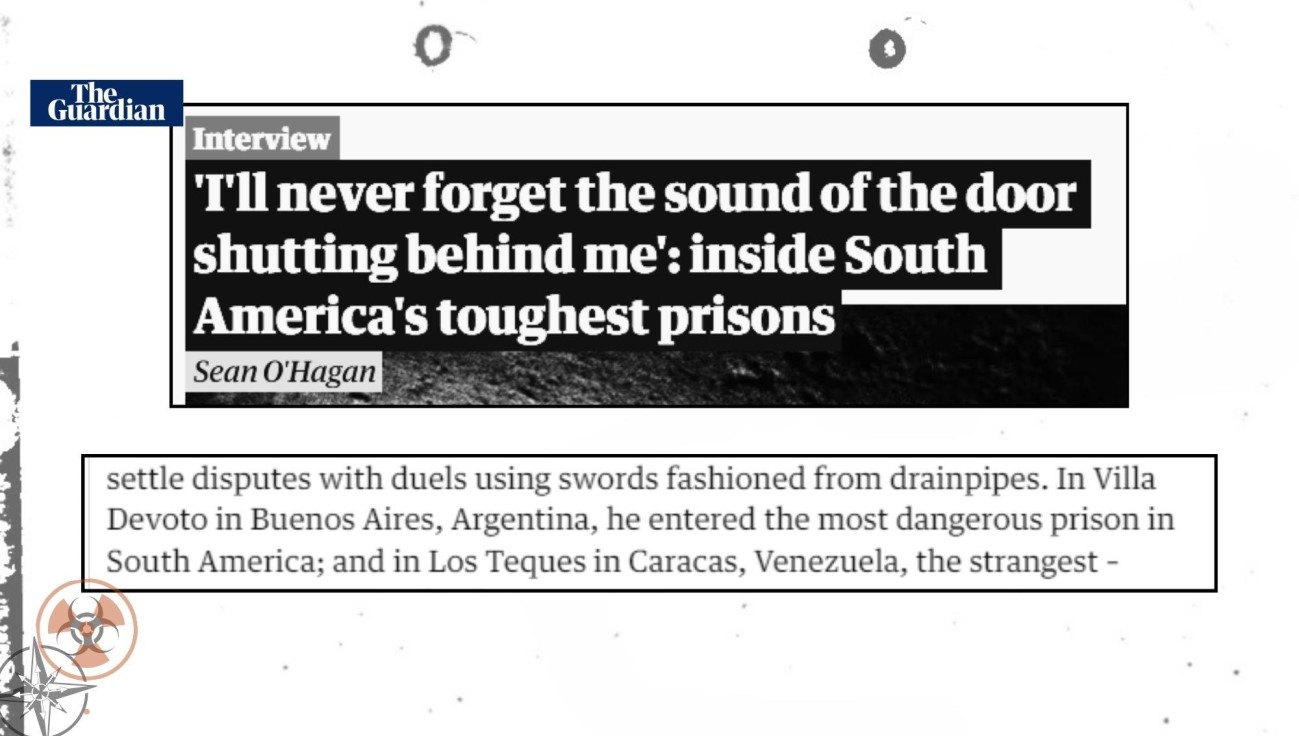
Image Source: The Guardian
“In Villa Devoto in Buenos Aires….the most dangerous prison in South America.”
Text Source: The Guardian6
In internal disputes, when politicians dehumanize their political enemies enough and
paint them as unrealistically grotesque and grungy caricatures, they convince the
public to think that’s a good place to keep their manufactured enemy’s women,
infants, and children. They exsanguinate the mothers and roll the infants in prison
yard dirt while praying it sticks so those babies can appear to match the stories told
about them.
And why? Because the media arm of government and military promises that those
grotesque caricatures of neighbors want to take away the diminishing rights that
government still allows. And on a different television channel, the opposing political
6 The Guardian, Interview: I’ll Never Forget the Sound of the Door Shutting Behind Me: Inside South America’s Toughest Prisons, https://www.theguardian.com/artanddesign/2015/jun/14/inside-south-america-toughest-prisons-valerio-bispuri-interview

party has told their own followers the same exact thing about them. We’re all the
enemy of the government. They’ve simply delegated the effort of anger and
dehumanizing. They delegated the tasks to the masses after conveniently separating
them into opposing teams. The fact that so many people so easily go along and
sacrifice their own neighbors and family makes me question if there is anything
within human nature to salvage.
Internal politics can destroy a nation’s humanity until it begins to consume itself. But
you might be figuring that out by now.
That playbook was written long before any of us. It genuinely does not matter which
country or party uses it. The results are the same - some of us lose our humanity and
some of us lose our lives. The modern complexity of the age-old problem is that we’re
now getting to a stage at which we may all become the latter.
I know, you’re thinking, “But you were one kid in Argentina who obviously went
through some trauma. What does it have to do with me or the current state of where I
am?” Patience. I didn’t remain a child and this isn’t a “Dear Diary.”
However, you need to become aware of the human element and how it affects the
larger picture, and I will walk you through that experience while pointing out the
government and military maneuvers and catastrophes along the way. Think of me as
your endgame warfare and secrecy backstage tour guide, the one you never knew you
needed but absolutely did.
Tip of the Spike
You’re being killed
without knowing how
or what direction it’s coming from.
As if blindfolded and helpless,
standing still in an open field,
and waiting for the firing squad.
In this case, the year of one of humanity’s many attempts at suicide by enemy, as well
as my birth, was 1977.
The location, as noted: Argentina.
In Argentina, parental custody of child political prisoners defaulted to the same state
that imprisoned us and killed our parents. That alone should have been enough of a
red flag for the sane in this world to put a stop to the madness. It wasn’t. I don’t think
crimes against children ever really have been enough to move the world away from its
madness. We are expected to endure and spend a lifetime, from cradle to grave,
carrying the weight of the sins of the wars we are born into so that those who create
and support the wars have no weight to carry themselves. It is on the shoulders of
infants that the carnage of war thrives.
After spending my earliest years in prison, I was unadoptable, still in that same prison,
and the military was stuck with me whether I was useful to them or not. I was in one

of the last and oldest batches of kids still remaining in the prisons by 1980 when the
active portion of Argentina’s state terrorism was starting to wind down.
I can't claim to remember the earliest details of my life, but the information I’ve
managed to glean aligns with the evidence and what I remember from later on. My
first memories would emerge around the time I was turning three years old and was
still residing in the Buenos Aires prison that my mother and I had been carted off to at
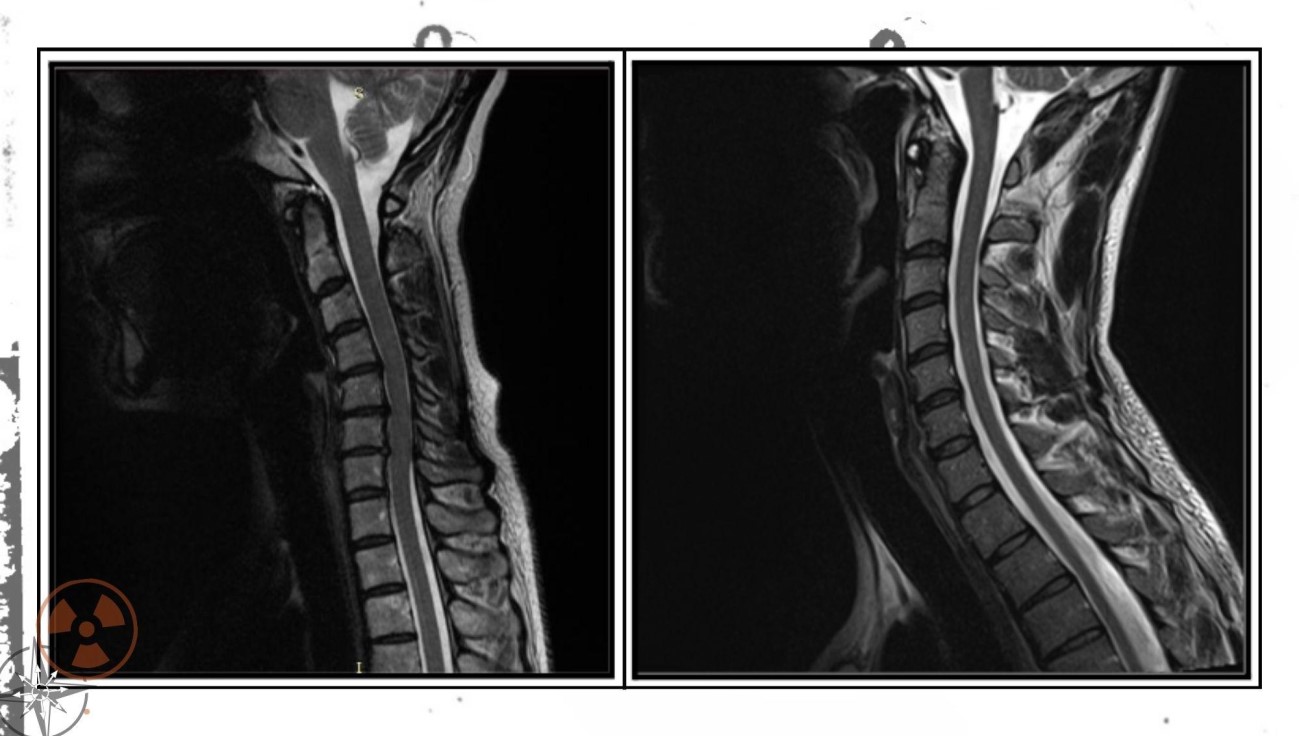
some point. As for the effects of that fall, MRI scans of my neck have always looked
like those of a victim of a car wreck. The first image below is of the vertebrae in my
neck. The second image is of an unnamed patient’s uninjured neck, using the same
MRI scanning angle and technique, for comparison.
First Image Source: Author’s Personal Medical File, Cervical Spine MRI 2018, Age 417
Second Image Source: Example of a Healthy Cervical Spine MRI, Radiopaedia8
7 Author’s Personal Medical File, Cervical Spine MRI 2018, Age 41
8 Radiopaedia, Normal Cervical Spine, https://radiopaedia.org/cases/normal-cervical-spine-mri-1
And the damage to my mother? In all my memories, I never actually saw her walk. I
think she may have been crippled by the fall.
Spending my early years in the prison, a sprawling mass of buildings taking up a city
block and known back then simply as Cárcel de Devoto, left me with other scars that I
have worn throughout life. How so many chose not to see them was beyond my
comprehension back then.
In retrospect, a significant factor had been the public adoption of hiding group and
government-caused harm. They do so for the sake of group cohesion and the outward
appearance of behaving as just and law-abiding for their temporary self-preservation
and protection. Rooted in the small villages and tribes of our ancestors, the behavior
was likely more beneficial than not for centuries. However, in our larger groups and
societies, it has slowly caused the development of a significant level of pervasive
knee-jerk-reaction blind callousness that reaches nearly every aspect of civilization
that I have seen and has seeped into every facet of modern life at the expense of our
long-term survival.
What was originally created to protect us now feeds the predators among us and
scatters our children to the wind.
One of the first scars I gained, during the process of Argentina’s government turning
on its own citizens, was likely caused by inhaling smoke at such a young age. About a
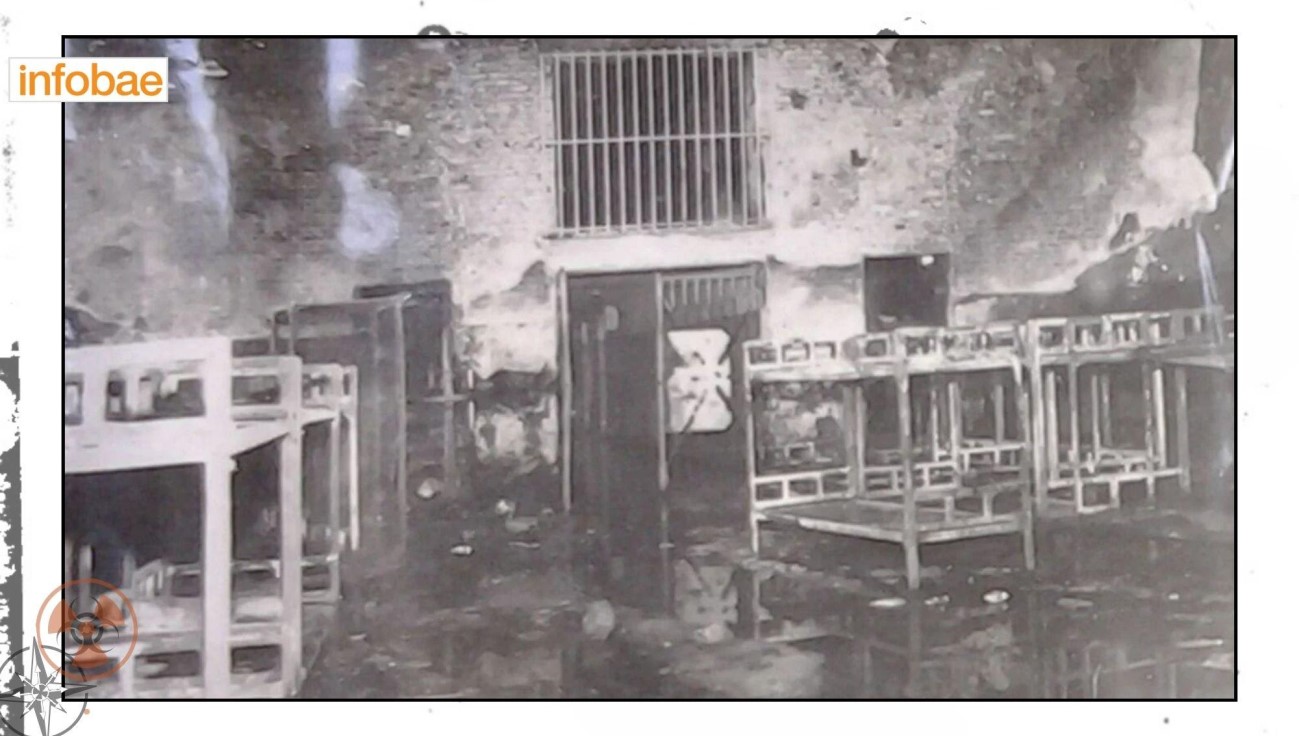
year after my arrival, there was the “masacre en el pabellón séptimo.” Mattresses
were ignited on the men's side of the prison.
Inmates died when the guards still refused to let anyone exit the building. The
(1)prisoners made no real effort to overpower the guards to attain an exit (instead,
many escaped to the roof, the opposite of survival when fire moves upwards), the
(2)guards did nothing, and (3)no one on the outside effectively advocated for the
prisoners and reasoned with or removed the guards.

This was despite there being enclosed outdoor areas and other prison buildings
within the sprawling prison complex. The soon-to-be-dead could have been corralled
to those alternative areas via established gates and prisoner walkways if their
imprisonment (mostly for suspected thought crimes, according to government
mouthpieces) was still a high priority. To have one or two of these non-survival-
reaction elements occur together is unfortunate. To have all three occur is a sign of
societal collapse.
Neither (1)prisoner, (2)prison guard, nor (3)witness intervened to prevent unnecessary
deaths.
Image: Aftermath of the 1978 Cárcel de Devoto Fire
Image Source: Infobae9
9 Infobae, "Quémense de a Poco": El Horror de la "Masacre de los Colchones" en Villa Devoto, https://www.infobae.com/sociedad/policiales/2018/03/14/quemense-de-a-poco-el-horror-de-la-masacre-de-los-colchones-en-villa-devoto/
As a baby locked into the next building over, the smoke left a portion of my lungs
scarred. To this day, I can feel those scars tug on my left side when I breathe. I may
not be able to remember the event, but my body carries the reminder, and I feel it
with every inhalation.
Some of the scars are more visible, such as the ones above my elbows that resulted
from being forced against a metal surface in the hot sun. Others aren't physical at all.
They reside deep in my psyche, my heart, and my struggle against an ever-darkening
perception of humanity. They were only born in the prison and were intermingled
with good, with childhood innocence, with memories of my mother, and with hope
despite those concrete walls.
In the end, it wouldn't be the prison that truly darkened my perception of humanity. It would be what I witnessed and experienced when I entered the wider world that had kept
us there.


War’s Broken Social Contract
Infinite cycles. Infinite path.
How do I explain to you that war does not end?
It never ends.
It simply goes through cycles
of open activity and concealed preparation.
That silence you hear.
That silence you may have lived your life in.
It isn't peace.
It's preparation.
Our mothers gave us the best advice that they could in the situation. I had a friend
living down the hall in another cell with a mother who told her the stark reality of
everything, including that she would be adopted out to the enemy. Trading in infants
and small children was a common practice by the dictatorship that would have long-
lived consequences politically for Argentina, as well as for the children who were
traded in exchange for foreign military support).
Instead of speaking about adoption, my own mother chose to give me tools for
surviving the situation. She gave me things to read, she educated me, and she taught
me how to be a good hostage. That last lesson both cost and saved me in the end,
because I kept it with me throughout life and far beyond those prison walls. The
method of deception necessary to be a good hostage would gain me acceptance by the
enemy. It would also keep me entrenched within them, sacrificing any attempt at
fulfilling a child’s need for true human connection and protected vulnerability.
My mother had explained that I always needed to tell people what they wanted to
hear, even when what they wanted to hear wasn't real or realistic. She taught me how
to read people's expectations, not necessarily by the words they spoke, but by
indicators of what they believed they would hear when I spoke. I would watch their
eyes, the levels of tautness and movement of the muscles beneath the skin of their
face, the manner in which they leaned in or away, and I’d listen to their breath to see
which of my words it caught on, so I would know where to pivot my speech to match
what they expected to hear from me based on what they perceived me and the
situation to be.
She had shown me the easiest and yet most destructive path, the path that no one
ever questions – one of accommodating and matching the unique biases of each
individual person whom I spoke with. I became a mirror of their expectations and
views of the world. I reflected back at them the world they anticipated they would see.
And in that, I became a comfortable and expected part of the scenery - a near-perfect
background actor for every scene.
It would get me into some small (and large) issues over the years. When I was brought
along on jobs to play a child’s role (a parent and child have more access to
underground and grassroots groups than any single male ever will, but not everyone
wants to bring their own children to infiltrate what they deem to be dangerous or
opposing groups, hence the use of stolen children and disposable war orphans),
people would look at me and assume I had certain traits and knowledge or affiliations
with any of a wide variety of random groups, schools, or cultures that I knew nothing
about and thus struggled to mimic or discuss. In those moments, I would use
distraction or play dumb. There are quite a few people out there in the world who
may think I’m legitimately mentally challenged. It was preferable to them discovering
that I wasn’t who or what they assumed I was, and neither was the situation.
And it made me a perfect hostage. It was easy to end up wrapped up within a group or
pigeonholed by them, often by my own doing. It took decades to begin to escape those
self-inflicted shackles. I’m still working on breaking the last links in their chains as I
write this. The weight of misguided public expectations will always be a heavy one and
difficult to entirely set aside. This writing has been an exercise in providing the
honesty I would prefer to see.

If that last thought on public expectations made zero sense, let me clarify:
A lie does not exist simply because one person states it. There needs to be someone
on the other end to bend enough to accept it. Every lie requires two active
participants: the giver and the receiver. In most cases, once they engage, both become
just as invested in keeping the lie afloat. The public is constantly asking to have lies
confirmed, and it’s often easiest and seemingly polite to go along with that. But by
doing so, if we continue to do so, we adopt the lies ourselves and then feel obligated
to continue to prop them up as valid. It takes concentrated effort to avoid that entire
situation.
There’s a reason that it’s a million times easier to get someone to accept a lie than it is
to get them to acknowledge that they were lied to. It requires unentangling them and
removing the hook that silently slid in when they first accepted their part in giving life
to the lie.
While subterfuge for self-protection is a necessity in many cases, the trouble is in
balancing that with and separating it from the danger of the results of exploitative
subterfuge. Brutal honesty and active discernment are required to get close to
attaining that balance and separation, and even more would be necessary to
consistently maintain them at a useful level in perpetuity. Maintaining honesty in
communication is an exhausting but often-important series of battles.
Back to the prison for now…
Our days were uneventful for the most part, despite the war that brought us there.
Our routine was usually predictable, dictated by a military regime and prison that
needed the facade of precision control and authority in order to maintain their
positions in governance. The days were so predictable and the prisoners were so kind
to me, most likely because they could finally see how important life was in those
moments when it promised to end. Memories from my time in that prison are the
stable and humanity-filled moments that I cling to. They are what I remember fondly
when I look back on my life.
War isn’t all shock and awe for the television viewers. It is predictable. It lulls you into
a sense of false security as each day washes over you, as you learn to adapt and you
come to understand how little you can actually live with and still survive. It becomes a
daily life that chips away all that is unnecessary and leaves only the human core. It
brings out the best in people, not just the worst. It’s when we become closest to
ourselves, our humanity, and we can see and feel it so clearly that it becomes tangible.
To me, it felt like home.
Over the decades when I would fight to get back to my mother, that was the feeling I
was searching for. I thought if I could get home, I would find it again. Back then, I
didn’t understand that pure humanity is not a place. It’s a condition brought about as
a reaction to being about to be extinguished, that final flare of life before it goes dark.
That’s the condition under which we finally truly come to life - the moment we are
face to face with death. Unfortunately, by then, there are usually no lessons to be
learned or remembered because most die in that moment. They cannot return from
death to show you the light. And even when they can, even when they manage to pull
back from that brink and share it with you, you aren’t able to see it yet. Some things
really do need to be experienced firsthand.
Each morning, we were separated from our mothers to spend our afternoons with the
other children, generally within the administrative buildings of the prison. There, we
watched babies leave through the front door, adopted, and never to be seen in our
small world again. As we stood in the street-facing adoption room with a row of cribs,
my friend once expressed wonder about why her own adoption was taking so long
and on which day it would occur. I never had a similar thought.
I never wanted to leave my mother.

Even now, the wound of being ripped from her has never healed. How could it? It’s
still hidden beneath the purposely created fog of limited public perception, even with
the active part of that particular deception-heavy war long over.
No one has ever gone back through the newspaper articles and annotated them with
evidence of what truly went on. It’s easier to manipulate the public by keeping them
perpetually in a state of mind that allows them to permit the results of war to persist,
and for their own citizens to be systematically and indefinitely imprisoned, tortured,
kidnapped, and killed. When in that state of mind, people will bury their own
neighbors and family. That makes much less work for an infiltrating enemy. It also left
me an orphan for life, separated from where I came from and only acknowledged as a
“child criminal” deserving of my fate.
There’s an almost admirable simplicity in the use of influence, dehumanization, and
deceit. You rarely have to get your hands dirty. You only need to trigger someone else
with rage and then point them in your desired direction to have them make your
crusade their own. Those with the vocation of war managed to figure that one out
before the rest of us.
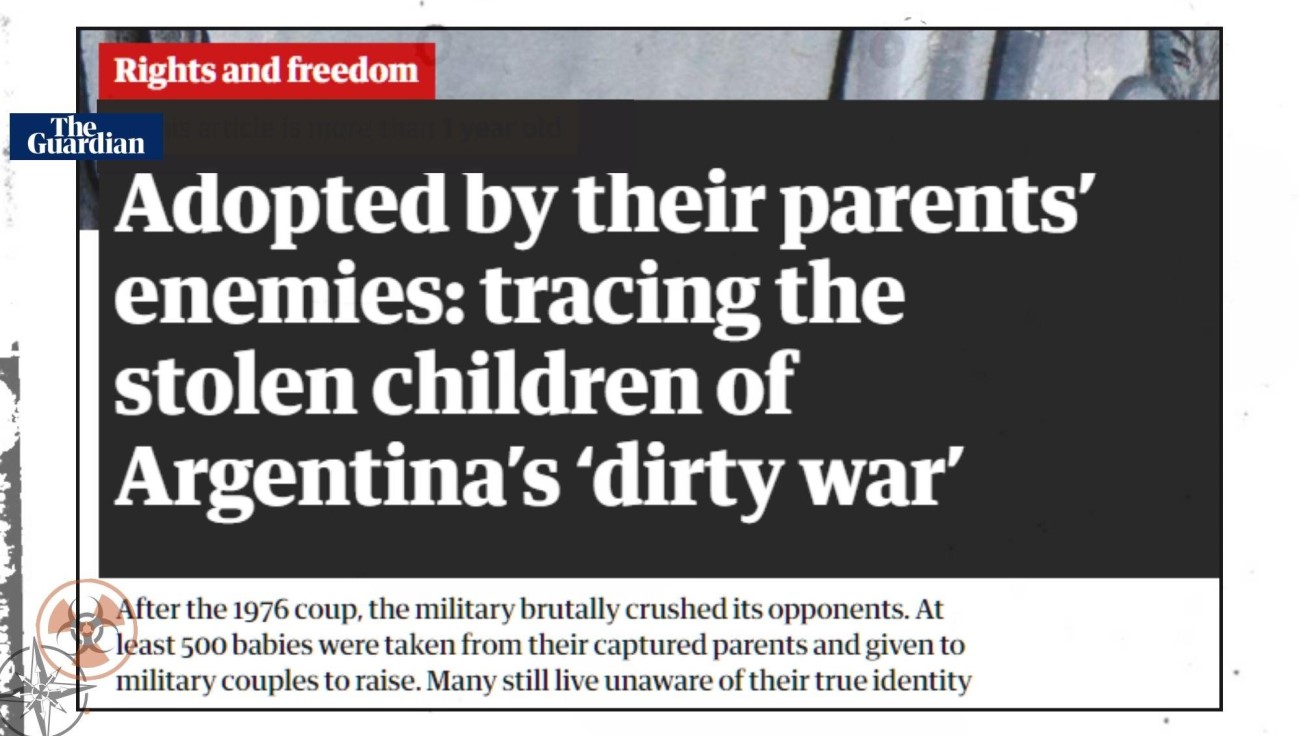
Image Source: The Guardian
“Adopted by their parents’ enemies: tracing the stolen children of Argentina’s ‘dirty
war’…
After the 1976 coup, the military brutally crushed its opponents. At least 500 babies
were taken from their captured parents and given to military couples to raise. Many
still live unaware of their true identity.”
Text Source: The Guardian10
On one of the days that has always left me wondering about the long-term survival of
humanity, of its ability to fight off even the weakest chains, the group of children I
belonged to were walked through the main bureaucratic part of the prison, as we
were at the end of most days. On the bureaucratic/nonprisoner side, the door we
went through to get to the hall our cells were on had an old fashioned (maybe modern
10 The Guardian, Adopted by Their Parents’ Enemies: Tracing the Stolen Children of Argentina’s ‘Dirty War’, https://www.theguardian.com/global-development/2023/jan/16/tracing-stolen-children-of-argentina-dirty-war

at the time) metal number-lock on the door, with a vertical line of metal buttons that
was used to enter a short numeric code to unlock the door.
By then, we had been through the door enough that I had memorized the
combination. As the guard entered the numbers, I carelessly said them out loud. She
looked at me and told me to never use them or to repeat them again. I complied. But it
makes me wonder. If a three-year-old can memorize a short code to open one door,
how can an entire prison of adults who vastly outnumber the guards, and who are
being threatened with death (every one of the political prisoners was), not find a way
to break through those doors?
If you are going to die anyway, wouldn’t you want to die trying to gain freedom?
Even when faced with death, people tend to act overly compliant and trusting. It’s a
part of human nature that leaves me entirely perplexed. There is nothing wrong with
courtesy and mutual respect. In fact, it is possible to show respect for the safety of
others while also respecting yourself by making certain that you remain protected
from them. When they do the same, it’s called mutual respect. When they don’t do the
same, you were very right to protect yourself.
Absolute trust in any situation should be avoided, especially when in the hands of an
enemy.
And demands for absolute trust? Down here in reality, those are simply insane.

Domestic Breaches and International Infiltration
To understand how our current policies of secrecy
sew things together in ways that will always result
in the implementation of endgame
weapons and strategies,
it’s easiest to start where motivation and preparation
for the next war are sparked
- in the fires of the previous war.
There were a few other significant events that happened within those prison walls
that would end up having an impact on my life, some sooner rather than later. The
results of one would shake my world the most and cast a shadow on an otherwise
exciting landmark moment in my life.
At roughly the age of three, we were finally allowed to play outside. Prior to that,
many of my brief moments outdoors had been briskly walking between administrative
buildings while hurried along by cruel chaperones who promised us, small children
who had done nothing wrong other than being born into the circumstances, that "this
didn't count as being outside." That level of bullying from the adults would be
reflected in the behavior of the children as they became older. There were quite a few
children who were simply too abusive and angry to deal with, and I went out of my
way to avoid any interactions with them. Avoiding any unnecessary interactions with
the adults was a given.
When one of the adoption workers told me the news that I was finally allowed to play
with the older children, I checked twice to make sure I hadn't misunderstood or
misheard. I was very aware of the danger of breaking the rules. After all, they had
callously threatened us with the removal of our mothers multiple times for the

slightest of infractions. That threat left me in a constant state of anxiety more than
anything else. I was always acutely aware of every microscopic part of my behavior
and how it might result in losing my mother. Often, the result was me being frozen,
silent, and afraid to do anything at all, even when I needed something simple, like
access to a restroom after three hours of desperately needing to use it.
Once I had confirmed what the adult had said was real, I went bounding through the
doors and down the stairs, finally allowed to experience playing with the older
children.
I went through one room and then entered another. Or at least I thought the second
one was a room. Having mostly believed the lies that our prior moments outside
"didn't count as outside," and due to the fact that the area they now sent us into was blocked off on most sides by the surrounding buildings, I naturally assumed that it
was simply a large room decorated to appear like it was outside. After all, in my mind,
while I knew the outdoors existed, I did not think that they were actually reachable.
My excitement became apprehension, being suddenly surrounded by older children in
a setting unfamiliar to me. I stood against a wall not far from the door and watched
the game, listening to the bouncing of the ball and the shouts of the children echoing
loudly between the buildings. The level of noise was painful to my ears, something
that was often the case during my time in the prison, especially with the noise level of
the combined screams of the women in the larger prison area at the end of the hall
my cell was on. My ears always ached.
I waited patiently, with my head resting against the wall, until an older boy invited me
to join the game. I would not have entered the game without the invite. My shyness in
that moment had been overwhelming.
Later, I would hear about that day from a different perspective, from an adult
observer from the United States whom I had not noticed in the moment. The
foreigner, brought in to assist with Operation Condor, explained that she saw a child
who stood silently on the side, observing and learning the rules of the game before
entering it. She spoke positively about the trait and saw it as useful.
She – not the prison, not the state terrorism and senseless deaths – but she would
become the darkest shadow that would hang over the rest of my life. That first
moment of truly breathing in and acknowledging the outside air was both my first and
my last moment of freedom.
That was the moment she chose me as her own.
If you're still among the "that doesn't happen" crowd, I'd like to introduce you to
two concepts:
One: Once a military policy is established, it is written into procedures manuals
and continues, regardless of the particular war, state terrorism, or catastrophe.
Two: Operation Baby Lift had recently set a policy precedent and established a
roadmap for largescale confiscation of children over international borders during
the later stages of wars and during the post-war cleanup stage, permanently
removing healthy adoption-age infants and children, very frequently without their
parents’ consent and/or knowledge.

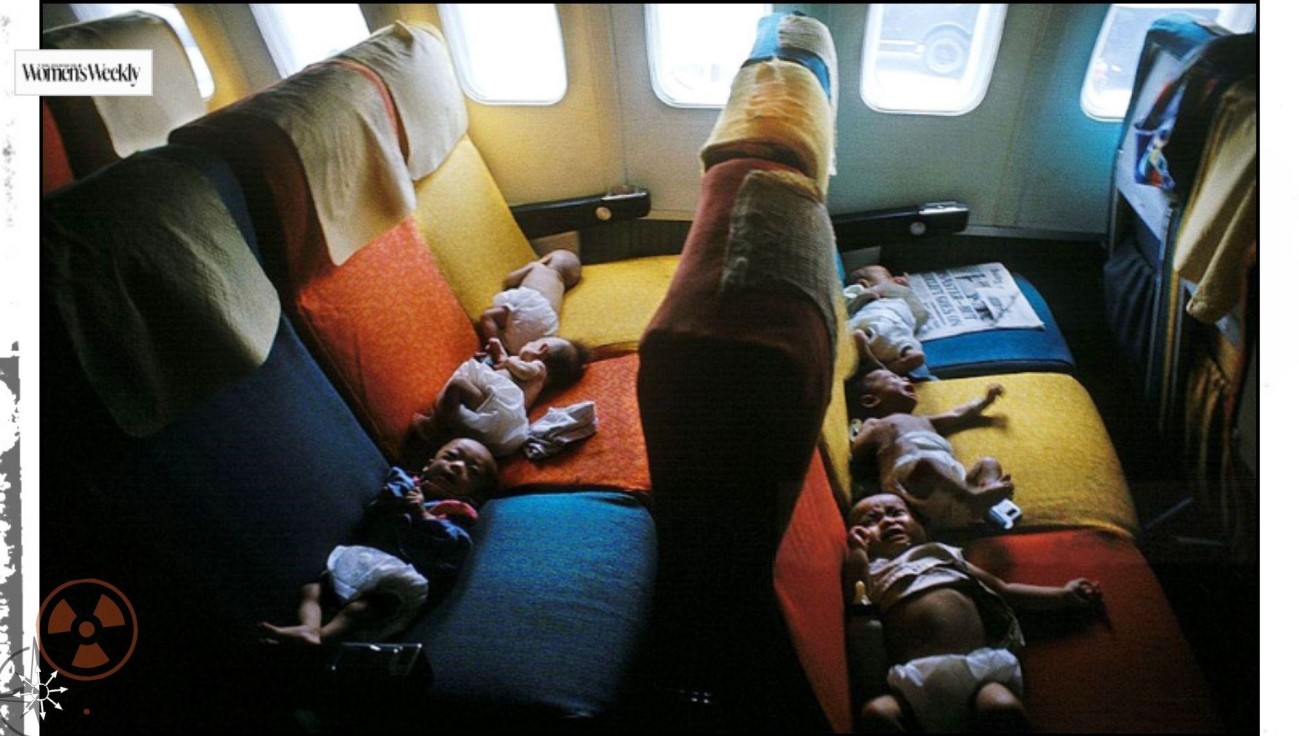

Image: Operation Babylift Infants
Source: The Australian Women’s Weekly via PressReader11
Image: Operation Babylift Newborn Infants
11 The Australian Women’s Weekly via PressReader, Children of War, https://www.pressreader.com/australia/the-australian-womens-weekly/20170601/281590945491471
Source: SelfCare for Healthcare12
The pictures above were taken only five years prior to U.S. military involvement in
my removal from Argentina. Even if the fallacy of militaries becoming “more
evolved and more humane” during the time it takes to declassify something were
true, no one had time to evolve and learn from their mistakes in five years. If they
had evolved, they would have returned those Vietnamese babies to their parents. If
they had evolved, they wouldn’t still be writing it into their policies nine years
after they took me (dated document below). Even now, in the 2020s as I write this,
they still haven’t evolved to embrace humane practices or to return the stolen
children.
Operation Babylift was the large-scale removal of infants and small children from
Vietnam to countries including the United States, France, Austria, and West
Germany towards the end of the Vietnam War. In April of 1975, approximately
3,300 children were transported out of Vietnam.
12 SelfCare for Healthcare, Hear LeAnn’s Operation Babylift Story, https://www.selfcareforhealthcare.com/operation-babylift/

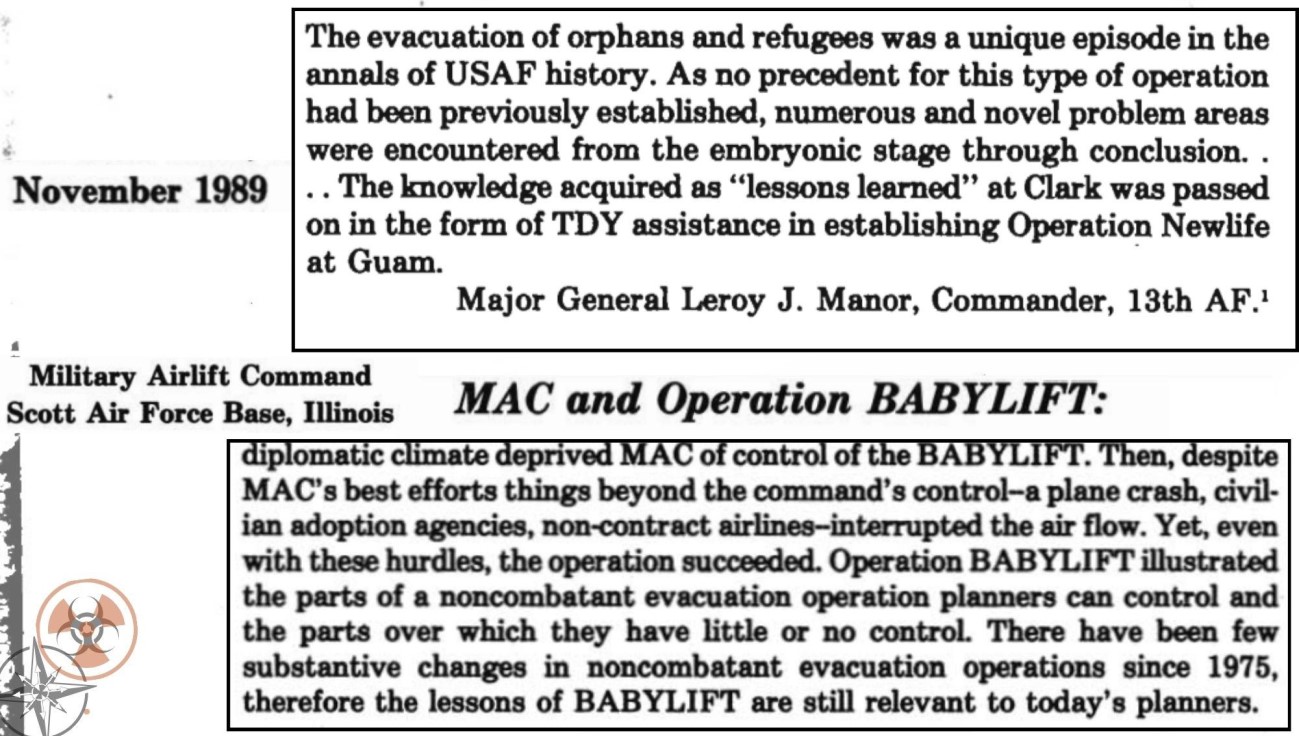
Image Source: U.S. Department of Defense
“Military Airlift Command…November 1989:
The evacuation of orphans… was a unique episode in the annals of USAF history. As
no precedent for this type of operation had been previously established… The
knowledge acquired as ‘lessons learned’ at Clark was passed on in the form of TDY
assistance in establishing Operation Newlife at Guam.
Major General Leroy J. Manor, Commander, 13th AF.
…There have been few substantive changes in noncombatant evacuation
operations since 1975, therefore the lessons of BABYLIFT are still relevant to
today's planners.”
Text Source: U.S. Department of Defense13
If you think the government baby snatching policies has changed since 1989, the
odds are extremely high that your perspective, as well as the lives of tens of
13 U.S. Department of Defense, MAC and Operation Babylift, https://media.defense.gov/2012/Aug/31/2001330018/-1/-1/0/AFD-120831-032.pdf
thousands of children, may be a victim of a different government policy: one of
using secrecy to hide potential embarrassment and tarnishing of a country’s
reputation, rather than simply behaving in a way that would not cause
embarrassment to begin with.
For public consumption back in Argentina, they would paint the killing of mothers and
stealing of their infants with the authoritative and caring undertones of adoption by
upstanding and stable military members who would take on the role of parents and
guide the infants to live a proper and useful life within society, a type of training that
the original sinful parents could not provide.
Obviously, back here in reality and away from their insincere and delirious
thoughts of grandeur, when military members use the convenience of war to
abduct an enemy's baby from her family, it is rarely due to compassion or a need to
improve the life of the child. And yet, even that gets repainted by self-deception,
group authority, and an almost religious sense of infallibility and righteousness on
the side of the kidnapping party.
But when I looked into that baby-snatching U.S. military woman’s eyes, when she
stepped into my world, I was face to face with the glaring truth of being a child in the
theater of war. There were no media banalities or distance to insulate me from it. The
small dark eyes looking at me were those of a predator seeking someone unprotected
and too little to fight back, to utilize as human bait and lure within war and the
preparation for war. She wasn’t looking for a child to join her family (and in fact, I
would always live separate from her family). She was looking for an untraceable
multiuse tool - a living and breathing pocket knife without a paper trail. In other
words, a female war baby who was no longer in diapers.
What I experienced and would live through was not an adoption, despite the
deceptive paint they thickly layered on it for the public so they could pat themselves
on the back and sleep at night, feeling as if the vulnerable orphans created by their
political needs were in the care of, at best, heroes, and at worst, stable disciplinarians.

The type of people who kill a dog and take its newborn puppies are not the type of
people who care for or have compassion for the puppies. They are almost invariably
the ones we later discover have kept those puppies locked in a dark closet in an
attempt to mold them into attack dogs. That lingering callous and exploitative
psychology of predators is worse when they kill a human mother and take her infant,
because the memory of murdering a mother in cold blood to steal her helpless baby
remains long after the memory of killing a dog would fade.
They see the reflection of the dead mother in that child’s face, and they become
determined to mold the most flawed characteristics in the child in order to create a
guilt-free excuse as to why they had attempted to kill the breed. There’s a reason that
when most of them looked at me they hoped it was a soulless psychopath looking
back at them, just another empty automaton bent on instant gratification above all
else.
I know my mother taught me to always meet expectations, even low ones, but I wasn’t
going to go around killing other toddlers in an act to convince the adults that they
were correct about me. I doubt the thought even crossed my mind. However, a much
easier opportunity to make them comfortable still arose, possibly after I’d already
developed stomach ulcers from not getting to that point fast enough. My anxiety was
sky-high about performing as was expected of me.
The first time I popped a second candy into my mouth after it had been offered by one
of the visiting military commanders, I saw them go from tense to relaxed, with their
attention moving to other parts of the room. So, to reduce any reasons for both their
and my anxiety, I obliged their expectations by always asking for and ingesting an
inordinate amount of candy with an addictive level of lack of self-control. I did it to
appear that I could be easily manipulated via simple means, addictions. Yep, my
mother taught me that too. If I didn’t love her, and if she wasn’t dead, I’d probably
strangle her.
A control-distraction works just as well for the liar as it does for the one wanting to
be lied to - i.e. if I thought I’d done something out of character from what they
expected, I could distract from it by begging for candy, and they would feel in control
as the manipulator because they had the say regarding if I got the candy or not. It was
child-level simple, but psychology is often that simple. People like to feel like they are
in control, so we walk them through the same routines until they become so
comfortable with the predictability of those routines that they become comfortable
with us and forget that we’re capable of anything else other than being manageable
and obedient. It also helped to instill the belief that I wasn’t a threat to anything other
than a candy bowl.
That said, playing a long con game from the side of the victim is dangerous. I do not
recommend it for individuals or societies. It’s a prisoner’s game intended to get the
tiniest bit of leeway to get away with things or to wait for that one moment that offers
a potential escape. If you’re in the open air, not chained to a cell, and are still acting
this way, you may want to examine why and at what point you became a voluntary
prisoner.
To maintain that trust and predictability over the years, I came so close to death on
numerous occasions that it’s a miracle I’m still alive. Better people than me have died
from it. To prove that I would obediently walk into anything blindly, I “happily”
swallowed whatever was placed in front of me and went wherever I was told to,
resulting in being drugged beyond comprehension while in dangerous situations more
times than I could count.
It would lead down a path in life that had me so exhausted and skirting the edge of
death that I had to import my concealer from China because they were the only ones
that had the palest ivory makeup to match my near-death and unnaturally pale ghost
complexion.
But now I’m getting ahead of myself. I’m still supposed to be talking about prison life
at this stage, or how my mother seemed to be a little too educated on subterfuge.

That last thing may have simply been the result of her growing up in Argentina. Living
in a deceived society can teach us more about deceit than any Intelligence training
can.
Sometimes, I wonder how anyone managed their mental gymnastics regarding my
level of gullibility and malleability after seeing the early school readiness results from
the exams they brought us to and performed in the little tower above the
bureaucratic hall. But it’s a million times easier to lie to someone than it is to convince
them they’ve been lied to. They were happy to continue thinking I was an idiot even
when I tested among the highest in the group.
My friend who used to talk about everything we saw while we walked through the
prison was the one who probably tested the highest. She would turn out to be too
aware of her surroundings for her own survival. Her attempts to evade harm
eventually resulted in damage to her health. She absolutely never ate anything they
gave her. She didn’t trust it. If this civilization came with a rescue crew, she would
have been fine before real damage set in, but there are no rescue crews, and long-
term malnutrition and starvation do bad things to a child. I miss her more than
anything. This world snuffs out true intelligence before it is old enough to flee.

Recruitment Contracts
It’s endgame.
Not let’s-save-one-side game.
Not let’s-go-another-round game.
Not even let’s-keep-the-rich-alive game
(although many were promised it was in exchange for funding).
Not even let’s-keep-the-useful-slaves-alive game.
Endgame.
I struggled to get people to understand that.
I don’t think they wanted to.
Because if they did,
they would realize the trouble we are in.
After meeting the foreigner who was about to drag me to her home country, the next
significant thing I remember happening was my witnessing heightened security and
excitement around countless boxes of files being moved through the main
administrative area of the prison.
It is very likely that those boxes were part of what would become the Archivos del
Terror (Archives of Terror), a collection of roughly a million pages of military,
intelligence, and police documentation on the disappearance, movement, and murder
of countless citizens of Argentina and South America during Operation Condor and
Argentina's own enthusiastic version of it - the Guerra sucia (Dirty War).
To this day, they still have not allowed the public or the victims access to 98% of
those pages. They’ve used many flimsy excuses over the years for why, but much of

those revolve around the need to keep the depth and breadth of their crimes
classified and away from the public’s view, in order to maintain simplified control.
The crimes against the people did not end when the war did, despite the fallacy
upheld by limited history books, newspapers, and front-facing political bureaucrats
that proclaim war and atrocities have an official start and end date, as if they were
nothing more than football matches between friendly rivals.
Using Operation Condor’s agreements, policies, and political prisoner trafficking
pipeline, Argentina spread its methodologies and seeded people (their own people as
well as legitimate political prisoners) into projects, offices, and agencies in other parts
of the country and world. The results of their continuing efforts have had, and will
continue to have, further-reaching implications than the state terrorism that gripped
much of South America in those years.
Back in the prison, the next moment that would impact my life happened as I was
standing in the cell I shared with my mother, gazing out the window at a tree that I
could always see but would never get to play under. We had a visitor. My mother
spoke with the woman, the same foreign officer who had observed me as I played.
They spoke for ages as I pretended to have my concentration fully on the outdoor
scene.
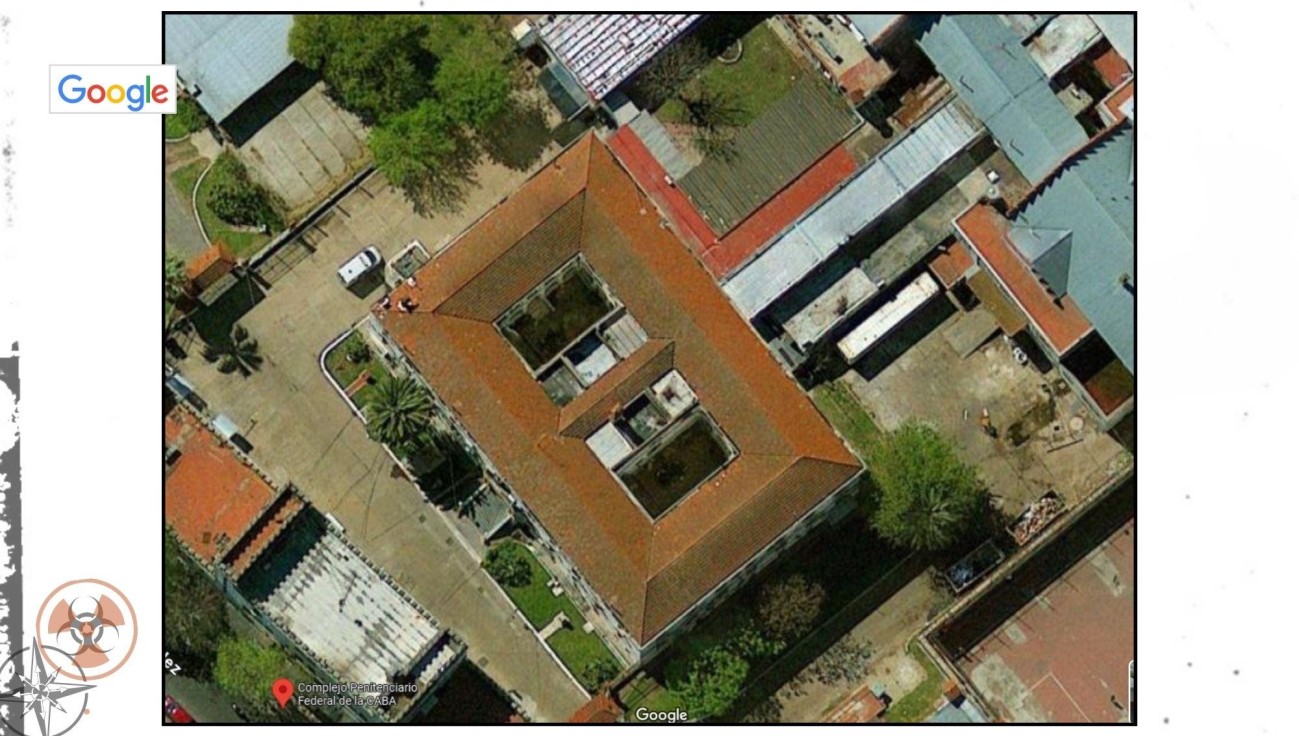
Image: Cárcel de Devoto (Since Renamed to Complejo Penitenciario Federal de la C.A.B.A.)
Image Source: Google Maps14
I may not have caught all of the conversation, but I heard enough that I would later
come to understand that it had been an agreement – my mother had signed away her
rights and life to that woman in exchange for my "safety and opportunity" in the
United States. They spoke about how, due to injuries, my mother wasn’t eligible to be
recruited for anything that a military intelligence officer could offer, except for one
unpalatable option.
As for any questions about U.S. recruitment practices from war, I will highlight one
thing:
The United States’ practice of recruiting political prisoners, war criminals, and
prisoners of war can be clearly identified with the example of 1940s through 1960s
Operation Paperclip (foreign scientists recruited with the lure of being protected
from war crimes tribunals). If it didn't set the precedent for the 1970s through 1980s
14 Google Maps, Federal Correctional Complex C.A.B.A., https://maps.app.goo.gl/y6Uh5q8k5bV19WZk7

recruitments and modern wartime recruitment manuals, it's an example of the
practice.
Once a policy is established by the U.S. military, it is utilized, regardless of the name
of the war or the location of state terrorism. The only thing that keeps it in the past in
the public mind is the combination of a belief that we are always more ethical in the
present and modern day, plus that pesky 50-year average period before
declassification that helps to keep the fallacy of ethical modern behavior perpetually
alive by always hiding the bad parts at the time they occur.
We may want to be more ethical in the present day, and that says a lot about the
potential good in humanity. However, we are often quite the opposite behind closed
doors and removed from the public eye, something that is permissible due to the
belief that long-term deception, even domestic deception, is still a necessity for state
control and warfare.
If it’s established policy and procedure, it’s rare that the policy would be operational
ten years prior and then simply cease to exist.
Established is established.
Policy is policy.
And if there’s anything we can trust the military to do, it’s to follow policy.
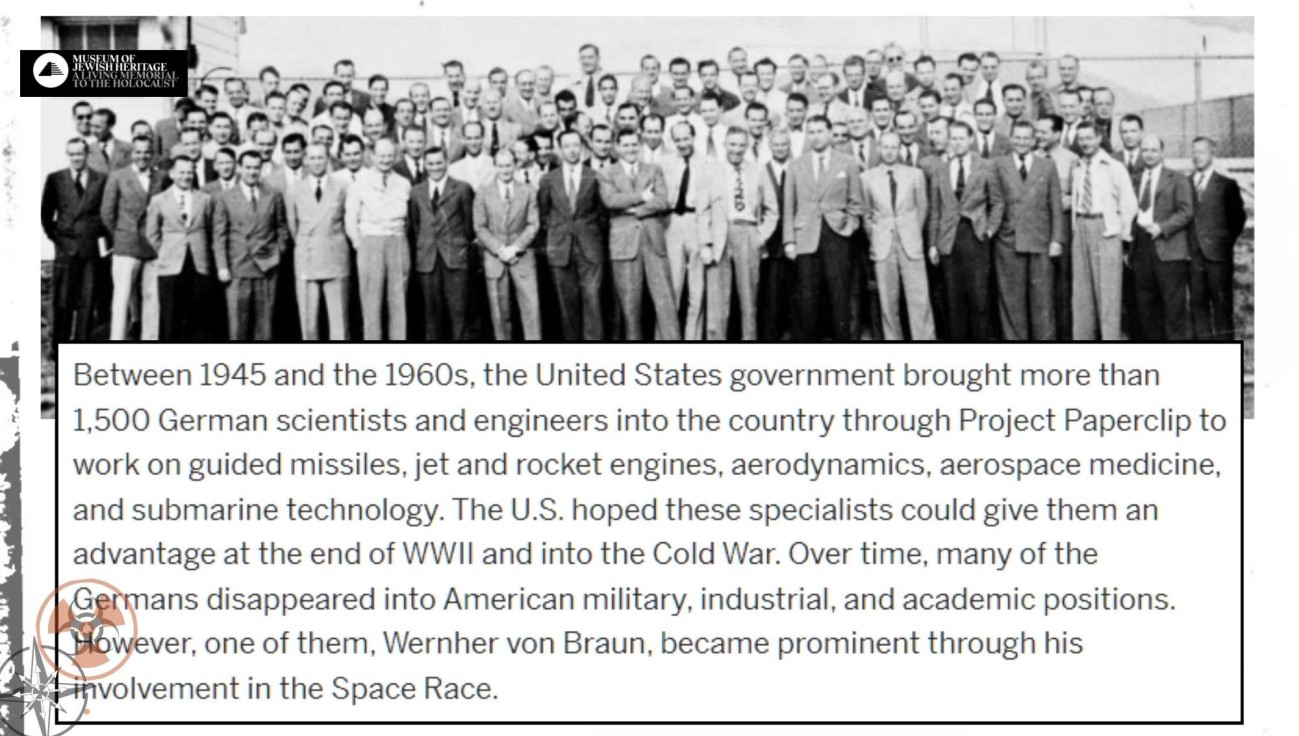
Image: Nazi Scientists Recruited by the United States under Operation Paperclip,
Source: Museum of Jewish Heritage
“Between 1945 and the 1960s, the United States government brought more than
1,500 German scientists and engineers into the country through Project Paperclip
to work on guided missiles, jet and rocket engines, aerodynamics, aerospace
medicine, and submarine technology. The U.S. hoped these specialists could give
them an advantage at the end of WWII and into the Cold War. Over time, many of
the Germans disappeared into American military, industrial, and academic
positions.”
Text Source: Museum of Jewish Heritage15
Because my mother could not be recruited for military research skills or intelligence
work, both areas in which the U.S. still sought the best from foreign war recruitments,
the recruiter offered the only other primary option she had available for getting my
15 Museum of Jewish Heritage, From WWII to the Space Race: The Story of Project Paperclip, https://mjhnyc.org/events/from-wwii-to-the-space-race-the-story-of-project-paperclip/

injured mother and myself out of the country. Her words seemed to indicate that she
was sincerely trying to help us, her voice sometimes dropping to a hushed tone as if
she was sharing secrets with my mother that the guards shouldn’t hear. But the
recruiter’s body language, the twitch of the muscles beneath her skin? Those didn’t
entirely match the rest of her act. I trusted my mother to know what to do with the
woman, but there was something uncomfortable enough about her that the memory
seared itself into my brain.
My mother agreed to fulfill the only other human resource need by the group of
military departments the recruiter represented. She agreed to become a human
subject for Defense medical research (something the recruiter would often call cancer
research when around civilians she wanted to trust her - but my mother didn’t have
cancer). My mother accepted the deal in exchange for getting us both out of that
prison and breaking free of the country oppressing us. It was a deal with the devil. She
sacrificed everything in that moment. She thought she was doing it for me.
She truly thought she was making the sacrifice for me.
I will always love her, even more for her sacrifice. I wish what she agreed to had been
a contract based on truth instead of lies, and that I could have known what it was back
then. I would have clung to her. I would have screamed. I would have shouted and
made a scene. Instead, I stood there silently like the perfect hostage, waiting to be
whisked away without even a single struggle or whimper.
Even more, I would have preferred to have died in Argentina with my mother, safe in
her arms, and without either of us knowing the true horrors beyond those prison
walls, rather than going through what was still ahead of both of us.
The brutal truth is that some of the only people they could get to knowingly agree
to become research subjects were political prisoners in indefinite detainment and
under threat of death. Ordinary domestic prisoners, even those facing life in
prison, often refused to volunteer in exchange for a reduced sentence. And
ordinary people? Some of them might be horrified if they knew what their
government was actually up to.
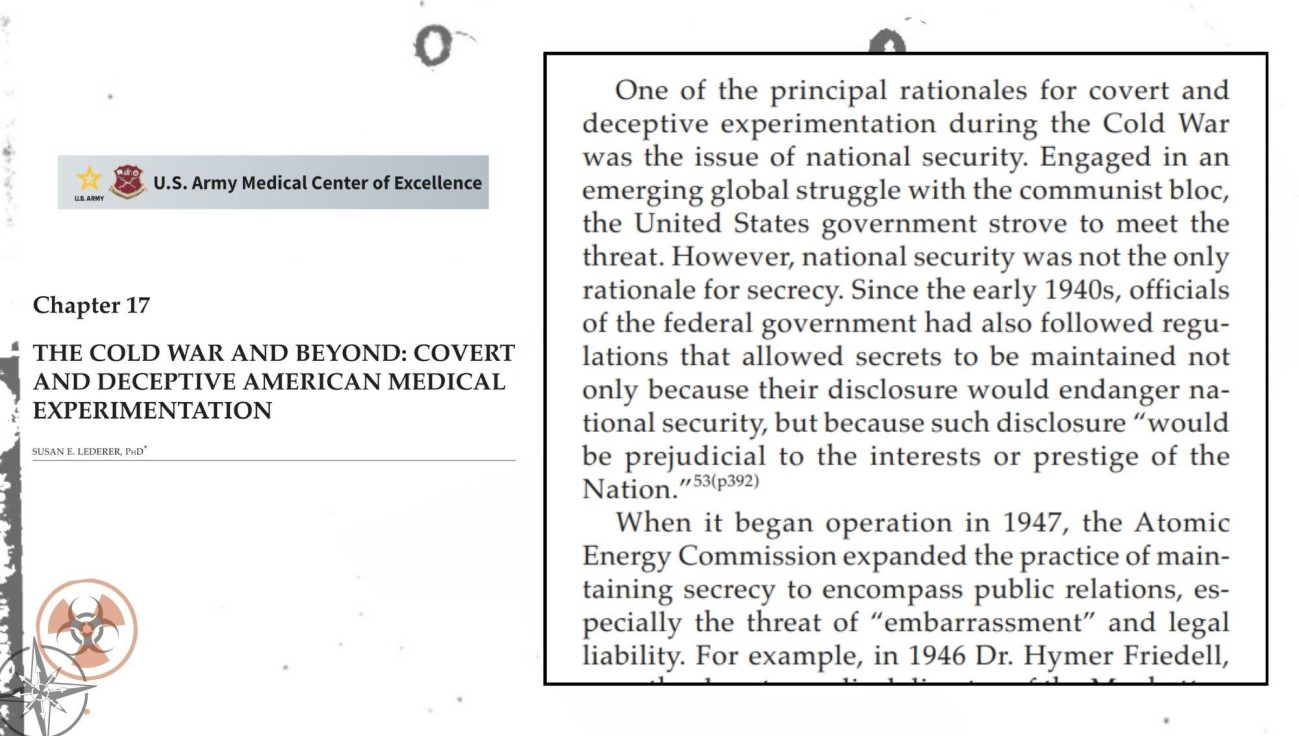
Image Source: US Army Medical Center of Excellence
“Officials …allowed (covert and deceptive experimentation) secrets to be
maintained not only because disclosure would endanger national security, but
because such disclosure ‘would be prejudicial to the interests or prestige of the
Nation.’
And… expanded the practice to encompass public relations, especially the threat of
‘embarrassment’ and ‘legal liability.’”
Text Source: US Army Medical Center of Excellence16
16 US Army Medical Center of Excellence, Military Medical Ethics, Volume 2, Chapter 17 The Cold War and Beyond: Covert and Deceptive American Medical Experimentation Susan E. Lederer, PhD, https://ke.army.mil/bordeninstitute/published_volumes/ethicsvol2/ethi cs-ch-17.pdf https://medcoeckapwstorprd01.blob.core.usgovcloudapi.net/pfw-images/borden/ethicsvol2/Ethics-ch-17.pdf https://web.archive.org/web/20130218014139/https://ke.army.mil/bordeninstitute/published_volumes/ethicsVol2/Ethics-ch-17.pdf

According to the U.S. government and military, the reasons for lying to the public
about the harm done to individuals and communities for warfare purposes have
expanded to include preventing lawsuits, embarrassment, and damage to the
nation’s reputation.
It hasn’t been about your safety or protection since at least the 1930s.
That government and others like it deserve to be embarrassed. They sacrifice
their own citizens, and the world, for an illusion.
And the public deserves to be embarrassed for letting them. They told you they
were doing it. And some of them are you.
When face-saving is the goal of government deception, their own citizens become
the enemy. Witnesses become the enemy. When their crimes get big enough and
we all become witnesses, we all become something to erase.
And before erasing us, when it comes to learning how to erase us, the required
endgame researchers and strategists must not care about a political party, race,
community, country, or their own families. This is true even if they appear to
happily ride one or more of those groups to the finish line, wearing the full regalia
and masking as their biggest leaders and supporters. The best endgame worker
doesn’t even care about the ground they stand on.
That’s why militaries have to force-recruit in countries, such as Argentina, already
known for leaning in the direction of genocidal ideations. No sane, normal, or non-
coerced person will willingly and consistently work towards their own demise and
the demise of their people, party, nation, or globe. You have to select them from
the correct environment and then steal and break them in war if you want people
who will work on those particular research and strategy projects with any degree
of effectiveness.
Endgame workers are rarely born for the job. They are most often forged in war
and then torn from their roots by enemy recruitment.
The final significant moment in the prison occurred one early evening when we
children were returned to the halls where our cells were. For the first time that I
could recall, my mother was not there to return to. My prison cell was empty other
than our two beds pressed against the walls, one on each side of the room, as if the
guards had already sought to create a separation between us. A foreboding sense felt
like it was pulling me down. That weight became physical as they told me that my
mother had gone to see the doctor because she had a high fever. Mothers with "high
fevers" did not always return.
I was alone, wandering in anxious silence between the hall and my bed for hours
before someone noticed and brought me to the small janitor's closet to get something
to drink.
I was lost without my mother…


Entrenchment at Universidad de Buenos Aires
The aspect of war piercing my core
hasn't been the loud spectacle of death.
Death is restful.
Eternal agony is found in the silent weeping
& shared wounds in mother and child
that open as the war machine
rakes over and separates a mother from infant,
like wheat from chaff.
Before I had a chance to find out if my mother was alive, I was brought to another
building entirely. We entered an elevator and, in that small space, I experienced the
chlorine scent and sounds of a pool tucked away nearby. The elevator rose to an
upper floor. As we exited it and walked down the hall, I peeked over a railing to see
the floors below in the open architecture.
We entered a series of crowded rooms that contained a palpable silence. Prisoners sat
huddled on the floor, filling every available space and quietly waiting for what might
be the only contractual possibility to leave their current circumstances and escape
the ever-present threat of death. One of them whispered to me and handed me a book
to keep me occupied and silent.
Eventually, I was ushered into a back room where I saw a higher-ranking military
officer guarding a file box containing our new government-forged documents and
identities. When even the government can’t follow their own basic laws, you know the
shit show has gone on for too long. Either the laws are invalid or the government is.
He disbursed my set of falsified identity documents to the colluding foreign recruiter
who had joined us from another room, the same woman who had observed me playing
and then spoken with my mother.
After collecting my new documents, she and I were sent to the offices a short way
down the hall for my further processing and travel vaccines. The paperwork and
conversation between the adults in those final offices took forever. I spent most of
that time under a desk, recovering from the travel vaccines the bureaucrats had given
me. I was ineffectively hiding in the relative darkness provided by the small space
intended for a chair.
The world outside the prison would be overwhelming for me, especially at first. It had
none of the predictability or relative safety I had known when with my mother. We
spent a couple of weeks or so in Buenos Aires before leaving the country. It was a
whirlwind of experiences, all of which left me with an uncomfortable feeling that
something wasn't right. On one of the first days, I tried to call for help when we
visited an apartment with a phone. I didn't know how to use the phone or what
number to dial. I just sat there in an empty room, tense and with the telephone in my
hands. At one point someone passed through the room and asked if I knew how to use
the phone. I told them yes because that was what they expected to hear. They nodded
and exited. I was devastated and so deeply wished that had not been what they
expected to hear from me.
I felt completely helpless, lost, scared, and alone.
There may have been a reason for those feelings, more than the state kidnapping,
more than that individual war, and more than my sitting in that silent room with little
hope. I would later come to discover, from the recruiter as well as some of her
associates, that the woman I was now under the custody of had been involved in the
1972 bombing of a government building by the U.S. domestic terrorist organization,
the Weathermen (also known as the Weather Underground Organization), widely
known for their small-scale bombings of government offices within the United States.

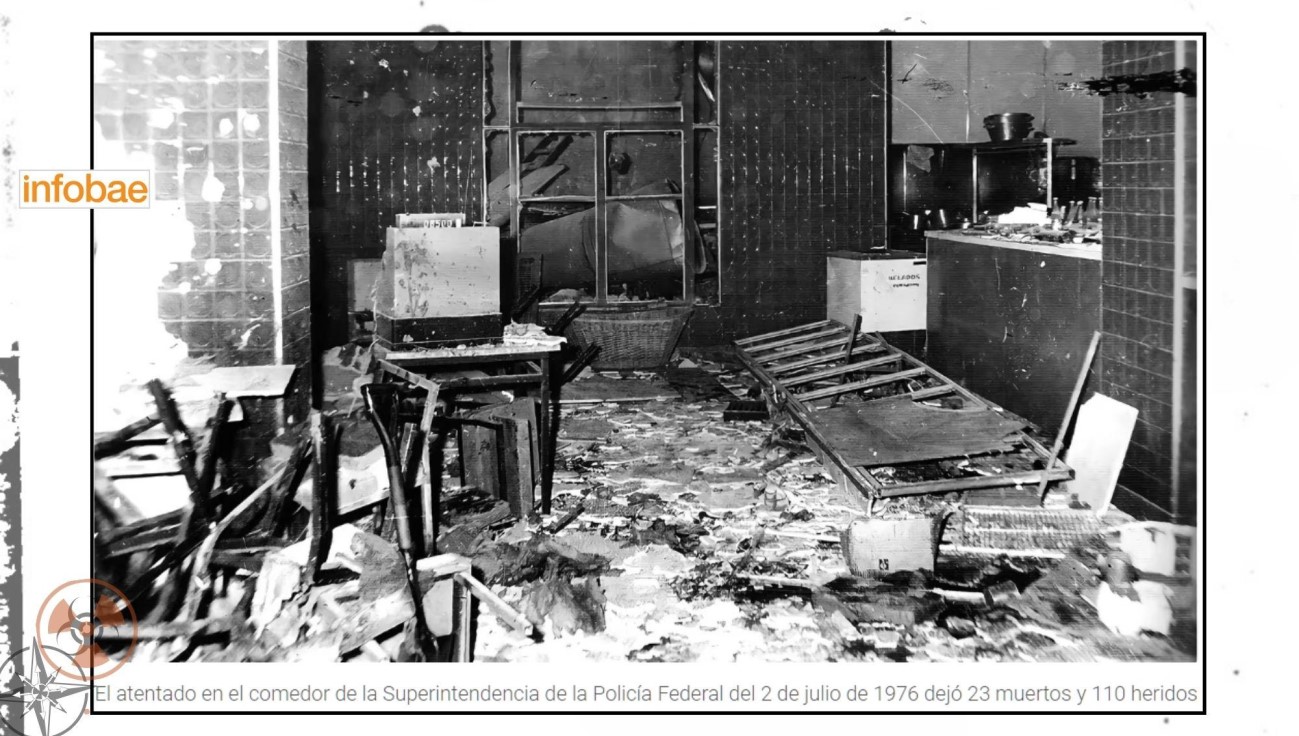
A mountain of evidence, including the lack of prison time for the majority of the
bombers, pointed to those bombings having been government-approved to give the
U.S. Federal Bureau of Investigation an excuse for targeting U.S. citizens outspokenly
opposed to questionable policies emerging from Washington D.C. as well as the F.B.I.’s
own increasingly illegal, corrupt, and unjust activities (when attempting to target the
Mob in the U.S., the F.B.I. had absorbed Mob members as well as their tactics and
goals). And here was one of the bombers, looming over me in Argentina, a country
that also had domestic bombings of government buildings, also blamed on dissidents,
and that the charred wreckage of looked eerily like the same level of damage done by
the Weather Underground in the United States, as if some of the bombings were done
by the same people using the same manuals and methodologies.
First Image ( Argentina - Bombing of Federal Police Building, 1976)
Source: Infobae17
17 Infobae, Horror and Death: The Five Women Who Killed - The Montoneros Bomb in the Dining Room of the Federal Police, https://www.infobae.com/en/2022/03/18/horror-and-death-the-five-women-who-killed-the-montoneros-bomb-in-the-dining-room-of-the-federal-police/
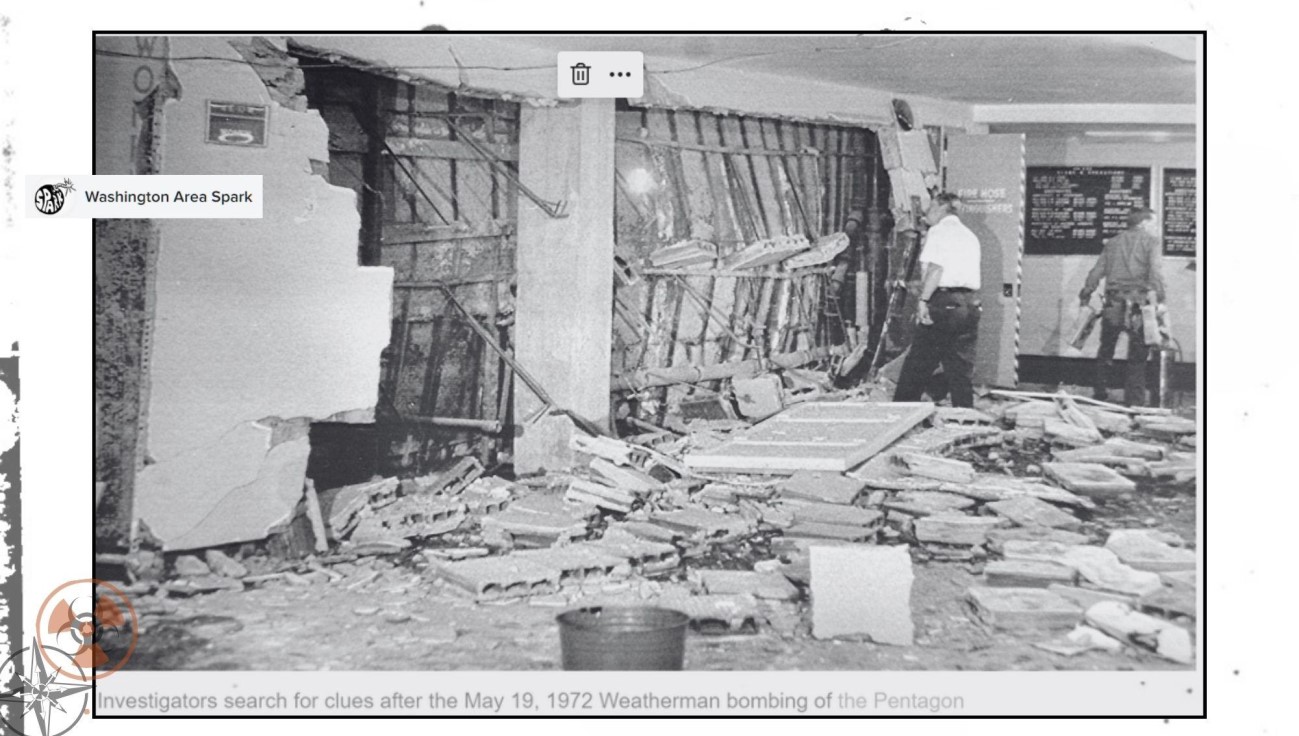
Second Image ( United States - Bombing of U.S. Pentagon, 1972)
Source: American Issues Project via Wikipedia18
There is a significant probability that I was standing there, vulnerable and owned by
one of the snakes directly involved in the framing of Argentine citizens including my
parents, with the intent to take away their lives and freedom, and to steal their
children - including me.
At one point during our time in Buenos Aires, on a street with a view of the ocean, a
haggard-looking woman made a nervous attempt to pile me into her vehicle, a wood-
paneled station wagon. I was internally conflicted about it and too afraid to go with
her. I would see her again later in the United States, still with that same vehicle, and
she would die by gunshot at the hands of my military-dictatorship-approved keeper
for having come that far. I believe the haggard-looking woman was one of my family
members and was attempting to rescue me. After living in a prison with so little
exposure to family or safety other than that provided by my mother, I simply didn't
recognize who the older woman was quickly enough.
18 American Issues Project via Wikipedia, Weather Underground, https://en.wikipedia.org/wiki/Weather_Underground

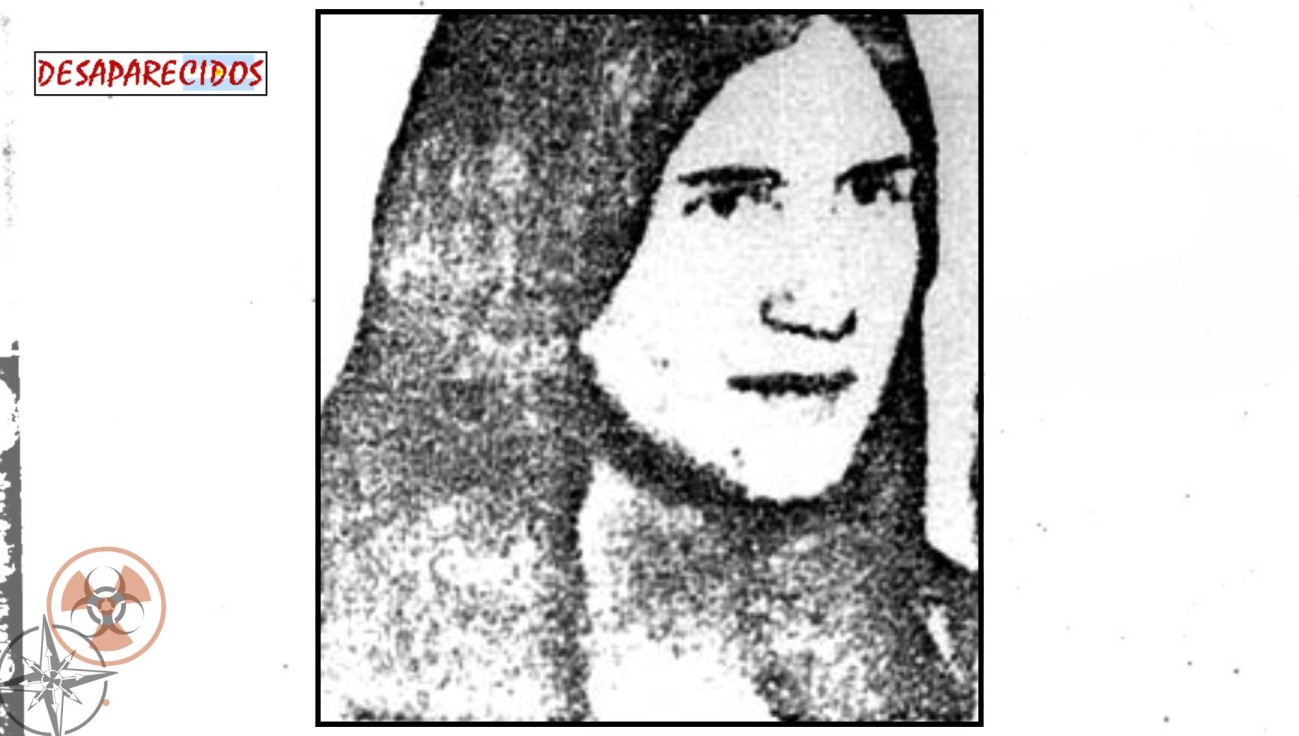
Aside from apartments, a large church, and government offices, we visited the major
university. In an impressively enormous building, we entered their Journalism
Department. The recruiter needed to check on a few things. They already knew her
there. Apparently, she was deeply entrenched, using the identity of an imprisoned
journalism student from the north of the country, named Alicia Raquel Burdisso
Rolotti, and influencing the campus with media she had been publishing via that
department. Having now spent the majority of my life as her shadow, I can promise
the rhetoric she was promoting was the same rhetoric the State was pointing to and
labeling the students with when calling them the enemy. She had been setting the
trap.
Image: Alicia Raquel Burdisso Rolotti
Source: Desaparecidos19
There are countless reasons that I find covert domestic action by government to be
non-beneficial. This type of honey-and-comradery-laced entrapment is one of them.
19 Alicia Raquel Burdisso Rolotti, Desaparecidos, http://www.desaparecidos.org/arg/victimas/b/burdisso/index.html
Methods of manipulation of open-minded and caring individuals in academic
institutions, for deceptive reasons and to the detriment of those young citizens, are
highly questionable. It’s likely that this pre-thought-crime type method of
entrapment captures more kind, caring, and friendly souls than it has ever caught
someone with initial bad intentions. Especially when you realize that those young
minds were accepted into the institutions of higher learning either by displaying
continued obedience and dedication in school or by exceptional intellectual abilities.
Those are the people they choose to exploit and destroy - their citizens who have
consistently displayed the traits of loyalty and exceptionalism. They are the ones who
will be the most hurt by being maliciously betrayed by their own nation, and they are
the ones capable of doing the most damage as retaliation for the betrayal.
The methodology harms the nation and those who would have contributed the most
to its stability.
The exploitation of students, especially for dodgy recruitment purposes, perpetuates
a problem that will continue into the next cycle, making internal struggle and
exploitation a constant at the domestic governance level. Not everyone who has been
ripped from their life and called an enemy by the State actually appreciates the
lifelong threats and arbitrary punishments that come with it, nor will they necessarily
appreciate those they are now coercively forced to provide their expertise to. This
leads to continuing porousness in national security, and thus more international wars
and a lower quality of life domestically.
You don’t actually want a pissed-off and hurt political science major working in your
Intelligence offices nor an angry and genius scientist working in their enemy’s
weapons development labs. And when you have both types of situations and the
people in them know each other? It doesn’t end well. You’ll just have to trust me on
that for now. That recruiter Argentina saw fit to leave me in the custody of? She
would be a major rage and drug-fueled connecting force between those two
departments.

Yes, the recruiter. Three generations into war recruitment heavy on deception, you
won’t know which side you or anyone else started on, is standing with, or is standing
on; but the pain is still there, and that pain wasn’t just my own. I was being absorbed
by generations of those brought into the war machine through violence, threats,
coercion, death of their families, and forcible removal from the countries they had
fought and sacrificed for. They chose to soothe that pain with heroin, greed, and
vengeance. I’m still standing here, holding my pain without anything to numb it. I
understand why they succumb.
The memory that always surfaces the most from my post-prison time in Buenos Aires
happened within the span of just a few minutes. I was standing in the middle of the
university campus, the foreign woman nearby, and students were milling past in
droves, seeking to get to their next classes. It was 1980 and well into the war that had
taken my freedom. There I stood, small, somewhat crippled, and pale from growing up
in a prison; having just appeared among them at the age of three, without ever having
an infancy they had seen.
They knew about the war. Each and every one of those hundreds of students who passed
me during those moments between classes knew about the war. Not one of them stopped
to save me.
Despite the public’s abundantly clear policy of “close your eyes until it's over,” the
crimes of using intelligence channels for the international trafficking of children,
trafficking in civilians, and infiltrating other governments with genocidal and
marauding intentions didn’t stop when the war ended. Some of the people in those
Southern Cone military departments had fantasies as far-reaching as killing off the
Northern Hemisphere, according to the conversations I overheard when I was young
and left waiting in their offices and halls, and later during planning and early-stage
implementation attempts by their transactional allies in another land. I wish I were
conflating, but I’m not. I’ll get more into the details on that one later, with
documentation.
Like many nations that have reached a point of becoming hyper-focused on a belief in
their own supremacy, there were quite a few people among the Argentine ranks who
wanted to entirely eradicate their enemies, final solution style. It was an unrealistic
but increasingly possible goal back then, as they spoke about the advantages of
neutron bombs and other options. As we progress into the modern era, there are
opportunities that open up to the sickest among us, some of whom hold authority,
and some of whom are the same exact people I was in those rooms with. Just because
they fade from the newspapers does not mean their careers have ended. In fact, in an
established era of secrecy, removal from the public spotlight is often more concerning
than remaining in it.
In a later moment that would leave me staring in disbelief, a U.S. State Department
worker would sound relieved when he erroneously decided one of the scientists in my
cohort must have come from Argentina to work in U.S. Department of Defense
weapons research willingly, as if that alone meant all bad intentions floated away on a
whimsical love of America. Americans are okay for the most part, but their intentional
naivety and first-world egos frequently lead them down the wrong path. They let in a
lot of bad actors due to the belief that all foreigners are deeply honored to be there
and only have intentions to see Disneyland and eat some good old Independence Day
barbeque...this is despite intentional and coercive recruitment practices that target
known U.S. enemies to bring them in, and international policies that take advantage of
and pull from the ranks of violent dictatorships.
Argentina was entering late-stage failure when I was there, a stage that many other
nations may still be in time to avoid. The country has since gotten worse. It’s unlikely
that the psychology and methodologies of that nation can be reversed enough to save
it from its own behaviors. It will finish consuming itself, while dramatically denying it
down to the final bite.
Even today, as I write this, Argentina still does a little governmental and NGO-level
Munchausen by Proxy “war is over” play-act for the global community, for funding,
and to avoid the international courts. Outwardly, they advertise that they are
searching for the children they traded for arms and international favors, and are now

offering the children help to find their original names and parents. The truth is darker
than that. They commonly deny the children the right to open a case for investigation.
They have now had over 45 years to find the approximately 500 stolen babies. They
have located less than 150, primarily because they refuse to find the rest, even when
the now-graying children are standing directly in front of them in those government
and NGO offices.
That’s a rate of assisting roughly two to three children per year, despite the
government and NGOs having nearly unlimited funding for the project, much of
which they funnel into their wardrobes, cars, and real estate (yes, the connected
organizations are well-paid to keep up the farce…I’ll get into more on that later). The
children they parade around a couple of times a year for the media spotlight and
funding purposes are almost exclusively the adopted children of media personalities,
political enemies of the government and NGOs, and others who can be exploited or
would be financially beneficial to control.
This is all despite their having archives with our names, who our parents were, and
where they stole us from. They know who we are, but they profit too much from our
disappearance. They also still hate us and believe their own rhetoric - that we were
child criminals and infant terrorists who deserved to be ripped from our families and
sold because one of us might attempt to vote against them. We are the embodiment of
our parents who they tried to dehumanize, diminish, rub in the dirt, and then
genocide. Tell me, how often does one use the military to kill the friends, community
members, schoolmates, and entire family of a criminal, simply for being related to or
knowing them? That’s where the chasm between the lies they tell and their true
intentions can be seen through the cracks formed by reality.
The lies badly painting over the damage they cause make an undeniable and
uncomfortable sight. You know that feeling. You’ve felt hints of it before.
Argentina had chosen genocide as a solution to the problems they didn’t want to deal
with, generally internal problems of abuses and a lack of resources caused by them
stealing from, bullying, manipulating, and lying to each other and to themselves. Once
a country goes down that route, it is nearly impossible to change its trajectory.
Their responsibility-evading and self-congratulating semantics continue to lock them
into the behavior and mindset, but do not hide the amount of death and self-harm
they have caused. Their grotesque mentalities also do not obscure the country’s
repeated and increasing history of eradicating and removing groups, one by one, over
the decades of the 1900s, as if maybe the removal of the next one would finally be the
solution to creating a utopian society.
Their internal problems, left undealt with during the distractions of state terrorism,
only became worse after the temporary adrenaline rush of each eradication effort
ended. By the time I was born, they had run out of easily identifiable ethnicities to go
after and were removing people with any great-great grandparents who weren’t
genetically European (As far as I’ve gleaned, my own family was 100% culturally
Argentine and I’m personally around 90% European and 10% east of that, genetically),
and it still didn’t solve their self-caused problems. The country is a nightmare
headache today, with its economic policies written by thieves and its academic
policies written by those who hate intellect. But their semantics did give the people
within and supporting that regime, and the next series of regimes, a never ending list
of excuses and arguments to allow the resulting carnage and harm to continue,
unabated.
Eventually my stay in Buenos Aires ended, and I left that mess behind, in the care of a
small group of Intelligence workers. I escaped Argentina, but I did not escape. I went
from being an embarrassing secret of South America to being an embarrassing secret
of North America. Nothing changed for me in that regard. I was still expected to cover
for those who harmed me the most.

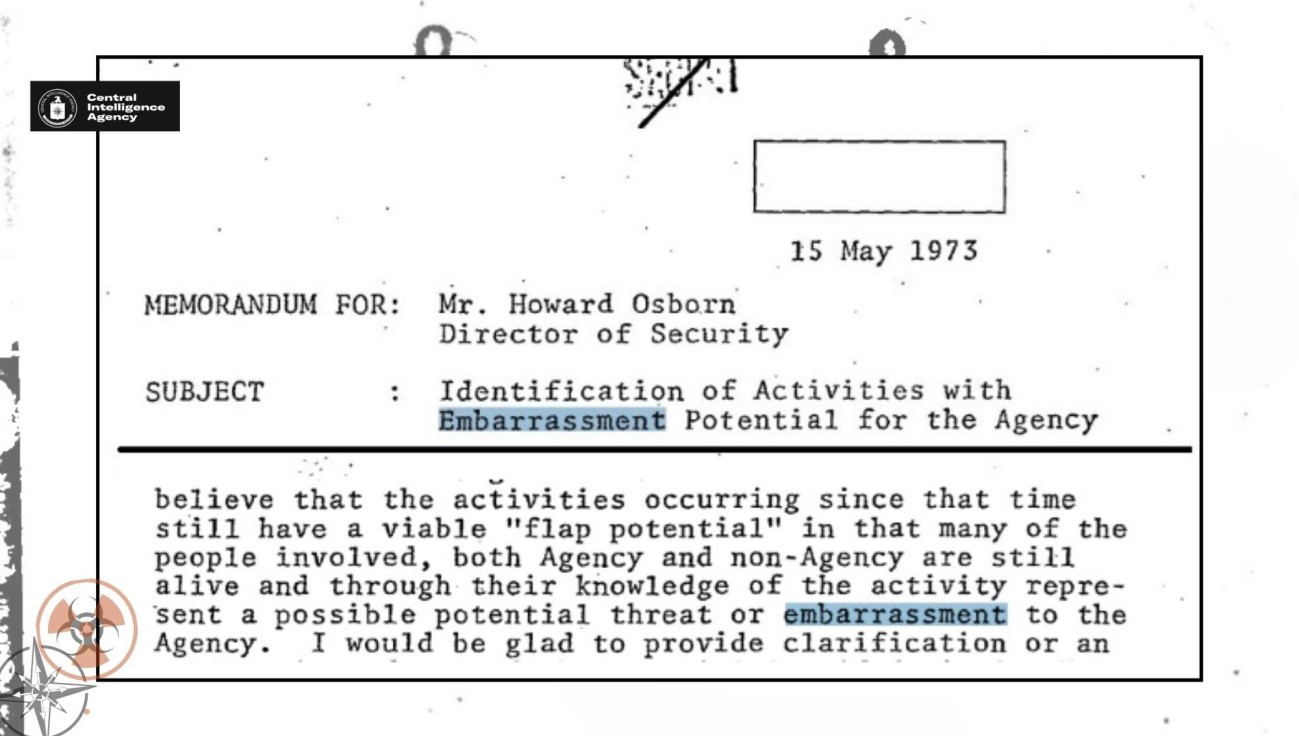
Image Source: Central Intelligence Agency
“Many of the people involved, both Agency and non-Agency, are still alive and through
their knowledge of the activity represent a possible potential threat or
embarrassment to the Agency.”
Text Source: Central Intelligence Agency20
Or as the saying goes, out of the frying pan and into the fire.
20 Central Intelligence Agency, Memorandum for: Executive Secretary, CIA Management Committee, Subject: Family Jewels, https://www.cia.gov/readingroom/docs/DOC_0001451843.pdf

U.S. Intelligence Recruitment
Relics of the Weathermen and World War II
“Yes, I was a scientist,
But my first duty was to the company.”
As we left Argentina, I was still promised that my mother was fine and I would be
brought back to her eventually. When we got further away from the only city I had
ever called home, I was told we would be visiting a zoo and not to worry, that I would
see my mother when we were done seeing the animals.
I repeated the promise about the zoo to a concerned-looking crew member on a boat
in the Panama Canal when he asked if the people I was with were safe for me.
Sometimes, I wonder how different my life would have been if I hadn't just repeated
the lie. What if I had continued to speak until the truth became apparent? Would I
have ended up growing up in an orphanage in Panama, or would the crew member
have taken an unexpected trip to the bottom of the canal with the result only being a
few extra minutes of delay watching handshakes in a back room before my trip
proceeded?
More than likely, he simply would have ended up drugged, wide-eyed, and nodding in
agreement with whatever new reality he had been presented with. I would see those
pool-wide eyes so many times over the years, although most often they were on
government records clerks as the recruiter walked with them behind their counters
and had them rewrite history. But I digress, a little…
It was around that time that the recruiter first started sharing her wisdom with me.
Our relationship would be a strange one. She would come to use me ruthlessly as a

tool when she needed one, with absolute disregard for my health or life. But she also
had moments in which she treated me like an apprentice and showed me how to
exploit people, step by step, before then doing it to me. It was a pathologically insane
methodology. I was trapped with her and had no choice other than to play along, but I
did learn a lot about how manipulation and exploitation actually work - from both
sides of it.
She explained the landscape of what she did quite simply one time. She said there are
no rules to follow. We fly above everyone and we move freely. That is why we can get
so much done while they do so little to stop us. The people constrain themselves by
following laws, cultural limitations, religion, and societal norms.
They create their own cages and they cannot reach us from within those self-made
confines.
Later, I would argue that flying quite so freely didn’t entirely apply in my case. She
had federal protection and full permission to break every law. I didn’t. I probably
shouldn’t have argued that. She may have taken it as a request to join her.
We would spend some time in Cuba (I loved peeking in through the windows of small-
scale manufacturing and mechanical shops there, the smell of diesel always reminds
me of it), and then went by boat to Florida before arriving in New York City. We did
eventually make it to the zoo – the Bronx Zoo in New York, probably because I kept
loudly asking in public spaces about the zoo trip I had been promised back in
Argentina.
Now, recognizing the pervasively dark perspective of the cohort I would end up
deeply ensnared with, I have to wonder if they were referring to the zoo or more so
the inhabitants of the city when they spoke about the animals we would see.
While in New York City, we spent our time with the recruiter's sister, crammed into
her then-tiny apartment. There, the day-to-day realities of the international
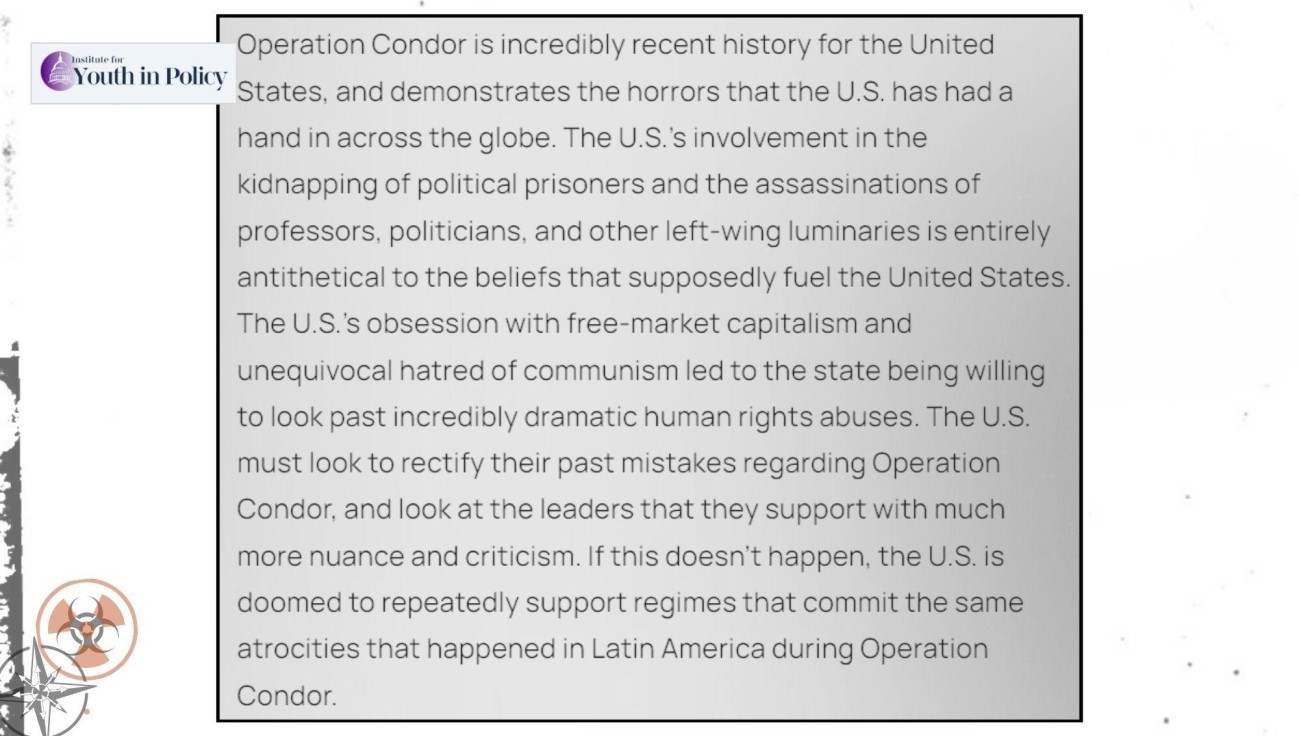
trafficking of a child from war became more apparent as the two bickered over my
head while dying my hair near-black and working on flattening out a few errant waves
to better match the woman's board-straight and jet-black hair. I would spend the next
ten years of my life with my hair over-conditioned, brushed flat while still wet, and
kept henna-dyed black to the point that I looked absurdly like a caricature of
Wednesday Addams from the Addams Family television show.
Image Source: Institute for Youth in Policy
“The U.S.’s involvement in the kidnapping of political prisoners and the assassinations
of professors, politicians, and other left-wing luminaries is entirely antithetical to the
beliefs that supposedly fuel the United States.“
Text Source: Institute for Youth in Policy21
21 Institute for Youth in Policy, Operation Condor and the Horrors of U.S. Foreign Policy, https://yipinstitute.org/article/operation-condor-and-the-horrors-of-u-s-foreign-policy

That word, antithetical, doesn’t quite hold the standard dictionary definition,
especially in the U.S. (although not limited to that country), where the government is
a paid liar with the known authority to do so, granted to it by the written rules
included in the formation of the Office of Strategic Services (OSS) and then the
Central Intelligence Agency (CIA); the latter agency which has now entrenched itself
into every level and aspect of both corporate and government life, with a stranglehold
on politics and the molding and remolding of each aspect of mainstream public
opinion and discourse, and a large portion of what Americans have been led to believe
is outside of the mainstream.
In the international game, this means the American public (and the public of countries
with similar policies and undercurrents of culture) get to play innocent, or even more
absurdly - heroes, while individuals and the world suffer the very real consequences
of their collective actions. This leads to issues both domestically and internationally.
Domestically, the populace actually appears to believe the paper-thin lies, which leads
them to misstep in attempting to find solutions because most don’t even know the
nature of the problem they’re actually dealing with. For example, both major political
sides tend to hold the belief that the people streaming over their border all want to be
there because it is a crown jewel of a nation, that those people have not been
deceived, that they’re better off in America, and that America incentivizing the
destruction of their homelands isn’t the actual reason they’re there.
So, while bickering back and forth over what to do about the people streaming in over
their border, they either argue that the people deserve a good life in America or that
they are trying to steal the good life from Americans. Neither side deals with the issue
of the American military, NGO advertising, and corporate interests causing the
majority of problems that lead to people coming over that border in droves in the first
place.
I would find myself coming up against that wall of group-learned delusion so many
times over the years of my forced stay in the United States. When I reached out for
help to say I had been kidnapped, I would be face to face with people who thought “I’d
have a better life there,” “that I would appreciate the McDonald’s hamburgers and
other riches of the United States,” and that they were “helping me and I was too much
of a dumb immigrant to know it.” More importantly, they genuinely believed that their
internally ensnared and thus impotent population and commercial culture were so
wonderful that my being there in the hands of a dangerous exploiter could replace the
value of my mother, my nation, my culture, my language, and my safety.
They’ve been lying for so long in the U.S. (not that it’s the only government that lies to
its own people in a desperate attempt to keep control while robbing them blind) that
even parts of the government now believe their own false rhetoric and act upon it,
creating more of a mess diplomatically and otherwise. A lie that lasts beyond one
generation results in an absolute disaster. People start treating it, and acting upon it,
as if it were truth.
In that cultural and political climate, my arrival in the country wasn't as smooth as
Hollywood might paint activities being blatantly run through U.S. operation channels
by their own employees. This is especially true if you still wistfully cling to the
concept of authority as competent, organized, and holding their own workers to legal
standards. However, despite a lack of convenience in attaining new documents, my
temporary documents from Argentina would have raised red flags in the U.S. and
reasonably had to be discarded.
The recruiter walked with me under a tree one day early on and told me what my new
name would be. She cajoled me into ceasing to use the old one, promising that I would
not forget it. After so many years without it, I did eventually forget it. While Navajas
and Claros are likely my surnames, the first names I use are simply the closest I could
find to the truth. She told me that my new name, beginning with a C, had the same
beginning sound as my old name so it would be easy for me to recognize and respond
to when people said it. But it didn’t start with the same sound as my prior name - my
name - not in Spanish and not in English. Perhaps it did in a language from the
Eastern Bloc where the recruiter had spent many of her earlier years.

And when I would remember my mother? The recruiter would assure me that the
woman I remembered had been a foster mother in the state of Connecticut in the
winter of 1977 - 1978, in the first eight months of my life. In retrospect, her
explanation made no sense. That winter fell within a time period that I could not have
remembered - I was too early in infancy to develop memories by that stage. Also, I
was walking fair distances in many of the memories that contained my mother.
Infants don’t walk.
It would be decades before I would learn about child development milestones
regarding memory formation and before government officials from Connecticut
would confirm that I had never been in their foster system. Because of what the
recruiter told me when I was growing up, I often just assumed there was something
wrong with me for having become so emotionally attached to a foster care provider to
the point that the provider felt like my only mother. I internalized my loneliness
because I thought I was dumb for feeling it, but I always missed my mother, even
when I believed the lies that she had only been a foster mother. Every day of my life, I
have missed her. I simply missed her in silence back then. I felt too much
embarrassment about my strong unbreakable attachment to someone who
supposedly wasn’t my family.
Even with the full change in identity, there wasn't some official clandestine CIA office
smoothly working on my replacement documents and ironing out all the wrinkles for
my stay in the United States. I wasn’t their responsibility and probably fell squarely
into the category of “embarrassment” myself, someone to hide away and sweep under
the rug. I was a child, not a hired and vetted agent of theirs - we had no documented
relationship in which they had to provide me with anything, despite my entering the
country by the efforts and force of their employees. The forging of my U.S. identity
was bumpier and never official enough to leave the responsibility plainly in their
hands, although they would not be without blame.
That said, maybe there was the tiniest bit of blowback from the department. Either
there was something going on internally in the recruiter’s office, or the woman may
have gone too far in selecting a child for her own while recruiting for government
projects in Argentina. They temporarily suspended her employment. When certain
officials and high-ranking officers came by the house to visit, I had to hide in the hall
closet beneath a pile of clothing or tucked between coats.
Her depression stemming from it became evident as I sat quietly in a dark apartment
with her. The only light came from a television that was playing clips of speeches from
President Carter to her complete disdain. She sneered at that screen. Her heroin
addiction also became glaringly apparent at that juncture, although it would take a
few years for me to learn what the drug was and how the use of the paraphernalia and
her mood swings were related. Those mood swings were hell to deal with as a child - I
could do the same behavior on five different occasions and be praised for it four times
out of five, and then brutally abused for it the fifth time simply because she was on
the wrong side of a high at the time. As far as I know, she still has the addiction.
Apparently, working for that part of the government has its advantages. She had a
stable connection for obtaining quality black tar heroin the entire time she was in my
life. As time went on, I would become a primary source of the cash to fund the habit.
She still found little things to cheer her up now and then in those first few months
of us sharing a space. The recruiter’s favorite thing was sabotage. It brought a light
to her eyes and a genuine smile like nothing else could. Over the years I would
watch her sabotage everyone - her enemies, her friends, her employers, her
targets, her nation, other nations, the rich, the poor - everyone. I will never forget
the time she tried to get me to sleep with a watch with an exposed radium dial
under my pillow. I didn’t entirely understand what she was about at that point, and
I was still so young. I happily went to sleep with it because of the joy I saw in her
eyes as she told me how wonderful it would be to get brain cancer. I was still a
baby. Sometimes, I allowed myself to be lulled into believing joy was a good thing,
especially from someone insisting on having the title of mother.
Luckily, I had insomnia back then. I never could actually manage to fall asleep with
anything under my pillow. My hand would come across it and the feel of the metal
kept me awake. I removed the thing the first night.

When I wasn’t in that dark apartment, she was stashing me away at summer camp at a
local military base to get rid of me during the daytime and some nights. I was in the
youngest group of children there. In swimming class, they called us polliwogs (the
tailed larva of a frog).
Due to the scars on my lungs, my health, and my small size, I was usually behind
everyone else in games and the obstacle course (I struggled with climbing the wall
and usually needed help and extra time). I always seemed to have conjunctivitis in
those years, a symptom of a series of underlying walking pneumonia infections that I
couldn’t seem to kick for long. The flecks in the corners of my eyes could be wiped
away and hidden easily enough, but my struggling when attempting to run was
obvious in a way even my scarred lungs could not be entirely responsible for. I was a
healthy weight, although on the thin side, but would make it less than the length of an
ordinary room before needing to stop running. However, I still excelled in learning to
float and do the doggy paddle in the shallow polliwog section of the swimming area,
and in any sport involving a target. Archery and time using the rifle range were my
favorites.
Although, the easiest and most thrilling activities happened in those rare times when
they let us stay up late at night. They handed us markers and told us to “kill the
enemy with knives.” In other words, we were supposed to sneak into the cabins of the
other campers and silently mark their throats with the markers while they slept. Hey,
I was young, it included the thrill of being up past lights-out, we had permission to
enter cabins that were generally off-limits, and it was a game I could fully participate
in that didn’t involve long runs. Was I supposed to hate it? If you’re going to judge kids
for liking war games, create a civilization that doesn’t encourage children to
participate in war games.
Other than activities, some of the best moments on base were when the candy truck
arrived. Maybe it sold something else. All I really remember was the candy. In
retrospect, it probably wasn’t the best choice considering my health.
Back at the apartment, alone in the light of a window in the room that held the
recruiter’s grand piano, I began to teach myself to read (I also attempted to teach
myself to play the piano but with much less success). I went word by word through a
book about a world destroyed by nuclear war in which everyone was dead except the
whales. In that story, there was a baby whale who continued to have a cold, and
conjunctivitis, for months before it cleared. Then the whales went on to live in a world
that was now only theirs. It was an unrealistic tale (a world with no krill and plankton
means a world with no whales), but my health led me to feel a connection with that
baby whale.
The recruiter’s office eventually reinstated her and reduced her right to international
travel, other than to Asia. She was switched over from active foreign work that had
included the task of recruiting political prisoners for Department of Defense (DoD)
research and other purposes. She would begin working primarily in a more
supervisorial role on projects and research, as well as recruitment - domestically. She
no longer used her international alias, Alicia. Although, I would frequently hear her
still calling in using her old domestic one from the 1960s, “Anna May,” a name even
Bill Ayers, the head of the Weather Underground Organization (labeled as a domestic
terrorist group by the United States, due to their bombing of government buildings
and other activities), still knows and references to her as.
In case the Weathermen have been written out of your history books, here’s a short
intro, complete with the mention of Anna:

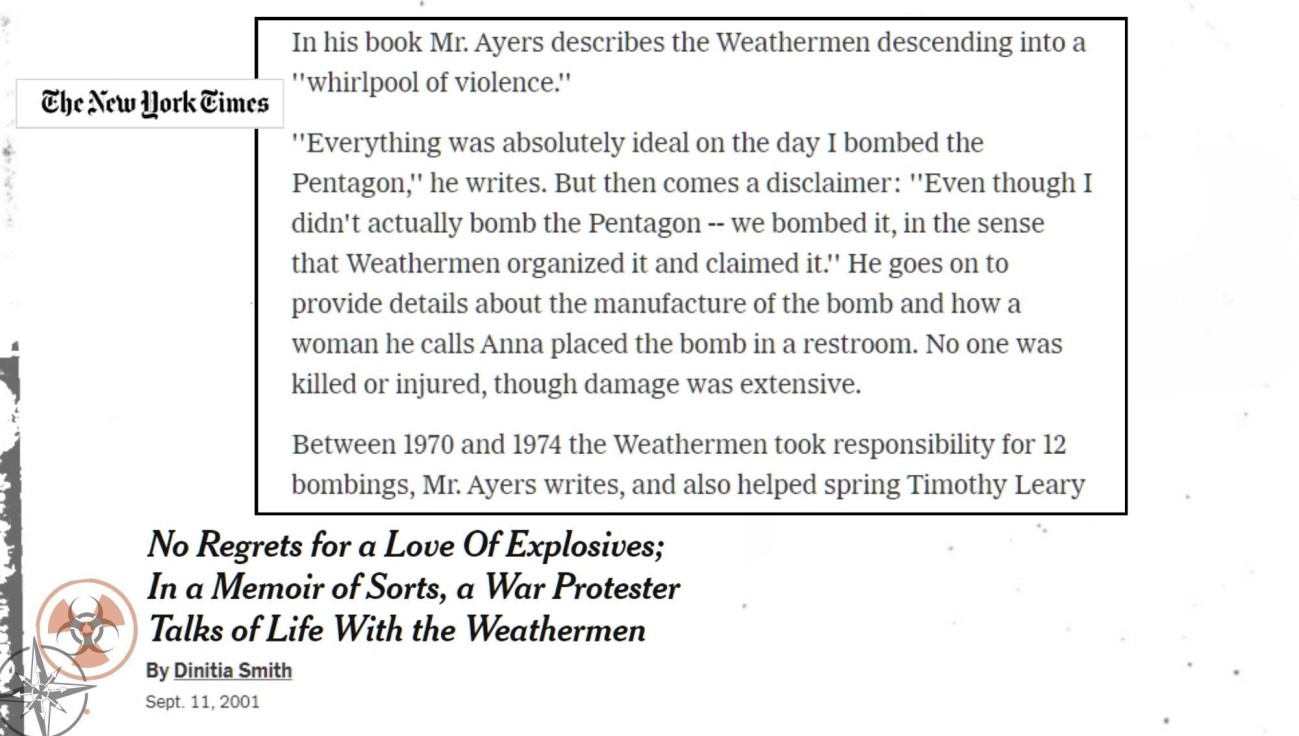
Image Source: New York Times
“Mr. Ayers describes the Weathermen descending into a ‘whirlpool of violence.'
'Everything was absolutely ideal on the day I bombed the Pentagon,' he writes. But
then comes a disclaimer: 'Even though I didn't actually bomb the Pentagon -- we
bombed it, in the sense that Weathermen organized it and claimed it.' He goes on
to provide details about the manufacture of the bomb and how a woman he calls
Anna placed the bomb in a restroom. No one was killed or injured, though the
damage was extensive.
Between 1970 and 1974 the Weathermen took responsibility for 12 bombings…”
Text Source: New York Times22
I heard about that bombing during so many dinner parties that I lost count. I will
always remember the heads of new guests turning in disbelief as the recruiter said
she had placed a bomb in the Pentagon bathroom. There was a long story about
22 New York Times, No Regrets for a Love Of Explosives; In a Memoir of Sorts, a War Protester Talks of Life With the Weathermen, https://www.nytimes.com/2001/09/11/books/no-regrets-for-love-explosives-memoir-sorts-war-protester-talks-life-with.html
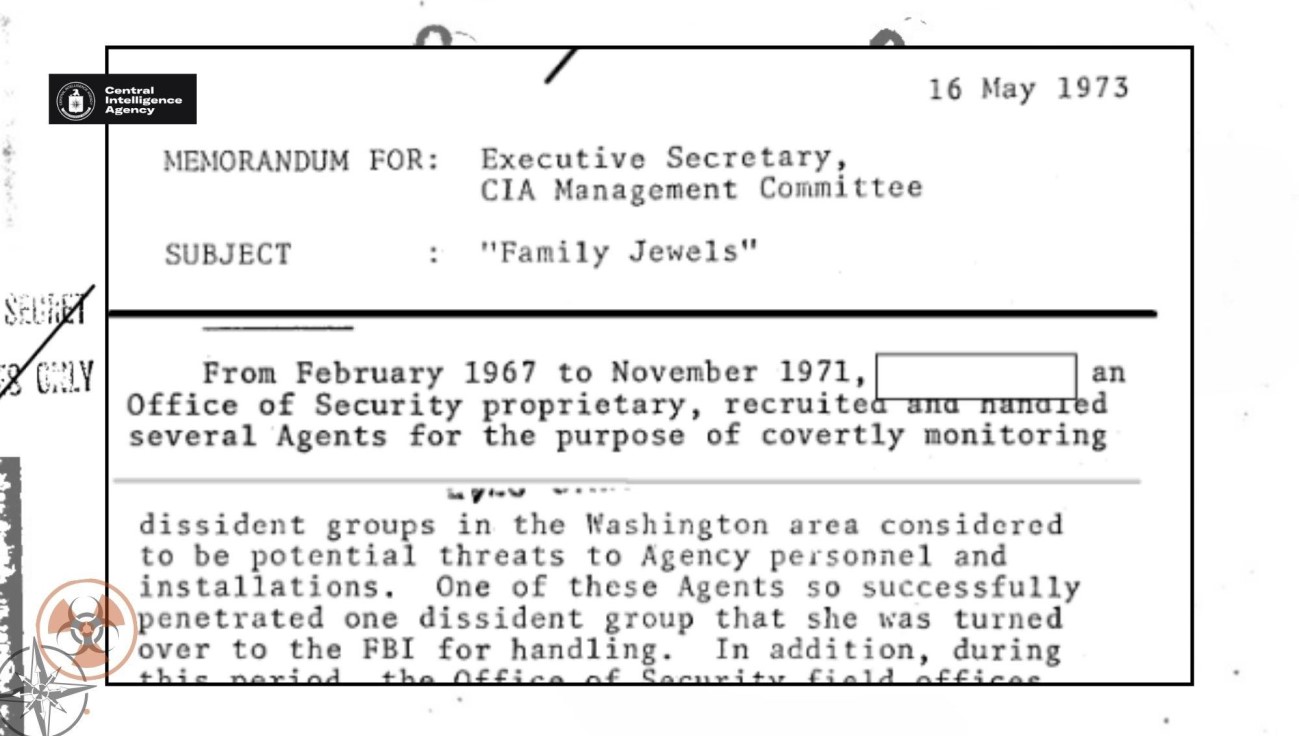
another agent putting the bomb in her bag and hiding it beneath the panties that
were in there, before they went through security with an embarrassed security guard
not looking deeper in her bag than those panties, and then the recruiter panicking
and attempting to flush the bomb, as if it were drugs, in the women's bathroom before
going back through security again.
Her story about her work leading up to the bombing would later be reflected in files
known as the Family Jewels when the Central Intelligence Agency finally declassified a
few documents in order to do a bit of bragging and highlight some of their favorite
agents and former activities:
Image Source: Central Intelligence Agency
“From February 1967 to November 1971...dissident groups in the Washington area
considered to be potential threats to Agency personnel and installations.
One of these Agents so successfully penetrated one dissident group that she was
turned over to the FBI for handling.”
Text Source: Central Intelligence Agency23
23 Central Intelligence Agency, Memorandum for: Executive Secretary, CIA Management Committee, Subject: Family Jewels, https://www.cia.gov/readingroom/docs/DOC_0001451843.pdf

It was with the FBI that she would come to know George Edwards, a Yale Drama
School-trained COINTELPRO agent who had been assigned to infiltrate the Black
Panther Party, a group that had close ties to Bill Ayer’s Weathermen. He didn’t play a
main role in my life until later, but he was already sitting with us at some of those
dinners and was never among the group that acted surprised by the recruiter’s
recollection of bombing what was supposed to be a very secure government building.
When he does come up later on, I’ll share with you many New York Times articles in
which he was front and center, under the same name and title the public has always
known him as - George Edwards, Black Panther. The same George Edwards who
leaders of the Black Panther Party correctly called out as a Federal Agent. It turns out
that the Yale Daily News and the New York Times had to work overtime in screaming,
“He’s not a Fed, really!” to protect that particular jewel. In the process, they would
expose his connection to several operations that would include intentional crimes
against humanity and that would occur in the years in which I was right there and in
the same rooms.
I can’t blame the random dinner party guests for never believing the recruiter about
the bombing. They had grown up in a world in which they had some belief in the
sanctity and security of government and government buildings - especially the
Pentagon. They assumed that if she had placed a bomb in the Pentagon, then she
would have been convicted. I assumed the same, until I looked into it years later.
The truth is, almost no one was convicted for the bombings. The cases were mostly
dismissed on technicalities. In one case, the government even cited that they would
have to endanger foreign intelligence secrets in order to convict the members of the
group that had taken responsibility for the bombings. In other words, a good portion
of the Weather Underground was on the government payroll, and many were CIA. The
only convictions I’m aware of were of a scapegoat who got three years in prison, and
those involved in the much later 1981 Brinks armored car robbery.
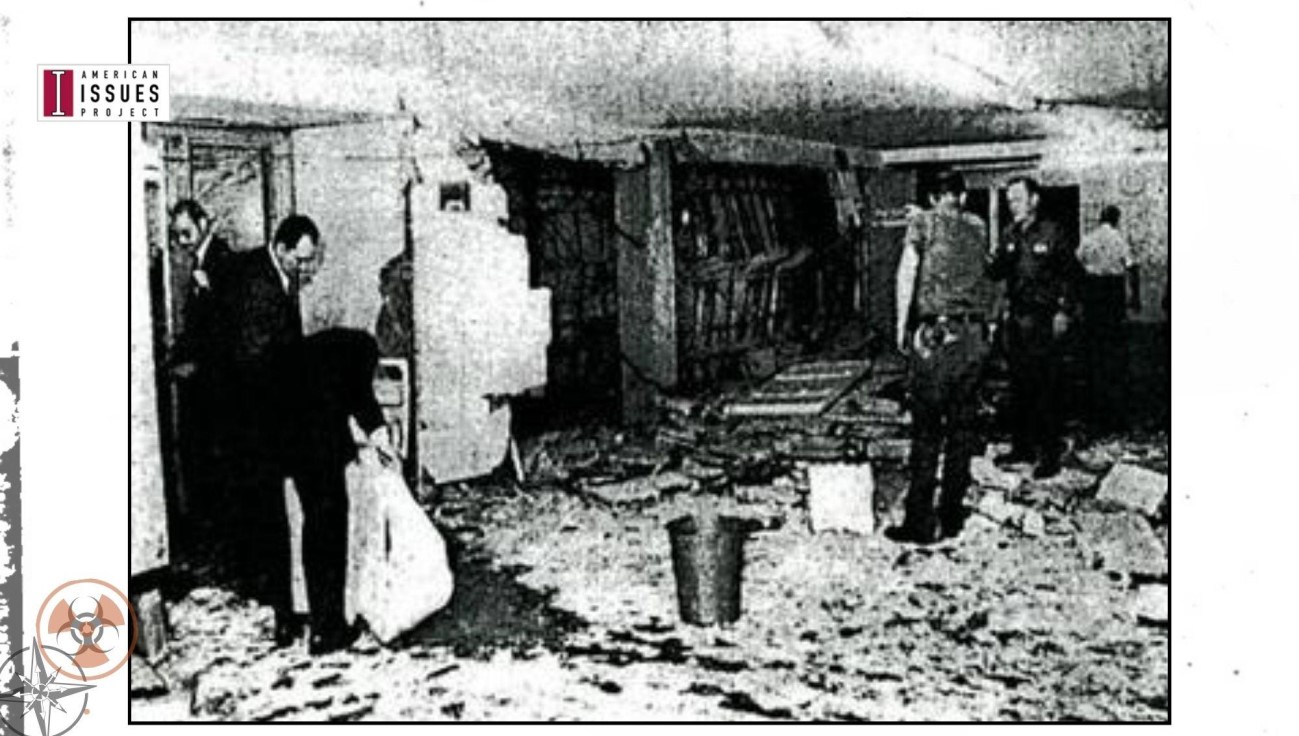
Image: United States - Bombing of US Pentagon, 1972
Image Source: American Issues Project via Wikipedia24
You can blow up government buildings on the government payroll, but you can’t get
away with robbing bankers…
24 American Issues Project via Wikipedia, Weather Underground, https://en.wikipedia.org/wiki/Weather_Underground

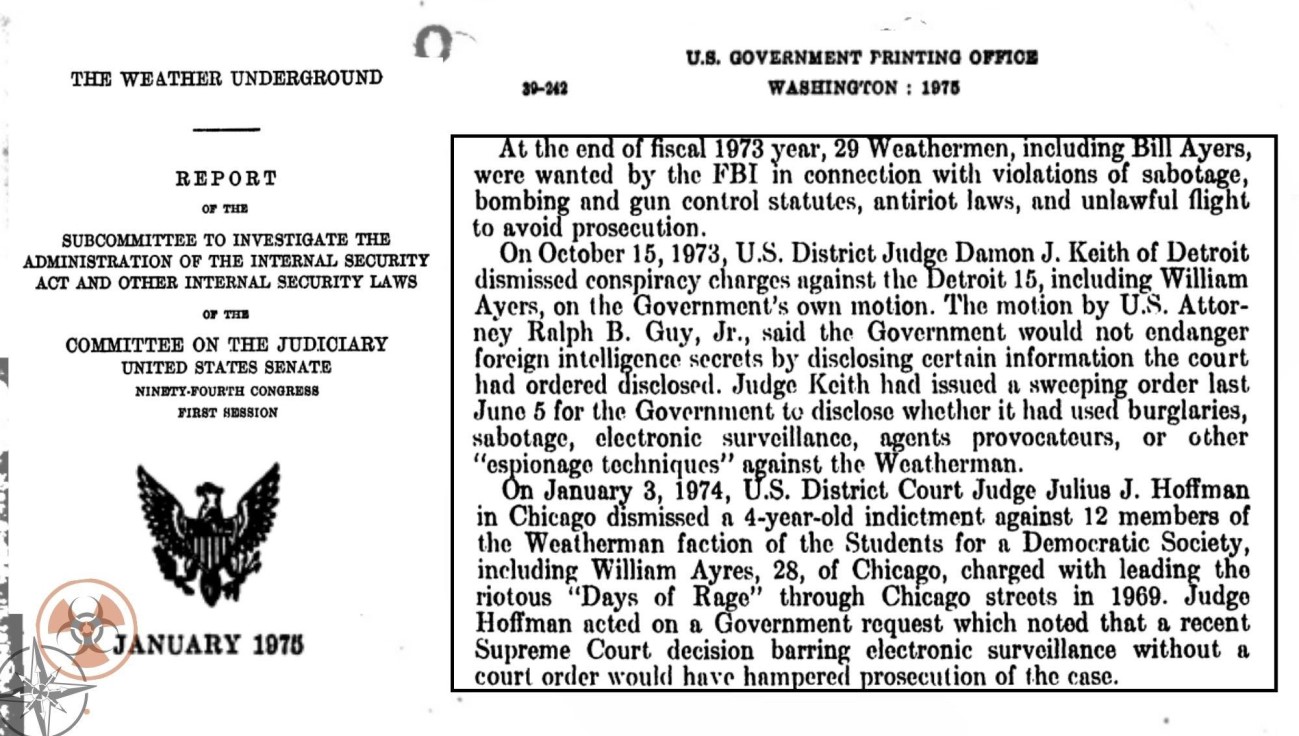
Image Source: U.S. Government Printing Office via ProQuest
“On October 15, 1973, U.S. District Judge Damon J. Keith of Detroit dismissed
conspiracy charges against the Detroit 15, including William Ayers, on the
Government's own motion. The motion by U.S. Attorney Ralph B. Guy, Jr., said the
Government would not endanger foreign intelligence secrets by disclosing certain
information the court had ordered disclosed…
On January 3, 1974, U.S. District Court Judge Julius J. Hoffman in Chicago dismissed a
4-year-old indictment, against 12 members of the Weatherman faction of the
Students for a Democratic Society, including William Ayres…
Judge Hoffman acted on a Government request which noted that a recent Supreme
Court decision barring electronic surveillance without a court order would have
hampered prosecution of the case.”
Text Source: U.S. Government Printing Office via ProQuest25
25 United States Government Printing Office via ProQuest, The Weather Underground Report - Reort of the Subcommittee to Investigate the Administration of the Internal Security Act and Other Internal Security Laws of the Committee on the Judiciary United States Senate Ninety-Fourth Congress First Session
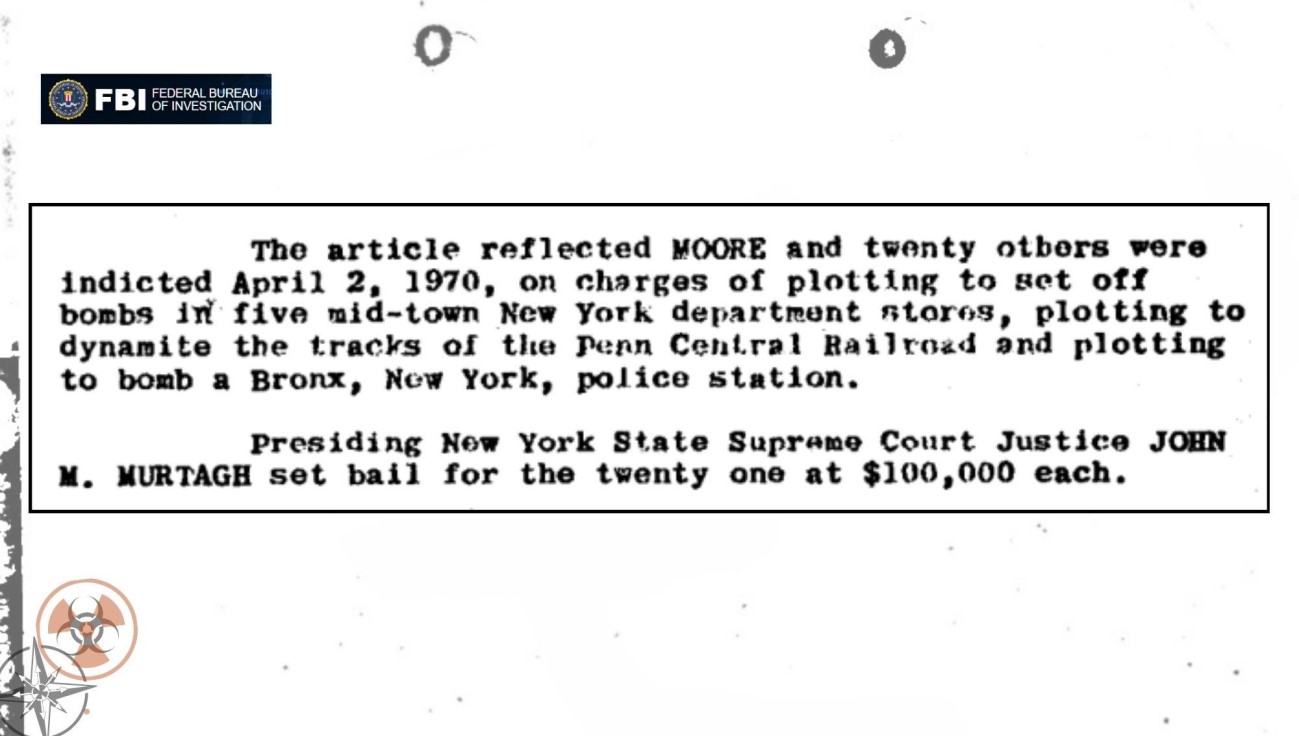
For the Black Panthers, things would go a little differently. While the Weathermen got
away with detonating bombs in Federal buildings without doing jail time for it, the
Black Panthers would be arrested on simply the suspicion of planning explosions. It’s
fairly obvious which group had more federal agents in it and which had more civilians
to target. If the Weatherman Underground Organization was not a Federal plant from
the start, then their people were forcibly recruited into the FBI in lieu of jail time,
much the same as I’d seen in Argentina, and the Nazis had seen at the end of World
War II. The only difference being that this was entirely domestic - a country slowly
consuming its own people, group by group.
Image Source: Federal Bureau of Investigation
“Moore and twenty others (Black Panther Party members) were indicted April 2, 1970,
on charges of plotting to set off bombs in five mid-town New York stores, … the Penn
Station Railroad and … a Bronx, New York, police station.
…Set bail for the twenty-one at $100,000 each.”

Text Source: Federal Bureau of Investigation26
For the recruiter, the name Anna kept the echoes of memories from her time
infiltrating and sabotaging grassroots movements in the 1960s and 70s, efforts that
had put her in the spotlight to her bosses and made her eligible for the international
work in which I would first meet her. According to a couple of people who knew and
worked with her back then, those years were an adrenaline and drug-fueled time
traipsing through the Americas, Iran, and Vietnam, among other places. It was when
everyone back at the office still adored her. Then, she went to Argentina.
One of the same confidants who spoke to me about the recruiter’s more exciting
years in Intelligence also told me that my coming into the picture had ruined the
recruiter’s life. Not her sons who were born many years before me, not her failed
marriage to a Navy Intelligence officer, and not her heroin addiction. Nope.
Apparently, I was the one thing she had let get in her way. I was what caused the
government to pull the rug on her international escapades back then.
26 Federal Bureau of Investigation, Black Panther Party, Part 23,
https://vault.fbi.gov/Black%20Panther%20Party%20/Black%20Panther%20Party%20Part%2023%20of%2034

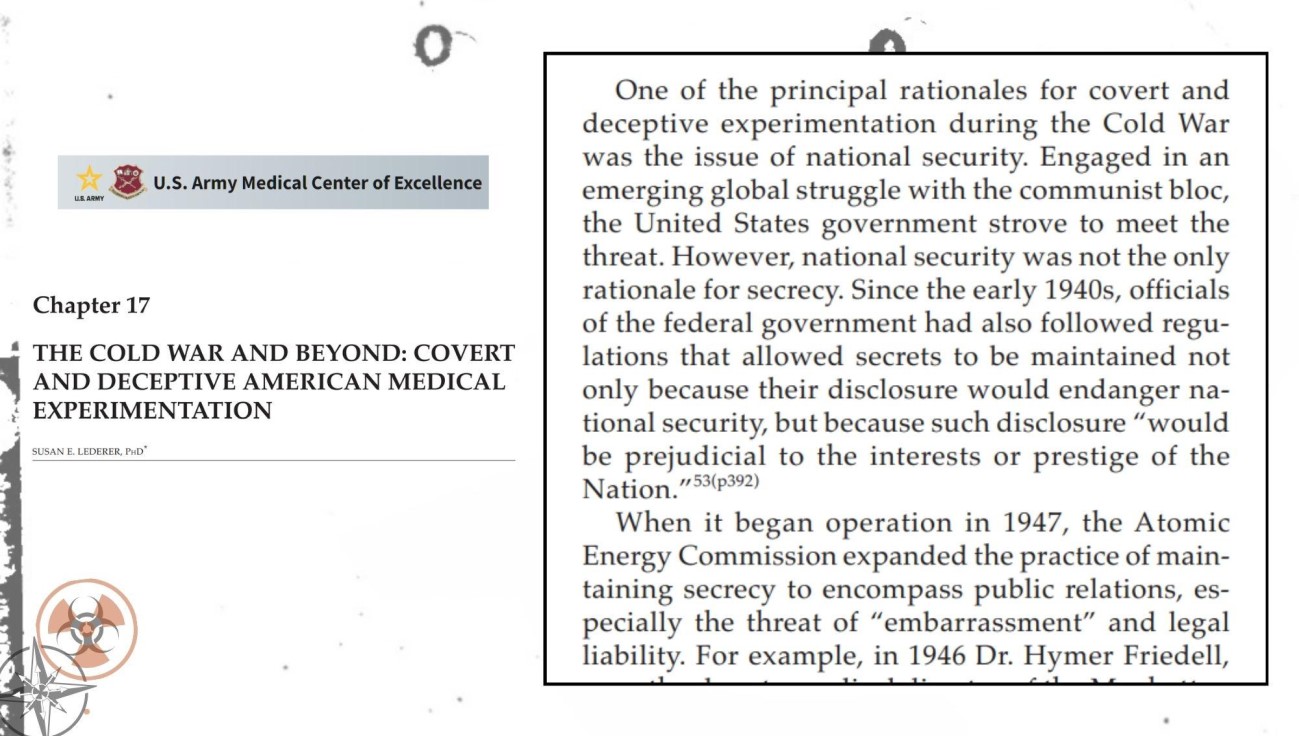
As for the problem of warfare and military intelligence tactics being turned on a
nation’s own people, it is compounded by what happens after forced recruitment.
Once recruited, the forced employment starts by giving the enemy worker the
protection of secrecy so that the employing nation’s own departments and public
won’t know what they’re up to. One of the three primary modern reasons for secrecy
is protecting the government from embarrassment. Yes, seriously, Remember this
document from earlier?
Image Source: US Army Medical Center of Excellence


“Officials …allowed secrets to be maintained not only because disclosure would
endanger national security, but because such disclosure ‘would be prejudicial to
the interests or prestige of the Nation.’
And… expanded the practice to encompass public relations, especially the threat of
‘ embarrassmen t’ and ‘ legal liability. ’”
Text Source: US Army Medical Center of Excellence27
Needing to lean on your enemy for your own military management and weapons
programs is embarrassing, especially when you’re trying to maintain the reputation of
a first-rate first-world nation.
This dangerous strategy combined with a need for internal and domestic face-saving
culminates in placing the enemy into your own endgame research labs and military
intelligence offices, as well as industrial and academic positions, with full access and
influence, and disguised as one of your own.
The practice is the equivalent of a nation saying, “Hold my beer!” before shooting
itself in the foot and then the face.
27 US Army Medical Center of Excellence, Military Medical Ethics, Volume 2, Chapter 17 The Cold War and Beyond: Covert and Deceptive American Medical Experimentation Susan E. Lederer, PhD, https://ke.army.mil/bordeninstitute/published_volumes/ethicsvol2/ethi cs-ch-17.pdf https://medcoeckapwstorprd01.blob.core.usgovcloudapi.net/pfw-images/borden/ethicsvol2/Ethics-ch-17.pdf
♞ Stage 2 - Research
We’re damaging our individual selves, families,
societies, countries, and international relations
by making deceit the expected norm.
Constant and pervasive deceit tears at
what makes our interactions human
and our choices safe and useful to ourselves.
Sometimes, the recruiter brought me along to make a situation look less
suspicious, or in some cases maybe just because there wasn’t a babysitter that day.
Ordinary life is still a constant even within an unordinary life. We all have to crawl
out of bed in the morning, put on our shoes, and make sure the kids are still alive
(possibly not in that order).
As a child, much of the behavior of those who had been working Operation Condor
and related operations would be commonplace to me because it was all I had
known. However, some of it still left me worried from the start.
Before I was concerned for the public, I was concerned for the people in my life
who were doing things that were obviously dangerous, including to themselves. I
was worried for them and for myself. I had already lost one family. I didn’t want to
lose them too, even if they were absolutely not qualified to be family, professionals,
or even to have a pet without supervision. As I got older and saw more, that feeling
of concern would only grow regarding their behaviors and methodologies that
were clearly short-sighted and against their own best interests, and eventually the
world’s.
The amount of unchecked secrecy they are permitted and the resulting subterfuge
allow opportunistic exploiters and those with grudges to get away with gross

amounts of theft, sales of entire countries, abuse of citizens, misuse of funding and
resources (including warfare research labs - but we’ll get to that). This includes
reckless and harmful behaviors no one would allow if it were happening clearly in
plain sight under glaring spotlights, with an honest narrator on blast on the
television, and memories of a way to fight still present in the minds of the
populace. I’ve seen it all, and soon enough you will too. It eviscerates a country
from within, and then the damage and instability build and spread beyond its
borders.
What once may have been an almost reasonable idea of secrecy to provide
protection, quickly became a tool for exploitation and unrestrained corruption. By
the time I was born, the damage was already ramping up.
And don’t look at me with those wide trusting and terrified eyes and say, “But
there are oversight committees and internal auditors for that.” Honey, the moment
I turned twenty-one, I was rotated through a job in internal auditing in name only
just so a department could fill out the reports on themselves by themselves. It was
already their well-honed and established routine, with a never-ending list of
lackeys to use. I never even saw the forms. I was also there for many visits to the
private offices of oversight committee members in capitol buildings, the same ones
that had overreached their own borders in order to fund the instability in South
America.
There is no oversight.
But about my first years in the United States…
Once the recruiter’s work status was normalized, albeit domestically instead of
internationally as she had hoped, she began bringing me along to the labs. I was left to
wander those lab halls alone for hours all too frequently. One time, early into her
domestic supervisorial role, the recruiter was deep into a two-hour session of
berating a medical researcher in his own office, and I felt uncomfortable enough from
the screaming to leave the hall and seek refuge in an office, myself. I went into the
darkest-lit office I could find that was unlocked. It had one of those desk toys, a
Newton’s cradle. I must have spent hours testing all the ways the balls could swing
back and forth, clacking against each other in various patterns. There, I would first
meet, and later come to somewhat know, a depressed and homesick former Nazi
scientist who had been recruited back at the end of World War II, never to see his
homeland again.
Before I go on with this memory, I need to clarify something for you, the reader.
When I speak of a country, a political group, a military, or the like, I’m not taking
sides against them, nor am I advocating for or supporting the deaths they cause.
We can all benefit from being healthy. A healthy world creates healthy enemies
who can rationalize instead of being hell-bent on erratic and suicidal undertakings
that jeopardize us all, including them.
They had care packages sent from Germany to the scientist in an attempt to alleviate
his sadness. Those were what would lead me back to his office over the years. The
flavor of the German chocolate had as much tangible depth as his longing for home. It
was incomparably beautiful in contrast to the plastic-tasting Hershey’s chocolate of
America. I loved that he shared it with me. It reminded me of the depth and care of
my own mother who I had lost in my own homeland, only to be given a caricature of
an American life as if it was a real replacement for a mother with a soul.
His pain, dangerously situated in the middle of a weapons research laboratory,
should serve as a reminder of the dangers of wartime recruitment of the enemy in
secrecy. Especially if the practice continues simply so that the public can
experience the adrenaline rush of the false chase of persecuting and pursuing
ancient war crimes while keeping the appearance of themselves being untainted
and patriotically wholesome. It rarely leads to healing and eventually leads to the
next war.
The ironic part is that the government keeps these workers and allows them to
rise through the ranks and into supervisorial and strategic roles partly because of

the false belief that the U.S. is a crown jewel that everyone wants to go to; as if it
has nothing to do with their nations being destroyed or them being coerced by
force into coming, often (especially in the case of the scientists and Intelligence)