The Philosophy of the Sitra Achra by Denys Spirin - HTML preview
Download the book in PDF, ePub for a complete version.
 |  |

Chapter 2. Emanation

Kabbalah draws a descent from the hidden source to the husks below and gives the work of repair a name. Among the systems that set a lack at the root of things, it diagrams being as the gathering of all difference back into the One while drawing, on the same sheet, the outside where that gathering gives out.
Kabbalah is the mystical tradition of Judaism. Its question is how a hidden and infinite God comes into relation with a finite world, and it reads scripture and creation together as a single disclosure of that concealed source, unfolding gradually into everything. The word means "reception," the teaching received and handed on. The teaching is held to pass from master to student through a chain that reaches back to revelation, taken on that authority rather than built up from argument.
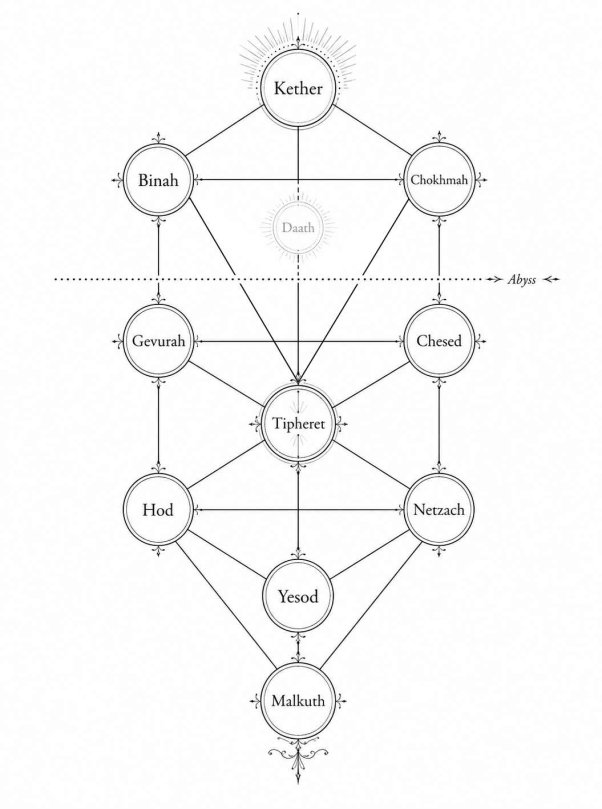
The Tree of Life is its central figure. In the later composite form used here, ten Sephiroth are joined by twenty-two paths; three veils stand above the Crown, and the shells lie beneath the Kingdom. The paths are channels between the Sephiroth, each a route along which the light passes from one station to the next, and the practitioner who works the Tree travels them as much as he dwells in its stations.
The Tree is not deduced from first principles. The ten Sephiroth come as the ten utterances by which the world was spoken, or the ten names of God, or the ten garments the infinite puts on; the three veils above them come as revealed degrees of the hidden; and the question of why there are ten Sephiroth and three veils, or why they fall in this order, is answered by inheritance. The map is given.
What follows keeps faith with the content of that inheritance and parts from it on one point. Where the tradition shows the Tree, the logic of it is drawn out: each station as a step the one before makes necessary, each veil as a move the infinite cannot skip on the way to becoming a source. The version is Lurianic in its account of emanation, Zoharic in its account of the shells, and Neoplatonic underneath, because this reading draws out the Neoplatonic structure running through much of Kabbalah: overflow, procession, and the long dimming into matter. Read this way the Tree stops being a list of names and becomes a single descent, each level produced by the level above.
Begin before any beginning. Ain Soph, the Without-End, is the infinite taken with no limit at all. It cannot be the first being, as a being is something bounded, marked off from what it is not, and what has no end has no edge. The infinite therefore cannot simply occupy the head of the Tree as its topmost item. It has to become a source, and that takes three conceptual steps, represented in the later occult Tree as the three veils. For the limitless to be an origin, it must first be thought apart from everything bounded that may proceed from it, and the only thing wholly unlike the bounded is nothing: Ain, the first veil, the infinite seen as no-thing. But a bare nothing originates nothing. The nothing must be taken as infinite, a fullness and not a blank: Ain Soph, the second veil, the nothing without limit. And an infinite fullness still does not pour until it inclines toward pouring and becomes light gathered at the verge of overflow: Ain Soph Aur, the limitless light, the third veil. Origination requires all three steps: severance from the bounded, then fullness, then the inclination to give. This is the negative theology Plotinus develops from the One beyond being, epekeina tes ousias: the dark Without-End, unreachable by any name.
From the light at the verge, the first thing to emanate is a limit. Kether, the Crown, is what the infinite becomes when it takes its initial bound: not yet anything in particular, the bare fact that now there is something. This first something is the One. Kether is the first formed unity, the image of the Plotinian One within the order of what descends. Kether is will before there is anything willed, the "that it is" before any "what." Its indeterminacy is undividedness: there is nothing vague in it, no second thing to oppose a first. Everything the Tree will become is here without distinction, and everything that descends from here comes as a departure from this unity and a candidate for return to it. Kether is the least determinate of the Sephiroth.
A point that only is must next be something, and the first content is the undivided whole of what will come, flashed out at once. Chokhmah, Wisdom, is that outflash, the seminal point of everything to be, held in a single unparted blaze. Wisdom contains all and draws no distinctions. It is the answer to a question Kether could not answer alone, the question of what the bare "it is" is going to be.
An undivided all is still indistinguishable from nothing. There must be something that draws the first distinctions and sets one thing apart from another. Binah, Understanding, is the dividing power, the womb where the seminal point is unfolded into distinct forms. Wisdom gives the undivided seed; Understanding draws the boundaries that let the seed become many. With Binah the basic machine of emanation is complete: a source, an undivided content, and the division that articulates it into forms.
Here is the first place the necessity leans on something it does not announce. Understanding divides, and the division could in principle run loose, difference proliferating with no counterforce drawing it back. The doctrine binds division to return: Binah divides only under the assumption that what is divided will be gathered again, every distinction made to be balanced and returned upward to the unity. That the many are for the sake of returning to the one is not forced by the logic of division alone. The whole Tree rests on this assumption, laid down early enough to read as necessity. The rest of the descent is the unfolding of that single buried decision.
Between the dividing power and what flows from it lies a station both counted and struck out: Daath, Knowledge, the place where Wisdom and Understanding would join. Drawn on some diagrams, absent from the ten on most, it is named here and left in that suspended position. The absence has a reason that cannot be given yet without breaking the order of the account.
What divides must now be governed, because division left alone gives only a scatter of distinct things and not a world. The next Sephiroth are the forces that govern the differentiated field. Chesed, Loving-kindness, is the first: the giving that pours outward without measure, the impulse to extend and grant without limit. The opening showed this at work; here it appears in its place as a principle. Left alone, Chesed would give beyond all form, dissolving boundaries Binah drew, an indulgence so total it unmakes all the distinctions.
Loving-kindness calls up its check. Gevurah, Severity, is the power that limits: judgment, which says "this much and no further," the force that draws the line and defends it. Where Chesed includes, Gevurah excludes. And severity alone is as ruinous as mercy, cutting until nothing is left standing, a rigor that withholds the world out of existence. The two principles correct one another, and each is fatal if left unrestrained.
These forces require a third that holds them in proportion. Tipheret, Beauty, is that holder, the balance that takes giving and withholding and keeps each from running to its ruinous end. Beauty is harmony, the balanced ratio between mercy and severity that lets a world endure, giving enough to exist and limit enough to keep shape. It sits at the heart of the Tree where the opposition is reconciled, and everything now descends from a struck balance.
Below the reconciling center, the same logic moves toward manifestation. Netzach, Victory, is the power of endurance and prevailing, the force by which a movement carries itself forward. Hod, Splendor, is acknowledgment and submission, the power by which what advances is received and given form. One persists and overcomes; the other yields and articulates. Their opposition repeats the higher pair in a lower register, no longer as mercy and severity but as advance and reception. Yesod, the Foundation, gathers all the flows above it and channels them to a single point of transmission, the funnel where the whole Tree narrows before its last step into the world.
Last, Malkuth, the Kingdom, adds no force. It is the pure vessel, receiving everything the nine above pour down and gathering it at the floor of the Tree. This floor is the made world, the cosmos as the settling-place of all that the Tree pours down, and what lies just beneath it is the husk. Malkuth is the one Sephirah that originates nothing, the bottom where the light, having passed through every limit, arrives at its faintest.
The descent traces a zigzag from crown to kingdom, right to left and down, the path called the lightning flash, and across it stand three pillars: mercy on the right, severity on the left, the reconciling column between them. Read schematically along its length, the Tree can be aligned with the four worlds and the four letters of YHWH, the divine name. In the arrangement used here, Atzilut is Kether alone, the Yod, the bare source before it has said what it is. Beriah takes Chokhmah and Binah, the outflash and the power that divides it, the first Heh, the throne. Below these two worlds the Abyss opens. Yetzirah holds the six that govern a world, Chesed down to Yesod, the Vav whose number is theirs. Asiyah is Malkuth, the Heh that closes the name, the made cosmos itself.
The four worlds present the Tree as the stages of a single name: source and throne above the Abyss, the governing forces and the vessel below. This division gives each stage of the descent its cosmological place. Ours is the last, Asiyah, the cosmos we inhabit, where the light in Malkuth has worn down to its faintest and the shells lie just under the threshold of the made world. With the name closed at that floor, the Neoplatonic account of imperfection is built into the frame of things: distance from the source measures deficiency, and what goes wrong keeps its address at the bottom.
But if distance alone explains the flaw, it should spread through the whole descent, thickening at every step. Kabbalah will instead locate the flaw in a single catastrophe: the breaking of the vessels.