The Philosophy of the Sitra Achra by Denys Spirin - HTML preview
Download the book in PDF, ePub for a complete version.
 |  |

Chapter 13. The Qliphoth

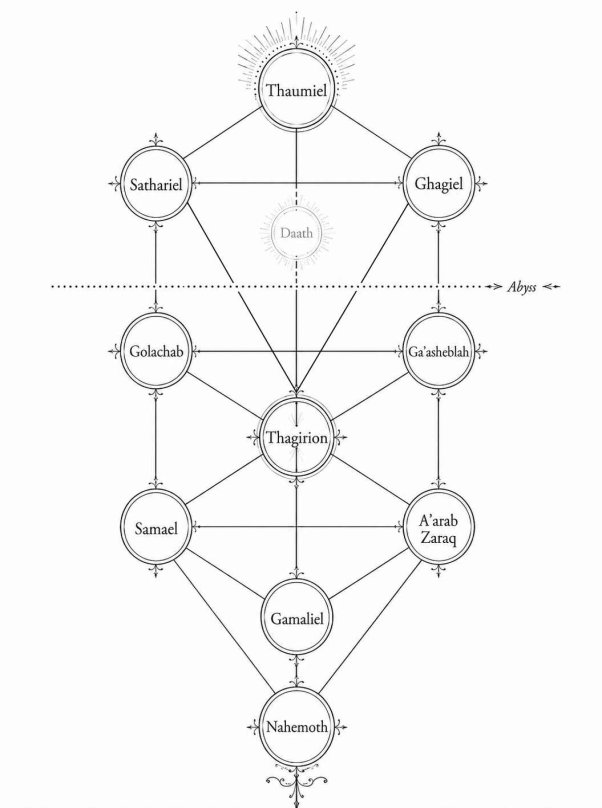
The map of the Qliphoth read here comes from no single document or age. Its oldest layer is medieval and Jewish: the doctrine that evil has a positive root and that each holy power throws off a dark counterpart. Azriel of Gerona and the school of David ben Yehudah he-Hasid held the latter under the name temurot, while Isaac ha-Kohen and the Zohar developed it further. Where the Zohar drew the underside in full, in Pekudei, it drew the Other Side as seven palaces of impurity facing the seven palaces of holiness. The later systematizers stretched that sevenfold underside to ten, ranging shell against Sephirah point for point across the whole Tree, and the fixed catalogue, Nahemoth and Gamaliel and the rest, was theirs.
These systematizers were the ritual magicians of the modern occult revival, who took the Kabbalah for a working magical system. Mathers, a founder of the Golden Dawn, set the ten husks opposite the ten Sephiroth in a finished table; the order systematized the scheme, and Crowley gave the spheres and the tunnels between them their catalogue of names; the Tree of Death took its tidy form in Victorian occultism, from Kabbalistic material crossed with later demonology. Later still the current that named itself the Left-Hand Path took the underside for the way up: Grant built the Nightside into a path, and Karlsson, Mason, and the Draconian orders made the roster a course of initiation climbed station by station. The names that follow belong mostly to that late codification.
That late arrangement gave the underside of the Tree a symmetry it had not possessed in the older sources. The chart is late, but the relation it displays is present in the Tree: every determination excludes, and what it excludes remains as its sediment. The tenfold counter-Tree makes that remainder visible station by station. A late synthesis laid them side by side and could not miss what the structure put there.
Malkuth is the vessel, matter holding still to receive what pours down. Its Qliphah is Nahemoth, that host refusing to stay silent, the material waking to its unruly origin instead of serving as a passive floor. It is the side of the kingdom suppressed so the kingdom can be a vessel at all.
Yesod transmits, binding form to image and passing the current on. Gamaliel is flooded with the repressed images the channel was built to exclude, what Yesod sheds in order to pass only clean ones.
Hod and Netzach shed their other halves as Samael and A'arab Zaraq. Hod is form, the order that gives a thing measure, and Samael is the poison that dissolves the logical structures form depends on, the formless eating the order. Netzach is the outward drive that holds its direction, and A'arab Zaraq is the Ravens of Dispersion, that drive scattered into aimless flight. Form loses the formless; the drive loses what will not keep its line.
Tipheret is the measure that demands proportion, the golden mean. Its shadow is Thagirion, the Disputer, the Black Sun that lights the lie in the ideal, the monstrous and unbalanced that Beauty casts out so that it can remain well-formed. The image recalls the Zoharic economy of darkening: human sin strengthens the Sitra Achra, and the light that should pass into the world is obstructed. Since Tipheret is the solar power of the Tree, Thagirion appears as its eclipse — the same radiance blackened by the underside its harmony excludes. It is the disproportionate as the underside of proportion.
Gevurah and Chesed shed Golachab and Ga'asheblah. Severity judges and punishes, and Golachab, the Burning Ones, refuses the limit and will not be punished, the side severity suppresses in order to bind. Mercy gives, and Ga'asheblah, the Smiters, strips the giving of its disguise and shows the hardness beneath it.
The tradition guards the last three as pure, and their shells are of another kind. The lower stations spill a real remainder in the act, a side dropped when the cut falls on a world. The supernal three drop nothing into a world, for above the Abyss no world exists yet; they are modes of knowing turned upon their own operation, logic and total sight closed upon themselves, and their shells are the dark that those modes cannot take. Each is a shadow counterpart, the limit of a mode of knowing. Binah is discursion, the line that parts the undivided into the distinct, and Satariel, the Concealer, is what discursion cannot part, the indivisible that slips the division. Chokhmah is intuition that grasps the undivided whole, and Ghagiel, the Hinderer, is what no such grasp can hold, the manifold and the contingent that will not gather into one seeing. Both rest on the duality Kether struck out, and Kether's shadow is that rejected duality returning: Thaumiel, the Twins, the crown split by duality. Here the crown splits under the difference it could not gather, and a logic closed upon itself mistakes the limit of its knowledge for the limit of being.
Ten Sephiroth seal ten cuts; the Qliphoth are the ten buried halves, each filed against the cut that dropped it.
Karlsson took it up in Qabalah, Qliphoth and Goetic Magic and pressed the Qliphoth toward the primordial as far as anyone has. He draws the sources together into one occult map, and in one strand the Qliphoth are given an existence more primeval than God (or rooted in Ain Soph), an independent world, the kingdom of manifoldness set against the Holy Side as the kingdom of unity. Here the material he assembles reaches the heteron in all but name, the duality that holds its own from before the Tree. Alongside it he keeps the traditional apparatus intact. In the other strand, the Qliphoth are the excrements of creation, the fragments of Gevurah that tore loose and escaped, the anti-worlds, each ranked against a Sephirotic world. The two strands lie side by side and are never drawn apart. A principle more primeval than Ain Soph cannot also be the refuse of a creation that postdates God; a kingdom of manifoldness prior to all organization cannot also be the debris a later catastrophe scattered below the Tree, and the map holds both without deciding between them.
The inherited Tree is where the unreconciled halves meet, and here the traditional model wins. The pairwise map is a map of the suppressed halves bound to ten sealings, the Tree's underside filed against it station by station, and to call that map primordial is to take one pole of the principle for the whole. The independent Other Side keeps collapsing back into a chart pegged point for point to the Tree, because the model Karlsson would not release drags it there. The problem is not that he betrayed a clean doctrine with a careless map. His error was to hold the deep and the sediment in one hand and let the sediment keep the name. He reached the Sitra Achra as the will prior to the Tree and could not stop reading it as the Tree's leavings, and the demiurgic frame he inherited closed over the insight each time he set it down.
Earlier, Grant extended that chart onto the paths. He gave the Nightside a positive development of its own, a whole region worked out rather than a margin of filth; he refused to read it as mere evil, taking it as the non-being from which being emerges; and he placed its entrance at Daath, in the Abyss, where the crossing actually opens, instead of beneath Malkuth. At the entrance he saw further than the tradition, and then he laid the inherited chart back down past the gate. The Nightside became the Tunnels of Set, twenty-two tunnels answering the twenty-two paths of the dayside, the underside of each path walked as a road. What he charted there is the suppressed pole of the Sitra Achra, and he took it for the whole.
Later practical charts come from inside the practice, and they strike the same wall. V.K. Jehannum, guiding a self-initiation through the spheres in his Rites of Acharayim, takes the tradition's name for the charted Nightside: Acharayim, the backwards tree. The map lays out the Tree reversed, the reflection filed against its original, and Acharayim says precisely that. The Gerona kabbalists had another name for it, ha-ilan ha-ḥiṣon, the outer tree, set beside and behind the Tree, a reflection wearing the tradition's word for its distance from the source. From inside the practice Jehannum sees what the orthodox miss, that the Other Side carries its initiatory weight and its primordiality, and that reducing it to pure evil and corruption is a failure of sight. He calls it the primordial portion of the One Tree. The seeing is real, and the sealing follows immediately. He makes Acharayim and the Sephiroth mirror-realms of one initiatory structure, and here he keeps a difference the orthodox never grant: the Qliphoth are the primordial Nightside, the Sephiroth its cosmic reflection, and the dark side is the older and the stronger. From the human vantage the two are separate, the primordial standing against its reflection. He holds that, from the acausal vantage of a god, no distinction between them remains.
The difference he grants below he dissolves above, ranking the undivided view as the higher truth and the divided one as the lower, so that at the summit the two realms fold into a single tree with nothing held apart. The monist reflex reaches its subtlest form here. The older tradition kept the Tree clean by renaming the sediment; Jehannum ennobles the sediment and then performs the Tree's move upon it. He has raised the Other Side and then subordinated it exactly as the Tree subordinates the many to the One, only with the sublation moved up to the vantage of a deity. The Sitra Achra, whose being is difference held open, cannot survive a view that crowns the vanishing of difference. Acharayim is the reflection, the Qliphoth wearing the tradition's truest name for it. The Sitra Achra is what casts no reflection, the difference the reflection cannot contain.
Why the reflection passes so easily for what it reflects lies in the word. Ibn Abi Zimra's account turns on the maxim that the shell precedes the fruit, drawing it from the darkness over the Tehom that Genesis sets before the first light, so qliphah there names the deep before any cut. The same word names the sediment a cut sheds behind it. Applied both to the depth that precedes all cutting and to the residue that follows a stroke, the term gives the reader no way to distinguish the primordial from the dross. The map charts the sediment and is read as if it had reached the primordial dark.
The inherited map meets the buried pole and stops, and readers took its terminus for the end. Neither Karlsson nor Grant failed in the undertaking; each took the Tree and worked it as far as it goes. What no chart of the underside can show is the work: what a practitioner does with the sediment once he moves among it.
Scholarship's answers to the Other Side would either annihilate the dark or incorporate it, cast it out or take it back. Berman observes that both projects are pyrrhic for the same reason: each is the Self trying to settle accounts with an Other to which it was bound before either had a separate name. Annihilation and incorporation are the two roads just walked, dissolution and integration, and they fail together because both set out to resolve a duality produced by unity. Neither reaches the act that produced the division. What lies there is no thing to be destroyed or reclaimed; it is the cut before it was sealed, and only the road that stops trying to resolve it, holding it open instead, reaches it at all.
One can retrieve it for the sake of completeness: go down into the disowned side, the suppressed face of one's cuts, take it back, and be more whole for the taking. Integration never leaves the Tree. It is the self closing the circle, unity widened to include what it had excluded, ending in a fuller One that has eaten the underside it first denied. Jung gave this the form of the shadow reclaimed into a Self that holds light and dark together, and called the wider wholeness the goal, which is a unity again. It is tikkun in the language of psychology.
A second motion looks like the opposite and ends at that place. One lets the cut go entirely, sinks the distinction back into the undivided, dissolves the self into the chaos that has no sides. This is the dissolution into Tiamat already distinguished from crossing.
The third move takes the sediment as a door, going into the suppressed side to find the cut held open, neither reclaiming it to enlarge the self nor dissolving it into peace: the buried face lifted level with the shown, both sides held open. What is reached there is the true Sitra Achra. What dissolves in the crossing is the sealing, the closure that ranked one's cuts into a unity and called it "I."
Adorno built a philosophy on the refusal we have been making. Negative dialectics declines the synthesis: against the Aufhebung that lifts contradictions into a higher unity, he held that the lifting is a violence, that the concept leaves a remainder it cannot absorb, das Nichtidentische, the nonidentical, and that the remainder is what matters. He held the cut open. But his was a mourning, a fidelity to what thought destroys, with no will in it. The nonidentical is for him the victim of the concept, the passive remainder that suffers identity, and there is no one on its side but the critic who refuses, on its behalf, to seal it. He sides with the cut and never with the cutting.
The Sitra Achra is the will that declines to seal, the self-postulation that keeps its difference as its own rather than grieving the difference unity took. Where Adorno mourns the nonidentical, we affirm it; where he holds the remainder as the limit of thought, the crossing holds it as the field of a sovereign act; where his refusal is a negation kept in fidelity to the victim, ours is a willing that affirms the cut. The step across is the Name, which holds the singular without converting it to a concept and does the one thing he thought impossible: says the nonidentical without identifying it.