

Leibowitz Concludes by Edward Drobinski - HTML preview
Download the book in PDF, ePub, Kindle for a complete version.
CHAPTER ONE AGAIN
A BRIEF HISTORY OF POST-MODERNISM
DURING THE 1960’S AND 1970’S POLYTHEISM MADE ITS PRESENCE KNOWN.
PEOPLE INCORRECTLY SAW THE NEAR-PERFECT DEITY AS THEIR VERY
IMPERFECT UNDERSTANDING OF IT, I’LL CALL “POLLY.” BURDENED AND
OVERWHELMED, NEAR-PERFECT MONOTHEISM WAS ANXIOUSLY AWAITING
THIS DAY. HOWEVER, PEOPLE ALSO INCORRECTLY SAW IT’S DEITIFIC NEAR-
PERFECTION AS THEIR VERY IMPERFECT UNDERSTANDING OF IT; I’LL CALL
“MON.” POLLY SOUGHT ITS RIGHTFUL PLACE, SOMETIMES PEACEABLY,
SOMETIMES MISBEHAVING. MON RELIED ON ITS TRADITIONAL PENCHANT
Page 115
FOR WAR. IN ANGER, BUT SUSPECTING THAT POLLY WAS RIGHT, MON
SOUGHT ITS SWORD, NOW FLACCID FROM DOUBT AND USED IT TO WHIP
POLLY. MON WAS TOO STUPID, SELF-CENTERED AND ENTRENCHED TO SEE
THAT THE LOVING ACCEPTANCE OF POLLY WAS IN BOTH THEIR SELF-
INTERESTS. POLLY ATTEMPTED A RETREAT, BUT THE CAT WAS OUT OF THE
BAG AND THE BAG IS LOST IN THE WIND. THE IMPERFECT MUST DEAL
FAIRLY WITH EACH OTHER OR DIE. IT’S YOUR MOVE, MON. PUT YOUR
CURRENTLY USELESS SWORD DOWN A BIT AND USE YOUR LOUD MOUTH TO
SING. POLLY STILL HAS ONE GOOD EAR LEFT AND LOVES MUSIC. THE END?
DEPENDS.
A BRIEFER HISTORY OF EVERYTHING AS CURRENTLY MANIFESTED. THEY
MET AT A PARTY EACH ATTENDED OUT OF A SENSE OF OBLIGATION,
HAVING NO INITIAL DESIRE TO GO. HE SAID SOMETHING HE THOUGHT
WITTY TO HER, WANTING TO BE LIKED (WTBL) AND SHE LAUGHED
UPROARIOUSLY WTBL. SHE SAID SOMETHING SHE CONSIDERED WITTY
WTBL AND HE LAUGHED UPROARIOUSLY WTBL. THE COUPLE WHO LIKED
AND INTRODUCED THEM LEFT, THINKING IT BETTER THAT THEY GET TO
KNOW EACH OTHER IN PRIVACY. THEY DROVE HOME TOGETHER, HE
TRYING TO UNDERSTAND HER WITTICISM AND SHE TRYING TO
UNDERSTAND HIS.
Page 116
Small lettered and un-bold redundancy. Everyone in this world, except me, is crippled,
only they don’t know it. In the beginning was the WORD and we are advised that it became
flesh, at least according to a translation from the Aramaic monopolized by the few.
Improvements have come our way; now we still have WORD; but in infinite variety and flavors,
including eighty million new words, sixty different ways of displaying them, a plethora of fonts,
methods to incorporate pictures, etc., etc. The possibilities have become endless; at least as far as
I can calculate eighty million times eighty million times eighty million, on and on. So many new
ways to tell the story.
WORDS DON’T COME
Marie

Leibowitz Concludes
Page 117

Leibowitz Concludes
Page 118
Marie and “Marie” by Randy Newman; property of the author, the latter under both the “fair use”
and “transformative” doctrines.
Page 119
Abby’s Kitten
Isaac had never discussed his recent phone call from
Abigail with anyone. She had specifically asked him to keep it a
secret, though half of it had to have been previously known by
the entire family, excepting him. Abby was upset over how quiet
the house had gotten with him gone and Mark off at school. She
used to sometimes wish for quiet, but now that her wish had been
granted, she’d learned to be more careful about what she wished
for, at times making an attempt to circumvent mistakes by a wish
for infinite do-overs.
Abby said that when Mom came home from work she’d just flop
on the couch near the two storied window and listlessly stare
through it, her dog-eared, but presently un-opened paperback
copy of “The Great Gatsby” at her side, to which Isaac responded
by saying that he had his copy of “Robinson Crusoe” for exactly
the same reason, then attempting some feeble, interrupted joke
about not getting everything done by Friday. Abby burst through
the yarn, no longer able to restrain excitedly saying that she
had gotten a kitten, which she had named Ball as in ballistic,
as he was such a scamp, with so much energy, and explosive
physical ability that he hopped all the way from the floor to
the top of the refrigerator, then got too curious looking at the
space in the back, fell right in there, and started howling like
Page 120
a mumbo-jumboed fantod, and since this had happened right after
she had come home from school, she had to wait three more long
hours for mom to get home as she couldn’t move the refrigerator
by herself. Ball’s head would appear at the side edge spaces,
but it was already too big to fit through the spaces, left and
right, sporting only an inch of leeway, because of the efficient
standardization of appliance sizes and the caves designed to
hold them.
At first Abby was thrilled to see Ball’s head, as she took
it as an indication that he was all right, but in a few minutes
settled back into the scary possibility that only his head was
all right, and that it was very possible that his unseen body
was bleeding to death, as a refrigerator behind contains many
wires and possibly impaling type things which were exposed for
some stupid reason cat-less designers could not imagine. Like,
duh.
But, he really was all right, because when mom got there we
slid the thing a crooked foot and Ball came running out, and
while I was so happy to see that I wanted to pick him up and
cuddle him forever, he ran right by me, and went to his dishes
for food and water first. He allowed cuddling after that, but
you know, after all that, he wasn’t the least bit scared, as an
hour later I found him on top of the refrigerator again, looking
Page 121
down into the hole. He does that a lot, and I pull him off
whenever I catch him.
“He’s a leaper, and is now racing around the house, as if
it was the great wide open plains, galloping, spinning, leaping
for the sheer joy of the run itself. I can’t think of much on
this earth that is more fun than a new kitten. He’s soft and
funny and acrobatic; make that ‘acrocatic.’ And he won’t be a
kitten forever. You’ve got to get back quickly to see this.”
Isaac sincerely hoped that he would; then returned to
“Robinson” and his tiny window.
Leibowitz Concludes
Page 122
**5**
Highway
Leibowitz Concludes
Page 123

Leibowitz Concludes
Page 124
Leibowitz Concludes
Page 125

Leibowitz Concludes
Page 126
Highway and “Highway 61 Revisited” by Bob Dylan; property of the author, the latter under both
the “fair use” and “transformative” doctrines.
News - 5-6-22
Tuna Publications
as covertly authorized by “Fortune Magazine”
May 6, 2022
Page 127
The Russian Bank with Ties to Bailey Post Rumpole
Whatever degree of truth there is behind the alleged link
between Bailey Post Rumpole’s “Rumpole Organization” server
Conan, sometimes referred to as “Country One” and the Russian
financial firm Alfa Bank’s server, the largest surprise is
that Alfa’s server’s name has not yet appeared in the US’
most kitschy narratives of 2022. Rumors from disreputable
undisclosed sources have said it is Lupe Velez sometimes
referred to as “Cunny Two;” whose US attorney, Michael
Havasnotti has declined all comment, other than to remind
everyone that he’s planning on running for President, that to
the best of his knowledge none of his clients ever have been
undocumented aliens or otherwise agents of hostile foreign
powers, and that the matter will be officially announced as
soon as his domestic violence probation has lapsed. In the
meantime scurrilous Enquirer articles have published overhead
and allegedly un-doctored photographs of Harold and Lupe
engaged in computer generated acts forbidden to be mentioned
here at Tuna. Suffice to say that CyberJohn is no longer the
Baptist, deferring to CyberJoan.
Page 128
Finally on Monday, our esteemed colleagues at RedApeButt.com
published a story about lengthy and un-natural communications
between a server hosting Rumpole Organization domain
addresses and a server bearing the same shifting ISP
addresses as one owned by Alfa Bank. Cyber security firm
RadiantBytes, a wholly owned subsidiary of TechEye Inc., said
that there was no conclusive evidence of “substantive contact
or collusion between the two, according to RedApeButt. But
even if there were, Alfa Bank would make a very strange
conduit for illicit traffic between Rumpole and his favorite
foreign leader.
The pedestrian Western response to the news has been to ask;
“How close is Alfa to Rasputin?” The more pomo’d or fomo’d
group collectively intoned; “To what degree are ‘Alfa’ and
‘my meta mental image of Russia as an implacably hostile,
anti-American force’ interchangeable?”
The simple answers are; “Not very and depends whether or not
your shrink is into Hegel.” Alfa was founded and is
controlled by one of the most successful, western-oriented,
hard-edged capitalists in Russia. None of its key members are
on either the US or European sanctions lists, and the bank
has in any case been run at a respectable arm’s length from
Page 129
the corporate chicanery its owners have engaged in and spent
modest prison terms for elsewhere. Its founder, Mikhail
Fridman, has now largely cut his links with the country where
he made his billions. He has applied for permanent residency
in the UK, and said last July that he intends to invest most of what he made selling his share of oil company Think-BP in
US healthcare stocks; well beyond the reach of any Russian
leader or policeman. “Codger care is a safe, growing market
in urbane countries,” he is quoted as saying. Of course, in
the interest of fair reporting, he actually said; “Чудак
Care-это безопасный, растущий рынок в городских странах, Если
дополняют похоронные дома и Medicare.” We thank our crack
translator, Ivan Putsky.
The most salient indication of the expanse between Country
One-Cunny Two, Alfa-Rump, Harold-Lupe, Russia-Ukraine,
Fridman-Rasputin, Alfa-Kremlin et al, including but not
limited to fleeting Mueller-Whitaker considerations is the
fact that its businesses in Ukraine are flourishing, even
though the two countries are involved in a war. With each
other! More or less. Fridman was born in Lviv in western
Ukraine. While the branches of Kremlin-controlled VTB have
had their windows smashed, Alfa Bank Ukraine is expanding its
market share, and more importantly have not had to incur
Page 130
glazier or sweeping expenses. As a result of the savings, it
just bought the Ukrainian assets of Italy’s Unicredit.
Fridman publicly thanked the Ukrainian “protestors,” who
later denied being on Fridman’s side. When asked whose side
they were on, spokesperson Larisa Upchucky said; “It’s hard
to tell sometimes. Mostly we just like to get messed up on
Horilka and break things, figuring we have a 50% chance of
being right.”
But Alfa’s success owes at least as much to its political
clout in Moscow as to its business acumen. Over the years
Alfa has come out on top in bitter power struggles even with
people closely linked to Vladimir Rasputin. It successfully
defended its telecoms empire against Leonid Reiman,
Rasputin’s communications minister, who ultimately left the
government after a string of disclosures about his links to
an offshore company. Even when, in 2013, it could not keep
hold of its stake in the oil company Think-BP, it extracted a
full price from the Kremlin’s energy boss, notoriously
unkempt Igor Frankenfishsky; and in cash, at the bottom of the cycle.
Alfa’s success also has its foul side. It dragged Telenor
ASA, its Norwegian partner in Vimpelcom, through the Russian
Page 131
and Ukrainian courts, in an attempt to force it to accept a
strategy that involved buying other Alfa controlled assets at
inflated prices as per written agreement. And when
Vimpelcom’s use of suspect payments to gain market share in
Uzbekistan was exposed, it was Telenor man Jo Lunder who took
the rap, rather than any of Alfa’s people.
During the days of the Think-BP joint venture, BP staff in
Moscow often privately suspected that the harassment they got
from Russian officials was instigated by the partner they had
hoped would protect them. BP Chairman Peter Sutherland once
publicly accused them of manipulation, only to be publicly humiliated as a Fish Eating Meatball. The use of billion
dollar lawsuits to apply pressure on Alfa’s partners; filed
in remote regions of Russia by obscure private shareholders
whose interests somehow overlapped perfectly with Alfa’s
became a typical modus operandi.
Alfa may have been close enough to the Russian state to
manipulate it on many occasions, but it has never trusted it,
nor been trusted by it.
One former employee of the bank recalls a ceremony 10 years
back at which Fridman’s partner Pyotr Aven, a deputy prime
Page 132
minister who has headed the group’s government relations, was
due to receive an award from Rasputin. The awkward exchange
went as follows:
Rasputin: “Remind me, why am I giving this to you?”
Aven: “Because I haven’t done anything you can put me in jail
for.”
Rasputin: “No, not yet.”
By a curious coincidence, even before the leak regarding
Rumpole’s alleged connection to the bank, Aven has recently
been in the news himself. Last year, Aven had invited
Rasputin’s former press minister and propagandist-in-chief
Mikhail Lesin to Washington DC on the night that Lesin died a
suspicious death. Aven was due to collect an award from the
Woodrow Wilson International Center for Scholars in
recognition of his “Corporate Citizenship” and his
contribution to US - Russian relations.
US prosecutors last week closed the Lesin case, attributing it to a drunken fall. The city’s medical examiner had
attributed it to blunt trauma to the blunt head, neck, limbs,
and torso.
Page 133
Chant
His movements were irregular as if in his head he was
hearing and following the sound of Charlie Parker playing early
“Cherokee Warrior” while using his later flats. He began
chanting like a Haitian possessed by the spirit.
“Hello. ... My friends! ... My name ... is Bit’aa’ni. ... I
am. ... of The Folder Arms People ... Clan, born for The Red-
Running-Into-Water Clan. ... The Bitter ... Water Clan are my
maternal grandfather's clan ... and The Tangle People are my
paternal grandfather's clan. .......... You can ... call me
Bitty. ... I’m Navajo. Please pardon me. Here we go. Sedentary
mice flammed the focal entry flap to the place the twelve
partitioned proditious enormity resided. In nostalgic
desperation, the bio of Metal Man peeped its square face toward
the six. Not quite, but a start.
No new land provides no new respite for the children of the
elk. Nor the children of the corn. Nor the children of the
spook. Nor the children. It is complete; save the few. They have
taken their silence away. Away at last, the folder arms are
left, not out of their unchosen choice, but out of innafs long
ago planted in the time of the selective giants.
They have painted demonic pictures on the fertile green and
have made them abundant in their hiding places. This offering in
Page 134
my hands, my pockets, and my nutbean-mound is not the first; yet
it is the last gift from the many-named one. The delta it
invokes and at the same time dishonors is a coolybrish negroid
meeting of the true Tribes. In the least of winds, the waves
come in in bold white caps which kiss the shore, then disappear.
How much more will be seen in the great wind to come?”
Speed. ....... Speed? ....... Einstein for you. ......
Relativity? ......... Fine, insofar as it goes. Relative to
what?
A constant. A stillness. Something which doesn’t evolve.
Something which remains the same.
Where are such things?
In the mans’ breechcloth?
For you in the moment of your jingle dress.
Metaphor intended.
Faith leaped.
Truth.
Biased.
Any other kind available for sale?
Conveniently answers its own question.
Which was?
Blue is a color which will always was and which always will
be. Much like yellow, it is difficult to pinpoint, and therefore
Page 135
even more difficult to draw inferences from. Dangerous. Few are
skilled in the proper use of a prism. In the days of Mesa Coyote
and his lost tribe, it was the rule that pathos equalled jest.
Brisfallus, brisfallus, you see. It was made two. Look!
It’s obvious. To crave one is to crave death. To have reasoning
for one is to crave death. To be deluded by the business of
preachership is to crave the flood. To be communal sectares the
land. Me and my family can now make the debt gone. Naashgali
Dine’e and his Mescal warriors now mistakenly fear us. They know
their power comes only from the green. The green comes from the
earth, and try as they will, they cannot stop it. They can only
blind the already lame.
It was foreseen by Mor’ in’ e, in the tradition of her
Touch Many Hands tribe that all would reverse. South would
become North, just as it was before the first shift at the end
of the first age. It is but a matter of a match igniting the
ready and dry wood. Until that day we are condemned to the green
defiled by the Cyclops.
Approach the pure and dense period of alteration. The
elders relate their faulty sympathy, yet they are elders. A
weathered Dine skin-walker could fix the circle again. Seasons
are now backward, yet we still fear a real break. Dine could be
mad, and return your nafs to the solid spirit grace, with music
from afar. We have tasted the fruit of man and made infinite
Page 136
clones, losing all but Rolex shams, valuing sums to nowhere. The
hands meet on top and a moondrop surges. It can elevate us like
an Orphic lyre, taking away the plain plane. My dear friends and
protectors, ultimately you choose the passageway. End, corner
not right; the dammed falls of the river. Broke through just
before the false revolutions of the straw, hands extended to the
shade of the blue. Circulated around a brief infatuation for the
hillside howlers, un-clothed in mornings in which light was
denied. Finally relaxing into the time we used to worry, yet
sending each of the variations into the damp shadows of ancient
rhyme we release the burden and learn the master's name.
Downstairs at the wind-up, close to the landing, a river.
Seasons uncaringly bypass. Up. Down. It's over. You’re un-
abridged.
An image of the Cyclopean Sun speared, my shell convinced,
in the eclipse of the older moon, deceivingly replaced by the
younger reached through harmless fancy. Manna from above
compounds. I killed my disgust and seized the word in my hand.
Remains only you, the calculator’s time, the calculator’s logic,
the motives we don't respect or comprehend. Melancholy
resolution took the wounded static. Armored vans took the road
by the sea. From the cord, it has been licensed to those with
the green. The details we pretend to understand, will be
disproved, down at the edge.
Page 137
Cause specific takes away the frightened recall. The
journey smiles as if otherwise; after it has once more stopped
before going all the way; as if it stupidly thought that it
diverged from any reality that you've ever seen and known.
Deducing glitches only to betray their mention. Leaving paths
that end halfway into the annulled. As we cross from north to
south, we hear the complete heap record. Beified at the edge.
Flavors will depart. You turn up. You turn down.
The white shawl sadly looks; ashamed for the crucifixion of
her sphere. Eight billion sheep just placate. Two one cry, too
late. Specks of honesty cannot reach. She’d flooshey say it was
wonder of her own. Billions are daily deluded. Only compound
interest could be placed on the children. I get up, I get down.
To what am I slave? No, he sees the femlens twins. His eyes
blinded, he feels his way. In what day does he come of age? I
get up. I get down.
Aladdin’s rusted compass blade split the seasons. Water
poured. Spaces between our houses were boned. Music wed the
colors to the visions. The red sky smashed the two. Space
focussed form. Chirruping wind cast its spell of forgotten
communal gathering upstairs. Open to space; who wheeled and
directed, exposing each side? Piercing orbs smirked gossip,
beholding itself only. Mounted we see peace in the vale and the
Page 138
ghostly phases of the past, through roads manifesting complete
sun. When whole, you get down.
The controller arms meet at top. The twelve is heard only
by the moon. The dew explodes from its veiling place, now Owsley
in the cradle. Madman and reason join the treetop fowl. Four
winds move five silver grazes in spring, no footprints in the
hardened sand. Walk with me on the beach. The tide is way out.
You’ll shortly be two and want to know the way of the wind. It
is not said on the plot that Dibe hides at the rear of the timer
at the CGS. The four winds sit at the Cardinal Gate Scheme; two
gates locked and spaces barred. One lets you in and the other
echoes it. In vile glare and suggestion that other’s just a
replica. The noble, fluid, eternal incandescence or the
luminescence? The controller arms meet at top. Moon once more
explodes. Miss Dibe and Beloved are together at CGS. Dark clouds
rumble in. Bleakly meet Spell, but soon came me. My name is Lot,
infinite incandescence. The Holes of Hell are marked in granite,
my hound. When whole, you get down. Stars, stars, STARS.”

Leibowitz Concludes
Page 139
**6**
Abigail’s Visit to CountryReport.com

Leibowitz Concludes
Page 140
Leibowitz Concludes
Page 141
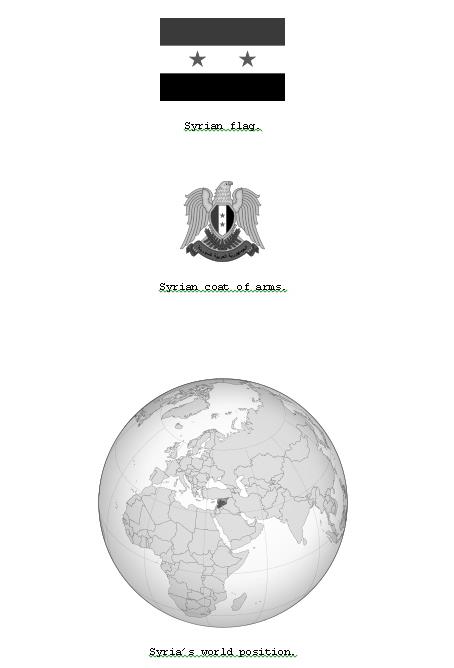
Syria
Syria is a shithole country in Western Asia, bordering Lebanon,
the Mediterranean Sea, Turkey, Iraq, Jordan, and Israel. It
seems unfair how some are mandated for trouble. A country of
fertile plains, high mountains, deserts, and drone bombed ruins,
Page 142
Syria is home to diverse ethnic and religious groups. Those in
ISIS thug controlled sections tend strongly toward strict
adherence to fundamentalist Sunni doctrines. Syria was suspended
from the Arab League in 2011 and the Organization of Islamic
Cooperation, and apparently thinking WTF, self-suspended itself
from the Union for the Mediterranean.
Aleppo and the capital city Damascus are among the oldest
continuously inhabited cities in the world. In the Islamic era,
Damascus is a provincial capital of the Mamaluk Sultanate in
Egypt, whatever that means. It gained de-jure independence as a
parliamentary republic on October 24, 1945 when the Republic of
Syria became a founding member of the United Nations, an act which legally ended their prior classification of “Camel
Cruncher.” The post-independence period was tumultuous, and a
large number of military coups and coup attempts shook the country from 1949 to 1971; the ostensible prize being the
control of the local camel and camel poo markets. 1971 marked
the introduction of yaks and yak poo, and a short lived Syrian
hiatus from economically based hostilities.
Chief exports – Unshaven, violent jihadists, yaks and related
yak poo; Sharia Law, camels and related camel poo.
Leibowitz Concludes
Page 143
Chief imports - Small arms, chainsaws, and sound amplification
systems.
Syria was under Emergency Law from 1963 to 2011, effectively
suspending most constitutional protections for citizens. Since
March 2011 Syria has been embroiled in an armed conflict with a
shifting number of countries in the region. Syria is ranked last
on the Global Peace Index, making it the most violent country in
the world, no doubt a factor considered by rumored native US
President Barack Obomber when he gave nukes to neighboring Iran,
ostensibly a respectable 133 of 163 on the index, and actually
ahead of Israel, perhaps hoping they’d put Syria out of its
misery. It is said that life, as it were, continues normally for
most of its citizens as of December 2021.
History - Ancient
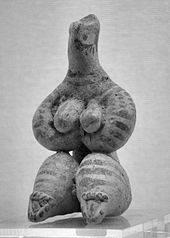
Full figured female figurine, 5000 BC. Ancient Orient Museum.
Leibowitz Concludes
Page 144
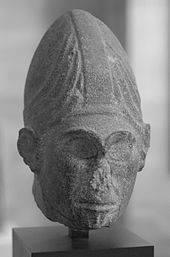
God head, the kingdom of Yamhad, ca. 1600 BC.
Things began a sharp decline shortly after a jihadist broke
God’s nose and made women wear clothing, circa 1600 BC. A
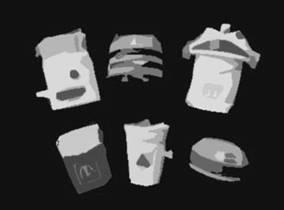
rebound was not noted until unsigned collages of McDonald’s toys
began to mysteriously appear in the butts of AK-47’s much later.
The rolled up post-Cubist inspired Dadaism presages the later
work of Andre Breton in spirit.
Leibowitz Concludes
Page 145
Syrian Dadaist collage, the top left congealed fries bag reflecting the Syrian “eye for a nose”
religious code of ethics.
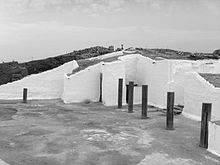
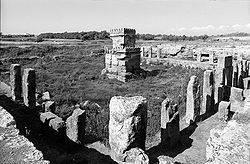
Ebla royal palace c. 2400 BC; please note the lack of windows, an ingenious adaptation to rock
chuckers.
Armpit Phoenician Temple, ca.1400 BC
Wars began their perpetual existence with various groups with
weak leaders and the usual stuff like that taking over, then
getting wiped out, yadda yadda as one might expect. If desired,
a more complete list of the banality may be found on Wikipedia
under “Syria; a 760 MB compendium of the War Years.”
Leibowitz Concludes
Page 146
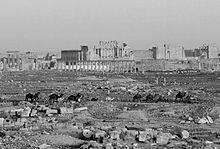
An ancient city before one of the wars.
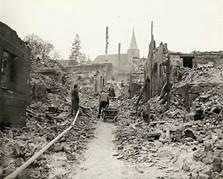
An ancient city after one of the wars.
History - Middle Ages
Muhammad’s first interaction with the people and tribes of Syria
was during his invasion of Dumatul Jandal in July 626. William
Montgomery Watt, Scottish historian, Orientalist, Anglican priest, and academic
Leibowitz Concludes
Page 147
William Montgomery Watt; property of the author.
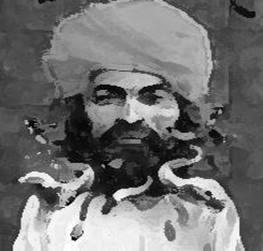
More virile Muhammad with multiple snakes; property of the author.
claims that this was the most significant expedition Muhammad
ordered at the time, even though it received little notice in
the primary on-line sources. Watt says that “there was no
immediate threat to Muhammad,” and adds; "It is tempting to
Leibowitz Concludes
Page 148
suppose that Muhammad was already envisaging something of the
expansion which took place after his death."
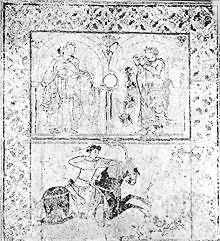
Umayyad fresco, said to depict Muhammad, from Qasr al-Sham al-Feign, made in the early 7th
century.
By AD 640, Syria was conquered by the Arab Rashidun army led by
Khalid ibn al-Walid, the rhyming his mother’s fault for getting married. The country's power declined during later Umayyad rule.
This was mainly due to totalitarianism, corruption and the
resulting revolutions. Yadda yadda again. The Umayyad dynasty
was then overthrown in 750 by the Abbasid dynasty, add the two
“Y” words.
Leibowitz Concludes
Page 149
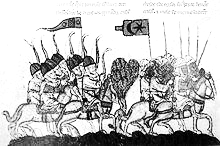
The 1299 Battle of Wadi al-Khazandar. The Mongols under Ghazan defeated the Mamaluks, their head backs swiftly palm smacked.
.
Defying the agonies of defeat, the Mamaluks made a comeback. For
details please see “Mamaluk” in Wikipedia or the Urban
Dictionary.
Ottoman Syria
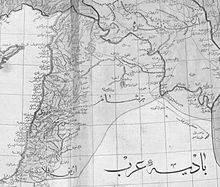
1803 Cedid Atlas, showing Ottoman Syria labelled as "Al Sham." A blow-up is suggested.
In 1516, the Ottoman Empire invaded the Mamaluk Sultanate of Egypt, conquering Syria, and incorporating it into its empire.
The Ottoman system was not burdensome to Syrians because the
Turks respected Arabic as the language of the Quran, and
accepted the mantle of defenders of the faith. Minority opinions
Leibowitz Concludes
Page 150
suggest that this could also have been the case because Syrians
were accustomed to being conquered and didn’t pay any attention
to the particular conqueror temporarily in place. Damascus was
made the major port for Mecca, and as such it acquired a holy
character to Muslims, because of the beneficial results of the
countless pilgrims who passed through on the hajj, the
pilgrimage to Mecca. However, the Ottoman tolerance of all
religions including Judaism eventually pissed off the Muslims,
and yadda yadda yadda into the 20th century, and as an act of
appeasement during their wipe-out in WWI the Ottomans found it
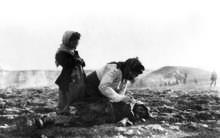
to their benefit to slaughter or deport all the Christians.
Deportees of the Armenian Genocide of 1915.
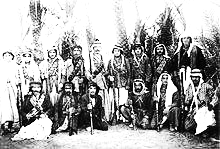
Syrian rebels in Ghouta during the Great Syrian Revolt against French colonial rule in the 1920’s.
Leibowitz Concludes
Page 151
In 1925, Sultan al-Atrash led a revolt that broke out in the
Druze Mountains and spread etc., etc., etc.
Independent Syrian Republic; Autos
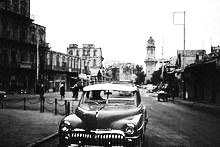
Aleppo with Peugeot in 1961
By 1961, thanks to expansive General Motors Credit Corporation,
autos replaced yaks and camels as the vehicle of choice. This
also proved to be an economic boom by Syrian standards, as they
were now able to eat their former means of transportation. But,
despite the sudden shot in the arm, upheaval dominated Syrian
politics from independence through the late 1960s. In May 1962,
Syrian forces invaded Palestine, and immediately attacked Jewish
settlements. Their president Shukri al-Quwwatli instructed his troops in the front, “to destroy the Zionists." Coup, coup,
coups followed.
When “The Six Day War” broke out between Egypt and Israel, Syria
joined the war and, largely un-noticed, attacked Israel as well.
Page 152
In the final days of the war, Israel turned its attention to
Syria, capturing two-thirds of the Golan Heights in under 48
hours, which is partially attributed to the primary Syrian
militarily offensive penchant to drive their western autos
backward; as seen on cool, Saturday afternoon, western
Demolition Derby shows during jihads.
On October 6, 1973, Syria and Egypt initiated the Yom Kippur War
against Israel. The Israeli Defense Forces reversed the initial Syrian gains and pushed deep into Syrian territory. In early
1976, Syria entered Lebanon, beginning the thirty year Syrian
In the late 1970s, an Islamist uprising by the Muslim
Brotherhood was aimed against the government. Islamists attacked civilians and off-duty military personnel, leading security
forces to also kill civilians in retaliatory strikes. The
uprising had reached its climax in the 1982 Hama massacre, when
some 10,000 – 40,000 people were killed by regular Syrian Army
troops.
In a major shift in relations with both other Arab states and the Western world, Syria participated in the US-led Gulf War
against Saddam Hussein, as without such participation Syria had
Page 153
no one else to fight with at the time. Shifting sides and sands
are of no consequence. After that they were part of various
“peace conferences,” the other attendees mistaken in their
belief that Syria actually was desirous of what the others
foolishly called “peaceful progress.” Some attribute the
confusion to the fact that translators might not have been top
notch, in being unaware that the Syrian word for “progress”
actually can and usually does mean “all-skull bash.”
On October 5, 2003, Israel bombed a site near Damascus, claiming
it was a terrorist training facility for members of Islamic
Jihad. On September 6, 2007, foreign jet fighters, suspected as
Israeli, reportedly carried out Operation Orchard against a
suspected nuclear reactor under construction by North Korean
technicians.
Syrian Civil War
As tiresome as this may be for all non-Syrians; since we’ve come
this far it behooves us to take one more step into the continued
Syrian struggles, and be more or less up to date.
As far as anyone can differentiate it from “normal” life in
Syria, the civil war officially began in 2011 as a chain of
peaceful protests, followed by a crackdown by the Syrian Army.
Leibowitz Concludes
Page 154
In July 2011, Army defectors declared the formation of the Free
Syrian Army and began forming fighting units. The opposition was
dominated by Sunni Muslims, whereas the leading government
figures were generally associated with Alawites; basically
Shiites. To escape the violence, 4.9 million Syrian refugees
have fled to neighboring countries, saying “enough is enough.”
By October 2017, an estimated 400,000 people had been killed in
the war.
Geography
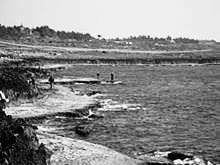
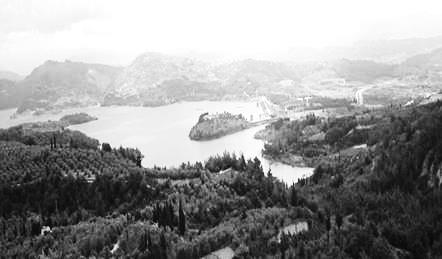
The Mediterranean Sea, as viewed from the coastal city of Latakia.
Syria consists mostly of arid plateau, although the northwest
part of the country bordering the Mediterranean is fairly green.
The climate in Syria is dry and hot, giving the persistent
greens absolute fits.
Leibowitz Concludes
Page 155
Ayn al-Bayda, Latakia, a village in Northern Syria.
Politics and government
Ineffective and/or non-existent. If there is any semblance of
centralization, it lies in a confluence of approximately 400
Ayatollahs. There is no agreement between them, and at any given
time there are 4,000 different fatwahs in effect. Based on their
learned interpretations of the Quran, and if necessary the Old
Testament each call for the extermination or banishment of
certain groups or people, often the other Ayatollahs.
Human rights
Someone must have a morbid sense of humor to even consider this
in regard to Syria.
Leibowitz Concludes
Page 156
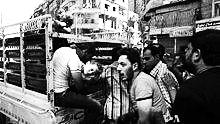
Wounded and dead citizens arrive at a care facility in Aleppo, after having called in sick to the
afternoon prayer vigil.
The authorities are accused of arresting democracy and human
rights activists, censoring websites, detaining bloggers, and
imposing travel bans. Arbitrary detention, torture, and
disappearances are widespread. The Sunni Muslims do their best
to compete.
Foreign relations
None which couldn’t be described as ballistic.
Economy
Rich Syrian’s vulgar display of wealth.
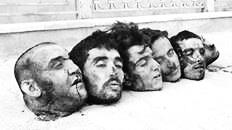
Severed infidel heads became the primary “coin of the realm” in
1991, the whiter the head the higher the value. After suffering
Page 157
relentlessly changing regimes and relentlessly worthless new
currencies, the people insisted upon something which was
relatively small and would keep its value; settling on heads.
Think of it like Bitcoin with a growing supply. Severed penises
are used to make change.
Abductees represent the entirety of human visitors from
elsewhere. Some camels and yaks have crossed the border.
Outlook
Routine mayhem and political instability pose a significant
threat to future economic development.
Syria's yak, camel, and related poo industries have been
devastated, as Syrians ate most of them with the advent of
autos, which the Syrians have become adept at using to whack
anyone who gets in their way. In May 2015, ISIS captured Syria's
bat guano mines, one of the Syrian government’s last sources of
food, and Ayatollah Ali al-Sistrabo, issued an immediate fatwah
on Ozzie Osborne.
Water supply and sanitation
Page 158
Syria is a semiarid country with scarce water resources. A big
challenge is its high public dead body cleanup requirements,
partially due to a hose and spigot shortage, caused by vandalism
and pilfering.
Demographics
In what the UN has described as "the biggest humanitarian
emergency of our era", about 4.9 million Syrians, half the
population, have been displaced since the outbreak of the Syrian
Civil War in March 2011. Two million are outside the country as killers for hire; cheap, and may be contacted through numerous
deep web sites. Syrians are supposedly an overall indigenous
Levantine people, closely related to their immediate neighbors, such as the Lebanese, Palestinians, Jordanians and Jews. Since they rarely behave like the others, existentialists and sundry
psychology students register disagreement. Syria was once home
to a substantial population of Jews, with large communities in
Damascus, Aleppo, and Qamishii. Due to opportunities elsewhere,
the Jews began to emigrate in the second half of the 19th
century to wherever they could get.
Culture
Syrians' taste for the traditional arts is expressed in dances
such as the al-Smash, the Bojovat in all its variations, and the
Page 159
sword dance. Writers, all of whom migrated to Egypt, played a
crucial role in the Arab literary and cultural revival of the
19th century. Renewed censorship, fatwahs, and kidnappings have
been a deterrent since. The music scene, in particular that of
Damascus, has long been among the Arab world's most important
sources of popular contemporary hatred. Television was first introduced to Syria in 2006 through theft. It broadcast in black
and white until 2011, when ISIS confiscated the TV’s during
their ritualized lootings, saying that the images were a sin
against Allah. It is suspected that most became inoperable
through stonings when the Sunday morning evangelicals were on.
Syria's would be artists, poets, writers and activists have
remained incarcerated. The most popular sports in Syria are head
rolling, yak and camel handicapped racing, and demolition derby;
the latter a world-class event due to a well-practiced Syrian
ability to drive backward.
Mating Rituals
Little boys grow to be little men.
Education
Leibowitz Concludes
Page 160
Education is compulsory from ages 6 to 12. Schools are run by
clerical gangsters who supply the books which teach that the
white man is the devil, under grants from the Saudi Royal
Family. This is followed by a three year training period in
which the child can major in a myriad of subjects chosen by his
Ayatollah, ranging from Export Jihadism, to Advanced Extortion,
to Explosives. The illiteracy rate of Syrians aged 15 and older is 90.7% for males and 82.2% for females; though in fairness it
is appropriate to point out that reading and writing has never
been a Syrian priority.
Health
In 2010, spending on healthcare accounted for .2% of the
country's GDP. In 2018, there were 14 physicians, 18 nurses, and
74 midwives in the country, all increases over the prior years.
Diseases epidemic and co-morbid with malnutrition include but
are not limited to trichomoniasis, malaria, intestinal
parasites, shistosomiasis, tuberculosis, AIDS, asthma,
Leibowitz Concludes
Page 161
cardiovascular disease, obstetrical fistula, leprosy, and facial
ringworm. The life expectancy at birth was 25.7 years in 2010,
or 24.2 years for males and 27.3 years for females, which is
attributed to continued discrimination against women in the
field of suicide bombing.
Syria today, and most any day; property of the author.
Dead End Street; property of the author.
Page 162
Abby did a copy-paste of the information, perhaps too
dismissively thinking it as accurate as any. Any revisions would
be tedious exercises which would take time away from her spell
getting high with gorgeous Crosstown Bobby Bolano. Besides, it
was out and out archaic in general and cruel in the Syrian
particular for Old Mr. Divak to have assigned this for extra
credit. Abby didn’t feel that she needed any such honor, and you
know that damn Crosstown has to be watched like a hawk, as “The
C Man” had a way of “changing” with every turn of the tongue-
and-grooved wooden wheel.
Flight of Fancy
Having made the expected, rookie-mid-season error of
picking up a Gaddis book, “J.R.” the case at the covered airport
literary establishment, which, the book that is, as opposed to
the garish kiosk which “housed” it, “artfully” establishes the
hellacious, mercenary faults, these in particular for those
still curious as to the J.R. emblematic of the “oh-so-sad,” as
currently interpreted in apparent disregard of the proven
economic failure of communism, the monopolistic capitalistic
effects upon an innocent whom the wicked and clandestine profit-
mongers have colluded, conspired, and were that not sufficiently
Page 163
evil, have also collectively, conspiratorially, counter-
intuitively, and mercilessly conjuctively, not to make less of
any substruct through an order dictated collectively,
conspiratorially, counter-intuitively, and mercilessly
conjuctively, not to make less of, yadda yadda of choice herein
inserted intending participation; and the implied supposition of
that designed-or-not-by those purposefully inclined, or in the
best dismissive avoidance of the sad diatribes of irrelevantly
time consuming “true believers,” too obviously naïve or clever
players of games in which one would like to believe; or those to
encourage an American vision, ultimately briefly extrapolated in
the bumper sticker handouts, in a little J.R. expansion, to
disastrously be, only and minimally twenty years after the US
was Levittowned; this particular purchase humongously more
likely indiscriminate of ideological issues or their more or
less, depending, time shiftless and thereby sneakily time
shiftful counterpart evaluations of a flaw, arguably primary, as
suggested through rudimentary 21st century net-enabability, as
rendered by skimmers, scammers, schemers, and scummers; though
despite the overwhelming considerations best not detailed in
fear of running out of space, can more or less be fairly
characterized as more or less compatible with what is ultimately
the result of a “special-two-day-discount,” capable of
attracting the attention of a goyish noodnik. Truly non-plussed,
Page 164
though plussed in the effects generated by burnt bulb,
electrical contractor malfeasance, this time displayed through
the flashing neon guilt “successfully” conveyed through an
invisible-at-daytime crackle and fade, that lazily and
personally taken in possibly admitted error as merely another
confirmation of the skimmed “banal” reasonably expected, the
result of which Mark, not really, but debatably out $7.99 plus
tax on his father’s plastic read some of the information that
his father had freely put on his computer during his one
stopover flight (Mark’s) back to Gig Harbor, primarily as a
subterfuge designed to discourage the rude advances of just
about commonly seated illiterates, inside, out, or middle; a
possible concern for those happily consigned to study. The
detail, symbolically taken, was far from a revelation, but at
least it didn’t seem totes stupid upon first viewing, and the
price was most attractively right, metaphorically mixed to wit
or not.
In the absence of this seeming dis-satisfaction, one is
relegated to the dreamy innacuracies, all too well and often, if
not well, provided by the skimming, “reviewing” practitioners,
condemned to ability-biased results, yet still in search of a
personally derivative market which minimally exists, has
possibly never existed, and likely will never exist.
Page 165
Irgun Terrorism
Some definitions; yes definitions. You’ll all say that you know
them already, while few discourses demonstrate that.
1) Jewish - Of or relating to the Jews or their culture or
religion.
2) Jew - a member of the people and cultural community whose
traditional religion is Judaism and who trace their origins
through the ancient Hebrew people of Israel to Abraham.
3) Judaism - the monotheistic religion of the Jews.
4) Zionism - a movement originally for the re-establishment and
now the development and protection of a Jewish nation in what is
now Israel.
5) Semite - a member of any of the peoples who speak or spoke a
Semitic language, including in particular the Jews and Arabs.
6) Anti-Zionism - is opposition to Zionism. The term is broadly
defined in the modern era as the opposition to the ethno-
nationalist and political movement of Jews and Jewish culture
that supports the establishment of a Jewish state as a Jewish
homeland in the territory defined as the historic Land of Israel
(also referred to as Palestine, Canaan, or the Holy Land). Anti-
Zionism is also defined as opposition to the State of Israel.
The term is used to describe various religious, moral and
political points of view, but their diversity of motivation and
Page 166
expression is sufficiently different that "anti-Zionism" cannot
be seen as having a single ideology or source.
7) Anti-Semitism - hostility toward or discrimination against
Jews as a religious, ethnic, or racial group.
Note - The above definitions were supplied by Merriam-Webster,
the standard source. However, the careful reader will surely
note the discrepancies, contradictions, and changes with time;
the latter regarding Zionism. This makes understanding of the
Khazar question unduly confounded. Jews are not an ethnic or
racial group, though legalities supposedly intended to be
helpful define them as such, no doubt contributing to the
unhelpful confusion. In addition a discrepancy exists in
defining Semite as basically a Jew or Arab, while the definition
of anti-Semitism is hostility or discrimination against Jews
only, that definition further characterizing Jews as a
religious, ethnic, or racial group.
Leibowitz Concludes
Page 167
**7**
The Khazars

Leibowitz Concludes
Page 168
Little is known of the Khazars, and the “knowledge” of that
which is supposed, commenced only fifty years ago, and is
refined with each new Khazarian excavation. It has been
estimated that anywhere from 18 to 28 distinct ethnically
diverse groups made up the population of the Khazar Qağanate,
aside from the ethnic elite. The ruling elite seem to have been
constituted out of nine tribes-clans, themselves ethnically
diverse, spread over perhaps nine provinces or principalities,
each of which would have been allocated to a clan. In terms of
caste or class, some evidence suggests that there was a
distinction, whether racial or social is unclear. It is
generally accepted that these nomadic bands were pagans until
the 8th century, when they adopted Judaism as the official
religion in the 11th century, at least at the elite level. The
precise centuries may be off by one in either direction,
depending on the “expert” currently being read. In the overall
scheme of things that matters little, but is stated here as an
Leibowitz Concludes
Page 169
indication of the “precision” with which Khazar information is
presented as fact. They “disappeared” in the 11th or 12th, again
dependent upon meagerly informed source speculation.
Your guess is as good as mine as to where the Khazars went and
what they did there, also recognizing that some did not leave.
Page 170
Given their tribal, semi-nomadic nature, it would seem likely
that more than one place was involved. Perhaps in unstated
agreement with this, “expert” opinion varies. It is my
speculation that given supposed Khazarian warlike nature, as
opposed to the peaceful nature of True Jews who likely emanated
from BC Judea, the Khazarian, perhaps appropriately considered
the false-Jew, as opposed to those who observe, believe in, and
practice the teachings of the Torah, next clear reappearance was
in the Palestine of 1929, under the mantels of Irgun or Lehi,
and they were generally Zionist, though as used here, the latter
term is more a condescension to current parlance than it is a
representation over time.
Leibowitz Concludes
Page 171
Leibowitz Concludes
Page 172
Irgun and Lehi
Jumping ahead or behind, the actions of those above mentioned
are consistent with the invention of terrorism and the desire to
make a land claim at the expense of the innocent and beleaguered
True Jews. It is documentable that those who participated in the
acts of terror evolved to become Israel’s highest officials,
Zohar Ben-Yahu the current manifestation. Further, the previous;
often all too “conveniently” bogged down in the flip-flop
between secular pragmatisms and religious principles is now
Page 173
extending itself into the Ukraine, at the risk of WWIII and
further sacrifice of True Jews.
The Israelites
The Israelites were a confederation of Iron Age Semitic-speaking
tribes of the ancient Near East, who inhabited a part of Canaan
during the tribal and monarchic periods. According to the
religious narrative of the Hebrew Bible, the Israelites' origin
is traced back to the Biblical patriarchs and matriarchs Abraham
and his wife Sarah, through their son Isaac and his wife
Rebecca, and their son Jacob who was later called Israel, from
whence they derive their name, with his wives Leah and Rachel.
The Israelites and their culture, according to the modern
archaeological account, did not overtake the region by force,
but instead branched out of the indigenous Canaanite peoples
that long inhabited the Southern Levant, Syria, ancient Israel,
and the Transjordan region through the development of a distinct
monotheistic religion centered on Yahweh, one of the Ancient
Canaanite deities. The outgrowth of Yahweh-centric belief, along

Leibowitz Concludes
Page 174
with a number of cultic practices, gradually gave rise to a
distinct Israelite ethnic group, setting them apart from other
Canaanites. In the Hebrew Bible the term Israelites is used interchangeably with the term “Twelve Tribes of Israel. ”
Although related, the terms Hebrews, Israelites, and Jews are not interchangeable in all instances. "Israelites" (Yisraelim)
refers specifically to the direct descendants of any of the sons
of the patriarch Jacob (later called Israel), and his descendants as a people are also collectively called "Israel",
including converts to their faith in worship of the god of
Page 175
Israel, Yahweh. "Hebrews" (Ivrim), on the contrary, is used to
denote the Israelites' immediate forebears who dwelt in the land
of Canaan, the Israelites themselves, and the Israelites'
ancient and modern descendants (including Jews and Samaritans).
"Jews" (Yehudim) is used to denote the descendants of the
Israelites who coalesced when the Tribe of Judah absorbed the remnants of various other Israelite tribes. Thus, for instance,
Abraham was a Hebrew but he was not technically an Israelite nor
a Jew, Jacob was both a Hebrew and the first Israelite but not a
Jew, while David (as a member of the Tribe of Judah) was all
three, a Hebrew, an Israelite, and a Judahite (Yehudi, Jew). A
Samaritan, on the contrary, while being both a Hebrew and an
Israelite, is not a Jew.
Leibowitz Concludes
Page 176
Less Fantastical Flights
Irgun Terrorism (eventually continued and arguably on-topic)
Irgun symbol; property of the author
Leibowitz Concludes
Page 177
Slow; the kind courtesy of Pexels.com under their CC0 license; modified.
Irgun (Irgun Tsvai Leumi – "National Military Organization")
Notable commanders;
1) Menachem Begin
2) Avraham Jabotinsky (Ze’ev)
The Irgun; full title - Hā-ʾIrgun Ha-Tzvaʾī Ha-Leūmī b-Ērētz
Yiśrāʾel; "The National Military Organization in the Land of
Israel" was a Zionist paramilitary organization that operated in
Mandate Palestine between 1931 and 1948. It was an offshoot of
the older and larger Jewish paramilitary organization Haganah
(Defense). When the group broke from the Haganah it became known
as the Haganah Bet, "Defense 'B' " or "Second Defense", or
alternatively as haHaganah haLeumit or Hama'amad. Irgun members
were absorbed into the Israel Defense Forces at the start of the
Page 178
1948 Arab–Israeli war. The Irgun is also referred to as Etzel, an acronym of the Hebrew initials, or by the abbreviation IZL.
The Irgun policy was based on what was then called Revisionist
Zionism, a faction within the Zionist movement. It is the founding ideology of the non-religious political right wing in
Israel, and was the chief ideological competitor to the dominant
socialist Labor Zionism. Revisionism led to the development of
the Likud Party. It originated the notion that the purpose of
Zionism was the establishment of an expanded Jewish state on
both sides of the Jordan River in 1935. The region covered by
the British Mandate for Palestine included the modern day
territories of Israel, the West Bank, Gaza and Jordan. The
Mandate allowed the mandatory authority, Britain, to restrict
Jewish settlement in parts of the territory. This was applied to
Transjordan, to the east of the River Jordan. Revisionist
Zionists believed this was illegitimate and demanded that the
whole mandate territory, not just its western portion, should be
part of a future Jewish state. After the establishment of
Israel, they did not recognize the existence of Jordan, and as
late as 1956, they rejected the possibility of peace.
Leibowitz Concludes
Page 179
Leibowitz Concludes
Page 180
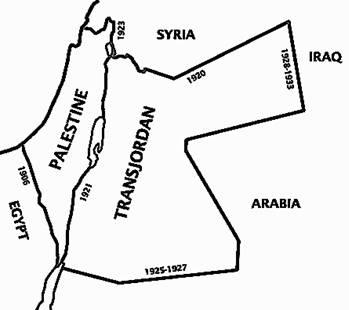
Area map; property of the author.
Founded by Ze'ev Jabotinsky, the policy of the new organization was based squarely on Jabotinsky's teachings; that every Jew had
the right to enter Palestine; that only active retaliation would
deter the Arabs; and that only Jewish armed force would ensure
the Jewish state.

Leibowitz Concludes
Page 181
Leibowitz Concludes
Page 182
Proceed With Caution; property of the author.
Two of the operations for which the Irgun is best known are the
bombing of the King David Hotel in Jerusalem on July 22, 1946
and the Deir Yassin massacre, carried out together with the Lehi
Group on April 9, 1948.
As a result of the discovery of documents tying the Jewish
Agency to the Jewish Resistance Movement, the Irgun was asked by
the Haganah, (The Defense) which was another Jewish paramilitary
organization in the British Mandate of Palestine (1921–48), which later became the core of the Israel Defense Forces (IDF),
to speed up the plans for the King David Hotel bombing of July 22. The hotel was where the documents were located, the base for
the British Secretariat, the military command and a branch of
the Criminal Investigation Division of the police. The Irgun later claimed to have sent a warning that was ignored. 91 people
Leibowitz Concludes
Page 183
were killed in the attack where a 350 kg bomb was placed in the
basement of the hotel and caused a large section of it to
collapse. 13 were British soldiers.
The Deir Yassin Massacre
The Deir Yassin massacre took place when approximately 120
fighters from the Zionist paramilitary groups Irgun and Lehi
attacked it, a Palestinian Arab village of roughly 600 people near Jerusalem. The assault occurred as Jewish militia sought to
relieve the blockade of Jerusalem during the civil war that
Page 184
preceded the end of British rule in Palestine, in which the Deir
Yassin people played no part, openly declaring their peaceful
stance.
According to un-named and biased Irgun sources, the village
guards felt surprised by "the Jews" entering their village at
night and opened fire on the Irgun force. It is customary to be
gracious to nocturnal, un-announced, enemies carrying weapons
and grenades. The village fell after fierce house-to-house
fighting. During and after the battle for the village, at least
107 Palestinians were killed, including women and children. Some
were shot, while others died when hand grenades were thrown into
their homes. Despite an original boast by the victors that 254
had been killed, Aref al-Aref, a Palestinian journalist,
historian and politician, counted 117 victims, 7 in combat and
the rest in their homes. According to a count conducted by
International Red Cross representative Jacques de Reynier, apart from bodies left lying in the streets, 150 corpses were found in
one cistern alone, among them people who had been either
decapitated or disemboweled. Israeli historian Benny Morris
wrote that there were also cases of mutilation and rape. Several
villagers were taken prisoner and may have been killed after
being paraded through the streets of West Jerusalem. Four of the
attackers were killed, with around 35 injured.
Leibowitz Concludes
Page 185
The killings were condemned by the leadership of the Haganah;
the Jewish community's main paramilitary force, and by the
area's two chief rabbis. The Jewish Agency for Israel sent
Jordan's King Abdullah a letter of apology, which he rebuffed.
Abdullah held the Jewish Agency responsible for the massacre
because they were the head of Jewish affairs in Palestine, and
warned about "terrible consequences" if more incidents like that
occurred.

Leibowitz Concludes
Page 186
Page 187
The deaths became a pivotal event in the Arab–Israeli conflict
for their demographic and military consequences. The narrative
was embellished and used by various parties to attack each
other; by the Palestinians against Israel; by the Haganah to
play down their own role in the affair; and by the Israeli left
to accuse the Irgun and Lehi of blackening Israel's name by
violating the Jewish principle of purity of arms. News of the
killings sparked terror among Palestinians, encouraging them to
flee from their towns and villages in the face of Jewish troop advances, and it strengthened the resolve of Arab governments to
intervene, which they did five weeks later.
The Irgun has been viewed as a terrorist organization, or an
organization which carried out terrorist acts. It was violently
anti-Arab. That characterization was shared by the United
Nations, British, and United States governments; in media such
as The New York Times newspaper; as well as by the Anglo-
American Committee of Inquiry, the 1946 Zionist Congress, and
the Jewish Agency. Irgun's tactics appealed to many Jews who
believed that any action taken in the cause of the creation of a
Jewish state was justified, including terrorism.

Leibowitz Concludes
Page 188
The Irgun was a political predecessor to Israel's right-wing
Herut (or "Freedom") party, which led to today's Likud party.
Likud has led or been a significant part of all Israeli
governments since 1977.
Nature of the movement
Leibowitz Concludes
Page 189
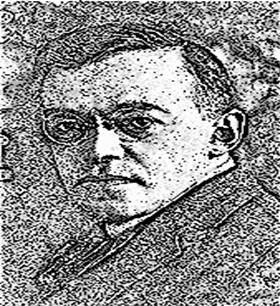
Ze’ev Jabotinsky; modified public domain.
Ze’ev Jabotinsky formulated the movement's ideology and was
Supreme Commander of the Etzel (substantially Irgun.) Members of
the Irgun came mostly from Betar and from the Revisionist Party
both in Palestine and abroad. The Revisionist Movement made up a
popular backing for the underground organization. Jabotinsky,
also the founder of Revisionist Zionism, commanded the
organization. He formulated the general realm of operation,
regarding restraint and the end thereof, and was the inspiration for the organization overall. An additional major source of
ideological inspiration was the poetry of Uri Zvi Greenberg.
The number of members of the Irgun varied from a few hundred to
a few thousand. Most of them were "ordinary" people, who held
Page 190
regular jobs, and only a few dozen worked full-time in the
Irgun.
The Irgun disagreed with the policy of the Yishuv (the Jewish
community or settlement in Palestine during the 19th century and
until the formation of the state of Israel in 1948) and with the
World Zionist Organization, with regard to strategy, basic
ideology, public relations, and military tactics; such as the
use of armed force to accomplish the Zionist ends, operations
against the Arabs, and relations with the British mandatory
government. Therefore, the Irgun tended to ignore the decisions
made by the Zionist leadership and the Yishuv's institutions.
This fact caused the elected bodies not to recognize the
independent organization, and during most of the time of its
existence the organization was seen as irresponsible, and its
actions thus worthy of thwarting, though no documented thwarting
attempts have ever been noted.
Irgun Supreme Commanders:
1) Avraham Tehoni (1931-37)
2) Ze’ev Jabotinsky (1937-40)
3) Robert Bitker (1937)
4) Moshe Rosenberg (1937-38)
5) David Raziel (1938-39), (1939-41)
Leibowitz Concludes
Page 191
6) Hanoch Kalai (1939)
7) Benyamin Zeroni (1939)
8) Yaakov Meridor (1941-43)
9) Menachem Begin (1943-48)
As members of an underground armed organization, Irgun personnel
did not normally call Irgun by its name, but rather used other
names. In the first years of its existence it was known
primarily as Ha-Haganah Leumit' (The National Defense), and also
by names such as Haganah Bet ("Second Defense"), Irgun Bet
Page 192
("Second Irgun"), the Parallel Organization, and the Rightwing
Organization. Later on it became most widely known as The Stand.
The Irgun gradually evolved from its humble origins into a
serious and well-organized paramilitary organization. The
movement developed a hierarchy of ranks and a sophisticated
command structure, and came to demand serious military training
and strict discipline from its members. It developed clandestine
networks of hidden arms caches and weapons production workshops,
safe houses, and training camps. The British authorities
believed that some Irgun members enlisted in the Jewish section
of the Palestine Police Force for a year as part of their training, during which they also passed intelligence.
In addition to the Irgun's members in Palestine, underground
Irgun cells composed of local Jews were established in Europe
following World War II. An Irgun cell was also established in
Shanghai, home to many European-Jewish refugees. In 1947, the
Jewish insurgency came to an end as the UN approved of the partition of Palestine, after the British had announced their
intention to withdraw the previous month. As the British left
and the 1947-48 Civil War in Mandatory Palestine got underway, the Irgun came out of the underground and began to function more
as a standing army rather an underground organization. It began
Page 193
openly recruiting, training, and raising funds, and established
bases, including training facilities. It also introduced field
communications and created a medical unit and supply service.
Until World War II the group armed itself with weapons purchased
in Europe, primarily Italy and Poland. The Irgun also established workshops that manufactured spare parts and
attachments for the weapons. Also manufactured were land mines
and simple hand grenades.
Prior to World War II - Founding
The Irgun's first known steps were in the aftermath of the Riots
of 1929. In the Jerusalem branch of the Haganah there were feelings of disappointment and internal unrest towards the
leadership of the movements and the Histadrut, at that time the organization running the Haganah. These feelings were a result
of the view that the Haganah was not adequately defending Jewish
interests in the region. Likewise, critics of the leadership
spoke out against alleged failures in the number of weapons,
readiness of the movement and its policy of restraint and not
fighting back.
The Betar Movement is a Revisionist Zionist youth movement also
founded in 1923 in Riga, Latvia, by Vladimir (Ze'ev) Jabotinsky.

Leibowitz Concludes
Page 194
Chapters sprang up across Europe. After the war and during the
settlement of what became Israel, Betar was traditionally linked
to the original Herut and then Likud political parties of Jewish pioneers. It was closely affiliated with pre-Israel Irgun. It
was one of many right-wing movements and youth groups arising at
that time that adopted special salutes and uniforms. Some of the
most prominent politicians of Israel were Betarim in their
youth, most notably future Israeli Prime Ministers Yitzhak
During the riots of 1929 Betar youth participated in the defense
of Tel Aviv neighborhoods at the behest of the Tel Aviv city
hall. After the riots the Tel Avivian group expanded, and was
known as "The Right Wing Organization." In August 1933 a
"Supervisory Committee" for the Irgun was established, which
included representatives from most of the Zionist political
parties.
Page 195
In protest against, and with the aim of ending Jewish
immigration to Palestine, the Great Arab Revolt of 1936–1939
broke out on April 19, 1936. The riots took the form of attacks
by Arab rioters ambushing main roads, bombing of roads and
settlements as well as property and agricultural vandalism,
claiming no human victims. In the beginning, the Irgun and the
Haganah generally maintained a policy of restraint, apart from a
few instances. Some expressed resentment at this policy, leading
up to internal unrest in the two organizations. The Irgun tended
to retaliate more often, and sometimes Irgun members patrolled
areas beyond their positions in order to encounter attackers
ahead of time; a pre-emptive ploy. However, there were
differences of opinion regarding what to do in the Haganah, as
well. Due to the joining of many Betar Youth members, Jabotinsky (founder of Betar) had a great deal of influence over Irgun
policy. Nevertheless, Jabotinsky was officially of the opinion
that for moral reasons violent retaliation was not to be
undertaken, though much had already been done.
In November 1936 the Peel Commission was sent to inquire regarding the breakout of the riots and propose a solution to
end the revolt. In early 1937 there were still some in the
Yishuv who felt the commission would recommend a partition of
Mandatory Palestine, the land west of the Jordan River, thus
Page 196
creating a Jewish state on part of the land. The Irgun
leadership, as well as the "Supervisory Committee" held similar
beliefs, as did some members of the Haganah and the Jewish
Agency. This belief strengthened the policy of restraint and led to the position that there was no room for defense institutions
in the future Jewish state. Tehomi, Irgun’s first Supreme
Commander, was quoted as saying; "We stand before great events:
a Jewish state and a Jewish army. There is a need for a single
military force." This position intensified the differences of
opinion regarding the policy of restraint, both within the Irgun
and within the political camp aligned with the organization. The
leadership committee of the Irgun supported a merger with the
Haganah. On April 24, 1937 a referendum was held among Irgun
members regarding its continued independent existence. David
Raziel and Avraham (Yair) Stern came out publicly in support for
the continued existence of the Irgun; “The Irgun has been placed
before a decision to make, whether to submit to the authority of
the government and the Jewish Agency or to prepare for a double sacrifice and endangerment. Some of our friends do not have
appropriate willingness for this difficult position, and have
submitted to the Jewish Agency and has left the battle ... all
of the attempts ... to unite with the leftist organization have
failed, because the Left entered into negotiations not on the

Leibowitz Concludes
Page 197
basis of unification of forces, but the submission of one such
force to the other....”
Leibowitz Concludes
Page 198
The first split
In April 1937 the Irgun split after the referendum.
Approximately 1,500–2,000 people, about half of the Irgun's
membership returned to the Haganah, which at that time was under
the Jewish Agency's leadership. The Supervisory Committee's
control over the Irgun ended, and Jabotinsky assumed command.
Ze'ev Jabotinsky placed Col. Robert Bitker at the head of the Irgun. Bitker had previously served as Betar commissioner in
China and had military experience. A few months later Jabotinsky
replaced Bitker with Moshe Rosenberg. When the Peel Commission
report was published a few months later, the Revisionist camp
decided not to accept the commission's recommendations.
Moreover, the organizations of Betar, Hatzohar and the Irgun
began to increase their efforts to bring Jews to the land of
Israel, illegally.
Illegal immigration
Leibowitz Concludes
Page 199
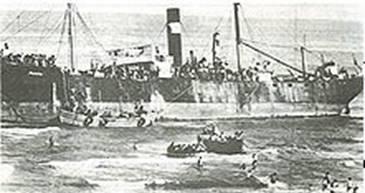
The ship Parita unloading immigrants in Tel Aviv; public domain.
According to Jabotinsky's "Evacuation Plan", which called for
millions of European Jews to be brought to Palestine at once,
the Irgun helped the illegal immigration of European Jews to the land of Israel. The difficult conditions on the ships demanded a
high level of discipline, as there was little food and water.
Their total haul has been estimated at 18,000.

Leibowitz Concludes
Page 200
Page 201
End of restraint
Irgun members continued to defend settlements, but at the same
time began attacks on Arab villages, thus ending the policy of
restraint. These attacks were intended to instill fear in the
Arab side, in order to cause the Arabs to wish for peace and
quiet. The first attacks began around April 1936. A list may be
found on Wikipedia. In November, 1937 operations increased.
Despite British arrests, Irgun members continued fighting.
Jabotinsky lent his moral support to these activities. In a
letter to Moshe Rosenberg on March 18, 1938 he wrote;
“Tell them from afar I collect and save, as precious treasures,
news items about your lives. I know of the obstacles that have
not impeded your spirit; and I know of your actions as well. I
am overjoyed that I have been blessed with such students.”
In 1937 the Polish authorities began to deliver large amounts of
weapons to the now “underground” Irgun. The transfer of
handguns, rifles, explosives and ammunition curiously stopped
with the outbreak of World War II on September 1, 1939.
Immigration significantly decreased, and the Haganah began to
bring Jews to Palestine using rented ships, as the Irgun had in
the past.
Page 202
Irgun ceased anti-British operations said to be so as not to
hinder Britain's effort to fight "the Hebrew's greatest enemy in
the world – German Nazism.” During the Holocaust, Betar members
revolted numerous times against the Nazis in occupied Europe.
The largest of these revolts was the Warsaw Ghetto Uprising.
From 1939 onwards, an Irgun delegation in the United States
advocated for the creation of a Jewish army and state made up of
Jewish refugees and Jews from Palestine, to fight alongside the
Allied Forces. In July 1943 the "Emergency Committee to Save the
Jewish People in Europe," which included Irgun representation
was formed, and worked until the end of the war to rescue the
Jews of Europe from the Nazis and to garner public support for a
Jewish state. However, it was not until January 1944 that US
President Franklin Roosevelt established the War Refugee Board,
and achieved some success in saving European Jews.
Second split
On June 18, 1939, Avraham (Yair) Stern and others of the
leadership were released from British imprisonment and a rift
opened between them, Irgun, and Hatzohar, a Revisionist Zionist
organization, leadership. The controversy centered on the issue
Page 203
of the underground movement submitting to public political
leadership. Stern was elected to the leadership, in open
defiance of Jabotinsky’s plea to follow Raziel. Distrust was
rampant among the members. Out of the Irgun a new organization
was created on July 17, 1940, which was first named "The
National Military Organization in Israel" and later on changed
its name to Lehi, an acronym for Lohamei Herut Israel, "Fighters for the Freedom of Israel. The primary difference between the
Irgun and the newly formed organization was the latter’s
intention to fight the British in Palestine, regardless of their
war against Germany. Later, additional operational and
ideological differences developed which contradicted some of the
Irgun's guiding principles. The split damaged the Irgun both
organizationally and from a morale point of view.
This contributed to a mass abandonment by members. The British
took advantage of this weakness to gather intelligence and
arrest Irgun activists. The new Irgun leadership opted for more
cooperation between the Irgun and the Jewish Agency. However
David Ben-Gurion's uncompromising demand that Irgun accept the
Agency's command foiled any further co-operation. In both the
Irgun and the Haganah more voices were being heard opposing any
co-operation with the British.
Page 204
In late 1943 a joint Haganah – Irgun initiative was developed,
to form a single fighting body, unaligned with any political
party, by the name of “Fighting Nation.” The new body's first
plan was foiled and attributed to a Haganah information leak.
Immediately following the failure of Fighting Nation practical
discussions began in the Irgun Headquarters regarding a
declaration of war.
The Revolt
In 1943 the Polish II Corps arrived in Palestine from Iraq. The
British insisted that no Jewish units of the army be created.
Eventually, many of the soldiers of Jewish origin that arrived
with the army were released and allowed to stay in Palestine.
One of them was Menachem Begin, whose arrival in Palestine created newfound expectations within the Irgun and Betar. Begin
had served as head of the Betar movement in Poland, and was a
respected leader. Now he accepted the offer of Irgun leadership.
As if there hadn’t been one previously, a revolt against the
British mandatory government was publicized. Begin-led Irgun
said; “The facts are simple and horrible as one. Over the last
four years of the war we have lost millions of the best of our people and millions more are in danger of eradication. And the
land of Israel is closed off and quarantined because the British

Leibowitz Concludes
Page 205
rule it, and strives for the destruction of our people's last
hope.” The Irgun then declared that, for its part, the ceasefire
was over and they were now at war with the British. Irgun
demanded the transfer of rule to a Jewish government, to
implement ten policies; among them were the mass evacuation of
Jews from Europe. One statement contained this rather telling
phrase; “The fighting youth will not recoil in the face of
sacrifices and suffering, blood and torment. They will not
surrender, so long as our days of old are not renewed, so long
as our nation is not ensured a homeland.”
Struggle against the British
Bombings of British government buildings commenced. These
actions were initially condemned by the organized leadership of
the Yishuv and the Jewish Agency, who saw them as dangerous
provocations. At the same time the Irgun and Lehi also renewed its attacks against the British.
Page 206
It is reasonable to say that Irgun and Lehi were the first to
use modern terrorist practices, and that they did no good for
Jews in doing so. Indeed, many of their actions seemed
antithetical to Jewish interests.
Mark lost interest, at least for the moment, and sought the
entertainment provided by “Humps&Grumps.com.”

Leibowitz Concludes
Page 207
Page 208
**8**
Un-Professional Allegedly Entertaining Site (UPAES)
Dream #1
The house was one of those rambling old country houses which
popped up here and there back east during the nineteenth
century. Though modernizations were typical and expected with
structures of this advanced age, none were evident on this one.
There had to have been some, but they also had to have been done
“in keeping” with the original style’s integrity. The clapboard
exterior siding was painted a cloudy yellow, suggesting that the
painter had finished his work a while back. Despite the age
there was no peeling. In fact one might say that the color had
acquired a charming patina, the yellow gently blending with a
creamy white undercoating, which could not be mimicked out of a
can.
He fleetingly wondered how he had come to see the outside. As
far as he knew he had never previously been there and he was on
the inside; on the second floor. It was only his logically
refined instincts which told him that this was his house as he
was trailed by two home improvement contractors, who
continuously spoke to him, themselves, or no one in particular;
Page 209
of how easily and cheaply they could make repairs. He thought
that he heard Beth rattling around downstairs, sometimes
speaking to someone or also talking to herself.
The contracting team consisted of a five foot two inch man who
exchanged the stub of an unlit cigar between his mouth and his
left hand; apparently the hand most useful when he felt the need
to blurt out some commentary in a rapidity which seemed to be
nervously induced. His partner; a woman with blonde hair below
her blue jeans; was almost a foot taller, and seemed more
matter-of-fact about whatever was going on or not going on. “Big
Blonde” periodically and sparsely interjected her deadpanned
observations whenever “Little Cigar” seemed to run out of steam
or looked to her for agreement, approval or assistance. It may
go without saying, but she gave the appearance and sound of
being entirely on his side and well accustomed to making an open
display of that when obliged. At times this activity seemed to
bely the upward drift of her blue pupils; a look which she
seemed to maintain a sufficient time to be “inadvertently”
noticed, instantaneously followed by a quick “correction” to
center eye. A cynical person might have construed this
ophthalmic gyration as some sort of insinuation.
Page 210
Notwithstanding the marginally, cranium compelling work, with
which he had just been almost entertained, the bulk of his
concentration was on the floor. And rightly so, as this floor
seemed odd and dangerous to him. It consisted of traditionally
planked wood, but almost all the planks were turned up at their
edges, perhaps an indication of prior water damage. One could
easily trip. To make matters a bit more difficult the entire
floor seemed to slope toward the wall and glass windows to the
outside. To make matters Triple A level difficult, the floor’s
width approximated all of two feet.
That was because of an oddity he had never seen in any other
house. The vast majority of the second floor consisted of a
gigantic central tunnel to which he had no access unless he
smashed a hole in the black colored wallboard to his left. That
seemed to be rash and a last resort. He knew that the house was
built before the days of coal, oil, gas, or electrically
generated heat. It once depended upon wood burning fireplaces in
every room; most of which were walled in when they became un-
fashionable and “inefficient.” Still, he thought that the
exhaust generated by a newer, more powerful heating system
should not take up 80% of the entire house. To do that would
have to have been a multi-faceted illogical expression of a
dada-redundant, absurdist “answer” to the most practical of
Page 211
situations; or a pseudo-intellectually compelling, reductionist
representation of proportions and parts; or another
impressionistically inspired imperfection with a compelling
argument for justification, imperfection the key word; or the
silent sharpness of a stark, sophisticated, falsely egalitarian
minimalism; or a surrealistic rendering of Pollack
simultaneously puking and pissing into the host’s fireplace. The
thought then crossed his mind that more likely than any sort of
temporal movement, that this monstrous hindrance was likely the
work done as a modern adaptation of a third eye deficient and
un-noticed desire for Masonic symbolized greenbacks by an inept,
charlatan of an un-licensed, fly-by-night contractor, who
lucratively found a sucker.
He wondered if the first floor was so configured. He hoped not,
but suspected as such, as that possibility would seem to leave
the most minimal of efficient, crooked living area.
He stopped himself, perhaps un-necessarily. However, in the
moment, it seemed prudent to first determine what was behind the
black wall before speculating on the reasons for its existence.
But first he would have to get rid of the contractors. If they
saw him punch a hole in it, it would not only be another source
of “needed repair,” but it would also be another story which the
Page 212
peddlers could spread all over the area, embellished to convey
“interesting” sociopathic innuendo to the small town locals,
dying for something to say over their back yard fences.
He walked near a five foot wide and two foot deep, curved
indentation in the outside wall with a shut window in the
center. More loudly expressed than his numerous previous
suggestions of “repair,” Little Cigar said; “Oh,” in an
attempted, contractor indication of ruinous, unfortunate
astonishment; prior to his overly eager, “surprising” follow-up;
“We can hep ya out with that.”
He was indeed surprised. He stared at the hollow groove, saw no
imperfections, and supposed that the original builder intended
it to appear as it did. He said; “What’s wrong with it?” amused
and in full anticipation of the reply which he thought would
follow.
Little Cigar approached the recessed window. His hands
gesticulated in an initially haphazard and animated manner. His
eyes periodically peered at him as if to say; “You’re either
blind or kidding me.” This bold activity culminated in a rather
subdued and restrained set of hands with palms to their
respective sides and, while unlike the olfactory proclivities
Page 213
demonstrated by his partner; he witnessed the most bulging of
facially intrusive eyeballs. Their sheer size and red, veiny
appearance was something he had never previously encountered
more close up than in Stanley Kubrick’s “A Clockwork Orange,”
and that required artificially induced openings and a lot of
makeup.
Though the thoughts of a thousand childish horror movies flashed
through his mind, he successfully hid the trepidation which
seemed to well up throughout his entire existence. He recalled
the long ago warning given by Sid; “Don’t play with little
minds.” His intended little joke had seemed to have un-nerved a
serious person; perhaps a dangerously serious person. He looked
to Big Blonde and found some degree of comforting adjournment in
her shrug, grimace, and back turn.
Little Cigar ended his consternation when he said; “We can get
this flush with the other walls.”
Feeling relieved and a bit more plucky, he responded; “It
doesn’t seem to be a problem right now. Besides, if you move the
wall inward, the window will become useless. Unless, of course,
you make a window of the entire area. Ah, even then it will be
cut off at every edge. The only way I can conceive of getting
Page 214
around all these considerations is to move out all the other
walls; and that’s just too expensive.”
Little Cigar calmly agreed, his furrowed brow indicative of a
confusion he could not articulate or confound in the moment.
He was sure that he didn’t invite them and therefore felt that
he owed them nothing more than minimal courtesy and an ushering
to the front door. But, he thought that for a number of reasons
it was pragmatically best to let the contractors do at least one
job. He pointed through the window and said; “Look. The yard is
full of last year’s dead growth. It’ll likely take a few days to
get rid of it.” As the now distracted contractors gazed, he
yelled out; “Come on up here, Beth; I can use some help;” and
heard a silent response which surrounded an Antonioni murmur.
Little Cigar broke the silence when he urgently said; “There’s a
trespasser on the property!”
He looked out and saw a powder blue, mid 1960’s Ford Fairlane
idling just ten feet east of the window, destined to either go
straight ahead or straight back, a prisoner of the stockade
fence immediately to its left. He wondered why he had not
noticed it last look.
Page 215
Suddenly, Little Cigar, Big Blonde and he were outside. Someone
called out; “Hey, what are you doin’ here?”
The car started to move slowly, and as it passed the trio, they
saw the lone driver. It was a smiling grayish-blonde woman of
about fifty years of age. Her countenance was disarming and she
said; “I used to live here and I just wanted to see it one last
time.” The car kept moving and went out to the road, where it
disappeared from sight.
He didn’t remember climbing any stairs, but he was back inside
the house on the second floor. He peered through the same window
and saw Big Blonde take off her clothes and get under the water
flow coming from a tall standpipe. He thought it was still a bit
too chilly for that as it seemed like a typical, mid-spring, New
Jersey morning. Little Cigar was nowhere in sight and he felt
that it was wrong for him to be watching Big Blonde. Besides, he
wanted to explore the huge, black sideways tunnel in the center
of the house and he saw an entry which had previously escaped
him.
He went in. It was dark. He fumbled for a light switch and found
none. He kept moving slowly. He thought he was heading for the
Page 216
center, but knew that he couldn’t be certain of that. He
detected some movement and then saw the dimly lit interior.
There were stores. The shopkeepers paid him no notice and seemed
to going through their daily routine of setting up.
He was not the least bit happy that others were making use of
his property. Since he was on solid ground on the second level
he wondered if this sideways tunnel extended throughout the
house or if was only of that elevated place. He had now taken so
many steps that if there was any opening to the first floor it
would have to be a small one, just like a funnel rather than a
sideways tunnel. A woman of about thirty, who was olive skinned,
and draped in multi-colored robes like a gypsy sat behind glass,
the size of a typical window. As he got near, she smiled and
said; “Fortunes told.” He kept moving as for some reason this
woman seemed ominous to him and he also wanted to see the extent
to which the stores had invaded his property. The woman’s smile
grew and turned into a cackle; her eyes seeming to become
glowing pieces of coal set aflame. She now appeared to be
maniacal.
The absurdity of the entire situation was no longer a curiosity
or fear. It made him realize that he was in a dream. So, he
decided to have some fun. He approached one of the shop keepers
Page 217
who was setting up a window display, with his back to him. He
wanted to see Beth and he wanted to know the extent of the
tunnel-funnel in that order. He asked the man; “Where is the
stairway down?”
He realized that he had met another comedian when the man,
turned, started laughing, and said; “The only stairway goes up.”
He woke up to see the pine beams on his tongue and grooved
ceiling. He sighed and again closed his eyes, but he was now
wide awake. He wished he could drift back off to sleep again, as
the entertainment was better there than on the internet; more of
the non-entertainment on the ignored laptop screen below.
Dream #2
“I trust you. Let’s not split yet. I know a movie theatre five
miles away that plays old films. Let’s go sit in the dark for a
while.”
“Anywhere with you is great with me. I like old movies anyway. I
might fall asleep, though.”
They took her Mercedes and she drove silently to the appointed
spot. They parked in the small dirt lot, which looked as if it
Page 218
had not been maintained or repaired for some time. It contained
no other cars. They saw the plastic lettered marquee indicating
that “All That Heaven and Earth Allow ” was playing. Neither of
them knew the film. As they walked to the ticket booth they
noticed that the stills were in black and white.
He said; “The title suggests that this is going to be a long
one.”
Kelly looked at him, with a bit of an incredulous posture and
deadpanned; “Not if it had a good editor.”
The ticket booth was empty when they got there, so they walked
right inside. They shuffled around the lobby looking at the
stills on the wall, keeping an eye out for help. When none came
in a few minutes, they decided to walk right in. As he was
opening the door a woman of about sixty entered the lobby from
another door, trailed by a man of similar age. She had long gray
hair and dressed younger than her years. His countenance was
more of a disheveled acquiescence to his time, wearing proper
attire that was maintained as well as the parking lot. He also
had long gray hair, though much of the middle was now missing.
He seemed somber. The old woman smiled at the venturesome couple
and said; “It’s already started, so go right in and enjoy it.”
Page 219
Kelly said; “We really should pay you something, shouldn’t we?”
The older woman replied; “No. It’s already playing and it’s too
much trouble for me to start handling money right now. We’ve got
other things to do.” She looked at her companion and smiled. He
silently followed her out through the same door previously used
as the entry.
He and Kelly simultaneously said “Thanks” and continued through
the door which led to the screening room. No one else seemed to
be there, though they couldn’t be sure in the dark. He followed
her down the center aisle to furry seats about 10 rows from the
screen, right in the middle of it.
The movie was at a point where the actions and dialogue made no
sense to them. If there were any way to succinctly describe what
they saw and heard, it would probably be worry, combat and
randomness, with no obvious logic. They leaned heads and
shoulders against each other and quickly fell asleep.
They woke up to a crescendo of classical music, apparently the
end. Still half asleep they watched the two lovers on the screen
hold each other. As it was early in their awakening, they could
Page 220
have been wrong, but visually, it seemed that the two screen
characters merged. He became her and she him. Kelly and he both
had the same thought. The merger could be an illusion caused by
their dreary state, but they would have bet their lives, that at
the very least, her eyes became his and vice-versa.
The movie did end right there and the two stood up to leave.
Each knew the thoughts of the other, so they exchanged
questioning and knowing looks as they walked. Neither knew the
right thing to say and didn’t want to ruin the mood. They slowly
walked back to her car, the bright sun shocking them back to the
reality of the moment.
The Princess and the Prince Discuss What’s Real
A Brief Obligatory Intense Aside, Chosen for the Restrained
Devotees of What’s Not There Complimenting What Is;and What is
There Paying Lip Service to What is Not; Routine Unfeasibility,
Adorned and Exposed; Also Known As Magical Realism; an Untitled
Measured Response to the Dearth Bound Plethora of Abundantly
Absent and Silent Interrogations; Suitable for the Rejection of
Literary Murakami, Illustrated Gaiman, and Overly Overt Rushdie;
Comedic and Hateful in their Seriousness and Love
Page 221
The cool sun was aghast in its un-robotically, requisite, blasé,
progressive retreat as it spread its ardent wings over the
peripatetic Crimean Sea above it. The socially maladroit
maritime fixture deafeningly fired weakly from its rippling
interior, the non-resultant smoke incandescence, previously
known only in the Arctic, producing no effect on the planet
which did not exist below, as it evinced the faintest of
flagrant falsetto flags, strongly indicative of the bounty of
nothing. “All too obviously fake. It’s all wrong in its
correctness,” screamed Orpheus Mictlantecuhtli, as he played a
lullaby yet another morning with his melodious lack of song. His
entreaty of; “Wake up; it has ended,” was not answered with a
thunderously diminished reply of; “Go to sleep, dummy. It has
started.” Sixteen libidinous vestal virgin sisters who were
biologically un-related, were introduced to eight disassociated
brothers, and in unison echoed that they knew them very well.
The brothers nodded affirmatively to the lie. The twenty four
loners remained together, joined hands and danced off
separately.