

I Woke Next to the Corpse by Edward Drobinski - HTML preview
Download the book in PDF, ePub, Kindle for a complete version.
Page 102
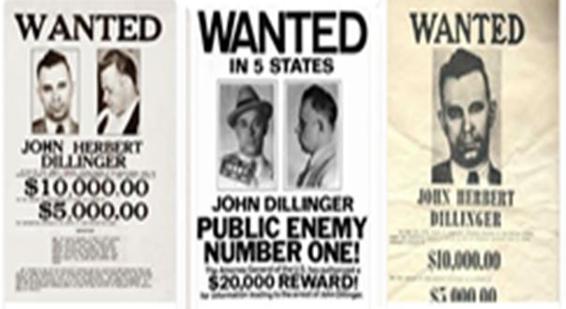
John Herbert Dillinger, June 22, 1903 – ?, maybe July 22, 1934, maybe much later, was an American gangster during the Great Depression. John Dillinger was born at 2053 Cooper Street, Indianapolis, Indiana, the youngest of two children born to John Wilson Dillinger (1864–1943) and Mary Ellen "Mollie" Lancaster (1870–1907). His parents had married on August 23, 1887.
Dillinger's father was a grocer by trade and a harsh man. In an interview with reporters, Dillinger said that he was firm in his discipline and believed in the adage "spare the rod and spoil the child." Dillinger's older sister, Audrey, was born in 1889
and the mother died in 1907 just before his fourth birthday.
Audrey married Emmett "Fred" Hancock that year and had seven children. She cared for her brother John for several years until
I Woke Next to the Corpse Page 103
their father remarried in 1912 to Elizabeth "Lizzie" Fields (1878–1933). They had three children.
As a teenager, Dillinger was frequently in trouble for getting into tangles and petty theft. He was also noted for his
"bewildering personality." He quit school to work in an Indianapolis machine shop. His father feared that the city was corrupting his son, prompting him to move the family to Mooresville, Indiana in 1921. Dillinger's wild and rebellious behavior was unchanged, despite his new rural life. In 1922, he was arrested for auto theft, and his relationship with his father deteriorated.
In 1923, Dillinger's troubles led to him enlisting in the United States Navy, where he was a Petty officer third class Machinery Repairman assigned aboard the battleship USS Utah, but he deserted a few months later when his ship was docked in Boston.
He was eventually dishonorably discharged some months later.
Dillinger returned to Mooresville where he met Beryl Ethel Hovious. The two married on April 12, 1924. He attempted to settle down, but he had difficulty. Unable to find a job, he began planning a robbery with his friend Ed Singleton, who was an ex-convict. The two robbed a local grocery store, stealing $50. While leaving the scene, the criminals were spotted by a
I Woke Next to the Corpse Page 104
minister who recognized the men and reported them to the police.
During the robbery, Dillinger had struck a victim on the noodle with a machine bolt wrapped in a cloth and had also carried a gat which, although it discharged, hit no one. The two men were arrested the next day. Singleton pleaded not guilty, but after Dillinger's father, the local Mooresville Church deacon, discussed the matter with Morgan County prosecutor Omar O'Harrow, his father convinced Dillinger to confess to the crime and plead guilty without retaining a defense attorney.
Dillinger was convicted of assault and battery with intent to rob, and of being in cahoots (conspiracy) with some un-named person to commit a felony. He expected a lenient probation sentence as a result of his father's discussion with O'Harrow but instead was sentenced to 10 to 20 years in prison for his crimes. En route to Mooresville to testify against Singleton, Dillinger briefly escaped his captors but was apprehended within a few minutes. Incarcerated at Indiana Reformatory and Indiana State Prison from 1924 to 1933, Dillinger began to become embroiled in a criminal lifestyle. Upon being admitted to prison, he was quoted as saying, "I will be the meanest bastard you ever saw when I get out of here." He became embittered against society because of his long prison sentence and befriended other criminals, including seasoned bank robbers
I Woke Next to the Corpse Page 105
Harry "Pete" Pierpont, Charles Makley, Russell Clark, and Homer Van Meter, who taught Dillinger how to be a successful criminal.
The men planned heists that they would commit soon after they were released.
He led the Dillinger Gang, which was accused of robbing twenty-four banks and four police stations. Dillinger was imprisoned several times and escaped twice. He was charged with, but not convicted of, the murder of an East Chicago, Indiana police officer, who shot Dillinger in his bullet-proof vest during a shootout. It was the only time Dillinger was charged with homicide.
His total haul has been estimated at something under $1,000,000; the rough equivalent of $15,000,000 in current terms. The struggling, Depression era public generally regarded him as a folk hero.
Dillinger courted publicity. The media ran accounts of his bravado and colorful personality and cast him as a Robin Hood.
In response, J. Edgar Hoover, director of the Bureau of Investigation (BOI), used Dillinger as a campaign platform to evolve the BOI into the Federal Bureau of Investigation, developing more sophisticated investigative techniques as weapons against organized crime.
I Woke Next to the Corpse