The Art by Dr Ved Prakash Bhardwaj - HTML preview
Download the book in PDF, ePub, Kindle for a complete version.
The Art
Madhvi Parekh’s art is deeply rooted in folk painted on village walls became a visual inheritance life—the folk life woven into memory, that continued to resurface throughout her career. Her childhood experience, stories, rituals and art can therefore be understood not as a straightforward the visual culture of rural Gujarat. One of India’s representation of folk culture, but as a process of most distinctive artistic voices, Parekh (b. 1942) has, remembering, transforming and reinventing it.
over more than six decades, developed an artistic This relationship between memory and
language that remains remarkably independent of imagination gives Parekh’s work its distinctive character.
dominant movements, trends and schools. Though she Her paintings appear to emerge organically rather than is a self-taught artist, her work reveals a sophisticated from a predetermined intellectual programme. As she engagement with both indigenous traditions and has observed, she does not pre-plan her paintings; modern art. At its heart, however, her practice remains instead, she paints what comes naturally to her. Her intensely personal: an imaginative reconstruction of subjects arise from memory, childhood stories and her the world she encountered during her childhood in immediate surroundings. The result is a body of work Sanjaya, Gujarat.
that feels spontaneous and instinctive, while remaining Most of us carry memories of folk life, whether remarkably controlled in its formal organisation.
consciously or otherwise. Yet these memories often Her sketchbooks provide an especially
remain dormant, absorbed into the background of revealing insight into this process. The daily act of everyday experience. For Parekh, they have become drawing is fundamental to her practice—“Even today, the very foundation of artistic expression. The village I draw every day.” These drawings function almost as life she witnessed as a child, the stories she heard, the visual rehearsals in which images, characters and forms rituals she encountered and, importantly, the images gradually discover their relationships. Many later 66
develop into larger compositions. The sketchbooks thus from intellectual pretension. Its sophistication comes reveal that the apparent spontaneity of her paintings is not from theoretical complexity but from the intuitive supported by a sustained discipline of observation and intelligence with which she brings disparate visual drawing.
experiences together.
Madhavi Parekh’s engagement with folk
Colour is another defining feature of Parekh’s
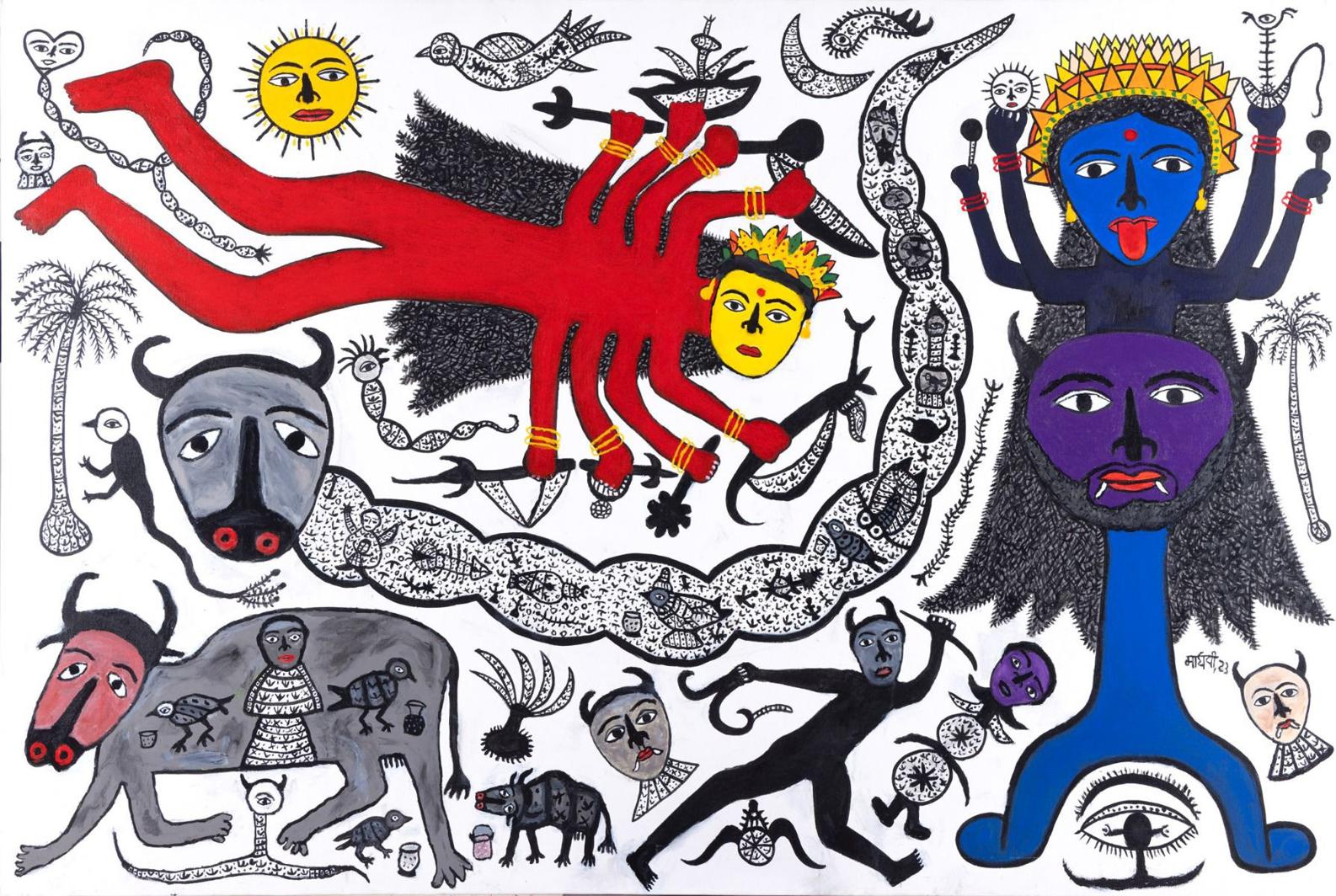
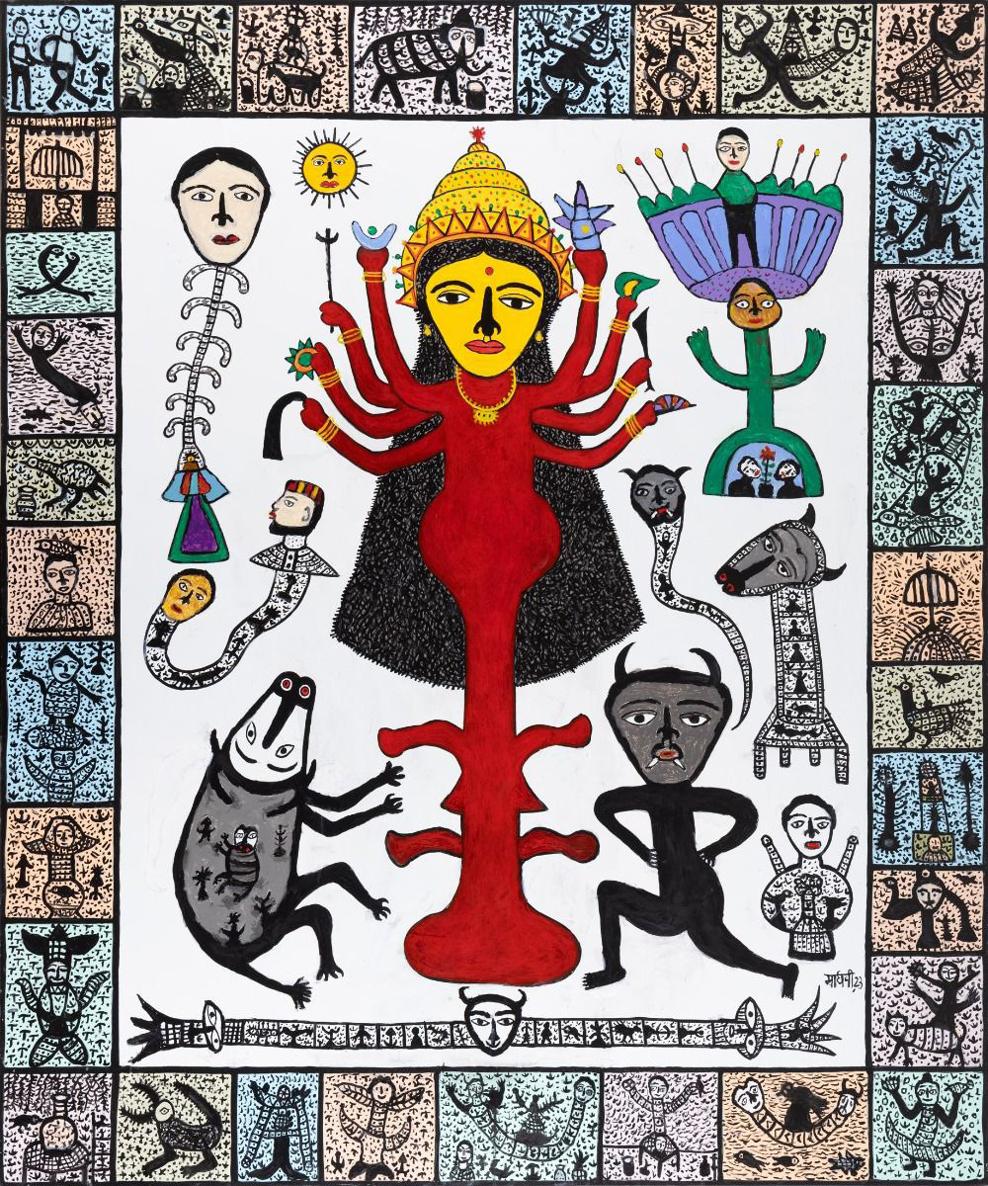
traditions is equally evident in her recurring imagery. work. Her palette is frequently vibrant and joyful, Figures of Kali and Durga, animals, snakes, lions, with strong reds, blues, greens and blacks recalling the magicians, circus performers and imaginary beings brilliance of Indian folk traditions. Yet these colours populate her visual world. These are not merely are not simply stylistic devices. They are intimately decorative motifs; they belong to a larger imaginative connected to memory. Reflecting on her childhood in universe shaped by indigenous memory and popular rural Gujarat, Parekh recalls the extraordinary light visual culture. The recurring presence of Durga, in of nature—the setting sun transforming the world particular, connects her work to the rich traditions around her with a golden brilliance. Such experiences, of folk and miniature painting across India. Her absorbed during childhood, seem to have become an compositions sometimes recall the structural logic of instinctive part of her visual vocabulary. Colour in her Kalamkari and Pichwai, in which a principal figure paintings therefore functions simultaneously as formal occupies the centre while subsidiary figures, animals or structure, emotional memory and cultural association.
ornamental elements populate the surrounding space. The surfaces of her paintings further reinforce this Yet Parekh does not simply imitate these traditions. connection to rural experience. At various stages of her She absorbs their principles of organisation and practice, Parekh has introduced textured backgrounds narrative and transforms them into a highly individual inspired by the walls she encountered in village contemporary language.
homes. These surfaces evoke the material character Her relationship with modern art adds another of vernacular environments and suggest the physical important dimension to this practice. Paul Klee has presence of memory itself. At other times, however, she been a significant influence, particularly in the playful uses flat, solid fields of colour. The contrast between treatment of form and the imaginative transformation textured and untextured surfaces demonstrates the of the visible world. The work of Joan Miró also flexibility of her approach and prevents her engagement provides an interesting point of comparison, especially with folk aesthetics from becoming formulaic.
in Parekh’s use of simplified, animated and sometimes Perhaps the most compelling aspect of Parekh’s
seemingly childlike forms. Her encounters with art is its sense of play. Her figures seem liberated from modern art during travels abroad broadened her visual the rigid logic of ordinary representation. Scale shifts, vocabulary, while her exposure to Christian imagery characters interact unexpectedly, and animals, humans and representations of the life of Jesus introduced and imaginary beings coexist within the same pictorial further subjects into her repertoire. Nevertheless, these space. Rhythm and repetition frequently organise the influences remain assimilated rather than imitative. composition, while central figures are surrounded by Parekh’s achievement lies precisely in her ability to secondary forms that create an almost theatrical or encounter modernism without allowing it to eclipse narrative environment. Her paintings consequently her indigenous and personal sources.
seem to unfold like stories or fables, with each image Her association with her husband, the artist containing the possibility of another.
Manu Parekh, was an important early encouragement This quality of playfulness is closely connected in her artistic journey. Her experiences in Kolkata to Parekh’s understanding of life itself. For her, the also deepened her understanding of folk culture and vibrancy of the things surrounding her is the source exposed her to different artistic environments. Yet her of her work. Her paintings represent different aspects development cannot be reduced to the influence of of life as she encounters it. This emphasis on lived either her husband or the artists she encountered. She experience gives the work a remarkable freshness.
gradually established an independent visual language Rather than imposing a fixed conceptual framework through an ongoing dialogue with folk artists, popular upon her subjects, she allows images to evolve through imagery and modern art. Her work is refreshingly free memory, intuition and association.
67