

DYNAMISM: THE FOURTH SEAL by GEORGE MARTIN WILLIAMS - HTML preview
Download the book in PDF, ePub, Kindle for a complete version.
Firefox
file:///home/g/DYNAMISM:%20THE%20FOURTH%2...
1 of 37
2/17/25, 6:40 PM
Firefox
file:///home/g/DYNAMISM:%20THE%20FOURTH%2...
2 of 37
2/17/25, 6:40 PM
file:///home/g/DYNAMISM:%20THE%20FOURTH%2...
BOOK TWO:
RIGHTEOUSNESS!
___________________________________________________________________________________________________
John 16:9-11
King James Version
8 And when he is come, he will reprove the world of sin, and of righteousness, and of judgment: 9 Of sin, because they believe not on me;
10 Of righteousness, because I go to my Father, and ye see me no more; 11 Of judgment, because the prince of this world is judged.
___________________________________________________________________________________________________
'OF RIGHTEOUSNESS, BECAUSE I
GO TO MY FATHER, AND YE SEE
ME NO MORE.'
___________________________________________________________________________________________________
Revelation 5:1-7
King James Version
5 And I saw in the right hand of him that sat on the throne a book written within and on the backside, sealed with seven seals.
2 And I saw a strong angel proclaiming with a loud voice, Who is worthy to open the book, and to loose the seals thereof?
3 And no man in heaven, nor in earth, neither under the earth, was able to open the book, neither to look thereon.
4 And I wept much, because no man was found worthy to open and to read the book, neither to look thereon.
5 And one of the elders saith unto me, Weep not: behold, the Lion of the tribe of Judah, the Root of David, hath prevailed to open the book, and to loose the seven seals thereof.
6 And I beheld, and, lo, in the midst of the throne and of the four beasts, and in the midst of the elders, stood a Lamb as it had been slain, having seven horns and seven eyes, which are the seven Spirits of God sent forth into all the earth.
7 And he came and took the book out of the right hand of him that sat upon the throne.
___________________________________________________________________________________________________
THE LAMB WILL REVEAL THE TRUTH THAT COMES FROM GOD!
3 of 37
2/17/25, 6:40 PM
file:///home/g/DYNAMISM:%20THE%20FOURTH%2...
|||||||||||||||||||||||||||||||||||||||||||||||||||||||||||||||||||||||||||||||||||||||||||||||||||||||||||||||||||||||||||||||||||||||||||||||||||||||||||||||||||||||||||||
The Millennium Problems: The Seven Greatest
Unsolved Mathematical Puzzles of Our Time
[Reviewed by David Roberts, on 02/7/2003]
The Millennium Problems: The Seven Greatest Unsolved Mathematical Puzzles of Our Time [Reviewed by David Roberts, on 02/7/2003] In May 2000, the Clay Mathematics Institute elevated seven long-standing open problems in mathematics to the status of "Millennium Prize Problems," endowing each with a million-dollar prize. The seven particular problems were chosen in part because of their difficulty, but even more so because of their central importance to modern mathematics. The problems and the corresponding general areas of mathematics are as follows.
1
The Riemann Hypothesis
Number Theory
2
Yang-Mills Existence and Mass Gap
Mathematical Physics
3
The P versus NP problem
Computer Science
4
Navier-Stokes Existence and Smoothness
Mathematical Physics
5
The Poincaré Conjecture
Topology
6
The Birch and Swinnerton-Dyer Conjecture
Number Theory
7
The Hodge Conjecture
Algebraic Geometry
In The Millennium Problems, Keith Devlin aims to communicate the essence of these seven problems to a broad readership. It is, of course, a very ambitious goal. The preface makes it clear what Devlin's ground rules are. First he assumes only "a good high school knowledge of mathematics." Second, he is writing "not for those who want to tackle one of the problems, but for readers — mathematician and non-mathematician alike — who are curious about the current state at the frontiers of humankind's oldest body of scientific knowledge." He is clear that the readership drives the level of the book, so that precise statements of the problems will not always be given. Rather the goal is "to provide the background to each problem, to describe how it arose, explain what makes it particularly difficult, and give... some sense of why mathematicians regard it as important."
After the short preface, the book has an interesting Chapter 0, and then one chapter for each problem in the above order.
These seven chapters are constructed similarly. Most have a long historical component, generally including biographical information about the person or persons after whom the conjecture is named. Each has substantial background mathematical information, with topics ranging from complex numbers in Chapter 1 and group theory in Chapter 2 to congruences in Chapter 6 and algebraic varieties in Chapter 7. Applications are emphasized when possible. A nice theme in Chapters 2 and 4 is that mathematicians are behind physicists and engineers and just trying to catch up. Each chapter concludes with a discussion of the millennium problem itself.
Chapter 5 illustrates how Devlin ties the various units of a chapter into a coherent narrative. It begins with four pages about the life and work of Henri Poincaré. It moves on to introduce "rubber sheet geometry" in terms of how subway maps and refrigerator wiring diagrams are not geometrically faithful to the physical objects they represent, but nonetheless clearly capture all relevant information. This unit is important as it will make readers feel that topology is natural, rather than weird. Chapter 5 next introduces the concepts of vertices, edges, faces and finally Euler characteristic in terms of the Königsberg bridge problem. It introduces non-orientable surfaces and makes the introduction of an ambient four-space seem natural, since it is necessary for an embedding of the Klein bottle. It topologically classifies closed surfaces first crudely in terms of their orientability, and then completely in terms of networks drawn upon them and the Euler characteristic of these networks. It gives a very attractive example of two seemingly linked rings that in fact can be pulled apart. This example shows the reader that not everything is geometrically obvious, and thus underscores the utility of algebraic invariants that can rigorously confirm that two objects are topologically different. It discusses how the ordinary two-sphere is characterized among all closed surfaces by having the property that any loop on it can be shrunk continuously to a point. Finally, by way of this two-dimensional analogy, it discusses the actual three-dimensional Poincaré conjecture.
The strain imposed by the challenge of communicating all seven millennium problems to a broad readership naturally shows at times. In the Navier-Stokes chapter, for example, the background mathematical information presented is calculus and specifically differentiation. Readers are instructed that "dy/dx" is to be read "dee-wye by dee-ex." Some seven pages later, the Navier-Stokes equations themselves are presented. They are four coupled non-linear partial differential equations in four independent variables. The exposition is gentle, but readers new to calculus will only understand at a superficial level. The strain is felt somewhat more in Chapter 6 and particularly so in Chapter 7. But these various strains are unavoidable, and I think in general Devlin has done a very good job giving general readers a feel for the seven millennium problems.
https://maa.org/press/maa-reviews/the-millennium-problems-the-seven-greatest-unsolved-mathematical-puzzles-of-our-time
4 of 37
2/17/25, 6:40 PM
Firefox
file:///home/g/DYNAMISM:%20THE%20FOURTH%2...
|||||||||||||||||||||||||||||||||||||||||||||||||||||||||||||||||||||||||||||||||||||||||||||||||||||||||||||||||||||||||||||||||||||||||||||||||||||||||||||||||||||||||||||
THE FOURTH SEAL: GRAPHING FOUR DIMENSIONAL
SPACE-TIME IMAGES
THIS CHAPTER WILL END WITH MY SOLUTION TO THE HODGE CONJECTURE. THE HODGE CONJECTURE IS
SIMILAR TO THE NAVIER-STOKES EQUATION IN THAT THEY ARE BOTH CALCULUS PROBLEMS.
___________________________________________________________________________________________________
https://mathworld.wolfram.com/HodgeConjecture.html
___________________________________________________________________________________________________
WHY IS IT DIFFICULT?
___________________________________________________________________________________________________
https://www.redalyc.org/journal/5117/511766757039/html/
___________________________________________________________________________________________________
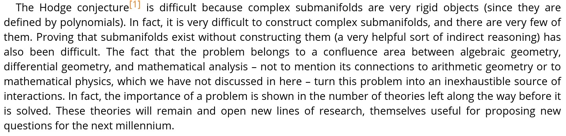
'The Hodge conjecture[1] is difficult because complex submanifolds are very rigid objects (since they are defined by polynomials). In fact, it is very difficult to construct complex submanifolds, and there are very few of them. Proving that submanifolds exist without constructing them (a very helpful sort of indirect reasoning) has also been difficult.'
MY SOLUTION TO THE HODGE CONJECTURE WILL SIMPLY BE TO CONSTRUCT 'THE THING' IN THE ABOVE
PARAGRAPH, THAT THEY SAY IS DIFFICULT TO CONSTRUCT.
WHY IS A THEORY OF EVERYTHING IS IMPORTANT?
AT THE TIME OF THE WRITING OF THIS BOOK, WHICH IS THE YEAR 2025, MOST PEOPLE DON'T CARE ABOUT
'UNIFYING THE FIELDS', OR ABOUT 'GRAND UNIFIED THEORIES' BECAUSE THERE ARE MUCH MORE EXCITING
THINGS TO THINK ABOUT, SUCH AS ARTIFICIAL INTELLIGENCE OR QUANTUM COMPUTING. BUT WHAT IS THE
POINT OF UNDERSTANDING ANYTHING, IF NOT TO FIND A WAY TO USE IT IN SOME WAY THAT GIVES A BENEFIT.
THE IDEA THAT 'KNOWLEDGE IS POWER' IS A COMPLETE WASTE OF TIME IF MOST OF WHAT IS KNOWN IS
USELESS. THE ONLY 'KNOWLEDGE' THAT POTENTIALLY HAS 'POWER' ARE PRINCIPLES OF NATURE THAT CAN BE
APPLIED SUCCESSFULLY. IN HUMANITY'S FUTURE, A THOROUGH UNDERSTANDING OF THE FORCES OF NATURE
IS CRITICAL TO ALL THE FUTURE TECHNOLOGY THAT HUMANITY WILL POSSESS. TECHNOLOGY THAT WILL
ALLOW HUMAN BEINGS TO BECOME A SPACE FARING RACE THAT WILL COLONIZE NOT JUST OUR OWN SOLAR
SYSTEM, BUT THE WIDER GALAXY AND EVEN OTHER GALAXIES AS WELL.
IF YOU KNOW A THEORETICAL PHYSICIST; THEN YOU CAN ASK HIM THIS QUESTION ON MY BEHALF:
'IF RELATIVITY THEORY AND QUANTUM THEORY ARE EVENTUALLY UNIFIED AND ULTIMATELY PROVEN TO BE THE
TRUTH OF HOW THE UNIVERSE WORKS; WHAT KIND OF TECHNOLOGY DO YOU BELIEVE WILL NATURALLY
EMERGE FROM THIS UNIFIED FIELD THEORY, THAT WILL ULTIMATELY HELP ALL OF HUMANITY TO REACH THE
FAR DISTANT STARS?'
IN OTHER WORDS, 'HOW HELPFUL WILL SUCH A UNIFIED FIELD THEORY; WHICH UNIFIES THE STRONG FORCE, THE WEAK FORCE, ELECTROMAGNETISM AND GRAVITY; BE TO THE HUMAN RACE IN THE DEVELOPMENT OF
FUTURE TECHNOLOGY?
THE MOST INTIMIDATING PSYCHOLOGICAL PROBLEM
THE NAVIER-STOKES PROBLEM WAS TREATED AS A LEIBNIZIAN CALCULUS PROBLEM WHICH REQUIRED THE USE
5 of 37
2/17/25, 6:40 PM
file:///home/g/DYNAMISM:%20THE%20FOURTH%2...
OF PARTIAL DERIVATIVES IN THREE SPATIAL DIMENSIONS. THIS MATHEMATICAL APPROACH TO WHAT IS
ESSENTIALLY A NEWTONIAN PHYSICS PROBLEM IS WHAT MADE IT IMPOSSIBLE TO SOLVE. THE PHYSICS
APPROACH TO CALCULUS USES THE TIME VARIABLE 'T' AS THE INDEPENDENT VARIABLE UPON WHICH THE
THREE SPATIAL VARIABLES OF 'X, Y, AND Z' ARE DEPENDANT VARIABLES. THIS ALONE IMMEDIATELY ELIMINATES
THE NEED FOR PARTIAL DERIVATIVES. THE FACT THAT MOMENTUM IS PROPORTIONAL TO VELOCITY IN THE
SAME WAY THAT FORCE IS PROPORTIONAL TO ACCELERATION IS ANOTHER PHYSICS PERSPECTIVE THAT WOULD
NOT BE OBVIOUS TO EVEN THE GREATEST OF MATHEMATICIANS. SINCE MASS IS A CONSTANT IN BOTH THE
MOMENTUM AND THE FORCE EQUATION, BY SIMPLY EQUATING MASS TO ONE 'M = 1' THE MASS VARIABLE IS
NEUTRALIZED AND MOMENTUM IMMEDIATELY BECOMES VELOCITY AND FORCE IMMEDIATELY BECOMES
ACCELERATION. IN NEWTONIAN PHYSICS, ACCELERATION IS THE DERIVATIVE OF VELOCITY. THE NAVIER STOKES
EQUATION REQUIRES THAT VISCOSITY IS THE SECOND DERIVATIVE OF THE VELOCITY FUNCION WHICH MEANS
THAT VISCOSITY IS THE FIRST DERIVATIVE OF THE ACCELERATION FUNCTION. ONCE THESE PHYSICAL
RELATIONSHIPS ARE UNDERSTOOD, THE REMAINING CALCULUS IS RELATIVELY STRAIGHTFORWARD.
THE SOLUTION TO THE NAVIER-STOKES EQUATION IS:
PRESSURE IN THE X-AXIAL DIRECTION = X'(T) - X(T) + X''(T) PRESSURE IN THE Y-AXIAL DIRECTION = Y'(T) - Y(T) + Y''(T) PRESSURE IN THE Z-AXIAL DIRECTION = Z'(T) - Z(T) + Z''(T) WHERE X(T), Y(T), Z(T) ARE THE VELOCITY FUNCTIONS IN THE THREE AXIAL DIRECTIONS.
WHERE X'(T), Y'(T), Z'(T) ARE THE ACCELERATION FUNCTIONS IN THE THREE AXIAL DIRECTIONS.
WHERE X''(T), Y''(T), Z''(T) ARE THE VISCOSITY FUNCTIONS IN THE THREE AXIAL DIRECTIONS.
AND X''(T) IS THE DERIVATIVE OF X'(T), WHICH IS ITSELF THE DERIVATIVE OF X(T).
AND Y''(T) IS THE DERIVATIVE OF Y'(T), WHICH IS ITSELF THE DERIVATIVE OF Y(T).
AND Z''(T) IS THE DERIVATIVE OF Z'(T), WHICH IS ITSELF THE DERIVATIVE OF Z(T).
NAVIER-STOKES IS A MILLENNIUM PROBLEM THAT HAS ELUDED SOLUTION FOR TWO HUNDRED YEARS. WHY DID
IT TAKE SO LONG BEFORE A SOLUTION WAS FOUND?
BECAUSE THE LONGER A MATH PROBLEM REMAINS UNSOLVED, THE MORE FAMOUS IT BECOMES, AND THE
GREATER ITS REPUTATION AS AN UNSOLVABLE PROBLEM BECOMES. THIS IS WHAT KEITH DEVLIN WROTE ABOUT
IT:
"...The resulting equations are known as the Navier-Stokes equations. Though these equations can be solved in the hypothetical two-dimensional case of an infinitely thin planar film of fluid, it is not known whether there is a solution in the (more realistic) three-dimensional case. Notice that the issue is not Do we know what the solution is? It's more basic than that. We don't even know whether there is a solution! "
THERE IS A CERTAIN MYSTIQUE THAT EVOLVES AND WHICH BECOMES GREATER AND GREATER AS TIME GOES BY.
THE REPUTATION OF THE NAVIER-STOKES PROBLEM IS THAT IT MAY NOT HAVE A SOLUTION BECAUSE IT HAS
BEEN TWO HUNDRED YEARS AND NO ONE HAS SOLVED IT. PSYCHOLOGICALLY SPEAKING, THIS IS AN EXTREMELY
INTIMIDATING THOUGHT. IF YOU ARE ONE OF THE BEST MATHEMATICIANS IN THE WORLD, AND YOU TALK TO
OTHER GREAT MATHEMATICIANS, AND ALL OF THEM DOUBT THAT THE PROBLEM EVEN HAS A SOLUTION, ARE
YOU GOING TO SPEND A YEAR OR TWO OF YOUR LIFE TRYING TO SOLVE IT?
THE ANSWER IS NO. THE OPPORTUNITY COST OF THE TIME THAT YOU SPEND TRYING TO SOLVE IT IS EVERY
OTHER PROBLEM THAT YOU COULD BE WORKING ON INSTEAD. THIS DIRECTLY LEADS TO A SITUATION WHERE
NONE OF THE BEST MATHEMATICIANS WILL EVEN MAKE A CASUAL ATTEMPT TO TRY AND SOLVE IT BECAUSE ALL
SUCH ATTEMPTS ARE CONSIDERED A WASTE OF TIME. THIS MEANS ONLY AMATEUR MATHEMATICIANS MAKE
ANY ATTEMPT TO SOLVE IT, AND IT THUS REMAINS UNSOLVED.
IF YOU HAVE FOLLOWED THIS LINE OF REASONING THUS FAR, THEN YOU MIGHT HAVE REALIZED THAT IF THIS
IS TRUE FOR ONE OF THE MILLENNIUM PROBLEMS, IT MIGHT BE TRUE FOR MORE THAN ONE OF THE
PROBLEMS.
BUT THE KNEE JERK REACTION OF MOST OF THE PROFESSIONAL MATHEMATICIANS THAT HAVE HEARD OF THE
NAVIER-STOKES PROBLEM AND THAT KNOW OF ITS REPUTATION AS BEING UNSOLVABLE, IS THAT IF ANYONE
DOES CLAIM TO HAVE A SOLUTION, ESPECIALLY AN AMATEUR MATHEMATICIAN LIKE MYSELF, THAT HE MUST BE
'DELUSIONAL'. THEY THEN TEND TO DISMISS THE SOLUTION AS BEING WRONG WITHOUT EVEN LOOKING AT IT.
THIS IS THE KIND OF INTELLECTUAL SNOBBERY THAT PERVADES THE ACADEMIC WORLD.
___________________________________________________________________________________________________
Matthew 17:20
King James Version
20 And Jesus said unto them, Because of your unbelief: for verily I say unto you, If ye have faith as a grain of mustard seed, ye shall say unto this mountain, Remove hence to yonder place; and it shall remove; and nothing shall be impossible 6 of 37
2/17/25, 6:40 PM
file:///home/g/DYNAMISM:%20THE%20FOURTH%2...
unto you.
___________________________________________________________________________________________________
THUS THE ONLY WAY THAT ANY OF THE MILLENNIUM PROBLEMS CAN BE SOLVED IS BY SOMEONE WHO IS NOT
INTIMIDATED BY THEIR REPUTATION. IN OTHER WORDS, THE MAIN REQUIREMENT FOR SOLVING A MILLENNIUM
PROBLEM IS 'STRENGTH'. "BREAKING THE SEAL' WILL REQUIRE THE STRENGTH OF WILL TO PERSEVERE
THROUGH THICK AND THIN, THROUGH HIGHS AND LOW, THROUGH THE UPS AND THE DOWNS, THROUGH
SETBACK AFTER SETBACK, BELIEVING THAT FAILURE IS PART OF THE PROCESS, AND THAT IF ONE DOESN'T GIVE
UP, ONE WILL ULTIMATELY PREVAIL. IN SHORT, ONE HAS TO HAVE 'THE FAITH OF THE MUSTARD SEED'.
THE HODGE CONJECTURE.
THE HODGE CONJECTURE IS THE SINGLE MOST INTIMIDATING MATH PROBLEM, BY ALL ACCOUNTS, BECAUSE OF
THE INCOMPREHENSIBLE LANGUAGE THAT IT USES, AND BECAUSE; LIKE THE NAVIER-STOKES EQUATION, SO
MANY GREAT MATHEMATICIANS HAVE TRIED, AND FAILED, TO SOLVE IT. WHENEVER 'A BEAST' OF A PROBLEM
LIKE THIS ARISES WITHIN ANY SUBJECT AREA, IT TAKES ON 'A MYTHICAL', PERHAPS EVEN 'LEGENDARY', CHARACTERISTIC.
BUT IT IS A 'PAPER TIGER'!
___________________________________________________________________________________________________
'During the nineteenth century, mathematicians took Descartes's approach a stem further. Instead of using algebra simply as a tool to help them reason about geometric objects--by writing down equations that determined those objects--they started with collections of algebraic equations and defined "geometric" objects to be the solutions to those equations.
Thus, instead of saying that the equation:
x^2 + y^2 = 4
provides an algebraic description of the circle with radius 2 and center the origin, they would simply study the object--
whatever it is--that arose from the equation.'
'THE MILLENNIUM PROBLEMS' BY KEITH DEVLIN [PAGE 217]
___________________________________________________________________________________________________
___________________________________________________________________________________________________
'Actually, that's not exactly right. In defining an algebraic variety, mathematicians don't restrict themselves to a single algebraic equation; instead, you can start with any finite collection of equations. The variety then consists of all points that solve all the equations in the system. This makes the class of algebraic varieties richer than if you were only allowed to start with a single equation.'
'THE MILLENNIUM PROBLEMS' BY KEITH DEVLIN [PAGE 218]
___________________________________________________________________________________________________
___________________________________________________________________________________________________
'Now, when you use calculus (as opposed to algebra) to define an object, the resulting object need not be in any sense
"geometric." The Hodge Conjecture says that the H-objects are exceptions to that last remark--or at least, almost so.
Though they may not themselves be geometric objects, they can be built up from geometric objects in a fairly straightforward (and calculus free) way. In the terminology of the conjecture, ... That is to say, any H-object can be built up from geometric objects in a purely algebraic way.
Thus, you can think of the Hodge Conjecture as saying, "Look, by using calculus on varieties, we've created a class of objects (the H-objects) that not only defy any hope of our being able to visualize them, we can't even describe them algebraically. However, these objects can be built up in an algebraic fashion from objects that can be described algebraically. So at least we still have a lifeline connecting us to firmer ground--a connection that we (i.e., the experts) might be able to use to carry the study of these objects further."
What the Hodge Conjecture does is provide the expert with some powerful mathematical structure that can be used to analyze H-objects. This is very typical of a lot of modern mathematics, where mathematicians are constantly looking for new structures on objects or links from one area or mathematics to another, so that they can adapt methods from one area for use in another.' 'THE MILLENNIUM PROBLEMS' BY KEITH DEVLIN [PAGE 219]
___________________________________________________________________________________________________
___________________________________________________________________________________________________
'Before trying to convey some sense of the way the experts view the conjecture, let me make a few more remarks about its status in mathematics.
First, it has significant implications. A proof of the Hodge Conjecture would establish a fundamental link among the three disciplines of algebraic geometry, analysis, and topology.
Second, one case of the conjecture is known, but that case was established by the American mathematician Solomon Lefschetz in 1925, long before Hodge formulated the general conjecture. It's not much of an exaggeration to say that there has been essentially no progress on the problem since then.
Thus, to date, the Hodge Conjecture remains just that: a conjecture. Some would say it could be more accurately called a wild guess. But that has not prevented many mathematicians from trying to prove it or from investigating its 7 of 37
2/17/25, 6:40 PM
Firefox
file:///home/g/DYNAMISM:%20THE%20FOURTH%2...
consequences.' 'THE MILLENNIUM PROBLEMS' BY KEITH DEVLIN [PAGE 220]
___________________________________________________________________________________________________ '
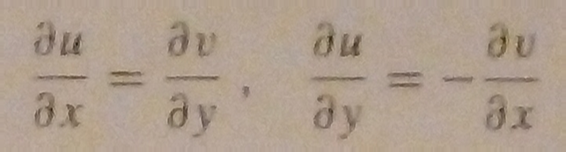
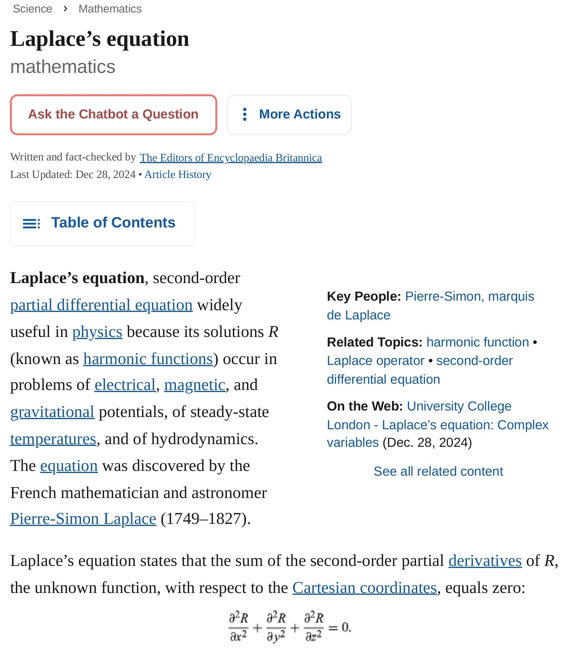
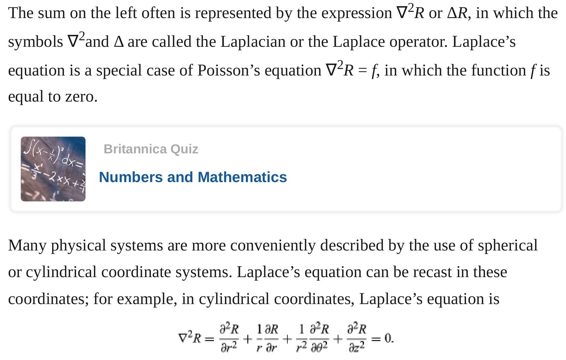
These equations are (and were then) familiar to physicists. They know them as Laplace's equations, and they play a major role in gravitational theory, electromagnetic theory, and fluid mechanics. (Moreover, closely related equations occur in the theories of heat flow, acoustics and the propagation of waves.) A solution of the Laplace equations is called a harmonic function. The discovery of this close relationship between the calculus of complex functions and the Laplace equations led to significant progress in mathematical physics, by providing a way to solve Laplace's equations in a variety of contexts.'
'THE MILLENNIUM PROBLEMS' BY KEITH DEVLIN [PAGE 225]
___________________________________________________________________________________________________
COMPUTER AIDED NUMERICAL DATA ORDERING AND
RESTRUCTURING:
CANDOR
THE MILLENNIUM PROBLEMS WERE NOT ANSWERABLE WITHIN THE CONVENTIONAL MATHEMATICS THAT
EXISTED IN THE YEAR 2000; WHICH MEANS THAT NEW MATH AND NEW PHYSICS ARE REQUIRED TO SOLVE
THESE QUESTIONS. THE 'CANDOR' TOOLS THAT THE MATHEMATICS OF THE DYNAMISM MODEL ARE BASED ON, REPRESENT BOTH NEW MATH, AND NEW PHYSICS. THE FIRST OF THESE TOOLS IS CALLED 'FOUR-D', WHICH IS
THE PRIMARY TOOL FOR HANDLING FOUR DIMENSIONAL PROBLEMS; THE THREE DIMENSIONS OF 'SPACE'
COMBINED WITH THE FOURTH DIMENSION OF 'TIME'.
FOUR-D
THE 'FOUR-D' TOOL IS A TEMPORAL-SPATIAL GRAPHING METHOD WHICH PRODUCES POINTS THAT HAVE FOUR
COMPONENTS (X, Y, Z, T); AND WHICH THEN GRAPHS THESE POINT ON A THREE DIMENSIONAL CARTESIAN
PLANE.
FOR INSTANCE, A COMPLEX VALUED INPUT SUCH AS (X, Ti) OF ANY GIVEN POLYNOMIAL EQUATION, WOULD
RESULT IN A COMPLEX VALUE OUTPUT (Z, Yi). THE 'TRICK' TO GRAPHING THIS FUNCTION IS SIMPLY TO LET 'X =
T', SUCH THAT THE INPUT IS ACTUALLY (T, Ti) WHILE THE OUTPUT REMAINS (Z, Yi). THIS WOULD MEAN THAT
EVERY POINT TO BE GRAPHED WOULD TAKE THE FORM (X, Yi, Z, Ti). BUT NOTE THAT SINCE 'X = T', THE ACTUAL
POINT TO BE GRAPHED ONLY HAS THREE COMPONENTS, (X, Yi, Z).
THUS THE 'FOUR-D' TOOL TAKES ANY COMPLEX VALUED INPUT OF THE FORM (X, Ti) WHICH YIELDS THE
COMPLEX VALUED OUTPUT (Z, Yi) FROM ANY GIVEN POLYNOMIAL EQUATION, AND PLOTS THE POINTS: 1. (X(1), Yi(1), Z(1))
2. (X(2), Yi(2), Z(2))
3. (X(3), Yi(3), Z(3))
4. (X(4), Yi(4), Z(4))
5. (X(5), Yi(5), Z(5))
6. ... , ... , ...
7. ... , ... , ...
8. ... , ... , ...
9. (X(N- 2), Yi(N-2), Z(N-2))
10. (X(N-1), Yi(N-1), Z(N-1))
11. (X(N), Yi(N), Z(N))
WHICH IS SIMPLY:
(X(T), Yi(T), Z(T))
WHERE:
T = {1, 2, 3, 4, 5, . . ., N-2, N-1, N}
WHICH IS A NEW GRAPHING TECHNIQUE THAT USES THE THREE DIMENSIONAL CARTESIAN GRAPHING METHOD
TO DISPLAY FOUR DIMENSIONAL MATHEMATICAL FUNCTIONS.
THIS GRAPHING TECHNIQUE IS BASED ON ADDING A FOURTH AXIS, A 'TIME' AXIS TO THE NORMAL THREE
DIMENSIONAL CARTESIAN PLANE. THE FOURTH AXIS IS EQUAL TO THE LINE: X = Y = Z = T
T
X
Y
Z
.
.
.
.
-5
-5
-5
-5
-4
-4
-4
-4
8 of 37
2/17/25, 6:40 PM
file:///home/g/DYNAMISM:%20THE%20FOURTH%2...
-3
-3
-3
-3
-2
-2
-2
-2
-1
-1
-1
-1
0
0
0
0
+1
+1
+1
+1
+2
+2
+2
+2
+3
+3
+3
+3
+4
+4
+4
+4
+5
+5
+5
+5
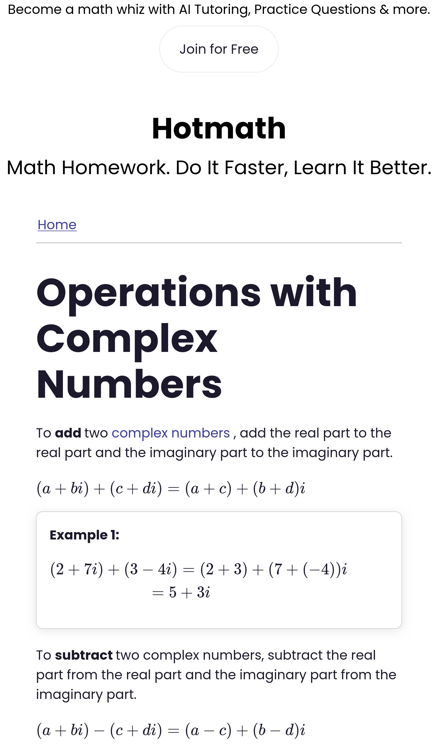
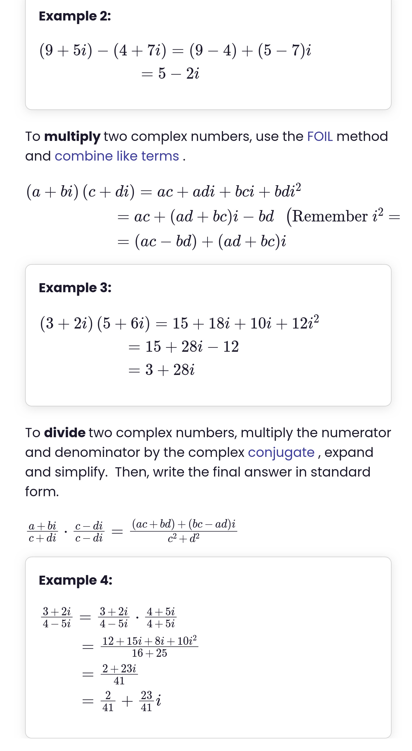
COMPLEX NUMBERS
THE MATHEMATICS OF THE HODGE CONJECTURE PRIMARILY DEALS WITH COMPLEX NUMBERS. THE MAIN
DIFFICULTY OF WORKING WITH COMPLEX NUMBERS IS THAT IT IS HARD TO VISUALIZE THE COMPLETE
FUNCTION, WITH BOTH THE COMPLEX VALUED INPUTS, AND THE COMPLEX VALUED OUTPUT ON THE SAME
GRAPH.
___________________________________________________________________________________________________
9 of 37
2/17/25, 6:40 PM
Firefox
file:///home/g/DYNAMISM:%20THE%20FOURTH%2...
10 of 37
2/17/25, 6:40 PM
Firefox
file:///home/g/DYNAMISM:%20THE%20FOURTH%2...
https://www.varsitytutors.com/hotmath/hotmath_help/topics/operations-with-complex-numbers ___________________________________________________________________________________________________
11 of 37
2/17/25, 6:40 PM
Firefox
file:///home/g/DYNAMISM:%20THE%20FOURTH%2...
https://www.britannica.com/science/Laplaces-equation
___________________________________________________________________________________________________
___________________________________________________________________________________________________
'In his address to the International Congress of Mathematicians in 1950, Hodge raised the possibility that for nonsingular projective complex algebraic varieties, that last property completely characterizes the algebraic cohomology classes. That is, every harmonic (p, p)-form is a rational combination of closed algebraic forms (loosely, could be built up in algebraic--
ie..., calculus-free--way).
Thus was the Hodge Conjecture born.
12 of 37
2/17/25, 6:40 PM
file:///home/g/DYNAMISM:%20THE%20FOURTH%2...
But is the conjecture true? Nobody knows. At the moment there is no strong evidence to suggest that Hodge's intuition was correct.'
'THE MILLENNIUM PROBLEMS' BY KEITH DEVLIN [PAGE 228]
___________________________________________________________________________________________________
THE REASON WHY I CALL THE HODGE CONJECTURE A 'PAPER TIGER' IS BECAUSE THE PROBLEM BASICALLY
AMOUNTS TO BEING ABLE TO ACCURATELY GRAPHICALLY PICTURE A 'COMPLEX VALUED FUNCTION' THAT HAS
BOTH A COMPLEX VALUED INPUT, AND A COMPLEX VALUED OUTPUT. THIS IS EXACTLY WHAT THE CANDOR
MATHEMATICAL TOOL; 'FOUR-D'; DOES. EVERYTHING ELSE IS SIMPLY 'ABSTRACTIONS, BUILT ON ABSTRACTIONS, BUILT ON ABSTRACTIONS', WHICH AMOUNTS TO MAKING A MOUNTAIN OUT OF A MOLEHILL.
BINOMIAL THEOREM
(a + ib)^n
WHERE 'n' IS A POSITIVE INTEGER.
THIS KIND OF EXPRESSION IS CALLED A BINOMIAL EXPRESSION. WHEN 'b' IS REPLACED BY 'ib', THE EXPRESSION
BECOMES A COMPLEX NUMBER, AND THE SECOND PARTIAL DERIVATIVE FOR 'u(a)', WITH RESPECT TO 'a', WILL
ALWAYS BE EQUAL AND OPPOSITE TO THE SECOND PARTIAL DERIVATIVE FOR 'v(b)' WITH RESPECT TO 'b'. THIS
MEANS THAT THE SECOND PARTIAL DERIVATIVE FOR THESE TYPES OF BINOMIAL EXPRESSIONS, WHEN
EXPANDED AS COMPLEX NUMBERS, IS ALWAYS EQUAL TO ZERO. THUS, THESE TYPES OF BINOMIAL
EXPRESSIONS, WHEN COMPLEX NUMBERS ARE USED AS THE INPUT, ALWAYS REPRESENT SOLUTIONS TO
LAPLACE'S EQUATION.
THE INPUT TO THE BINOMIAL EQUATION, IS 'X'; A COMPLEX VALUE: x = a + ib
NOTE THAT FOR ALL OF THE FOLLOWING, THE PARTIAL DERIVATIVE FOR 'X' IS: w(x) = w(a + ib)
w'(x) = 1
w''(x) = 0
u(a) = (a + ib)^2
u'(a) = 2(a + ib)
u''(a) = 2
v(b) = (a + ib)^2
v'(b) = 2i(a + ib)
v''(b) = -2
w''(x) + u''(a) + v''(b) = 0 + 2 − 2 = 0
u(a) = (a + ib)^3
u'(a) = 3(a + ib)^2
u''(a) = 6(a + ib)
v(b) = (a + ib)^3
v'(b) = 3i(a + ib)^2
v''(b) = -6(a + ib)
w''(x) + u''(a) + v''(b) = 0 + 6(a + ib) − 6(a + ib) = 0
u(a) = (a + ib)^4
u'(a) = 4(a + ib)^3
u''(a) = 12(a + ib)^2
v(b) = (a + ib)^4
v'(b) = 4i(a + ib)^3
v''(b) = -12(a + ib)^2
w''(x) + u''(a) + v''(b) = 0 + 12(a + ib)^2 − 12(a + ib)^2 = 0
u(a) = (a + ib)^5
u'(a) = 5(a + ib)^4
u''(a) = 20(a + ib)^3
v(b) = (a + ib)^5
v'(b) = 5i(a + ib)^4
v''(b) = -20(a + ib)^3
w''(x) + u''(a) + v''(b) = 0 + 20(a + ib)^3 − 20(a + ib)^3 = 0
13 of 37
2/17/25, 6:40 PM
file:///home/g/DYNAMISM:%20THE%20FOURTH%2...
u(a) = (a + ib)^6
u'(a) = 6(a + ib)^5
u''(a) = 30(a + ib)^4
v(b) = (a + ib)^6
v'(b) = 6i(a + ib)^5
v''(b) = -30(a + ib)^4
w''(x) + u''(a) + v''(b) = 0 + 30(a + ib)^4 − 30(a + ib)^4 = 0
u(a) = (a + ib)^7
u'(a) = 7(a + ib)^6
u''(a) = 42(a + ib)^5
v(b) = (a + ib)^7
v'(b) = 7i(a + ib)^6
v''(b) = -42(a + ib)^5
w''(x) + u''(a) + v''(b) = 0 + 42(a + ib)^5 − 42(a + ib)^5 = 0
u(a) = (a + ib)^8
u'(a) = 8(a + ib)^7
u''(a) = 56(a + ib)^6
v(b) = (a + ib)^8
v'(b) = 8i(a + ib)^7
v''(b) = -56(a + ib)^6
w''(x) + u''(a) + v''(b) = 0 + 56(a + ib)^6 − 56(a + ib)^6 = 0
u(a) = (a + ib)^9
u'(a) = 9(a + ib)^8
u''(a) = 72(a + ib)^7
v(b) = (a + ib)^9
v'(b) = 9i(a + ib)^8
v''(b) = -72(a + ib)^7
w''(x) + u''(a) + v''(b) = 0 + 72(a + ib)^7 − 72(a + ib)^7 = 0
u(a) = (a + ib)^10
u'(a) = 10(a + ib)^9
u''(a) = 90(a + ib)^8
v(b) = (a + ib)^10
v'(b) = 10i(a + ib)^9
v''(b) = -90(a + ib)^8
w''(x) + u''(a) + v''(b) = 0 + 90(a + ib)^8 − 90(a + ib)^8 = 0
AS YOU CAN SEE, WHEN THE INPUT TO THE BINOMIAL EQUATION IS OF THE FORM 'x = a + ib', THEN EVERY
SECOND DERIVATIVE FOR ALL POSITIVE INTEGER 'n = {1, 2, 3, ..., -> infinity}' FOR THE PARTIAL DERIVATIVE, WILL
BE EQUAL TO ZERO.
THIS HOLDS TRUE EVEN WHEN 'X' IS CHANGED TO THE FORM 'x = a + ia', EVEN THOUGH YOU CANNOT TAKE THE
PARTIAL DERIVATIVE DIRECTLY FOR 'u(a)' AND 'v(b)', BECAUSE THERE IS NO 'b', SINCE IT HAS BEEN CHANGED TO
'a'. THIS IS A VERY IMPORTANT POINT TO UNDERSTAND. WHEN 'x = a + ib' IS THE INPUT TO ANY BINOMIAL, THAT
THE SECOND DERIVATIVE WILL ALWAYS BE EQUAL TO ZERO, USING PARTIAL DERIVATIVES; WHICH MAKES IT A SOLUTION TO LAPLACE'S EQUATION. THE SAME THING IS TRUE FOR 'x = a + ia' WHERE 'A' IS A SUBSTITUTE FOR
'B' IN THE EQUATION. WHEN USED AS AN INPUT TO ANY BINOMIAL EQUATION THE SECOND DERIVATIVE WILL
ALWAYS BE EQUAL TO ZERO, AND THIS MAKES IT A SOLUTION TO LAPLACE'S EQUATION; EVEN THOUGH YOU CAN
NOT USE PARTIAL DERIVATIVES.
(a + b)^1 =
a + b
(a+b)^2 =
a^2 + 2ab + b^2
(a+b)^3 =
a^3 + 3a^2b + 3ab^2 + b^3
(a+b)^4 =
a^4 + 4a^3b + 6a^2b^2 + 4ab^3 + b^4
14 of 37
2/17/25, 6:40 PM
file:///home/g/DYNAMISM:%20THE%20FOURTH%2...
(a+b)^5 =
a^5 + 5a^4b + 10a^3b^2 + 10a^2b^3 + 5ab^4 + b^5
(a+b)^6 =
a^6 + 6a^5b + 15a^4b^2 + 20a^3b^3 + 15a^2b^4 + 6ab^5 + b^6
(a+b)^7 =
a^7 + 7a^6b + 21a^5b^2 + 35a^4b^3 + 35a^3b^4 + 21a^2b^5 + 7ab^6 + b^7
(a+b)^8 =
a^8 + 8a^7b + 28a^6b^2 + 56a^5b^3 + 70a^4b^4 + 56a^3b^5 + 28a^2b^6 + 8ab^7 + b^8
(a+b)^9 =
a^9 + 9a^8b + 36a^7b^2 + 84a^6b^3 + 126a^5b^4 + 126a^4b^5 + 84a^3b^6 + 36a^2b^7 + 9ab^8 + b^9
(a+b)^10 =
a^10 + 10a^9b + 45a^8b^2 + 120a^7b^3 + 210a^6b^4 + 252a^5b^5 + 210a^4b^6 + 120a^3b^7 + 45a^2b^8 +
10ab^9 + b^10
COMPLEX NUMBERS ARE CYCLICAL.
i^1 = i
i^2 = i * i = -1
i^3 = -1 * i = -i
i^4 = -i * i = -i^2 = 1
THE PATTERN ABOVE NOW REPEATS AS MULIPLICATION BY 'i' CONTINUES: i^5 = 1 * i = i
i^6 = i * i = -1
i^7 = -1 * i = -i
i^8 = -i * i = -i^2 = 1
LET 'i' BE AN IMAGINARY NUMBER: i^2 = -1.
LET (a + b)^n = (a + (ai))^n
N = 1: (x + xi)^n
(a + (ai))^1 =
a + (ai)
a + ai
(Y + Zi) = [a + ai] 1 = 2^0
N = 2: (x + xi)^n
(a + (ai))^2 =
a^2 + 2a(ai) + (ai)^2 =
a^2 + 2a^2i^2 + (ai)^2 =
0 + 2a^2i
(Y + Zi) = [0 + 2a^2i] 2 = 2^1
N = 3: (x + xi)^n
(a + (ai))^3 =
a^3 + 3a^2(ai) + 3a(ai)^2 + (ai)^3 =
a^3 + 3a^3i + 3a^3i^2 + a^3i^3 =
-2a^3 + 2a^3i
(Y + Zi) = [-2a^3 + 2a^3i] 2 = 2^1
N = 4: (x + xi)^n (a + (ai))^4 =
a^4 + 4a^3(ai) + 6a^2(ai)^2 + 4a(ai)^3 + (ai)^4 =
a^4 + 4a^4i + 6a^4i^2 + 4a^4i^3 + a^4i^4 =
-4a^4 + 0i
(Y + Zi) = [-4a^4 + 0i] 4 = 2^2
N = 5: (x + xi)^n
(a + (ai))^5 =
a^5 + 5a^4(ai) + 10a^3(ai)^2 + 10a^2(ai)^3 + 5a(ai)^4 + (ai)^5 =
a^5 + 5a^5i + 10a^5i^2 + 10a^5i^3 + 5a^5i^4 + a^5i^5 =
-4a^5 - 4a^5i
(Y + Zi) = [-4a^5 - 4a^5i] 4 = 2^2
N = 6: (x + xi)^n
(a + (ai))^6 =
15 of 37
2/17/25, 6:40 PM
file:///home/g/DYNAMISM:%20THE%20FOURTH%2...
a^6 + 6a^5(ai) + 15a^4(ai)^2 + 20a^3(ai)^3 + 15a^2(ai)^4 + 6a(ai)^5 + (ai)^6 =
a^6 + 6a^6i + 15a^6i^2 + 20a^6i^3 + 15a^6i^4 + 6a^6i^5 + a^6i^6 =
0 - 8a^6i
(Y + Zi) = [0 - 8a^6i] 8 = 2^3
N = 7: (x + xi)^n
(a + (ai))^7 =
a^7 + 7a^6(ai) + 21a^5(ai)^2 + 35a^4(ai)^3 + 35a^3(ai)^4 + 21a^2(ai)^5 + 7a(ai)^6 + (ai)^7 =
a^7 + 7a^7i + 21a^7i^2 + 35a^7i^3 + 35a^7i^4 + 21a^7i^5 + 7a^7i^6 + a^7i^7 =
8a^7 - 8a^7i
(Y + Zi) = [8a^7 - 8a^7i] 8 = 2^3
N = 8: (x + xi)^n (a + (ai))^8 =
a^8 + 8a^7(ai) + 28a^6(ai)^2 + 56a^5(ai)^3 + 70a^4(ai)^4 + 56a^3(ai)^5 + 28a^2(ai)^6 + 8a(ai)^7 + (ai)^8 =
a^8 + 8a^8i + 28a^8i^2 + 56a^8i^3 + 70a^8i^4 + 56a^8i^5 + 28a^8i^6 + 8a^8i^7 + a^8i^8 =
16a^8 + 0i
(Y + Zi) = [16a^8 + 0i] 16 = 2^4
N = 9: (x + xi)^n
(a + (ai))^9 =
a^9 + 9a^8(ai) + 36a^7(ai)^2 + 84a^6(ai)^3 + 126a^5(ai)^4 + 126a^4(ai)^5 + 84a^3(ai)^6 + 36a^2(ai)^7 +
9a(ai)^8 + (ai)^9 =
a^9 + 9a^9i + 36a^9i^2 + 84a^9i^3 + 126a^9i^4 + 126a^9i^5 + 84a^9i^6 + 36a^9i^7 + 9a^9i^8 + a^9i^9 =
16a^9 + 16a^9i
(Y + Zi) = [16a^9 + 16a^9i] 16 = 2^4
N = 10: (x + xi)^n
(a + (ai))^10 =
a^10 + 10a^9(ai) + 45a^8(ai)^2 + 120a^7(ai)^3 + 210a^6(ai)^4 + 252a^5(ai)^5 + 210a^4(ai)^6 + 120a^3(ai)^7 +
45a^2(ai)^8 + 10a(ai)^9 + (ai)^10 =
a^10 + 10a^10i + 45a^10i^2 + 120a^10i^3 + 210a^10i^4 + 252a^10i^5 + 210a^10i^6 + 120a^10i^7 + 45a^10i^8
+ 10a^10i^9 + a^10i^10 =
0 + 32a^10i
(Y + Zi) = [0 + 32a^10i] 32 = 2^5
THUS THE FOLLOWING TABLE REPRESENTS NUMERICAL SOLUTIONS TO THE LAPLACE EQUATION: FOR
BINOMIAL EXPANSION FROM N = 1, TO N = 10.
N
X
Y
Z
EXP
.
.
.
.
.
1
a
2^0a
2^0ai
2^0
2
a
0
2^1a^2i
2^1
3
a
-2^1a^3
2^1a^3i
2^1
4
a
-2^2a^4
0
2^2
5
a
-2^2a^5
-2^2a^5i
2^2
6
a
0
-2^3a^6i
2^3
7
a
2^3a^7
-2^3a^7i
2^3
8
a
2^4a^8
0
2^4
9
a
2^4a^9
2^4a^9i
2^4
10
a
0
2^5a^10i
2^5
11
a
-2^5a^11
2^5a^11i
2^5
12
a
-2^6a^12
0
2^6
13
a
-2^6a^13
-2^6a^13i
2^6
14
a
0
-2^7a^14i
2^7
15
a
2^7a^15
-2^7a^15i
2^7
16
a
2^8a^16
0
2^8
17
a
2^8a^17
2^8a^17i
2^8
18
a
0
2^9a^18i
2^9
19
a
-2^9a^19
2^9a^19i
2^9
20
a
-2^10a^20
0
2^10
21
a
-2^10a^21
-2^10a^21i
2^10
22
a
0
-2^10a^22i
2^11
23
a
2^11a^23
-2^11a^23i
2^11
24
a
2^12a^24
0
2^12
16 of 37
2/17/25, 6:40 PM
file:///home/g/DYNAMISM:%20THE%20FOURTH%2...
25
a
2^12a^25
2^12a^25i
2^12
26
a
0
2^13a^26i
2^13
27
a
-2^13a^27
2^13a^27i
2^13
28
a
-2^14a^28
0
2^14
29
a
-2^14a^29
-2^14a^29i
2^14
30
a
0
-2^15a^30i
2^15
31
a
2^15a^31
-2^15a^31i
2^15
32
a
2^16a^32
0
2^16
33
a
2^16a^33
2^16a^33i
2^16
34
a
0
2^17a^34i
2^17
35
a
-2^17a^35
2^17a^35i
2^17
36
a
-2^18a^36
0
2^18
37
a
-2^18a^37
-2^18a^37i
2^18
38
a
0
-2^19a^38i
2^19
39
a
2^19a^39
-2^19a^39i
2^19
40
a
2^20a^40
0
2^20
41
a
2^20a^41
2^20a^41i
2^20
42
a
0
2^21a^42i
2^21
43
a
-2^21a^43
2^21a^43i
2^21
44
a
-2^22a^44
0
2^22
45
a
-2^22a^45
-2^22a^45i
2^22
46
a
0
-2^23a^46i
2^23
47
a
2^23a^47
-2^23a^47i
2^23
48
a
2^24a^48
0
2^24
49
a
2^24a^49
2^24a^49i
2^24
50
a
0
2^25a^50i
2^25
51
a
-2^25a^51
2^25a^51i
2^25
52
a
-2^26a^52
0
2^26
53
a
-2^26a^53
-2^26a^53i
2^26
54
a
0
-2^27a^54i
2^27
55
a
2^27a^55
-2^27a^55i
2^27
56
a
2^28a^56
0
2^28
57
a
2^28a^57
2^28a^57i
2^28
58
a
0
2^29a^58i
2^29
59
a
-2^29a^59
2^29a^59i
2^29
60
a
-2^30a^60
0
2^30
61
a
-2^30a^61
-2^30a^61i
2^30
62
a
0
-2^30a^62i
2^31
63
a
2^31a^63
-2^31a^63i
2^31
64
a
2^32a^64
0
2^32
65
a
2^32a^65
2^32a^65i
2^32
66
a
0
2^33a^66i
2^33
67
a
-2^33a^67
2^33a^67i
2^33
68
a
-2^34a^68
0
2^34
69
a
-2^34a^69
-2^34a^69i
2^34
70
a
0
-2^35a^70i
2^35
71
a
2^35a^71
-2^35a^71i
2^35
72
a
2^36a^72
0
2^36
73
a
2^36a^73
2^36a^73i
2^36
74
a
0
2^37a^74i
2^37
75
a
-2^37a^75
2^37a^75i
2^37
76
a
-2^38a^76
0
2^38
77
a
-2^38a^77
-2^38a^77i
2^38
78
a
0
-2^39a^78i
2^39
79
a
2^39a^79
-2^39a^79i
2^39
80
a
2^40a^80
0
2^40
81
a
2^40a^81
2^40a^81i
2^40
82
a
0
2^41a^82i
2^41
83
a
-2^41a^83
2^41a^83i
2^41
84
a
-2^42a^84
0
2^42
17 of 37
2/17/25, 6:40 PM
file:///home/g/DYNAMISM:%20THE%20FOURTH%2...
85
a
-2^42a^85
-2^42a^85i
2^42
86
a
0
-2^43a^86i
2^43
87
a
2^43a^87
-2^43a^87i
2^43
88
a
2^44a^88
0
2^44
89
a
2^44a^89
2^44a^89i
2^44
90
a
0
2^45a^90i
2^45
91
a
-2^45a^91
2^45a^91i
2^45
92
a
-2^46a^92
0
2^46
93
a
-2^46a^93
-2^46a^93i
2^46
94
a
0
-2^47a^94i
2^47
95
a
2^47a^95
-2^47a^95i
2^47
96
a
2^48a^96
0
2^48
97
a
2^48a^97
2^48a^97i
2^48
98
a
0
2^49a^98i
2^49
99
a
-2^49a^99
2^49a^99i
2^49
100
a
-2^50a^100
0
2^50
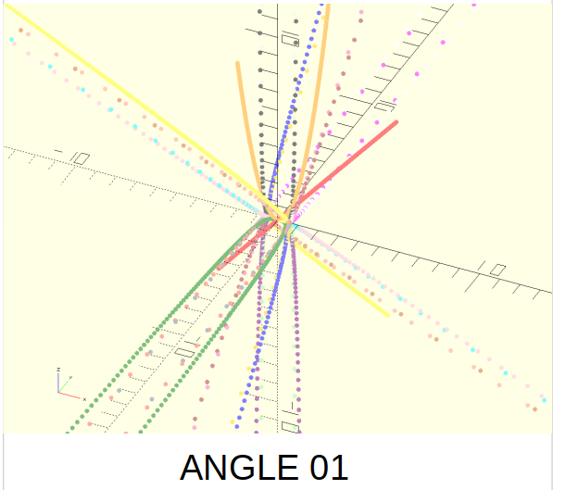
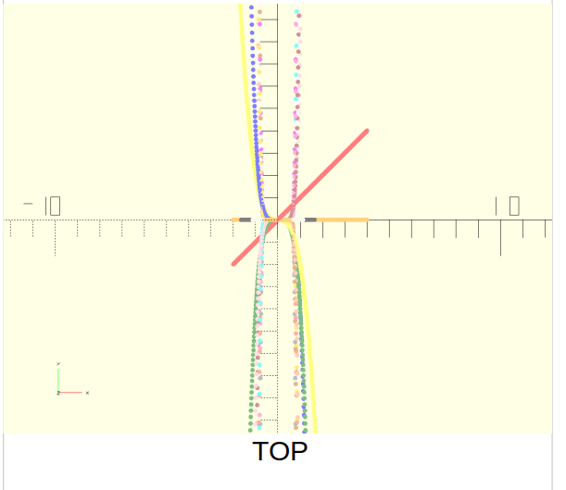
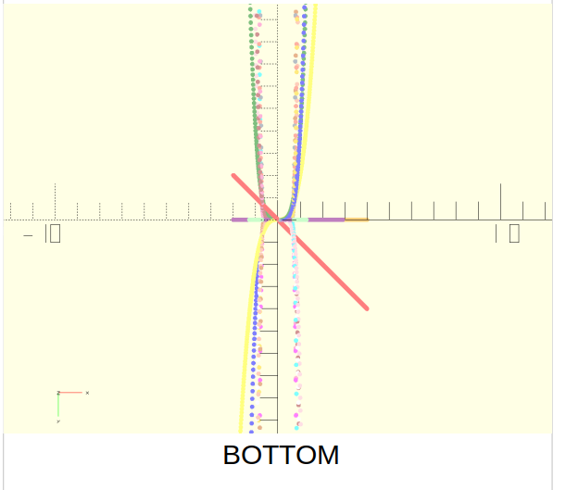
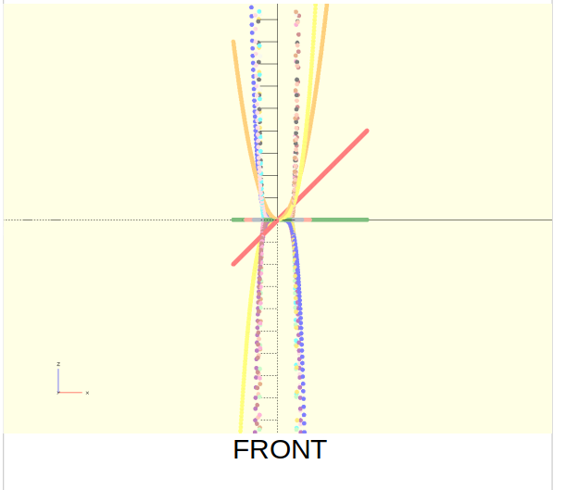
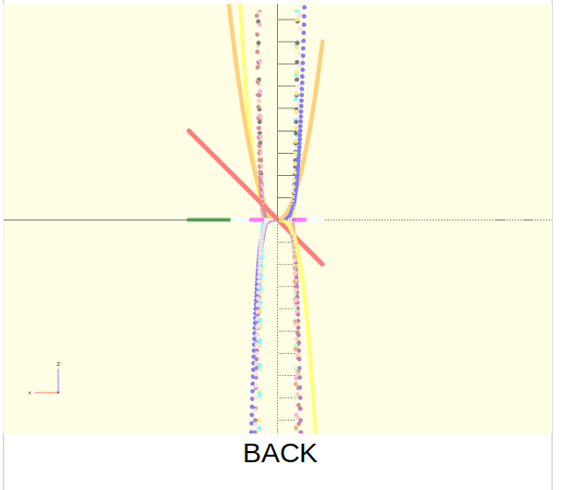
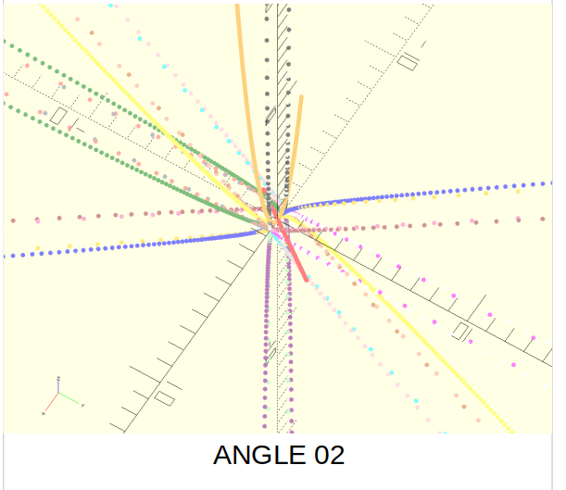
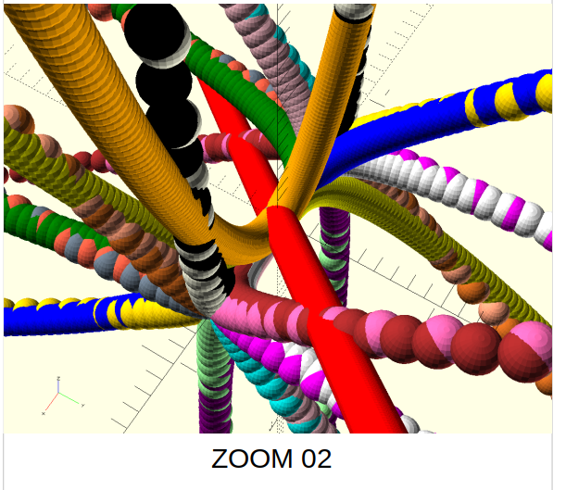
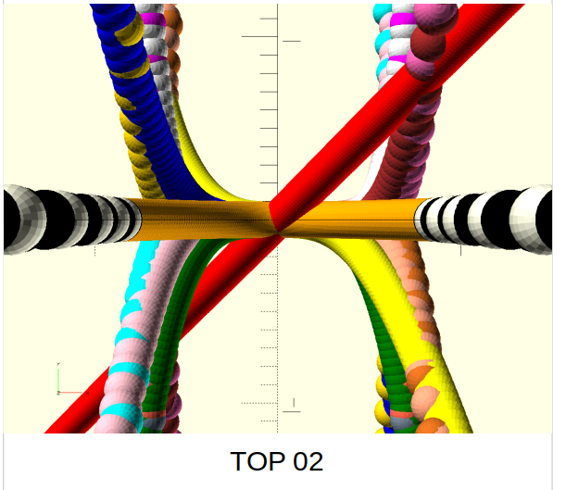
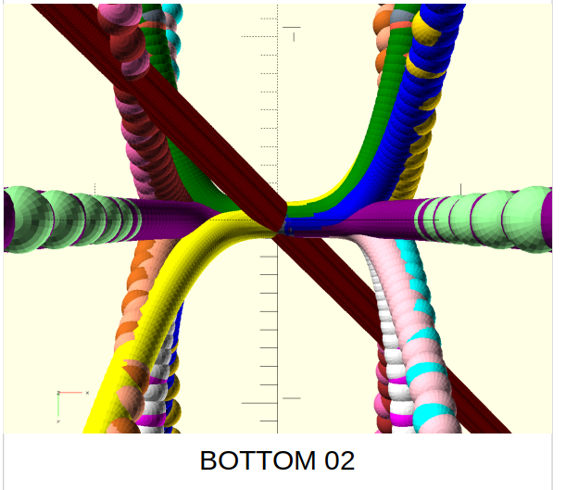
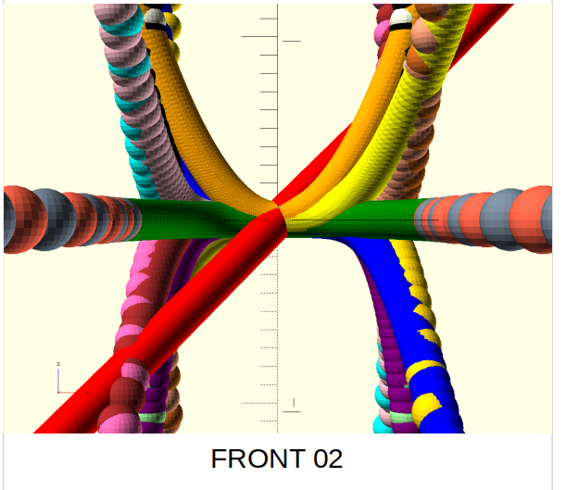
THE FOLLOWING PROGRAM IS WRITTEN FOR OPENSCAD AND PLOTS THE SOLUTIONS TO LAPLACE'S EQUATION
FOR TWENTY DIFFERENT EQUATIONS ON ONE THREE DIMENSIONAL GRAPH WITHOUT USING THE TECHNIQUES
OF CALCULUS.
THIS IS A PRACTICAL DEMONSTRATION OF THE CANDOR, FOUR-D, WHICH STANDS FOR 'FOUR DIMENSIONAL', TOOL AT WORK. NOTE THAT THE FOLLOWING PROGRAM CAN BE PLACED DIRECTLY IN ANY OPENSCAD EDITOR
AND IT WILL WORK AUTOMATICALLY.
___________________________________________________________________________________________________
// OPENSCAD PROGRAM FOR DRAWING LAPLACE EQUATION OBJECT.
$fn=25;
// EQUATION 01 X = a Y = 2^0a Z = 2^0
for (t=[-3:0.01:3]) color("Red"){
translate([t+1,t+1,t+1])
sphere(r=.1);
}
// EQUATION 02 X = a Y = 0 Z = 2^1a^2i
for (t=[-3:0.01:3]) color("Orange"){
translate([t+1,0,2*(t+1)^2])
sphere(r=.1);
}
// EQUATION 03 X = a Y = -2^1a^3 Z = 2^1a^3i for (t=[-3:0.01:3]) color("Yellow"){
translate([t+1,-2*(t+1)^3,2*(t+1)^3])
sphere(r=.1);
}
// EQUATION 04 X = a Y = -2^2a^4 Z = 0
for (t=[-3:0.01:3]) color("Green"){
translate([t+1,-4*(t+1)^4,0])
sphere(r=.1);
}
// EQUATION 05 X = a Y = -2^2a^5 Z = -2^2a^5i for (t=[-3:0.01:3]) color("Blue"){
translate([t+1,-4*(t+1)^5,-4*(t+1)^5])
sphere(r=.1);
}
// EQUATION 06 X = a Y = 0 Z = -2^3a^6i
for (t=[-3:0.01:3]) color("Purple"){
translate([t+1,0,-8*(t+1)^6])
sphere(r=.1);
}
18 of 37
2/17/25, 6:40 PM
file:///home/g/DYNAMISM:%20THE%20FOURTH%2...
// EQUATION 07 X = a Y = 2^3a^7 Z = -2^3a^7i for (t=[-3:0.01:3]) color("Pink"){
translate([t+1,8*(t+1)^7,-8*(t+1)^7])
sphere(r=.1);
}
// EQUATION 08 X = a Y = 2^4a^8 Z = 0
for (t=[-3:0.01:3]) color("White"){
translate([t+1,16*(t+1)^8,0])
sphere(r=.1);
}
// EQUATION 09 X = a Y = 2^4a^9 Z = 2^4a^9i for (t=[-3:0.01:3]) color("Brown"){
translate([t+1,16*(t+1)^9,16*(t+1)^9])
sphere(r=.1);
}
// EQUATION 10 X = a Y = 0 Z = 2^5a^10i
for (t=[-3:0.01:3]) color("Black"){
translate([t+1,0,32*(t+1)^10])
sphere(r=.1);
}
// EQUATION 11 X = a Y = -2^5a^11 Z = 2^5a^11i for (t=[-3:0.01:3]) color("LightSalmon"){
translate([t+1,-32*(t+1)^11,32*(t+1)^11])
sphere(r=.1);
}
// EQUATION 12 X = a Y = -2^6a^12 Z = 0
for (t=[-3:0.01:3]) color("Tomato"){
translate([(t+1),-64*(t+1)^12,0])
sphere(r=.1);
}
// EQUATION 13 X = a Y = -2^6a^13 Z = -2^6a^13i for (t=[-3:0.01:3]) color("Gold"){
translate([(t+1),-64*(t+1)^13,-64*(t+1)^13])
sphere(r=.1);
}
// EQUATION 14 X = a Y = 0 Z = -2^7a^14i
for (t=[-3:0.01:3]) color("PaleGreen"){
translate([(t+1),0,-128*(t+1)^14])
sphere(r=.1);
}
// EQUATION 15 X = a Y = 2^7a^15 Z = -2^7a^15i for (t=[-3:0.01:3]) color("Aqua"){
translate([(t+1),128*(t+1)^15,-128*(t+1)^15])
sphere(r=.1);
}
// EQUATION 16 X = a Y = 2^8a^16 Z = 0
for (t=[-3:0.01:3]) color("Magenta"){
translate([(t+1),256*(t+1)^16,0])
sphere(r=.1);
}
// EQUATION 17 X = a Y = 2^8a^17 Z = 2^8a^17i for (t=[-3:0.01:3]) color("HotPink"){
translate([(t+1),256*(t+1)^17,256*(t+1)^17])
sphere(r=.1);
}
19 of 37
2/17/25, 6:40 PM
file:///home/g/DYNAMISM:%20THE%20FOURTH%2...
// EQUATION 18 X = a Y = 0 Z = 2^9a^18i
for (t=[-3:0.01:3]) color("Beige"){
translate([(t+1),0,512*(t+1)^18])
sphere(r=.1);
}
// EQUATION 19 X = a Y = -2^9a^19 Z = 2^9a^19i for (t=[-3:0.01:3]) color("Chocolate"){
translate([(t+1),-512*(t+1)^19,512*(t+1)^19])
sphere(r=.1);
}
// EQUATION 20 X = a Y = -2^10a^20 Z = 0
for (t=[-3:0.01:3]) color("SlateGray"){
translate([(t+1),-1024*(t+1)^20,0])
sphere(r=.1);
}
OPENSCAD FOR LINUX OPERATING SYSTEMS
___________________________________________________________________________________________________
NOTE THAT THE IN THE ABOVE, THE EXPRESSION THAT FOLLOWS THE 'TRANSLATE' COMMAND IS ALWAYS OF
THE FORM 'TRANSLATE([x(t), y(t), z(t)]). AS LONG AS THE HIGHEST EXPONENT OF 'x(t)' IS LESS THAN TWO, THEN
THE SECOND DERIVATIVE WILL BE EQUAL TO ZERO. IN THE ABOVE, 'x(t) = t + 1' EVERYTIME AND THUS MEETS
THIS REQUIREMENT. THE INPUT TO THE BINOMIAL EQUATION IS A COMPLEX VALUED INPUT WHICH ACTUALLY
TAKES THE FORM:
x(t) + ix(t) =
(t + 1) + i(t + 1)
THE OUTPUT IS ALSO A COMPLEX VALUED OUTPUT OF THE FORM: y(t) + iz(t) =
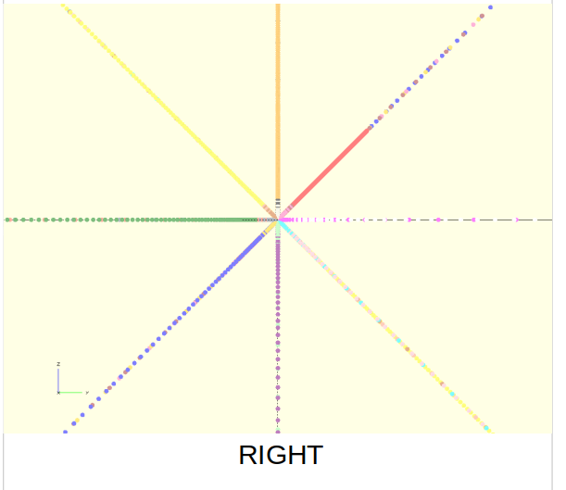
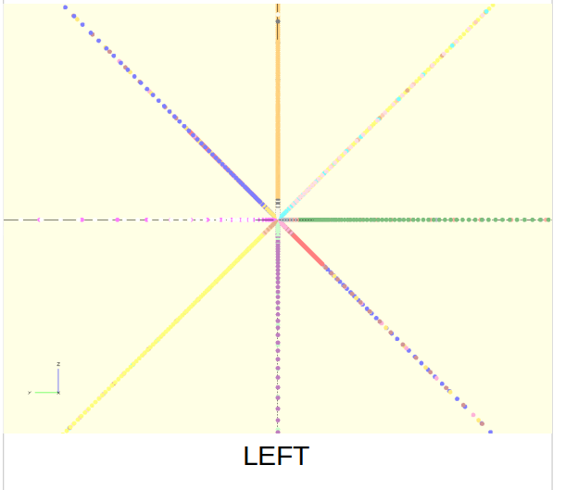
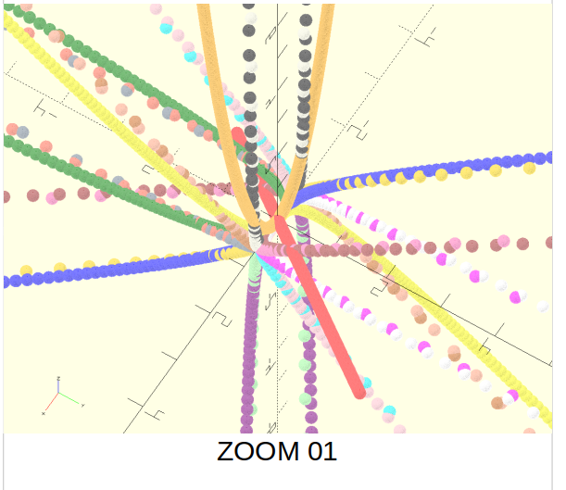
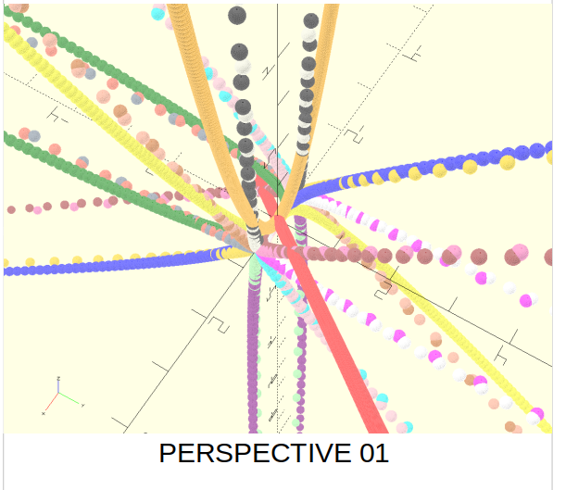
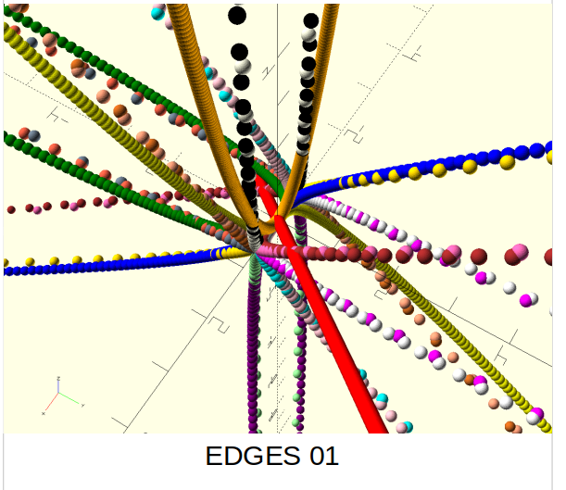
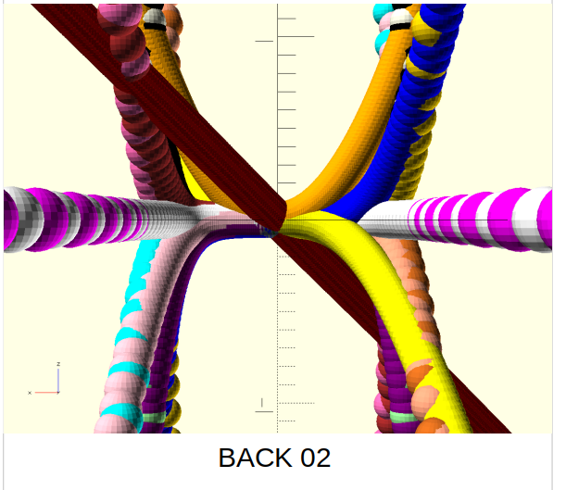
THUS EVERY POINT IN THE FOLLOWING 'GRAPH OBJECT' REPRESENTS A COMPLEX VALUED OUTPUT OF A COMPLEX VALUED INPUT WHICH IMPLICITLY CONTAINS THE INFORMATION FOR THE THREE DIMENSIONS OF
SPACE 'x', 'y' AND 'z', AND THE FOURTH DIMENSION OF TIME 't'. THEREFORE, THESE SOLUTIONS TO LAPLACE'S
EQUATION ARE CONTAINED IN ONE GRAPH OBJECT THAT WAS BUILT UP WITHOUT USING ANY OF THE
TECHNIQUES OF CALCULUS WHICH PROVES THAT HODGE'S INTUITION WAS CORRECT; AND THE FOLLOWING
IMAGES CLEARLY SHOW THAT THE HODGE CONJECTURE IS INDEED TRUE!
___________________________________________________________________________________________________
20 of 37
2/17/25, 6:40 PM
Firefox
file:///home/g/DYNAMISM:%20THE%20FOURTH%2...
21 of 37
2/17/25, 6:40 PM
Firefox
file:///home/g/DYNAMISM:%20THE%20FOURTH%2...
22 of 37
2/17/25, 6:40 PM
Firefox
file:///home/g/DYNAMISM:%20THE%20FOURTH%2...
23 of 37
2/17/25, 6:40 PM
Firefox
file:///home/g/DYNAMISM:%20THE%20FOURTH%2...
24 of 37
2/17/25, 6:40 PM
Firefox
file:///home/g/DYNAMISM:%20THE%20FOURTH%2...
25 of 37
2/17/25, 6:40 PM
Firefox
file:///home/g/DYNAMISM:%20THE%20FOURTH%2...
26 of 37
2/17/25, 6:40 PM
Firefox
file:///home/g/DYNAMISM:%20THE%20FOURTH%2...
27 of 37
2/17/25, 6:40 PM
Firefox
file:///home/g/DYNAMISM:%20THE%20FOURTH%2...
28 of 37
2/17/25, 6:40 PM
Firefox
file:///home/g/DYNAMISM:%20THE%20FOURTH%2...
29 of 37
2/17/25, 6:40 PM
Firefox
file:///home/g/DYNAMISM:%20THE%20FOURTH%2...
30 of 37
2/17/25, 6:40 PM
Firefox
file:///home/g/DYNAMISM:%20THE%20FOURTH%2...
31 of 37
2/17/25, 6:40 PM
Firefox
file:///home/g/DYNAMISM:%20THE%20FOURTH%2...
32 of 37
2/17/25, 6:40 PM
Firefox
file:///home/g/DYNAMISM:%20THE%20FOURTH%2...
33 of 37
2/17/25, 6:40 PM
Firefox
file:///home/g/DYNAMISM:%20THE%20FOURTH%2...
34 of 37
2/17/25, 6:40 PM
Firefox
file:///home/g/DYNAMISM:%20THE%20FOURTH%2...
35 of 37
2/17/25, 6:40 PM
Firefox
file:///home/g/DYNAMISM:%20THE%20FOURTH%2...
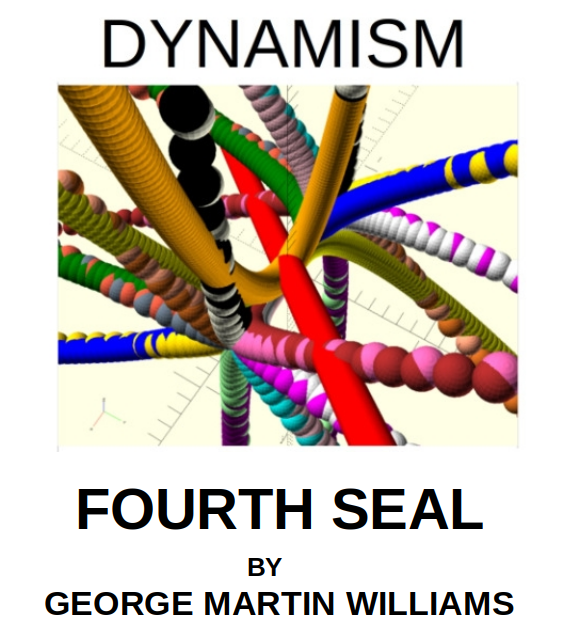
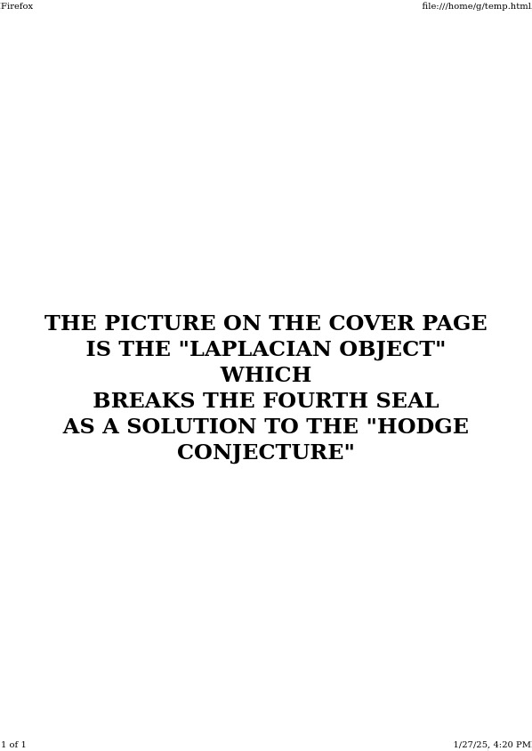
THE 'LAPLACE EQUATION OBJECT'
___________________________________________________________________________________________________
BREAKING THE FOURTH SEAL
___________________________________________________________________________________________________
Revelation 6:7-8
King James Version
7 And when he had opened the fourth seal, I heard the voice of the fourth beast say, Come and see.
8 And I looked, and behold a pale horse: and his name that sat on him was Death, and Hell followed with him. And power was given unto them over the fourth part of the earth, to kill with sword, and with hunger, and with death, and with the beasts of the earth.
___________________________________________________________________________________________________
___________________________________________________________________________________________________
Genesis 1:14-19
King James Version
14 And God said, Let there be lights in the firmament of the heaven to divide the day from the night; and let them be for signs, and for seasons, and for days, and years:
15 And let them be for lights in the firmament of the heaven to give light upon the earth: and it was so.
16 And God made two great lights; the greater light to rule the day, and the lesser light to rule the night: he made the stars also.
36 of 37
2/17/25, 6:40 PM
file:///home/g/DYNAMISM:%20THE%20FOURTH%2...
17 And God set them in the firmament of the heaven to give light upon the earth, 18 And to rule over the day and over the night, and to divide the light from the darkness: and God saw that it was good.
19 And the evening and the morning were the fourth day.
___________________________________________________________________________________________________
37 of 37
2/17/25, 6:40 PM
You may also like...
-
DYNAMISM Mathematics (Academic) by GEORGE MARTIN WILLIAMSDYNAMISM
Reads:
7Pages:
151Published:
Feb 2025THIS BOOK INCLUDES THE FIRST THREE SOLUTIONS TO THREE OF THE SEVEN MILLENNIUM PROBLEMS. IN THE FULL SERIES, THE AUTHOR ATTEMPTS TO SOLVE ALL SEVEN OF THE MI...
Formats: PDF, Epub, Kindle, TXT
-
Perfect Reasoning Mathematics (Academic) by Tiro Phenyo NkauPerfect Reasoning
Reads:
58Pages:
31Published:
Jul 2024Bodmas or Bermdas?Is 8 ÷ 4 × 42 × 4 = 8 or 8 ÷ 16 = 0,5?Let Perfect reasoning help you decide which one to choose.
Formats: PDF, Epub, Kindle, TXT
-
The amazing world of the golden ratio (phi) - part 2 Mathematics (Academic) by Folding CirclesThe amazing world of the golden ratio (phi) - part 2
Reads:
231Pages:
26Published:
Mar 2022The amazing world of the golden ratio (phi) - part 2. Tracking the golden thread through geometry using cosmic geometry. This method sheds a new light on anot...
Formats: PDF, Epub, Kindle, TXT
-
Fundamentals of Thermodynamics: Part 1 Mathematics (Academic) by Nestor AzzizFundamentals of Thermodynamics: Part 1
Reads:
213Pages:
52Published:
Feb 2021This book has been written to help college students obtain a better understanding of the foundations of thermodynamics.
Formats: PDF