

Core Concepts of Marketing by John Burnett - HTML preview
Download the book in PDF, ePub, Kindle for a complete version.
CHAPTER 9
PRICING THE PRODUCT
PR ICE
I
I
VALUE =PERCEIVED BENEFITS - PERCEIVED COSTS
FIGURE 9 .1
The customer's vi ew of price
To a certain extent, perceived benefi ts are the mirror image of perceived costs. For
example, paying a premium price-e.g. , $650 for a piece of Lalique crystal-is
sated for by having this exquisite work of art displayed in one's home. Other possible
ceived benefits directly related to the price- value equation are status, convenience, the deal , brand, quality, choice, and so forth. Many of these benefits tend to overlap. For instance,
a Mercedes Benz E 750 is a very high-status brand name and possesses superb quality. This
makes it worth the $100,000 price tag. Further, if Mark Smith can negotiate a deal
ing the price by $ 15,000, that would be his incentive to purchase. Likewise, someone
ing in an isolated mountain community is willing to pay substantially more for groceries
at a local store rather than drive 78 miles to the nearest Safeway. That person is also
ing to sacrifice choice for greater convenience. Increasing these perceived benefits is rep-
resented by a recently coined term-value-added. Thus, providing value-added elements
to the product has become a popular strategic alternative. Computer manufacturers now
pete on value-added components such as free delivery setup, training, a
help line,
trade-in, and upgrades .
Perceived costs include the actual dollar amount printed on the product, plus a host
of additional factors. As noted, these perceived costs are the mirror-opposite of the
fits. When fi nding a gas station that is selling its highest grade for 6¢ less per gallon, the
customer mus t consider the
drive to get there, the long line, the fact that the
dle grade is not available, and heavy traffi c. Therefore, inconvenience, limited choice, and
poor service are possible perceived costs. Other common perceived costs include risk of
making a mistake, related costs, lost opportunity, and unexpected consequences, to name
but a few. A new cru ise traveler discovers she really doesn' t enjoy that venue for several
reasons-e.g., she is given a bill for incidentals when she leaves the ship, she has used up
her vacation time and money, and she receives unwanted materials from this company for
years to come.
In the end, viewing price fro m the customer's
pays off in many ways. Most
notably, it helps define value-the most important basis for creating a competitive advantage.
Price from a Societal Perspective
Price, at least in dollars and cents, has been the historical view of value. Derived from a
bartering system-i.e., exchanging goods of equal value-the monetary system of each soci-
ety provides a more convenient way to purchase goods and accumulate wealth . Price has
also become a variable society employs to control its economic health. Price can be
sive or exclusive. In many countries, such as Russia, China, and South Africa, high prices
for products such as foo d, health care, housing, and automobiles, means that most of the
population is excluded from purchase. In contrast, countries such as Denmark, Germany,
and Great Britain charge little for health care and consequently make it available to all .
There are two different ways to look at the role price plays in a society: rational man
and irratio nal man. The former is the primary assumption underlying economic theory, and








PRICE DEFINED:THREE DIFFERENT PERSPECTIVES
229
suggests that the results of price manipulatio'1 are predictable. The latter role for price
acknowledges that man's response to price is sometimes unpredictable and pretesting price
manipulation is a necessary task. Let's discuss each briefly.
Rational Man Pricing: An Economic Perspective
Basically,
the consumer is a rational decision maker and has per-
fect :nformation.
if a price for a particular product goes up and the customer is
aware of all relevant information, demand will be reduced for that product. Should price
decline, demand would increase. That is, the quantity demanded typically rises causing a
downward sloping demand curve.
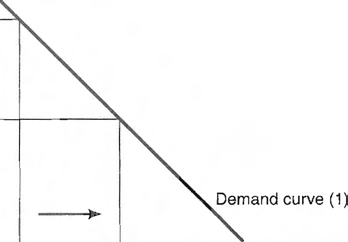
A demand curve shows the quantity demanded at various price levels (see Figure 9.2).
As a seller changes the price requested to a lower
product or service may become
an attractive use of fin ancial resources to a larger number of buyers, thus expanding the
total market for the item. This total market demand by all buyers for a product type (not
just for the company 's own brand name) is
primary demand. Additionally, a lower
price may cause buyers to shift purchases from competitors, assuming that the competitors
do not
the lower price. If
demand
not expand and competitors meet the
lower price the result will be lower total revenue
all sellers.
Since, in the U.S., we operate as a free market economy, there are few instances when
someone outside the organization controls a product's price. Even commodity-like prod-
ucts such as air travel, gasoline, and telecommunications, now determine their own prices.
Because large companies have economists on staff and buy into the assumptions of eco-
nomic
as it relates to price, the classic price-demand relationship dictates the eco-
nomic health of most societies. Alan Greenspan, Chairman of the U. S. Federal Reserve,
determines interest rates charged by banks as well as the money supply, thereby directly
affecting price (especially of stocks and bonds). He is considered by many to be the most
influential person in the world.
o
100
140
Quantity demanded in a given period of time (# of units)
A
reduction in price unit would cause a 40-unit increase in the
quantity demanded assuming no other variable changes.
FIGURE 9.2
Price and der;land



230