

Core Concepts of Marketing by John Burnett - HTML preview
Download the book in PDF, ePub, Kindle for a complete version.
CHAPTER 7
INTRODUCING AND MANAGING THE PRODUCT
AD 7.2
The "Got Mi lk" campaign ma de an old product new.
1. Mergers and Acquisitions. Acquiring another company already successful in a
fi eld your company wishes to enter
an effective way of introducing products
while still diversifying. Research suggests that mergers and acquisitions can take
place between companies of various sizes and backgrounds, and that fi rst expe-
riences with th is process tend to be less than satisfactory. Even large marketers
such as General Motors engage in acquisitions.

PRODUCT PLANNING AND STRATEGY FORMULATION
173
2. Licenses and Patents. A patent, and the related license, arise from legal efforts
to protect property rights of investors or of those who own inventions. A patent
is acquired from the U.S. Patent Office and provides legal coverage for a period
of seventeen years, which means all other manufacturers are excluded from mak-
ing or marketing the product. However, there are no foolproof ways to prevent
competition. There are two main types of patents: those for products and those
for processes. The first covers only the product's physical attributes while the lat-
ter covers only a phase of a production procedure, not the product. The patent holder
has the right to its assignment or license. An assignment is any outright sale, with
the transfer of all rights of ownership conveyed to the assignee. A license is a right
to use the patent for certain considerations in accordance with specific terms, but
legal title to the patent remains with the licensor.
3. Joint Ventures. When two or more companies create a third organization to con-
duct a new business, a joint venture exists. This organization structure emerges,
primarily, when either the risk or capital requirements are too great for any sin-
gle firm to bear. Lack of technical expertise, limited distribution networks, and
unfamiliarity with certain markets are other possible reasons . Joint ventures are
common in industries such as oil and gas, real estate, and chemicals, or between
foreign and domestic partners.
Joint ventures have obvious application to product development. For exam-
ple, small firms with technological resources are afforded an opportunity to acquire
capital
marketing expertise provided by a larger firm.
The New Product Development Process
Evidence suggests that there may be as many varieties of new product development sys-
tems as there are kinds of companies. For the most part, most companies do have a formal
comprehensive new product development system, and the evolution of such systems were
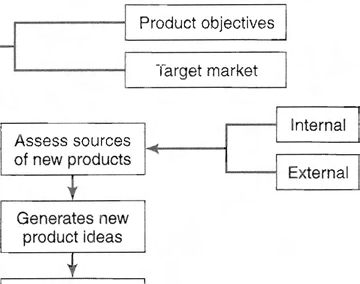
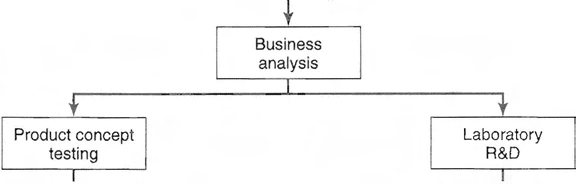
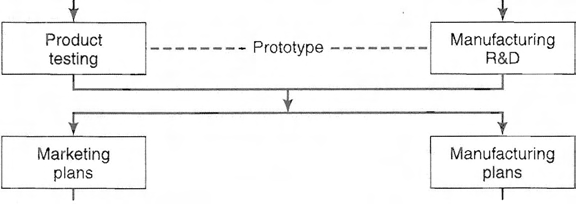
not necessarily the result of systematic planning. The list of activities suggested in Figure
7.5 illustrates the extensiveness of this process. Because of the complexity of the process,
it is important that the general guidelines of effective management be applied to new prod-
uct development. 13
Before starting our discussion of the eight-step process of new product development,
a necessary caveat should be considered: a great many new products fail. Depending on
definitions used fol' products actually introduced, failure rates range between 20 percent
and 30 percent, but have been as high as 80 percent. Of more concern than the level of fail-
ure are the reasons for failure . Possibilities include: technical problems, bad timing, mis-
understanding the consumer, actions by competitors, and misunderstanding the environment.
Step 1: Generating New Product Ideas
Generating new product ideas is a creative task that requires a specific way of thinking.
Gathering ideas is easy, but generating good ideas is another story. Examples of internal
sources are
1. Basic research: many companies, such as DuPont, have several scientists who are
assigned the task of developing new product ideas and related technology.
2. Manufacturing: people who manufacture products often have ideas about modi-
fications and improvements, as well as completely new concepts.









174