

Engineering Mindset for Early-Career Developers by Moyinoluwalogo O. Mayowa - HTML preview
Download the book in PDF, ePub, Kindle for a complete version.
CHAPTER 11
PERFORMANCE AND OPTIMIZATION MINDSET
INTRODUCTION
As software systems grow and handle increasing numbers of users, performance becomes an important consideration.
Performance refers to how efficiently a system uses resources and how quickly it responds to requests.
Users expect applications to be fast and responsive. Slow systems can lead to frustration, reduced engagement, and lost business opportunities.
However, optimizing performance requires careful thinking. Engineers must understand where performance issues originate and how improvements can be made without introducing unnecessary complexity.
This chapter explores how developers can develop a performance and optimization mindset.
UNDERSTANDING PERFORMANCE
Performance in software systems can be influenced by several factors, including:
• processing speed
• database queries
• network latency
• memory usage
• system architecture
Performance problems often appear when systems scale to handle large workloads.
For example, a system that works well with ten users may struggle when serving thousands of users simultaneously.
Engineers must analyze how systems behave under increasing demand.
IDENTIFYING PERFORMANCE BOTTLENECKS
A bottleneck occurs when one component limits the overall performance of a system.
Common bottlenecks include:
• inefficient database queries
• slow external APIs
• excessive memory usage
• blocking operations
Performance analysis tools help engineers identify these bottlenecks.
Examples include:
• monitoring dashboards
• profiling tools
• logging systems
Once bottlenecks are identified, developers can focus optimization efforts on the most critical areas.
THE DANGER OF PREMATURE OPTIMIZATION
While performance is important, optimizing too early can waste time and create unnecessary complexity.
This concept is often summarized by the phrase:
“Premature optimization is the root of many engineering problems.”
Before optimizing code, developers should measure system performance and confirm that a real issue exists.
Optimization should be guided by data rather than assumptions.
EFFICIENT ALGORITHMS AND DATA STRUCTURES
The choice of algorithms and data structures significantly affects system performance.
For example:
• searching through a list can be slow for large datasets
• using appropriate indexing can dramatically improve database performance
Understanding algorithm efficiency helps developers design systems that scale effectively.
CACHING STRATEGIES
Caching is a common technique used to improve system performance.
A cache stores frequently used data so that it can be retrieved quickly without repeating expensive operations.
Examples include:
• caching database query results
• storing frequently accessed API responses
• using content delivery networks for static files
Caching can significantly reduce system load and improve response times.
However, engineers must also manage cache consistency to ensure data remains accurate.
ASYNCHRONOUS PROCESSING
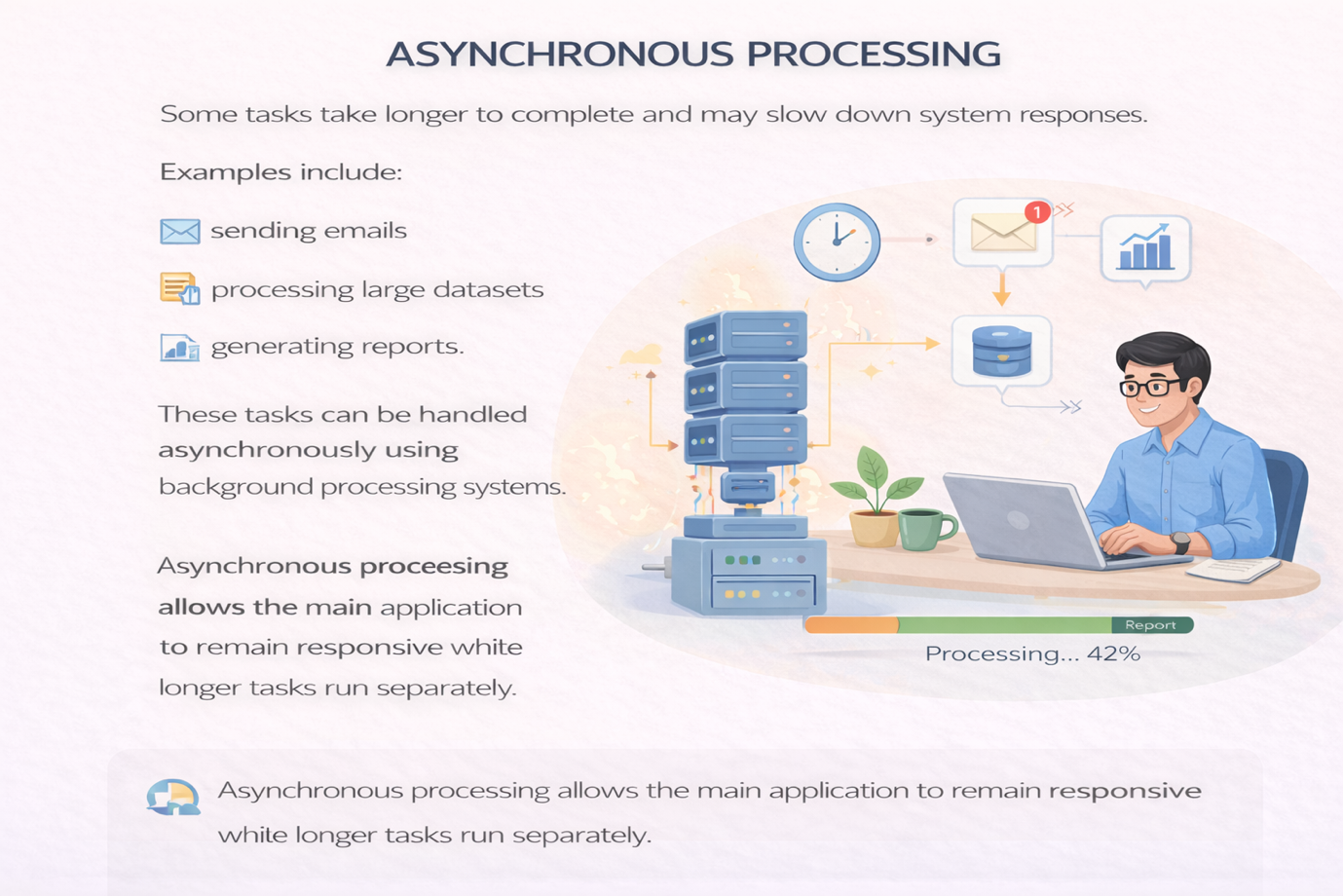
Some tasks take longer to complete and may slow down system responses.
Examples include:
• sending emails
• processing large datasets
• generating reports
These tasks can be handled asynchronously using background processing systems.
Asynchronous processing allows the main application to remain responsive while longer tasks run separately.
MONITORING PERFORMANCE
Continuous monitoring is essential for maintaining system performance.
Monitoring tools track metrics such as:
• response time
• system load
• database query duration
• error rates
These metrics help engineers detect performance problems early and respond quickly.
PERFORMANCE AND USER EXPERIENCE
Performance directly affects user satisfaction.
Even small delays can impact how users perceive an application.
Studies have shown that users expect pages to load within seconds.
Engineers must consider performance as part of the overall user experience.