

Engineering Mindset for Early-Career Developers by Moyinoluwalogo O. Mayowa - HTML preview
Download the book in PDF, ePub, Kindle for a complete version.
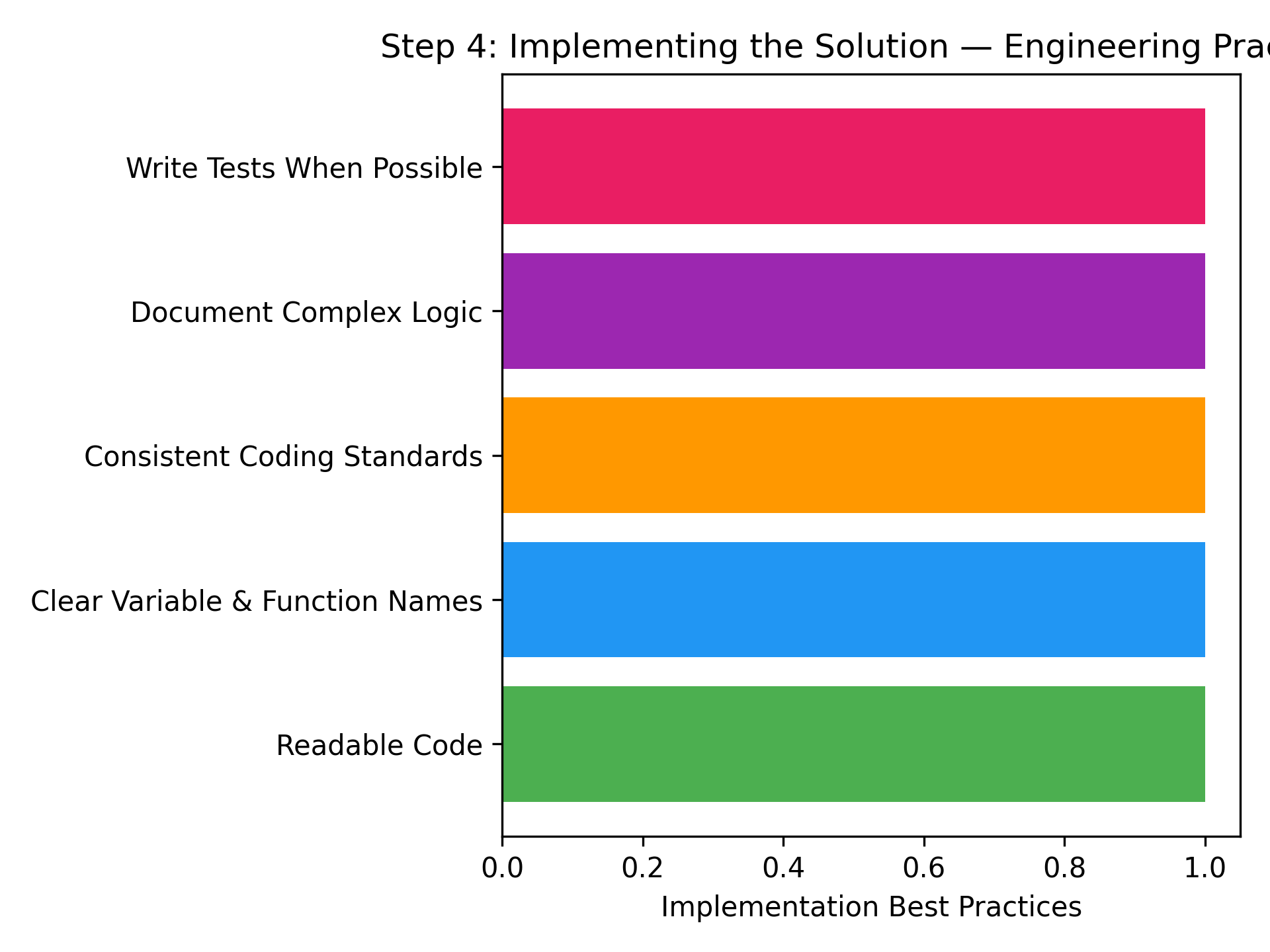
These practices make the solution easier to maintain and improve later.
Early-career developers sometimes rush through implementation to finish tasks quickly. However, careful implementation often saves time in the long run by preventing bugs and maintenance issues.
STEP 5: EVALUATING AND IMPROVING THE SOLUTION
Once the solution is implemented, engineers evaluate its effectiveness.
Evaluation may involve:
• testing functionality
• reviewing code quality
• measuring performance
• gathering feedback from users
Sometimes the first solution is not the best one. Engineers continuously refine their work.
For example, an initial implementation might solve the problem but run slowly when handling large datasets.
In such cases, developers analyze the performance bottlenecks and improve the system.
This iterative process of improvement is central to engineering.
LOGICAL THINKING AND ANALYTICAL SKILLS
Problem solving relies heavily on logical reasoning.
Developers must evaluate information, identify patterns, and eliminate incorrect assumptions.
Analytical thinking involves examining problems step by step.
For example, when debugging a system failure, an engineer might ask:
• Did the problem start after a recent update?
• Are there error messages in the logs?
• Which component failed first?
By narrowing down possibilities, engineers gradually move closer to the root cause.
This process resembles scientific investigation.
THE IMPORTANCE OF ASKING THE RIGHT QUESTIONS
Many problems become easier to solve when the right questions are asked.
Early-career developers sometimes hesitate to ask questions because they worry about appearing inexperienced.
However, asking thoughtful questions is a sign of professionalism.
Questions might include:
• What are the exact requirements?
• Are there edge cases we should consider?
• How will this feature interact with existing systems?
• What performance expectations exist?
Clarifying these details early prevents misunderstandings later.
DEVELOPING A HYPOTHESIS
When solving problems, engineers often form hypotheses.
A hypothesis is an educated guess about the cause of a problem or the effectiveness of a solution.
For example, if a website loads slowly, a developer might hypothesize that a particular database query is inefficient.
The developer can then test this hypothesis by measuring query performance.
If the hypothesis proves correct, optimization can begin.
If not, the developer explores other possibilities.
This methodical approach prevents wasted effort.