

Ponitka's Pierogi by Edward Drobinski - HTML preview
Download the book in PDF, ePub, Kindle for a complete version.
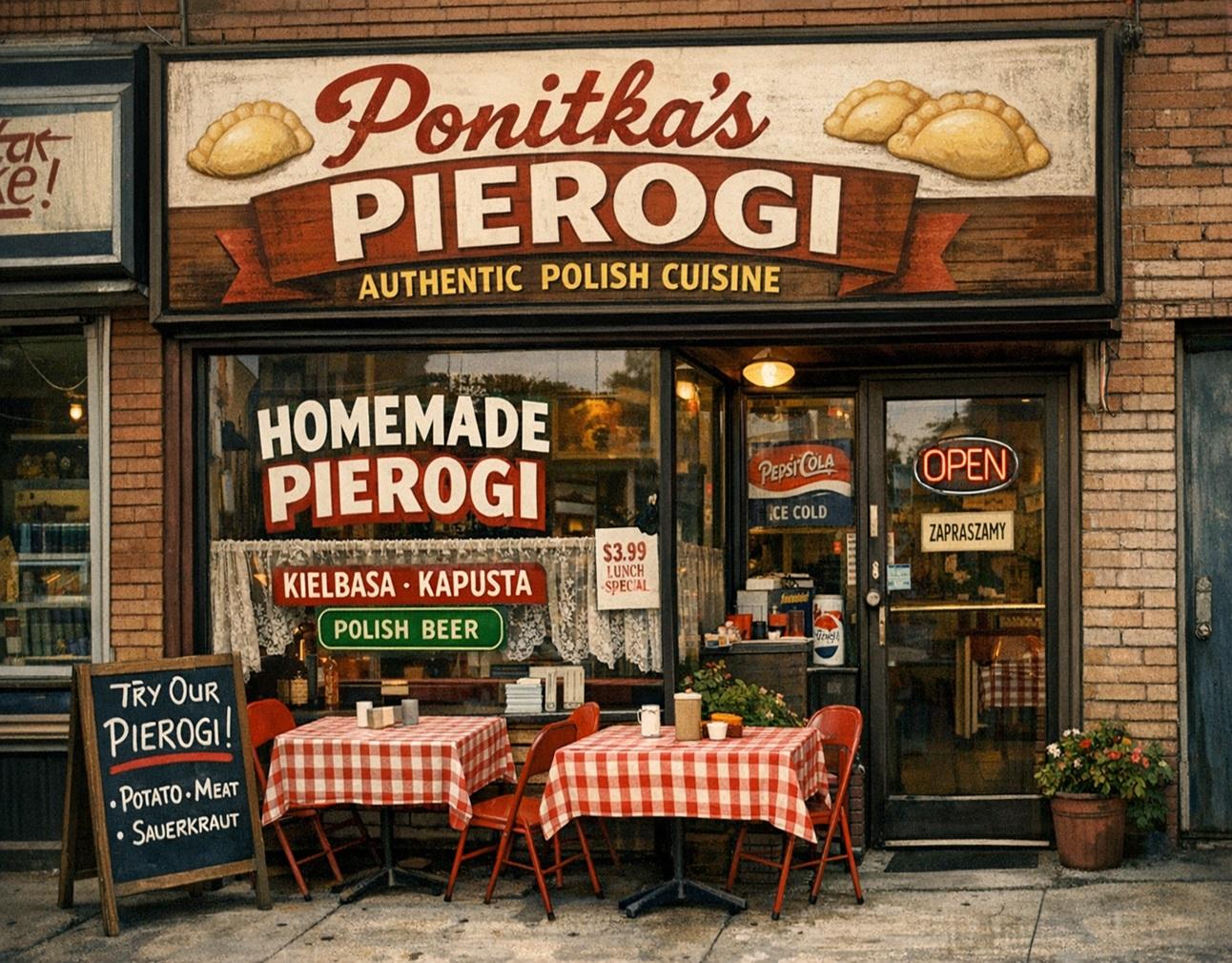
It was a humble storefront, proud signage, a little too much confidence in the neon budget. It felt like the kind of place where the pierogi was handmade and the pricing was improvised. The original Ponitka’s Pierogi in Albion didn’t look like a business trying to save a town. It looked like a place that simply refused to die. Mama Ponitka was there everyday, all day; and had chased Norm Pitkin out while threatening him with a large wooden spoon. Everyone thought that she owned the place, including her.
The storefront sat on a tired commercial strip; brick buildings with more memories than tenants, yet Ponitka’s announced itself with a kind of cheerful stubbornness. The sign was oversized for the space, a bright, earnest banner promising Authentic Polish Cuisine with pictures of pierogi so glossy they felt aspirational. It wasn’t slick; it was hopeful.
The windows did most of the talking. HOMEMADE PIEROGI. KIELBASA. KAPUSTA. POLISH BEER. The kind of blunt, declarative menu that comes from a family that knows exactly what it does well and sees no reason to apologize for it.
A neon OPEN sign glowed in the doorway, paired with ZAPRASZAMY; a welcome that felt both old country formal and small town friendly. Outside, two tables with red and white checkered cloths tried their best to create a patio where no patio should logically exist. They weren’t stylish; they were sincere. They said; “Sit. Eat. Talk. We’ll make it work.”
A chalkboard leaned against the wall, hand lettered with the day’s offerings; potato, meat, sauerkraut, written with the confidence of someone who knows that three good options beat twenty mediocre ones.
What made it unmistakably Albion was the atmosphere; a little worn, a little improvised, but warm. A place where the town’s past; immigrant, industrial, stubborn, wasn’t nostalgia but texture. A place that didn’t pretend to be anything other than what it was; a family kitchen with a door open to the street.
Ponitka’s didn’t arrive as a revitalization project. It arrived as a gesture. A reminder that even in a shrinking town, something homemade, hot, and honest could still draw people in.
Inside, you could glimpse the Pepsi sign, the narrow counter, the kind of space where you could hear and smell the kitchen even when you couldn’t see it. It felt like a shop built from memory rather than market research. The steam, the argument, the crucifix, the fogged window; every detail was anti-calibrated to evoke the real mechanics of a family run pierogi shop. You can feel the tension between pride and improvisation, between tradition and the daily scramble.