

Ponitka's Pierogi by Edward Drobinski - HTML preview
Download the book in PDF, ePub, Kindle for a complete version.

He assumed that when the checks stopped, nothing else would change. He assumed wrong.

The house’ entrance hall makes an immediate impression. One walks into a space that was built to impress without ever needing to say so. Everything is oversized, carved, weighty. It's the kind of entrance that assumes you'll pause; because the room has already decided it deserves that pause.
A massive central staircase rises gently straight ahead, as if it had all the time in the world, before splitting into two sweeping flights. The wood is dark, heavily carved, almost baroque in its density. The balustrades are ornate but not delicate. This is craftsmanship meant to last a century, not a showpiece meant to be admired from afar. The split staircase creates a ceremonial geometry; the room is symmetrical, but not stiff.
Above everything is a domed glass skylight, segmented like an old conservatory roof. It pours natural light down onto the wood, softening what could otherwise feel imposing. The light makes the space feel inhabited rather than museum like.
The walls are wrapped in rich wood paneling, carved and framed like a library or a historic lodge. Wall sconces with multiple bulbs line the walls; warm, amber light that complements the skylight rather than competing with it. The combination of natural and artificial light gives the room a golden, steady glow.
The floor is parquet, patterned and precise. A large, ornate rug anchors the center, softening the acoustics and giving the staircase a stage like presence.
This is the kind of entrance a man embraces when he wants to signal permanence, not flash. It's old world, heavy, confident. It doesn't try to be modern or clever. It's a room that says; "You've arrived somewhere that took time to build." And for Ponitka; -15 rooms, 15 acres, Pulawski Township, it's exactly the right kind of improbable grandeur; earnest, slightly anachronistic, and completely committed.

The living room opens upward into a vaulted ceiling supported by exposed wooden beams; thick, warm toned, and slightly irregular, the kind that feel hand hewn rather than machined. Two wrought iron chandeliers hang from the beams, their scale matching the height of the room so the space feels grand but not cavernous. A massive stone fireplace anchors the room, built from rough, uneven stones that give it a lodge like solidity. The firebox is framed by a decorative wrought iron screen, more functional than ornamental.
Above it hangs a large abstract painting, a surprising modern note against the rustic stone; just enough tension to keep the room from feeling like a period set. Tall arched windows flank the fireplace, and matching French doors open outward, letting in a soft, natural light that warms the wood and stone. The room feels bright even with the chandeliers lit; daylight and lamplight working together rather than competing.
Plush sofas and armchairs form a conversational square around a polished wooden coffee table. The table holds a few decorative vases, arranged with the kind of restraint that suggests someone tidies the room but doesn't stage it. A patterned area rug anchors the seating area, softening the acoustics and giving the room a center of gravity.
To the right, a built in wooden entertainment unit blends into the wall; dark wood, clean lines, nothing flashy. A small reading nook sits beside it; an armchair, a side table, a piece of wall art.
In the background, an arched doorway leads to what looks like a small bar or study; wood cabinetry, a couple of stools, a quieter, more private zone. This room tells you exactly who Ponitka is without saying a word; rustic bones, because he trusts materials that age well; modern art, because he's not stuck in nostalgia; warmth over spectacle, because he wants people to sit, not gawk; and a vaulted ceiling, but furniture arranged for conversation, not display. It's the room of a man who made it, for at least a while, but didn't forget what comfort feels like.
After staring into the living area, his thoughts drifted to yesterday’s conversation with his wife Ada; childhood sweethearts from the age of 15; she no gold digger, but apparently unable to understand why things have to economically change just because he was no longer in the NBA.
Late evening. Pulawski Township. The house is too big for the silence inside it. Wladyslaw is at the counter sorting mail. Ada, stands by the sink, arms folded; not angry, just bracing.

Ada: Wlady, I looked at the filled out, but as yet unsigned house listing agreement again. And I'm trying, I really am, but I don't understand why everything has to change just because you're not in the league anymore.
Wladyslaw: It's not "just because," Ada. The checks stopped. The per diem stopped. The playoff bonuses stopped. The endorsements dried up the minute I wasn't on TV. That life was built on money that isn't coming in now.
Ada: But we lived that way for twelve years. Twelve. I built a whole rhythm around it. The travel, the house, the trainers, the schools ..... I didn't think it all disappeared the second you weren't wearing a jersey.
Wladyslaw: I didn't think so either. But it does. That's the part nobody tells you. The league is a faucet; on or off. Mine's off.
Ada: I'm not asking for yachts. I'm not asking for Beverly Hills. I just ..... I don't want to go backwards. I don't want to feel like we peaked at thirty-four.
Wladyslaw: We didn't peak. We just finished one chapter. And now we have to live like normal people again.
Ada: But we're not normal. You played in the NBA. We lived in hotels where the pillows had menus. You can't expect me to pretend that didn't happen.
Wladyslaw: I'm not asking you to pretend. I'm asking you to adjust. I'm asking both of us to.
Ada: You adjusted faster than I did. (She softens.) Maybe because you always knew it would end.
Wladyslaw: Every player knows. But they see it as something far away. Then you feel the clock in your knees and you know time is short. But you think “not yet.” Knowing isn't the same as being ready.
Ada: I just thought ..... after everything you did, everything you sacrificed, the league would take care of you. Of us.
Wladyslaw: The league doesn't take care of anyone. They think that’s the agent’s job. It replaces you. That's the business.
Ada: So what do we do?
Wladyslaw: We build something that isn't dependent on a scoreboard. Something that doesn't vanish when my minutes do.
Ada: Like a franchise?
Wladyslaw: (Smiles, embarrassed.) Yeah. Like a franchise. It's stupid, I know .....
Ada: It's not stupid. It's just ..... small. Compared to what we had.
Wladyslaw: Small is fine. Small is real. Small doesn't get cut from the rotation.
Ada: (Sighs, then steps closer.) I married you when you were a skinny kid shooting in a freezing gym. I didn't marry the lifestyle. I just ..... got used to it. And I'm scared of losing it.
Wladyslaw: I'm scared too. But I'd rather lose the lifestyle than lose us.
Ada: (Quiet.) I don't want to lose us either.
They stood there a moment; two people mentally recalibrating, not collapsing.
The Best Is Yet to Come
Frank Sinatra
Out of the tree of life, I just picked me a plum
You came along and everything started in to hum
Still, it's a real good bet
The best is yet to come
Best is yet to come, and babe, won't that be fine?
You think you've seen the sun
But you ain't seen it shine
A wait 'til the warm-up's underway
Wait 'til our lips have met
Wait 'til you see that sunshine day
You ain't seen nothing yet
The best is yet to come, and babe, won't it be fine?
Best is yet to come
Come the day you're mine
Come the day you're mine
I'm gonna teach you to fly
We've only tasted the wine
We're gonna drain the cup dry
Wait 'til your charms are right for these arms to surround
You think you've flown before
But baby, you ain't left the ground
A wait 'til you're locked in my embrace
Wait 'til I draw you near
A wait 'til you see that sunshine place
Ain't nothin' like it here
The best is yet to come, and babe, won't it be fine?
The best is yet to come, come the day you're mine
Come the day you're mine
And you're gonna be mine
Written by Cy Coleman and Carolyn Leigh.
3 – Ponitka’s B-Ball Stats
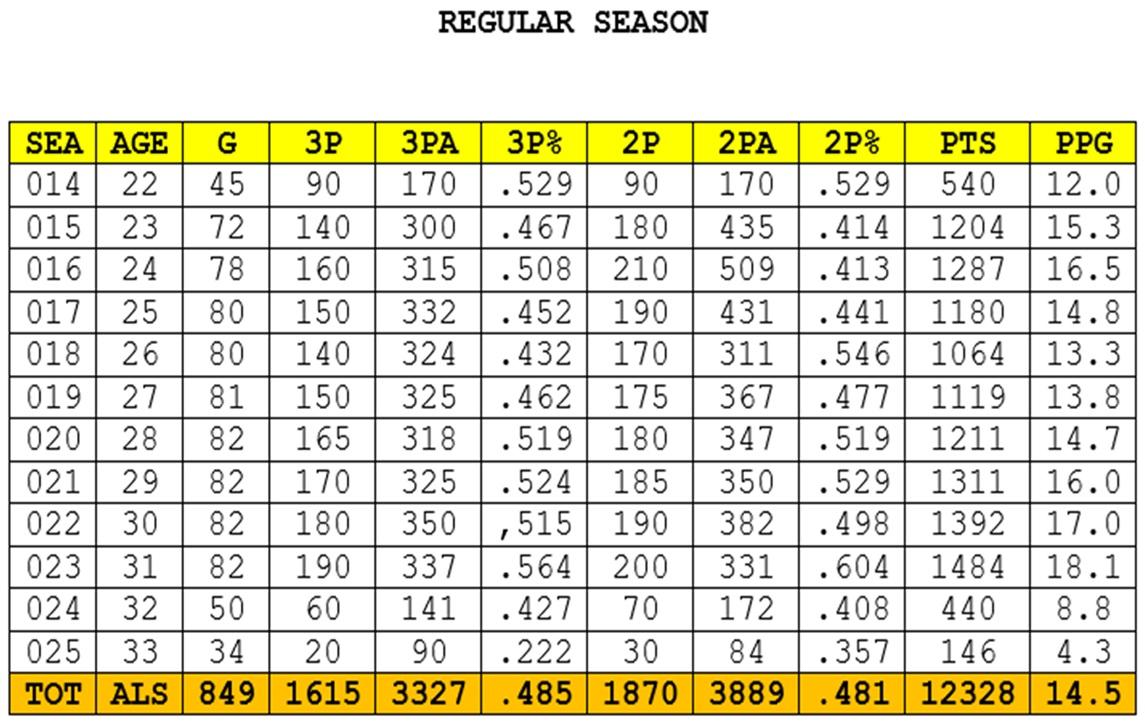
The Career of Wladyslaw Ponitka Ponitka carved out a twelve year NBA career as the league's idealized modern role player; a high efficiency, low usage perimeter shooter who never hijacked an offense, never complained about touches, and reliably punished any defense that lost track of him. Think a mellowed out Danny Ainge with less volume, more durability, and just enough off the dribble competence to stay on the floor in any lineup.
He was never a star, but he was the kind of player stars trusted. Across 849 games, Ponitka averaged 14.5 points per game on elite shooting splits - 3P% - .485 on over 3,300 attempts and 2P% - .481 on nearly 4,000 attempts
That combination is rare. Most elite shooters are specialists; Ponitka was a generalist marksman. He could hit movement threes, spot ups, and transition pull ups, but he also finished enough two pointers to keep defenses honest. His peak years, ages 22-31, show remarkable consistency; always between 12-18 points per game, always efficient, always available.
His late career decline, ages 32-33, fits the arc of a player whose value was tied to legs, rhythm, and repetition. Once the mileage caught up with the injured legs, the games played and shot volume dipped and the percentages followed.
But the body of work is unmistakable. Ponitka was one of the most efficient low volume shooters of his era.
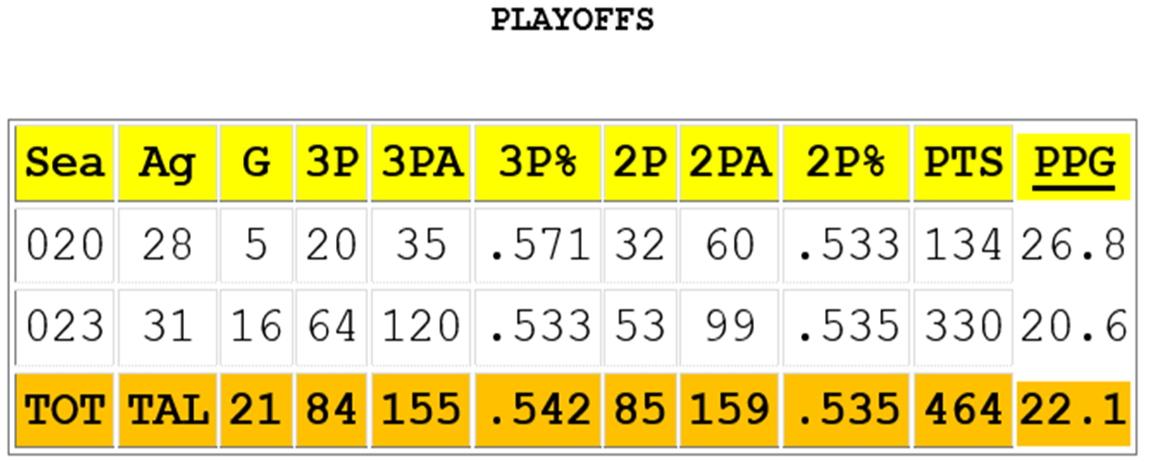
In 21 playoff games, he averaged 22.1 points per game on 3P% - .542, and 2P% - .535. That's not a role player surviving the post season. That's a role player scaling up in the post season.
His 2020 run, 5 games, 26.8 PPG on absurd splits, is the kind of small sample heater that becomes franchise folklore. His 2023 run, 16 games, 20.6 PPG, proved it wasn't a fluke. Ponitka was the rare shooter who didn't shrink under pressure. He expanded.
Coaches loved him because he never broke the offense. He understood spacing, timing, and the geometry of the floor. He didn't need the ball to influence possessions. He didn't need plays drawn for him. He didn't need to be hidden on defense. He was the connective tissue in any lineup; the guy who made the stars' lives easier.
Ponitka never made an All Star team, though he got a few votes in 2023, never led the league in a category, and never had a signature shoe. But he had something more durable; respect. Players trusted him. Coaches relied on him. Fans remembered him as the guy who always hit the shot that stopped a run, or started one.
He retired as a top tier career three point shooter by percentage, a playoff overperformer, a model of consistency and professionalism, and a player whose statistical footprint is bigger than his fame.
And on the other hand, there is always a contrary opinion in the sports world.
Excerpt from "Role Player, My Ass: The Untold Story of a Starter
Stuck on the Bench" by Darius "D Train" Ahmed
“Ponitka? Yeah, I remember him. You want the real story? Fine, man.
Everybody talks about Ponitka like he was this quiet assassin, the efficient glue guy, the coach's dream. And sure, the numbers look clean; because he only took shots he liked, and he only played hard when the lights were bright. Regular season? He coasted. You don't put up the same 13-16 points every year by accident. You do that by not going all out. That's a man who figured out the bare minimum required to keep his reputation intact.
But the playoffs; hardly any and that's where the myth comes from. He'd suddenly turn into a different person. Hit everything. Act like he'd been grinding all year. And then the media would swoon. ‘Ponitka elevates his game when it matters.’ Yeah, well, some of us didn't have the luxury of ‘elevating.’ Some of us had to actually carry the damn load from November to April.
He was like Danny Ainge if Ainge believed his own press clippings.
And don't get me wrong. He could shoot. Best shooter I ever played with. He was very selective. But he never made anyone better. He never bent a defense by himself. He never took the tough assignment. He was a passenger who happened to sit in first class.
You know what really got me? The way he'd act like he was some misunderstood grinder. He'd give these humble little interviews-‘Just trying to help the team, just doing my job.’ And his Polak Brigade just ate it up. Meanwhile, he'd lose his mind if he didn't get his 8-10 clean looks a night. You think those .485 career threes came from selflessness? No. They came from him barking at the second unit in practice because the screens weren't ‘angled right.’
And the fans loved him. Of course they did. They always love the guy who hits the open shots and never says anything interesting. They don't see the rest. They don't see him casually jogging back on defense because he's ‘saving his legs.’ I don’t think he ever even came close to fouling out of a game. I think that he registered zero, I mean zero assists all damn year. They don't see him refusing to take a late clock heave because it would hurt his percentages. But the funniest part? He genuinely thought he was underrated.
A guy with a 12 year career, perfect role, perfect usage, perfect reputation; walking around like the league owed him something. Like he was one hot streak away from being an All Star. Like the only thing separating him from greatness was ‘opportunity.’
No, man. The opportunity was there. He just didn't want the responsibility that came with it.
So yeah, Ponitka was good. Better than good on offense. But don't let the numbers fool you. He wasn't a star trapped in a role. He was a role player who found the perfect hiding place.
And some of us are still annoyed he got away with it.”
The previous excerpt was written by Darius "D Train" Ahmed, Ponitka's longtime teammate and occasional rival for touches. Ahmed was a rugged, under-skilled, over-confident combo forward who spent most of his career convinced he was one coaching change away from becoming an All Star 20 point scorer. He wasn't.
He and Ponitka overlapped for four seasons, and Ahmed never quite forgave Ponitka for being the guy the stars trusted instead of him.
It's a 312 page grievance document disguised as a leadership book. Half the chapters are about how misunderstood he was. The other half are about how everyone else got in his way. Ponitka gets an entire chapter - Chapter 9, "The Golden Boy Mirage."
The book sold modestly, mostly because people bought it hoping for gossip, and Ahmed delivered just enough pettiness to make it as entertaining as a Scottie Pippen bitch.